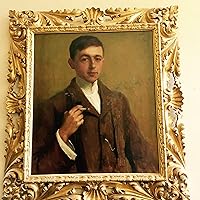
Peter Harmer Lovesey, also known by his pen name Peter Lear, was a British writer of historical and contemporary detective novels and short stories. His best-known series characters are Sergeant Cribb, a Victorian-era police detective based in London, and Peter Diamond, a modern-day police detective in Bath. He was also one of the world's leading track and field statisticians.
I read this as part of the three-book omnibus called Bertie. The Prince of Wales, Bertie, is jaunting around the country seemingly without many cares or attendants. He copes with a lady guest dying in the middle of dinner at a country house, but finding a man shot dead in the middle of a pheasant shoot next day makes him decide to play sleuth. Best for those who enjoy historical crime with many references to the rich and famous. I downloaded an e-ARC from Fresh Fiction. This is an unbiased review.
Every blue moon I come across a character or property that, to me, seems egregiously obscure and underrated. This is the case with Bertie, Peter Lovesey’s detective and Queen Victoria’s son and successor King Edward VII, of “I’m too fat, horny, and important to not have a custom-made sex chair” fame. He should have at least one or two TV series under his belt, at least. He’s a riot. Picture a bumbling wannabe detective who also happens to be the heir to the throne. Oversexed, overfed, part Nigel Bruce’s Doctor Watson, part Inspector Gadget, imperious and self-important but understanding and funny, too. An English bulldog, essentially.
Once upon a time I acquired this book somewhere, somehow—maybe I’d found it on one of those “best country house whodunnit” lists and bought it online or maybe I saw it in a shop and bought it because of the cover (Arrow, 1990: A Gorey-ish illustration shows a latter day Raymond Burr type at a dinner table looking over his spoon at a woman with her face in her plate, presumably dead.) I loved this right away. Such a clear, easy to read style, similar to Christie. Even more accessible because Bertie is a hoot right out the gate. I’ve read a ton of golden age and faux-golden age country house whodunnits and while the mystery here is by no means extraordinary the detective is. (Bertie kind of gives me (book) Agatha Raisin vibes: insolent, pigheaded, imperious, but somehow lovable.) It scratches all the whodunnit itches and Lovesey has fun with all the staples: red herrings, clue-gathering, deductions, misdirections, twists, etc.
I’ve been meaning to read some Lovesey and now that I have I’m bummed there’s only three of these Bertie books. Seven Bodies kind of reminds me of the Valentine and Lovelace books: eminently readable but not dumb, clean, clear, not a little frothy—I hope the same can be said of the other two. Recommended.
(I have a novel observation for you. You better take a seat. Keep the smelling salts handy. Wenches, to your fainting couches. Gents, ready the brandy. Here it is… There’s nothing better than a physical book: the yellow pages, the smell, flipping back and forth, reading the list of other books written by the author, maps and diagrams, dramatis personae.)
(Bonus parenthetical: Apropos of nothing, have you ever found the penultimate page of a whodunnit to be dog-eared?)
This was a "humerous mystery featuring a fictitious character based on the actual Albert Edward, Prince of Wales, son of Queen Victoria." Bertie and his wife are invited for a weekend shooting party where the guests begin dying one by one. Bertie "fancies himself quite a sleuth" and tries to solve the crimes. I listened to this on tape while I scrapbooked. British who-done-its are always fun. This one had a little element of history mixed in. Yes, Bertie was the playboy in the book that he was reputed to be in life.
The narrator's voice is amusing in his self-importance and the ease with which he switches opinions or takes another's point as his own and the world of grand country estates with fleets of servants preparing delicious meals was deliciously 19th century English, but the characters were highly immoral (and only offended at their immorality being discussed) and didn't really appeal to me. Also I KNEW the motive behind the crime right away, although I didn't guess the murderer, and actually found that part quite intriguing. I don't think I'll look up any more in this series.
Fluffy mystery. Not bad but Peter sure plays hard on the insipid and ego exaggerated school of thought concerning the prince regent and then King Edward VII 'Bertie.' Only thru luck and the assistance of deprecating servants and peers does Bertie conduct and solve the case. Alright for a quick read but I won't bother with another one in the series for awhile.
The second book in this two book series, it did not disappoint.
Once again the Prince of Wales is on the scene of a murder and takes up the investigation to solve the case.
Accepting an invitation for a shooting party at Desborough, the county estate of Lady Amelia Drummond, Bertie is looking forward to an enjoyable time of shooting, good food, games and more, with interesting people.
It starts out fine, but during the first dinner party one of the guests falls face first into the dessert. She is rushed to a nearby doctor but dies on the way.
Rather than cancel the rest of the event, the group carries on. Cancelling and having the Prince of Wales return home could reveal the death and create a scandal. Something the Queen (Victoria) would greatly disapprove of.
Bertie isn’t the best of sleuths and keeps trying. Some of his solutions are a bit in left field, but he is determined to find the killer.
Meanwhile, a few more guests wind up dead. Can Bertie find the murder before everyone is dead?
A fun read with humour and a persistent detective.
Witty, amusing, sometimes amusingly salacious. Writing style seems like it was written in the 40’s, so good job on that, as it was written in the 70’s.
A ‘closed house party” romance/mystery, but the ‘romance’ is from the man’s perspective, which is definitely different. The mystery is clever, and even when (first person writer) Bertie challenges me to guess the murderer before he ‘reveals all’, I’m still stumped. But, the culprit is reasonable and I could have figured it out – so fair play. I liked the interesting information on the origin of the word Clue.
Not sure that I like Bertie, he is very full of himself – but perhaps if I were a princess in 1890 I might be that way as well. I do plan to read others in the series.
Bertie (son of Queen Victoria and future King of England) is at a "shooting party" at which an appalling number of game birds are killed, and not a few of the attendees at the week-long event. Bertie considers himself a competent amateur detective, so he takes upon himself to solve the murders without arousing the interest of the press and the public. As the upper-class attendees get bumped off one after another, it is fascinating to watch the athletic jumps Bertie makes as he leaps from one unfounded conclusion after another. I don't think this entry is as well done as the other two in this series, and overall it is a very weak entry in the works of Lovesey.
The second and most intricate of the three Bertie whodunits. (The first, Bertie and the Tinman contained racing lore which I found a little tedious while the second, Bertie and the Crime of Passion was too easy to guess).
…the Seven Bodies uses tropes made famous by Agatha Christie — viz. killings committed according to a nursery rhyme, killer masquerading as a servant as ‘no one looks at a servant too closely’, possibility of one significant murder concealed among a series of pointless other murders, killer pretending to be dead, etc. The novel mixes witty comedy with thrills and suspense, the killer’s identity comes as a complete surprise and Bertie, Prince of Wales, future Edward VII, makes for an engaging and entertaining narrator.
Better than the first in this series, as Bertie is a bit less annoying in his self-important narration, and as the tongue-in-cheek Agatha Christie allusions abound. Given the title, the reader (unlike the characters) knows that it's not over 'til it's over. Set at a shooting party at a country house, the bloodshed is enormous, especially among the poor pheasants. I had no idea the toll was so great at one of these things.
This was fun! A blend of some typical Christie-like conceits- locked room, manor house party, countdown serial murders- with a roguish ruffian Crown Prince for a bumbling amateur sleuth. Definitely a little silly. It called to mind the game of Clue with its mix of stock characters, victims and suspects alike.
The central joke in this is that the main character, the Prince of Wales, is kind of clueless and blind to his failings or weaknesses.
It means that the main character is really not sympathetic. In this second volume, there are some cute interactions where his (cleverer?) wife calls him out on his nonsense.
I think I’ll take a break before book three, but I’ll probably read it.
In this second story of the detective activities of Bertie, Prince of Wales, Peter Lovesey amuses the reader with a behind-the-scenes of a "shooting weekend" or "a grand battue" at Desborough in Buckinghamshire. Bodies begin to mysteriously appear and Bertie applies his intuition to solving the murders. Wonderful.
This is enjoyable because, well, it’s a Lovesey. And he is always enjoyable. Clever. Well plotted. Very solid characters and lots of humor. But there were a few spots in the middle where the narrative dragged.
I am sure peoplethink I am a complete lunatic now, I was giggling so much reading this. Entertaining and a book that makes you smile is definitely worth it.
4.7/5 Wild! It was a crazy funny ride for the whole book. Told in first person by the sassy Prince of Wales - "Bertie, to the ladies" - and he's hilariously not good at solving crimes. I absolutely love his witty wife who knows him so well and on all accounts they're a cute couple ... if he wasn't a cheating husband. The end caught me by surprise, though. I knew the motive of the killer had to have been tied to the death of that orphan boy the year prior, but the murderer was not whom I would have suspected. Something to say about Albert's character in the book was that he was incredibly prideful and hated admitting he was wrong, and there is no character development for him in this book. In a way, since this felt like a murder-mystery comedy, it felt like his arrogance was a part of the book's charm. I also love the whole "we're a bunch of people out in the middle of nowhere to have a good time, and suddenly an enigma is afoot" type of mystery. This book was fun, and I am not a historian who might be able to say whether the Prince of Wales was accurate or not, but I think the point of the book was for one's own pure enjoyment. I would recommend it to people who might not mind a character that is elegantly crude at times and just wants to sit down and laugh at a character's silly antics all while trying to solve several murders. It was a nice change to a character that isn't on the mental level of Poirot or Sherlock Holmes, but instead thinks that they are. NOTE: I didn't know this was a part of a trilogy until I found the 3rd book for free. I fully intend to find the first book to read and complete the series :)
This entire review has been hidden because of spoilers.
Although I didn’t really enjoy the first book in this series, “Bertie and the Tinman,” this second book was hilarious! The extent to which Bertie was made a fool of himself with his outlandish “deductions” and theories never seemed to dull and I found myself laughing out loud on several occasions. What I found most interesting is although the list of suspects were quickly dwindling down, I still wasn’t able to solve the mystery. For me, the ending was a bit of a cheat, but it was an enjoyable ride nonetheless.
An English Country House Mystery. I had hoped, since "Bertie" was in the title, it might have been a little bit more like Wodehouse, but the voice wasn't nearly as crazed. Still, a good read for a lockdown day.
Bertie, the Prince of Wales, goes to a shooting party. The first night, a woman falls into her plate poisoned. The next day, one of the guests is found dead. As the days go on, so do the deaths. Meanwhile, the Prince is trying to solve what is happening. They don't call Scotland Yard, and the party dwindles. The plot and story seemed a little silly, and not up to Peter Lovesey's usual work.
The style of writing isn't one to remember...it's the kind of book that you buy during some holiday to read at the beach. Both the style and the story reminded me of Agatha Christie's, but much less brilliant. It wasn't a bad read though.