Jump to ratings and reviews
Rate this book

To Timbuktu for a Haircut: A Journey Through West Africa

Rate this book
Historically rich, remote, and once unimaginably dangerous for travellers, Timbuktu still teases with "Find me if you can." Rick Antonson's encounters with entertaining train companions Ebou and Ussegnou, a mysterious cook called Nema, and intrepid guide Zak all make you want to pack up and leave for Timbuktu tomorrow. As Antonson travels in Senegal and Mali by train, four-wheel drive, river pinasse, camel, and foot, he tells of fourteenth-century legends, eighteenth-century explorers, and today's endangered existence of Timbuktu's 700,000 ancient manuscripts in what scholars have described as the most important archaeological discovery since the Dead Sea Scrolls. Think Eric Newby's A Short Walk in the Hindu Kush or Redmond O'Hanlon's Into the Heart of Borneo and you begin to see what kind of writer Rick Antonson is. To Timbuktu for a Haircut combines wry humour with shrewd observation to deliver an armchair experience that will linger in the mind long after the last page is read.

256 pages, Paperback

First published May 12, 2008

459 people are currently reading
1309 people want to read

About the author

Rick Antonson

8 books18 followers
Rick Antonson's latest book is Slumach's Gold: In Search of a Legend - and a Curse (Heritage House Publishers, 2024). Rick is author of 5 acclaimed travel books including Train Beyond the Mountains: Journeys on the Rocky Mountaineer (Greystone, 2023) and Route 66 Still Kicks: Driving America's Main Street which The New York Times called "One of the best books of the bunch" in their Christmas travel book roundup, and To Timbuktu for a Haircut: A Journey Through West Africa (2013) which the Chicago Tribune noted as a "travel classic." Full Moon Over Noah's Ark: An Odyssey to Mount Ararat, also, Walking With Ghosts in Papua New Guinea: Crossing the Kokoda Trail in the Last Wild Place on Earth (Skyhorse, NY). Rick is the former CEO of Tourism Vancouver, an Ambassador for the 2010 Winter Olympic and Paralympic Games, chair of Destination Marketing Association International (based in Washington, DC), former deputy chair of the Pacific Asia Travel Association (based in Bangkok, Thailand), and president of Pacific Coast Public Television, Antonson now enjoys a career as a full time author,

Ratings & Reviews

What do you think?
Rate this book

Friends & Following

Create a free account to discover what your friends think of this book!

Community Reviews

5 stars
218 (21%)
4 stars
386 (38%)
3 stars
307 (30%)
2 stars
67 (6%)
1 star
17 (1%)
Displaying 1 - 30 of 169 reviews
Profile Image for Petra X.
2,455 reviews35.7k followers
June 1, 2015
I started off with this book feeling good, better than good, great. I used to be a world music journalist. Some of the music I love best comes from Mali. So when the scamming local travel agent tells the author he has to go to Timbuktu for the music festival I'm like jigging around in my head.

This is the African music festival (to me). It's called Festival au Desert d'Essakane as it's in the Sahara desert and includes Tuareg music as this is Tuareg territory. Imagine getting to go to that! But the author doesn't want to go. He doesn't want to listen to music. He doesn't want to go to Essakane. He doesn't want to see other white people. He wants to get to Timbuktu and explore ....himself.

So the rest of the book was spoiled for me because I had a definite emotional feeling towards the author. I thought it was all very one note, no highs or lows and a lot of grumbling. He has to go to the music fest as his rip off travel agent will only send him that way. He enjoys it. He later raves over the late Ali Farke Toure which kind of made me perk up a bit. So then I start reading with a better attitude.

The book however, really doesn't improve. It's neither really interesting as a trip through the Sahara and it should have been - I really wanted to know much more about the Tuareg, the only veiled men in the world, but all he says is stuff I could look up anyway. Then there is trekking in the Dogon. The Dogon are a tribe descended from the ancient Egyptians with an unusual religion based on very old astronomy. So I was mad keen to read of actually being in this area for ten days... but nothing, just talk of unspoiled wilderness.

The author is accompanied by Zak, a young native guide who until the end could be anyone, and a young girl who cooks for him and is cheeky. I expected more. I wanted to know about these Malians, not in relation to the author, what they could do for him, but who they were, how they lived, what life in Mali for a Malian was actually like. But what we got was the usual stuff about third world/diseases, garbage everywhere/smiling but poor, all the usual. We get it in the Caribbean too. So hackneyed.

Towards the end it did perk up. I knew about the Bibliothèque Nationale du Mali in Bamako but the author provided a lot more information. The library houses the greatest collection of books and papers of African history written by Africans over the whole continent. It is a treasure house that is as yet mostly unexplored.

Sadly, in the epilogue, by far the best part of the book, the jihadists turn their attention to Mali. These Muslims terrorise, behead, rape, enslave and in every way mistreat the Malians who are (by and large) also Muslim. The world shakes its collective heads in sorrow but does nothing. Then these Muslims torch this collection of Muslim history written by African Muslims and France sends in the military. One step too far! Luckily the manuscripts survived by being packed so tightly together the fire couldn't penetrate, says the author.

The Malians liberated from the jihadists have done their best with their library, but it is sad, they are so poor they even beg for $600 to finish the corrugated roof, to protect their treasures. The author is generous toward both Zak and to the Library which was good to hear.

Sadly for the musicians, the Jihadists have enough of a hold that music is banned in most of Mali where they hold sway, women's voices especially are anathema to these people. The overt violence might have been controlled but this land of musicians has become a cultural desert.

It was also good to hear that the author is apparently an amazing speaker on his travels. It just didn't translate into the written word, or not for me.


It's a 3 star book, but a 5 star epilogue. So 4 stars it is.

Amazing site on the Tuareg. Such a good-looking and interesting people.
Profile Image for Woman Reading  (is away exploring).
470 reviews376 followers
January 21, 2022
2.5 ☆

I am an avid traveler. What people derive from the travel experience varies greatly as travel can be deeply personal. In Route 66, author Rick Antonson and his friend Peter decided to drive the entirety of Route 66, which originally stretched for about 2,400 miles through eight states from Chicago, Illinois, to Santa Monica, California. Route 66 had been officially designated in 1926 and then decommissioned in 1985. Before its demise, it had been celebrated in song ("Get Your Kicks on Route 66") and in an eponymous television series during the 1960s. Some parts had been absorbed by the present-day interstate system but many sections had fallen into disrepair and faded into obscurity. It was these dead ends and lost spaces that these two baby boomers sought.

The two had been asked about their motivations to travel. Peter responded, "maybe you travel to learn who you are." Antonson wanted to write a book as he pondered -
Has a neglected road left the "real America" intact? ... of an America that was still one of a kind... would we find it? The odds seemed against us.

I'd also confirmed that the myth is as important to America's self-esteem as is fact... if there is a place to see America at its truest, it is Route 66 - the road first renowned for its attractions, then for its deterioration, and now for its attempts to reassert itself in the eyes of those who seek an authentic America. Americans love an underdog. Even more, they love stories about people who rolled high, lost it all, and fought to regain respect. In that way, Route 66 is America.

I've always favored depth over breadth when it comes to travel. So a 12-day road trip seemed rather ambitious for Antonson's existential questions. He also wanted to dodge the "conspiracy of kitsch" - of the big blue whale, the neon signs, the fake "wigwam" motels - that are often photographed as the symbols of Route 66. In the end,
America's Main Street became for me a series of stories, symbolized by a baseball player, a roadbuilder, a novelist, a photojournalist, a humorist, a political poet, a songwriter, a jazz musician, two actors, and a Corvette. Each of them recognized that Route 66 was America's podium.

I'd embarked on this trip convinced that America is more hung up on myths than on reality, more tied to perceptions than fact. The trip validated that, though it left me with a sense that this situation is okay... Will Roger's said of his America: "There is no other country with as much air, and not knowing where it's going, as this country."

Antonson's summation and conclusion from his October 2011 journey are, of course, valid for him. But the messenger really lessened this book's impact for me. Antonson described himself as a "curmudgeon," an euphemism as Peter often (justifiably) called him an "ass." These two were petty and bickered like a stereotypical old married couple. Antonson revealed his own penchant for perception over facts as I found errors in the beginning. His statement about franchising "brought to the world" in 1941 by Dairy Queen was incorrect. A&W got the boasting right in the 1910s. He wrote that there were "hundreds of English dialects" in the US. Three different websites stated that there are 20 to 27 dialects in the US. He erroneously stated that Abraham Lincoln had been born in Illinois; no, he had been born in Kentucky. Thereafter, I decided to save myself the aggravation and not to pause and check his stories for substance and just distill the spirit.
Travel's trials reveal more about travelers than do the happy experiences... Nor had we shed our disposition to ignore signs that were explicit in advising caution.
When I've had misadventures while traveling, I've always said that those make for the best, or certainly more popular, travel tales. And yes, I found their muddy road ensnarements amusing both the first and the second times. They were incredibly lucky that good Samaritans drove by in their road-appropriate vehicles and rescued them. At least, these average people who helped them are part of the "authentic" America as were the "Okies" and the other climate refugees who fled the Dust Bowl via Route 66 during the Dirty Thirties.

I've been to both end points of Route 66. My only knowledge of that at the moment, however, came from seeing the highway marker in downtown Chicago. I read this because vicarious travel is currently the only option for me. But yet, I don't feel particularly desirous of following in their rented Mustang's wake. If I do, I'll consult the National Historic Route 66 Federation - www.national66.org - and a different guidebook.
Profile Image for Quo.
343 reviews
November 30, 2022
Fernweh is a German word roughly translating as "far-sickness", conveying a longing for far-off places & the opposite of homesickness. And what could possibly be a more exotic destination than Timbuktu, a place that conjures up both distance & the allure of the utterly unfamiliar?


Rick Antonson's To Timbuktu For a Haircut: A Journey Through West Africa is a travel tale to Mali, a landscape now almost completely off-limits due to political instability merged with tribal & religious animosity that has made safe travel to UNESCO World Heritage Sites within Mali, to places like Timbuktu, Mopti & Gao well beyond the reach of all but the most intrepid traveler. In fact the U.S. State Department lists Mali as "Category 4: Do Not Travel!", with the U.K. authorities also declaring it completely unsafe.

To Timbuktu For a Haircut by Rick Antonson interweaves the author's quest to visit Timbuktu with an arduous rail journey from Dakar, Senegal to Mali's capital at Bamako on the ill-named Express International, lacing in a quote from Paul Theroux that "train travel is the last word in truth serum."

From Bamako, using a rather shady travel agent, Antonson hires a less-than-adequate car, a warm-hearted guide called "Zak" & a spirited cook, "Nema"; much of the pleasure of reading his account involves coming to know these hearty souls who are enlisted for the quest to reach Timbuktu following the 45 hour train journey. Antonson mentions that nothing prepares the naive traveler to Timbuktu & other places in Mali quite like the question Malians constantly pose, "Why?"


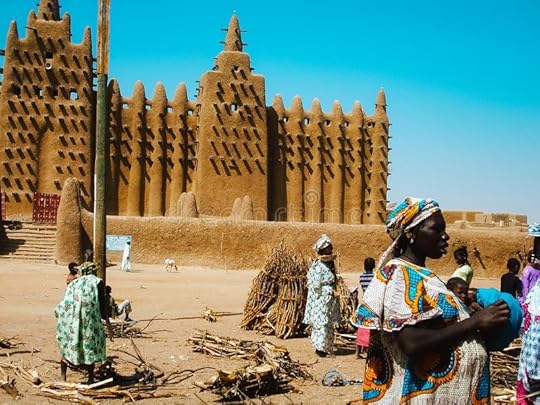
When Timbuktu is finally reached, it turns out to be a place ravaged by time & the sands of Sahara Desert, as well as general neglect, with garbage, urine & feces cluttering almost every step. Along the way, Antonson details the previous Europeans to reach Timbuktu, many of whom failed to survive. That said, it did have a "Golden Age" from the 11th to the 16th century, when at its peak it became "an epicenter of learning & Islamic education, hosting Arab scholars who wrote & collected books, a place with large libraries & universities."

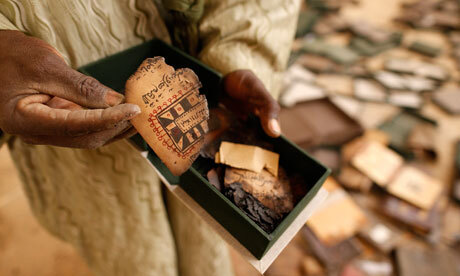
So many manuscripts were written during Timbuktu's prime that it was once said that it acted as "the purveyor of gold, salt & ink." Alas, the important history of the place & its 700,000 precious manuscripts elaborating a medieval period of relative peace & especially of great Islamic scholarship, seems imperiled as many of the manuscripts are presently riddled with bugs, gradually becoming dust.


Encountering the manuscripts, only a few of which are being carefully preserved, the author comes to sense that he is "a tourist in history, not a traveler in the present." However, there are sporadic efforts to preserve the manuscripts by Norway, Germany, the U.S. & South Africa, though sometimes this "antiquarian goldmine of books on mathematics, optics & chemistry as well as legal texts & Koranic commentaries seems a losing battle."

Ultimately, Timbuktu comes to represent not an imaginary place but an embellished one, far more of a personal passage than a real destination, more a pilgrimage than a meaningful travel journey. But in spite of poverty, indifference, despair & disappointment, there is resignation on the part of Mali's people and beyond that, always a sense of hope.
Mali is the largest country in West Africa & like all nations, a fabrication of history--more than 10 million people living within 1.2 million square kilometers, an area twice the size of France, much of it vividly inhospitable & the site of wars, invasions & shifting commands that led to nation-state status only 50 years ago, while including the remnants of a once-great empire.

Curiously, Mali seems an apt name, derived from the 13th century Mandigo word meaning "free". To achieve this connotation of a country, various tribes & nationalities have endured the ebb & flow of defeats & dictatorships before settling on a common accord of suffering & optimism.
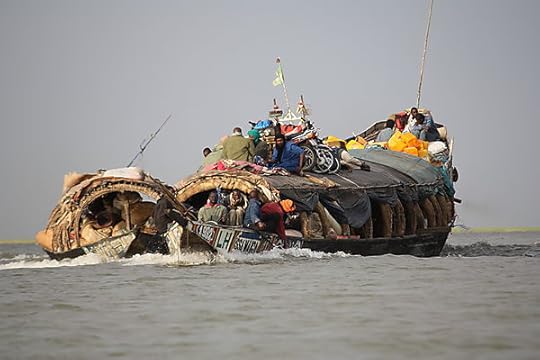

In making his exit from Timbuktu, Antonson & his entourage travel down the River Niger on a pinasse, a small, crowded vessel of dubious wooden construction, seemingly pieced together haphazardly but offering the author another experience of Mali & its people, with nights spent in a sleeping bag on riverbanks or atop sand-hewn dwellings.

After this, he makes a 10 day trek through the "Country of the Dogon" & its welcoming people, spending time at Bandiagara & elsewhere, something that becomes "the true goal of the sojourn", the pinnacle of his time in Mali.

Unfortunately, Timbuktu & Mali have become a metaphor for parts of the African continent with jihadists attacking people, while desecrating towns, even World Heritage Sites & their irreplaceable manuscripts. What remains for many of us in the face of an inaccessible Timbuktu & Mali is to read the travel accounts of such places by writers like Antonson, made at a time when it was at least relatively safe to travel to them.

For Antonson, Mali & the dream of Timbuktu represented a clash of dreams with reality but he was fortunate enough to have explored Mali well before its disintegration as a viable travel destination. The author goes on to declare that...
At its core, travel holds immense hope for a better world, with tourism being the right hand of peace. Tourism, more than any other industry, can break down barriers to understanding, can bring people together to celebrate differences.

Beyond that, I explored Mali at the dawn of the 21st century & did not have to compete with earlier paragons of travel, though their impression of Timbuktu echoed across the canyon of the 200 years between us: "Is that all there is?" Timbuktu was not what any of us imagined it would be. Few destinations are as fascinating as the journeys they inspire.
Rick Steves could not have stated it any better. To Timbuktu For a Haircut represents an engaging travelogue and perhaps more importantly, it heartily embraces ways in which a traveler can enhance the lives of those whose space he encounters. Antonson suggests ways in which each of us can contribute to making Mali a more sustainable place in which to live. For this reason, I have upgraded the book from 3*s to 4*s.

*The book's title traces back to the author's father who would on occasionally suggest that he was "going to Timbuktu for a haircut." as he left the house. **There are numerous black & white photos interspersed within the book + a helpful listing of "Sources for Recommended Reading", a map of Antonson's itinerary & also "A Plea to Preserve the Past", a race against time to preserve the treasured manuscripts & heritage of Timbuktu.

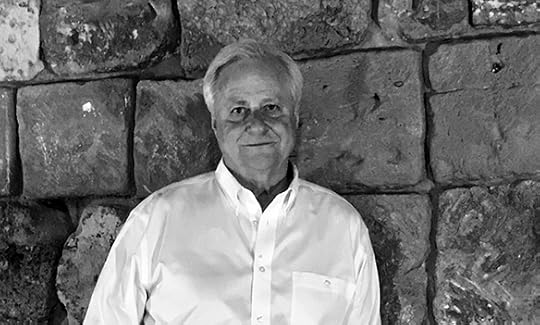
***Within my review are photo images of the author, Rick Antonson; a historic structure in Timbuktu; a pinasse afloat on the River Niger and the image of ancient manuscripts in Mali.
Profile Image for Chris Steeden.
489 reviews
May 5, 2021
I had seen Bruce Parry’s ‘Cannibals and Crampons’ documentary years ago where he and an ex-British army pal set off through the jungle of New Guinea to get to and scale Mandala mountain. I highly recommend this doc if you have not seen it. They are in the Indonesian part. New Guinea is split in two. Here is what the blurb in Britannica.com states: ‘New Guinea is administratively divided into two parts: its western half comprises the Indonesian propinsi (or provinsi; provinces) of Papua and West Papua (collectively, formerly called Irian Jaya); and its eastern half comprises the major part of Papua New Guinea, an independent country since 1975’.

I had not read a travel writing book for a while, so I was really looking forward to this. I had also seen a few other docs that took in New Guinea and specifically PNG as it is called. Port Moresby was home to the dreaded ‘Raskols’. Not a headhunter tribe. Maybe a modern version though. Inner-city gangs. Ruthless and deadly. Just as I started reading this I remembered another book I had read, ‘The Lost Tribe: A Search Through the Jungles of Papua New Guinea’ by Edward Marriott. I was hoping that this would be a little better than Marriott’s one. I had to go back and find my notes on that. It was not a book that lived in the memory.

The author is from Canada but moves with his wife to Cairns, Australia as she is working out there in airport management. Instantly, his neighbour, Glen, known as the Monk, asks him if he wants to come along on the Kokoda (place of skulls) Trail which starts in, none other than, Port Moresby. A nice 60-mile, two-week trek. I love travel writing where a lot of history is thrown in and Antonson does that specifically about PNG’s position during the Second World War and the invasion of the island by the Japanese in 1942. This was called the Papuan Campaign. The Australian fight the Japanese on the track as it was called at that time. The Papuans were assisting the Australians.

They have to use a professional trekking company so will have two guides. ‘Anyone headed for the Kokoda Trail needs to be accompanied by professional leaders and is expected to retain local packers.’ There are 17 trekkers in the group. Once packers and porters are added it brings that number up to 60. Not really Paul Theroux territory and his one-man band.

The trekkers in this group are trekking the trail to learn about the Japanese invasion as some of their ancestors fought at that time. You will learn a lot as well. There is a lot of detail given about the invasion and fighting. It actually seems that 60% of the book is the history of the fighting and 40% the actual journey they are on. If you are going to read this book then you do need to bear in mind this little statistic.

I enjoyed the book but it does not make me want to pack my bags and trek the Kokoda trail. Not because it is dangerous or difficult but the book lacked a little in the travel writing descriptive sense of scenery and place. That has not stopped me adding Antonson’s other books to my wishlist.
Profile Image for Betsy.
1,123 reviews144 followers
September 29, 2020
This is a review of two books camouflaged as one. The. first one covers Route 66 from Chicago to L.A. with poignant memories of a time gone by, of people who still make their homes in small towns which once thrived. This is the book I wanted to read because my hometown is right on Route 66. True, it's a city, but growing up 'the Mother Road' was still important, still used for the purpose it was intended. That has now changed, but there are many who revere and like to read about Route 66.

The two travelers, Rick and Peter, were determined to drive the 2000+ miles in twelve days, seeing as much of the original road as possible. Rick especially acted as a historian with Peter adding asides. The stories added a great deal of pleasure to the first book along with some sightseeng tips about restaurants and Route 66 sites. When my sister and I did our trip in 2002, we didn't have the time that Rick and Peter did, but we stayed at several of the orginal motels/hotels, which were mentioned in the book. We had a great time, and I hoped to rekindle some of those memories in reading this book.

Unfortunately, this is where the second book comes in. Rick, and especially Peter, came across as selfish, obstinate, immature travelers with money to spend, even if Peter insisted on negotiating for each night's stay. They showed a notable lack of common sense in some decisions, depending on locals to 'rescue' them. In fact, the book became more an example of, 'Don't do this,' than about Route 66. I will admit that I had an inkling that I might have a problem with the book when Rick assured his readers that Abe Lincoln was born in Springfield, Illinois. He was born in Kentucky.

So, I cannot decide how to rate the book: 4 stars for the first part but only 1 star for the travelers themselves. Out of respect for Route 66, I guess I will go with 3 stars. 'The Mother Road' deserves better.
Profile Image for Richard.
318 reviews34 followers
January 25, 2013
The author ticked me off three times in the first four pages. First, the two travelers began this journey only because they couldn't do what they really wanted to do, which was to visit Asia. Route 66 was what they settled for. Second, when the author's notion of a nation is the summation of land + people + climate + commerce, I knew not to trust any of his other insights along the way. Maybe SOME countries can be represented by that equation. Not the US, to which you must add its founding vision, its constitution (tattered though it is today), and its struggle to realize its ideals. His starting view is that America is the "sum of its flaws." That's right, Mr. Antonson, keep insulting my country. It doesn't gain you any credibility with me. Later, I learned he is Canadian, so that explains some of it.

I never shook the feeling that Antonson drove the length of the highway with a patronizing smirk on his face. Let's see what the yokels in this little burg look like, how faded their accommodations are, how unpolished they are. Funny that they needed some of these yokels to pull them out of the mud more than once when they drove their rental Mustang on roads a 4x4 would have trouble navigating. I didn't find it particularly interesting reading the travails of people who couldn't be bothered to prepare for their trip by driving a proper vehicle or stocking emergency supplies that they would later need. I also didn't appreciate the way they abused the rental car. I feel sorry for the later users/owners of that car.

They wanted to experience the authentic Route 66 as much as possible. Yet they bypassed the southern branch of 66 through St Louis where they would have encountered several still-operating cabin-style motor lodges. In fact, St Louis barely gets a mention beyond the Arch. Oklahoma City gets even less of a mention than St Louis does.

They managed to get themselves lost in Union MO which is actually rather difficult to do. They bypassed Meramec Caverns. Their conversations were wall-to-wall wisecracks and their amusements were more appropriate for 15-year olds than for the 50-ish year old men they appear to be. Things like one trying to trick the other to step into donkey dung. Not the kind of book I was expecting.

I did like the historical vignettes about such men and events as Bobby Troup (composer of the song Get Your Kicks on Route 66), Woodie Guthrie, and the early US highway system. This is the reason the book gets 2 stars instead of one.

Bottom line, if you think America is the sum of its flaws, or if you find the Jackass program amusing, then this book might be for you.

By the way, the edition of the book I read has a different front cover than the one shown here.
Profile Image for Cynda.
1,435 reviews180 followers
November 20, 2020
After WWII, Americans were encouraged to get out, to see their vast country. This song helped get us mobilized for travel.

Rick Antonson came to awareness of time passing and opportunities closing. He shared this awareness with his long-time friend Peter. (We know Rick's last name "Antonson" but not Peter's.) So they brainstorm--or at least Pete does: Route 66, trying all the dead ends. Rick agrees.

The drive starts out as a let's do-something-while-we-still-can decision. Quickly becomes an effort to step back into time. Glides into grappling with the meaning of the road, Route 66. Instead of communing with nature, our drivers, particularly Rick, better senses the nature if the road. Peter better understands things about the road. They make a great team for traveling as much of the original Route 66 as possible.

The traveling duo contemplate the nature of the road. This road was built upon existent trails and roads, ultimately a road built to combine parts of various local roads. To travel over the original route means to travel at various times on packed earth, an expanded sidewalk, a brick road, a plank road, along with paved road.

The spirit of the road emanates from the variety of road surfaces, and nonstandard, non homogenized road culture. The food and accommodations were filled with personality, spirit of the community providing services.

Sometimes quickly, sometimes slowly local entities received funds to improve roads. As local entities saw fit, they moved the roadway, ever changing Main Street, USA.

Although Eisenhower signed off on the National Interstate and Defense Highways Act (1956)--made other roads more efficient and safe--and although the federal government decommisioned Route 66 as a highway, the road lives on. a road highlight

After Rick and Peter drive various dead ends to find all of the original Route 66, they find that their friendship has deepened as they each brought skills and awareness to the trip the other needed help with. These long-time friends took the trip of a lifetime, one they know they cannot repeat. They bring us along with them. I could see a website, how ever short, for each place they mentioned on their way. They stopped at all the points named in the song and many more. I feel as though I have experienced some of Route 66.

Overall this book provides a kick in pants to Get Your Kicks on Route 66.

Read for Nonfiction Side Reads' Journey study.
Profile Image for Bandit.
4,943 reviews578 followers
May 19, 2019
Seriously? I’m the first person reviewing this? Read this book. It’s great. It deserves an audience. Some walks are not like the others. This one, the two week trek to traverse the Kokoda trail that bisects Papua New Guinea, is obviously of the more extraordinary nature, due to its exotic setting and a surprisingly diverse and complex past. In my (and possibly yours too) imagination the location is indelibly infused with headhunting adventures and cannibalism. Turns out Papua New Guinea had a crucial role in WWII, where it was a much sought after advantageous military zone, sort of like a gateway to Australia and the expansionist ambitions of imperial Japan. I’m throwing all this in to demonstrate that this isn’t just a travelogue account from an unusual far away location. That alone would have worked too, the place fascinates me the way places I would definitely never want to set a foot in, let alone both feet and make them walk around, do. But this is also a terrific historical account of Papua New Guinea’s past from early settlers to modern day. Although the concentration seems to be given to WWII era. Which was great, actually, because in North America and some Europe, the war is being thought of mainly as something more or less contained in the continent (with some Northern African involvement) and Japan’s role is fairly limited to two major events. This book does a great job of presenting the way WWII way playing out in the other (huge) section of the world and it’s really interesting to learn about. Personally, my interests lay more along the lines of cultural anthropology and more of an ancient past, but this was terrific too, all learning is, really. So, not so much in the way of headhunting adventures and cannibals after all. A lot of dense and wild jungle, definitely. But the author did complete the trek (pretty impressive in itself for a man his age), wrote very engagingly about it, took some photos and also did an awesome and thorough and thoroughly awesome job of enlightening and educating the readers about the strange and distant land of Papua New Guinea. Very enjoyable read. Terrific for any armchair traveler out there. Recommended. Thanks Netgalley.
Profile Image for Calzean.
2,770 reviews1 follower
January 7, 2020
I've walked the Kokoda Track both ways. I walked the first 200m down the track and back again. I was stuffed. Anyone who can spend 7 - 10 days walking in PNG's humidity across steep terrain, rivers, mud, dirt and remoteness is special. An awesome Australian Kurt Fearnley has crawled the track. In this book the author turned 66 of age while on the trek.
The track is infamous for the fighting that occurred during WWII as the Japanese advance towards Australia. So the book covers a lot of the details of the fighting. Importantly, the author and his fellow trekkers all become inspired by the beauty of the PNG landscape and the warmth of its people. The author shows a lot of empathy towards the people and passes no judgements just praise for the way the majority live.
A good book for those planning to do the trek. The definitive text of the track remains Field Guide To The Kokoda Track: An Historical Guide To The Lost Battlefields
Profile Image for Carla (Carla's Book Bits).
588 reviews126 followers
June 5, 2019
You don't need to tell me twice for me to know that this is an important book.

My rating is largely based on how important of a read I think it is. However, my overall enjoyment factor is a different story. Let me explain.

In Walking with Ghosts in Papua New Guinea, Rick Antonson recounts his time walking the Kokoda trail in Papua New Guinea. Along the way, he talks about the history of the country, and provides interesting facts about its capital city. I love this book for the sole fact that I went into it knowing nothing about Papua New Guinea and I've come out feeling like at least I know a little bit.

An important thing to note before you go into this book, though: it's not just a travelogue. It's also an extended recounting of the events that took place during WW2 on the Kokoda trail. It never gets lost on me how many stories have been told about WW2, and how many still have yet to be told. Personally, monologues about army movements have never been my favorite. I just find it hard to grasp military nonfiction, which lessens my enjoyment of this. If I were to rate this based on enjoyment factor alone, I'd probably only give it a 3. But the knowledge I gained from this book (and the wonderful immediacy in the writing style) makes this an easy 4 stars.

However, if you enjoy (or don't mind) military nonfiction, you're going to enjoy this a lot. This is a beautifully written book, and such a tender acknowledgement of the soldiers who fought in the mysterious and beautiful land of PNG.

Thank you so much to NetGalley and Skyhorse Publishing for this free copy in exchange for a review!
Profile Image for Todd Stockslager.
1,831 reviews32 followers
October 23, 2016
Review title: Head east on the Silk Road, hang a left

Just to the north of the fabled Silk Road that linked Europe, Africa, and Asia in trade, religion, culture, language, and war, stands Ararat, a range of mountains that carry their own weight of history. It is here that the Bible and other ancient sources say that the world was repopulated after God swept the world clean. It is here that the evil of genocide burst forth in its 20th century form as the newly empowered country of Turkey systematically murdered and displaced over a million Armenians from disputed territory in the wake of the first World War. And it is here the modern national borders of Iraq, Iran, Turkey, and Armenia today meet across ethnic and religious boundaries thousands of years old. Ethnic Kurds, of all religions and spread across all these nations, hope for their own national home some day. Armenians, confined to a small landlocked country today, hope for expanded borders including the return of the Mount Ararat holy site and access to the Black Sea. And Christians and others who believe in the historicity of the ancient flood accounts, hope to find physical, geological, or archeological evidence on that mountain to back their faith.

For all these reasons, professional traveler Rick Antonson fulfilled a childhood ambition by visiting this foreboding and volatile region in 2013 and "summitting" Mount Ararat. While his book is partly an adventure story about the climb to the 16,000-plus summit, that event is complete just halfway through the book, with plenty of history,, culture, and further travel adventures to come. Crossing into and out of northern Iraq proved to be both a rewarding and harrowing experience, and makes for page-turning reading.

Like the authors of the decade or so earlier journey In the Footsteps of Marco Polo that I recently read, Antonson found the people and cultures in this melting pot both complex but also open and friendly. This is a common thread in travel accounts to "non Western" locations and perhaps reflects a puncturing of an unconscious expectation of cultural superiority. Perhaps our homogenized, franchised, brand-name existence has actually placed us below other cultures, to which in comparison ours seems simple, closed, and unfriendly.

Early in the book, I found Antonson's writing voice kind of grating and arrogant, but as the book goes along either some of those edges were knocked off during his adventures, or I just came to like him more as I knew him better. While initially skeptical of the historical veracity of the flood accounts, his research, travels and encounters with believers for several different reasons opened his mind to consider various theories and potential sites for that famous landing. While he never saw "Noah's Ark", and most likely no one ever will, his writing about it is a good summary of the current state of geological, archeological, and historical research.

The book is well illustrated, although the black and white photos are often small and dark; a separate section of color photography on higher quality glossy paper would have been nice. The maps are useful, but scattered throughout with no table of maps to find them and refer back to them later (keep a second bookmark for that). And the time line of key historical events in the back is useful.

This was a fun and thought provoking journey to a part of the world I will probably never see first hand. So Antonson will be my worthy eyes and feet there as I think about and watch that region from a distance.
Profile Image for Jana Eichhorn.
1,127 reviews15 followers
October 1, 2013
The only reason this book got two stars from me instead of one is my love for the subject itself. I love Route 66 and all things related to it, which is more than I can say for the author. This man clearly doesn't "get it." To him, Route 66 is just a road to be driven on, in a country he feels secure looking down upon. The Canadian author's tone is condescending to the extreme, often pointing out how little he likes Americans - until they show up to drag his silly ass out of the mud he's gotten himself stuck in or to offer up much-needed kindness when he and his road trip companion have gotten themselves into a jam again. The book is well researched, but it lacks heart. They skipped over some major Route 66 sights, or stopped long enough to mock them, and then get to the end of the road wondering if they've "experienced" America. Guess what, buddy? All that stuff you were too good to stop for, is the stuff that makes Route 66, and my country, great. All you did was drive down a road.
147 reviews33 followers
September 3, 2018
I have driven on sections of Route 66 in Oklahoma and New Mexico so the idea of driving from beginning to end sounded interesting to me. But common sense would tell me to choose a more durable vehicle than a Mustang if I was going to explore numerous unpaved rut filled sections of it.
Profile Image for Claudia.
1,288 reviews39 followers
November 8, 2020
Seriously - a rental Mustang to drive over roads that had not seen maintenance in any form in decades! I've surprised they were lucky to just overheat the radiator a couple times after getting mired in thick mud and fortunate not to be swept away when the sensible thing to do was turn around when confronted with water of an unknown depth and the road in equally unknown condition underneath it. They were very lucky that locals - with pickup trucks equipped with various towlines and chains came upon them and towed them out of the predicament their stupid egos placed them in.

Okay, I feel better now. Travelling Route 66 from Chicago to Santa Monica, attempting to find and drive over all the little pieces that made it a renowned highway is made all the more difficult as sections have been abandoned not only due to the consolidation of the route itself but due to realignment for major highways. The old Burma Shave signage that became a specific type of advertising recognized across America - about a year ago, some spouse put up a series of signs ala Burma Shave along the nearby interstate celebrating his affection for his wife on their anniversary. There was about a dozen signs and I was disappointed that I had to normally exit before I got to the last one. Did eventually travel further down the highway to read the final ones.

Anyway, today, many businesses along the old Mother Road depend on the tourists that made the journey, take on the quest like the author and his companion did. Have to admit, a trip such as they experienced could make or break a friendship and there were times - especially in the beginning as they worked out various "rules" - the reader had to wonder if this friendship would survive. Peter's original intention to find every abandoned piece of the old route and travel on it may have been a goal but as the miles went by, accessibility by lack of connections to regular roads or completely blocked access via fencing and streams along with deteriorated conditions from plant growth breaking up whatever paving there may have been to weather and water damage stalled that hope. Despite several guide books, it is likely they missed several more sections.

Oh, and Peter's determination to barter down the cost per hotel room to lower than the one they paid the night before seemed . . .well, childish. Most times he had to deal with a clerk who could not make that decision but he would insist on badgering him until he got some type of deal. In turn, Rick just tossed his credit card on the desk and said he settle up in the morning.

Today, organizations throughout the states that the original Route 66 passed - one of the first in the U.S. highway system established in 1926 - work to preserve the buildings and atmosphere of the communities that lined the old road, providing gasoline, service of vehicles, hotels and regional food. Today the world zips by, bypassing not only the history but the spirit of America. Maybe we need to slow down a bit more. Stop at Delgadillo's Snow Cap in Seligman, Arizona for a meal and dessert.

This is lavishly illustrated with photos not only from the trip itself but a couple maps and historic photos. It would have been nice to find out who the artist was that painted? drew? the portraits that are scattered through the book from Cyrus Avery to Will Rogers, from John Steinbeck to Woody Guthrie.

2020-224
Profile Image for Mary.
516 reviews59 followers
July 19, 2019
I went into this book thinking I was going to be reading a travel guide to Papua New Guinea,, It did start out with that feel as a group of hikers would be bisecting the island by the kokoda trail. I thought the trail was to be like a road on other islands, a way for the islanders to travel for trade, visits etc. I knew going in that it would detail the rugged trek through the jungles, up steep mountains, down steeper trails and many river crossings. Those things were part of the book, in fact a big part of the trek. The oppressive heat, humidity and rains set part of the background.

But more important were the "ghosts" in the title. I was surprised when the book became more of a history of a part of WW!! than a normal travel guide. The descriptions of battles, killing, trenches and other places to hide and the diseases in the midst that added to the death count. The author mostly describes the horrors that the young Australian men , boys really, faced. This is where the "ghosts" came in. Antonson helps you to feel the past almost in personal ways. When he stood somewhere that had been an important stand in the war it was possible to feel the horror and bravery these men had shown. While the hikers were there for adventure and to test their will and strength I quickly understood that the soldiers had a very different view of the island. They had no one to carry the heavy gear, no camps set up for them at the end of the day and no bridges and ropes for crossing rivers.

In a small part of the book some sympathy was for the Japanese soldiers who were also really boys as well. They were fighting under the same conditions Both sides were fighting under the same untenable conditions.

All in all, this book was a great read but the horror and good writing combined to make it so very real that it became a difficult book for me. I put it down for a break several times.
Developed characters,many great stories and exotic settings, vivid history, these all combine to make this a book I would definitely recommend.
Thanks I just reviewed Walking with Ghosts in Papua New Guinea by Rick Antonson. #NetGalley


.
Profile Image for Karen.
617 reviews73 followers
June 6, 2020
In January, I was making family vacation plans for this coming August. The plans included visiting friends, seeing a few baseball games and exploring Route 66 with an emphasis on St. Louis and Joplin, MO. As a result of unexpected events, we are not traveling anywhere this summer. So my research book became my arm chair vacation.

About ten years ago, Rick Antonson, and his friend Peter Armstrong, both native Canadians, decided to drive the full length of Route 66 in a rented Ford Mustang. They decided they would explore as many back roads and dead ends as possible, staying overnight in non-chain hotels and eating at local restaurants as much as possible. Nine states in ten days, over 2,400 miles. It's quite an ambitious itinerary. And they stayed true to their plans, exploring and motoring through the back roads of the heart of the this country.

I'm not sure how I would feel if I were from any of the places where they stayed or drove through because their observations were pretty straightforward. In some places, the conditions were pretty bleak - stores and businesses were closed and only abandoned buildings remained. What are the conditions now, I wonder. But, in some places, Rick and Peter enjoyed a nice breakfast and interacted with locals who were willing to share their opinions about Route 66 and life in general.

The highlights of the book for me were the analysis of the "Mother Road" on Woody Guthrie, Will Rogers and John Steinbeck (I really want to read The Grapes of Wrath again). The summary of Dorothea Lange's work with the Okies in the 1930s and the history of the song "Get Your Kicks on Route 66" were interesting. I also enjoyed the banter that Rick and Peter shared as they drove on strange roads, often getting lost or stuck in mud.

I have several books on Route 66 that I plan to read this year, regardless of my vacation plans. I would recommend this book to anyone who wants to take a road trip across the country.
Profile Image for Diogenes Grief.
536 reviews
July 13, 2014
With the updated info and reflections, my rating went from a 4 to a 5. As a professional in the field of tourism, Antonson has some important perspectives to give on what it's like to immerse oneself in another culture with humility and curiosity, especially as Westerners too-often wrongly portray Africa and its people as a whole, if such marginalizations could ever be justified. At first I thought the author was young, in a Dan Eldon's "The Journey Is the Destination" kind of way, but Antonson's age and experience lend their weight in wisdom over time. Perhaps most powerfully for me, reading this book made me reflect upon and wonder about the culture, ancient history, and people--and especially the children--I had the privilege and honor of meeting in war-torn Iraq ten years ago. Some memories make me smile, but with watery eyes knowing the hell those kids-now-teenagers are probably still swimming in. The world is an f-ed up place. We should all try to do more to pop our tiny bubbles and embrace the entire human condition.

Peace.
Profile Image for Alison.
2,466 reviews46 followers
July 3, 2019
I have always wanted to read a story of people who have walked the kokoda Track in Papua New Guinea.
This was a very interesting story of the author and his fellow walkers, and the challenges they encountered in this harsh terrain, but also of the history of the trail which became a battle field between Japanese, Australian and American troops during WWII, causing many casualties as well to the people on Papua New Guinea.
As the hikers ended each day, we would hear about what happened along the trail during the war, or history of the people who live there.
It was fun to see the reason each of these individuals decided to do this walk
Well researched and It was interesting to see what was going on during the war in areas we barely heard of.
I would like to thank NetGalley and Skyhorse Publishing for the ARC of this book.
Profile Image for Sue.
1,319 reviews
August 28, 2022
As a child, Rick was fascinated by a book called _The Forbidden Mountain_ that recounted a 1952 climb of Mt Ararat. As an adult, an opportunity came up for him to be part of a group attempting a climb. He made that the first part of a trip in the area which then culminated with a stop in London to visit the British Museum where a number of records of searches for Noah's Ark are housed.
This started slow for me as he spent a bunch of time on background and trip preparation. Once he started traveling, I enjoyed it a bit more. Traveling alone in countries where you don't know the language isn't for me so I'll sit back and read of others doing just that.
Profile Image for Annarella.
14.2k reviews165 followers
August 11, 2019
When I requested this book I was thinking about Chatwin's The Songlines.
There's just some tenous link between the two books but I can say that this one, even less poetic, is a fantastic read that will make you travel in Papua New Guinea and discover new places, traditions and people.
I read it like a novel and found it engrossing and very interesting.
I look forward to reading other books by this author, highly recommended!
Many thanks to the publisher and Edelweiss for this ARC, all opinions are mine.
Profile Image for Wendelle.
2,046 reviews66 followers
Read
June 27, 2025
This book has 2 parts: the first is a straightforward mountaineering tale of an expedition to the summit of Mt. Ararat, long held to be the apocryphal landing site of Noah's Ark. This part is nice in practical terms too, because the author goes into detail of the travel guide he hired, the equipment such as crampons and ice axes that they needed, and the stages and weather conditions of the journey. The second part follows after the author successfully conquers the summit and goes to visit Iraqi Kurdistan in Northern Iraq, in the city of Erbil. This part is educational too in showing the boundless traditional hospitality, history and aspirations of the Kurdish people, which are centered on the desire to have their own UN-recognized state.
Profile Image for Moiz Ahmed.
16 reviews
May 6, 2025
well written book that covers the travels through Rockies and through time of the area's history. The Author travels on the luxurious (And out of reach for most) Rocky Mountaineer offering a window into the history of the rails in western Canada, the indigenous groups and the very rocky tale of the Banff-Vancoiver route.

since he travels with his 8 years old grandson, he does offer some poignant experiences of how age effects our ability to venture out and have adventures which I personally found to be quite meaningful.
Profile Image for Jrobertus.
1,069 reviews30 followers
October 2, 2019
Antonson is a big wheel in international travel organizations and has been all over the world, but usually in high style on someone else’s expense account. He wanted to take a real journey, like the heroes of the 18th and early 19th century and so why not go to Timbuktu, the quintessence of remote? Now it turns out, you can fly there but he takes a long train ride from Dakar on the coast, on a train that some guide books claim no longer runs, then a horrible boat ride up the Niger, then in broken down 4-wheelers etc. etc. and gets to the mystery city. Timbuktu was once, apparently, a glorious city with many Moslem scholars, and indeed a central aim was to assist in the preservation of thousands of medieval manuscripts. However, the contemporary city, in 2004, was clearly a dirty, backward, inefficient and impoverished disappointment. However, by making an arduous trip, the author meets some local people, particularly his guide Zak and cook Nema, who are warm human beings. His fixer/arranger, Mohammed, is clearly a liar, cheat, and all around a-hole. I enjoyed the descriptions of this barren land fighting against the desert, and of the lives of the locals. In the afterward to the second edition Antonson relates how Moslem Jihadists attacked Mali and tried to create a terrorist haven. They destroyed a lot of Timbuktu architecture, terrorized the local folk and tried to destroy the manuscripts, but were thwarted in the latter effort by the arrival in 2013 of the French army which kicked their butts back into the desert. Still, Mali looks to be a basket case and the rich world is probably more interested in the old books than the current inhabitants. Antonson’s narrative style is crisp and sharp, and he is describing an unusual and interesting journey, so I give this book a strong thumbs-up.
Profile Image for George1st.
298 reviews
June 15, 2019
This was the first book that I have read by travel writer Rick Antonson and after finishing it my immediate reaction was that I must try to obtain some of his other travel titles. His writing is clear and concise and contains an agreeable mixture of humour, information and analysis which in the book includes an examination and an attempt at understanding the complexity of how Papua New Guinea and its diverse peoples are trying to come to terms with the fast changing modern world. The story begins in Australia where Rick has newly arrived and after a chance conversation with his new neighbour decides to join him on a trek along the 60-mile footpath through rough jungle and high elevations that constitutes the harsh and inhospitable Kokoda Trail in Papua New Guinea.

This is a book that not only tells the trials and tribulations, highs and lows experienced by the group of trekkers as they make their way through the hazardous route but more importantly it has an accompanying narration that looks back to that time when Japanese, Australian, and American soldiers engaged in some of the most bloodiest combat of World World II. The reminders of this conflict can still be witnessed on the trail and the title Walking with Ghosts aptly sums up the experience of going through terrain seeped with so much horror and inhumanity. Indeed one of the running themes of the book is the attempt of Monk (Ricks's neighbour) to try to make sense of why his father who went through the campaign later abandoned his family.

This is a book of insight and adventure, comedy and pathos that certainly gripped me and belongs to a superior level of the rather now crowded travel writing genre. I would certainly recommended this.
Profile Image for Monica.
477 reviews4 followers
June 13, 2021
The author, Rick, has a kind of romantic idea about the - for him - mythical city of Timbuktu in Mali. He wants to travel there like the 18th and 19th century explorers did, however it's the 21th century so that way doesn't excist anymore. (Also, he reflects quite often on those explorers, not that much happy endings there, shouldn't be envied...)

So Rick wants to go to Timbuktu 'the hard way' - even if that's not always necessary. He gets grumpy when he hears of tourists already been and he doesn't want to travel with other tourists. (Much to the dislike of his travel agent Mohammed.) Ricks 'hard way' starts with a multi-day, very basic, trainride. But he continues his journey in a private car, with private driver, private cook and private guide who will be joining him on his further travels. Before the arrivall in Timbuktu Rick visits a multi-day festival in the desert but doesn't share much information about the festival itself, too bad for the reader.

Luckely, after Timbuktu, there's a change in the story and in Rick's writing. Rick starts to relax and enjoy himself, gets more likeable, is willing to travel/socialize with other tourists. And the most interesting part of he's journey starts on the river Niger and the Dogon area. There are even flashes of humour!

Also interesting is the afterword about the current situation (2013) and the whereabouts of the people he met on his journey. Now (2021) Mali endured two coups in a short time and again puts this story in a new perspective.

So in short, I liked the book but the second part - after Timbuktu - was much better than the first part. So if you get through the first part - you'll be fine.
1,256 reviews12 followers
August 8, 2019
This is a very interesting book, quite different from the standard trek manual.

The author, an American living in Australia, decides with his neighbour to walk the Kokoda Trail in Papua New Guinea. This is a physically demanding walk, and I had great admiration for the group who attempted the walk itself.

Their guides were very good - ecologically sound, they paid the villages for the facilities they used and encouraged projects to improve their lives while maintaining the native lifestyle as far as possible. The guides were also very knowledgeable about this area's role in the Second World War. The Trail was the scene of serious fighting between Japanese and Australian (and eventually American) troops, who had to cope with the unforgiving terrain as well as transporting kit and risking attack from the enemy.

The book explores the history in detail, and its effects on the group of travellers. Most knew little about the area before they arrived, but learned as they walked.

A very interesting book, both from an historical and walking perspective. It was great to be able to put the history into context along the Trail. The writing style was very good and drew the reader in, so it did not feel too much like being in school! I will look out for more from this author.

Thank you to NetGalley and Skyhorse Publishing for allowing me access to the ARC in exchange for an honest review.
Profile Image for Patty Simpson.
402 reviews3 followers
September 9, 2020
The military history was interesting and new to me, and well presented, but the rest of the writing was not very good. Several times I'd read a sentence and realize that it made no sense at all - he was trying to use an unusual word or syntax to sound elegant, but got it really wrong. Some were so bad I couldn't believe an editor had left them in.

I was really hoping for a great book as I love trekking and travel and I am sure the Kokoda is a very memorable trail. I've been on lots of long, challenging treks in many parts of the world, and hoped that it would bring back all those amazing experiences, but it just didn't. He didn't make his fellow trekkers or the porters and guides memorable; he didn't get across the exhilaration that comes with accomplishment on the trail, and his discussion of indigenous issues was almost childishly amateur.

It's not a BAD book and I'm not sorry I read it, but I really wish it had been better. If I could give it 2.5 stars I guess I would, but I just can't give it 3.
Profile Image for Dave Butler.
Author 5 books61 followers
April 14, 2023
In "Train Beyond the Mountains," fellow author and tourism pro Rick Antonson has created a compelling, inspiring and emotional combination of train journey, Western Canadian history, and legacy travel.

This is a wonderful, powerful story not only of the Rocky Mountaineer and its courageous and forward-thinking founders, but of the many men and women who provide life-changing experiences on those trains every season. And it's also the story of the men and women (both Indigenous and non-) who were the foundation of Canada's cross-Canada rail system as we know it today.

Antonson's story of days on Rocky Mountaineer trains with his grandson Riley is emotional and thought-provoking. It's clear that Rick learned as much from Riley as Riley did from Rick.

After reading "Train Beyond the Mountains," I'm sure most readers will -- like I have -- come away with a deep desire to book a trip on the Rocky Mountaineer with either parents or grandparents, or with children or grandchildren. There's not time like the present to share such a gift.
Profile Image for Kim Olson.
175 reviews4 followers
June 10, 2017
I'm pretty intrigued by the romance of Route 66 and I love Americana, so I was excited to read this book, but I simply couldn't get into it. Antonson chronicles a Route 66 road trip that he and his friend Peter took from the route's start in Chicago to LA.

He shares some interesting history and tidbits, and they have some (usually very brief) chats with locals along the way to garner insights. But overall, they seemed to be ambling from one place to the next, checking off boxes. I found the book lacking in heart and passion. They also bickered a bit, which could have been humorous but was just kind of unpleasant. I definitely learned some things about Route 66 and the towns it passes through, so that's worth something. But I expected the journey to be a bit more fun.
Displaying 1 - 30 of 169 reviews

Can't find what you're looking for?

Get help and learn more about the design.