In this book you will find: Spanish Short Stories for Beginners has been written especially for students from beginner to intermediate level (A1-B1 on the Common European Framework of Reference). The eight captivating stories are designed to give you a sense of achievement and a feeling of progress when reading. You’ll finally be able to enjoy reading in Spanish, grow your vocabulary in a natural way, and improve your comprehension at the same time. Based on extensive research into how people most enjoy and benefit from reading in a new language, this book eliminates all the frustrations you have experienced when trying to read in Spanish: If you’re learning Spanish and enjoy reading, this is the book you need to rekindle your passion for the language and take your Spanish to the next level! So what are you waiting for? Scroll up and grab your copy now!
I bought this on audible, recently, intending to use the stories purely as listening exercises to tune my ear back into the key of Spanish before attempting to tackle some more difficult material. They worked excellently for this specific purpose, forcing me to actively listen and punishing me only temporarily when my mind wandered. Given the fairly simple cache of vocabulary that is utilised and the elementary nature of the tales, it doesn’t take long to find your feet if you miss something and, if you can’t, there are chapter summaries at the end of each of the 3 Chapters that form each story.
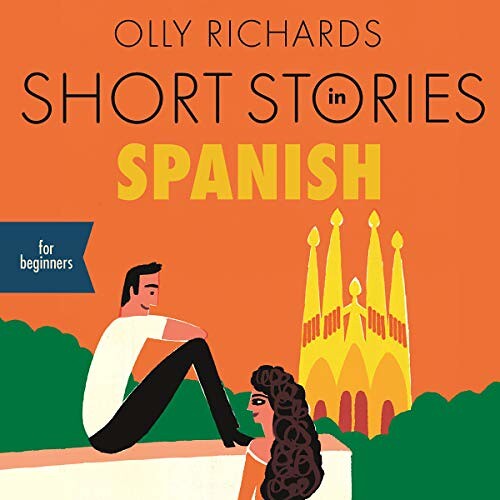
Shortly after I began listening to the audiobook, I actually discovered that I owned the paperback, only with a different cover. My paperback is the 2015 edition under which I’m reviewing. The audiobook (2018) cover looks like this:
The paperback was beneficial in its own way as well and I’m a fan of the format. That being 8 three-Chapter (Four in the 1st) stories with a paragraph-length summary at the end of each chapter, a vocabulary list made up of words that are boldened throughout the actual story, and a few multiple-choice questions regarding the story up until that point. I found it to be a little bit on the easy side as I whizzed through it at about the same speed I’d read a book in English. Although the text is so big even Stevie Wonder’d have a chance of reading it so that might’ve helped.
The stories themselves begin very, very easily (the first story is almost entirely in the present tense) and get progressively more advanced (up until a late beginner to very early intermediate level) towards the end. So far, so good BUT, unfortunately, the stories themselves are mind-numbingly dull and are absolutely littered with grammatical/structural errors and illogicalities that will actually hurt your brain to process. I won’t go into them here but I have a huge list if anyone wants details.
The Spanish used is Castilian Spanish which is not a negative, obviously, in and of itself but for my personal goals, this is something I’d usually try to avoid, opting more for Latin-American Spanish. It’s not going to matter to everyone but my partner is Venezuelan and therefore, and perhaps controversially, I find the whole vosotros form most often redundant, and there’s a lot of it in here! It’s ok, I know it. I’m not so ignorant as to ignore it, but I just feel like the worst you could possibly do by using the Ustedes form in its place, is be perceived as a bit stiff and overly polite when addressing a group. I think I can deal with this.
There are also maaaany, many words that mean 2 completely different things depending on the region. I’ll use a slightly vulgar example in Coger. This is used an enormous amount of times throughout the book and I hadn’t previously used it at all. Anyway, my partner and I were going to pick our little one up from Childcare the other day and as she was waiting in the garage I yelled out, “Ya voy! Estoy cogiendo las llaves”. Now, I’m not even sure if I was using it in the correct context but she was in stitches laughing. Apparently, I told her I was doing something most unsavoury to the car keys and I should probably never, ever use the verb coger again.
I also noticed that the stories were expanded upon in the audiobook, which was produced 3 years after my physical copy so it’s possible that some of the errors that I mentioned have been edited out from later editions but I listened to that before I read the old paperback and haven’t had the inclination to go back and listen again so can’t confirm. The order of the stories also differs towards the end and, in fact, there is one story from the 2015 edition, ‘Ferrg, El Dragon’, which is replaced with ‘La Capsula’ in the 2018 edition.
Long story short, if you can get past the awful quality of the stories themselves, then you’ll actually find a reasonably beneficial language learning resource for the late beginner looking to branch out into reading some short works outside of their scenario specific textbook dialogues.
Extremely useful learning tool. As has been noted, the stories aren't great literature, but much better than what else is out there at this level. This series fills an important niche for language learners.
Note to readers: this is written in Castellano (Spain), not Español (Latin America). Note to author: please offer these stories in Latin American Spanish.
This is a well-designed introduction to Spanish. I had previously overestimated my ability and started with Richards' Intermediate-level book; I quickly realized my mistake and obtained a Kindle copy of this for $1. What a difference having appropriately difficult material makes!
Bored of children's books, on the one hand, and unable to make meaningful progress on Spanish translations of familiar English works, on the other, I had almost given up in frustration. Then I came across a few language learning websites, particularly those of Benny Lewis and Olly Richards. Through them I've learned some keys to efficient language learning. One is to begin with material that is just a step beyond your ability—you need to be able to understand the majority (say, about 70+%) of the material in order to make meaningful progress but without getting frustrated.
This collection of short stories fit my needs quite nicely. Each succeeding story increased in length and complexity, incorporating previously-encountered vocabulary and grammatical structures but in new contexts, thereby providing essential (and not overly repetitive) practice. A summary, glossary and 5 question quiz at the end of each section help test and consolidate your learning. The stories are not great literature, to be sure, but they get the job done.
I followed the author's instructions on best practices for reading and found it an effective process. To wit:
1A) Begin by reading through to the end of each section of the story, taking care not to get bogged down in understanding everything. Do not look up words. The goal is just to reach the end (and develop at least a basic understanding of the plot).
1B) Read the section summary and see if you understand it. It may help clarify things a bit.
2A) Read the section through to the end again, now with a little more care.
2B) Read the summary again and take the 5 question comprehension quiz. (Again, it's just to help you improve your understanding, so, don't worry about wrong answers.)
3) Read the chapter again. Now you can use the vocab list if you must.
4) Continue process with the next story of the book.
I was worried that this process would be rather too repetitive and boring, but it wasn't bad at all in the end, and productive besides. I had a visceral sense of improving my ease of understanding with each story, which helped me to continue. Additionally, I made sure to read only 1 or 2 (of the 8) stories per day maximum, to prevent burnout.
Crucially, I have a real sense of accomplishment at having read 260+ pages of Spanish, albeit at a grade-school level. I look forward to reading Richards' 2nd Beginner book, and then moving on to his Intermediate book. My hope then is to take a stab at—if not Cien años de soledad or Don Quixote—at least an appropriate real work of Spanish literature or nonfiction. I hope this gets you started on your own foreign language journey.
This entire review has been hidden because of spoilers.
More than thirty-six years after living for a couple of years in Latin America and becoming fairly fluent in spanish, I am now currently trying to brush up on my sorely-neglected spanish skills. My hope is to travel to South America for 1-2 months starting about a year from now. I bought this book based on reviews and because it seemed like it would be good for the kind of practice that I need.
Overall, it met my expectations and was very helpful. It consists of 8 short stories, all of which are written fairly simply, similar to what a second or third grader would probably read for school reading assignments. The stories were mostly pretty lame, but I was okay with that as long as I felt like I was improving my spanish as I read them. Boldfaced words and phrases within the story meant that the word's definition appears at the end of the chapter. This part was kind of annoying because many of the boldface words were very simple and didn't need an english description, while several other words were not boldface but should have been (at least in my opinion), which meant that I had to keep my spanish-english dictionary nearby. Also, in more than a few cases, words that appeared in boldface were not to be found in the definition section at all.
Still, it was a good investment, and I will read through it several more times as I work toward my goal.
Esto me tomó bastante tiempo (medio año 😅), no porque fuera difícil o algo así, pero porque no quería apresurarme. Este libro fue mi primera lectura en español y ahora, cuándo ya sé algo de español básico gracias a mis clases en la universidad, fue mucho más fácil terminar los últimos cuentos. Todos los cuentos fueron entretenidos y la estructura del libro es perfecta. Definitivamente voy a leer el segundo volumen. En resumen, ¡lo recomiendo de verdad!
Such fun stories! Perfect for students in the basic and upper elementary (A1-A2). All the stories are very much unique! Loads of vocab, grammar and intriguing stories!
Grateful for this line of books that serve their purpose very well. From memory, some of the stories were about AI, a traveling band, space exploration, and a boat trip. So they're far more interesting than most beginner material. Short stories allow us to more easily make new connections with context. I was often able to work out what new words meant this way. This follows with Krashen's input hypothesis of going from i to i+1 with the help of our learned aspects of the language, knowledge of the world, and knowledge of the current situation.
Each story has multiple chapters, complete with chapter summaries and some multiple choice questions. Uploading the book to LingQ allowed me to compare the book's content to my already known words. I began the book somewhere around 4,000 known words, and the book contained 20–30% new words for me. But this is counting all of the English words that are in the introduction and conclusion, where Olly includes some extra information about the stories. Personally I think between 10–20% new words in a piece of content is most enjoyable at a lower level. Under 10% is too easy and above 20% can slow down the reading quite a bit. But the book was a smooth and very enjoyable read. Soon I'll start Olly's intermediate book, which currently contains 37% new words at 6,985 known words.
A very useful introduction for adults to reading in Spanish. The stories are not great literature perhaps but they are inventive and far more fun to read than the usual Beginners texts about school classes, picnics and family holidays.
Each story is in 3-4 chapters with useful vocabulary and a brief comprehension test at the end of each chapter. This format is great because you’re not interrupted by vocab checking on every page and you get a sense of the story as a story rather than just a lesson. That said, the author makes sure to introduce plenty of practice with verb conjugations and moods and useful adverbs and phrases as well as new vocabulary.
Yes, it is Castilian Spanish but I found that useful because I plan to use the language in both Europe and Latin America. There is already so much available educational material in Latin American Spanish and things like the vosotros forms are all but ignored in those books.
Olly Richards has succeeded in self-publishing an extraordinary book of stories. If inter-medial readers can get past enjoying the velvety cover to actually reading the stories aloud, they will experience some Spanish practice but mostly just fun. Surely readers will long to read with family and friends in order to practice listening skills and test how well they are being understood.
Olly Richards ha tenido éxito en la auto-publicación de un extraordinario libro de historias. Si los lectores intermediales pueden pasar disfrutando de la cubierta aterciopelada para leer realmente las historias en voz alta, experimentarán alguna práctica española, pero sobre todo simplemente diversión. Seguramente los lectores anhelarán leer con la familia y los amigos para practicar habilidades que escuchan y para probar cómo están siendo entendidos bien. ~google translate
Definitely intermediate, not beginner (all but the first story are in past tense and use subjunctive, etc., and they use a pretty wide range of vocab). And it uses the vosotros form, which is annoying. But they are actual stories and are engaging overall. And it’s a lot of bang for your buck since it’s a full-length book unlike most graded readers.
The glossing is pretty random. It bolds some words and then glosses them at the end of the chapter. But some really easy words are glossed while much harder words aren’t. Not really a problem since it’s on Kindle so you just use the dictionary, but odd.
This was definitely a useful read, but it's not particularly reader-friendly, especially since there is no translation available for the full chapter or for the summary I'd you got lost somewhere. Still solid, and probably a good measure of progress if I tried it again in a few months.
I liked being able to read and chapter and then listen to it on audio (I did pay to have the audio book version on my phone: the promo code is included with the book for a discount). I think it’s helped refresh old knowledge and learn new things.
**It is not written in Latin American Spanish so there were several words I had to look up.
Great for learners moving from beginner to intermediate.
Great range of vocabulary, easy to make progress and quickly understand the gist of each short story. Vocabulary summary and quiz at the end of each chapter to consolidate understanding.
These stories have lots of variety in theme and setting, use vocabulary in such a way as to help a reader learn new words, and also use many different grammar constructions. So, yes I do recommend it for what it is.
These stories were short and fun, and I like that there is a glossary at the end of each chapter. Each one seems to focus on one or two specific grammatical concepts, which is so useful as a learner! Thank you Olly!
Excellent reading to improve Spanish skills. The Stories are presented in away that are relatively easy to understand. I forgive the fact that they don’t always hang together perfectly. Eg. Laura finds an object in the woods right before dark. Hours go by and yet she and her friends are able to, apparently, see perfectly in the dark woods.