На редкость душещипательная сказка о том, как Смерть забрала у безутешной матери душу единственного ребеночка, а Мать кинулась за ней следом, чтобы не дать ей похитить детскую душу...
Hans Christian Andersen (often referred to in Scandinavia as H.C. Andersen) was a Danish author and poet. Although a prolific writer of plays, travelogues, novels, and poems, Andersen is best remembered for his fairy tales. Andersen's popularity is not limited to children; his stories — called eventyr, or "fairy-tales" — express themes that transcend age and nationality.
Andersen's fairy tales, which have been translated into more than 125 languages, have become culturally embedded in the West's collective consciousness, readily accessible to children, but presenting lessons of virtue and resilience in the face of adversity for mature readers as well. Some of his most famous fairy tales include "The Little Mermaid", "The Ugly Duckling", "The Nightingale", "The Emperor's New Clothes" and many more. His stories have inspired plays, ballets, and both live-action and animated films.
داستان هفدهم از همخوانی آثار اندرسن تو این داستان به صورت نمادین دلیل از بین رفتن چشمها در نتیجه اشک ریزی و...(تبادل چشماش) و پیر شدنشون(عوض کردن موهاش) متعاقب عزیز از دست رفته رو نشون داد. بعد از اینکه از غصه اولیه در اومد و تونست درست ببینه (چشماش برگشت) عملا سوگ رو طی کرد و مرگ رو پذیرفت. مرگ اینجا با اینکه سراغ بچه میره ولی پلید به تصویر کشیده نشده و با ذکر مامورم و معذور، یه نیروی بیطرف سرنوشته که کمک میکنه ادامه مسیر زندگی طی بشه. از اون طرف طبق اون سفر قهرمانانه بخوایم بررسیش کنیم، شاید بشه گفت سفر مادر یه سفری بود که توش به مرور از خودگذشتگی، درد و آگاهی عبور میکنه. نابینایی و بیمویی نماد غصه خوردن و اشک ریزش فراوان، ریشهکن شدن از هویت قبلی و شاید رشد ناگهانی و رسیدن به یه درک عمیقتر از سرنوشت و زندگیه. اسفند ۱۴۰۳
In my opinion every parents should be like this. Therefore also everyone who thinks of having children and becoming a parent should read this before they decide. The story is so touching. I hope from all my heart that the woman who is one day going to be the mother of my children and I, too, will become parents and be able to sacrifice our selves and love our children as much as the mother in the story.
A courageous mother pleads with Death, demanding the return of her deceased daughter. Suspenseful to the very end, especially since Death gives some tidbits on the Lord's selection process :) A hair short of 5 stars.
11/2023 reread: This time I was struck by the personification of night with a lady in a black dress who wants to hear lullabies, the greenhouse, and the way, when Death asks the mother how she beat him to his house, she simply replies "I am a mother." I still do not agree with the theology and implications of the story, but what a striking tale.
***
11/2022 reread: The amazing things in this story: the descriptions and personification of Death as a gardener of lives, the demonstration of the strength of a mother's love, and the message that we are not meant to decide who should live and who should die. The only problem I have with the story is the notion that God makes things happen and therefore we must accept tragedies as part of His will. Instead, I believe that things just happen, but God can bring good out of them. He's not controlling everything like a puppet master and definitely doesn't cause people to die. True, the child will be spared the sorrows of living in this broken world, but that doesn't mean that dying was better than him continuing to live. The mother is allowed to be sad! Yet she must let him go and turn to God for strength.
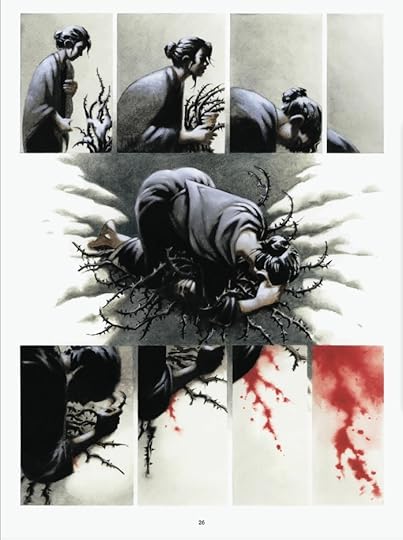
She (mother) pressed the blackthorn bush against her heart to warm it, and the thorns stabbed so deep into her flesh that great drops of red blood flowed. So warm was the mother's heart that the blackthorn bush blossomed and put forth green leaves on that dark winter's night.
"Death walks faster than the wind and never returns what he has taken." "Tell me which way he went and I will find him!"
Night tells her to go into the forest, but first the mother must sing every lullaby that she has ever sung for her child. In the forest, a thorn bush tells her which way to continue, but only after she has warmed the bush by pressing it to her chest, causing her to bleed. The mother then reaches a lake that carries her across in exchange for her eyes, which she cries out.
I read a version of this at http://www.andersen.sdu.dk/vaerk/hers... I would like to read other versions to compare, as I've noticed with other stories by Andersen that versions by different translators can vary quite a bit.
The reason I read this is because it was a favorite story of Vincent Van Gogh, according to the biography by Steven Naifeh and Gregory White Smith which my daughter is reading. Why this sad tale for a favorite story that he told many times to children he met?
#Binge Reviewing My Previous Reads #Classic fairy tales with Modern Implications
Hans Christian Andersen’s The Story of a Mother is among his dimmest, inexorable explorations of grief, mortality, and the confrontation with forces larger than human will. Unlike the gentler fairy tales that promise moral instruction, consolation, or redemptive closure, this narrative thrusts its protagonist into a series of tests where the only certainty is loss.
The mother, upon finding Death has taken her child, embarks on a nightmarish journey in which she bargains, suffers, and sacrifices in order to follow the shadowy figure. Every encounter—the thorn bush demanding her blood, the lake demanding her eyes, the gatekeeper demanding her hair—exacts a bodily price, literalising grief as mutilation. To love here is to be unmade.
What makes the tale radical, especially for 21st-century readers, is its refusal of sentimental catharsis. In contemporary culture, death narratives often circle toward “closure,” a therapeutic promise that grief can be resolved through narrative framing or psychological processing. Andersen offers none of this.
The mother never reclaims her child, nor is her suffering compensated with divine revelation. Instead, she arrives at a position of contradictory acceptance: her anguish coexists with the unchangeable fact of loss. Modern readers might recognise in this the texture of trauma rather than a tidy fable—the cyclical bargaining, the fragmentation of self, and the sense of encountering an otherness (Death) that cannot be negotiated away.
The postmodern reader, attuned to deconstruction, might see The Story of a Mother as dismantling the very genre of the fairy tale. Where we expect magical intervention to restore order, we instead get a relentless deferral of hope. Death is not a villain nor a saviour but an implacable force—an opaque agency that cannot be anthropomorphised into good or evil.
The mother’s repeated acts of sacrifice echo a theological pattern—martyrdom, kenosis—but Andersen undercuts this: her pain does not redeem; it only strips. In this sense, the text anticipates existentialist literature, where meaning is not guaranteed by divine plan but must be wrestled with in the void.
For 21st-century readers, especially in an age of medical technologies that both prolong life and complicate dying, Andersen’s story resonates with ethical ambiguity. When the mother pleads with Death to spare her child, she embodies the modern dilemma: how much intervention is too much, and how much suffering is justified in the pursuit of prolongation?
The thorn bush that drinks her blood is not unlike the machinery of hospitals, the procedures that demand bodily sacrifice with no promise of restored life. The lake that asks for her eyes conjures the metaphor of blindness in grief, but also recalls the modern condition of sacrificing clarity—choosing not to see the inevitability of death in the hope of staving it off.
Another striking modern implication lies in gender. The figure of the grieving mother has long been central to cultural representations of mourning—from the Pietà to countless national allegories—but Andersen pushes this to extremes.
The mother’s suffering is coded as absolute, self-effacing, and limitless. A feminist reading might see this as reinscribing patriarchal expectations of maternal devotion: the woman who gives everything, even her body, for the child. Yet there is also a quiet subversiveness: her agency is ferocious, her determination unstoppable.
She chases Death, she bargains, and she endures mutilation. She refuses passivity. In this sense, she is not merely a victim of fate but an active force, even if her activity cannot alter the outcome.
What lingers is not the narrative’s moral but its atmosphere—a relentless bleakness that refuses consolation. This makes The Story of a Mother extraordinarily contemporary. We live in a moment saturated by loss—pandemics, climate catastrophes, wars—and Andersen’s story resonates precisely because it refuses false hope.
Instead, it insists on the coexistence of unbearable love and inevitable death, of action that does not guarantee result. It dramatises the inescapable human condition: to struggle, to sacrifice, and finally to submit not out of consent, but out of recognition of limit.
For today’s reader, then, The Story of a Mother functions less as a children’s fable than as a proto-modernist meditation, a stark allegory that strips the sentimental from love and the redemptive from loss.
It leaves us not with closure but with the raw awareness that to be human is to inhabit precisely this space: where grief has no resolution, where love is indistinguishable from pain, and where Death is not an intruder but a neighbour we cannot evict.
Creepy, as all the tales for kids with religious messages. In this case, it speaks about how good is the death despite it may hurt to the ones that are still alive. Cringe, but good, I must say, interesting.
A mother goes on a journey to save her child from Death. It reminded me of the story of Orpheus on the theme of the inevitability of Death. I love the imagery of the garden of souls and allegorical approach.