This work has been selected by scholars as being culturally important, and is part of the knowledge base of civilization as we know it. This work was reproduced from the original artifact, and remains as true to the original work as possible. Therefore, you will see the original copyright references, library stamps (as most of these works have been housed in our most important libraries around the world), and other notations in the work. This work is in the public domain in the United States of America, and possibly other nations. Within the United States, you may freely copy and distribute this work, as no entity (individual or corporate) has a copyright on the body of the work.As a reproduction of a historical artifact, this work may contain missing or blurred pages, poor pictures, errant marks, etc. Scholars believe, and we concur, that this work is important enough to be preserved, reproduced, and made generally available to the public. We appreciate your support of the preservation process, and thank you for being an important part of keeping this knowledge alive and relevant.
James Branch Cabell was an American author of fantasy fiction and belles lettres. Cabell was well regarded by his contemporaries, including H. L. Mencken, Edmund Wilson, and Sinclair Lewis. His works were considered escapist and fit well in the culture of the 1920s, when they were most popular. For Cabell, veracity was "the one unpardonable sin, not merely against art, but against human welfare."
Continuing my reread of the Biography of Manuel, now in hardcopy. Physical object leatherbound print-on-demand. Contents, Storisende 14th edition. I’m actually close to giving this 5-stars, that was very unexpected. I really didn’t think my feelings would change much on a reread but here we are. And i think oddly, my change of feelings is the result of liking most of the characters less. So... on the first read i hated Charteris (and still do). However on this read, i felt how everyone else was somewhat culpable for events too and this made it sting a bit less and enabled me to enjoy the experience more.
First Read [3/5] "And he found it, as many others have done, but cheerless sexton's work, this digging up of boyish recollections. One by one, they come to light—the brave hopes and dreams and aspirations of youth; the ruddy life has gone out of them; they have shriveled into an alien, pathetic dignity. They might have been one's great-grandfather's or Hannibal's or Adam's; the boy whose life was swayed by them is quite as dead as these."
I really liked that. My 3 stars is more a general survey of quality than a reflection of personal enjoyment. Its a sort of anti-romance, like '500 Days of Summer' or maybe just a realistic romance like 'When Harry Met Sally'. Its kind of funny, but not a comedy, did remind me a bit of Jeeves and Wooster at times though. Set in the deep south of america after the civil war, set amongst the dying aristocracy of the former slave owners. Or rather their descendents and while it doesn't tackle racism head on it gives a good idea of the sort of stubborn minded traditionalism which inevitably tends to create such thinking.
The rivet in the title is really a metaphor for peoples inability to change both on a social and a personal level. The book is very bookish... :P i mean its the sort of writing which doesn't care about normal conventions and might be more appreciated by fellow authors or at least people who read a lot, than average readers.
Overall its a whimsically depressing book about peoples general lack of ambition. "for it would mirror the life of Lichfield with unengaging candor; and, as a consequence, people would complain that my tragedy lacked sustained interest, and that its participants were inconsistent; that it had no ordered plot, no startling incidents, no high endeavors, and no especial aim; and that it was equally deficient in all time-hallowed provocatives of either laughter or tears."
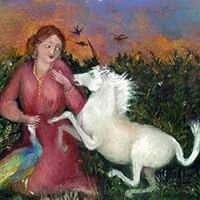
Inspired by themes in the fairy tale, "The Shepherdess and the Sweep," this is the 14th entry in the Biography of Manuel.
This is a long review because this book is a hard one to rate. If I had read this on its own, or after having only read a few of Cabell's books, I would have had lukewarm feelings to it. But I also want to assure the interested reader who may have stumbled here that you are entering into a wonderfully rich world of thought and imagination. It is like drinking your first REAL martini.
First of all, what made this book forgotten in literary history is because the author forgot his audience. It is, on the surface, a dated period drama. Diving deeper, it is a key piece of Cabell's fantasy epic about Dom Manuel and his descendants. This novel takes the allegorical adventures in the land of Poictesme and continues them in the satirical world of post-Civil War Virginia. Then things start to go very weird.
Like the boy in the school attic from the movie "Never Ending Story," the reader of this novel feels something is coming... something dark that will break open not only the shallow world of the featured town of Lichfield, but the reality experienced by the reader.
Though a brilliant work, it suffers from an identity problem. It would probably appeal to those readers who like such Southern American period romances as "Cold Sassy Tree," and those fans of 19th century Russian drawing room conspirancy novels in which Dostoevsky excelled. But Cabell placed this otherwise straightforward comedy-drama as part of his greater work in "fantasy."
All of this is hard to explain, so I hope my review helps anybody wandering toward this book to become interested in this and the other books of the Manuel series.
First of all, let's discuss this work in terms of it's medium--the English language. This book is written in ten parts, a number sacred in the Dom Manuel world, and each part has a simple, one-word title that sums up the events within the entire set of chapters in terms of one concept. As an example, "Propinquity" is the title of the first part of the novel, a term that refers to qualitative factors that link us to other members of humanity. So I may share propinquity with a person who lives in the same neighborhood as me, but I share greater propinquity with the guy who is my work peer, is in my age group, and who shares the same parenthood experiences. This part of the novel has the main character attempt to advance in his relationships based on this concept. Cabell was very good at recognizing how English can capture complex thought with one word, let alone a clever turn of phrase. He also is just damn funny. Though this book is not one of his triumphs at comedy, he still manages through the battles that his characters face with decorum and desire to pull off chuckles with lines like: "I hate him, I loathe him, I detest him, I despise him! I never intend to speak to him again—oh, yes, I shall have to at supper, I suppose, but that doesn't count." And Cabell at this time was facing obscenity trials for another book in this series, "Jurgen," only for nods to sex that many would consider tame today but are nonetheless delicious. This book is no exception, with lines as: "All I ask in return is that you will be a good boy—by which I mean a naughty boy..." as said by a wife contemplating elopement with her lover. I've read many novels of this era, but Cabell proves over and over to be ahead of his time, an author who writes in the first two decades of the 20th century, and who embraces the Victorian era of writing, but who sets the bar for comedy and fantasy for the 60s and today. Reading Cabell can be a pure pleasure just for his rich use of language.
Secondly, the novel is about multiple descendants of a "rediscovered" (but entirely fictional) mythologic character who allegedly lived in 13th century France, namely Dom Manuel. But the book can be read completely independent of the others entries in the series, yet it follows patterns and themes found throughout the series. So I'll provide you with an insufficient beginner's guide. If you like what you see, read the books and come to your own conclusions.
1) Cabell reinvents the "myth." He writes how the unlikeliest and unlikable of characters can earn the title of "Myth," especially highlighted in other entries of the series like "Figures of Earth," "The Line of Love," "Jurgen," and "Something About Eve." I love how, in this book, the myth concept is applied to America, and it will make you think about how we treat our pop music legends, movie actors, and political figures today.
2) As a historical fiction novel, it is a rather funny critique of the post-Civil War, industrial-era, Southern culture "of Breeding." In reality, most of us Americans alive today could not imagine what the descendents of the Confederate nobility must have been like years after their "Apocalypse" following the Civil War. But if you think about it, there IS a lush story there, and Cabell help us have a clue of what they were like from real experience in a tender yet critical portrayal... "For (in Lichfield), you know, we have the best blood in America, and—for utilitarian purposes—that means the worst blood."
3) Chivalry and gallantry are really characters in Cabell's novels rather than concepts, and we see what becomes of Them throughout the ages. In one of the more touching scenes, Col. Musgrave sits alone but contented after his latest act of Chivalry, an act which he recognizes would seem ludicrous to most people. He has just given up his betrothed to another man whom he believes she loves, because it is expected as the gentlemanly thing to do. He raises a toast ""To this new South that has not any longer need of me or of my kind."
4) Cabell is a puzzle-maker and he designs them to expand the reader's consciousness. From creating alien rune writings for the reader to translate, to poems and prose that are really riddles, Cabell explored his interest in the lineage between reality, memory of the reality, translation of the memory into language, transformation of the spoken word into story, transmutation of the story to myth, and what may come next. This book fleshes out how that lineage plays out in ordinary daily life in a way that feels very real. Every passage explores this phenomenon. For example, there is a discussion of an ex-slave household maid, Virginia, that modern readers may find racist. But read what Cabell is really saying about the "story" created about her and it is like staring into a fractal. Like a mandala or an Orthodox icon, Cabell's works are not meant to taken at face value, because his puzzles are micro-stories within meta-stories that carry an even more meta-philosophy.
5) As a treat for those dedicated fans of the "Life of Dom Manuel," this book offers several nods and references to others in the series. Part Four opens with one of my favorite poems in "From the Hidden Way," with the haunting and eerie line "I am no longer I, you are not you..." which takes on more meaning as the series progresses. Other parts open up with poems by a "Paul Vanderhoffen," who was created as an earthen figure by Dom Manuel and later brought to life, and from whom the main character of this book, Rudolph Musgrave, is descended. And another of these earthen characters made human is that of John Charteris, who makes his third appearance in the series as a man trying to seduce Musgrave's wife. Dark, hook-nosed, selfish, sarcastic, but ultimately charming, I imagine him as something like Stephen King's Randall Flagg. To me, he is one of the most mysterious characters in literature. Why does Cabell choose to keep writing this rather peripheral character into his novels? Was he a representation of someone special in Cabell's life? But though how he came to be alive as a character remains elusive, his fate which is hinted at in "The Cords of Vanity" is revealed. The novel also offers a deeper look into the character of Gerald Musgrave, from the book "Something About Eve," that starts to unravel the whole mystery behind the 20 plus works that discuss the fictional Manuel lineage, and sets the stage for one of the most controversial endings of a series in the fantasy genre besides "The Dark Tower."
Oddly enough, this novel was published in 1915, long before Cabell ever conceived of Dom Manuel! But there IS a reason he later crammed this slice of Americana with an epic about a Frankish myth.
Yet I think that Cabell's relative obscurity amongst the great literary artists is that he made the mistake of putting the weight of his scientific, philosophical, and humanisitc thought into his early stories like this one. He realized by 1924 that the bulk of his writing all pointed to a central theme and so he tried to reinvent all of his previously unrelated work as the Storisend edition of Dom Manuel. I think that people just didn't buy it, seeing it as a marketing campaign at the time.
But I hope I have given some perspective in what I think is a novel both ahead of its time and yet very dated. Enjoy your journey!
Very dated, ornate and obsolete language, euphemisms obscure meanings. I still felt it was worth reading for the contrast an old South that my grandmother knew with the idea of merit. Unfortunately, the writing exhibits 'almost' total blindness to the problems left from slavery. This will offend many readers.
On ancestry and its study: "... some obscure captain in a long forgotten regiment, which if it had not actually served in the Revolution, had at least been demonstrably granted money "for services," and so entitled hundreds of aspirants to become the Sons (or Daughters) of various international disagreements."
At least twice, the author questions "the exploits of an ancestor to guarantee an innate and personal excellence." This is contrasted with the person who actually does something other than live and behave pleasantly. The main character goes back and forth on the idea that "... nobody is justified in living without even an attempt at any personal achievement."
Disappointing. I love Cabell's books but the best thing about this one is the odd title -- not a reference to Frankenstein's monster but to an old Hans Anderson fairy tale.
This early Cabell novel is a drawing room comedy, like a less strange version of a Ronald Firbank book. Some of the writing is beautiful and some of Cabell's trademark dry wit and irony is in evidence, but mostly the story is inconsequental and the characters are mildly irritating.
Cabell improved vastly in the years following publication of this novel!
The first six chapters (more or less) were so delightfully funny that I was beginning to think I had stumbled upon a second Wodehouse. However, the text gradually faded into mere social commentary with, admittedly, an occasional funny line. The plot line is (usually) not predictable, so that helps to hold one's attention.
All in all, it is not bad book, but neither is it a great book.