A major new exploration of the history and development of gunpowder weapons in the 15th century based on the artillery of the Dukes of Burgundy.
The four Valois Dukes of Burgundy created, in little more than a century, a fabulously wealthy and independent state. Their centralised control and chancellery have bequeathed to us a vast treasure trove of documents, including accounts and inventories of the Masters of the artillery under the later Dukes. Although many of these were extracted and transcribed in the late nineteenth century, modern historians have largely ignored their unprecedented insights into fifteenth-century guns and their use. When Charles the Bold, the last Valois Duke, took on the combined Swiss confederate forces in 1476 he lost not just the battles and his personal fortune, but much of his artillerytrain as well. Of the dozens of cannons captured, at least 25 pieces survive in Swiss museums. The documents that survive from the Valois state give us, almost for the first time in medieval Europe, the ability to see the course of history in a period when Europe was undergoing some of the most profound changes before the 20th century. The Artillery of the Dukes of Burgundy is the first attempt to combine all these sources, bringing newand fresh insights into the development and use of artillery in the fifteenth century. Moreover this is the first modern study of medieval cannon, one of the most important discoveries of the post-classical world.
KELLY DeVRIES has authored numerous books and articles on medieval warfare. ROBERT DOUGLAS SMITH formerly Head of Conservation in the Royal Armouries, Tower of London, is an acknowledged expert on medieval artillery. This study is thefirst major fruit of their combined researches.
Knights and soldiers clashed to the sound of cannon and handguns firing in the late Middle Ages. This is a book that makes you re-think the way you imagined the past. By the 15th century gunpowder was prevalent in France and Burgundy. The last Burgundian duke, Charles the Bold, had 329 firearms with him at the siege of Nancy in 1475, and these were just from one of his many arsenals. The impact of these weapons varied. Charles was successful at Nancy but unsuccessful on many other occasions, and the experiences of the previous Burgundian dukes were just as checkered. What this book makes clear, however, is that late medieval rulers took gunpowder seriously even if it didn’t always prove to be decisive.
The guns themselves were mostly made from pieces of wrought iron, which could be heated and welded together by hammering, or from cast iron which was poured into a mold. In the 14th century some of them fired bolts and other projectiles, in other words, not just cannonballs. When cannonballs became more widely used, many of them were cut from stone by masons.
Employing all of these guns and craftsmen to service them created a need for more bureaucracy and planning. A commander who wanted to take his artillery train to a siege or a battle had to figure out how many horses and carts he needed for the guns themselves, their ammunition, and their crews. Even the saints got involved. At the siege of Calais, the English prayed to St. Barbara, the patron saint of cannoners, to protect them from the enemy bombardment.
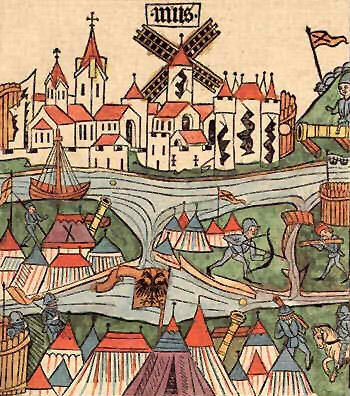
Charles the Bold's cannon bombard Neuss in 1474. From the Geschichte Peter Hagenbachs und der Burgunderkriege.