Jump to ratings and reviews
Rate this book

Miss Jane

Rate this book
Astonishing prose brings to life a forgotten woman and a lost world in a strange and bittersweet Southern pastoral.

Inspired by the true story of his own great-aunt, Watson explores the life of Miss Jane Chisolm, born in rural, early-twentieth-century Mississippi with a genital birth defect that would stand in the way of the central “uses” for a woman in that time and place—namely, sex and marriage.

From the country doctor who adopts Jane to the hard tactile labor of farm life, from the highly erotic world of nature around her to the boy who loved but was forced to leave her, the world of Miss Jane Chisolm is anything but barren. Free to satisfy only herself, she mesmerizes those around her, exerting an unearthly fascination that lives beyond her still.

284 pages, Hardcover

First published November 3, 2016

462 people are currently reading
10716 people want to read

About the author

Brad Watson

22 books173 followers
Librarian Note: There is more than one author in the Goodreads database with this name.


Brad Watson taught creative writing at the University of Wyoming, Laramie. His first collection, Last Days of the Dog-Men, won the Sue Kauffman Award for First Fiction from the American Academy of Arts & Letters; his first novel, The Heaven of Mercury, was a finalist for the National Book Award, and his Aliens in the Prime of Their Lives was a finalist for the PEN/Faulkner Award for Fiction.

Ratings & Reviews

What do you think?
Rate this book

Friends & Following

Create a free account to discover what your friends think of this book!

Community Reviews

5 stars
1,670 (28%)
4 stars
2,624 (44%)
3 stars
1,349 (22%)
2 stars
223 (3%)
1 star
67 (1%)
Displaying 1 - 30 of 944 reviews
Profile Image for Elyse Walters.
4,010 reviews11.9k followers
April 12, 2017
"She did not like the vexation of her incontinence, and wished she would outgrow it, but eventually accepted it as part of who she was, no matter how unsavory.
She determined that she would live like any other girl as best she could, and when she could no longer do that, she would adjust her life to its terms accordingly. So she did not fear her own strangeness, even though her awareness of it grew and evolved as she got older".

I really had no idea what to expect when I started reading this story. All I knew is that it was about a girl named Jane - and most people thought it was a beautiful story. I thought it had something to do with Jane Eyre - shows how completely off base I was.

I know - first hand what it's like to be born with a rare physical condition ..... a little 'too soon'..... I rather not go into details ...
but I, too, was born with a rare disease - Had they operated on me as a baby - even a toddler -- I would have have less permanent struggles. In 1952 - when I was born - nobody diagnosed my condition by name yet - ( today all babies are tested at birth)... and if this disease is detected, babies as young as 8 weeks old have the surgery and grow up with no complications. I wasn't as lucky.

Jane was less lucky. Her rare congenital deformity was a handicap that was harder to keep private than mine -- more challenging to live with in public.
She had other issues: it was the depression era in the South.....complexity with her parents and their depression....and the every day reminder that she was kept apart from others - doesn't attend school as the other children do.

All the characters in this story play an essential role --but the country doctor and her sister Grace...were gifts from God!

Trust & Love ......'especially' trust was something Jane needed to learn to embrace and strengthen on her own to live well in this world. And she does! It's hard - as the reader - not to feel sad for Jane --( even when she doesn't for herself). She's an intelligent, courageous, and lovely person.

Beautiful lyrical prose throughout......
"A human being made out of dust from the earth would never hold up, and a human
being made from mud would be nothing but a crumbling mold creeping about swamps to keep from drying and whisking away in the wind, like the dust she stood watching drift and settle back onto their driveway, no longer disturbed".

It's very moving that Brad Watson was inspired to write this story drawing on his great-aunt. Exquisitely written!

Thank you Linda for this book....it's more special than I had any idea!
Profile Image for Diane S ☔.
4,901 reviews14.6k followers
June 22, 2016
Third book I have given five stars to in the past week, so....... either I am getting sentimentally sappy (which I don't believe for a minute) or (there are some awfully good books being published), yep let's go with this one. Jane and Dr. Thompson are two of the most memorable and admirable characters that I have had the pleasure of encountering in fiction. Jane's characters is based on the author's great aunt and this makes her even more special.

Early 1900's in Mississippi, Jane is born to a mother who thought she was done having children, who is mourning the death of the child born before Jane, and who conceived Jane in a less than savory way. Jane, is born with genital abnormalities, which will not allow her to ever have a normal relationship with a man, have children and she will suffer incontinence throughout her life. Dr. Thompson will become her mentor, her champion and the one who will attempt to guide her through these difficulties.

This is one of those quiet, but meaningful novels, characters just trying to deal with what fate throws at them. Sounds sad, I know and it is that but it is so much more. She learns to love the woods, her farm, animals and nature. She has a personality that tries to find the good in everything, to make the best of life. Her family, the sister who at nine was given the responsibility of her and would leave home as soon as she could. her father, who loves Jane, but drinks heavily and would not, show her how much he thought of her until after his death. Her mother who barely copes. The prose, the descriptions, so wonderful. I was amazed that this was written by a male author but then again I think that gave it a special, nondramatic touch. A really wonderful book, was so incredibly impressed and so grateful to have met these two wonderful people.

ARC from publisher.
Profile Image for Candi.
707 reviews5,513 followers
November 17, 2017
Miss Jane is a beautiful book which delivers a message that is both meditative and quietly powerful. Brad Watson relates a fictional account about a woman, Jane Chisolm, inspired by his real-life great aunt. He does so with a prose that is lyrical, elegant and soothing. Solidly character-driven, this novel introduces us to Jane at birth, where she is brought into this world in 1915 in rural Mississippi. Jane is born with a congenital deformity that will have a lasting effect on all of her relationships, especially her most intimate. I am convinced that your heart, like mine, will go out to Jane from the first time she realizes that there is something ‘different’ about her. "She had moments when she felt like a secret, silent creation, invisible, more the ghost of something unknowable than a person, a child, a little girl."

While there were instances of sadness throughout the book, the overall tone is not melancholic. There are times of joy and keen insight that will leave the reader rather breathless. This has much to do with Jane herself who does not let her isolation overcome her, but rather learns to adapt and make the most of the life that has been doled out to her. Her relationships with mother, father, sister, and the family physician, Dr. Thompson, are all thoughtfully handled by the author’s sensitive awareness of human nature. We see what it is like for a family living a demanding life on a farm during the early part of the twentieth century. Mrs. Chisolm has suffered loss that has left her with a deep-seated sadness and bitterness that affects her relationship with both husband and daughters. "Her mother was more of an enigma than a threat, tending to lash out but seeming more angry at something inside herself than at others." Mr. Chisolm is hard-working, but carries a burden of guilt that is defeating; he resorts to the bottle for comfort. Older sister Grace just wants to get out and escape the farm at the earliest opportunity. Then there is Dr. Thompson. Along with Jane, he is without a doubt a memorable character, and all that is decent in a companion and friend. Not without his own sorrows and regrets, Dr. Thompson yet guides Jane through an understanding of her condition and what it means to live for oneself. He is a rock.

Jane’s coming of age, her strong affinity to the natural world, her resilience, and her growing knowledge of self-worth make for a compelling and heartwarming read. There are some wonderfully sensual passages that show the connection between nature and sexuality that are just lovely in their simplicity: "… a torrential storm, the burst of salty liquid from a plump and ice-cold raw oyster, the soft skins of wild mushrooms, the quick and violent death of a chicken, the tight and unopened bud of a flower blossom, a pack of wild scruffy dogs a-trot in a field, the thrum of fishing line against the attack of a bream, and peeling away the delicate frame of its bones from the sweet white meat of its body, a smooth and hard oval nutshell rolled in a palm, the somehow palpable feel of fading light…"

If you are at all curious as to the meaning behind the cover depicting a gorgeous peacock, then you’ll have to read this book in its entirety. The revelation is sweetly satisfying. I highly recommend Miss Jane to those that appreciate contemplative novels with superb writing and excellent, convincing characterizations. Another gem for my favorites shelf.
Profile Image for Karen.
742 reviews1,965 followers
November 21, 2022
Oh…this quiet little book, drawing upon the life of the author's great aunt.
Jane, born in rural, early twentieth century Mississippi, who was born with a genital defect, was so good. It was sad, that she had to live with the limitations this caused her, but she lived her life with a grace and strength that I will not forget. There are a few other great characters in this book also...her father, the doctor country doctor who examined her at birth and continued to be a huge part of her life, and the young neighbor farm boy that had feelings for her and her for him. Very good, highly recommended!
Profile Image for Dem.
1,263 reviews1,431 followers
January 8, 2017
Beautifully written - a story that is quietly intriguing and inspiring. This is a novel where the characters will take hold of you and you will have great difficulty letting go of them by the end of the story.

Miss Jane is a story of a child born with an inoperable condition in rural Mississippi in 1915.

An amazing sense of time and place with wonderful characters. The story is based loosely on the life of the authors great aunt Jane who was born with a rare congenital deformity.
We are introduced to rural life in Mississippi and we grow up with Jane as she learns to cope with life and the difficulties that come with living with her condition. A heartwarming story and yet is is not a sad book. Its a story of hope and courage and living life with dignity. Watson prose is charming and compelling and he writes a sensitive portrayal of a woman adapting to her condition in a time where there is limited medical information and care.

I listened to this one on audio and the narrator was excellent.(still cant help wishing I owned a hard copy) This would make a great book club read as the it is character driven, well written and unique.


Profile Image for Jennifer ~ TarHeelReader.
2,785 reviews31.9k followers
April 8, 2017
The best kind of book inspires you, transports you, and wraps you up inside it. The main character of Miss Jane, Jane Chisholm, faced one of life's considerable obstacles with grace and fortitude. I felt sad at times because of the hardships Jane had, but as I was reading, the point the author was making in my mind was that I should not feel sorry for Jane, that she would not want me to feel sad for her; Jane was good with how she was, how her life was. She accepted her life and lived it exactly how she wanted. Everyone in Jane's family had a lonely way of experiencing the loss of Jane's expected life, but even amid that loneliness there was deep connection. This book had it all. The writing was exquisite, the characters and their deep emotions were poignant, and the plot moved along through Jane's life from her birth to over sixty years old in less than 300 pages. Please, Brad Watson, write more novels!
Profile Image for Diane Barnes.
1,613 reviews446 followers
August 4, 2016
This is my favorite type of book, a quiet and contemplative novel of the life of a woman born in 1915 in rural Mississippi. Jane was born with a "defect" that was not fixable at that time in medical history. It made her incontinent and unable to have sex or bear children. It also caused caused her to be a social outcast of sorts, as school and normal friendships were impossible because of her frequent accidents. So she grew up on the farm, with only a sister who resented being her caretaker, a mother who hadn't wanted another baby to begin with, and a father who loved her dearly, but worked hard and had a bit of a drinking problem.

This is also the story of the doctor who delivered her, who had loneliness problems of his own, but was a wise and good man who became a trusted friend and advisor to the whole family. That Jane grew up happy, even knowing exactly what her problem was and the lack of science's inability to fix it, was largely due to him. He was always honest and gentle with Jane telling her that she was a normal child in every way but one, and through no fault of her own or her parents, her insides just didn't develope all the way.

This was such a beautifully written story of Miss Jane's life, from birth to old age, alone at many times in her life, but blessed with strong intellect, great common sense, and a refusal to feel sorry for herself. And she was loved along the way. This author made me feel a bond with all the characters in this book; the unhappy mother, the heartbroken father, the cantankerous and difficult sister. But Jane and Dr. Thompson were the true stars of this tale.

And let's not forget the peacocks. They added some beauty and mystery along the way.
Profile Image for Perry.
634 reviews617 followers
July 31, 2020
RIP Brad Watson
A Love Bird
A Simply Superb Novel

"A little girl, I believe," Dr. Thompson pronounced. Brad Watson set the mood perfectly by showing rather than telling about this 1915 baby delivery in a small farmhouse in rural Mississippi. The midwife's "narrowed eyes" as she washed the baby, while the father waited outside with "his long face in half shadow," and mom viewed the baby like she was "some kind of potentially dangerous creature."

The condition of the baby, "Jane" but called "Janie," was medically defined as urogenital sinus anomaly and persistent cloaca. The doctor explained it to her when she was old enough to inquire of him about sex (and her developing crush on a cute young lad), "Everything is kind of tucked up inside you....And one thing you do not have is the little muscle that allows you to control yourself." She and the doctor form a special kind of father-daughter bond throughout the novel.

More than half the book is about Janie growing up on her family's farm in the 1920s into the early 1930s and the Great Depression, with an alcoholic dad and a bitter mother, both parents being "disposed to darkness of spirit," and a sister Grace who starts smoking at 11 and leaves home at 16. Despite nature and nurture dealing her bad hands, she is a sweet girl, always curious about plants and animals and their mating rituals:
"She was fascinated by the mushrooms and their dry or slimy tops and delicate stems and gills beneath their caps. She liked to pop her toes against the ones that burst into orange dust that bloomed in the breezeless air. But it was the quiet, modest ones that were most interesting. If they didn't want you to see them, you would not. They lived out their lives in shade and dampness, quivering when you passed and going so still if you happened to notice and squat down to take a closer look, to touch."
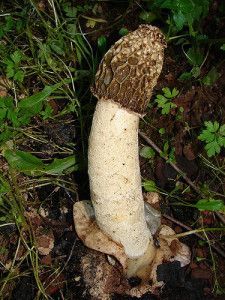
As a young girl, she found a stinkhorn mushroom, the most phallic fungus, and plunged it into a womb-shaped plant trying to figure out the act of mating. As she gets older, her sister invites Janie to watch her (sis is around 15) and an older boy do the deed in a secluded area. Later she spies on the neighbor couple, her curiosity piqued after she sees the woman with a black eye and bruises.


A Stinkhorn Mushroom

Watson poetically describes Janie's relationship to nature, as almost wild:
A "torrential storm, ... the soft skins of wild mushrooms, the quick and violent death of a chicken, the tight and unopened bud of a flower blossom,... the somehow palpable feel of fading light -- were in some ways sexual for Jane."

She must endure the torment of a love unconsummated, and the novel offers answers to the question posed by the doctor toward the end, "Who can say what life will make of a body?" That is to say, can someone live a full life without physical love when we innately desire a mate with whom we share ourselves carnally?

In the same conversation, the doctor offered, "In my opinion many I've known would've been better off following their solitary natures."

Near the end, as Jane and Doc Thompson approach a flock of peacocks, he says:
"...they don't have obvious genitalia. It's mostly on the inside. The males and females have this little puckering down there, called the cloaca, and when they're ready to mate the cloaca swell up, and they simply press their little puckerings together..... They call it a cloacal kiss. Now, don't you think that's just kind of endearing?"

"I do," Janes replies, "Maybe I'm part bird."

This was a tender, touching and poignant novel that's both sad and hopeful without ever getting sentimental. Simply Superb.
Profile Image for Lindsay L.
868 reviews1,659 followers
February 7, 2017
3 stars. I know I'm in the minority with having less than a 4 or 5 star rating. There is no doubt that this author writes beautifully. My less than excellent rating is based on my overall feelings throughout this book - I just couldn't help but feel saddened while reading this entire novel. My heart broke for Jane on every single page - I felt so bad for her, her condition and her loneliness. Jane learned to accept her condition and grew to experience happiness, excitement (my heart melted during the scenes of her at the dances) and love, but Jane's struggles due to her condition were simply heartbreaking. I have a huge spot in my heart for Dr. Thompson and how he so kindly and lovingly mentored and took on a parental role to Jane through her life. I am glad I read this book as it is such a unique, well written story. It will just take time for me to move past the sadness I feel upon finishing it.
Profile Image for Linda.
76 reviews219 followers
January 5, 2017
This book quietly and tenderly tip-toed into my heart. It introduced me to each character so vividly that I felt like I was standing among them. I found myself so engaged that my reading pace slowed down as to not miss a word of what this disheartened family had to endure. Each member of the Chisolm family suffered in solitude in their own unique way with the tragic, congenital defect of little Jane.

The story was based on the author's great-aunt. It began with her birth and continued through the years until she was sixty-seven. During this time, I witnessed Jane learn to accept what life had given her and develop into a self-fulfilled, independent, and dignified lady. She saw the good in everyone and found comfort in the beauty of nature. She also experienced love--not the lowest form of physical love, but the pure love that is akin to divine love, when love between two people exists on a higher plane and belongs to them forever.

What a wonderfully written piece of literature.
Profile Image for Cathrine ☯️ .
812 reviews420 followers
June 27, 2017
5★
Inspired by a great-aunt born with a “difference,” and a single photograph of her as a young woman, Brad Watson has crafted a quietly stunning story that captivated me on every page. Not one word was superfluous or wasted. I’m not sure if I’m more astonished that a man wrote it or at how sensitively and beguilingly his prose washed over me.
From the moment of her birth, Miss Jane defies expectation and lives a life not defined by what is missing, rather by what is present—in herself and in her world, taking advantage of what it offers.
The way of life depicted in early 20th century Mississippi that provided her the opportunity to flourish has all but vanished but is brought vividly to life in gentle prose that enchants the reader page after page.
Thirty friends have this one on their TBRs and I want to encourage them to move it up because it’s that special.
Profile Image for Dolors.
605 reviews2,811 followers
November 22, 2022
This is a beautifully crafted story of resilience and fulfillment against all the odds.
Set in Mississipi at the beginning of the 20th century, a girl is born with a rare genital malformation. Her parents have been trapped in a loveless marriage for years, her older sister is weary of farmlife and seeking for an escape, and so Jane, the strange little girl, grows mostly with the company of the wilderness that surrounds the family farm and the kind presence of Doctor Thomson, the man who tended her birth and who becomes her best friend and confidante.

Very early in life, Jane senses that she is different and that her condition will be a burden to carry, a dirty secret that will suffocate any hope to love and be loved in the traditional way. No man will marry a woman who can’t have sexual intercourse and therefore, who can’t have children.
Surprisingly, what ensues is not a story of isolation and defeat. Instead, Watson’s quiet heroine chooses to live her life with self-respect and an extraordinary awareness of the natural world. Trees, birds, plants and occasionally human beings become the recipients of Jane’s uncanny observation, and the world flourishes under her undivided and caring attention.

It’s no wonder that Doctor Thomson, who is quite the eccentric, starts breeding peacocks after his wife’s sudden death. He wonders about the natural function of such gorgeous animals. Vibrant colors, silky feathers and penetrating screams in the middle of the night fill his loneliness while he ponders about Jane’s fate.

Peacocks have traditionally been associated with Hera, the wife of Zeus and the patroness of women, marriage, and childbirth.
Even if it doesn’t seem so at first glance, peacocks and Jane seem to share several qualities. Both are unearthly beautiful, quite from another world. Both dispel a spiritual intensity difficult to ignore. Both possess an elegant quality, a subtle defiance to exist and to celebrate their exhuberance, for Jane’s story is as sensual and tantalizing as any erotic narrative. Hers is a love story with nature and with the gift of being herself. Unique. Whole. Inspiring.
Profile Image for Sue.
1,438 reviews650 followers
June 18, 2016
Miss Jane is the story of Miss Jane Chisholm, born in early 20th century Missisippi, in a very rural setting, with birth defects, genital birth defects, that will affect her entire life. The local doctor who delivers her, discovers, and later researches her physical deficits, and remains a major force in her life. This story is apparently based on the life of a distant relative of the author.

Miss Jane is a novel of self, but not selfishness, of persistence in the face of major physical difficulties that interfere with basic human relationships, of acceptance of limits while still working to maximize life within them. We watch Jane live amid the hardscrabble life of a farm family along with the differences her body requires. She is often an observer, but with the suitably childlike awe of her age. We see the natural world around her, including the erotic observations she is initially too young to understand. And we watch her mature and become an adult.

This is a beautifully written novel, delicately written, observant of a beautiful young woman who truly lives a separate life in many ways, observant of what is now a distant rural past, observant of a natural world in all its beauty and sometime cruelty.

Highly recommended

A copy of this book was provided by the publisher through NetGalley in return for an honest review.
Profile Image for Cheri.
2,041 reviews2,966 followers
October 26, 2018
”You would not think someone so afflicted would or could be cheerful, not prone to melancholy or the miseries. Early on she acquired ways of dealing with her life, with life in general. And as she grew older it became evident that she feared almost nothing—perhaps only horses and something she couldn’t quite name, a strange presence of danger not quite or not really a part of the world.”

Jane Chisolm is a young woman born into a rural part of Mississippi in the early 1900s, when and where the condition she was born with would never be understood, she would never truly be accepted in any “normal” sense. At this time and place, there was little known about her condition, and nothing known that could be done. Her condition has side effects, one of which is incontinence, and so she spends much of her early life alone. Her mother seems worn down from the loss of her son that died before Jane was born, and her father seems to have trouble coping with all that life has left on his doorstep, and the only person who consistently seems to care for her and about her is doctor, Eldred Thompson. While her sister, Grace, is good with her in their early years, she is anxious to leave their farm, leave them all behind her, and live a different kind of life.

Jane seems to have born with an innate love of the world and all the creatures that roam it. She has no real fears of nature, she loves the woods and the creatures that live there, she feels more at home there than anywhere else, surrounded by the beauty of nature and the animals who accept her as she is. She doesn’t even seem afraid of the darker side of nature, the storms that brought down limbs of trees or the hail or the lightning.

”She did not like the vexation of her incontinence, and wished she would outgrow it, but eventually accepted it as part of who she was, no matter how unsavory. She determined that she would live like any other girl as best she could, and when she could no longer do that, she would adjust her life to its terms accordingly. So she did not fear her own strangeness, even though her awareness of it grew and evolved as she got older.”

It would be difficult, at best, not to love Jane, this girl who by the age of six, had ”... moments when she felt like a secret, silent creation, invisible, more the ghost of something unknowable than a person, a child, a little girl.” Still, there is an element of this that is heartbreaking at the same time.

This story covers Jane’s life, her coming of age, her journey to be more fully accepting of the life she can have that can still offer her fulfillment and love. I loved every second of reading this story that was based on the author’s great-aunt.

I have a friend whose brother and his girlfriend / wife had a baby who was born with a very similar condition. I remember how heartbreaking that was, and this was when the outcome would be a much more positive one, with surgeries to correct the abnormalities that nature created. I can still recall how many tears were shed, and can only marvel at the resilience of this young woman born in another place and time, when options were few and the world was less kind to those who were different.
Profile Image for Sara.
Author 1 book934 followers
November 5, 2020
Think of all the difficulties you have encountered in your life. Remember the heartbreak of first love, the nervousness of meeting another human being you wanted to love and be loved by, and the doubts you entertained about whether your love, freely given, would be returned. Imagine how much harder it would be to find your place in the world if, along with all the normal difficulties life throws at us, you had a physical defect that made it impossible for you to have sex or bear children, and that left you incontinent as well. This is the life of Miss Jane Chisolm. Sounds rather bleak out of context, but that is because you don’t know Miss Jane.

This is a soft, simple book. The story is very straight forward, and yet there is a strength at the core of Jane that keeps you coloring with bright colors instead of gloomy ones. It isn’t only Jane’s story that resonates, it is also her sister, her parents and the doctor who brought her into this world and then held her hand as she journeyed through it. Dr. Thompson is a hero, in my eyes, and one of my favorite characters in a long, long while. Jane is intelligent, positive and stalwart; the kind of person you admire and strive to emulate.

Jane lives on a farm in Mississippi, and Watson’s descriptions of her life there and the nature around her are remarkable.

She loved most being in the woods, with the diffused light and the quiet there. Such a stillness, with just the pecking of ground birds and forest animals, the flutter of wings, the occasional skittering of squirrels playing up and down a tree. The silent, imperceptible unfurling of spring buds into blossom. She felt comfortable there. As if nothing could be unnatural in that place, within but apart from the world.

This seems to me to be the heart of Jane herself, “within but apart from the world”, and in just as many positive ways as negative ones. It is a book about perception. How people see Jane, how she sees herself, and how they all see each other.

Jane had never seen the look in her eyes she saw then. She almost looked empty. And for the first time Jane could remember, she saw her mother as a woman whom life had made not just hard but also exhausted and plain. Older-looking than her years.

Just as Jane came to see her mother differently, I came to see her differently as well. The weight of her life began to dawn upon me and soften my view of her behavior.

The creek would be up in such a rain, if it didn’t dump all of itself into the valley where the people of the town sat awaiting it, powerless like all of God’s children on this earth, who needed such reminding now and then that they were mortal. Ida Chisolm didn’t.

Yes, this is a quiet, flowing sort of story, not action packed or exciting, thoughtful and perhaps even brooding at times, but it offers characters you will never forget and a circumstance that would seem to break a person, but doesn’t. And therein is the magic, for if Jane is unbroken by who she is, why should any of us be broken by the things we cannot control. If the heart is strong, the spirit can win.


Profile Image for Robin.
575 reviews3,653 followers
February 22, 2017
Life is not fair in that way or any other way. We are who and what we are.

This is a beautiful, meditative book about how one woman's physical differences create a separateness and life-long aloneness in the world.

Jane Chisolm (a character based on the author's great aunt) was born differently than other girls - with a condition making sexual coupling physically impossible, an inability to conceive and carry a baby, as well as lifelong incontinence. Born on a farm in early twentieth century Mississippi, her life was destined to be somewhat quiet. But because of her condition, her life is more than quiet. It is solitary.

The book depicts her gradual understanding of her differences from others, and the effects it has on her life. Her family life is difficult. Her mother is remote and bitter. Her father is hardworking and good at heart, but is a functioning alcoholic, plagued by his own disappointments and demons. Her older sister Grace is a rebel who gets off the farm at the first opportunity. Her constant friend turns out to be the doctor who delivered her, Doctor Thompson. He looks out for her and cares for her in a fatherly way throughout her life.

This sounds depressing. And it is, I guess. But it's also heartwarming, because of who Jane is. She manages to find beauty in the world. Her connection to the natural world borders on the sensual. She is strong, sensible, and resilient, and doesn't wallow or feel sorry for herself despite whatever heartbreaks befall her.

This quiet tale highlights how integral physical love is to a life. The lack of it, or the impossibility of it in Jane's case, keeps her isolated and "other" in an extreme sense. This lack of connection shapes her destiny in a profound way. The story also poses the question whether there is a higher love, one that does not require sexual consummation.

This is a lovely story, as mesmerizing and mysterious as the peacocks that feature so vividly towards the end of the book.

4.5 stars

Note: I may have enjoyed this even more had I not listened to the audio version - it was easily the worst audio I have ever listened to, jarring and distracting. It's a testament to the power of this story that I continued through to the end!
Profile Image for Heidi Wiechert.
1,399 reviews1,525 followers
August 6, 2016
Confession time: I picked this one up because of the cover. I do that sometimes. Who could resist that peacock? It's an exciting method of book selection because I read novels I would have never considered otherwise and occasionally discover a gem. Miss Jane is, fortunately, one of those gems.

Miss Jane is about Jane Chisolm- an extraordinary girl born in the deep South in the early 19th century with a physical deformity so extreme that she can never have children or even control her bowels. Though Jane struggles with her handicap, it doesn't define her and she manages to have a beautiful and meaningful life in an otherwise hardscrabble, country existence. Jane's father is an alcoholic, brewing his own stuff during prohibition, and her mother is deeply unhappy with their relationship, her life, and the world. Jane's sister, Grace, just wants out of her childhood home and will do anything to achieve that goal. Jane's doctor, Dr. Thompson, delivers Jane into the world and then spends the rest of his life trying to help her improve the quality of her existence and to also educate the medical community about her condition (there was very little information on it at the time). Miss Jane is based on one of Brad Watson's actual relatives and I found it to be a fascinating study of not only the South at the turn of the century, but also how poor farming communities handled day-to-day drudgery, poor prospects, and major differences of mind and body.

The farm and nature portions of the story read a lot like a southern, more adult version of Laura Ingalls Wilder's books, which I've always loved, so I guess it's no huge surprise that I enjoyed this as well. I also loved the way that he wrote about dogs on the farm. Here's Mr. Chisolm and his hound: "You got the face of bored sadness," he said to the dog. The dog didn't take umbrage. Came over beside his left foot and plopped down with a heavy sigh as if he were the one going through all the trouble on this evening." pg 16 ebook. The peacock from the cover makes an appearance in the story as well, but that has a lot to do with Jane's condition and I'll let Watson tell you that detail in his own, lovely way.

Here's Dr. Thompson, trying to understand the attitudes of the country folk he treats: "Sometimes he was astonished how often he forgot people's cruel ignorance, people who'd never been anywhere but the little hamlets where they were born, raised, and would die. Not that he hadn't known plenty of so-called sophisticated people with the same attitude." pg 39 ebook. Dr. Thompson is a complicated character. He's highly educated and open minded, but prone to indulging in vices like Mr. Chisolm's homemade alcohol and prostitutes. Dr. Thompson sees the worst of those he treats- the abuse and neglect- but also their sacrifices and loves. At first, it seems that he only cares for Jane as a medical oddity, but as the story progresses, he comes to love her as a father figure.

In some ways, the isolated world that Jane grew up in was perfect for her. Take the description of her grade school: "It was a small school that took the community children all the way from first grade to high school graduation, and there were not many enrolled, so the environment was relatively intimate, like some great, overgrown family, in a way. The children seemed to know and understand one another like siblings, whether lovingly, or with hostility, or with the purposeful ignoring of this one or that." pg 58 ebook. That's the positive and negative of growing up in a small town- that everyone knows everyone else's business.

Jane's struggle to fit in is written very beautifully by Watson: "She'd never put a word to the sadness she could sometimes feel, especially in the last couple of years, that would linger at the edge of her thoughts like the invisible ghost of someone she thought she recognized but didn't know who it was, some kind of familiar she couldn't quite grasp." pg 127 ebook

Or this: "She stayed so busy and tired that it seemed like time didn't matter anymore. Didn't so much pass as disappear, like memories neglected and forgotten. Years can slip away in such a manner, in such a life." pg 156 ebook.

A read-alike for Miss Jane: Bull Mountain by Brian Panowich, a story about a family in the deep south but much more violent and with drugs.
Profile Image for Sam.
142 reviews386 followers
February 7, 2017
She understood somehow that she was lucky in her special way to love these events without the complicated, pressing question of physical love, to absorb life from the center and its periphery at once, so she could for a while take it all in with the sweet fullness of the entirely human and the utterly strange, without apprehension or fear.

Miss Jane, like its titular character and beautiful cover, is a strange, sad sort of bird for a book, a quietly powerful tale of a girl both unusual and ordinary living the only life she can: fully and meaningfully. Jane Chisolm is born in early 20th century Mississippi with what's described as urogenital sinus anomaly and persistent cloaca, ultimately resulting in incontinence and an inability to be physically intimate with others. Brad Watson's novel revolves mostly around Jane's childhood into early adulthood, only lightly touching on later times of her life, and I was quietly swept away by his simple, affecting prose, beautiful descriptions, and charged emotions as Jane's world opens and closes in stages. Her existence is perhaps challenged and troubled at times, but I never pitied Jane: Watson walks an admirable line to make Jane's "tale of woe" (to borrow from another literary Jane) poignant and specific and sad and affirming, without becoming overly dramatic on either front, neither too maudlin nor too saccharine. It's masterfully crafted, and Jane such a quiet force of nature and feeling, I couldn't help but love and admire this little read, and indeed I wish there had been more of it, more phrases and descriptions to read, more time to spend inhabiting Jane's world. I'll add more thoughts later, but for now: five stars, recommended for lovers of literary fiction who don't mind a quiet read with beautiful writing and strong characterization.


Profile Image for Betsy Robinson.
Author 11 books1,228 followers
July 25, 2017
What a story! Well written, intriguing, and until page 199—with the help of google—maddeningly mysterious. I'm not sure how much to say in a review. The book's commercial blurb tells too much for my taste and I would advise against reading it.

Suffice it to say this is a quiet, sensitive, and sensual story of a girl with a birth defect. For the longest time, I couldn't properly visualize it. When I finally saw medical pictures via my own research, I was so shocked that I understand why it was intentionally made ambiguous for such a long time.

This is a story about love and fear and courage and living in isolation. It is deeply realistic, feminine, and honest—with an ending that made me feel self-accepting about my own differences and idiosyncratic life choices.

The writing is mostly elegant (narrative is poetic, ending is positively gorgeous, but there is a strange dip into over-explaining dialogue a la "women's fiction" for a couple of chapters). The place and characters are vivid, and the pacing of the revelation and withholding of enough information for a curious reader to google were artistically right decisions. I'm glad my inquisitiveness was foiled. Instead of satisfying my need for a literal picture, the author made me feel with this girl, turning old woman, live with her own ignorance, and face reality only when she did.
Profile Image for Dana.
217 reviews
October 30, 2016
5+ stars.

Miss Jane is a novel that is both heartbreaking and heartwarming.

Jane Chilson, born with a urogenital birth defect is faced to live life the best she can given the hand she was dealt. Her parents are emotionally unavailable and she only realizes her father’s love after he dies. The one figure who has been a constant in her life is Dr. Thompson, her physician. He is like a father figure to her, looking after her from birth until his death. He is the one she reaches out to when she has questions about life. It is Dr. Thompson who explains to Jane, and the young farm boy she has fallen in love with, that they have no future given her birth defect. The doctor tells Jane “Just as the way you are denies you some things, it also gives you license that others may not have... In my opinion you live on higher moral ground.” Jane goes on creating a beautiful, meaningful life in spite of her condition.

As the years go by Jane and Dr. Thompson are talking after dinner one evening when he tells her (my favorite paragraph in the book) – "You know, the Greeks believed that physical love was the lowest form of love. That true love was akin to divine love. ... The highest form of love somehow transcends physical love. ...I guess I meant to say that, if you get down to it, you have loved. You’ve had love. ....So it doesn’t matter that you were not allow to stay with or even marry that Key boy. In fact what you had with him, and still do in your memory, in your mind, is something greater than many people have in the end, when they find themselves trapped in the business of love and marriage.”

And then there is the beautiful comparison to Jane’s condition and the peacocks. Part of Jane’s condition is called persistent cloaca. Dr. Thompson explains to Jane that birds don’t have obvious genitalia and that it is mostly inside, like hers. He explains to her that when they mate it is a called a cloacal kiss. “Now don’t you think that is endearing?” Jane replies, “I do. – Maybe I’m part bird.” Dr. Thompson’s only companions, after his wife passed away, are his peacocks. He has lived a lonely life, as well. He tells Jane he got them “simply because they are beautiful, they’re strange. People don’t know what to make of them. I liked that....But I like to think that they really exist just because they are oddly beautiful.” I especially loved how in the end, the author so elegantly draws a parallel to Jane’s condition and the peacocks. Just beautiful.

I really loved this simple, quiet novel which was inspired by a great-aunt of the author. The prose is so elegant and tender - not a word wasted. It is a powerful reminder that how we choose to view our circumstances and what we do with them, is entirely up to us. It is one of the few favorites I would consider rereading one day.
Profile Image for Lori  Keeton.
690 reviews207 followers
November 7, 2020
4 Stars!
First a bit of a disclaimer: I have to admit from the start that I wasn't quite aware of the topic of this book before I picked it up. Many GR friends had high praise for it and I was ready to read it based solely on those recommendations. It was difficult for me to completely lose myself in the beautiful yet melancholic prose for distractions brought on by the election. Had I been wholly invested, I most likely would have given a higher rating.

Now, on to my thoughts on Miss Jane. This novel was quite unexpected. The writing was quite serene and quiet with a tone of sorrow. Jane Chisolm is born in 1915 in Mississippi with a genital defect which left her with a burden for the rest of her life. She would never know what it is like to live a normal functioning life without the worry of her incontinence bearing itself. She would never know the physical coming together between a woman and a man or what it is like to have children.

She had moments when she felt like a secret, silent creation, invisible, more the ghost of something unknowable than a person, a child, a little girl.

It descended more deeply into her mind that she was the only one made the way she was made. That she was strange. She became accustomed to that flushing sense of shame that could come on and heat your face and make your scalp tingle and make you want to cry.

Jane was quite the curious child enjoying mostly the things of nature unafraid of most everything. She seemed to have an innate ability for the sleuth-type of observation. She watched animals, plants, people, and was very intelligent. She loved being in the woods and the quiet and stillness that she could experience. She felt comfortable there. As if nothing could be unnatural in that place, within but apart from the world.

Her mother was an unhappy and harsh woman having lost a favorite child just a few years before Jane was born. She left most of the mothering to her eldest daughter, Grace, about 10 at Jane's birth. Grace did what she was expected and had her eyes on greener pastures and a life that didn't include those closest to her. Their father, Sylvester, was a man too dependent on the bottle but had goodness in him regardless. I believe he loved Jane in a way that he never was able to demonstrate and I believe he knew this about himself and felt great guilt. Dr. Thompson, the man who delivered Jane, became the one in whom Jane could confide and the man who treated her most like a daughter. He did everything he could to try to make her life more bearable, even encouraging her that someday she could be fixed. He patiently tried to teach Jane how to understand her body knowing she was different. There was honesty in his approach and a willingness to insure that Jane would live successfully on her own.

She did not like the vexation of her incontinence, and wished she would outgrow it, but eventually accepted it as part of who she was, no matter how unsavory. She determined that she would live like any other girl as best she could, and when she could no longer do that, she would adjust her life to its terms accordingly. So she did not fear her own strangeness, even though her awareness of it grew and evolved as she got older.

Jane learned to live with her bodily infractions knowing that her life would be a lonely one. Her resiliency allowed her to to become the strong and realistic woman she knew she needed to be. Jane's story is heartbreaking most of the time but certainly awe-inspiring to see how one can overcome life's burdens that are a result of natural occurrences. Brad Watson loosely based Jane's character on the life of his great aunt.

Profile Image for Amanda.
1,199 reviews275 followers
September 28, 2016
This book completely blew me away. It was so good. I still have a few more of the Nat'l Book Award list to get to but of the ones I've read this is my favorite and I can't imagine anything knocking it out of that spot.

It is the story, loosely based on the authors Aunt, who was born with a genital defect that causes her incontinence and infertility among other things. It takes place in rural Mississippi in the early parts of the 20th century. Jane is a remarkable character and despite everyone feeling sorry for her and wanting to "fix" her she lives and enjoys her life. This is a quite book with no big reveals or plot twists just some great characters and great storytelling. Really glad I read this. Oh and let's talk about that cover. Gorgeous!
Profile Image for Mike W.
171 reviews23 followers
July 20, 2017
In a novel sure to draw initial comparisons with Jeffrey Eugenides’ Middlesex, Brad Watson imagines the life of a woman with a difference so great that it has the power to leave her feeling utterly alone in the world. Comparisons with Middlesex are warranted, Jane is conceived in a, let’s say baleful coupling, and though she appears in nearly every way to be a normal child there is one great difference that will result in a lifetime of being an outsider.

Comparisons between the two novels should stop there. Miss Jane is not in any way derivative, and in fact Watson has drawn on the true life experiences of his own Great Aunt who suffered from the exact condition described in the novel. The result is a heartfelt exploration of loneliness, acceptance and happiness expertly guided by a taut prose that seems to own the language and experience of those times.

I don’t plan to reveal any more about Jane’s problem except to say that is a congenital anomaly of the genitals. I felt that Watson purposefully held back on the details, adding them bit by bit as the novel progressed, and this slow reveal of the diagnosis and its prognosis gave me some sense of the uncertainty, melancholy and mystery that Jane (and her real life model) must have felt in earlier times.

One of the great strengths of this novel is its look at early 20th century medicine. Watson accomplishes this through the character of a sage, country doctor who has spurned the big hospitals and East Coast opportunities of his medical school colleagues and has chosen to remain in the south, serving mostly the poor. In one of the novel’s opening and most interesting scenes, this Dr. Thompson comes home tired and a bit intoxicated to find his porch full of several of the county’s afflicted. This scene alone would make the book worth reading, especially the man gone blind after being struck in the head with a shovel by his wife (who accompanies him and assures the doctor her husband deserved it). These scenes are powerful and more than once they inspired comparisons to Steinbeck and to some extent Stegner.

While the cast of characters here is not large, all are strong and interesting and serve to make Watson’s points well. In addition to the bright and engaging Jane and the magnanimous Dr. Thompson, there is Jane’s father, the self made man who makes a legendary apple brandy, and her mother a melancholy and distant woman who never got over the death of her third child. Grace, her sister is a rebel looking for the quickest way off of the farm even at the young age of 9. When the depression hits, it exaggerates the flaws in each of these characters and Jane becomes in many ways the most stable part of their family.

In another great scene, Jane’s mother exasperated and saddened seeks out a local fortune teller. She asks the seer, “will my daughter ever be normal?” Her answer, “no, but she’ll be happy. Happier than you.” That prediction is a tidy summation of the novel itself. We spend so much time hurting for Jane, putting ourselves in her shoes or even worse, putting our children in her shoes and we want to fix her. And don’t get me wrong, Jane wants a solution to her problem too. But instead of yielding to the melancholy her family is certain she should feel and the reader feels she should feel, she gets on with the business of living.

Miss Jane is a contemplative novel that takes long and deliberate looks at the human condition including loneliness and sadness, love, self worth, adversity and happiness among a great many others. At one point, Jane’s father, late in his life and with the angst of a parent who knows he did not deliver his best for his child apologizes to Jane for his role in her condition. She calms him saying, “I’m fine. I know who I am, and I know how to live with that.” We’d all do well to arrive in that same place and Miss Jane is a beautifully written vehicle that leads the reader down the path she takes to get there.

Note: Free ARC received from the publisher via NetGalley

Sidenote: If you are into cover art, this is among the year’s best. It actually becomes more meaningful as the novel progresses, something I thought was unique.
Profile Image for Melanie.
368 reviews158 followers
September 1, 2023
I really enjoyed this quiet, thought provoking story. The author transported me to rural Mississippi in the 1920’s. I especially loved Jane’s relationship with the country doctor who delivered her, how he supported her throughout his life and was always trying to find a surgery that would help her lead a more normal life. It left me wondering how I would have handled (or not) my life if I were born with the birth defect Jane had.
Profile Image for Rebecca.
4,182 reviews3,447 followers
July 5, 2016
This is a historical novel loosely based on the story of the author’s great-aunt. Born in Mississippi in 1915, she had malformed genitals, which led to lifelong incontinence. Jane is a wonderfully plucky protagonist, and her friendship with her doctor, Ed Thompson, is particularly touching. “You would not think someone so afflicted would or could be cheerful, not prone to melancholy or the miseries.” This reminded me most of What Is Visible by Kimberly Elkins, an excellent novel about living a full life and finding romance in spite of disability.
Profile Image for Lynne King.
500 reviews829 followers
December 20, 2022
This is the best book that I have read this year.

All I will say, as there are so many excellent reviews, is that Jane is born in 1915, in the east-central farmland area of the Mississippi, with a rare genital defect. The family doctor, Dr Thomson, notices this at her birth and advises Ida Chisolm, the mother, to immediately put a diaper on her. He keeps abreast of changes in medical procedures hoping to give Jane a normal life. Sadly none are available when he attempts this. After his death, Jane hears about progress and ... Not for me to say.

The book is narrated with such sensitivity and portrays a very intelligent young lady (who knows she is different), who lives on a farm, meets a young man who could have changed her life and yet ... There is always that factor that intervenes.

A book of different loves that have got lost with time, emotional aspects and wonderful descriptions of the fauna (especially the peacocks and hens) and flora around Jane's farm.

A highly recommended read.
Profile Image for Jenny (Reading Envy).
3,876 reviews3,709 followers
July 3, 2016
Jane is born in 1915 in rural eastern Mississippi. She is born with a condition that is inoperable during that time and makes her unable to have a "normal" life - schooling is more difficult, as is future job opportunities, and relationships are practically out of question. But the author takes this as a jumping off point to examine the value in a single life, the assumptions we make about how people will be, and throws in a little history of female genital surgery history.

I don't know. I'm a bit confused by the five-star ratings because I wasn't sure I even wanted to finish this one. It all felt a bit too contrived, like the author wanted to examine the themes and worked really hard to find an impossible medical condition to allow him to do so. Well, he did that. But I'm not sure I enjoyed reading it. My favorite characters were probably the doctor and Jane's older sister, and it's still a decent read because of the historical setting. I just didn't care for the main storyline.

Thanks to the publisher for providing an early copy through Edelweiss in exchange for an honest review.
Profile Image for Ingrid.
1,552 reviews127 followers
February 16, 2019
Jane Chisholm is born with a physical defect, she's incontinent. It rules her life but it doesn't get her down. I like the description of the farmers' life in early twentieth century Mississippi and I love the way the GP takes her under his wing throughout his life. But it's not a very dynamic read, at times a bit too slow to my liking.
I forgot to say that this was an audiobook and the reader wasn't good. Unfortunately that has an influence as well.
Profile Image for Sharon Metcalf.
754 reviews202 followers
February 16, 2019
These days there's a wealth of information for pregnant women aged over 35. In fact there's even a medical term for it - geriatric pregnancy. Women can read about and consider the risks involved, obtain advice about what an exectant mum should and shouldn't do, know what to expect after the birth and understand in advance about possible complications such as birth defects. In 1815 when young Jane Chisolm was born none of this was available to her parents who already had adult children, and their youngest was 10 years old. So it came as something of a shock for them to learn their newborn had a genital birth defect. Their ways of coping were not necessarily healthy for them but Jane herself was a remarkably resilient young girl. Her condition would substantially impact her ability to lead a "normal" life. Incontinence and the risk of infection were the biggest physical issues she faced throughout her life but there were other aspects such as isolation through a lack of friends, limited opportunities for education, employment, love, sex and marriage. Fortunately for Jane the doctor who delivered her was a wonderful man who invested heavily into her well being, became a protector of sorts and her only real friend.

Jane was intelligent despite missing out on schooling. Hers was a knowledge gleaned from her observations of the farm and the things she saw in nature. She was virtually self taught but loved to read. Her situation could have been sad but her attitude was one of acceptance.
The author created characters who came to life on the page and I admired the way he treated them with dignity - Jane in particular but also her father and the doctor. His writing was beautifully crafted without sentimentality yet it was gentle and touching. I have since learnt this book was dedicated to, and told the story of, his great aunt. Knowing this story was fiction based upon fact made Jane all the more impressive to me.

Miss Jane had been on my TBR for almost three years and I'm so glad I finally prioritised it. It would have been a terrible shame to have missed this reading experience. If you have also put off reading Miss Jane but still hope to, I can only encourage you to do so as I'm sure you will not be sorry.
Profile Image for Connie  G.
2,143 reviews708 followers
November 2, 2020
"She would always be the odd one, the one with the secret. Who hurried from company without a word, returned a while later, as if nothing were unusual about it."

Brad Watson was inspired by the life of his great-aunt to write the story of Jane Chisolm. The girl was born on a Mississippi farm with a birth defect. Medicine had not advanced enough in the early twentieth century to surgically repair it. It took a special kind of courage to find what the world offered her, instead of only dwelling on the things she was missing. "Miss Jane" shows her relationships with her parents, her sister, a compassionate doctor, and the young man on the next farm. Her mother consulted a fortune teller about her concerns for Jane's future and was told, "She is strong. Even stronger than you. . . . She may even be relatively happy in life. Unlike you."

The book is written beautifully, especially showing how nature can be exquisitely lovely or terribly cruel. I found myself rereading passages of gorgeous lyrical prose describing Jane's enjoyment of nature:

"She loved most being in the woods, with the diffused light and quiet there. Such a stillness, with just the pecking of ground birds and forest animals, the flutter of wings, the occasional skittering of squirrels playing up and down a tree. The silent, imperceptible unfurling of spring buds into blossom. She felt comfortable there. As if nothing could be unnatural in that place, within but apart from the world." 4.5 stars.
Displaying 1 - 30 of 944 reviews

Can't find what you're looking for?

Get help and learn more about the design.