

What do you think?
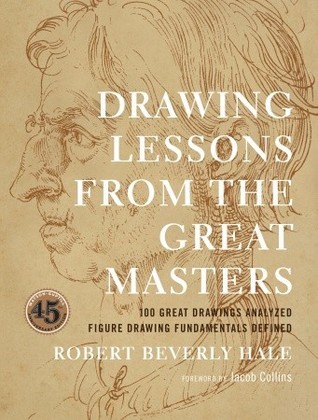
Drawing Lessons from the Great Masters
A book whose sales have not diminished but rather increased dramatically since its publication 45 years ago, this bestselling classic is the ultimate manual of drawing taught by the late Robert Beverly Hale, who’s famed lectures and classes at New York City’s Art Student League captivated artists and art educators from around the world.
Faithfully producing and methodically analyzing 100 master drawings—including works of Michelangelo, Leonardo da Vinci, Rodin, Goya, and Rembrandt among others—Hale shows how these artists tackled basic problems such as line, light and planes, mass, position and thrust, and anatomy. With detailed analytical captions and diagrams, every lesson is clearly delineated and illustrated. Throughout, also, is commentary that sheds light on the creative process of drawing and offers deep insight into the unsurpassed achievements of the masters.
Faithfully producing and methodically analyzing 100 master drawings—including works of Michelangelo, Leonardo da Vinci, Rodin, Goya, and Rembrandt among others—Hale shows how these artists tackled basic problems such as line, light and planes, mass, position and thrust, and anatomy. With detailed analytical captions and diagrams, every lesson is clearly delineated and illustrated. Throughout, also, is commentary that sheds light on the creative process of drawing and offers deep insight into the unsurpassed achievements of the masters.
272 pages, Paperback
First published June 1, 1964
About the author
Robert Beverly Hale
14 books13 followersRobert Beverly Hale (1901–November 14, 1985) was an artist, curator of American paintings at the Metropolitan Museum of Art, and instructor of artistic anatomy at the Art Students League of New York and the Pennsylvania Academy of Fine Art.
https://en.wikipedia.org/wiki/Robert_...
https://en.wikipedia.org/wiki/Robert_...
Ratings & Reviews
Friends & Following
Create a free account to discover what your friends think of this book!
Community Reviews
Displaying 1 - 30 of 47 reviews
October 16, 2019
Please buy some bones. (c) Robert Hale
Or at least rob some graves. (c) Leonardo da Vinci
Or at least rob some graves. (c) Leonardo da Vinci

December 23, 2018
I've always been very interested in art, especially drawing, but never had a chance to take a class in the subject after grade school. My interest was piqued again after my participation in #inktober this year, so a few weeks back, I dusted off this old book.
I actually bought this book years back, about a decade ago or so. It was interesting to see how much easier the text is to understand now that I've completed the training to become a musculoskeletal radiologist than it was when I first attempted to read it ten years ago, back when my understanding of human musculoskeletal anatomy was relatively poor. I see that some earlier Goodreads reviewers have commented on how their enjoyment of this book's drawings was compromised by their dislike for the text, and I think this has to do with the cheeky tone Hale takes, the sort of airy high-handed way he sprinkles anatomy jargon everywhere without adequately explaining it so that readers will marvel at what a hard job he has as an artist and how much study must have been required to achieve his level of expertise. I can see how this tone and approach could be off-putting to some. Still, now that I happen to have some understanding of musculoskeletal anatomy under my belt, I found myself able to follow along and even enjoy it. Your mileage may vary.
To be fair, this book doesn't pretend to teach beginning artists everything they need to know about drawing: in fact, Hale repeatedly and explicitly directs beginners to seek out other resources to round out their knowledge of anatomy, perspective, etc. But he does cover some fundamentals (highlights, shade, planes) at a basic level, driving them home with a healthy amount of repetition and examples. And the choice of examples is impeccable: if you want to learn from the best -- Michelangelo, Leonardo, Durer, Rembrandt -- you can do so here. This is a book to which I can see myself returning time and time again.
I underlined a few passages that I thought had surprising applicability, albeit unintentionally, to the world of creative writing and poetry:
"Beginners always feel that all details are created equal and that it is thoroughly undemocratic to put details in their proper place. But this liberal belief leads to disaster. Of course a drawing must have details. But the student must realize that their impact must be subordinated or intensified at times. And sometimes they are selected, invented, or even eliminated altogether. These procedures require the deepest resources of the artist."
And:
"It is curious that we all cannot draw hands well -- after all, our own hands are constantly in view. This simply proves the point again: we cannot draw anything well unless we have thought about it a great deal. Very often, when I am lecturing on hands, I notice the students carefully examining their own hands as if they were seeing them for the first time. Actually, I suppose the forms we draw are just thoughts with lines around them."
And:
"This drawing was done very quickly. Students always feel that they can make a good drawing if they have enough time. But these marvelously rapid sketches of Rembrandt may teach you that it is not time that makes a good drawing, but understanding."
I actually bought this book years back, about a decade ago or so. It was interesting to see how much easier the text is to understand now that I've completed the training to become a musculoskeletal radiologist than it was when I first attempted to read it ten years ago, back when my understanding of human musculoskeletal anatomy was relatively poor. I see that some earlier Goodreads reviewers have commented on how their enjoyment of this book's drawings was compromised by their dislike for the text, and I think this has to do with the cheeky tone Hale takes, the sort of airy high-handed way he sprinkles anatomy jargon everywhere without adequately explaining it so that readers will marvel at what a hard job he has as an artist and how much study must have been required to achieve his level of expertise. I can see how this tone and approach could be off-putting to some. Still, now that I happen to have some understanding of musculoskeletal anatomy under my belt, I found myself able to follow along and even enjoy it. Your mileage may vary.
"You may wonder whether artists have X-ray eyes; I assure you that is just what all good artists have."
To be fair, this book doesn't pretend to teach beginning artists everything they need to know about drawing: in fact, Hale repeatedly and explicitly directs beginners to seek out other resources to round out their knowledge of anatomy, perspective, etc. But he does cover some fundamentals (highlights, shade, planes) at a basic level, driving them home with a healthy amount of repetition and examples. And the choice of examples is impeccable: if you want to learn from the best -- Michelangelo, Leonardo, Durer, Rembrandt -- you can do so here. This is a book to which I can see myself returning time and time again.
I underlined a few passages that I thought had surprising applicability, albeit unintentionally, to the world of creative writing and poetry:
"Beginners always feel that all details are created equal and that it is thoroughly undemocratic to put details in their proper place. But this liberal belief leads to disaster. Of course a drawing must have details. But the student must realize that their impact must be subordinated or intensified at times. And sometimes they are selected, invented, or even eliminated altogether. These procedures require the deepest resources of the artist."
And:
"It is curious that we all cannot draw hands well -- after all, our own hands are constantly in view. This simply proves the point again: we cannot draw anything well unless we have thought about it a great deal. Very often, when I am lecturing on hands, I notice the students carefully examining their own hands as if they were seeing them for the first time. Actually, I suppose the forms we draw are just thoughts with lines around them."
And:
"This drawing was done very quickly. Students always feel that they can make a good drawing if they have enough time. But these marvelously rapid sketches of Rembrandt may teach you that it is not time that makes a good drawing, but understanding."

November 17, 2009

(More pictures at parkablogs.com)
Drawing Lessons From the Great Masters is an art book that teaches by looking at the art fundamentals used by great art masters themselves — Michelangelo, Leonardo Da Vinci, Rodin, Goya, Rembrandt, among others.
There are 100 master drawings analysed by Robert Beverly Hale on the fundamentals such as line, light and planes, mass, position and thrust, and anatomy. These are all figure drawings. Each illustration is printed full on one page with a certain section selected for analyzing on the next. The commentary is simple and concise, providing great insight to what these artists were thinking. Many of these pieces are really sketches but when you realised the thought put behind every stroke and what the artist was trying to show, you'll instantly be enlightened.
At the end of this book, even if you can't draw yet, you'll be able to identify the difference between a good and bad drawing. And when you draw, you'll remember the principles.
This is a really useful and inspirational reference book, great for beginner to advanced artists.
Robert Beverly Hale has also authored Anatomy Lessons From The Great Masters, which uses the same teaching style here but focusing on anatomy drawings.

February 28, 2018
This is a thorough guide to figure drawing. I found the actual information on anatomy far too technical for the average student, but the book does do a great job getting you to really see light, shadow, and planes. You do, however, also get the impression that Hale was a terrifying teacher: incredibly demanding and arrogant. I can't even count the number of times he says you'll never become a competent draftsman unless you acquire a literal skeleton of human bones, or that you basically need to have a knowledge of anatomy rivaling that of the average MD. It's a good thing Hale has been safely dead for decades, and I can study this book in peace.

July 4, 2014
As a student of art and art history, I was disappointed in how few photographs and drawings the book contained. There were a few illustrations. The title of the book was misleading. I would have like to have seen multiple drawings in color by the masters. As a student it helps to see examples of art principles clearly demonstrated. I feel this book missed the mark. I have read numerous books that did a better job of illustrating the principals in art. Therefore, this book was not that helpful to me.

April 27, 2025
So much of academic drawing teaching is focused on learning how to draw shapes as shapes, rather than things (people’s faces, hands etc) that I really had forgotten – or never realised – that a lot of it IS invented. Hale quite sniffily makes this clear when he points out that Renaissance artists hardly had rearing stallions in their studios. It is quite liberating, and also explains why there’s so few cast shadows about! I have heretofore struggled mightily with the nose cast shadow and now I have permission to edit it at will.
Other gems:
‘If the movement of light and shade clearly indicates that a form faces in a certain direction, then the same tones on another part of the form will give the illusion of facing in the same direction.’
‘[...] the way to bring the front form forward is to intensify the contrast between the planes of the front form.’
‘Remember, highlights should not be violated by darks.’
‘It is a very good thing to visualise heads without noses because noses disturb the front plane.
‘The rule, up plane light, down plane dark, is based on the fact hta light almost always comes from above, as from the sun, skylights, and lamps.’
‘Study tones on white things first. Tones on coloured things confuse a beginner.’
‘Similarly, if he wishes to draw an eye, he will simply run lines over a sphere, and eyelids will appear. The shade on the sphere, of course, will influence the shade on the lids.’
‘Beginners always feel that all details are created equal and that it is thoroughly undemocratic to put details in their proper place. But this liberal belief leads to disaster. Of course a drawing must have details. But the student must realise that their impact must be subordinated or intensified at times. And sometimes they are selected, invented, or even eliminated altogether. These procedures require the deepest resources of the artist.’
‘[Leonardo] shows you that the front of the eyeball, on the side view, may be as far back as the end of the mouth; that the outer corner of the eye may be as far back as the point of the cheekbone.’
‘Shadows cast by the principle light never fall on side planes. Shadows cast by reflected light may fall on side planes, but they are seldom permitted to do so.’
‘The form of the hair is the interior plane of a cylinder, with the direct light causing the highlight. The curl is a cylinder, as curls so often are, with the highlight taking its proper place.’
‘Pretend the foot is on the lawn, and put up a croquet wicket to represent [the tarsus meeting the metatarsals] arch. Then draw a line on the lawn itself, where the distal ends of the metatarsals reach the ground. Then draw lines to represent the movement of the metatarsals. This will give you a nice sense of the dorsum of the foot.’
‘The distance from the pit of the neck to the top of the ensiform cartilage [at the bottom of the sternum], if doubled, will give you the bottom of the ribcage. Since artists have a hard time deciding where the bottom of the ribcage is, this is a convenient bit of information.’
‘The really hard thing about drawing is that you have to think of so many things at once. But this is true of many skills, such as playing a musical instrument, speaking a language, or designing a building. It is evident that we humans are so organised that we can cope with these tasks, provided we take the time and trouble.’
‘Actually, I suppose the forms we draw are just thoughts with lines around them.’
Other gems:
‘If the movement of light and shade clearly indicates that a form faces in a certain direction, then the same tones on another part of the form will give the illusion of facing in the same direction.’
‘[...] the way to bring the front form forward is to intensify the contrast between the planes of the front form.’
‘Remember, highlights should not be violated by darks.’
‘It is a very good thing to visualise heads without noses because noses disturb the front plane.
‘The rule, up plane light, down plane dark, is based on the fact hta light almost always comes from above, as from the sun, skylights, and lamps.’
‘Study tones on white things first. Tones on coloured things confuse a beginner.’
‘Similarly, if he wishes to draw an eye, he will simply run lines over a sphere, and eyelids will appear. The shade on the sphere, of course, will influence the shade on the lids.’
‘Beginners always feel that all details are created equal and that it is thoroughly undemocratic to put details in their proper place. But this liberal belief leads to disaster. Of course a drawing must have details. But the student must realise that their impact must be subordinated or intensified at times. And sometimes they are selected, invented, or even eliminated altogether. These procedures require the deepest resources of the artist.’
‘[Leonardo] shows you that the front of the eyeball, on the side view, may be as far back as the end of the mouth; that the outer corner of the eye may be as far back as the point of the cheekbone.’
‘Shadows cast by the principle light never fall on side planes. Shadows cast by reflected light may fall on side planes, but they are seldom permitted to do so.’
‘The form of the hair is the interior plane of a cylinder, with the direct light causing the highlight. The curl is a cylinder, as curls so often are, with the highlight taking its proper place.’
‘Pretend the foot is on the lawn, and put up a croquet wicket to represent [the tarsus meeting the metatarsals] arch. Then draw a line on the lawn itself, where the distal ends of the metatarsals reach the ground. Then draw lines to represent the movement of the metatarsals. This will give you a nice sense of the dorsum of the foot.’
‘The distance from the pit of the neck to the top of the ensiform cartilage [at the bottom of the sternum], if doubled, will give you the bottom of the ribcage. Since artists have a hard time deciding where the bottom of the ribcage is, this is a convenient bit of information.’
‘The really hard thing about drawing is that you have to think of so many things at once. But this is true of many skills, such as playing a musical instrument, speaking a language, or designing a building. It is evident that we humans are so organised that we can cope with these tasks, provided we take the time and trouble.’
‘Actually, I suppose the forms we draw are just thoughts with lines around them.’
This entire review has been hidden because of spoilers.

April 19, 2021
Within every area of interest there are books that can be considered “essential”. The designation as essential, usually relates to a certain aspect of the topic at hand. Robert Beverly Hale’s classic book, “Drawing Lessons From the Great Masters” is one such book.
The book features 100 drawings by some of the greatest artists from the past, and are analyzed by Hale himself. The format of the book is that the left side of the page will feature a smaller version of the featured piece and then there are paragraphs that go into whatever is being discussed at the moment. Each of the works of art have letters from the alphabet attributed to points of reference and Hale the explains what is happening at each of the “lettered points”. The reader is then able to look of the facing page, where a larger, full page, presentation of the piece is featured, and can then examine the nuances and details that Hale is describing on the preceding page. This format works brilliantly throughout the book and gives the reader the opportunity to take a look at the two pages and walk away with a valuable lesson in a short amount of time. This is not a book that you will want to read “cover to cover” in one sitting, as there is enough instruction in each lesson that you will want to close the book and meditate/savor on the lesson learned and absorb it into your subconscious.
The topics covered are: “Learning to Draw”, “Line”, “Light and Planes”, “Mass”, “Position, Thrust or Direction”, “Artistic Anatomy” and “Driving all the Horses at Once”. At the start of each of the topics, Hale spends a few pages discussing the topic at hand, before moving onto the annotated illustrations. He does a great job of communicating the essential skills and concepts to be further explored.
Besides Hale’s excellent analysis, the book features outstanding works by the likes of Michelangelo, Da Vinci, Raphael, Rembrandt and others!
This is a book that you will return to many times during your lifetime, as the insights provided will reveal more of themselves as you further mature as an artist.
Highly Recommended!
The book features 100 drawings by some of the greatest artists from the past, and are analyzed by Hale himself. The format of the book is that the left side of the page will feature a smaller version of the featured piece and then there are paragraphs that go into whatever is being discussed at the moment. Each of the works of art have letters from the alphabet attributed to points of reference and Hale the explains what is happening at each of the “lettered points”. The reader is then able to look of the facing page, where a larger, full page, presentation of the piece is featured, and can then examine the nuances and details that Hale is describing on the preceding page. This format works brilliantly throughout the book and gives the reader the opportunity to take a look at the two pages and walk away with a valuable lesson in a short amount of time. This is not a book that you will want to read “cover to cover” in one sitting, as there is enough instruction in each lesson that you will want to close the book and meditate/savor on the lesson learned and absorb it into your subconscious.
The topics covered are: “Learning to Draw”, “Line”, “Light and Planes”, “Mass”, “Position, Thrust or Direction”, “Artistic Anatomy” and “Driving all the Horses at Once”. At the start of each of the topics, Hale spends a few pages discussing the topic at hand, before moving onto the annotated illustrations. He does a great job of communicating the essential skills and concepts to be further explored.
Besides Hale’s excellent analysis, the book features outstanding works by the likes of Michelangelo, Da Vinci, Raphael, Rembrandt and others!
This is a book that you will return to many times during your lifetime, as the insights provided will reveal more of themselves as you further mature as an artist.
Highly Recommended!

February 4, 2025
Excellent. Professor Hale was one of the leading art teachers of the last century. This book was like being guided by the man himself. Coupled with his lectures available on YouTube, I learned so much it’s hard to put it all in one review. If I had to say one thing I learned it was how visionary our Old Masters were about the human body. They clearly put a lot of thought in how and where to craft the form. Ovals and squares, but also the contours and curves that make us who we are is something sort of magical (dare I say “divine?”). Not one for religion or God, personally, there is something enchanting about how Hale describes the drawings of Michelangelo, Raphael’s “perfect ovals,” or Cambiaso’s geometric models. That sort of skill is rare for a number of reasons. Not the least of which the sort of work they did no longer requires the intense apprenticeship that it did back then. Now, you can use Photoshop to do the “drawing” for you. But even there you should have an idea just what it is you’re doing. Software will only take you so far. And AI… well, no comment. No here we learn from those who did the work and why they did it at the same time. I consumed every page ravenously!
You’ll almost wish you could go back in time and study with these masters yourself! Since we can’t, we can start by reading Hale’s delightful book and take it from there. You won’t regret it.
You’ll almost wish you could go back in time and study with these masters yourself! Since we can’t, we can start by reading Hale’s delightful book and take it from there. You won’t regret it.

March 19, 2017
Drawing Lessons From the Great Masters has remained in print since the 1960s. Robert Gale came up with an ambitious goal for an art instruction book, using drawing from the old masters to illustrate various lessons about drawing. The book is divided into topics, such as line, mass, anatomy, and after each explanation he shows several examples. And what fine examples they are. I was particularly pleased to see so many drawings by Andrea Del Sarto.
Gale's concept and organization are far better than his actual writing. I found the anatomy section problematic. He uses terms that aren't well explained - or explained at all. I have a pretty good knowledge of bone structure and basic musculature, but I had to resort to google several times. I wondered how a beginner would navigate this section. In spite of this, I found the book useful and would recommend checking it out of the library and doing some of the exercises.
(In the same vein, I recommend The Master Draughtsman Series, which is out of print, but one can still find them on eBay or Amazon. The volumes cover a vast array of artists going from the Rennaisance to the mid-20th century. I especially liked the volumes on Watteau, Ingres, Raphael, and The Hand in Art)
Gale's concept and organization are far better than his actual writing. I found the anatomy section problematic. He uses terms that aren't well explained - or explained at all. I have a pretty good knowledge of bone structure and basic musculature, but I had to resort to google several times. I wondered how a beginner would navigate this section. In spite of this, I found the book useful and would recommend checking it out of the library and doing some of the exercises.
(In the same vein, I recommend The Master Draughtsman Series, which is out of print, but one can still find them on eBay or Amazon. The volumes cover a vast array of artists going from the Rennaisance to the mid-20th century. I especially liked the volumes on Watteau, Ingres, Raphael, and The Hand in Art)

September 22, 2012
This was a very helpful guide on drawing and I learned much about how to approach my own drawing studies. It includes drawings in various stages of finish from a wide variety of Greats such as da Vinci, Durer, Titian, Rembrandt, Degas, and many more. Full page illustrations were each followed with an analysis by Robert Beverly Hale complete with a smaller version of the artwork, labeled for easy reference.
The forward is by Jacob Collins, one of the leading realist artists working today. He founded the Water Street Atelier and Grand Central Academy of Art in New York, where I hope to take some summer workshops at some point.
This book is definitely one to keep.
The forward is by Jacob Collins, one of the leading realist artists working today. He founded the Water Street Atelier and Grand Central Academy of Art in New York, where I hope to take some summer workshops at some point.
This book is definitely one to keep.
July 4, 2023
A VERY INTENSIVE BOOK
The author is very thorough explaing what goes into making great art. A lot of knowledge of anatomy as well as form, perspective and composition are needed. He goes into great detail explaing how great masters of the past created their works of art.This book is not a just look and draw type of book. It is a look, think ,observe and plan before you draw kind of book.
The author is very thorough explaing what goes into making great art. A lot of knowledge of anatomy as well as form, perspective and composition are needed. He goes into great detail explaing how great masters of the past created their works of art.This book is not a just look and draw type of book. It is a look, think ,observe and plan before you draw kind of book.

Read
December 16, 2021向大师学绘画
9.2 (128人评价) [美] 罗伯特•贝弗利•黑尔 / 朱岩 / 上海人民美术出版社 / 2017
如果你想学习精深的素描技法,就应当求教于杰出的画家,譬如米开朗基罗、达·芬奇、波提切利、鲁本斯……当然,这些大师已经不能亲自向我们传授技法
9.2 (128人评价) [美] 罗伯特•贝弗利•黑尔 / 朱岩 / 上海人民美术出版社 / 2017
如果你想学习精深的素描技法,就应当求教于杰出的画家,譬如米开朗基罗、达·芬奇、波提切利、鲁本斯……当然,这些大师已经不能亲自向我们传授技法
This entire review has been hidden because of spoilers.

June 7, 2022
One of the essential books on drawing one can read, I believe. The key is not to work through it at once, but to return to it on different stages of your own development as artist. Otherwise, if you aren't an experienced artist or going to art school at least, your probably gonna be oberwhelmed by this treasure trove of insights, tips and helpful pointers to important details regarding various subjects such as shape, form, shade etc. I especially appreciate him pointing out common mistakes. Of course, the reader has to deal with his frank and direct "no bullshit"-tone. For me it's just the icing of entertainment on the cake of education.
Favorite sentence: "Therefore, the first thing to do is to get a collection of bones. […] I know that bones are expensive and art students are poor; but remember, they will last for a lifetime, and it is possible that you will be giving your lifetime to your art."
Favorite sentence: "Therefore, the first thing to do is to get a collection of bones. […] I know that bones are expensive and art students are poor; but remember, they will last for a lifetime, and it is possible that you will be giving your lifetime to your art."

February 19, 2022
This book has definitely helped me to see references as three dimensional forms composed of simple shapes. This allows me to focus on the direction of light and how the eye interprets the position and thrust of limbs and other features even outside of figure drawing. My only criticisms are that it's a little academic and a little dry. There are many instances of the masters where the rules that are strictly stated in this text are broken or forgotten. In fact, many of the example works displayed here I would not consider to be worthy of the title "mastered anatomy". Micbaelangeo and Raphael are well known for inventing muscles where they do not exist.
Overall, a worth-while read but not for a beginner.
Overall, a worth-while read but not for a beginner.
August 22, 2017
One of my all-time favorite art instruction books. It answers so many questions that I developed while drawing and painting. For example, which artist uses which type of head construction: sphere, box, cylinder, other? I never found another book that acknowledges the choice, let alone shows me how to analyze the drawings of my choice.
This book has a very good treatment of lines and planes in particular. I also love the little gems like page 31 where the author caught da Vinci practicing his shading!
I'm calling it read, but I come back to this book whenever I have a question, so I'll never truly be done. Solidly worth five stars.
This book has a very good treatment of lines and planes in particular. I also love the little gems like page 31 where the author caught da Vinci practicing his shading!
I'm calling it read, but I come back to this book whenever I have a question, so I'll never truly be done. Solidly worth five stars.

May 7, 2021
Study from this and you will get better at figure drawing. The main thing you learn is how past artists tackled subjects such as anatomy and lighting.
I also think your tastes will improve. Your standards for a "good" figure drawing will change for the better I think. These days we might see a lot of crazy dynamic figure drawings in comics and anime etc. This book will teach you that there can be power in subtlety.
I also think your tastes will improve. Your standards for a "good" figure drawing will change for the better I think. These days we might see a lot of crazy dynamic figure drawings in comics and anime etc. This book will teach you that there can be power in subtlety.
June 21, 2017
This book is a little bit advanced.
It guides readers to analyze and appreciated masterpieces from artist and lessons reader why the drawings are good and how to learn.
It introduces concepts such as line, light and planes, mass, position, and directions. All these are extremely useful as a systematic way to understand drawings.
It guides readers to analyze and appreciated masterpieces from artist and lessons reader why the drawings are good and how to learn.
It introduces concepts such as line, light and planes, mass, position, and directions. All these are extremely useful as a systematic way to understand drawings.

Read
February 5, 2021Boa introdução à abordagem conceitual do desenho, focando principalmente nos fundamentos espaciais e anatômicos. Para qualquer artista ou teórico minimamente versado, o livro torna-se apenas uma referência de como apresentar a abordagem à leigos.
Atenta-se ao vocabulário específico para termos e conceitos que foi parcialmente descontinuado na língua inglesa.
Atenta-se ao vocabulário específico para termos e conceitos que foi parcialmente descontinuado na língua inglesa.
October 11, 2022
Instructive. Even the simplest lines don't escape from his notice. Hale is an anatomy instructor and museum curator, as well as the translator of Dr. Paul Richer's legendary 19th century book on anatomy. I'm using this book primarily to understand how to convey accurate anatomical landmarks by using as little lines as possible. Even a short sketch by these masters could convey so much.
October 5, 2018
Excellent ideas and progression of skills and concepts, as well as compelling, canonical drawings, though the author's analysis and detailed examination of each drawing, which often fell on the left page, remained tedious throughout.

July 25, 2021
This is definitely not for the beginning artist. However, for those with a general sense of artistic anatomy, Hale’s discussion of these master works in terms of form, massing, tone, and thrust is truly informative.

December 27, 2025
this book cleared so many misconceptions i had about figure drawing and shading. and it has given me clear direction for practice exercises. the advice given alongside the master drawings were extremely helpful. the author’s voice was clear and engaging, which is how i finished it so quickly

March 1, 2018
A bunch of excellent life drawing tips to keep in mind. Excellent examples.
August 6, 2020
This book contains interesting concepts pointing into the nuances of observation. I can see it changing the way I practice drawing. It is a valuable tool.
January 11, 2022
pretentiös författare, men bra innehåll

August 2, 2023
Very helpful in learning figure drawing with a lot of anatomical examples using Old Masters.

March 21, 2017
it was amazing and very helpful
This entire review has been hidden because of spoilers.

February 5, 2017
Libro magistral sobre la figura humana. Analiza los dibujos y bocetos de maestros tales como Rembrandt, Da Vinci, Degas, Goya, Miguel Ángel, Durero, Cambiaso y Rafael entre otros.
Empieza con la primicia de que todos los grandes maestros utilizaban el cílindro, el cubo, el circulo y el triángulo para poder construir cualquier figura humana. La forma del huevo es la clave para poder hacer la caja torácica.
Todos los artistas tienen que tener un conocimiento minucioso sobre la estructura ósea del cuerpo humano. Inclusive Robert Hale nos dice que nuestro deber como artistas es tratar de conseguir todos los huesos reales del cuerpo humano. Nos propone la idea de ir a un cementerio y hablar con un enterrador para poder obtenerlos. La idea es agarrar los huesos y dibujarlos desde cualquier ángulo y conocerlos con lujo de detalle.
Es un libro para estudiarlo y leerlo cientos de veces. La idea es poder dibujar el cuerpo humano desde cualquier ángulo sin la ayuda de un modelo.
El concepto principal de este libro es pensar antes de dibujar. El dibujo antes que imitación de la realidad es pensamiento.
Empieza con la primicia de que todos los grandes maestros utilizaban el cílindro, el cubo, el circulo y el triángulo para poder construir cualquier figura humana. La forma del huevo es la clave para poder hacer la caja torácica.
Todos los artistas tienen que tener un conocimiento minucioso sobre la estructura ósea del cuerpo humano. Inclusive Robert Hale nos dice que nuestro deber como artistas es tratar de conseguir todos los huesos reales del cuerpo humano. Nos propone la idea de ir a un cementerio y hablar con un enterrador para poder obtenerlos. La idea es agarrar los huesos y dibujarlos desde cualquier ángulo y conocerlos con lujo de detalle.
Es un libro para estudiarlo y leerlo cientos de veces. La idea es poder dibujar el cuerpo humano desde cualquier ángulo sin la ayuda de un modelo.
El concepto principal de este libro es pensar antes de dibujar. El dibujo antes que imitación de la realidad es pensamiento.

October 31, 2012
A very basic primer in drawing based on classical techniques and the work of the great masters, usually the post-Renaissance Italian masters. The material is very basic, going through the primaries of line, form, shade and structures, but the real gold is the simplified analysis of master drawings. An interesting book and worth a look through. Four stars, not five.

May 5, 2014
Initially, this seemed like a basic "how to" drawing book, using solely lines, but Hale continued to develop the nuances of drawing through examination of drawings by masters. Eventually, he looks at all of the facets of a drawing and details what you can learn from the problems that the great artists resolved. A fascinating book.
Displaying 1 - 30 of 47 reviews