

What do you think?
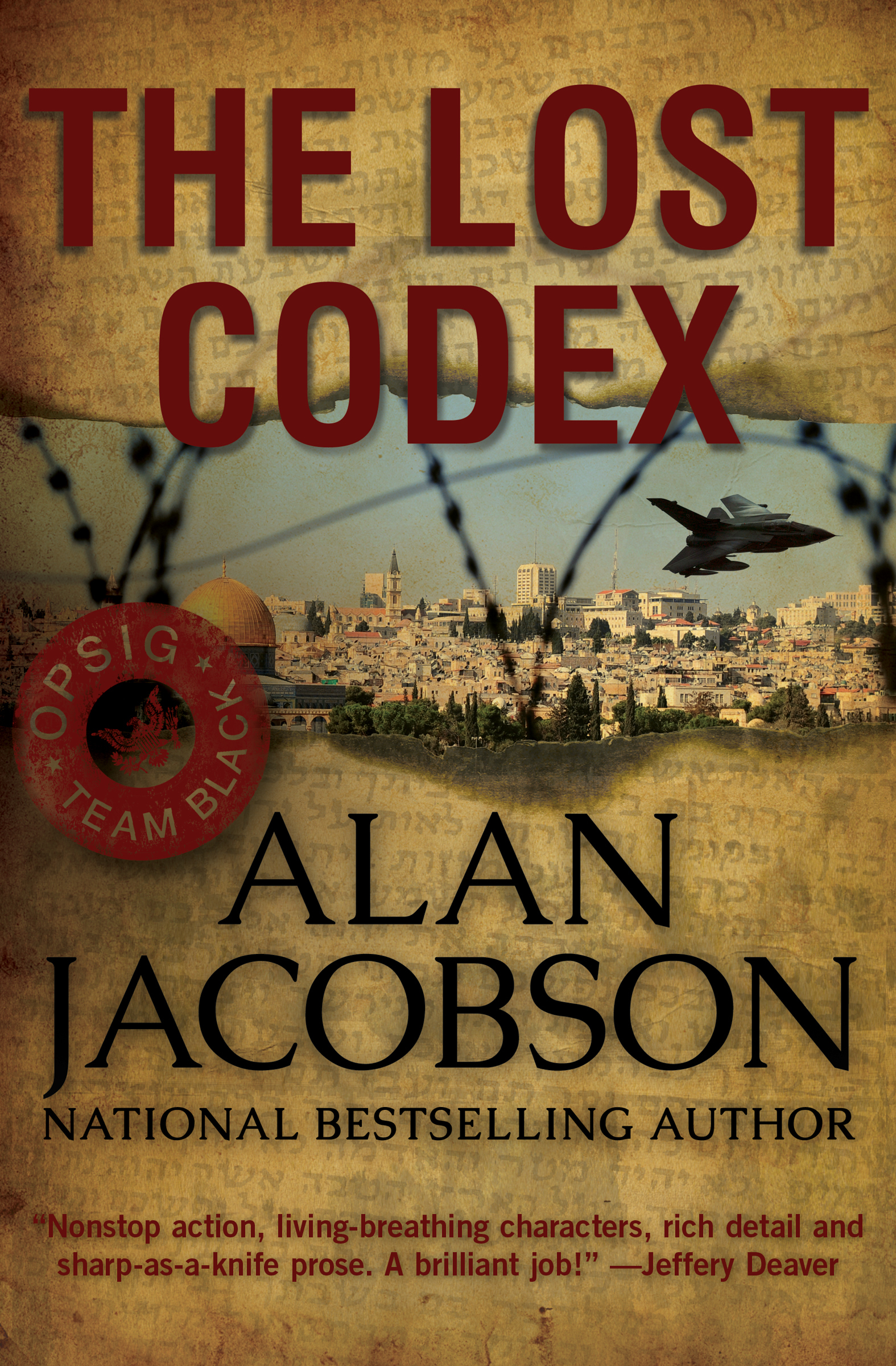
OPSIG Team Black #3
The Lost Codex
In a novel Jeffery Deaver has called “brilliant,” two ancient biblical documents reveal long-buried secrets that could change the world as we know it
In 930 CE, a revered group of scholars pen the first sanctioned Bible, planting the seed from which other major religions will grow. But in 1953, half the manuscript goes missing while being transported from Syria. Around the same time, in the foothills of the Dead Sea, an ancient scroll is discovered—and promptly stolen. Six decades later, both parchments stand at the heart of a geopolitical battle between foreign governments and radical extremists, threatening the lives of millions. With the American homeland under siege, the president turns to a team of uniquely trained covert operatives including FBI profiler Karen Vail, Special Forces veteran Hector DeSantos, and FBI terrorism expert Aaron Uziel. Their mission: Find the stolen documents and capture—or kill—those responsible for unleashing a coordinated and unprecedented attack on US soil. Set in DC, New York, Paris, England, and Israel, The Lost Codex has been called “a masterwork of international suspense” and “an outstanding novel” by Douglas Preston.
In 930 CE, a revered group of scholars pen the first sanctioned Bible, planting the seed from which other major religions will grow. But in 1953, half the manuscript goes missing while being transported from Syria. Around the same time, in the foothills of the Dead Sea, an ancient scroll is discovered—and promptly stolen. Six decades later, both parchments stand at the heart of a geopolitical battle between foreign governments and radical extremists, threatening the lives of millions. With the American homeland under siege, the president turns to a team of uniquely trained covert operatives including FBI profiler Karen Vail, Special Forces veteran Hector DeSantos, and FBI terrorism expert Aaron Uziel. Their mission: Find the stolen documents and capture—or kill—those responsible for unleashing a coordinated and unprecedented attack on US soil. Set in DC, New York, Paris, England, and Israel, The Lost Codex has been called “a masterwork of international suspense” and “an outstanding novel” by Douglas Preston.
428 pages, Paperback
First published November 3, 2015
About the author
Alan Jacobson
36 books334 followersALAN JACOBSON is the USA Today bestselling author of a dozen critically acclaimed, award-winning thrillers. His 20 years of research and training with the FBI’s Behavioral Analysis Unit, DEA, US Marshals Service, ATF, Scotland Yard, SWAT, and the US military bring unparalleled realism to his stories and characters—prompting the San Francisco Chronicle to write that “Alan Jacobson researches his books like a good newspaper reporter and then pushes the envelope into reality more thoroughly than the typical crime novel could ever allow.”
Jacobson's series protagonist, FBI profiler Karen Vail, has resonated with both female and male readers and inspired Nelson DeMille, James Patterson, and Michael Connelly to call Vail one of the most compelling heroes in suspense fiction. Likewise, his OPSIG Team Black series has been lauded by real-life Navy SEALs.
Jacobson’s thrillers have been published internationally and several have been optioned by Hollywood.
Web: www.AlanJacobson.com
Facebook: Facebook.com/AlanJacobsonFans Instagram: alan.jacobson
Twitter: @JacobsonAlan
Jacobson's series protagonist, FBI profiler Karen Vail, has resonated with both female and male readers and inspired Nelson DeMille, James Patterson, and Michael Connelly to call Vail one of the most compelling heroes in suspense fiction. Likewise, his OPSIG Team Black series has been lauded by real-life Navy SEALs.
Jacobson’s thrillers have been published internationally and several have been optioned by Hollywood.
Web: www.AlanJacobson.com
Facebook: Facebook.com/AlanJacobsonFans Instagram: alan.jacobson
Twitter: @JacobsonAlan
Ratings & Reviews
Friends & Following
Create a free account to discover what your friends think of this book!
Community Reviews
Displaying 1 - 30 of 109 reviews

August 9, 2015
A Dead Sea scroll with a stunning secret is discovered. The United States is under attack by terrorists. The OPSIG team has been put together to find the leaders and eliminate the threat. The team is made up of four people with specific training. FBI terrorism expert Uzi whose background was with Israel’s Mossad, and Karen Vail an FBI profiler, and Hector Santos a Special Forces veteran, and Mohammad El-Fahad or Mo, a Palestinian working for the CIA.
This is a Karen Vail novel, but I felt that she was only a minor player in all the action that was taking place.... and there is a LOT of action! The book takes place in multiple countries and not being a traveler, I loved the glimpses I got. The plot is extremely complex, made more so by a few red herrings and an ending that took me by surprise.
This was not my favorite book by the author, but it was engaging. It involves the issues that face, most notably, Israel, and the whole world today. It was so much like real life ... kudos to Mr Jacobson for the realism. And while there was violence throughout the book, I'd rather see Karen Vail hunting down serial killers.
My thanks to NetGalley and Matthew Blackburn, Marketing Coordinator for Open Road Integrated Media for the book to read in exchange for an honest and unbiased review.
This is a Karen Vail novel, but I felt that she was only a minor player in all the action that was taking place.... and there is a LOT of action! The book takes place in multiple countries and not being a traveler, I loved the glimpses I got. The plot is extremely complex, made more so by a few red herrings and an ending that took me by surprise.
This was not my favorite book by the author, but it was engaging. It involves the issues that face, most notably, Israel, and the whole world today. It was so much like real life ... kudos to Mr Jacobson for the realism. And while there was violence throughout the book, I'd rather see Karen Vail hunting down serial killers.
My thanks to NetGalley and Matthew Blackburn, Marketing Coordinator for Open Road Integrated Media for the book to read in exchange for an honest and unbiased review.

August 29, 2015
I won't bother repeating the synopsis here, as it has been well covered by others. I was excited to read this book - I love history - I really enjoyed Dan Brown's books...so I thought this one would suit me to a T. ... Well, not exactly.
Alan Jacobson's new novel, "The Lost Codex" has all the elements of a great book...unfortunately, the way those individual elements are put together fall short. FBI Profiler Karen Vail has been the star of previous books, here - she plays such a minor role, that had she been left out entirely it wouldn't make a difference in the story. It would however, have eliminated her immature dialogue and that would be a plus. This is a serious novel, dealing with heavy subject matter and too often Vail's voice sounds more like a teenager. The action sequences (and there's a lot of them) are powerful and Jacobson does a good job of explaining the complexities of the terror network. understood. When shooting stopped, the good/bad and more importantly - the why was crystal clear.
But the biggest disappointment is the codex. I know there's only one DaVinci Code, and that's great - I didn't expect (nor want) a repeat. I did expect the codex to be the main part of the story and it isn't. Calling it a subplot stretches the definition. There's just enough information scattered throughout to cause me to keep reading, thinking "okay, now we are getting to the good stuff." Sadly...we never did.
This isn't a bad book. There are several great ideas - had they been sewn tightly together this would have been the kind of book you read again and talk about a lot...instead it's an okay book, you read once and quickly forget.
Happy Reading!
RJ
Alan Jacobson's new novel, "The Lost Codex" has all the elements of a great book...unfortunately, the way those individual elements are put together fall short. FBI Profiler Karen Vail has been the star of previous books, here - she plays such a minor role, that had she been left out entirely it wouldn't make a difference in the story. It would however, have eliminated her immature dialogue and that would be a plus. This is a serious novel, dealing with heavy subject matter and too often Vail's voice sounds more like a teenager. The action sequences (and there's a lot of them) are powerful and Jacobson does a good job of explaining the complexities of the terror network. understood. When shooting stopped, the good/bad and more importantly - the why was crystal clear.
But the biggest disappointment is the codex. I know there's only one DaVinci Code, and that's great - I didn't expect (nor want) a repeat. I did expect the codex to be the main part of the story and it isn't. Calling it a subplot stretches the definition. There's just enough information scattered throughout to cause me to keep reading, thinking "okay, now we are getting to the good stuff." Sadly...we never did.
This isn't a bad book. There are several great ideas - had they been sewn tightly together this would have been the kind of book you read again and talk about a lot...instead it's an okay book, you read once and quickly forget.
Happy Reading!
RJ

March 21, 2019
Another grand slam from author Alan Jacobson. The team of Karen Vail-Aaron Uziel-Hector DeSantos save the world from Islamist terrorists. Great characters. Book reads extremely quickly as the chapters fly by. Five stars. Check it out. !

June 5, 2018
Escalating terrorist attacks in the US lead to the deployment of a covert special ops group. Their mission is to find ancient documents (the lost codex referred to in the title) that will shake Christianity to its core and stop a terrorist plot to place the entire western world under Sharia law.
The story is fast-paced and the plot is intriguing. Unfortunately, all the racism and misogyny made me feel uncomfortable for the whole book.
The one female member of the special ops group is constantly afraid. The fear is understandable, given the situations she is in. My problem is that none of the male members of the group ever express fear. Furthermore, she's also the object of unwanted sexual desire from one of the other group members and this behaviour seems to be perfectly acceptable. Not only do none of the other men object (thanks for that, guys), but the woman herself never does. She doesn't even express any kind of distaste, or even let on that she notices.
The whole Muslims=terrorists thing really put me off. I know that Islamic extremism is a threat we all need to take seriously. I also know that less than a tenth of one percent of Muslims belong to violent extremist organizations. The central idea of the novel, that Muslims are readying to take over the world and place everybody under Sharia law, is painfully reminiscent of theories that the Jews are running a secret cabal with the aim of infiltrating world governments. I kept thinking that, if I kept reading, I'd get to the part where stereotypes about Muslims are challenged and the reader sees a more nuanced view, but alas: it isn't there. At one point, the token Muslim character and the token Jewish character do have a discussion about how their two peoples need to work together, but it's more about portraying Mo as the "good" Muslim.
Even without the abovementioned issues, the book still falls short of expectations. The title of the book, and the description, leads one to believe the recovery of the lost codex is central to the plot, but it's really only tangential. It's more of a politico-thriller instead and is almost completely missing the historical essence I was expecting (and wanting).
Also, there is a great deal of reference to something that happened in London at some point before the story starts. I realize this book is part of a series, but since I haven't read any of the previous books, I have no idea what happened previously and there isn't enough of an explanation to fill me in. I felt like I was missing something important.
I can't recommend this one. Only my distaste of putting a book away without finishing it kept me going.
The story is fast-paced and the plot is intriguing. Unfortunately, all the racism and misogyny made me feel uncomfortable for the whole book.
The one female member of the special ops group is constantly afraid. The fear is understandable, given the situations she is in. My problem is that none of the male members of the group ever express fear. Furthermore, she's also the object of unwanted sexual desire from one of the other group members and this behaviour seems to be perfectly acceptable. Not only do none of the other men object (thanks for that, guys), but the woman herself never does. She doesn't even express any kind of distaste, or even let on that she notices.
The whole Muslims=terrorists thing really put me off. I know that Islamic extremism is a threat we all need to take seriously. I also know that less than a tenth of one percent of Muslims belong to violent extremist organizations. The central idea of the novel, that Muslims are readying to take over the world and place everybody under Sharia law, is painfully reminiscent of theories that the Jews are running a secret cabal with the aim of infiltrating world governments. I kept thinking that, if I kept reading, I'd get to the part where stereotypes about Muslims are challenged and the reader sees a more nuanced view, but alas: it isn't there. At one point, the token Muslim character and the token Jewish character do have a discussion about how their two peoples need to work together, but it's more about portraying Mo as the "good" Muslim.
Even without the abovementioned issues, the book still falls short of expectations. The title of the book, and the description, leads one to believe the recovery of the lost codex is central to the plot, but it's really only tangential. It's more of a politico-thriller instead and is almost completely missing the historical essence I was expecting (and wanting).
Also, there is a great deal of reference to something that happened in London at some point before the story starts. I realize this book is part of a series, but since I haven't read any of the previous books, I have no idea what happened previously and there isn't enough of an explanation to fill me in. I felt like I was missing something important.
I can't recommend this one. Only my distaste of putting a book away without finishing it kept me going.

October 28, 2015
The phenomenon of suicide bombers comes up a lot in this story, and although there’s a bit of an infodump here, I found it fascinating enough to not mind it. There’s plenty going on in the US, but our heroes end up chasing the codex through a handful of other countries and regions. It was a bit head-spinning; I’m sure it was done for the realism of it, but I admit I got a little lost for a bit trying to remember which country they were in and what they were chasing there.
Most of my knowledge of the Israeli/Palestinian conflict comes from the internet (I have friends who feel exceedingly strongly about each side of the issue, so often the bits I 'know' conflict, just to make things more confusing). Anyway, I mostly bring this up because I am utterly unable to render any kind of judgment on how accurately the book handles that conflict. I love how it gets into the Aleppo Codex, though; it really is fascinating, and it’s neat to see how it could affect things very differently depending on who gets their hands on it. I also think it’s great that there’s plenty of conflict going on–and a lot of danger–that’s not directly about the Codex.
Karen herself gets into some awfully sticky situations, as do her co-workers. Life and death situations come up repeatedly, and Karen has to do things she’s never dealt with before. It makes her a great point-of-view character through which to experience this.
This may not be the best thriller I’ve ever read, but I did enjoy it and would be willing to read more from the author.
NOTE: Book provided free for review by publisher
For longer review including premise, visit my site: http://www.errantdreams.com/2015/10/r...
Most of my knowledge of the Israeli/Palestinian conflict comes from the internet (I have friends who feel exceedingly strongly about each side of the issue, so often the bits I 'know' conflict, just to make things more confusing). Anyway, I mostly bring this up because I am utterly unable to render any kind of judgment on how accurately the book handles that conflict. I love how it gets into the Aleppo Codex, though; it really is fascinating, and it’s neat to see how it could affect things very differently depending on who gets their hands on it. I also think it’s great that there’s plenty of conflict going on–and a lot of danger–that’s not directly about the Codex.
Karen herself gets into some awfully sticky situations, as do her co-workers. Life and death situations come up repeatedly, and Karen has to do things she’s never dealt with before. It makes her a great point-of-view character through which to experience this.
This may not be the best thriller I’ve ever read, but I did enjoy it and would be willing to read more from the author.
NOTE: Book provided free for review by publisher
For longer review including premise, visit my site: http://www.errantdreams.com/2015/10/r...

September 9, 2015
An Action-Packed Thriller with a Historical Mystery
Karen Vail and her fiancé, Robbie Hernandez, are enjoying a quiet date. Hearing two gunshots, they rush into the street where they stumble across the body of an FBI agent. Karen sees the perp running away, shoots, hits him and causes a major explosion. This incident pulls Karen into an undercover assignment linked to terrorists trying to take over the United States and Europe.
The historical link is the Codex, an ancient scroll that could change the history of Judaism and Christianity. The terrorists want the scroll, but so does the US Government. Looking for the scroll and trying to root out the terrorists take Karen and her team from the US to Europe and to the Near East.
The book is a fast, paced-action thriller. The action sequences are very well done and there are many of them. However, some parts of the novel are disappointing. Karen Vail, the FBI Profiler who has been featured in some of Jacobson's previous novels, is not as forceful as usual. Some of her internal monologues are simplistic and detract from her mission.
I was also disappointed in the role given the Codex. I love historical mysteries and looked forward to this one, but the Codex turned out to be a subplot. We get glimpses of it from time to time, but it plays a minor role in the action.
The part I most enjoyed was Jacobson's discussions of terrorism. It's worth reading the book to become involved in how terrorist networks perform in western countries. The book was enjoyable, but I wish the balance between the historical mystery and the present day terrorist activities had been more equal.
I reviewed this book for Net Galley.
Karen Vail and her fiancé, Robbie Hernandez, are enjoying a quiet date. Hearing two gunshots, they rush into the street where they stumble across the body of an FBI agent. Karen sees the perp running away, shoots, hits him and causes a major explosion. This incident pulls Karen into an undercover assignment linked to terrorists trying to take over the United States and Europe.
The historical link is the Codex, an ancient scroll that could change the history of Judaism and Christianity. The terrorists want the scroll, but so does the US Government. Looking for the scroll and trying to root out the terrorists take Karen and her team from the US to Europe and to the Near East.
The book is a fast, paced-action thriller. The action sequences are very well done and there are many of them. However, some parts of the novel are disappointing. Karen Vail, the FBI Profiler who has been featured in some of Jacobson's previous novels, is not as forceful as usual. Some of her internal monologues are simplistic and detract from her mission.
I was also disappointed in the role given the Codex. I love historical mysteries and looked forward to this one, but the Codex turned out to be a subplot. We get glimpses of it from time to time, but it plays a minor role in the action.
The part I most enjoyed was Jacobson's discussions of terrorism. It's worth reading the book to become involved in how terrorist networks perform in western countries. The book was enjoyable, but I wish the balance between the historical mystery and the present day terrorist activities had been more equal.
I reviewed this book for Net Galley.

November 11, 2015
The Lost Codex is the third novel in Alan Jacobson's OPSIG series. I had not read any of the previous OPSIG novels but I found it easy to pick this one up without reading the previous ones. I have read most of Jacobson's series with FBI agent Karen Vail.
The book begins in the Middle East with a backstory about missing sea scrolls that could have a lasting impact on religion. The story jumps to the present day in Washington DC. Karen Vail was having dinner with her fiancé when they heard gunshots and rush to the scene. Unknowingly, Karen has now involved herself into a scenario where she will become involved in a terrorist threat. She is added to a team of specialists from different government agencies that are trying to unravel a plan to unleash suicide bombers on Washington DC.
The action takes off quickly with the team following leads on the bombers and the terrorist targets. The evidence leads them to realize that the motives of the terrorists are connected to the missing sea scrolls. The OPSIG team travels the world to find the scrolls that could have a permanent impact on the course of religion. It is a fast paced novel with a lot of action. If you like political action/thrillers I think you would enjoy this one. It was not one of my favorites but it was an enjoyable read.
I enjoyed the book but I think I prefer the Karen Vail series over OPSIG (even though Karen Vail was in this one).
I received a free copy of this book from NetGalley in exchange for an honest review.
The book begins in the Middle East with a backstory about missing sea scrolls that could have a lasting impact on religion. The story jumps to the present day in Washington DC. Karen Vail was having dinner with her fiancé when they heard gunshots and rush to the scene. Unknowingly, Karen has now involved herself into a scenario where she will become involved in a terrorist threat. She is added to a team of specialists from different government agencies that are trying to unravel a plan to unleash suicide bombers on Washington DC.
The action takes off quickly with the team following leads on the bombers and the terrorist targets. The evidence leads them to realize that the motives of the terrorists are connected to the missing sea scrolls. The OPSIG team travels the world to find the scrolls that could have a permanent impact on the course of religion. It is a fast paced novel with a lot of action. If you like political action/thrillers I think you would enjoy this one. It was not one of my favorites but it was an enjoyable read.
I enjoyed the book but I think I prefer the Karen Vail series over OPSIG (even though Karen Vail was in this one).
I received a free copy of this book from NetGalley in exchange for an honest review.

September 17, 2015
A look at the state of modern day terrorism and supposing that behind it may be the existence of a Codex that included missing sections of the Bible. This lost text would have deadly impact on the present day struggle between radical extremists and the rest of the world.
Standing in the way of this is the OPSIG Team created by author Alan Jacobson: FBI Profiler Karen Vail, Special Forces vet Hector DeSantos and FBI Terrorism expert Aaron Uziel. The novel is packed with tension and slow boiling conspiracy theories as the OPSIG team and their other members traverse the globe to keep another deadly terrorist attack from taking place.
Interesting and well-researched but a little slow in getting to the heart of the matter. It's nearly 1/3 of the way into the novel until the idea of the Lost Codex is truly introduced.
Standing in the way of this is the OPSIG Team created by author Alan Jacobson: FBI Profiler Karen Vail, Special Forces vet Hector DeSantos and FBI Terrorism expert Aaron Uziel. The novel is packed with tension and slow boiling conspiracy theories as the OPSIG team and their other members traverse the globe to keep another deadly terrorist attack from taking place.
Interesting and well-researched but a little slow in getting to the heart of the matter. It's nearly 1/3 of the way into the novel until the idea of the Lost Codex is truly introduced.

December 27, 2016
In general, it was well written. It dragged quite a bit. It took until 13rd through before the critical focus came into play. It seems that much of it was fairly well researched. However, I found his paternalistic treatment of religion, and Christianity in particular, troubling and offensive. There was, in my thinking, a combining of good and poor scholarship without distinction.
Very few religion scholars today believe that Jesus did not exist. There is significant disagreement about the meaning of his existence and his identity, but far too much collaborative evidence to think he was not an historical person. Yet this is what Jacobson presents as scholarly opinion. It's pretty parallel to climate change deniers. This as my primary objection to the book and why I rated it a "2" instead of a "3".
Very few religion scholars today believe that Jesus did not exist. There is significant disagreement about the meaning of his existence and his identity, but far too much collaborative evidence to think he was not an historical person. Yet this is what Jacobson presents as scholarly opinion. It's pretty parallel to climate change deniers. This as my primary objection to the book and why I rated it a "2" instead of a "3".

November 17, 2015
(I received a copy from NetGalley in exchange for my honest review)
This is the first book I've read by Alan Jacobson and I'm glad I had the chance to pick this up.
The story is action-packed with interlaces from the past.
Karen Vail is an FBI profiler and she was pulled in to help investigate a series of suicide bombings attacks. There's more than meets the eye when Karen alongside her team mates discover the Aleppo Codex and the Dead Sea Scrolls and how they relate to the terrorist attacks of the modern times.
I've thoroughly enjoyed reading The Lost Codex and there never was any dull moment. Highly recommended!
This is the first book I've read by Alan Jacobson and I'm glad I had the chance to pick this up.
The story is action-packed with interlaces from the past.
Karen Vail is an FBI profiler and she was pulled in to help investigate a series of suicide bombings attacks. There's more than meets the eye when Karen alongside her team mates discover the Aleppo Codex and the Dead Sea Scrolls and how they relate to the terrorist attacks of the modern times.
I've thoroughly enjoyed reading The Lost Codex and there never was any dull moment. Highly recommended!

August 10, 2015
Received a free copy from NetGalley.
It sounded great, an terrorist plot and old book, but it just never grabbed me. I had a hard time believing so many government groups would work together. It jumped from team to team after each short chapter breaking up the flow of the story. I never related to any of the characters. I always felt like there was more going on in the background that they would get around to telling us about, but didn't. And I either didn't read the book in the series about London or don't remember it, and I got tired of reading "back in London".
It sounded great, an terrorist plot and old book, but it just never grabbed me. I had a hard time believing so many government groups would work together. It jumped from team to team after each short chapter breaking up the flow of the story. I never related to any of the characters. I always felt like there was more going on in the background that they would get around to telling us about, but didn't. And I either didn't read the book in the series about London or don't remember it, and I got tired of reading "back in London".

March 27, 2019
The author of ten thrillers, including six featuring a female FBI agent who also appears in this, the third of his OPSIG (Operations Support Intelligence Group) novels, Alan Jacobson brings to readers a depth of knowledge of the organizations and procedures that prevail in today’s technology driven world of international espionage. The result is a fast-paced story which takes the reader from Washington, D.C. to New York, London, Paris, and finally Israel all in search of the leaders of a terrorist cabal with seeming unstoppable ability to cause death and mayhem in order undermine public confidence and advance their jihadist aims.
The team charged with tracking down and eliminating the terrorists includes FBI profiler Karen Vail, the heroine of her own Jacobon series, Hector Santos, a kick-ass special ops expert, Aaron Uziel, a refugee from Israeli intelligence, and Mahmoud El-Fahad, a Palestinian by birth and the representative of the CIA. That combination invites potential conflict and distrust, especially between Uziel and El-Fahad, which Jacobson exploits to the very end. Having four main characters demonstrates the author’s story-telling talent as he interweaves each agent’s role in moving towards their goal as they track down and eliminate members of the cabal.
While each of the four plays their part, Jacobson assigns Vail the central tasks assigning her with the key insights and strategies they need to employ at crucial moments to find and take down their enemies. Jacobson tells us Vail’s thoughts throughout allowing us to see her view of the world and of the task the FBI has assigned her as she goes from one near-death conflict to another.
The Lost Codex provides readers not just with a window into how real-world terrorists are tracked and removed, but adds real-world international politics. Central to the story’s outcome is the import of not just eliminating the terrorists who have already killed hundreds, but also recapturing documents that in the wrong hands could become tools to wreck American-led Israeli-Palestinian negotiations.
While the past never slows down, my reading of The Lost Codex was interrupted more than once by the book’s author and editor to fail to identify the speaker in a multi-person conversation. I also thought the central role of the “lost codex” needed to be introduced earlier in the story. That said, I’m ready for another Jacobson thriller.
The team charged with tracking down and eliminating the terrorists includes FBI profiler Karen Vail, the heroine of her own Jacobon series, Hector Santos, a kick-ass special ops expert, Aaron Uziel, a refugee from Israeli intelligence, and Mahmoud El-Fahad, a Palestinian by birth and the representative of the CIA. That combination invites potential conflict and distrust, especially between Uziel and El-Fahad, which Jacobson exploits to the very end. Having four main characters demonstrates the author’s story-telling talent as he interweaves each agent’s role in moving towards their goal as they track down and eliminate members of the cabal.
While each of the four plays their part, Jacobson assigns Vail the central tasks assigning her with the key insights and strategies they need to employ at crucial moments to find and take down their enemies. Jacobson tells us Vail’s thoughts throughout allowing us to see her view of the world and of the task the FBI has assigned her as she goes from one near-death conflict to another.
The Lost Codex provides readers not just with a window into how real-world terrorists are tracked and removed, but adds real-world international politics. Central to the story’s outcome is the import of not just eliminating the terrorists who have already killed hundreds, but also recapturing documents that in the wrong hands could become tools to wreck American-led Israeli-Palestinian negotiations.
While the past never slows down, my reading of The Lost Codex was interrupted more than once by the book’s author and editor to fail to identify the speaker in a multi-person conversation. I also thought the central role of the “lost codex” needed to be introduced earlier in the story. That said, I’m ready for another Jacobson thriller.
July 4, 2018
This book completely lost me on details (spoilers below!)
1) Most annoying was putting thoughts of Karen Veil in italics; there is nothing special in them, mostly attempts on ironic comments in her head on what people around her are saying. But she is not the main protagonist, so why put any special meaning to her private thoughts?
2) OPSIG and FBI can and should operate only in US, instead they run deniable operation in UK, France, Israel, Gaza, etc. CIA only has an undercover agent in the group.
3) Karen is a profiler, right. No special training which she readily admits. But she chases (in her 40's she has a son who is a student) and outruns young terrorist who is running for his life; she battles with a tough Arab twice her size and makes a bloody mess of him
4) While chasing the terrorist she sends four text messages on her phone and receives two (if my memory serves me right); covert agents of OPSIG have to rely on cell phones, no other means of encrypted comm; the most ridiculous moment is when deSantos sends her a text message with (can you believe it?) countdown: "ten... nine..." to sync, expecting her on zero to rush through the door of a bunker and take part in the battle there. Is there a range? What is the text message delivery delay? What is the interval (in seconds) between 'ten', 'nine', eight...? Who cares?
5) For God's sake, the OPSIG agent have fake EU passports and they escape UK thanks to a military plane for which no rules of border crossing apply
6) They don't even have fire suppressors on their guns!
7) Fingerprints are sent by phone!
8) By some impossible feat termoimaging (in infrared) is done on a underground bunker supposed to withstand missile attack and bodies of moving men inside are shown on screen in real time
9) Aaron Uziel's (one of the OPSIG group) father conveniently turns out to be (of all seven billion people on Earth) the archaeologist who translated the most important document which the group has to find and recover.
I could go on and on but this book defies all logic.
1) Most annoying was putting thoughts of Karen Veil in italics; there is nothing special in them, mostly attempts on ironic comments in her head on what people around her are saying. But she is not the main protagonist, so why put any special meaning to her private thoughts?
2) OPSIG and FBI can and should operate only in US, instead they run deniable operation in UK, France, Israel, Gaza, etc. CIA only has an undercover agent in the group.
3) Karen is a profiler, right. No special training which she readily admits. But she chases (in her 40's she has a son who is a student) and outruns young terrorist who is running for his life; she battles with a tough Arab twice her size and makes a bloody mess of him
4) While chasing the terrorist she sends four text messages on her phone and receives two (if my memory serves me right); covert agents of OPSIG have to rely on cell phones, no other means of encrypted comm; the most ridiculous moment is when deSantos sends her a text message with (can you believe it?) countdown: "ten... nine..." to sync, expecting her on zero to rush through the door of a bunker and take part in the battle there. Is there a range? What is the text message delivery delay? What is the interval (in seconds) between 'ten', 'nine', eight...? Who cares?
5) For God's sake, the OPSIG agent have fake EU passports and they escape UK thanks to a military plane for which no rules of border crossing apply
6) They don't even have fire suppressors on their guns!
7) Fingerprints are sent by phone!
8) By some impossible feat termoimaging (in infrared) is done on a underground bunker supposed to withstand missile attack and bodies of moving men inside are shown on screen in real time
9) Aaron Uziel's (one of the OPSIG group) father conveniently turns out to be (of all seven billion people on Earth) the archaeologist who translated the most important document which the group has to find and recover.
I could go on and on but this book defies all logic.

April 14, 2018
A big book And exciting. The story covers several countries, the us, London, Uk, France and Israel. For authenticity I trAcked the places named in London and discovered location to be correct so I assume it was the same with the other countries. Now to the gist of the book. A missing Dead Sea scroll is discovered and everyone wants to have it and is willing to kill. There was quite a bit of propaganda for each of the sides and history if you were pro Arab, Jew or Christian. But in my mind, no side has a right to anything and unfortunately there will never be peace in the Middle East because the hatred is long and deep and they will always distrust the other. Interesting that the author inserted both a Jew and an Arab into the mix of good guys just to keep the plot stirred up a bit. I did learn that in this post 9 11 world even the good guys have a hard time evading cameras, biometrics and police who are just trying to do their jobs. Hats off to the plods in this world for trying to keep us all safe.

September 14, 2020
This is a novel that operates on a umber of levels. The religious element is almost incidental to a more conventional black ops/ anti terrorist plot. All pretty standard stuff with the good guys racing to save the world from the bad Islamic guys. Action all the way, and a thrilling chase across several countries.
The interplay between the three core members of the team is interesting. They've worked together before, with details of past missions dropped in here and there, and exhibit the shorthand that a team can use. This becomes very interesting when a Palestinian born CIA operative is added to the mix - but should they trust him?
The novel is marred by an incredibly one sided view of middle east politics that permeates the action. Israel is apparently the greatest, most benign and fairest country in the world, and all Palestinians are terrorists. There is no subtlety or nuance here, and this backdrop comes close to spoiling a decent read.
The interplay between the three core members of the team is interesting. They've worked together before, with details of past missions dropped in here and there, and exhibit the shorthand that a team can use. This becomes very interesting when a Palestinian born CIA operative is added to the mix - but should they trust him?
The novel is marred by an incredibly one sided view of middle east politics that permeates the action. Israel is apparently the greatest, most benign and fairest country in the world, and all Palestinians are terrorists. There is no subtlety or nuance here, and this backdrop comes close to spoiling a decent read.
Read
December 17, 2019The book is a solid 4 but doesn’t reach a level of 5 (must read) due to it lacking the ability to command my interest. Good characters, a decent plot but a couple of the major points of conflict were solved in a couple of paragraph near the end of the book. It took me longer than normal to read this book due to travel schedule and I wasn’t compelled to stay up late or get up early to read. The good part was that the plot and character development are good enough to ensure memory without having to reread over and over again. I’m sure my schedule interferes with the books ability to be contagious but I have read books that wouldn’t allow this lack of attention.

June 7, 2023
Got this book through Prime Reading. Good story - edgy and fast-paced action, but the writing style wasn’t great. The author assumed too much ignorance from readers if this genre, having to explain simple terms used by government agencies - like HUMINT and OPSIG - in a patronizing way. If you read this genre, you know! I also didn’t like the italicized brain-thoughts of Karen’s character. There would be dialog, and then her thoughts would appear in these italics - often snarky comments like she was back talking or sassing on her head. I think the author was trying to offer additional scenarios, but to me it would have been better written into his narrative. I found it annoying.
July 22, 2026
Stumbled onto this series when my library switched to new online (Libby) service and I was looking for books to read during the transition and saw the first Alan Jacobson OPSIG book and now I'm hooked. Last Codex may be best so far in the series with Uzi, Karen Vail and Santa chasing ancient Jewish documents across Europe against the backdrop of a potentially catastrophic series of terrorists events in US, London and France. Action is pretty non-stop with a complex new character, Fahad, a Palestinian CIA operative with a shady past challenging the new team dynamics. Complex religious and political questions keep you engaged. Well worth the read.

July 12, 2019
I really enjoyed this spy/counterterrorism drama. It was fast paced, had lots of believable characters, and a satisfying resolution. I'll definitely be sure to check out some of the author's other books. It looks like he writes two series that occasionally converge, like in this one. Despite this be mid-series for both, I didn't feel lost or like I was missing backstory. The book stands on its own, although there are tantilizing hints to past books that I want to check out.
July 22, 2020
Great topic, but far too much blood and guts for my taste. Not to mention the lead characters are so easily picked out of a crowd that they must be wearing colorful "Hey, it's me!" clothing instead of blending in.
And hey, if you are trying to be inconspicuous order food from a street vendor and then take off running before you get the food. No way anyone will notice you that way!
And hey, if you are trying to be inconspicuous order food from a street vendor and then take off running before you get the food. No way anyone will notice you that way!
This entire review has been hidden because of spoilers.
September 4, 2020
Excellent novel, great plot with tons of twists and turns. Definitely an adventure that keeps going and changing directions. The characters are deep and will developed as is the whole terrorist senario that is way to believable, enough to give you nightmares. This stood on it's own, I didn't read the first 2 books in this series.
September 14, 2020
Two Dimensional
The characters are two dimensional, paper thin, and the dialogue unbearable. However, most repugnant was the underlying anti-Arab slant. I have no problem with the “bad guys” being anything, ethnically, but nuance -to make it real- is always needed. It reminded me of the 1980s anti-Japanese crime books.
The characters are two dimensional, paper thin, and the dialogue unbearable. However, most repugnant was the underlying anti-Arab slant. I have no problem with the “bad guys” being anything, ethnically, but nuance -to make it real- is always needed. It reminded me of the 1980s anti-Japanese crime books.

April 30, 2019
Heartpounding Action!
Whew! I think I held my breath through at least half of this book! Loved the spycraft, the suspense, and the story. This was my first Alan Jacobson read. Certainly won't be my last!
Whew! I think I held my breath through at least half of this book! Loved the spycraft, the suspense, and the story. This was my first Alan Jacobson read. Certainly won't be my last!

October 17, 2019
I wanted this to be a book about a lost or newly found Dead Sea Scroll. While said scroll was, indeed, part of the plot, this was a complex thriller with characters that had been introduced in earlier novels. As such, I was seeking a different kind of book than the one I picked up.

November 20, 2019
I had a hard time maintaining interest since I hadn't read the others in the series. A lot of interpersonal relationships I was unaware of were aluded to and made it difficult to follow. The plot is engaging if you have a knowledge of the characters.

November 21, 2020
I have a love- hate vibe with Mr Jacobson’s works. This one I loved. Kindle version at 466 pages. A good 400 of those pages were action packed. Also some Paris & Jerusalem touristy info. Highly recommended
November 9, 2021
Very twisted tale and intriguing. Books by this author take me a little longer to read than some authors, I find myself reading short passages to make sure I haven't missed something. Definitely recommned.
February 9, 2022
Fabulous!
Just like the first & second of the series. Kind of deep into the intricacies of our government, the UK and Middle East. Found it fascinating and will definitely read Book 4!
Just like the first & second of the series. Kind of deep into the intricacies of our government, the UK and Middle East. Found it fascinating and will definitely read Book 4!

June 8, 2022
This is an advance copy that I’ve had on my shelf for a while. Jacobson is quite a storyteller. The story is a mix of ancient history and modern tourism which makes for an interesting combination. The characters are real and he kept me reading.
Read
July 10, 2023Really bad - I gave up after reading about 50%. I kept hoping the plot might improve, but both the narrator and the author must have spent all their creative juices somewhere between Saturday morning Loony Tunes, the Godfather and ancient wild west tales geared to 10-year-old boys. 0 ⭐️’s
Displaying 1 - 30 of 109 reviews