Francis Scott Key Fitzgerald, widely known simply as Scott Fitzgerald, was an American novelist, essayist, and short story writer. He is best known for his novels depicting the flamboyance and excess of the Jazz Age, a term he popularized in his short story collection Tales of the Jazz Age. During his lifetime, he published four novels, four story collections, and 164 short stories. Although he achieved temporary popular success and fortune in the 1920s, Fitzgerald received critical acclaim only after his death and is now widely regarded as one of the greatest American writers of the 20th century. Born into a middle-class family in Saint Paul, Minnesota, Fitzgerald was raised primarily in New York state. He attended Princeton University where he befriended future literary critic Edmund Wilson. Owing to a failed romantic relationship with Chicago socialite Ginevra King, he dropped out in 1917 to join the United States Army during World War I. While stationed in Alabama, he met Zelda Sayre, a Southern debutante who belonged to Montgomery's exclusive country-club set. Although she initially rejected Fitzgerald's marriage proposal due to his lack of financial prospects, Zelda agreed to marry him after he published the commercially successful This Side of Paradise (1920). The novel became a cultural sensation and cemented his reputation as one of the eminent writers of the decade. His second novel, The Beautiful and Damned (1922), propelled him further into the cultural elite. To maintain his affluent lifestyle, he wrote numerous stories for popular magazines such as The Saturday Evening Post, Collier's Weekly, and Esquire. During this period, Fitzgerald frequented Europe, where he befriended modernist writers and artists of the "Lost Generation" expatriate community, including Ernest Hemingway. His third novel, The Great Gatsby (1925), received generally favorable reviews but was a commercial failure, selling fewer than 23,000 copies in its first year. Despite its lackluster debut, The Great Gatsby is now hailed by some literary critics as the "Great American Novel". Following the deterioration of his wife's mental health and her placement in a mental institute for schizophrenia, Fitzgerald completed his final novel, Tender Is the Night (1934). Struggling financially because of the declining popularity of his works during the Great Depression, Fitzgerald moved to Hollywood, where he embarked upon an unsuccessful career as a screenwriter. While living in Hollywood, he cohabited with columnist Sheilah Graham, his final companion before his death. After a long struggle with alcoholism, he attained sobriety only to die of a heart attack in 1940, at 44. His friend Edmund Wilson edited and published an unfinished fifth novel, The Last Tycoon (1941), after Fitzgerald's death. In 1993, a new edition was published as The Love of the Last Tycoon, edited by Matthew J. Bruccoli.
“They were smiling at each other as if this was the beginning of the world.”
There are very few writers whose careers you can trace through their work like F. Scott Fitzgerald.
The kind of charming immaturity of This Side of Paradise; the polished, profound (if a little thematically evident), career-defining The Great Gatsby; Tender is the Night, a decade’s attempt to live up to Gatsby; and, finally, The Last Tycoon, the book that finally would’ve done so.
AND FITZGERALD JUST HAD TO GO AND DIE IN THE MIDDLE OF IT.
I do not know how to review this book. I am completely, truly, one hundred percent sure this would have been Fitzgerald’s greatest. Maybe not his most well-read (Gatsby is perfect for high school underclassmen reading lists - theme-filled AND obvious) but definitely his best.
“These lights, this brightness, these clusters of human hope, of wild desire—I shall take these lights in my fingers. I shall make them bright, and whether they shine or not, it is in these fingers that they shall succeed or fail.”
This book, even in its incompleteness, is so subtle and evocative and nuanced. The characters are what Gatsby’s could have been if they were more people than images. Fitzgerald treats his women better, even his minorities better.
1930s Hollywood is as glamorous and seedy and fascinating as one of Gatsby’s parties - and as Fitzgerald himself pointed out, a much needed escape from the war burgeoning as he wrote.
“People fall in and out of love all the time. I wonder how they manage it.”
Reading this is an experience. It’s kind of like if you were assigned a translated book for school, and you read two thirds of the wrong translation before giving it up and Sparknoting the rest. Thorough Sparknoting, but Sparknoting all the same.
It’s interesting, and it provides a unique look, but god the whole time I was just wishing that Fitzgerald lived to finish this work.
Maybe I’m wrong. Maybe he would have gotten too wrapped up in it - made it too much like Gatsby, rewritten the themes as too obvious, changed the ending or added more motifs. Maybe Kathleen would have gotten the treatment Daisy Buchanan did. Maybe it would have always been way too overshadowed by Gatsby to get any attention.
But we’ll never know. And it feels like the worst thing ever that we’ll never get the chance.
Bottom line: I loved this so, so, so much. Fitzgerald, man. If only you had another year.
“How different it all was from what you'd planned.”
This actually isn’t a book, not in the traditional sense at least.
You see, Fitzgerald never finished this novel. On December 21, 1940, at the age of 44, Fitzgerald died after writing approximately half of The Last Tycoon.
Does this book just stop mid-sentence or mid-paragraph? Did he just keel over writing?
No. It wasn’t quite that dramatic.
Fitzgerald ended the chapter, and he did leave behind an outline of the story and notes on the plot, the ending, the setting, and some of the characters so we have a relatively good idea of how Fitzgerald intended to finish the novel. If you are curious, the outline and notes are included in this 2023 version.
Undoubtedly, the book is unfinished. It has not been cleaned up, cut, and edited to only the glorious bits. Some of the chapters are too long, and even Fitzgerald wrote that some chapters need to be better organized and cut. There were a few too many scenes depicting Stahr as a competent professional. Ok, we get it. Some of the scenes would have been prime to cut.
Additionally, the first paragraph is weak: “Although I haven’t ever been on the screen I was brought up in pictures. Rudolph Valentino came to my fifth birthday party – or so I was told. I put this down only to indicate that even before the age of reason I was in a position to watch the wheels go round.”
Contrast that with The Great Gatsby’s first paragraph: “In my younger and more vulnerable years my father gave me some advice that I’ve been turning over in my mind ever since.”
And, to be clear, The Last Tycoon is not The Great Gatsby.
Gone is the relentless dreamer, and the plot isn’t as strong. The narrative voice is a bit off in The Last Tycoon. It starts off with Cecilia and then seems to drift away and then inelegantly and abruptly returns to Cecilia, “This is Cecilia taking up the narrative in person.” Yikes!
Also, the Last Tycoon is set in Hollywood; however, in Fitzgerald’s notes, he states, “It is impossible to tell you anything about Stahr’s day except at the risk of being dull. […] Tell them pictures have a private grammar […] and watch the blank look come into their faces.” So if Fitzgerald knew it was boring, why did he choose to write about it? Hubris?
The Last Tycoon is distinctly Fitzgerald though.
Although some authors churn out multiple books a year, Fitzgerald thinks about every word, how the reader is supposed to feel while reading each passage. His writing isn’t bogged down in giant paragraphs. He has such an impressive vocabulary, and he knows the perfect amount of adjectives. The way he propels the story forward, the dialogue, the restraint is masterful. This book provides Fitzgerald’s notes and outline, allowing us mere mortals to follow in his footsteps, providing unparalleled transparency into his writing process.
For many of us, our first exposure to symbolism is the green light at the end of Daisy’s deck in The Great Gatsby. As a consequence, Fitzgerald is the effective father of symbolism. The Last Tycoon doesn’t disappoint on that front. The main character is a man named Stahr (pronounced Star). He is a spectacularly shining star who is sick (like a supernova). There is also a lot of mention of three and light.
This book felt autobiographical in nature. Stahr is contemplating his legacy, and the system he will leave behind. There is one particularly striking passage where Fitzgerald is pushing back against those who just want him to write another Great Gatsby: “[Broaca] was an ignoramus, and Stahr often caught him making the same scenes over and over – one scene about a rich young girl occurred in all his pictures with the same action, the same business. […] As a trademark for glamour it was stamped on his brain forever.”
Don’t read this for the plot. Read this for the prose and structure.
Purchase a copy to annotate, highlight, markup, and underline.
*Thanks, Scribner and Simon Books, for a free copy of this book in exchange for my fair and unbiased opinion.
How much I spent: Physical Softcover – Free provided by publisher
Si può accettare Hollywood qual è, come facevo io, o si può ignorarla con il disprezzo riservato a ciò che non riusciamo a capire. Si può anche capirla, ma solo confusamente, e a tratti. Non più di cinque o sei uomini sono riusciti ad avere ben chiara nella mente l’intera equazione dell’industria del cinema; e forse, a una donna, per avvicinarsi il più possibile alla situazione reale, non rimane che sforzarsi di capire uno di tali uomini.
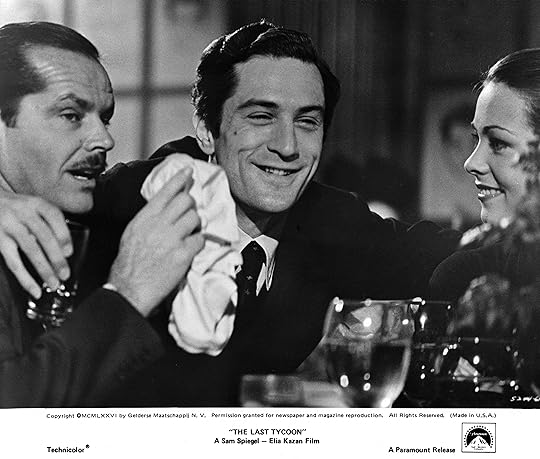
Robert DeNiro tra Jack Nicholson, che interpreta il sindacalista comunista, e Theresa Russell, che è Cecelia, l’io-narrante del romanzo.
La prima sorpresa che mi è venuta incontro sin dall’incipit – che non è quello riportato qui sopra – è che Fitzgerald adotta un io-narrante femminile. Non solo, è il punto di vista di una poco più che adolescente, non ancora ventenne. Non solo: mi pare che sia la prima volta che Fitzgerald abbandona il narratore classico – anche se pure qui, qua e là, l’io-narrante sembra diventare classico narratore in terza persona. Infatti scrive: Sono Cecelia e riprendo il racconto in prima persona.
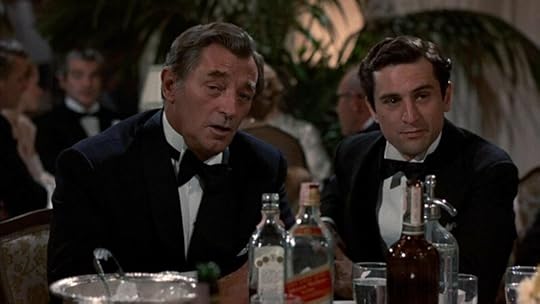
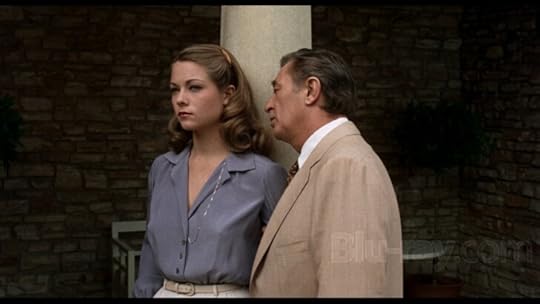
A sin. Robert Mitchum nel ruolo di Pat Brady, il padre di Cecelia.
Gli anni belli sono tramontati, la cosiddetta età del jazz, the roaring ‘20s, il decennio che vide uscire Gatsby e la nascita di Dick Diver. Siamo ormai nel decennio successivo e Fitzgerald è probabilmente rimasto ancora inchiodato al 1929, la grande crisi, e la Depressione che seguì. D’altra parte i Venti sono il decennio del successo per Fitz, mentre i trenta quelli del declino: Tenera è la notte è uscito nel 1934, nove anni dopo il Gatsby, e si è rivelato sostanzialmente un fiasco, nonostante sia un capolavoro. Ma il romanticismo non è morto: Gli occhi di Stahr e di Kathleen si incontrarono e rimasero avvinti. Per un attimo lui e Kathleen si amarono come nessuno usa fare dopo. Lo sguardo era più lento di un abbraccio, più incalzante di una invocazione. Romantico oltre misura: Stahr s’innamora di Kathleen perché assomiglia a sua moglie morte. Amore senza fine.
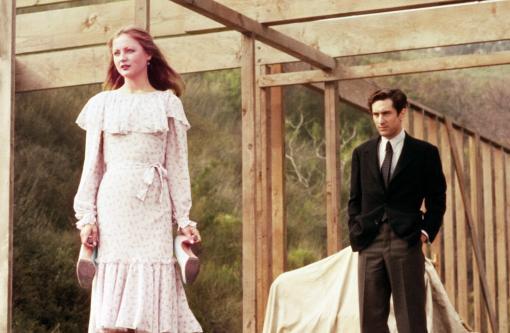
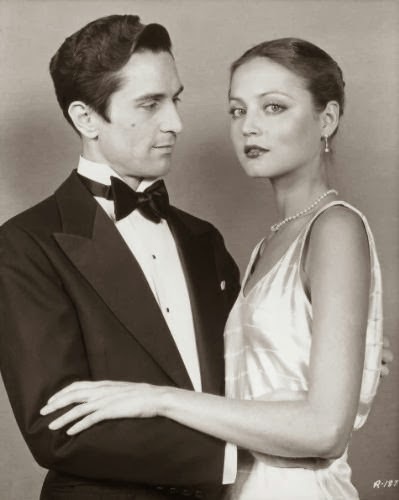
De Niro con Ingrid Boulting che interpreta Kathleen.
Fitzgerald si lasciò coinvolgere da Hollywood essenzialmente per ragioni economiche: la paga era buona. Di tutto quello che scrisse per il cinema un solo copione approdò sullo schermo, il resto finì nel dimenticatoio. Un’esperienza deludente, frustrante. Eppure, il suo senso cinematografico, il suo occhio che sa descrivere come se mostrasse al lettore un’immagine dietro l’altra, è vivo più che mai, scrive fotografando. E mi torna alla mente l’entrata in scena di Gatsby, attesa, rimandata, costruita, un’entrata in scena da artista. L’azione è protagonista, afferma Fitz: e ci può essere dichiarazione d’amore più sentita per la settima musa? E sembra che tutto in The Last Tycoon sia immaginato con luci a cavallo – albe e tramonti, magic hour – o di notte, gli orari del giorno che il cinema preferisce.
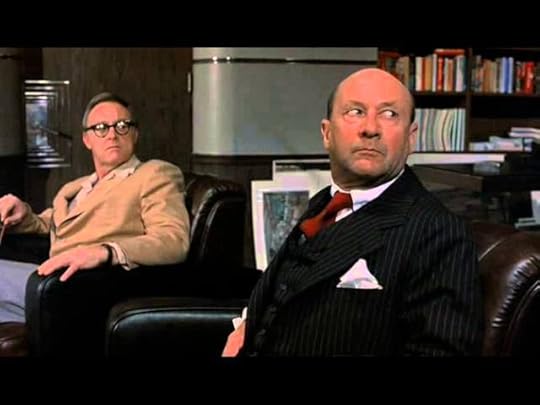
Donald Pleasance che interpreta lo sceneggiatore che forse dovrebbe rappresentare lo stesso Fitzgerald.
Monroe Stahr è impostato sul modello del noto produttore Irving Thalberg (1899-1936) del quale Fitzgerald scrive in una lettera: Thalberg mi ha sempre attratto. Il suo fascino eccezionale, la sua straordinaria bellezza, il suo immenso successo, la tragica fine della sua grande avventura. E si pensa immediatamente a Gatsby.
Non poteva essere un’esperienza felice quella hollywoodiana – assegno settimanale a parte – per uno scrittore professionista del talento di Fitzgerald che aveva della scrittura un tale rispetto da limare i suoi romanzi con continue revisioni censure aggiunte, perché tutto doveva essere chiaro e però denso, anzi chiarissimo e densissimo, perché il rispetto della propria arte comportava per lui anche il rispetto dell'arte della comunicazione.
Padre e figlia, Pat e Cecelia Brady.
Il film di Elia Kazan mi sembrò anacronistico all’epoca, così poco anni Settanta (1976), e me lo è sembrato anche oggi, visto che in qualche momento sembra quasi voler rifare il cinema dell’epoca raccontata sullo schermo (e sulla pagina, gli anni Trenta. Anacronistico anche l’abbinamento di un regista d’antan come Elia Kazan e uno sceneggiatore come Harold Pinter. Davvero strano connubio: nell’introduzione all’edizione Minimum Fax che riprende il titolo originale, L’amore dell’ultimo milionario, Goffredo Fofi afferma senza fronzoli non aver giovato al risultato finale. Anche se bisogna sottolineare il geniale espediente di Pinter di eliminare la voce narrativa di Cecelia trasformando i commenti della vicenda da ‘fuori campo’ a ‘in campo’ affidandoli a spezzoni di film proiettati e supervisionati da Sthar/DeNiro in sala proiezione. E non dimentichiamo la meravigliosa scena in cui Stahr spiega il cinema al novello sceneggiatore, la cosiddetta scena del nichelino, perfetta nel romanzo e sullo schermo, quintessenza di cinema. Il cast è stellare, ma c’è qualcosa che stona: forse troppo moderna la recitazione del protagonista Robert DeNiro, o del cammeo di Jack Nicholson, accanto a quella di Robert Mitchum, Tony Curtis, Ray Milland, Dana Andrews, John Carradine. A completare il parterre Theresa Russell – al suo esordio, diciannovenne – Jeanne Moreau, Donald Pleasance, Peter Strauss, Anjelica Huston. E forse a sintetizzare questa situazione c’è il fatto che l’attrice protagonista, quella che interpreta la giovane donna che fa innamorare Monroe Stahr è tale Ingrid Boulting, di cui si sono perse le tracce molto presto, che ebbe carriera breve e incerta. Quando sbagli un personaggio protagonista, il film zoppica. Che Stahr s’innamori di lei perché gli ricorda dannatamente la moglie morta è più detto che mostrato, scivola via. Rimane – come nel romanzo – un racconto su Hollywood realistico e finalmente non macchiettistico.
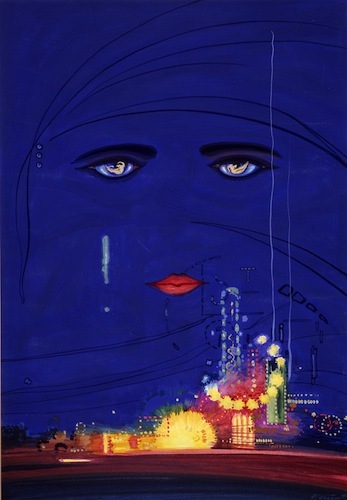
La copertina originale di “Il grande Gatsby” a opera di Francis Cugat. Fitzgerald ne era così entusiasta da dichiarare di aver scritto la copertina dentro il romanzo.
I'm not precisely sure why this book effected me the way it did, but it certainly did. Fitzgerald finished writing the fifth chapter of this book before he had a heart attack and died. When you get to the end of this unfinished novel, you find the last word one of the greatest American writers ever wrote. Something about this is chilling. And despite the fact that one can not make any substantial investment in characters who we know in advance we'll never know completely or whose stories we won't ever realize; there is something in the simplistic and honest quality of this novel that pits it amongst Fitzgerald's greats. He himself said in his notes and letters to friends that he had no fear in writing this novel and that it was to most resemble Gatsby, but in a new way. He wanted to expose things to people in nuanced ways.
My version came with the author's original outline and plot synopsis so you can piece together the original intention; but what is really important is what you get: a concise look at the small chances of love in big people. Calamity in the real world. What you get is Fitzgerald's last hurrah; his final statement. What you get, is a novel that could have been, and is enough.
Oh, Fitzgerald, Fitzy, Scott, F. I kept putting this one off because I knew exactly how it would leave me, and I was exactly right. As much as I love Gatsby, as much as I love Tender is the Night and the short stories and the essays and every wastebasket scrap he’s written, this would have been It. Capital-I It. It still almost is, even terribly unfinished.
Now what? The other woman was more missed in her absence. They were alone and on too slim a basis for what had passed already. They existed nowhere. His world seemed far away— she had no world at all except the idol’s head, the half open door. “You’re Irish,” he said, trying to build one for her.
I recently reread The Great Gatsby in August with my book club and fell in love all over again with Fitzgerald’s writing. I was absolutely thrilled to have the opportunity to read Fitzgerald’s last novel.
Set in 1930’s Hollywood, The Last Tycoon tells the tragic story of a young film producer Monroe Stahr. The story tells Monroe’s struggle in balancing his personal life and running a successful film studio. With the themes of ambition, power, and corruption, the story is a bittersweet exposé of the glittering excess of the film industry.
After recently reading Gatsby, falling back into Fitzgerald’s words was like revisiting an old friend. With less than 200 pages, I flew through this one and didn’t want to put it down. I can’t remember how many passages I highlighted but the lines and beauty of Fitzgerald’s words are some of the deepest and most profound that I’ve read recently. And that last sentence, knowing that it was the last sentence the author ever wrote, gave my chills!
If you are a fan of any of Fitzgerald’s works, then you will love The Last Tycoon!
This gorgeous edition is available now. Many thanks to Scribner for the gifted copy!
Some very smooth and beautiful writing but changes of scene and mood were often abrupt and the end certainly felt truncated. I have no idea where Scott ended and ghost writers began but the ending was too soon, too fast and left me totally unsatisfied.
This was another Scott novel where I felt sorry the love didn’t happen. Just like I felt with Gatsby, The Beautiful and the Damned and Tender is the Night.
Obviously there needed to be much more, because a new relationship was just burgeoning, we’re told it comes to fruition, and that’s it. No more. Nada. The novel is over and so is Scott’s writing. Forever.
I’d say this is worth reading to experience Scott’s prose in the first 3/4s of the book and to get an insider’s look at producing movies in 1930s Hollywood. It’s very interesting. And you certainly get the sense of how difficult it was (and is) to be a writer for the motion picture industry.
Stunning scenes shrouded in the typical softness of Fitzgerald, not exempt from clichés, but that the author reclaims thanks to a strong presence, and some subtle dialogues punctuate the story and maintain the attention. We, therefore, regret that the author could not complete it because it would undoubtedly have given a new great novel, entirely in line with its two previous ones, if the drafts had kept all their promises. In the meantime, despite the absence of unity and, above all, the incompleteness of the story, we have access to the study of a writer who had linked his work very closely to his life, which makes it a fascinating piece, enlightening its twilight light the rest of Fitzgerald's production.
Me gusta la gente y me agrada gustar a la gente, pero tengo el corazón donde Dios manda: dentro.
Este 2019 que se está terminando descubrí (tarde) a Francis Scott Fitzgerald. No sé si "descubrir" es la palabra, pero sí lo leí por primera vez y me encantó lo que encontré. Este gran escritor, uno de los fundamentales referentes de la "generación perdida", como llamaron a ese grupo de autores que incluía entre otros a él y también a John Dos Passos, Erskine Caldwell, William Faulkner, Ernest Hemingway, John Steinbeck y Sherwood Anderson entre otros, situada en los Estados Unidos de entreguerras y que supo captar como nadie el glamour y el desencanto, la fastuosidad del dinero y la depresión económica de un modo real y claro. Entre el fin de la primera guerra mundial, pasando por la gran depresión norteamericana y desembocando en la segunda guerra mundial, este país fue sacudido por sucesos que lo marcaron a fuego y desde allí, se trasladó a todos los ámbitos, recalando obviamente en la literatura y es allí donde se plasmó en forma explícita. Ya habiendo leído "El gran Gatsby" y "El curioso caso de Benjamin Button", pude tener una noción de la maravillosa narrativa de Fitzgerald mientras me preparo para otras novelas que leeré el año que viene como "Suave es la noche" o "El precio era alto." Esta novela en particular está inacabada. La muerte sorprendió de un ataque al corazón a Fitzgerald un 21 de diciembre de 1940 cuando el autor recién había iniciado el capítulo VI del libro. Indudablemente, quedan muchos cabos sueltos que nos hacen preguntar cómo hubiera terminado la historia de este emblemático productor de cine llamado Monroe Stahr y en el que Fitzgerald encarna a esos últimos empresarios que buscaban con sus películas inmortalizarse para siempre en el mundo de Hollywood, meca del sétimo arte. Naturalmente, es inevitable no trazar una comparación entre Stahr y Gatsby; el primero como eje central del poder hegemónico en el mundo de las películas y el otro como ideal del sueño americano, dandi y conquistador, pero ambos con algo a favor: millonarios. Tal vez, lo que más los une es esa latente fragilidad sentimental que poseen aquellos que lo tienen todo pero que anhelan compartir sus vidas con una mujer ideal que les es esquiva. Para el caso de Stahr, su obsesión es llegar al corazón de Kathleen Moore, quien le recuerda físicamente a su fallecida esposa, Mina Davies, y a su vez al relato por otro lado de Cecilia Brady, una joven asistente de Stahr e hija de un amigo de este. Dentro de todo ese mundo de lujo y poder, están los vaivenes del corazón que afectan a cualquier ser humano y Stahr no es la excepción. El contrapunto entre ambas mujeres es puesto en escena por el autor en el caso de Kathleen contado en tercera persona, mientras que Cecilia narra sus experiencias en primera. Es que el manuscrito del autor, si bien no estaba terminado sí había sido corregido aunque nunca decidió si escribir la novela en primera o tercera persona. Cuando uno lee "El último magnate", es advertido por los editores acerca de esta cuestión. Muchos afirman que paradojamente esta es la mejor novela de Fitzgerald y que tenía un gran potencial de ser recordada si el autor hubiera podido terminarla. Mi edición posee la supuesta continuación a partir de los borradores y anotaciones que el autor dejó a su muerte, así como distintas teorías narrativas y argumentales que discutió con sus editores. De todas maneras, la novela no deja de mostrarnos ese asombroso mundo del cine, así también como de lo que las pasiones generan aún en los hombres más poderosos. Nuevamente Francis Scott Fitzgerald logra captar mi admiración y mis ganas de seguir leyendo sus libros.
It's a tragedy Fitzgerald died before finishing this because it's brimming with beautiful inspired writing and completely contradicts any notion that he was washed up as a writer. It appears it would have been more similar to Gatsby than Tender is the Night. Starr is an idealistic film director who believes in treating people with kindness and respect. He's out of synch with a Hollywood becoming ever more ruthless and cynical. Not enough of the story is written down to get a feel for how exactly the novel is going to play out - though at the end there's a lot of detail from Fitzgerald's notes - but the exalted nature of the prose made this a compelling read for me. I can't really recommend an unfinished novel or give it five stars but I loved reading it.
Reading F. Scott Fitzgerald’s penultimate novel, “Tender is the Night,” saddened me, because it showed a once-great man struggling—and failing—to write a novel worthy of his prodigious talent and storied past.
Reading “The Last Tycoon” saddens me, because he found that novel, then suddenly died before he could finish it.
“The Last Tycoon” tells the story of Hollywood golden boy Monroe Stahr. He’s a good guy, pays his people well, and works hard to make good, profitable films—he’s not even afraid to green-light a film that will lose, $250,000 dollars, simply because it will be brilliant. Monroe is a widower, his work now his mistress.
One night, a water main breaks during an earthquake, and two young women are being swept away in the deluge. He manages to rescue them. One of the girls looks like his late wife. Monroe is intrigued, and searches her out.
Her name is Kathleen Moore, and she’s probably the only young woman in Hollywood not looking for movie stardom. Monroe finds himself smitten, but Kathleen has a secret.
Monroe himself is the object of Cecilia Brady, twenty-year-old daughter of Stahr’s business partner. Cecilia wants Stahr in a most grown-up way, even though he looks at her rather like a niece. Naturally, she becomes jealous of the mysterious woman who captures Monroe Stahr’s heart.
The three wrangle through their odd love triangle, and Stahr has studio business to run, and then--
That’s where Fitzgerald’s manuscript ends, after a bombshell revelation.
I literally swore. I mean, I knew it was incomplete, but why couldn’t he have written another chapter? Or two? His writing was strong, beautiful, and sharp again, so why couldn’t he have just skipped over “Tender is the Night,” and written this one to completion? Why, literary gods, why?
I think the reason is Hollywood. The author had, of course, spent his final years working in Hollywood, miserably writing miserable screenplays just for the big paychecks he needed. The downside is that he wasn’t especially happy with this new world. The upside is that it pulled his head out of the whole creatively stifling “Scott & Zelda, Jazz Age Royalty” rut he’d been stuck in. Fitzgerald’s four previous novels were either thinly veiled autobiography, or featured characters based on himself and Zelda, thrust into some fictional realm or another. “Tycoon” features characters either completely fictional, or based on various Hollywood personae (Stahr is supposedly Irving Thalberg). I found a couple of snippets that were probably from Fitzgerald’s perspective—when Stahr explains to a whiny novelist the difference between novel-writing and screenwriting.
After Fitzgerald’s narrative ends, there are various materials explaining where he intended the book to go. There’s a summary, cobbled from letters, conversations with his friends and editors, et al. There are the author’s own notes from the manuscript, explaining changes he was planning to make to his manuscript, plus his own outline and character sketches.
Based on these posthumous additions, it’s hard to know how good “Tycoon” could have been. If Fitzgerald had continued along the narrative’s natural arc, I think “The Last Tycoon” could have been his masterpiece. If he followed-through on his notes and outlines, I think it could have fizzled in unnecessary melodrama. It would be interesting to see his notes and outlines on “The Great Gatsby” at the same point of evolution, just to see how faithfully he normally adhered to his original plans.
The sad part is, we’ll never know, unless we can check it out from The Afterlife Public Library, if such a thing exists.
For now, “The Last Tycoon” is three novels. It’s the novel that follows where we as readers imagine it will go. It’s the novel that closely adheres to the author’s outline and notes. Mostly—sadly—it’s the novel that ends entirely too damned soon.
Originally, I had planned not to rate this book at all. After all, it's an unfinished novel. And yet...it's some of Fitzgerald's finest. Here on display is one of Fitzgerald's best literary tricks -- to have characters act in peculiar and implausible ways and to make them completely realistic and plausible. I loved every scene in this book. There is not a single sentence in this book, a single line, that doesn't crackle with energy. I just wished I could have read the finished product.
Not my favorite Fitzgerald. There were lots of characters, but I didn't feel connected to any of them except for Cecelia. I wanted to watch her grow up in this book, and it's not Fitzgerald's fault for dying before it was finished, but I'm not sure knowing the rest of the story would've been enough. I definitely caught glimpses of his genius here and I'm glad I read it, but it left me wanting more.
I have now read all of Fitzgerald's major published works. After finishing The Love of The Last Tycoon, the incomplete manuscript on his desk when he died, I ask immediately wonder how this novel differs from his other works. Did he know he had this one last chance to voice his ideas? Did he compile the breadth of his lifelong learning into his final literary hero? Unfortunately, we can only speculate on these questions. But I find comfort in the idea that we would not have these questions had not Fitzgerald left The Love of The Last Tycoon as his final stamp on American literary art.
Fitzgerald's protagonist, Monroe Stahr, stands apart from the other heroes of his novels. Amory Blaine endures a sort of intellectual maturation which coincides with his struggle with humility. Anthony Patch, born to privilege, would rather spend his time thinking about his future instead of pursuing it. Jay Gatsby put a human face on the iconic rich and influential socialite image of the 1920s. And the autobiographical sketch of Dick Diver portrays a man burdened with a sick love. Only with Monroe Stahr do we meet a hero who seems to have it all, a self-sustaining character who does not need a feminine Virgil to guide him, a successful businessman who nobly soars above a town of flared egos and disingenuous fakes. We might think of Gatsby, but Stahr differs by bearing his full persona to everyone, even by mixing an arrogant sense of savior ethics into his professional career as a producer. He also seems to embrace any self-inflicted personal detriment and defends his methods like a Hollywood mystic who confidently awaits others to naturally arrive at his conclusions.
I wanted to appreciate Cecelia's first-person narrative more than I did. Nick Carraway remains the heavy-weight champion in this arena. But I did appreciate her overall tone. For a young woman, writing about something which happened in her childhood, I liked the contrast of her tired and seemingly cynical tone with her proximity to the glamorous bustle of Hollywood life. Fitzgerald positions her as a Hollywood insider but with no personal credits in movies - the privileged fly on a wall in a town which hasn't wrapped her in its spider silk. Fitzgerald presents her with a keen sense of simile which cleverly meets the demands of the situation while cultivating her consistently disenchanted tone. At least half of the novel, however, happens away from her presence. So how much do we believe about a story which takes place in Hollywood about the most successful and revered contemporary Hollywood producer from someone who was absent from much of the story? I don't believe Fitzgerald made a mistake. I think he wants us to ask this question - a scripted silver screen drama based on real life. And he developed her tone to draw us in just enough to consider how these people relate to us.
Unfortunately, Fitzgerald did not have the chance to finish this book, and though I commend Matthew Bruccoli for producing a publication enhanced with editing notes and outlines from Fitzgerald himself, readers can only contemplate open-ended themes doomed to resolution purgatory. Nonetheless, I think Fitzgerald did reach an important stage of the story as Stahr vulnerably enters the center of the hero's labyrinth and faces himself. And, again, as opposed to Fitzgerald's other heroes, I don't think Stahr felt familiar with himself when coupled with some of the people who enter his life. His brief love affair with Kathleen tests his conviction for his Hollywood work by presenting an escape into a more traditional American life. The last episodes with the visiting communist force him to acknowledge his personal ethics particularly regarding relations with writers. Stahr strikes me with his honesty as he faces himself. While many heroes wage bloody battle against the beast representing their other half, I imagine Stahr finding the beast, introducing himself with one hand in his pocket, his head tipped to one side, slightly squinting as he assesses his adversary. The beast says nothing to disarm him. Stahr listens. Understands. Responds inquisitively. Perhaps he defends his choices and his noble intentions. Perhaps he even describes what he sacrifices for a growing town which transforms the imagination into a reality of sensory overload.
But we don't see Stahr come out of the labyrinth. And we don't know who "survives" the interaction in the center. But we do meet a very different Fitzgerald vision - a confident man, a brilliant and intuitive Hollywood producer, a loveable persona and the last of the traditional Americana icons.
It is strange, perhaps even morbid, to read the very last words of a favorite author on the very last page of his unfinished novel. The words wouldn’t mean as much had they been in the middle of one of the chapters, as he had originally intended them to be. But now, I feel as if this unfinished book would’ve been so much greater than his other ones, and that realization makes me so sad. You just had to go and die, Francis, didn’t ya?
So I read the outline he had in mind and where he wanted to go with the story after the sections we ended up with. There’s so much in his notes that didn’t make it to his unfinished book, and reading them was interesting, to say the least. It just pains me to see how everything ended. But from what I can see and piece together, I can say it would’ve been one of his best works. The characters feel real - at least the main three do- with nuances that make them interesting people. The writing is subtle yet gorgeous, and the scenery and atmosphere breathtaking.
I shall stop this review right here and go read another book of his to make myself feel better.
THE LAST TYCOON: weird in the pleasant way (5 stars). I wonder how the movie based on the book ends.
THIS SIDE OF PARADISE: I need to read reviews to understand who the romantic egoist is and why he's the sole focus of the novel. Emory, an egoist, becomes an individual and a socialist in the end... I fell in love with Fitzgerald's prose, not so much with the novel's plot in general (4 stars)
THE LAST TYCOON, though unfinished, radiates more maturity than THIS SIDE OF PARADISE
An incomplete first draft only of the book FSF was still writing when he died, this feels like a new departure or at least a fresh start. As in Gatsby there is a first person narrator who isn't one of the romantic protagonists, and large sections of what exists are almost third-person narratives of the doomed love between Monroe Stahr and Kathleen.
What marks a diversion from the previous books is that this is set in Hollywood and that Stahr is a film producer: a large part of the story revolves around his work and business dealings, very different from Anthony Patch, Amory Blaine or even Gatsby and Dick Diver. Offering up an insider's view of Hollywood, complete with concerns about unionization and communism, this is a book about a man who works, and works hard at his trade.
Does anyone write romance like FSF? "Stahr's eyes and Kathleen's met and tangled. For an instant they made love as no one ever dares to do after. Their glance was closer than an embrace, more urgent than a call." Yet Hollywood with its foundational alchemy of glorious illusion and hard-headed cynicism turns out to be the ideal backdrop for FSF's unique vision of love which is always doomed to fail and fade.
I really wish that Fitzgerald had the chance to finish this before he died. I think out of all his novels this had the potential to be as great as the Great Gatsby. My copy of this book had notes on how Fitzgerald planned to finish the novel, he planned meticulously by all accounts. But it’s simply not the same as reading the actual story, especially as one of my favourite parts of his books are his endings.
Another Fitzgerald novel that I read in French a long time ago, and have just rediscovered with wonder by reading it in English. There's something about Fitzgerald's writing style that is really unique and that no translation, as good as it may be, can communicate. Because The Last Tycoon is unfinished, and is a work in progress that will always stay this way, it can come across as frustrating not to have the complete novel, and to read sentences and paragraphs that the author may have rewritten. But it's actually an incredibly fascinating read. It is very moving to dive into this manuscript knowing it's an incomplete draft, that was supposed to be perfected - you can almost feel Fitzgerald writing it. More than that, it is one of the very best (if not the best) novels ever written about Hollywood: Fitzgerald has perfectly understood how the whole system worked - which makes his own failure at working within this system heartbreaking. Monroe Stahr, reminiscent of Gatsby in some aspects, is a wonderfully enigmatic character, he's the heart of a deeply melancholic story that, once more, goes to the heart of the American dream - this time as it's been shaped by Hollywood and its mythology.
C’è vita. Vita e la sua negazione. Sfiancarsi per costruire. Costruire un impero in cui riflettersi, per sfuggire se stessi. Esperienza che scorre febbrile nelle vene. È così difficile per l’essere umano consumare il tempo in una dimensione presente. È un limbo di non vissuto per allontanare la felicità, paura sconosciuta.
É difícil pontuar este livro, pois não se encontra terminado. A escrita de Fitzgerald, revolve quase invariavelmente em torno da crítica social e à hipocrisia das classes por onde se movimentava - e do peso que os interesses sociais tomavam relativamente aos verdadeiros sentimentos das personagens. Nesta obra não é diferente, até tendo em conta o final que o autor pretendeu dar-lhe.
Sou uma grande apreciadora da escrita do autor e tenho curiosidade em ler mais obras do mesmo após The Great Gatsby e The Last Tycoon.
Unfinished works aren't the best starting point for reading a new-to-you author, but Fitzgerald's skillful way with words instantly put me on his side. General consensus among friends who've read Gatsby implied that it was "kind-of a boring book"; nobody told me that Fitzgerald is simply a delight to read, regardless of subject. His mastery is much in evidence here, a book begun roughly twenty years into his professional career. Its romance is touching, and the relational and emotional tangle of its characters is compelling: a piece of writing worth the reader's journey, despite never reaching its destination.
It's extremely unfair to rate this as it's an unfinished manuscript, especially as it's an unfinished manuscript by F. Scott Fitzgerald who was notoriously sensitive about the reception of his books. However, it's really and truly awful. I can't finish it. 72 pages in and I'm bailing. Probably best for Fitzgerald fans not to engage with this one. I absolutely adored This Side of Paradise and think his earlier work is brilliant, but this shows how deeply Fitzgerald had, at the end of his life and career, slid into false starts and lost ways.
Für ein Werk von F. Scott Fitzgerald kommt "Die Liebe des letzten Tycoon" bei den Goodreadern nicht besonders gut weg. Das liegt wahrscheinlich daran, dass der Autor das Werk nicht vollendet hat und manchen das ungeschliffene oder unbeendete missfällt. Mir hat gerade das gefallen. Es ist weniger Fragment als der 2. Teil des Mannes ohne Eigenschaften, sondern eher unpoliert und man kann sich nicht sicher sein, ob das Ende schon als wirkliches Ende gedacht war aber mir gefällt gerade diese Unvollendetheit.
F. Scott Fitzgerald nahm dieses Werk nach einigen kommerziell sehr erfolgreichen aber literarisch erfolglosen Jahren als Drehbuchautor in Hollywood in Angriff . In meinen Augen lesen sich weite Teile wie ein Film aus der damaligen Zeit. So legt der Autor in vielen Szenen Wert auf die (beschriebene) musikalische Untermalung, (beschriebene) Lichteffekte und plastische Schnitt- und Szenenwechsel. Leider ist die eigentliche Handlung von holywoodesquer Plattheit, wenngleich manche Charaktere gut gezeichnet sind.
This was F. Scott Fitzgerald's final book. He never finished it. On December 21, 1940, the day after he wrote chapter 6, Scott Fitzgerald died of a heart attack. For an unfinished novel The Last Tycoon is a powerful work. I feels like a second draft rather than the first draft that it apparently is. Heavens, the man could write!
I'm not sure why GR has this book listed under the title The Love of the Last Tycoon. My copy was a first edition, published in 1941 and is titled simply, The Last Tycoon--a much more fitting title. As the forward by Edmund Wilson points out The Last Tycoon is not just about Monroe Stahr but about Hollywood in the 1940s.
Unlike many of Fitzgerald's characters, Stahr is no playboy but rather a hard driven producer, immensely talented, working often around the clock at an impossible business. At one point Stahr pops a Benzedrine and I was reminded of my time on Wall Street where almost all of the traders and quite a few of the investment bankers lived on cocaine and coffee.
The atmosphere and pace of Hollywood life is vividly captured here. The romance(s) is secondary--and from the notes that was intentional. This is primarily a book about an industry and the powerful men who dominate it. The issues of the day are central: Communism, censorship, unions, tight studio budgets. It was a time when ordinary Americans were still so damaged from the Depression that going to the movies was a nearly impossible luxury and class resentment was so sharp that the rich often feared that revolution was nigh.
It's a tragedy this was left unfinished, as this felt like the most unique of his works, in that it felt like he was leaning less on his old habits to write it. Monroe is a character I'd love to see more of, and he was perfectly balanced: just special enough you'd want to read about him, but not so larger than life that you don't think you could bump into someone like him on the street somewhere.
I think this could have been one of his best works, and I think he captured so well the trappings and allures of old-school Hollywood. He also seems to have written more of himself into this novel than Zelda, and that was somehow refreshing.
Brilliantly written, expertly envisioned, yet it somehow feels like a welcome evolution from his previous style. It's such a shame we never got the full vision because, if this novel is any indication, Fitzgerald was adapting marvelously to the changes and shifting sensibilities of American culture.
وقتی کتابی اثر اسکات فیتزجرالد در فقسه کتابفروشی دیدم که نخوانده بودم، انقدر ذوق کردم که مثل همیشه قبل از خرید تورقی نکردم.. اما حالا که شروع کردم بخونم میبینم کتاب آخرین قارون به خاطر درگذشت ناگهانی نویسنده نیمهکاره مانده و پس از مرگش با کمک یادداشتها و اتودهای نویسنده پایانی برای کتاب تهیه شده و به چاپ رسیده. حالا شاید خیلی هم بد نباشه. بخونم ببینم چی میشه.