

What do you think?

The Stray Dog Cabaret: A Book of Russian Poems
A New York Review Books Original
A master anthology of Russia’s most important poetry, newly collected and never before published in English
In the years before the 1917 Russian Revolution, the Stray Dog cabaret in St. Petersburg was the haunt of poets, artists, and musicians, a place to meet, drink, read, brawl, celebrate, and stage performances of all kinds. It has since become a symbol of the extraordinary literary ferment of that time. It was then that Alexander Blok composed his apocalyptic sequence “Twelve”; that the futurists Velimir Khlebnikov and Vladimir Mayakovsky exploded language into bold new forms; that the lapidary lyrics of Osip Mandelstam and plangent love poems of Anna Akhmatova saw the light; that the electrifying Marina Tsvetaeva stunned and dazzled everyone. Boris Pasternak was also of this company, putting together his great youthful hymn to nature, My Sister, Life.
It was a transforming moment—not just for Russian but for world poetry—but a short-lived one. Within little more than a decade, revolution and terror were to disperse, silence, and destroy almost all the poets of the Stray Dog cabaret.
A master anthology of Russia’s most important poetry, newly collected and never before published in English
In the years before the 1917 Russian Revolution, the Stray Dog cabaret in St. Petersburg was the haunt of poets, artists, and musicians, a place to meet, drink, read, brawl, celebrate, and stage performances of all kinds. It has since become a symbol of the extraordinary literary ferment of that time. It was then that Alexander Blok composed his apocalyptic sequence “Twelve”; that the futurists Velimir Khlebnikov and Vladimir Mayakovsky exploded language into bold new forms; that the lapidary lyrics of Osip Mandelstam and plangent love poems of Anna Akhmatova saw the light; that the electrifying Marina Tsvetaeva stunned and dazzled everyone. Boris Pasternak was also of this company, putting together his great youthful hymn to nature, My Sister, Life.
It was a transforming moment—not just for Russian but for world poetry—but a short-lived one. Within little more than a decade, revolution and terror were to disperse, silence, and destroy almost all the poets of the Stray Dog cabaret.
168 pages, Paperback
First published December 5, 2006
About the author
Paul Schmidt
115 books12 followersPaul Schmidt was an American translator, poet, playwright, and essayist.
Ratings & Reviews
Friends & Following
Create a free account to discover what your friends think of this book!
Community Reviews
Displaying 1 - 30 of 41 reviews
![Profile Image for s.penkevich [hiatus-will return-miss you all].](https://i.gr-assets.com/images/S/compressed.photo.goodreads.com/users/1735525095i/6431467._UX200_CR0,11,200,200_.jpg)
September 16, 2022
Nestled away in my local library is a wonderful little volume of poems that I’ve been periodically checking out for the past six years. Long before I came to work in this library, I would spend much of my free time in the 811s (poetry section), pouring through the volumes and enjoying all the perks of my library card to bring a nearly inexhaustible amount home. It was during this time I discovered that hidden away in 891.71 was an amazing book called the Stray Dog Cabaret, a book of Russian poems of those who performed at the short-lived but influential cafe in St. Petersburg. Included in this collection, and all translated by Paul Schmidt, are some of my favorites like Marina Tsvetaeva and Anna Akhmatova along with Alexander Blok, Osip Mandelstam, Velimir Khlebnikov, Vladimir Mayakovsky, Boris Pasternak and Sergei Esenin, though many other poets, writers and musicians performed there.
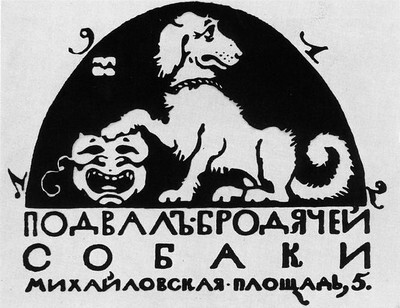
Stray Dog logo, 1912
The Stray Dog Cafe opened on New Years Eve, 1911 in St. Petersburg and became an immediate hit. Boris Pronin, the proprietor, studded at the Moscow Art Theater and envisioned the cafe as a ‘spectacle of culture’, painting the ceiling and walls with bright birds and flowers as a reference to Les Fleurs du Mal and bringing in Russia’s first openly gay writer, Mikhail Kuzmin, as co-founder and session pianist. It attracted many young up-and-coming artists, notably Akhmatova and Mandelstam who had met while performing elsewhere in 1910. While many of the artists were schooled in the Symbolist style, they were eager to branch out and push in new directions, with Acmeist poetry being credited as beginning inside the Stray Dog Cafe as well as early efforts towards the Russian Futurist movement. It was named because the artists considered themselves ‘stray dogs' that had been ‘shunted aside by proper aristocratic society’. Unfortunately the doors were shut by authorities in 1915, with the World War being given as the reasoning though several performers had attracted ire of the local authorities such as Mayakovsky with the performance of his poem Meant For You.
The Stray Dog Cabaret
- Anna Akhmatova
All of us here are hookers and hustlers.
We drink too much, and don't care.
The walls are covered with birds and flowers
that have never seen sunshine or air.
You smoke too much. There's always a cloud
of nicotine over your head.
Do you like this skirt? I wore it on purpose.
I wanted to show lots of leg.
The windows here have been covered forever.
Is it snowing out? maybe it's rain.
You've got that look in your eyes again,
like a cat in a crouch for a kill.
Sometimes I feel this awful pain,
as if someone were breaking a spell.
Take a good look at that one over there!
She's dancing her way into hell
The poems contained in here are from the period these poets were performing inside the Stray Dog and are a great insight into the early works of poets who would become icons in the literary field. Many of the poets reference each other, writing poems ‘To’ one another and collaborating in fun ways that must have been amazing to see performed. Reading this makes you think that being inside on a full evening must have been an absolute delight of art and alcohol, a frenzied period of creativity and calm before the storm of arrests and life crises that befell many of these poets. They are playful and funny at times, with lots of political undertones though occasionally more overt such as Mandelstam taking cracks at Stalin with lines like ‘evert time someone gets murdered, / he sticks out his chest for a medal.’ It is a fun collection.
Poems grow like stars, like flowers,
Like the beauty a family never needs.
And there's only one answer possible
To praise, to apotheosis: why to me?
We sleep—and then, between the paving stones
The divine visitation, quatrefoil.
Understand me, world. The poet's dream reveals
the laws of stars, the formulas of flowers.
-Marina Tsvetaeva
The translations are, unfortunately, not my favorite though I can’t be sure as I’ve not encountered these poems under other translators but they seem a bit clunkier compared to other translations of Tsvetaeva and Akhmatova I have enjoyed (anything pales in comparison to Elaine Feinstein translating though). Still, this is a great collection and I keep checking it out just to enjoy the idea of witnessing the dawn of an era of Greats all working together in the comfort of the cafe. This is a lovely book that celebrates a piece of history, and in cool news the Stray Dog Cabaret reopened in 2001.
SILENTIUM
-Osip Mandelstam
Nobody knows what silence is.
Silence is words and music.
It's the thing that links all things alive,
the link that lasts forever.
Let me open my mouth and let nothing come out,
silent as an unborn baby.
Let me be a perfect crystal note
that lasts unchanged forever!
Do nothing, love, don't ever change.
Change only words to music.
And let my heart of hearts grow still
as a life I can barely remember.
Stray Dog logo, 1912
The Stray Dog Cafe opened on New Years Eve, 1911 in St. Petersburg and became an immediate hit. Boris Pronin, the proprietor, studded at the Moscow Art Theater and envisioned the cafe as a ‘spectacle of culture’, painting the ceiling and walls with bright birds and flowers as a reference to Les Fleurs du Mal and bringing in Russia’s first openly gay writer, Mikhail Kuzmin, as co-founder and session pianist. It attracted many young up-and-coming artists, notably Akhmatova and Mandelstam who had met while performing elsewhere in 1910. While many of the artists were schooled in the Symbolist style, they were eager to branch out and push in new directions, with Acmeist poetry being credited as beginning inside the Stray Dog Cafe as well as early efforts towards the Russian Futurist movement. It was named because the artists considered themselves ‘stray dogs' that had been ‘shunted aside by proper aristocratic society’. Unfortunately the doors were shut by authorities in 1915, with the World War being given as the reasoning though several performers had attracted ire of the local authorities such as Mayakovsky with the performance of his poem Meant For You.
The Stray Dog Cabaret
- Anna Akhmatova
All of us here are hookers and hustlers.
We drink too much, and don't care.
The walls are covered with birds and flowers
that have never seen sunshine or air.
You smoke too much. There's always a cloud
of nicotine over your head.
Do you like this skirt? I wore it on purpose.
I wanted to show lots of leg.
The windows here have been covered forever.
Is it snowing out? maybe it's rain.
You've got that look in your eyes again,
like a cat in a crouch for a kill.
Sometimes I feel this awful pain,
as if someone were breaking a spell.
Take a good look at that one over there!
She's dancing her way into hell
The poems contained in here are from the period these poets were performing inside the Stray Dog and are a great insight into the early works of poets who would become icons in the literary field. Many of the poets reference each other, writing poems ‘To’ one another and collaborating in fun ways that must have been amazing to see performed. Reading this makes you think that being inside on a full evening must have been an absolute delight of art and alcohol, a frenzied period of creativity and calm before the storm of arrests and life crises that befell many of these poets. They are playful and funny at times, with lots of political undertones though occasionally more overt such as Mandelstam taking cracks at Stalin with lines like ‘evert time someone gets murdered, / he sticks out his chest for a medal.’ It is a fun collection.
Poems grow like stars, like flowers,
Like the beauty a family never needs.
And there's only one answer possible
To praise, to apotheosis: why to me?
We sleep—and then, between the paving stones
The divine visitation, quatrefoil.
Understand me, world. The poet's dream reveals
the laws of stars, the formulas of flowers.
-Marina Tsvetaeva
The translations are, unfortunately, not my favorite though I can’t be sure as I’ve not encountered these poems under other translators but they seem a bit clunkier compared to other translations of Tsvetaeva and Akhmatova I have enjoyed (anything pales in comparison to Elaine Feinstein translating though). Still, this is a great collection and I keep checking it out just to enjoy the idea of witnessing the dawn of an era of Greats all working together in the comfort of the cafe. This is a lovely book that celebrates a piece of history, and in cool news the Stray Dog Cabaret reopened in 2001.
SILENTIUM
-Osip Mandelstam
Nobody knows what silence is.
Silence is words and music.
It's the thing that links all things alive,
the link that lasts forever.
Let me open my mouth and let nothing come out,
silent as an unborn baby.
Let me be a perfect crystal note
that lasts unchanged forever!
Do nothing, love, don't ever change.
Change only words to music.
And let my heart of hearts grow still
as a life I can barely remember.

March 23, 2012
This is brief, but special. Its aim is modest - to represent a night at the Stray Dog Cabaret, a poetry club in St Petersburgh in the years before the 1917 revolution - but in fulfilling that aim it also bears testament to a golden age of Russian poetry. That all these talents could have gathered in one room at one time seems scarcely credible, and points to a flowering of culture that we may never truly comprehend given that it was subsequently trampled by Stalinism. Is it coincidence, this raising of voices on the eve of destruction? I think not, and yet these poems seem, for the most part, touchingly innocent of the violence to come. The young Akhmatova, it's true, shines brightest - and we sense the love of her fellow poets for this prodigy - but all around is creativity of the highest order, eclipsed in our cultural memory by the Cabaret Voltaire perhaps only because, after all, this is Russia - a place more foreign than Switzerland could ever be - and because these voices seem to come to us from another epoch, an alternate reality even, in which they groped forward towards a modernity that was never to be, a Russia they saw only in their imaginations. In a culture that celebrates the Beats ad nauseum yet knows next to nothing of the Stray Dog Cabaret, this little book is a revelation. And since it contains seeds that sadly never germinated, why not use it to cultivate a new strain of our own poetry, and take a rest from our endless, incestuous sifting through the many-times planted seeds of our own culture?
Sisters, brothers, welcome to the Stray Dog Cabaret. If you'll grab yourself a drink and take a seat, the proceedings will begin.
Sisters, brothers, welcome to the Stray Dog Cabaret. If you'll grab yourself a drink and take a seat, the proceedings will begin.

August 19, 2010
some of my favorite parts:
"Nights burn with unknown constellations
in the transparent heavens of july." anna akhmatova
"... to be, but by deceit:
to strike yourself from latitudes.
To slip through time as through the sea
and not to break the waves." marina tsvetaeva
"For - no more splendid
superfluous words - love is a seam.
A seam, not a sling, a seam, not a shield
(oh, don't ask to be shielded!)
A seam - dead people are sewn to the ground
and I am sewn to you.
(Time will show what the seam was like:
a simple stitch or triple.)
Cut as you like, my dear, you must tear
on a seam. Wave the pieces in the air!
It's good at least that you tore,
didn't just let it unravel.
That the broken basting shows a live
red vein, not something rotting away." marina tsvetaeva
"Nights burn with unknown constellations
in the transparent heavens of july." anna akhmatova
"... to be, but by deceit:
to strike yourself from latitudes.
To slip through time as through the sea
and not to break the waves." marina tsvetaeva
"For - no more splendid
superfluous words - love is a seam.
A seam, not a sling, a seam, not a shield
(oh, don't ask to be shielded!)
A seam - dead people are sewn to the ground
and I am sewn to you.
(Time will show what the seam was like:
a simple stitch or triple.)
Cut as you like, my dear, you must tear
on a seam. Wave the pieces in the air!
It's good at least that you tore,
didn't just let it unravel.
That the broken basting shows a live
red vein, not something rotting away." marina tsvetaeva

December 22, 2021
You are my song, my dark blue dream
Of doves, of winter's drowsy drone,
And sleighs that slow and golden go
Through gray blue shadows on the snow.
—Velimir Khlebnikov
We are a pair, close as the right hand
holding the left.
We are one, warm as the right wing
enfolding the left.
But the whirlwind carves a crater between us,
and nothing is left.
—Marina Tsvetaeva
Goodbye, my dear, goodbye,
Goodbye. You are in my heart.
We'll meet again, I promise,
Though now we have to part.
Goodbye, my dear, don't say a word.
Don't cry. And don't be blue.
In this life, death is nothing new.
But living's nothing newer.
—Sergei Esenin

March 10, 2014
Oh Anna Akhmatova, I found her at just the right moment. Sarah Keliher (esteemed bibliophile and colleague at Orca Books) pressed a used penguin paperback of her work into my hand one dreary winter evening when I was grey and dragging. I read the words without knowing anything of her or The Stray Dog Cabaret, and was fed by them, love poems and ruminations. I discovered Marina Tsvetaeva in much the same way (Sarah, rain) a few months later, and both women seemed to me reaching out, responding, participating, but as I'm not one to read the back of books (ugh, impressions) I never made the connection of their relationship, of their part in this major historical movement.
This excellent, slim NYRB volume contains the correspondence I was missing, the back and forth lit party readings of the Stray Dog Cabaret in St. Petersburg just before the revolution, and the meeting of minds such as the world rarely sees.
Take an afternoon to read it. The few love poems back and forth between Aleksander Blok and Akhmatova are wonderful, and so is the crackle of change, or stasis too long left, that exists between the pages.
This excellent, slim NYRB volume contains the correspondence I was missing, the back and forth lit party readings of the Stray Dog Cabaret in St. Petersburg just before the revolution, and the meeting of minds such as the world rarely sees.
Take an afternoon to read it. The few love poems back and forth between Aleksander Blok and Akhmatova are wonderful, and so is the crackle of change, or stasis too long left, that exists between the pages.

January 20, 2008
this is the moment they told us would come some day
when there's nobody left alive to hear what we say.
the world is no longer the place it used to be.
be still, don't break my heart. be silent, poetry.
~anna akhmatova 1917
when there's nobody left alive to hear what we say.
the world is no longer the place it used to be.
be still, don't break my heart. be silent, poetry.
~anna akhmatova 1917

February 5, 2009
During the years 1912 to 1915, the greatest flowering of Russian poetry since Pushkin's day centered in a two room cellar nightclub in Petersburg. Akhmatova, Mandelstam, Mayakovsky, Blok, Khlebnikov, Esenin to name a few, plus Muscovites Tsvetaevna and Pasternak made it their clubhouse. Freely translated for dramatic impact, Schmidt's project's intention is to deliver the essence of these poets to a general American audience looking to understand "what's the big deal" about these particular artistic colossi. If you ever wondered about these poets, this book gives you a great introduction. Set up like a conversation at the cabaret, each poem "speaks" to the others, so it's more like a show than a traditional anthology, the back and forth between the poems is an innovative way to go.
However, the translations themselves really take liberties with the poems, crunching 3 stanzas into one, cutting the length of poems often by a third or more, inserting completely imagined lines... if you enjoy this collection, I'd urge you to find the more sensitive, accurate translations to see the truest beauty and genius of these poets.
However, the translations themselves really take liberties with the poems, crunching 3 stanzas into one, cutting the length of poems often by a third or more, inserting completely imagined lines... if you enjoy this collection, I'd urge you to find the more sensitive, accurate translations to see the truest beauty and genius of these poets.

March 16, 2018
I rated this highly because I love all of the poets included, but I'm not sold on the translation. This is a good, approachable, engaging introduction to 20th century Russian poetry, but it's not a good choice it you want something that is as close to the original poems as possible. Schmidt's approach to translation is to capture the feel of a poem at the expense of its literal meaning. In some cases, such as his jazzy, bluesy rendition of Blok's "The Twelve," it was especially effective, but in other cases, he not only changed a few lines, but left out entire stanzas, which I think is taking too much liberty with the text. My preference is for more literal translations, but this was still a pleasure to read.

May 6, 2015
060515: really really like this poetry, it is only a four because it is translated, do not know Russian, do not know enough poetry to judge- but then maybe this is better, to enjoy the work, independent of time or style or language or theory. so maybe it is a five, sometimes, when the the world is no longer the place it used to be...

July 6, 2024
A book that makes a fantastic argument for translator-as-artist, as Schmidt condenses and sometimes creatively interprets the original Russian text of eight poets in ways that keep their unique voice and style (this still reads like a collection of authors) but serve as magnificent English-language works in their own right.
July 9, 2024
The Stray Dog Cabaret was home to, basically, a poetry club. The poets represented in this book were something of a friend group and were close with eachother. They come from the same generation, born around 1890 or so, and are among Russia's most famous poets. They are modernist and yet stylistically very diverse. This is perhaps Russia's poetry peak. During the time of the Stray Dog in the years leading up to the Russian Revolution, they were young and absolutely brilliant.
This is also a work by Paul Schmidt. Schmidt was bisexual, and a victim of AIDS. He was a passionate theater kid and academic, and a top expert on Russian poetry. As his illness progressed, the intensity of his work increased. He ended his life with a Eugene Onegin translation. Yet his special interests were the Stray Dog poets, especially Marina Tsvetaeva. Tucked away was a manuscript, a passion project, compiling a series of translations of poems by Stray Dog poets. The poems are disproportionately from the time of the Stray Dog Cabaret, but many poems trace the post-revolution output of the poets. He created a greatest hits of a distinct cluster of poets, and it remains a fantastic introduction to modernist Russian poetry.
Much has been made of the poems, but what is captivating to me is this book as Schmidt's project. Here, the poets aren't just poets, but also characters, and the story of the poets is told through their poems. There is biographical information in both the introduction and appendices. The introduction sets the stage as I have done, and the one-page biographies contextualize further after the poems have been read. These are the work of the other two editors (more on them later), and with that information, the story can be read.
We begin with a deeply colorful assortment of poems, showcasing the eccentricity, passion, creativity, experimentation, interests, worries, philosophy and love lives of the poets, including between eachother. Then the Revolution begins. There is some dramatic irony that comes from the introduction: we already know that most of these poets do not find happy endings, and in these endings, and their paths to them, we can find a great deal of characterization. Generally though, they supported the revolution, and those who would live long enough would all find disillusionment and disappointment in their own way.
What was at first a great variety of names, gradually dwindles. A couple drop off the map unnoticed. Blok joined the Bolsheviks at 14. His poetry was at times raucous, horny and even rock n roll, and certainly very left wing and revolutionary when the time comes for it. Blok's death was perhaps the most tragic. He was the first to go, never finding disappointment, dying fully believing in the Soviet project, simply of illness, in his 20's. Khlebnikov's poems to me are the most fun. He was the most curious character, perhaps schizophrenic. He was obsessed with the number 317 and had an idiosyncratic pseudohistorical theory that it played a grand role in history, and had a group dedicated to this: the Presidents of Planet Earth. He died of illness too, a year after Blok, a believer in the revolution.
By the start of the revolution, the poems darken. The context of the warring in Russia hangs over the poems; there is darkness, fear, and revolutionary fervor. The tragedy is worked towards, and then we get the first suicide poem. Esenin hanged himself following serious alcoholism, and left behind an enigmatic suicide poem. He was interested in the avant garde and poverty. The very next poem is from Mayakovsky, reacting to the death of Esenin in his usual style. Mayakovsky, like Esenin, was invested in the revolution, and avant garde art; he saw the two as intertwined. He was polyamorous, and hopeful. His poem is upset at Esenin for giving up, and calls for action: make the future better, which we can do. He too would give up, for the very next poem is Mayakovsky's own suicide poem.
Mandelstam was a philosopher, a writer of both poetry and essays. He would live long enough to deal with the consequences of the Soviet project, facing censorship and eventually arrest and exile. He died on the return journey when his exile ended, not quite in the clear. After the suicides of Esenin and Mayakovksky, Tsvetaeva weighs in. Marina Tsvetaeva, the poet who likely brought Schmidt to this project in the first place. Perhaps the hardest poet here, in tone, not difficulty. Wise, bold and passionate. To her, they were stupid to kill themselves. And yet, "perhaps this age is iron and all must fall". She would fall during the second world war. Making it through the interwar period, publishing a great deal of output and making herself the biggest name of these poets from France, she returned to Russia only to die during Germany's invasion.
Two are left standing. Boris Pasternak, the novelist, was in fact one of the Stray Dog poets. He was younger than most, and by my estimation, the normal one. He made it through to the 50's, outliving Stalin, dealing with the disappointment of censorship. Dr. Zhivago was published abroad, he gave up his Nobel prize, and died of a heart attack. He was luckiest. Anna Akhmatova was the Sappho of Russia. Queer, gothic and somehow the longest lived. Her style to me is very elegant, beautiful and bleak. She faced the most censorship, but won in the end as a great poet by the end of her life, as she was earlier in it, and was the last woman standing.
Maybe Paul Schmidt is something of a Stray Dog poet too. He was a poet, and his circle had their own analog to the stray dog. He didn't have a happy ending either, dying of AIDS, but just as the stray dog poets created their poetry, Schmidt's work translating them has become one of the main vehicles that English speakers can experience them. His own life can find some parallels; he was queer, had an uneven love life, died of illness, was a fiery and passionate creative. He was kindred spirits with the bunch.
I must confess that the quality of Schmidt's work is worthy of criticism, despite the romanticism of it. While literal translation of poetry is far more difficult than prose, there are a lot of creative liberties. Some poems are abridged in a cherry-picked way, and some are out of the context of their cycles. This is a good intro to these poets, great for creating an interest and a taste, as has happened to me, but these are not... Nabokov-approved translations, lets say. Yet, this is great poetry. The greatness of the poetry is not only on the poets, but on Schmidt the poet, because translating poetry is interpretation. A translator of a poem is a poet; poetry must be done to translate poetry. This is a great work of Schmidt poetry, as much as it is a great collection of Russian poetry. And honestly? That's just fine. It's the best time I had reading poetry in quite a while. It is in its own way a great work of art, a project of passion from Schmidt to the poets he loved, and to the readers who got to see if after his death.
As a critical edition by NYRB, Catherine Ciepiela and Honor Moore do wonders. Moore's essay on Schmidt in his memory does more contextualizing of a translation than any other critical edition I've seen, and along the way, is a masterful work of creative non-fiction, from a friend to a great scholar. The introduction and biographical appendix are fantastic; well-written secondary information that contextualizes the story of the poems very well, and is just plain good biography.
Honestly, this is one of my favorite bits of Russian literature. I love the idea of the Stray Dog poets as a cast of characters, and as friends. I love the story of Paul Schmidt and his passion for the subject. I have not discussed the poetry much, but I do love it too; experimental, fun, thoughtful, cathartic and a vast plethora of other emotions. It's even easier than I expected. This is more the bohemian side of poetry. Blok's very unusual format and musicality, Khlebnikov's playing around, Tsvetaeva's graveness, Akhmatova's gothic beauty, and so on. This is a good gateway to Russian poetry, and pretty essential for fans of Russian literature, and poetry in general. One of my best impulse reads.
This is also a work by Paul Schmidt. Schmidt was bisexual, and a victim of AIDS. He was a passionate theater kid and academic, and a top expert on Russian poetry. As his illness progressed, the intensity of his work increased. He ended his life with a Eugene Onegin translation. Yet his special interests were the Stray Dog poets, especially Marina Tsvetaeva. Tucked away was a manuscript, a passion project, compiling a series of translations of poems by Stray Dog poets. The poems are disproportionately from the time of the Stray Dog Cabaret, but many poems trace the post-revolution output of the poets. He created a greatest hits of a distinct cluster of poets, and it remains a fantastic introduction to modernist Russian poetry.
Much has been made of the poems, but what is captivating to me is this book as Schmidt's project. Here, the poets aren't just poets, but also characters, and the story of the poets is told through their poems. There is biographical information in both the introduction and appendices. The introduction sets the stage as I have done, and the one-page biographies contextualize further after the poems have been read. These are the work of the other two editors (more on them later), and with that information, the story can be read.
We begin with a deeply colorful assortment of poems, showcasing the eccentricity, passion, creativity, experimentation, interests, worries, philosophy and love lives of the poets, including between eachother. Then the Revolution begins. There is some dramatic irony that comes from the introduction: we already know that most of these poets do not find happy endings, and in these endings, and their paths to them, we can find a great deal of characterization. Generally though, they supported the revolution, and those who would live long enough would all find disillusionment and disappointment in their own way.
What was at first a great variety of names, gradually dwindles. A couple drop off the map unnoticed. Blok joined the Bolsheviks at 14. His poetry was at times raucous, horny and even rock n roll, and certainly very left wing and revolutionary when the time comes for it. Blok's death was perhaps the most tragic. He was the first to go, never finding disappointment, dying fully believing in the Soviet project, simply of illness, in his 20's. Khlebnikov's poems to me are the most fun. He was the most curious character, perhaps schizophrenic. He was obsessed with the number 317 and had an idiosyncratic pseudohistorical theory that it played a grand role in history, and had a group dedicated to this: the Presidents of Planet Earth. He died of illness too, a year after Blok, a believer in the revolution.
By the start of the revolution, the poems darken. The context of the warring in Russia hangs over the poems; there is darkness, fear, and revolutionary fervor. The tragedy is worked towards, and then we get the first suicide poem. Esenin hanged himself following serious alcoholism, and left behind an enigmatic suicide poem. He was interested in the avant garde and poverty. The very next poem is from Mayakovsky, reacting to the death of Esenin in his usual style. Mayakovsky, like Esenin, was invested in the revolution, and avant garde art; he saw the two as intertwined. He was polyamorous, and hopeful. His poem is upset at Esenin for giving up, and calls for action: make the future better, which we can do. He too would give up, for the very next poem is Mayakovsky's own suicide poem.
Mandelstam was a philosopher, a writer of both poetry and essays. He would live long enough to deal with the consequences of the Soviet project, facing censorship and eventually arrest and exile. He died on the return journey when his exile ended, not quite in the clear. After the suicides of Esenin and Mayakovksky, Tsvetaeva weighs in. Marina Tsvetaeva, the poet who likely brought Schmidt to this project in the first place. Perhaps the hardest poet here, in tone, not difficulty. Wise, bold and passionate. To her, they were stupid to kill themselves. And yet, "perhaps this age is iron and all must fall". She would fall during the second world war. Making it through the interwar period, publishing a great deal of output and making herself the biggest name of these poets from France, she returned to Russia only to die during Germany's invasion.
Two are left standing. Boris Pasternak, the novelist, was in fact one of the Stray Dog poets. He was younger than most, and by my estimation, the normal one. He made it through to the 50's, outliving Stalin, dealing with the disappointment of censorship. Dr. Zhivago was published abroad, he gave up his Nobel prize, and died of a heart attack. He was luckiest. Anna Akhmatova was the Sappho of Russia. Queer, gothic and somehow the longest lived. Her style to me is very elegant, beautiful and bleak. She faced the most censorship, but won in the end as a great poet by the end of her life, as she was earlier in it, and was the last woman standing.
Maybe Paul Schmidt is something of a Stray Dog poet too. He was a poet, and his circle had their own analog to the stray dog. He didn't have a happy ending either, dying of AIDS, but just as the stray dog poets created their poetry, Schmidt's work translating them has become one of the main vehicles that English speakers can experience them. His own life can find some parallels; he was queer, had an uneven love life, died of illness, was a fiery and passionate creative. He was kindred spirits with the bunch.
I must confess that the quality of Schmidt's work is worthy of criticism, despite the romanticism of it. While literal translation of poetry is far more difficult than prose, there are a lot of creative liberties. Some poems are abridged in a cherry-picked way, and some are out of the context of their cycles. This is a good intro to these poets, great for creating an interest and a taste, as has happened to me, but these are not... Nabokov-approved translations, lets say. Yet, this is great poetry. The greatness of the poetry is not only on the poets, but on Schmidt the poet, because translating poetry is interpretation. A translator of a poem is a poet; poetry must be done to translate poetry. This is a great work of Schmidt poetry, as much as it is a great collection of Russian poetry. And honestly? That's just fine. It's the best time I had reading poetry in quite a while. It is in its own way a great work of art, a project of passion from Schmidt to the poets he loved, and to the readers who got to see if after his death.
As a critical edition by NYRB, Catherine Ciepiela and Honor Moore do wonders. Moore's essay on Schmidt in his memory does more contextualizing of a translation than any other critical edition I've seen, and along the way, is a masterful work of creative non-fiction, from a friend to a great scholar. The introduction and biographical appendix are fantastic; well-written secondary information that contextualizes the story of the poems very well, and is just plain good biography.
Honestly, this is one of my favorite bits of Russian literature. I love the idea of the Stray Dog poets as a cast of characters, and as friends. I love the story of Paul Schmidt and his passion for the subject. I have not discussed the poetry much, but I do love it too; experimental, fun, thoughtful, cathartic and a vast plethora of other emotions. It's even easier than I expected. This is more the bohemian side of poetry. Blok's very unusual format and musicality, Khlebnikov's playing around, Tsvetaeva's graveness, Akhmatova's gothic beauty, and so on. This is a good gateway to Russian poetry, and pretty essential for fans of Russian literature, and poetry in general. One of my best impulse reads.

June 24, 2013
hough!!! a little poetical punch in the gut! a wonderful collection of russion poets who congregated at the stray dog cabaret in old st. pete's. the poetry is inventive, fantastical, but most of all vital. from conversations with the sun, to suicide notes written in blood, the collection is rather diverse. my only complaint would be paul schmidt's translation: while i don't read russian i tracked down a few other translations and used some deductive reasoning, to infer that schmidt did alot of creative translating; or, as nabokov calls it: paraphrasing. and even worse he makes wholesale STRUCTURAL decisions, deleting stanzas, morphing 3 stanzas into one, etc. the good news is the editor is kind enough to tell you when he is doing so, thus you can seek out something more literal if you like (assuming you can find another translation; while the poets are somewhat famous, all of there poems aren't). this whole issue makes me nervous about schmidt's rimbaud translations, so that was another bummer. but alas, the wondrous poems herein make up for all the translational nitpicking i can muster. please find, and please enjoy: we shine and we don't know why, that is the motto of the sun and i!

October 29, 2008
This was an incredible anthology, and I really can't say enough about it. All of the poems are wonderful, and the translations are masterful - they were lovely to read, and I got a deeper appreciation for Paul Schmidt's skill from the editors' introduction. It was everything that a poetry anthology should be, and gave a real sense of the artistic and historical moment. I will return to this one again and again!

February 5, 2010
This book has inspired me to open up a cabaret in New Orleans and call it The Stray Dog Cabaret. It'll be just like the one in turn of the century Russia, except these poets won't commit suicide.
I love the Russians. This is a fabulous book of poetry, not only because of the original poets, but the translations are well adapted for the audience. I love this book of poetry probably above all others I've read.
I love the Russians. This is a fabulous book of poetry, not only because of the original poets, but the translations are well adapted for the audience. I love this book of poetry probably above all others I've read.
June 20, 2009
Akhmatova is clearly superior here, although I also enjoyed many of the other poems, especially by Mandelstam and Tsvetaeva. Still, on the whole I found the collection very dramatic in a way that didn't appeal to me. I imagine the performance would give the poems more power and passion - there's something that isn't conveyed on the page.

August 9, 2011
More an imagined conversation between the great poets of the Silver Age than anything, Schmidt takes liberties but the results are fantastic. A great intro to early 20th century poetry with some stunning moments.

September 15, 2018
Better for the curation and selection of the poems to represent this era of Russian poetry, not so good for Paul Schimdt's somewhat dispassionate translations.
Still a good time, and a safe choice for those who are afraid of starting to read translated poetry.
Still a good time, and a safe choice for those who are afraid of starting to read translated poetry.

June 19, 2009
A nearly perfect anthology: consistently wonderful poems, a thoughtful introduction, a passionate and talented translator, and a fluid structure. Thank you bringing this back into print, NYRB.

July 20, 2024
One more time I read The Stray Dog Cabaret a book of Russian poems from a very important era, translated by Paul Schmidt. Included are the greats: Marina Tsvetaeva, Anna Akhmatova, odio Mandelstam, Boris Pasternak, Vladimir Mayakovsky, Sergei Esenin, Velimir Khlebnikov and Alexander Blok. The poems, deftly and beautifully translated and collected, go from the fun times at the Stray Dog to its denouement and several of the poets taking their lives (Tsvetaeva, Mayakovsky, Esenin).
This is a very complex time—the beginnings of the Revolution— when several of the poets supported the forming of the Soviet Union but then felt disillusioned. During the time of the Stray Dog Cabaret which was co-founded by Mikhail Kuzmin, an openly gay poet in St Petersburg, other poets and performers also came out, or we can say we’re more open about their sexual liaisons. For example, Marina Tsvetaeva began her relationship with lesbian poet Sofia Parnok, Sergey Esenin had relationships with men, and Mayakovsky had his threesome with Lilia and David Burliuk, and there were many more. Briefly alluded to in Catherine Ciepiela’s introduction but not mentioned at all in the poets’ biographies at the end, it seems to be a casualty of the deep homophobia in our society (not just in Soviet and Russian society).
I thank Honor Moore for her wonderful Afterward about Paul Schmidt who died of AIDS, and her acknowledgment of his life and his gay sensibility.
It is truly a wonderful book of poems to read— to get an idea of the amazing poetry that was written at this time in Russia, called the Silver Age.
This is a very complex time—the beginnings of the Revolution— when several of the poets supported the forming of the Soviet Union but then felt disillusioned. During the time of the Stray Dog Cabaret which was co-founded by Mikhail Kuzmin, an openly gay poet in St Petersburg, other poets and performers also came out, or we can say we’re more open about their sexual liaisons. For example, Marina Tsvetaeva began her relationship with lesbian poet Sofia Parnok, Sergey Esenin had relationships with men, and Mayakovsky had his threesome with Lilia and David Burliuk, and there were many more. Briefly alluded to in Catherine Ciepiela’s introduction but not mentioned at all in the poets’ biographies at the end, it seems to be a casualty of the deep homophobia in our society (not just in Soviet and Russian society).
I thank Honor Moore for her wonderful Afterward about Paul Schmidt who died of AIDS, and her acknowledgment of his life and his gay sensibility.
It is truly a wonderful book of poems to read— to get an idea of the amazing poetry that was written at this time in Russia, called the Silver Age.
Read
February 22, 2023Opened in St. Petersburg in 1912. the eponymous space (described as a wine cellar) quickly became a gathering place for what would become the greatest Russian artists of the time, as illustrated by this volume of poetry. As Richard Howard's blurb on the back states, "For Paul Schmidt...expression became literature insofar as it was dramatic." This anthology is conceived as a sort of series of performances of the 8 poets, with their works echoing one another & in some cases directly in response to each other (memorably towards the end there is a suicide poem by Sergei Esenin, followed by Mayakovsky's poem responding to Esenin's suicide, next is Mayakovsky's suicide poem & finally Tsvetaeva's poem responding to the suicide of both poets which could be considered her own suicide poem.) If you are looking for faithful translations, this isn't the volume for you. However, if you are looking for a volume that captures the innovativeness, vitality & lyrical richness of a group of Russian poets who were lovers, occasional enemies, friends then this is a great volume. This volume contains (as of the publication in '07) the first complete translation into English of Tsvetaeva's The Poem of the End, which I have long thought of as one of the greatest breakup poems of all-time. Worth it just for that.

October 2, 2026
The Stray Dog Cabaret: A Book of Russian Poems is a remarkable collection that offers a fascinating glimpse into one of the most extraordinary periods in Russian literary history. What makes this anthology especially compelling is the way it brings together powerful poetic voices whose creativity flourished during a time of tremendous cultural change.
I particularly appreciate the diversity of expression represented by poets such as Anna Akhmatova, Vladimir Mayakovsky, Marina Tsvetaeva, and Osip Mandelstam. Their different approaches to language, love, nature, and human experience make this collection feel rich and engaging. The historical background of the Stray Dog cabaret also adds another layer of meaning, making the poems feel connected to a vibrant artistic community.
What stayed with me most is the contrast between the extraordinary freedom of artistic expression celebrated in this collection and the political upheaval and tragedy that followed. It gives the anthology a deeply moving historical dimension beyond its literary value.
Overall, this is a fascinating collection for anyone who appreciates poetry, cultural history, and the power of language to capture a particular moment in time. A deserving five-star read for lovers of poetry and literary heritage.
I particularly appreciate the diversity of expression represented by poets such as Anna Akhmatova, Vladimir Mayakovsky, Marina Tsvetaeva, and Osip Mandelstam. Their different approaches to language, love, nature, and human experience make this collection feel rich and engaging. The historical background of the Stray Dog cabaret also adds another layer of meaning, making the poems feel connected to a vibrant artistic community.
What stayed with me most is the contrast between the extraordinary freedom of artistic expression celebrated in this collection and the political upheaval and tragedy that followed. It gives the anthology a deeply moving historical dimension beyond its literary value.
Overall, this is a fascinating collection for anyone who appreciates poetry, cultural history, and the power of language to capture a particular moment in time. A deserving five-star read for lovers of poetry and literary heritage.

March 8, 2024
I have always had a soft spot for Russian poetry, and even Slavic poetry in general, especially from the early 20th century. I enjoyed the formatting and content in this collection and how it all fit within the poets' relationships with one another and the setting in which some of the poems were performed. In addition, Schmidt was a masterful translator, knowing how to work a poem so that it was not just a direct translation that may make little sense, but still kept the feeling and message of the original.

Read
November 5, 2025Could this be the reference in the title of Bungo Stray Dogs? This place in which numerous authors convened, influencing each other and their works prior to the Russian revolution? Of course, the title of the show could simply refer to the characters in how they are metaphorically stray dogs. However, for a show in which every character and location serves as a literary reference, this falls nicely into place.

April 17, 2022
My feelings on this are a little bit mixed. It's an enjoyable little volume, but--as the book itself makes clear--the poems are very much Schmidt's versions of them, not necessarily faithful translations of the originals. I truly don't mind this, at least when it's made clear as this volume does--but it does make me wish that the originals were included alongside these versions.

June 4, 2020
I don't really read Russian, so I can't compare these translations to the original. But I loved the collection, love all these poets, and I thought the order of the poems, arranged as pseudo-conversations between them, was brilliant. I only wish the book was longer.
January 22, 2025
This was great. I love all the poets in this collection. But they all died in horrible ways. That makes me sad. But their poetry rocks and that makes me happy. I will return to this book most likely in the future. I like the cover too. Typeface is ok.
June 1, 2026
Djupt besviken, hälften av dikterna lät som slap poetry från instagram. Kvinnorna var dock okej, männen borde bara stay quite
"John you bourgeois son of a bitch you cann kiss me where i itch!"
girl what?
"John you bourgeois son of a bitch you cann kiss me where i itch!"
girl what?

February 15, 2020
A few great poems, but mostly mumbo jumbo. BTW how does this translating poetry thing work??
July 11, 2022
Theatrically helps to bring the brief life of the Stray Dog Cafe to life,

March 7, 2024
A compact little primer on some of the greatest poets of the twentieth century.
Displaying 1 - 30 of 41 reviews