Non siamo più noi stessi racconta la storia struggente di Eileen Tumulty, figlia di immigrati irlandesi del Queens, che da sempre sogna un futuro migliore, lontano dalla madre alcolista e dal padre operaio. Eileen sposa Ed Leary, uno scienziato serio e dai modi gentili che indaga gli effetti degli psicofarmaci sul cervello. Non le ci vuole molto per capire che Ed rinuncia volentieri a un lavoro meglio remunerato, a una casa più grande o a delle amicizie più stimolanti, per dedicarsi anima e corpo alla ricerca e all’insegnamento. Così, dopo la nascita del figlio Connell, Eileen decide che tocca a lei lottare per il benessere della famiglia. Risparmiando parte del suo salario da infermiera riesce ad aprire un mutuo per una casa a Bronxville, ma proprio quando finalmente il suo sogno sembra avverarsi, la famiglia viene messa a dura prova da un colpo del destino. Ed è qui che si aprono le pagine più straordinarie del romanzo di Matthew Thomas. Eileen Tumulty – come Oliver Kitteridge – è un personaggio che il lettore non dimenticherà mai. Balzato subito ai primi posti della classifica dei bestseller del New York Times, il romanzo d’esordio di Matthew Thomas è un magnifico affresco che ripercorre la vita di una coppia alle prese, dapprima, con il Grande sogno americano e, poi, con una malattia crudele che sembra voler cancellare i loro anni felici. Incensato dalla critica come uno dei libri più belli dell’anno, è una storia epica, coinvolgente e magnificamente scritta che, mettendo insieme una documentazione sterminata e una scrittura impeccabile, ci parla dei sogni, delle promesse mantenute e di quelle accantonate, e della lotta che ognuno deve compiere ogni giorno per dare un significato alla propria vita.
Matthew Thomas was born and raised in New York City. A graduate of the University of Chicago, he has an MA from the Writing Seminars at Johns Hopkins University and an MFA from the University of California, Irvine. His New York Times-bestselling novel WE ARE NOT OURSELVES has been shortlisted for the Center for Fiction First Novel Prize, the James Tait Black Prize, and the John Gardner Fiction Book Award, longlisted for the International Dublin Literary Award, the Guardian First Book Award, and the Folio Prize, named a New York Times Notable Book, and named one of the best fiction books of 2014 by the Washington Post, Entertainment Weekly, Esquire, Publishers Weekly, Barnes & Noble, Amazon, Apple, and others.
It was a bit hard for me to rate this review with stars. There were times that I thought that I was going to give it 3 and other times 5 stars, so I've settled in the middle of the two.
Instead of being plot-driven this book seems to be solely character-driven where you get a feel of the families individual idiosyncrasies and if you pay particular attention to detail, you can see how the twists and turns in their lives cause subtle changes in each character as you would in real life. This story is best summed up as being centered around one family, mostly following the mother Eileen, and their ups and downs throughout life. Although I would have to say that it was mostly downs than ups.
Eileen wants to live a life of prestige. She not only graduated from high school but received a BS in Nursing as well as a Masters in Nursing Administration. At some point she finally meets a man that she deems worthy enough for her, after giving up the dream that some wealthy man would sweep her off her feet and allow her to live off of his wealth. And when life sets in and things start to move off-track, Eileen chooses to overlook them as if they weren't happening because in her mind her life was going to be projected the way she wanted her life to actually be.
Eileen and her husband, Ed, eventually have a child and name him Connell. Luckily for Connell his dad seems to be great at giving him emotional support. Growing up Eileen's mother was very distant and as a result, Eileen is hard and off-putting almost as though she were narcissistic, but I am not sure that she could be labeled as so. It seemed that her image would shift from indifferent to cruel to passive and then controlling. I couldn't quite figure her out, but I felt sorry for her son because she treated him horribly at times. I think deep down though that she loved him the best way that she knew how.
Because this story is mainly character-driven, it is long and at times slow moving. I think this would be the only reason why I didn't take the plunge and give it five stars. I think as much could have been achieved with developing the characters in the story had it been tightened down to at least 100 less pages, but this is my personal opinion.
The author did an excellent job with making the characters three dimensional because I found myself getting angry and frustrated at the mother when she would act so indifferent to her son or controlling toward her environment and at other times when she was so oblivious and chose to see things not as they really were. At times it was painful to read these parts because as the book progressed I began to loathe her. She reminded me a lot of the mother from the movie/book 'Ordinary People', Beth Jarrett, because she was wound so tight and was so concerned with outside appearances than to open her eyes and look at her life as it really was. At first I thought that the book failed by making the MC so dislikable, but the more I thought about it afterward, I realized that the character of Eileen was so well developed that she pulled some serious emotion from me.
If you are looking for a great character-driven novel then this is definitely the book for you.
The word I keep coming back to with this book is "honest." No punches pulled here. These characters might let you down, they might not do what you want them to do in every instance, but damn if they don't feel real throughout. Still, the second half of this book is an epic, gut-punch of a page-turner. Highly recommended.
I wish I was a professional writer or reviewer so I could give this novel the brilliant review it deserves. But, alas, I am just a reader who is still processing and recovering from the last highly emotional pages of it. This is about as perfectly written as a novel can be.
Eileen Tumulty is born to Irish immigrants in Queens, New York. Her childhood was tumultuous, and she was forced to grow up sooner than most girls her age. She knew early on that she wanted more of a life for herself. She thought she had found it when she fell in love with and married Ed Leary, a loving and brilliant scientist, professor and truly decent man. No slouch herself, Eileen became a high-achieving nurse. Ed and Eileen went on to have a son, Connell, in whom they placed high expectations.
Eileen's American Dream was shattered by events of which I won't speak for fear of ruining the story. I like to go into a book knowing as little as possible, and this story is a prime example of why I feel as I do. The story is so remarkable and emotional that it deserves to flow and gradually reveal itself to the reader.
I loved Matthew Thomas's sparse writing style. I loved his evocative character studies. He seemed to write as if from a distance, but he knew his characters so intimately that I took them into my own heart. Even his minor characters were unique and memorable.
I would be surprised if this novel doesn't earn all sorts of awards, and I think it will appeal to a wide spectrum of readers. It is such a perfect novel.
Thank you to NetGalley and Simon and Schuster for the honor of reading an advanced galley of this book.
Did not finish. Characters were flat and plot mundane. It was just unrelenting misery throughout the story - alcoholism, miscarriages, death, illness, bullying - and that was only the first quarter of the book! I know I am in the minority as most people loved this book - but I needed to see a glimmer of hope (or even a likeable character), and Matthew Thomas failed to deliver it.
As bored with this book as Eileen was with her life. 100 pages in I figured something needed to change, and if it wasn't going to be her, it had to be me.
How can We Are Not Ourselves be a debut novel? If you had the opportunity to hear Matthew Thomas explain it, it would make sense. Ten years, yes ten years of hard work, tweaking and self- editing before he even tried to sell his manuscript. Ten years. Thomas' diligence paid off in a bidding war for his novel and with glowing early reviews from professionals and readers alike.
It was enlightening to hear Matthew Thomas speak at R.J. Julia's in Madison, CT this past Monday evening. It also makes my thoughts on We Are Not Ourselves harder to express. Not only did I really like We Are Not Ourselves but I liked Matthew also. These two things combined make we want to get this right but unlike Matthew I don't have ten years.
Simply stated We Are Not Ourselves is an impelling saga of a multigenerational Irish family and their life in New York. Would this description alone make you want to read this? We Are Not Ourselves has beautiful language, a well-constructed plot, is atmospheric and has characters with great depth. What makes this one stand out in a crowd of good books and worth your time to commit its 600+ pages? For this reader it was the feelings it evoked. It is like watching ordinary people with ordinary dreams and passions, a window to their soul or self.
Eileen Tumulty, daughter, wife, mother is at the center and the driving force of much of the novel. The author's thoughts on naming her were quite interesting but I leave you to your own conclusions. We meet Eileen as a young girl and it is here, like most of us, that her self is formed. She is the daughter of an alcoholic mother and a father who is like the mayor of the local pub. Early on Eileen becomes fixed in her caretaker role. These things should make Eileen a strong woman with the power to be whatever she wishes yet somehow she becomes a shadow of what?, circumstance?, choices?, leading to her own undoing. She wants, she yearns, she strives, and the quest is always just a bit beyond her reach. She is a sad rendering of a smart woman and it is hard for me to like her. Ed Leary, her husband became my focus. A man who is content to just be. A college professor who truly believes motivating and teaching his students is far more important than position or money. A man with a brilliant mind that is slowly falling apart. Clues are given, the thought of Alzheimer's is there but it is kick in the gut when it is confirmed. Connell, the offspring, their son. The relationship between Connell and his parents bears close attention. The father/son affinity is powerful and doubly sad in consideration of Ed's disease. Watching this sensitive boy dropped in the middle of this nest was painful.
In the end I haven't disclosed much.We Are Not Ourselves is a book that needs to be digested in its own way by each reader. I do feel it is worth your time. Read a few reviews. Consider the subject matter. Enjoy.
This is an unblinkingly awful exploration of dementia, that’s what dominates three quarters of this very long novel. It’s a very stately, simple, no-flash account of an Irish American woman who meets a guy and has a son, that’s really it. Eileen is really not the nicest person, husband Ed is kind of strange and hugely dorky and the son Connell is frankly someone I would pay not to spend any time with, and this, of course, is the point. She is a senior nurse craving for upward mobility, he is a pharmaceutical researcher and college lecturer, you might think that they would be going places but he vetoes every plum job that’s dangled in front of him as he’s in love with the idea of being the chemical Dead Poets Society guy, you know, impressing tender minds with the inviolable truths of Western whatjamacallit.
She wants to get out of the Jackson Heights neighborhood as it’s frankly going down, by which she means that the local skin colour is modulating in a brownish direction. So she surreptitiously buys a large house in Bronxville, which is so much better, meaning the neighbours are pleasantly white and you don’t have to ever talk to them. Meanwhile Connell is just your standard government issue teenage American jerk. When they move is when Ed gets the disastrous disease and from then on it’s all pretty much suffering.
It's very compelling. It’s almost dull to begin with, but that’s okay. Everything, even the later horrors, moves at the same speed, which I think is around 19 miles per hour. It was an antidote to all the kinetic eyeball-wrenching modern movies I have seen recently. There were no jump cuts, no flashbacks, no postmodern party tricks. It was the sweet, sad music of humanity.
**
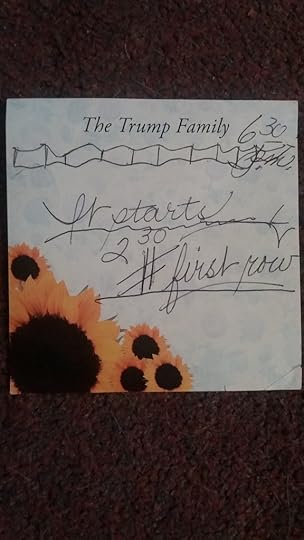
A REAL LIFE MYSTERY!
When I got this handsome hardback I saw it was previously owned by Queens Library. I get a lot of ex-library books. Then I found the following curious item in between one of the pages :
I can't really believe this relates to THE Trump Family... but could there be another? And if it is one of THEM, why would they be borrowing books from Queens Library? Or maybe the above notelet was given to a Trump family acquaintance who does use Queens Library?
Matthew Thomas' debut, and thus far only, novel We Are Not Ourselves follows three generations of Irish Americans in Queens, NY from 1951 to 2011. The story centers on Eileen Tumulty Leary who is nine when the story begins. Thomas writes of the ordinary everyday activities, desires, ambitions, failings, and achievements of his characters.
Eileen is a caretaker, the daughter of an alcoholic mother and an expansive father with a gambling habit. Hoping to move out of her poverty and into the middle class, she pursues a career in nursing. She meets an academic scientist, falls in love, marries, and they raise a son. Good things and bad things happen.
Thomas writes polished sentences that distill the essence of each of his characters. He is a wise soul who is insightful about humans, our motivations and our feelings. His tale occasionally meanders a little too much for my taste and he quickly adjusts course and I am right back there with the Learys. My only other niggle is that a few details resolve a little too neatly or are ignored.
As a partner in a 39 year year marriage, a daughter, a mother, and a friend I found this story thoroughly relatable. I enjoyed watching Eileen and Connell grow and mature. We Are Not Ourselves is a tribute to life and resilience and a darned good read.
Thanks to my GR friend Carol for passing on her book to me.
"If I could make days last forever / If words could make wishes come true / I'd save every day like a treasure and then / Again, I would spend them with you." Croce, Time in a Bottle, 1972
An elegiac novel to a committed wife whose husband suffers early onset Alzheimer's. I found particularly moving her ability to adapt and accept and cope with the loss of her dreams of a husband who's a dashing, successful professor arriving each evening to a beautiful home in the perfect suburb, all transformed into a constant pain and loneliness as passion and all their past slowly falls away like sand through an hour glass.
A pure work of artistry in development of the characters of the wife, the husband and their son. It takes on a special meaning if you have a close family member with Alzheimer's.
I just finished reading and reviewing a novel about home, identity, and how unexpected human developments/illness can capsize lives, called THE ARSONIST, by Sue Miller. And here are those themes again, but in a much different style, plot, and story. Thomas's debut novel is an epic saga, a tersely executed but moving tale of an Irish-American family, and spans a few generations, from the early 1950s to 2011. The story predominantly focuses on Eileen Tumulty, who is a first generation American, and opens when she is just a child. However, it is her married adult life that is the heart of the novel.
The story is both broad and specific. Thomas expands his lens to incorporate Eileen's life experiences growing up in New York, her hard-bitten childhood, especially dealing with her mother's alcoholism and her father's more veiled gambling problems. At the same time, we get a sense of each era that we pass through, but just enough to strengthen the story at hand. Too, as neighborhoods change or gentrify, we see how they evolve from what preceded them. The details of different suburbs in New York City make them come alive, both physically, socially, and emotionally--an analogy to how people evolve in families. Each generation leaves its fingerprint on the next one. Eileen, in her quest for self-improvement, and her status-conscious nature, is tenacious in her ambitions to climb the ladder of success, "the ineffable something she'd been chasing."
Eileen loves to entertain, and to take pride in her home. Her husband, Ed Leary, a quirky academic/scientist, cares little for furnishings and material trappings. He cares about his work and his students, and playing baseball with their son, Connell. Ed has no aspirations to attain financial wealth, especially if it means sacrificing his principles and giving way to what he calls the decadence of capitalism and consumerism. It is all about the students to him. He has no interest in being an administrator, dean, or corporate executive, positions that were offered to him but that he turned down. Eileen was frustrated at his complacency; she yearned for Ed to aspire for more, specifically a climb to the top of the food chain.
"She needed him to be her partner, because she loved him terribly...and so she was going to save him from himself...He needed a real home no less than she did. His mind had grown smaller as he'd bunkered himself in his ideals...He needed to regroup, to see new possibilities, to think bigger than ever. If there was anything she could help him with, it was thinking big."
Life throws some curve balls at the Leary family, and what is most vivid about the book is the gravitas of Eileen, Ed, and Connell. Eileen is the polestar of the family, and I deeply felt every twist and turn in her life. There are chapters devoted to her husband and son, but it was mostly though Eileen's eyes that we experienced their lives.
Despite the large page count, the pages move swiftly--it isn't dense and wordy. The prose is lean and assured, and the characterizations were supple and organic. There were a few times that I felt the story editing could go a bit smoother, as far as which events were captured and which were not. Periodically, I felt I had missed something, and realized it was just that some events that happened offstage were referred to only later, and it came out slightly unnatural. There were also a few anachronisms, like "Oh, snap," said by a character in the 1990s. However, these are minor irritants, and although it may have removed me from the novel for a few seconds, it didn't have severe consequences.
I don't want to cover much detail, as the surprises and developments in the story daunted me as if I were one of the Leary family, a sort of free-fall that I felt for them when life handed them lemons. And, although Eileen is a completely different character than Scarlett O'Hara, both Irish-American women possessed a certain degree of self-possession, and, especially, resourcefulness. Both women had threats to the nature of their home and home lives (one in Civil War, the other in the everyday war of life), and yet they both persevered with determination and resolute aim. It took me no less than 75 pages to really engage, but eventually it fully absorbed my attention.
I don't think I'm qualified to declare this book a "Great American Novel," so I'll just call it a Great American Story... one whose quiet power I will long remember.
The beginning of this novel was rough. Multiple characters are thrown at you, the story seems to be going in different directions, and I was utterly confused. I was actually on the verge of putting down the book 80 pages in when something magical happened: We zoom in on the MAIN characters and things start to get interesting. This is a 600+-page-novel, and having now read it I'm thankful that I didn't put it down after all. What a wonderful, but tragic story about goals, dreams, living life in the moment, as well as disease. Actually, I had no idea that this was going to be a book about this mental disease that turns out to guide the storyline and all its characters. I found it fascinating, and I found it scary. Another thing about this novel is that it made me feel homely and autumnal. There's something about reading about a family, sticking to their side season after season, year after year, really getting to know them for better and worse, and finally not wanting to let go of them when the 600 pages are coming to a close. I felt comforted by these many pages while autumn was setting in outside my windows, and I loved it. This is a beautiful story, regardless of the characters who are not at all that likable. Actually, they're all pretty flawed and I loved them for it. I wonder how long it will take me to put this book behind me and pick up another one, because this is one of those stories that will stick with me for a time to come, because I ended up becoming so invested. Thank God I didn't put it down after just 80 pages!
I think this is a good book for those who loved A Tree Grows in Brooklyn—it could be the life of her granddaughter, starting in the suburban-most part of Queens and moving up to Westchester like a true American dreamer. In fact, this was a key difference between the two books: the girl who narrated Tree was survival focused—she didn’t have the luxury to be anything else—whereas, the woman here (who starts as a girl) is highly focused on social striving, it is the main conflict in her marriage at first, and it creates inner conflicts for her.
The fact that this was written by a man is impressive. The mother-character is full, unique, nuanced. She is clearly written with love. The story took place in more than one of my stomping grounds in NY, and I’m always tickled by this. My family made the move from The Bronx to Westchester, so lots to relate to. On the flip-side, there was nothing new in this story other than the human details, and sometimes a relatable, reliable tale is just what’s needed. But I’ve been enjoying more experimental or contemporary-feeling works lately, and this gets lost in the noise.
I will say that I’m usually more drawn to the sections in novels about childhood, but in this I thought what the author did best was later, within the marriage. I felt close enough to see something new and lovely and loving and hard in that space, and for that alone this was worth reading.
The only thing worse than reading 282 pages of this book would have been reading 283 pages of this book. That many pages equates an entire (other) novel I could have been engaged in! It felt as if Thomas was quietly observing very boring lives unfolding in front of him and decided to document it. It's too bad because the first line had me thinking I might be reading a family saga akin to 'Angela's Ashes'. The daughter, Eileen, is brought into the pub where her charismatic Irish father is easily the centre of attention. Every man refers to him for advice and laughter. Unfortunately, the characters fall flat almost immediately after this first scene. I really didn't know who they were and had no emotional investment in them whatsoever. The problems each one of them struggles with is dragged on and on and on…. Eileen (when she's all grown up) wants to move and buy a new house and wastes not only the realtor's time looking at properties she can't afford, but wastes the reader's time with unnecessary details; Ed (the husband) is behaving stranger and stranger every day and yet noone in his family (wife or son) or any of his colleagues or students, in fact, think he needs to see a doctor or get some help! They just keep shrugging his inane and obsessive behaviours off like, "That was weird… oh well!" and move on; Connell (the son) acts like he's about 8 years old in some cases (when he's in fact 14 at this point) and then acts like he's 16 in others; sometimes he's athletic, sometimes not; he gets bullied because he's a "nerd" but then doesn't want to move from this neighbourhood because he has friends. What kid getting bullied every day after school would not jump on the opportunity to get out of there? No kidding, "We Are Not Ourselves" -- you are not yourselves and I can't figure out who anyone was, honestly, because it felt like the book was on auto-repeat most of the time painfully exhausting the same scenarios over and over again and never moving forward.
Who'd a thunk it? I won this as a result of entering a Goodreads giveaway. I am a lucky First Reads winner!
Sept. 25/14: And the book has finally arrived! (Although I'm not sure how long it has been waiting in the mailbox...)
This is the story of an Irish American girl from New York named Eileen Tumulty, who, because of her less-than-ideal family situation, is forced to care for her parents and grow up too fast. She falls for an odd but endearing scientist named Ed Leary, and they are soon married with a child named Connell. Eileen sets out to make a good life for herself in spite of the fact that her husband does not always react to life's challenges the way she expects or hopes. When she discovers the reason for this, things take a very unexpected turn.
This is an ambitious and admirable novel. Its characters are vividly presented and fully fleshed out. It has some similarities to A Tree Grows in Brooklyn but is set in more modern times and takes on some different issues. Eileen, Ed and Connell are all people who think that they have everything under control, and they think that they have their futures all planned out, but they must eventually face the bleak truth that this is not the case. The novel examines how the characters' choices, sometimes wise and sometimes not, affect them and the other members of the family. How they deal with their insecurities and how they struggle to see the meaning in all of it is what gives this book its depth and its resonance.
First I should say this is a very long read. Some parts of this story held my interest, while others left me indifferent. It is often written in the third person, as such, this story is mostly told rather than felt.
It begins in the 1950's childhood of our main character Eileen. Coming from a painful Irish immigrant background, Eileen wants more out of life. If fact, this is the main theme of the story. She is always looking for greener pastures, cares only what others may think of her, and believes having more is what life is about. This is "The American Dream" which carries itself throughout this book.
Eileen chooses a husband who is refined and sentimental. In doing so, she soon realizes that he miserly and content with his life as it is. While something is happening to her husband at a much deeper level, there is no attempt to understand, only a deeper drive for more. Eileen has trouble conceiving and even suffers a miscarriage, all the while being indignant and jealous of friends who can. When she finally conceives later in life, it is all about being the "perfect" family. The child himself grows up indifferent and as such is reluctant to help, even when he is desperately needed.
While I understand the need to better oneself, I believe this comes from the inside not the outside. I found this book interesting in what one believes is success, especially starting out with so little. But, I mostly found it sad that in so doing, nothing matters but the material.
Finally finished this one and I must say it was a drag. Talk about a downer of a book! Eileen really is one of those glass half empty (or possibly fully empty) type characters. She really needed to stop looking in other people's windows for that will never make you happy. All in all a "low Lifting" read that one needs to take Zoloft after finishing.
Thanks to NetGalley and Simon and Schuster for this ARC ******************************************************* 3.5 if I could give half stars.
There are no perfect people in this book . I liked them one minute and didn't like them the next and then liked them again. That's pretty much how I felt about the book overall because for me it's really a character driven story rather than one that is driven by the plot.
A lot of ground is covered here. The early part of the book is actually my favorite part, even though there are heartbreaking moments with 8 year old Eileen dealing with the problems of her Irish immigrant parents. Her mother is an alcoholic and her father, though well respected in the community is a gambler. At times, this part of the story reminded me a little of the quiet beautiful writing of Alice McDermott.
Given her tough childhood, it makes perfect sense that Eileen wants bigger and better things in life – a bigger house, a more prestigious neighborhood – what she sees as a better life and you can’t fault her for those desires. She marries Ed, a scientist and professor and believes that together they will acquire the house and the better life that she envisions. Shortly after their marriage, Eileen becomes disillusioned with her marriage, as it becomes clear that she and Ed, no matter how much they love each other, do not want the same thing. My least favorite part of the book was the pages and pages of Eileen whining and plotting about how to get that better house.
This is about more than just a house, though. It’s about ordinary people trying to live their day to day lives with their dreams, aspirations and daily burdens. Ultimately, it’s about these characters, Eileen, Ed, and their son Connell finding out who their real selves are in the face of devastating illness that changed everything in this family.
This is a great debut for Matthew Thomas and I look forward to what he will write in the future.
This is an almost perfect novel, the simple yet complicated story of the Leary family trying to attain a slice of The American Dream. Eileen, Ed, and Connell Leary will live on through their heartbreaking, somber journey into dark territory that will threaten their very livelihoods.
Eileen's story will especially break your heart- but she keeps up appearances, and her pragmatism and iron will is definitely something that is incredibly human and maddeningly annoying at the same time.
Mr. Thomas's treatment of Alzheimer's Disease is also incredibly sensitive and straightforward which packs a punch especially in the later half of his extremely ambitious and gripping work of art.
Meticulous and ponderous, Matthew Thomas's debut novel, We Are Not Ourselves spans several decades, from a classic New York Irish immigrant story to the grinding tragedy of dementia and health care in the 21st century United States (at least prior to the Affordable Care Act).
I've just lost a loved one to Alzheimer's and there is tremendous mercy to be realized in the relatively short span of time between diagnosis and death—only a few years and only in the final months was the decline as devastating as what is portrayed in We Are Not Ourselves. Still, the descriptions of what patient and caregivers endure as the brain slips into the shadow of dementia are chilling, heartbreaking, and painfully familiar.
Despite the connection to the themes, and many beautifully written passages, I struggled to connect with much of the narrative. It often read like a laundry list of events, rather than a story of flesh and heart. The relevance of Eileen Tumulty's childhood, her Irish immigrant parents, her mother's alcoholism, her father's conflicting public and private personas is lost as the decades roll on and Eileen becomes someone else entirely. That she is largely insufferable is not a detriment to the story-I have little patience for readers who have little patience for "unlikeable" characters-but the immigrant story seems to belong to a different book.
What we can and must endure for those we love is deeply private and personal; Matthew Thomas shows us the terrible costs exacted by dementia: the tragic loss of money, time, memory, patience, energy, vitality, and hope.
“Polished prose” (The New York Times), “epic of small events” (Los Angeles Times) and “extraordinary portrait of Alzheimer’s disease” (The Guardian). I would have to agree with this last comment about the depiction of Alzheimer’s but not with most of the praise given to this first novel.
I struggled with it, exasperated on almost every page by both the emphasis on too many unnecessary details on one hand with not enough illuminating details on the other. Then, there’s the often cumbersome writing – the frequency of sentences so chunky and so lengthy that I had to reread them several times. Here’s one example:
“He asked her to get him another napkin, because they kept them behind the counter and it would have required some negotiation on his part to get one, and she felt a surge of connection to him that made all the nights of his holding her settle in, like a dog going to sleep with a sigh by a fireplace, and she wanted to reach out and touch his face, but she knew that she would never be with him, that something about the circumstances of how they’d come together made that impossible, that their lives were too different, too incommensurable, and that while they’d had this thing that she saw meant more to her than she’d understood while it was happening, it too, now, was gone.”
Reviewers have said it took Thomas ten years to write this book. I have to admire his tenacity but find it off-putting that he manages to lose the reader at certain points. The character of Virginia is a good example. It took me a while to remember that she was the woman Eileen met once, thirty years earlier in a store’s dressing room. Now living in her desired upscale neighborhood, Eileen is determined to have Virginia be aware of her improved economic status. So, after their first and only meeting thirty years earlier Eileen drives to Virginia’s house to confront her. Really?
On the positive side, reviewers have hailed the author’s depiction of Alzheimer’s disease. My criticism of this part of the novel is the fact that while Eileen is a highly trained and experienced nurse, she doesn’t recognize the need for her husband to wear a medical alert bracelet, even after he has deteriorated dramatically and she has allowed him to walk to town where he disrupts traffic. It is only when Ed’s disease reaches the ultimate point of disorientation that Eileen finally yields.
I muddled through to the end of the book knowing that my personal opinion is at odds with those of many critics. I think that additional editing might have made me somewhat more satisfied.
This is as close to perfect as you're going to get, not just from a debut novel, but from any novel, period. There's such great heart in here. Primarily, the story focuses on Eileen Leary, a tough-as-nails nurse originally from Woodside, Queens, but each member of the family—Big Mike, Eileen's father; Ed, her husband; and Connell, her son—gets his due. You feel irretrievably drawn to all of them, so that every heartbreak, either minor or major, becomes your heartbreak and grips you long after you've put the book down, whether it's at the end of the first chapter or the last. (I am not ashamed to admit that this book had me in tears several times during rush hour on the Long Island Railroad.) Thomas pulls no punches. Each character endures his or her share of failure and suffering, but redemption is always close by, either in the form of fatherly advice on a pilgrimage to Cooperstown, or in the day-to-day selfless tasks Eileen must perform for her husband in the face of tragic illness.
As far as the prose goes, there were too many moments to count in here that left me awestruck. Nearly every page had something on it I wanted to highlight, underline, and commit to memory. What you have here is a work of a genius, but he's a genius with a heart as big as his brain. Despite Thomas's obvious great gifts and talents—and they are truly astounding—it's his great love and understanding of humanity that make it such a special read.
When a debut book sparks a bidding war on both sides of the Atlantic, the inevitable question is, “Is it worth all the hype?”
The answer, I’m pleased to say, is mostly “yes.”
Oh sure, there are some quibbles. The opening 100 pages – the background information that fleshes out the characters – could be edited down a bit. A very minor character appears in the second half of the book and I had to wade back through pages to remind myself who she was. Another minor character’s part could easily have been written out. And so on.
But in general, this is a page-turning novel that will easily appeal to both literary and mass readers because it’s so darn good. The focal character is Eileen Leary – wife, mother, nurse, and striver. Upwardly mobile, she marries Ed, a man who is, in many ways, her opposite: a reliably knowledgeable man who lacked the tolerance for superficial interaction, a scientist and professor. Together, they welcome a son, Connell, who becomes the center of their lives.
But – to paraphrase George Bernard Shaw – men dream and the gods laugh and make other plans. The family is tested in an unforeseen way. Each of them must strive to figure out what’s important and what’s authentic in a life where the future is shady and the rules have been turned upside-down.
This is a book that poses questions that each of us have mulled over in our minds. How do we claim our own lives and live by our own inner radar…as opposed to what we THINK we want? What makes a life worth livable? How do we survive when the odds are long? What endures when little else remains?
Matthew Thomas creates an authenticity in this story and breathes life into his characters. Without giving anything away, the epilogue is beautifully written and encapsulates the book’s meaning and purpose. My best guess is that We Are Not Ourselves will be leading the best-seller list when autumn comes around. 4.75.
I wasn't sure what I expected when I started this, but I loved, loved. loved this book.
Thomas tells a real story, of every day people, sometimes not likable people, sad people who are living a real life. His characters are so gritty. Overachievers, quiet men, confused children...all struggling to fit together. The story follows a family as they grow apart and back together.
There is tragedy and strength in this story and I will say there were parts I cried through.
His characters and their lives touched me, more that a book has in quite some time. This is not an epic family saga, a huge dramatic display. It is a quiet story, of love, of ambition, of loss, of acceptance, of growing older and wiser.
WE ARE NOT OURSELVES by Matthew Thomas is a novel that starts off with a bang – the murder of a frog and a father abusing his son for it. Unfortunately, the bang fizzles quickly. The opening scene was something this reader wants to know more about – who the boy and the father are, for example. This reader is disappointed.
Thomas moves swiftly from the frog and the abuse to the small daughter of Irish immigrants to New York City. There is no little boy in sight.
Eileen Tumulty is interesting enough for a while.
Not for long, but for a while.
She grows from a wide-eyed girl ready to conquer the world to a jaded young woman in a very short span of time. Her father dotes on her and her mother mostly ignores her. There’s a boarder in their house who plays the clarinet and he’s interesting but he disappears almost as fast as the boy and the frog.
As girl children of immigrants, and girl children in general, are wont to do, Eileen marries a man she figures she must love. It’s a very odd sort of love, to be honest. Mostly, Eileen and Ed are ships passing in the night. The night being, of course, when Thomas makes the point again and again that marital relations are just fine in bed.
When they have a son after years of trying and failing, everything starts to crumble.
This seems due in part to Ed’s total disinterest in family and marriage and the constantly evolving racism that grows in Eileen. She is absolutely convinced that she is not racist but anyone who reads this book will see that she is. And she really could do something about it. But she doesn’t.
All this happened in a quarter of the book. I stopped reading when my Kindle told me I was at 25% and I realized I no longer particularly cared what happened to these people.
I’m still a little curious about the boy who murdered the frog, but I’m not that curious.
The blurb that attracted me to this book on NetGalley mentioned the words masterwork, powerfully moving, epic in scope, heroic in character…
I didn’t get those things. I’m sure someone else will.
(I received a copy of WE ARE NOT OURSELVES via NetGalley in return for an honest review. My thoughts are my own. This review will be cross-posted on NetGalley, Goodreads, and my blog.)
Spectacular. I cried through the last third, and I'm not much of a crier. And I found myself constantly astounded that this is a first novel. Six hundred pages and none of it wasted.
4.5 stars: The press calls this a family saga; I would refer to it as an epic family saga. Redundant, perhaps, but it deserves redundancy. Luckily, I did not realize how long the novel is, because I doubt I would have read it. Don’t be intimidated by the 600+ pages (as I would have been). It reads easily and smoothly. There wasn’t a moment that I was distracted, bored, or tired.
Also the press states that it’s destined to be a classic, with which I whole-heartedly concur. Matthew Thomas captures the struggles of the American Dream of a second-generation immigrant family in the NYC area.
The protagonist, Eileen Tumulty, is born to Irish immigrant parents. As Eileen grows, she becomes determined to have a better life than the one she was born into. She becomes frustrated with her station in life and the limits put on her from society and economics. But she sees there’s more out there than what she has as a child.
With this inner drive, she fights for a solid education and seeks a husband that will further her in her dream. She finds Ed Leary, a neuroscientist who is not only brilliant, but also a true gentleman. Eileen is off and running to complete her dream.
As in life, her dreams are derailed by, well life. Thomas writes so well, that I am amazed he is a young man and not a middle-aged woman. As a reader, you feel Eileen’s frustrations, struggles and dreams. You understand her husband Ed, her son Connell and all the other characters, major or minor. Thomas gets into the nitty-gritty of humanity. No character in the novel is glorified or sainted. Thomas writes beautifully and cleanly.
After reading the novel, I was motivated to research Thomas. In the novel, Ed Leary has health issues that leave his family in turmoil. As I read, I felt there was an authenticity that could not be without personal knowledge. Thomas’s father did indeed suffer from the same affliction as Ed Leary; Thomas admits that he used personal experiences in his novel. He also wanted to portray the fragilities of humans as they deal with suffering; this includes family, friends, work colleagues, and the public. Thomas elucidates the human condition. He also makes the reader aware of yet another area of our health care system that is remiss.
This is pure literature of the 20th century. I highly recommend it. Plan to spend some time with this novel, as it is engaging and deeply moving. You will see yourself, your neighbors, and your community in this tome.
Raw emotion-that is what I felt reading We Are Not Ourselves. This debut work is about a family…not the wider world or the major events of the more than six decades it covers, just a family. Not even an extraordinary family, just a typical American family with so many dreams and aspirations-some of which will be accomplished, but many more will be rationalized or compromised away.
This book will leave you thinking deeply about your own life, your family and your place in the world. Stunning beautiful prose and the characters were so vibrant-I LOVED IT!!!
Not all aspects of the novel are entirely satisfactory but the characterisation is strong,and interaction of the characters in this Irish American family is handled very well by the author.The plot is linear and predictable and overall the text could have been condensed.Nonetheless a thoroughly enjoyable read and I award 4 stars
There were times in the early stages of reading this book that I was certain it would only get 3 stars from me. It wasn't badly written, but not beautifully written. It felt at times as though chunks of the story were missing or skipped over, and story characters were a little confusing in their thoughts and actions. Not the kind of writing I wanted to devote 600 pages to, but it was for a book club assignment, so I needed to persevere. But then Eileen, her husband Ed, and their son Connell are dealt a blow from life, and their efforts to cope with this thing are so achingly rendered by this author that my heart broke into pieces. They are good people, hard-working people trying to live the American Dream. But life happens, and the dream has to take a backseat to reality, or as one character states, "their former future life. The ghost of the life they almost had." This book was a difficult read because of the subject matter which I won't state here because it's a spoiler, but it is something that can happen to any of us, and which thousands of people are dealing with right now. That also makes it scary, and illuminating, and all the more heart-breaking. But, as Ed writes to his son Connell in a letter, "It is worth something to be a good man. It cannot be worth nothing to do the right thing." Yes, to all of us, men and women, who try to do the right thing even when it's hard, even when we're tired, even when it's impossible, this book celebrates that effort. Recommended only to readers able to take a blow to the guts, but worth the time and effort in my case.