

What do you think?

Shutting Out the Sun: How Japan Created Its Own Lost Generation
The world’s second-wealthiest country, Japan once seemed poised to overtake America. But its failure to recover from the economic collapse of the early 1990s was unprecedented, and today it confronts an array of disturbing social trends. Japan has the highest suicide rate and lowest birthrate of all industrialized countries, and a rising incidence of untreated cases of depression. Equally as troubling are the more than one million young men who shut themselves in their rooms, withdrawing from society, and the growing numbers of “parasite singles,” the name given to single women who refuse to leave home, marry, or bear children.
In Shutting Out the Sun , Michael Zielenziger argues that Japan’s rigid, tradition-steeped society, its aversion to change, and its distrust of individuality and the expression of self are stifling economic revival, political reform, and social evolution. Giving a human face to the country’s malaise, Zielenziger explains how these constraints have driven intelligent, creative young men to become modern-day hermits. At the same time, young women, better educated than their mothers and earning high salaries, are rejecting the traditional path to marriage and motherhood, preferring to spend their money on luxury goods and travel.
Smart, unconventional, and politically controversial, Shutting Out the Sun is a bold explanation of Japan’s stagnation and its implications for the rest of the world.
In Shutting Out the Sun , Michael Zielenziger argues that Japan’s rigid, tradition-steeped society, its aversion to change, and its distrust of individuality and the expression of self are stifling economic revival, political reform, and social evolution. Giving a human face to the country’s malaise, Zielenziger explains how these constraints have driven intelligent, creative young men to become modern-day hermits. At the same time, young women, better educated than their mothers and earning high salaries, are rejecting the traditional path to marriage and motherhood, preferring to spend their money on luxury goods and travel.
Smart, unconventional, and politically controversial, Shutting Out the Sun is a bold explanation of Japan’s stagnation and its implications for the rest of the world.
352 pages, Hardcover
First published January 1, 2006
Ratings & Reviews
Friends & Following
Create a free account to discover what your friends think of this book!
Community Reviews
Displaying 1 - 30 of 144 reviews

February 24, 2009
One of the things you learn about Japan when you get here - and you learn it pretty quickly - is that there can be a vast difference between the appearance of Japan and the reality of it. The faces that people show you, or even that the city shows you, is not necessarily their true face.
Take Kyoto as an example: it prides itself on being a city of traditional culture, the touchstone of all that is Truly Japanese. When you first see it, though, you think, "Really? Because it looks like a big ol' jumbled-up city to me." And it does - aside from the temples, which remain more or less relegated to the edges of the city, the vestiges of Old Japan have been swept away in favor of concrete and glass. Kyoto Station is a glimmering lump in the middle of the city, and Kyoto Tower, as many have said, is a stake through its heart. But ask anyone and we'll say, "Kyoto is a beautiful city." Because that's the way it's supposed to be.
This is how it is to live in Japan. There is a gulf between the true nature of things and the way we want them to be. For someone born and raised here, this kind of thinking is taught from birth, and without the ability to divide oneself in twain, life in Japanese society can be very difficult. These two states have names, too - tatemae is the face that you present to the world, the one that everyone expects of you. Honne is your "true self," the feelings and thoughts that you hold in reserve so as not to cause conflict with the greater society around you.
The origins of this dichotomy are unclear, although there are those who attribute it to a culture with roots in collective agriculture. If your life and the lives of everyone in your village depends on getting the rice crop in, you have to learn to hold back certain feelings or desires for the good of the group. You sublimate yourself into the group structure, because that's what has to be done. So, tatemae isn't a lie, or a deliberate performance designed to deceive people. It's a bargain between oneself and society - "This is what society needs me to be? Fine. I can be that." What remains is honne, the inner self that society cannot touch, but can never see.
So what happens when someone can't hold up their end of this social contract? What happens when the modern world makes demands of people that this ancient compact can't handle? Well, that's when things start to go wrong....
For many years, this bargain between the individual and society worked, mainly because society kept up its end of the deal. People were protected, employed, and given a place in the world, whether it was the feudal culture of the Edo era, the wartime mobilization of the 30s and 40s, or the indomitable Japan Inc. of the post-war years. As the world progressed, however, it soon became evident that the old ways weren't enough. Japan needed to change, or face stagnation and irrelevance.
In this book, Zielenziger tries to figure out how Japan got into the state it's in - a decade and a half of stagnation, with no end in sight, and the very real possibility of a slide into graying irrelevance by the middle of the century. To do so, he looks first on the human scale, at the people who have given up on Japan's social contract - the hikkikomori.
Like so many other things Japanese, the hikkikomori phenomenon is said to be unique to Japan. Not quite agoraphobics, not quite dropouts or depressives, the hikkikomori are people - usually men - who have given up on the world. They usually live in a single room, often in the homes of parents who enable their hermit lifestyle, and refuse to come out. They sit in there and read, or watch TV, or think. They see no place for themselves in the outside world, and so they give up on it. The men that Zielenziger interviewed suggested that the outside world was too much for them. In many cases they were bullied by others - a pattern of social control that is unfortunately ingrained here - or they simply looked at their parents and thought, "Is this what I will become?"
An American child, faced with the knowledge that he doesn't fit with the rest of the world, will probably see it as an opportunity to shape his own identity. A hikkikomori sees it as a personal failure. He knows how Japanese society works, and rather than blame the world for not accepting him, he blames himself for not being able to fit in. Thus, retiring from the world is seen as the only option available, other than suicide. Some hikkikomori spend years in their rooms, refusing to speak even with their parents, who - often out of a sense of shame or the nurturing love known as amae - support their boys' choice of lifestyle.
At the other end are the people who give their identity over to an outside source. In more dangerous cases, this outside source might be a cult, like the Aum Shinrinkyo group who carried out the deadly sarin attack against the Tokyo subway in 1995. A more benign manifestation, however, is brand mania. Zielenziger talks to women who identify themselves through the brands they buy. These people will spend money they don't have in order to get a bag from Louis Vuitton or Gucci or Chanel. They distinguish themselves with their brand identity, willingly giving up their own in the process. In a country where one can no longer trust the government to look after your best interests, or the media to tell you the truth, or business to give you a job, putting all your faith in Louis Vuitton - with its worldwide reputation for quality - seems to be a good idea.
It's a nation in crisis, according to Zielenziger . It's a country that's gone from feudalism to full modernity in only a century and a half, but the culture hasn't changed nearly as much as the country has. It's a bustling, 21st-century nation built on a foundation that was laid in the 17th century, and things are starting to fall apart. It's a country that puts society before the individual, but that premise is cracking under the weight of a world that values individuality. It's a place where responsibility is distributed and accountability doesn't exist, where mistakes go unexamined lest they bring shame upon those who made them, and where the past is a thing that can be easily ignored if it troubles you. Zielenziger believes that the underlying social structure of Japan is holding it back, leading the entire country to another withdrawal from the world. Much like the hikkikomori that no one likes to talk about, Japan may one day find itself alone and isolated, not knowing its place in the world and not knowing how it can get back to what it used to be.
The book is quite a read, going from small one-on-one interviews to historical and sociological analyses, but it is overwhelmingly negative in tone. Zielenziger isn't wrong, necessarily, but he is of the mind-set that Japan is irrevocably screwed and that only Western cultural intervention can save it.
He lays the hikkikomori problem - and the problem of parasite singles, NEETs, and all the other dysfunctional youth - at the foot of Japan's collectivist culture, as well as the intense bond of amae that exists between the parent and child. While he doesn't say it in so many words, he does imply that the traditional social structure of Japan is simply incapable of keeping Japan competitive in the modern era. He believes that Western values, especially those stemming from Christianity, are what Japan needs to survive.
The bit about Christianity seemed to come from left field, but he does make a case for it. Christianity, he believes, places the onus of salvation on the individual. It is a person's works (or faith) that ensure his place in the afterlife. This focus on one's personal responsibility, and ultimate judgment, fosters a Self that is harder to suppress. From that strong sense of individuality, a culture can foster more competition, thereby preventing stagnation.
There's a long, not entirely interesting chapter on Korea that he uses to illustrate this point. Unlike Japan, Korea - once called "The Hermit Kingdom" - found itself facing economic turmoil and got themselves out of it. Not because Korean ways were better, but because they knew that if they stuck to their traditions they'd be screwed. Korea is a nation strongly influenced by Christianity, and the individuality that Christianity fosters, suggests Zielenziger, is what gave Korea the courage to risk social turmoil for the betterment of their nation.
There may be something to this, but I doubt that adopting Christianity en masse will save Japan from Zielenziger's dire future. Honestly, it was tough to stay objective while reading this, mainly because of the gulf between what I see, having lived here for the better part of a decade, and how Zielenziger describes the place. If I didn't know better, I would have read this and thought that Japan was a zombie nation, populated either by hermits or soulless consumers. From what I've seen, I know that this is not the case.
Granted, I haven't completely immersed myself in the culture, mainly because that's an extremely difficult thing for a non-Japanese to do. Most of the people I talk to are my students, and people with the desire and the resources to study English are probably not an accurate cross-section of the country. So I don't claim to have any more insight into the Japanese mind than Mr. Zielenziger does, but from my experience it seems that all hope is not lost. Yes, the government is a faceless bureaucracy, the media is completely complacent and the corporate community that once offered jobs for life has vanished. But Japan has proved resilient in the past, adapting to great changes that were thrust upon it from the outside. And a quick look at Japanese history shows that, when the times need it, people emerge to challenge the established order.
That's what Japan needs now. Someone - or, more effectively, a group of someones - to stand up, stick out and risk themselves for the betterment of their country. It won't be easy - revolution never is - but it needs to be done. Perhaps one day, instead of shutting themselves in their rooms, there might be young men and women who take to the streets and show Japan that there is value in the individual. I hope I get to see it.
Take Kyoto as an example: it prides itself on being a city of traditional culture, the touchstone of all that is Truly Japanese. When you first see it, though, you think, "Really? Because it looks like a big ol' jumbled-up city to me." And it does - aside from the temples, which remain more or less relegated to the edges of the city, the vestiges of Old Japan have been swept away in favor of concrete and glass. Kyoto Station is a glimmering lump in the middle of the city, and Kyoto Tower, as many have said, is a stake through its heart. But ask anyone and we'll say, "Kyoto is a beautiful city." Because that's the way it's supposed to be.
This is how it is to live in Japan. There is a gulf between the true nature of things and the way we want them to be. For someone born and raised here, this kind of thinking is taught from birth, and without the ability to divide oneself in twain, life in Japanese society can be very difficult. These two states have names, too - tatemae is the face that you present to the world, the one that everyone expects of you. Honne is your "true self," the feelings and thoughts that you hold in reserve so as not to cause conflict with the greater society around you.
The origins of this dichotomy are unclear, although there are those who attribute it to a culture with roots in collective agriculture. If your life and the lives of everyone in your village depends on getting the rice crop in, you have to learn to hold back certain feelings or desires for the good of the group. You sublimate yourself into the group structure, because that's what has to be done. So, tatemae isn't a lie, or a deliberate performance designed to deceive people. It's a bargain between oneself and society - "This is what society needs me to be? Fine. I can be that." What remains is honne, the inner self that society cannot touch, but can never see.
So what happens when someone can't hold up their end of this social contract? What happens when the modern world makes demands of people that this ancient compact can't handle? Well, that's when things start to go wrong....
For many years, this bargain between the individual and society worked, mainly because society kept up its end of the deal. People were protected, employed, and given a place in the world, whether it was the feudal culture of the Edo era, the wartime mobilization of the 30s and 40s, or the indomitable Japan Inc. of the post-war years. As the world progressed, however, it soon became evident that the old ways weren't enough. Japan needed to change, or face stagnation and irrelevance.
In this book, Zielenziger tries to figure out how Japan got into the state it's in - a decade and a half of stagnation, with no end in sight, and the very real possibility of a slide into graying irrelevance by the middle of the century. To do so, he looks first on the human scale, at the people who have given up on Japan's social contract - the hikkikomori.
Like so many other things Japanese, the hikkikomori phenomenon is said to be unique to Japan. Not quite agoraphobics, not quite dropouts or depressives, the hikkikomori are people - usually men - who have given up on the world. They usually live in a single room, often in the homes of parents who enable their hermit lifestyle, and refuse to come out. They sit in there and read, or watch TV, or think. They see no place for themselves in the outside world, and so they give up on it. The men that Zielenziger interviewed suggested that the outside world was too much for them. In many cases they were bullied by others - a pattern of social control that is unfortunately ingrained here - or they simply looked at their parents and thought, "Is this what I will become?"
An American child, faced with the knowledge that he doesn't fit with the rest of the world, will probably see it as an opportunity to shape his own identity. A hikkikomori sees it as a personal failure. He knows how Japanese society works, and rather than blame the world for not accepting him, he blames himself for not being able to fit in. Thus, retiring from the world is seen as the only option available, other than suicide. Some hikkikomori spend years in their rooms, refusing to speak even with their parents, who - often out of a sense of shame or the nurturing love known as amae - support their boys' choice of lifestyle.
At the other end are the people who give their identity over to an outside source. In more dangerous cases, this outside source might be a cult, like the Aum Shinrinkyo group who carried out the deadly sarin attack against the Tokyo subway in 1995. A more benign manifestation, however, is brand mania. Zielenziger talks to women who identify themselves through the brands they buy. These people will spend money they don't have in order to get a bag from Louis Vuitton or Gucci or Chanel. They distinguish themselves with their brand identity, willingly giving up their own in the process. In a country where one can no longer trust the government to look after your best interests, or the media to tell you the truth, or business to give you a job, putting all your faith in Louis Vuitton - with its worldwide reputation for quality - seems to be a good idea.
It's a nation in crisis, according to Zielenziger . It's a country that's gone from feudalism to full modernity in only a century and a half, but the culture hasn't changed nearly as much as the country has. It's a bustling, 21st-century nation built on a foundation that was laid in the 17th century, and things are starting to fall apart. It's a country that puts society before the individual, but that premise is cracking under the weight of a world that values individuality. It's a place where responsibility is distributed and accountability doesn't exist, where mistakes go unexamined lest they bring shame upon those who made them, and where the past is a thing that can be easily ignored if it troubles you. Zielenziger believes that the underlying social structure of Japan is holding it back, leading the entire country to another withdrawal from the world. Much like the hikkikomori that no one likes to talk about, Japan may one day find itself alone and isolated, not knowing its place in the world and not knowing how it can get back to what it used to be.
The book is quite a read, going from small one-on-one interviews to historical and sociological analyses, but it is overwhelmingly negative in tone. Zielenziger isn't wrong, necessarily, but he is of the mind-set that Japan is irrevocably screwed and that only Western cultural intervention can save it.
He lays the hikkikomori problem - and the problem of parasite singles, NEETs, and all the other dysfunctional youth - at the foot of Japan's collectivist culture, as well as the intense bond of amae that exists between the parent and child. While he doesn't say it in so many words, he does imply that the traditional social structure of Japan is simply incapable of keeping Japan competitive in the modern era. He believes that Western values, especially those stemming from Christianity, are what Japan needs to survive.
The bit about Christianity seemed to come from left field, but he does make a case for it. Christianity, he believes, places the onus of salvation on the individual. It is a person's works (or faith) that ensure his place in the afterlife. This focus on one's personal responsibility, and ultimate judgment, fosters a Self that is harder to suppress. From that strong sense of individuality, a culture can foster more competition, thereby preventing stagnation.
There's a long, not entirely interesting chapter on Korea that he uses to illustrate this point. Unlike Japan, Korea - once called "The Hermit Kingdom" - found itself facing economic turmoil and got themselves out of it. Not because Korean ways were better, but because they knew that if they stuck to their traditions they'd be screwed. Korea is a nation strongly influenced by Christianity, and the individuality that Christianity fosters, suggests Zielenziger, is what gave Korea the courage to risk social turmoil for the betterment of their nation.
There may be something to this, but I doubt that adopting Christianity en masse will save Japan from Zielenziger's dire future. Honestly, it was tough to stay objective while reading this, mainly because of the gulf between what I see, having lived here for the better part of a decade, and how Zielenziger describes the place. If I didn't know better, I would have read this and thought that Japan was a zombie nation, populated either by hermits or soulless consumers. From what I've seen, I know that this is not the case.
Granted, I haven't completely immersed myself in the culture, mainly because that's an extremely difficult thing for a non-Japanese to do. Most of the people I talk to are my students, and people with the desire and the resources to study English are probably not an accurate cross-section of the country. So I don't claim to have any more insight into the Japanese mind than Mr. Zielenziger does, but from my experience it seems that all hope is not lost. Yes, the government is a faceless bureaucracy, the media is completely complacent and the corporate community that once offered jobs for life has vanished. But Japan has proved resilient in the past, adapting to great changes that were thrust upon it from the outside. And a quick look at Japanese history shows that, when the times need it, people emerge to challenge the established order.
That's what Japan needs now. Someone - or, more effectively, a group of someones - to stand up, stick out and risk themselves for the betterment of their country. It won't be easy - revolution never is - but it needs to be done. Perhaps one day, instead of shutting themselves in their rooms, there might be young men and women who take to the streets and show Japan that there is value in the individual. I hope I get to see it.

July 5, 2012
I enjoyed the first 1/3rd of this book, but as soon as it fell into `the only way to save Japan is through Christianity`, I was so put off, I could barely finish it.
While I agree with a lot of what the author says about the future of Japan and about the need for some kind of revolution, this whole book felt like some left over journalism thrown together and sellotaped into a book. Such an interesting topic, but very poorly executed.
While I agree with a lot of what the author says about the future of Japan and about the need for some kind of revolution, this whole book felt like some left over journalism thrown together and sellotaped into a book. Such an interesting topic, but very poorly executed.

August 9, 2019
Michael Zielenziger’s goal in this book is to show how Japanese culture produced the hikikomori, the young people who use extreme measures to isolate themselves from the world. He shows how the phenomenon is unique to Japan, by drawing parallels to the seclusion of Princess Masako, by comparing the post war experience of Japan and Korea and through commentary on the unique social, historical and economic forces that created modern day Japan. This broad agenda makes for a sprawling book only about 1/3 or which directly pertains to the hikikomori.
The portraits of the hikikomori and their families are the 5 star highlights of the book. In this you see a different Japan than the tourist sees. You learn of a culture of bullying, competition, conformance and shame. Some young people, mostly male, look at the compromised life of their fathers while they are facing social and/or academic failure at school and become immobilized by fear of not fitting in. They are indulged by the family that is ashamed and helps the hikikomori to hide by allowing him (usually him) to cover bedroom windows and by putting their food outside their bedroom doors. Some of these parents have not seen their sons for years. Some of the hikikomori, when they see their parents are violent; they may say something like “You have wrecked my life” as they assault them.
There is commentary on how widespread this is, the problems of parents who can overcome shame only to find very little help available and the hikikomori’s difficulties in “coming out” without an education credential or a social network.
The author ties the problem of Japan’s low birth rate to the same circumstances that produce the hikikomori. Unlike the hikikomori phenomenon, the author seems to blame this on the women who see only obstacles in marriage (care of the inlaws – no help in raising children – husbands working 7am-9pm) almost saying women should overlook them. There is only passing recognition that the men of marriage age want women who will put up with all of this and are not able to grasp what they are asking of a potential mate.
The other parts of the book are commentaries, many quite negative, on Japan. I presume these were adapted from material by the author in his role as a journalist. A few are timeless, others, because the book is from 2007, were interesting to see how they held up.
While the part on the hikikomori is excellent, rest of the book, while informative in some parts, brings it down.
The portraits of the hikikomori and their families are the 5 star highlights of the book. In this you see a different Japan than the tourist sees. You learn of a culture of bullying, competition, conformance and shame. Some young people, mostly male, look at the compromised life of their fathers while they are facing social and/or academic failure at school and become immobilized by fear of not fitting in. They are indulged by the family that is ashamed and helps the hikikomori to hide by allowing him (usually him) to cover bedroom windows and by putting their food outside their bedroom doors. Some of these parents have not seen their sons for years. Some of the hikikomori, when they see their parents are violent; they may say something like “You have wrecked my life” as they assault them.
There is commentary on how widespread this is, the problems of parents who can overcome shame only to find very little help available and the hikikomori’s difficulties in “coming out” without an education credential or a social network.
The author ties the problem of Japan’s low birth rate to the same circumstances that produce the hikikomori. Unlike the hikikomori phenomenon, the author seems to blame this on the women who see only obstacles in marriage (care of the inlaws – no help in raising children – husbands working 7am-9pm) almost saying women should overlook them. There is only passing recognition that the men of marriage age want women who will put up with all of this and are not able to grasp what they are asking of a potential mate.
The other parts of the book are commentaries, many quite negative, on Japan. I presume these were adapted from material by the author in his role as a journalist. A few are timeless, others, because the book is from 2007, were interesting to see how they held up.
While the part on the hikikomori is excellent, rest of the book, while informative in some parts, brings it down.

April 3, 2018
I read this book hoping for an account of the hikikomori, the (estimated) one million young Japanese men who withdraw from society so completely that many of them literally do not leave their bedrooms for years at a time.
And for the first few chapters, that's what "Shutting Out the Sun" is about. However, rather than dig into the details of these isolated lives, Zielenziger spends the rest of the book trying to explain the roots of the hikikomori phenomenon through broad, structural analysis of Japanese society. And he does this, by the way, while sounding like a parody of a Western chauvinist. If all you knew about Japan came from this book, you'd think all Japanese people were alcoholic, suicidal robots, and that their society was days away from total collapse. Zielenziger spends the entire book unfavorably comparing aspects of Japanese society to America, and doesn't even bother to hide the fact he thinks the West is far superior. He also seems to believe (and pretty much states this explicitly) that the only thing that could "save" Japan would be mass conversion to Christianity.
How about we.... not.
And for the first few chapters, that's what "Shutting Out the Sun" is about. However, rather than dig into the details of these isolated lives, Zielenziger spends the rest of the book trying to explain the roots of the hikikomori phenomenon through broad, structural analysis of Japanese society. And he does this, by the way, while sounding like a parody of a Western chauvinist. If all you knew about Japan came from this book, you'd think all Japanese people were alcoholic, suicidal robots, and that their society was days away from total collapse. Zielenziger spends the entire book unfavorably comparing aspects of Japanese society to America, and doesn't even bother to hide the fact he thinks the West is far superior. He also seems to believe (and pretty much states this explicitly) that the only thing that could "save" Japan would be mass conversion to Christianity.
How about we.... not.

April 16, 2011
(2.0) Feels like loose stitching of previous reporting
Kyusik and I have this thing about journalists throwing a bunch of articles together to make some money on the side...yet we (or at least I) continue to pick up books on interesting topics only to be disappointed when the same thing happens.
Well, chalk another one up. Zielenziger didn't even try to hide this from us. The primary piece of evidence is how frequently he repeats sharing the very same interesting facts and clearly writing them as they are included for the first time (e.g. provides definitions, analogies). Some examples of his repetition that I can recall now:
that juku are so-called cram schools
that Japan is a "maternal society" whereas Western societies are "paternal"
that a particular liquor drunk frequently by businessmen is "like vodka"
that Japanese men list "sleeping" as their #1 weekend activity
that South Korea has far fewer hokikomori than Japan in part because of Korea's compulsory military service at majority
that during the 19th century, Western traders were isolated Deshima, the island off Nagasaki (where a fabulous novel, The Thousand Autumns of Jacob de Zoet, takes place incidentally)
that many Japanese firms conspire to hold shareholder meetings on the same day to minimize the presence of activist shareholders
To continue the rant, I did not appreciate his style at all...needlessly injecting himself into the exposition as though it were a narrative: "I met so-and-so at a great French bistro, and..." or "I met him in an unusual encounter...". Yes, we believe you interviewed these people, we don't need to visualize you in conversation with them over lunch. The other side of this criticism is that it's all interviews. Very little actual research appears to have been performed. Yes, it's the 'human side' of the lost generation, but meh.
And finally, he doesn't even stay on topic (further evidence of his article stitching). We spend a little time with the hokikimori (about whom I assumed this book was primarily written) into Japanese macroeconomics, globalization, its relationship with the US (and what "we" should be wary of in our foreign policy), Korea as a case study/counterexample, the rising influence of China in the region. I just couldn't really follow where he was going and never felt like he tied the second half of the book back to the Lost Generation.
All that said, I found modern Japan an interesting subject and did learn a few things that I've already shared in conversation. So it wasn't a total waste of time, just very poorly executed.
Kyusik and I have this thing about journalists throwing a bunch of articles together to make some money on the side...yet we (or at least I) continue to pick up books on interesting topics only to be disappointed when the same thing happens.
Well, chalk another one up. Zielenziger didn't even try to hide this from us. The primary piece of evidence is how frequently he repeats sharing the very same interesting facts and clearly writing them as they are included for the first time (e.g. provides definitions, analogies). Some examples of his repetition that I can recall now:
that juku are so-called cram schools
that Japan is a "maternal society" whereas Western societies are "paternal"
that a particular liquor drunk frequently by businessmen is "like vodka"
that Japanese men list "sleeping" as their #1 weekend activity
that South Korea has far fewer hokikomori than Japan in part because of Korea's compulsory military service at majority
that during the 19th century, Western traders were isolated Deshima, the island off Nagasaki (where a fabulous novel, The Thousand Autumns of Jacob de Zoet, takes place incidentally)
that many Japanese firms conspire to hold shareholder meetings on the same day to minimize the presence of activist shareholders
To continue the rant, I did not appreciate his style at all...needlessly injecting himself into the exposition as though it were a narrative: "I met so-and-so at a great French bistro, and..." or "I met him in an unusual encounter...". Yes, we believe you interviewed these people, we don't need to visualize you in conversation with them over lunch. The other side of this criticism is that it's all interviews. Very little actual research appears to have been performed. Yes, it's the 'human side' of the lost generation, but meh.
And finally, he doesn't even stay on topic (further evidence of his article stitching). We spend a little time with the hokikimori (about whom I assumed this book was primarily written) into Japanese macroeconomics, globalization, its relationship with the US (and what "we" should be wary of in our foreign policy), Korea as a case study/counterexample, the rising influence of China in the region. I just couldn't really follow where he was going and never felt like he tied the second half of the book back to the Lost Generation.
All that said, I found modern Japan an interesting subject and did learn a few things that I've already shared in conversation. So it wasn't a total waste of time, just very poorly executed.

December 23, 2011
This book touched on nearly every Japanese socio-cultural ill that has plagued my mind since I began living here . Scathing in every dimension, often backed by insightful research and careful observations, the author paints a truer picture of Japan than most books. While much of the book delves into the Hikikomori phenomenon (shut ins, those who seclude themselves from society for a variety of reasons), many elements of social interaction in modern Japanese life are discussed. It makes for an enthralling read, even frightening in its portrayal of the levels of dysfunction that follow each Japanese person from the cradle to the grave.
One of the more interesting points made, and one central to its thesis, is the idea of “social trust”. Essentially, Zielenziger argues that because of Japan’s rather agnostic sense of spirituality(Shinto with accents of Buddhism), modern Japanese are extremely hesitant to reach out to “the other”; whether that be those in different social circles or the neighbor next door. This isolating pattern is seen everywhere, from the groups that are formed in school, to the workplace, and the family. Breaking free of these imposed group relationships is nearly impossible to do, and dangerous for those who try.
Most of these “shut-ins” who stay locked in their rooms sometimes for several decades, find this psychic break from the group to be the root of their troubles. Many of these Hikikomori stories begin with the person being dubbed an outcast in their schooling days, bullied for being different. Although such ostracism exists in all societies, in many other cultures the young person finds a way to prevail, remaining eccentric, and develop in to interesting, creative adults. (albeit with some mental scars) However, the chains of group dynamics in Japan are just too strong to overcome and those who try to break free are rejected by society as a whole. It is a sad state of affairs and leads one to question how many interesting, eclectic, creative individuals are locked away in Japan’s back closets.
Altogether this is a fascinating book that gets to the heart of many issues. If read in conjunction with Alex Kerr’s works, those interested in modern Japanese society can obtain a truer picture of this complicated nation, without wearing rose tinted glasses.
One of the more interesting points made, and one central to its thesis, is the idea of “social trust”. Essentially, Zielenziger argues that because of Japan’s rather agnostic sense of spirituality(Shinto with accents of Buddhism), modern Japanese are extremely hesitant to reach out to “the other”; whether that be those in different social circles or the neighbor next door. This isolating pattern is seen everywhere, from the groups that are formed in school, to the workplace, and the family. Breaking free of these imposed group relationships is nearly impossible to do, and dangerous for those who try.
Most of these “shut-ins” who stay locked in their rooms sometimes for several decades, find this psychic break from the group to be the root of their troubles. Many of these Hikikomori stories begin with the person being dubbed an outcast in their schooling days, bullied for being different. Although such ostracism exists in all societies, in many other cultures the young person finds a way to prevail, remaining eccentric, and develop in to interesting, creative adults. (albeit with some mental scars) However, the chains of group dynamics in Japan are just too strong to overcome and those who try to break free are rejected by society as a whole. It is a sad state of affairs and leads one to question how many interesting, eclectic, creative individuals are locked away in Japan’s back closets.
Altogether this is a fascinating book that gets to the heart of many issues. If read in conjunction with Alex Kerr’s works, those interested in modern Japanese society can obtain a truer picture of this complicated nation, without wearing rose tinted glasses.

July 13, 2007
This book provides essential insight into Japan's mindset as a country of largely homogeneous citizens who still trust only those in their closest circles and its younger generation's struggle to find their place in a banquet with too few seats and too strict a dress-code. What happens when democracy is forced onto a nation that has not fought for its rights? What happens when bullying becomes an accepted form of social feedback and women are given the same tests as men, only to enter into an adulthood of limited choices? What happens to a country founded on stable employment when the jobs no longer last a lifetime?
Zieelenziger does confront intriguing and necessary questions about a nation in turmoil that insists on maintaining a placid front. I only wish the book were better organized and less lumped together, as it often seemed, that Zielenziger had laid out in the beginning why boys and girls have tended to take drastically different solutions to the crisis in their schooling, and perhaps even begun by giving us the historical foundation for the current social crises he reports, instead of leaving this analysis to the end. The answer of how to weave together the present dilemma among Japan's youth and adult population and the historical underpinnings of the crisis remains uncertain. Most books provide a glimpse of the crisis, then provide the history, then delve back into the individual cont4mporary issues and the people they affect. Zielenziger perhaps wanted to do things differently by ending on a historical note, but I don't know if this made sense narratively. And certainly he should have confronted directly the obvious gender divide in the youth's response to tremendous pressure in school.
A lumpy but fascinating read.
Zieelenziger does confront intriguing and necessary questions about a nation in turmoil that insists on maintaining a placid front. I only wish the book were better organized and less lumped together, as it often seemed, that Zielenziger had laid out in the beginning why boys and girls have tended to take drastically different solutions to the crisis in their schooling, and perhaps even begun by giving us the historical foundation for the current social crises he reports, instead of leaving this analysis to the end. The answer of how to weave together the present dilemma among Japan's youth and adult population and the historical underpinnings of the crisis remains uncertain. Most books provide a glimpse of the crisis, then provide the history, then delve back into the individual cont4mporary issues and the people they affect. Zielenziger perhaps wanted to do things differently by ending on a historical note, but I don't know if this made sense narratively. And certainly he should have confronted directly the obvious gender divide in the youth's response to tremendous pressure in school.
A lumpy but fascinating read.

Read
April 19, 2009I enjoyed this book, with one complaint.
All the information in the book comes from Zeilenziger or someone he interviews telling us "how it is." There are very few statistics or 'hard facts' anywhere, and that makes it difficult for me to imagine or care about the world Zeilenziger describes. However, it sounds like Japan's secretive attitude forces that sort of writing.
Japan faces a host of weird social issues, made incredible by the coupling of an unbelievably rigid society with a difficult past.
You can find that one sentence summary in any other review. The book itself adds details which first seemed reasonable, then incredible, then fantastic, after which point my mind could stretch no further-- yet things kept getting weirder.
If the theories espoused within the book really describe Japan, then the Japanese culture must bend its group of our species about as far away from the main branch as it can while remaining Homo Sapiens. Through the book I kept waiting for Zeilenzeiger to mention how the Japanese culture causes certain unusual genes to be expressed or something.
For example, Japanese people's brains process images differently than ours. The limited Japanese idea of 'self' does not include self-esteem, and they do not have a word for the concept. Also, the book mentions weirder things like how the institution of gonin-gumi in the Tokugawa period (1603 to 1868) supposedly removed the Japanese's ability to distinguish trustworthiness in others, and has forced them to rely utterly and completely on members of their limited 'family' group.
I recommend you check this out from a library if you like to read stuff like that.
All the information in the book comes from Zeilenziger or someone he interviews telling us "how it is." There are very few statistics or 'hard facts' anywhere, and that makes it difficult for me to imagine or care about the world Zeilenziger describes. However, it sounds like Japan's secretive attitude forces that sort of writing.
Japan faces a host of weird social issues, made incredible by the coupling of an unbelievably rigid society with a difficult past.
You can find that one sentence summary in any other review. The book itself adds details which first seemed reasonable, then incredible, then fantastic, after which point my mind could stretch no further-- yet things kept getting weirder.
If the theories espoused within the book really describe Japan, then the Japanese culture must bend its group of our species about as far away from the main branch as it can while remaining Homo Sapiens. Through the book I kept waiting for Zeilenzeiger to mention how the Japanese culture causes certain unusual genes to be expressed or something.
For example, Japanese people's brains process images differently than ours. The limited Japanese idea of 'self' does not include self-esteem, and they do not have a word for the concept. Also, the book mentions weirder things like how the institution of gonin-gumi in the Tokugawa period (1603 to 1868) supposedly removed the Japanese's ability to distinguish trustworthiness in others, and has forced them to rely utterly and completely on members of their limited 'family' group.
I recommend you check this out from a library if you like to read stuff like that.

January 16, 2011
While this book started off fascinating for me, by the end I was struggling to complete it. The information on the hikikomori were fascinating, as was much of the history, but I felt that by the end, the author drifted so far away from the hikikomori side of the book, I couldn't remember why he was discussing the issues that he was.
For a long time, probably half the book, the author discusses not only Japanese history and religion, but Korean history and religion, and compares the two. He does analyze why Japan has hikikomori whereas South Korea doesn't, despite their similarities.
I would have also liked to have learned more information on the "parasite women" of Japan. I know if I lived there that I would be considered one. It is hard to believe that even today, in the modern age, women are treated essentially as second class citizens. It's no wonder why many women choose to keep their jobs rather than get married and have children. And the costs of education! How incredible. I had no idea.
Overall the book was a fascinating read. I wonder how much has changed since the book was first published five years ago.
For a long time, probably half the book, the author discusses not only Japanese history and religion, but Korean history and religion, and compares the two. He does analyze why Japan has hikikomori whereas South Korea doesn't, despite their similarities.
I would have also liked to have learned more information on the "parasite women" of Japan. I know if I lived there that I would be considered one. It is hard to believe that even today, in the modern age, women are treated essentially as second class citizens. It's no wonder why many women choose to keep their jobs rather than get married and have children. And the costs of education! How incredible. I had no idea.
Overall the book was a fascinating read. I wonder how much has changed since the book was first published five years ago.

April 22, 2019
*Re-read March 2023 - hmm not as interesting the second time around. This is definitely being "culled" from the bookshelves. I'm not entirely sure how accurate a picture Zielenziger can give here. I think many of the issues identified by Hikikomori are actually the same as those experienced by Western kids- a severe disillusionment with the world in which we are living. It seems Western kids aren't able to just drop out of school as easily. It's annoying how the author seems to equate organised religion and especially Christianity as "the saving grace of developed nations"! Shut up man! This is a very presumptuous book in my opinion. I have no doubt there is a problem but I doubt that the author is the best person to fully explain it. 1 star.
Original review : 3.5 stars
An interesting read regarding the Hikikomori of Japan; disillusioned young Japanese who, having felt as though they've "failed society", shut themselves away in their rooms, cutting off contact to the outside world and equally rely upon yet are antagonized by their exasperated yet perhaps unsupportive parents.
The book is an interesting read which relies heavily upon verbal accounts of the phenomenon and oral histories from Hikikomori, their parents, employers, politicians, and psychiatrists alike.
Whilst the "story" is interesting, some parts of the text are a little repetitive (especially the chapters regarding Japanese economics, yawn!); and some statements appear somewhat unsubstantiated by factual evidence. The cultural aspect of this phenomenon is obviously paramount, however I did feel a bit of racial stereotyping and sweeping generalisation abound regarding the subject.
I veered from feeling extremely sorry for these disenchanted young men, to wanting to give them a figurative kick up the arse and tell them to have a shave, go and get some Vitamin D and sort your shit out!! Due to the lack of factual evidence from the psychiatric side of the argument, its difficult to tell whether the individuals suffer from crippling depression (in which case Japan needs a MAJOR overhaul in its mental health services), or if they're just spoiled brats who didn't really like school so decided to drop out, play on the computer in their rooms, expect Mum to pass dinner through the door and adopt a serious case of CBA!! This element of reading frustrated me. Another frustration was Zielenziger's occasional sanctimonious attitude regarding America, how great it is, and how helpful they are to "other states in need"!!! Really Zielenziger, which version of America are you thinking of?!!
Frustrations aside, a good read, just needs a few facts to back up the sweeping statements!
Original review : 3.5 stars
An interesting read regarding the Hikikomori of Japan; disillusioned young Japanese who, having felt as though they've "failed society", shut themselves away in their rooms, cutting off contact to the outside world and equally rely upon yet are antagonized by their exasperated yet perhaps unsupportive parents.
The book is an interesting read which relies heavily upon verbal accounts of the phenomenon and oral histories from Hikikomori, their parents, employers, politicians, and psychiatrists alike.
Whilst the "story" is interesting, some parts of the text are a little repetitive (especially the chapters regarding Japanese economics, yawn!); and some statements appear somewhat unsubstantiated by factual evidence. The cultural aspect of this phenomenon is obviously paramount, however I did feel a bit of racial stereotyping and sweeping generalisation abound regarding the subject.
I veered from feeling extremely sorry for these disenchanted young men, to wanting to give them a figurative kick up the arse and tell them to have a shave, go and get some Vitamin D and sort your shit out!! Due to the lack of factual evidence from the psychiatric side of the argument, its difficult to tell whether the individuals suffer from crippling depression (in which case Japan needs a MAJOR overhaul in its mental health services), or if they're just spoiled brats who didn't really like school so decided to drop out, play on the computer in their rooms, expect Mum to pass dinner through the door and adopt a serious case of CBA!! This element of reading frustrated me. Another frustration was Zielenziger's occasional sanctimonious attitude regarding America, how great it is, and how helpful they are to "other states in need"!!! Really Zielenziger, which version of America are you thinking of?!!
Frustrations aside, a good read, just needs a few facts to back up the sweeping statements!

July 20, 2008
Great job from an outsider into Japan's hikikomori problem - boys (usually bullied at school) who just decide to "drop out" of society, not even leaving their bedrooms for years; there's also a discussion of the growing trend among young women to stay at home, refusing to marry, well past the traditional age of 25. Latter part of the book is a bit dry, giving social/economic/political backgground of Japanese society, as well as a contrast with that of South Korea, where the phenomenon is unknown; Korean men, in contrast, are require to perform military service at age 18, unlike their Japanese counterparts.
Author touches briefly on the hikikomori in closing, but the issue is basically dropped for the last third or so of the book.
Recommended, though I can understand folks who don't finish the entire book.
Author touches briefly on the hikikomori in closing, but the issue is basically dropped for the last third or so of the book.
Recommended, though I can understand folks who don't finish the entire book.

October 24, 2011
I do not typically read non-fiction; reading is less of a chance to learn and more of a chance to escape. Reading is slightly more mentally stimulating than, say, watching a movie or surfing the Internet, but the purpose is the same. I would rather read of the fictional adventures of a character or group of characters than to observe the what's-what of real life. Even so, I would have been a total idiot to overlook Zielenziger's book on the basis of, "my tiny exhausted undergrad brain cannot handle it." As an Asian Studies/Japanese Studies major and a psychology geek, the subject of this book hit all my buttons.
It took me forever to finish it. I started in the beginning of January and only just managed to finish the book, right at the start of April. It is a dense read, and it's not easy. Zielenziger is clear in his words, being a journalist, but clarity only gets one so far. For example, much of the book's economic explanations were lost on me, simply because I know nothing about economics. Sometimes the book felt like a chore to read and by the middle it was less about hikikomori and more about business and economic history. As someone with very little prior knowledge of economics and someone who wasn't even alive in Japan's heyday, these parts of the book - though relevant - made things somewhat hard to follow and confusing.
Even so, the book offers an in-depth look at the psyche of Japan's hikikomori and the psyche of Japanese culture as a whole by analyzing the events that led up to and followed the burst of Japan's bubble economy. As an American, it feels to me that we often do not get much by way of an explanation when it comes to Asia; even now, this region of the world feels enigmatic to me, and I'm studying it in college! What many people perceive to be Japan hides the darker, more pressing social issues at play. Many people are unaware of the phenomenon of hikikomori, or the surprising amount of xenophobic regulations that make it hard for foreigners to assimilate, or the collective mindset that sweeping issues under the rug will make them disappear.
This book gives a lot of insight into the rise of hikikomori, though it is now slightly dated (it makes several mentions to the Bush presidency as a present-day situation; international relations have surely changed by now). That does not make the information inside it any less relevant. Anyone wishing to gain a deeper knowledge of Japan and the less-glamorous side of a culture that brought anime and gadgets to our shore should definitely read this book; it is insightful, interesting, and, in my eyes, vital to understand the complexities of Japanese culture.
It took me forever to finish it. I started in the beginning of January and only just managed to finish the book, right at the start of April. It is a dense read, and it's not easy. Zielenziger is clear in his words, being a journalist, but clarity only gets one so far. For example, much of the book's economic explanations were lost on me, simply because I know nothing about economics. Sometimes the book felt like a chore to read and by the middle it was less about hikikomori and more about business and economic history. As someone with very little prior knowledge of economics and someone who wasn't even alive in Japan's heyday, these parts of the book - though relevant - made things somewhat hard to follow and confusing.
Even so, the book offers an in-depth look at the psyche of Japan's hikikomori and the psyche of Japanese culture as a whole by analyzing the events that led up to and followed the burst of Japan's bubble economy. As an American, it feels to me that we often do not get much by way of an explanation when it comes to Asia; even now, this region of the world feels enigmatic to me, and I'm studying it in college! What many people perceive to be Japan hides the darker, more pressing social issues at play. Many people are unaware of the phenomenon of hikikomori, or the surprising amount of xenophobic regulations that make it hard for foreigners to assimilate, or the collective mindset that sweeping issues under the rug will make them disappear.
This book gives a lot of insight into the rise of hikikomori, though it is now slightly dated (it makes several mentions to the Bush presidency as a present-day situation; international relations have surely changed by now). That does not make the information inside it any less relevant. Anyone wishing to gain a deeper knowledge of Japan and the less-glamorous side of a culture that brought anime and gadgets to our shore should definitely read this book; it is insightful, interesting, and, in my eyes, vital to understand the complexities of Japanese culture.

July 26, 2010
Interesting, but not facsinating. Zielenziger has the tendency to write as if he's doing a college term paper. At the begining of the book he says that he's going to let the individual Japanese hikikomori tell their own stories, but after one short quote, he lauches into his own opinions and findings and statistics for the rest of the chapter. I most enjoyed learning about the single Japanese women (dubbed "parasite singles"!!!) who refuse a traditional and expected life of marriage and children and instead opt for careers. The last part of the book is a comparison of S.Korean and Japanese society, mildly interesting. I definately enjoyed the middle of the book the best.

May 19, 2009
What I liked most about Zielenziger's book is that he spends very little time talking about cultural differences between East and West, or between Japan and everywhere else. He explains in great detail the problem of Japan's disaffected hikikomori, and how they are the product of centuries of rigid thinking and decades of economic prosperity (and subsequent bust). Interviews with some of these people gives a personal focus. Refreshing.

November 19, 2019
Very well written, interesting, this book connects so many subjects together (economy, philosophy and psychology for example) that in the end it seems to me that Japan is no more an unknown world. I have only doubts about the prognosis, and I really hope that, somewhere, the author made a mistake so the future is not so dark for our oriental friends.
Molto bello, interessante, ben scritto. Questo libro connette cosí tanti argomenti ( per esempio l'economia con la filosofia, la sociologia e la religione) che alla fine il Giappone sembra non solo ben noto, ma anche ovviamente destinato ad una brutta fine. Siccome mi piace sperare che non sia cosí, non resta che augurarsi che l'autore abbia fatto qualche errore procedurale e il futuro non sia cosí oscuro per i nostri amici orientali....
Molto bello, interessante, ben scritto. Questo libro connette cosí tanti argomenti ( per esempio l'economia con la filosofia, la sociologia e la religione) che alla fine il Giappone sembra non solo ben noto, ma anche ovviamente destinato ad una brutta fine. Siccome mi piace sperare che non sia cosí, non resta che augurarsi che l'autore abbia fatto qualche errore procedurale e il futuro non sia cosí oscuro per i nostri amici orientali....

April 29, 2023
Aside from Japanese aesthetics and technology and car manufacturing is a much darker world exacerbated by the somewhat recent economic crash of the ‘90s. Social pressures continue to force many young adults to literally shut out the Sun: to stay in their rooms for years without going outside. Exposed here are the dangers of communal dependence going too far, so far that individualism and uniqueness is discouraged.
I really could not put this book down, maybe because I’m a nerd for Japanese history but also maybe because it speaks to my own fears about my own individuality being consumed into corporate capitalist consumer culture when I graduate….happy reading!
I really could not put this book down, maybe because I’m a nerd for Japanese history but also maybe because it speaks to my own fears about my own individuality being consumed into corporate capitalist consumer culture when I graduate….happy reading!

February 10, 2021
Informative, but the front half was far more interesting than the last. I wasn't ready for the thorough economics lesson, but it was relevant to create the atmosphere.
Also just a note, a lot of readers here were turned off because Zielenziger discusses the role Christianity has in the modernization of countries like S. Korea as opposed to the slow burnout of Japan. He does bring up the main difference of religion in both culture and the process of individuation but I didn't read that he credited Christianity in any substantial way - he just talked about it a bit.
Also just a note, a lot of readers here were turned off because Zielenziger discusses the role Christianity has in the modernization of countries like S. Korea as opposed to the slow burnout of Japan. He does bring up the main difference of religion in both culture and the process of individuation but I didn't read that he credited Christianity in any substantial way - he just talked about it a bit.
December 9, 2020
It started out good, but at some point went off the rails and lost me...I 'ganman'd through to the end.

July 11, 2014
One of the best texts on Japanese culture that I've read, this book initially seemed like it would be a disappointment. Zielenziger starts off his book writing about the hikikomori, and since that discussion takes up the first several chapters, I initially thought I'd ended up reading a book on some uniquely Japanese psychological problem. The hikikimori are adults who live at home with their parents, usually holed up in their room. Unable to take the pressure of integrating socially, they choose to wile away there time alone. The psychological problem sounded to me not dissimilar to autism or Asperger's syndrome, but in fact the problem is uniquely Japanese, as such people integrate normally into foreign societies. Usually, a bullying experience or something similar is the cause for the decision to withdraw from society; the hikikomori, Zielenziger claims, are often people who are too individualistic to fit in in Japan's very conformist society.
Zielenziger's discussion moves then to a more general discussion of Japan, a society, he claims, is essentially a hikikomori nation--a country that historically withdraws from other nations in the world. Here's where the book gets interesting: Zielenziger hypothesizes on why the Japanese are the kind of people they are and on why Japan, which had so much promise economically in the 1980s, fell into economic disarray in the 1990s and has not wholly recovered.
Zielenziger then goes into a history and culture of Japanese business. Japan's economy and politics is routed in the feudal culture that predates the modern world. Even though the United States transformed Japan in terms of its economic system, opening it up to the world, it did not transform the Japanese spirit. Hence, even though Japan became capitalist, the country transferred its warrior culture to the economic world: trade essentially remained one way (few imports, many exports), and businesses became the new extended families that one conformed to and that took care of the people.
Because Japan lacks a moral compass outside of societal conformity, Zielenziger hints, the Japanese often lack a sense of greater purpose or individuality. As such, capitalism becomes the end all and be all even more than it does in Western countries. A chapter is given over to fads and materialism in Japan, and how that is often the means by which Japanese gain a sense of “self,” which is not a sense of self at all but of cliques or groups.
It's at this point that Zielenziger gets into some of his most interesting discussions, comparing Korean culture to that of Japan's. Korea doesn't have quite the same tendency to cut itself off, and it thus doesn't have hikikomori. As a nation invaded multiple times by neighbors, Korea's independence is relatively short lived. It too has gotten rich in the capitalist realm, but unlike Japan it has managed to recover from the 1990s doldrums. This is because it has opened its economy to foreign investors. (Japan, meanwhile, closes itself off, maintaining corrupt or zombi firms, and slowly driving itself into debt. It was a nation of savers, but its debt has grown in the last few decades. That said, statistically, on the Web, it is still as far as I can tell a creditor nation, unlike, say, the United States, to which Zielenziger often compares Japan--I don't see the American system as all that great; then again, Zielenziger later notes how our two nations contribute to our mutual problems, since Japan allows us to drive up our debt by buying it.)
Zielenziger then goes into a very interesting study of why this might be so, and he comes to the conclusion that it is because Korea adopted Christianity (or at least one-third of Korea did). This has created a more Western sense of self that no longer looks entirely to the group for personal action and decision making. Zielenziger isn't trying to claim the Christianity is the boon of the world or anything like that--he's Jewish--but he is saying that Western ideas do lend themselves more to globalization and to the flexibility necessary to transform a culture when economic turmoil and other problems arise.
Zielenziger's discussion moves then to a more general discussion of Japan, a society, he claims, is essentially a hikikomori nation--a country that historically withdraws from other nations in the world. Here's where the book gets interesting: Zielenziger hypothesizes on why the Japanese are the kind of people they are and on why Japan, which had so much promise economically in the 1980s, fell into economic disarray in the 1990s and has not wholly recovered.
Zielenziger then goes into a history and culture of Japanese business. Japan's economy and politics is routed in the feudal culture that predates the modern world. Even though the United States transformed Japan in terms of its economic system, opening it up to the world, it did not transform the Japanese spirit. Hence, even though Japan became capitalist, the country transferred its warrior culture to the economic world: trade essentially remained one way (few imports, many exports), and businesses became the new extended families that one conformed to and that took care of the people.
Because Japan lacks a moral compass outside of societal conformity, Zielenziger hints, the Japanese often lack a sense of greater purpose or individuality. As such, capitalism becomes the end all and be all even more than it does in Western countries. A chapter is given over to fads and materialism in Japan, and how that is often the means by which Japanese gain a sense of “self,” which is not a sense of self at all but of cliques or groups.
It's at this point that Zielenziger gets into some of his most interesting discussions, comparing Korean culture to that of Japan's. Korea doesn't have quite the same tendency to cut itself off, and it thus doesn't have hikikomori. As a nation invaded multiple times by neighbors, Korea's independence is relatively short lived. It too has gotten rich in the capitalist realm, but unlike Japan it has managed to recover from the 1990s doldrums. This is because it has opened its economy to foreign investors. (Japan, meanwhile, closes itself off, maintaining corrupt or zombi firms, and slowly driving itself into debt. It was a nation of savers, but its debt has grown in the last few decades. That said, statistically, on the Web, it is still as far as I can tell a creditor nation, unlike, say, the United States, to which Zielenziger often compares Japan--I don't see the American system as all that great; then again, Zielenziger later notes how our two nations contribute to our mutual problems, since Japan allows us to drive up our debt by buying it.)
Zielenziger then goes into a very interesting study of why this might be so, and he comes to the conclusion that it is because Korea adopted Christianity (or at least one-third of Korea did). This has created a more Western sense of self that no longer looks entirely to the group for personal action and decision making. Zielenziger isn't trying to claim the Christianity is the boon of the world or anything like that--he's Jewish--but he is saying that Western ideas do lend themselves more to globalization and to the flexibility necessary to transform a culture when economic turmoil and other problems arise.

September 20, 2011
Shutting Out The Sun: How Japan Created Its Own Lost Generation, by Michael Zielenziger, is a fascinating look at contemporary societal problems in Japan. The central metaphor of the book is the social problem known as “hikikomori.” Hikikomori is a condition where, basically young men, few women have this condition, withdraw from the world and society by shutting themselves in their rooms and refusing to interact with their families and society. As far as it can be established, this condition only exists in Japan. I guess anywhere else the parents would knock down the door and tell to get a job or get out; apparently many of the men who suffer from this condition had been bullied at school. There is no official recognition of this condition and few treatment centers with no government funding.
I was first inspired to read this book when a friend of mine who was a long time resident of Japan said this book and a recent work related experience changed his perception of Japanese society. My friend is an executive recruiter (headhunter), it has been his belief that people are people and an understanding can always be made. But one of his placements, a western woman, was fired for being too opinionated. In his words, “fired for trying to make the company better.” So when he met a young Japanese applicant that had studied in America and said that she could maneuver both cultures due to her experience, he started to think there might be something to that.
Throughout the book he gives other well-supported examples of other societal problems plaguing modern Japanese society. For example, he looks at the phenomena of suicide which continues to rise yearly with over 30, 000 suicides a year. Then there are the people’s obsessions with goods and consumer society where 94% of women in their 20s have at least one Luis Vuitton product. There are significant problems within the family unit as where in a disproportionate number couples are living in separate bedrooms. According to one source in the book, one in three custom homes is built with separate bedrooms for the husband and wife.
Zielenziger’s discussion of the underlying social reasons for these problems is particularly interesting to me as he discusses concepts like that of the tradition of dependence and social obligations related to communal rice production. Rice cultivation required broad cooperation and meant that achieving consensus and making sure agreements were followed had been matters of life and death. This collectivist concept survives today and in studies between Japanese and Americans-Americans try to “influence” others to change behavior, while Japanese are more likely to change their behavior.
He also discusses how the collectivist mind set undermines trust of strangers and “social capital.” Trust is an essential to make society efficient, productive, and responsive to new concepts. A Japanese social psychologist suggests that Japanese collectivist society undermines trust and prevents social capital from accumulating. They have trouble looking outside their the scope of their predefined relationships.
I also found his comparison and contrast of contemporary Korea with Japan quite fascinating, since I have spent some time there as well. Korean culture is similar to Japan, but distinct nonetheless. One observation the author makes in this section is that basic civil liberties are guaranteed, but real choice is absent. Another observation states that democracy was imposed on Japan from the outside and warped by the one party rule and other factors. The results of this kind of democracy results in a system where dissent disturbs group harmony and deviance from the mainstream can jeopardize one’s livelihood.
All in all, Zielenziger’s book is painstakingly researched and supported with any number of facts, statistics, and authoritative opinions form people that matter. He has produced a balanced and though provoking book about contemporary society, which seems to be ignoring some of its greatest social problems.
I was first inspired to read this book when a friend of mine who was a long time resident of Japan said this book and a recent work related experience changed his perception of Japanese society. My friend is an executive recruiter (headhunter), it has been his belief that people are people and an understanding can always be made. But one of his placements, a western woman, was fired for being too opinionated. In his words, “fired for trying to make the company better.” So when he met a young Japanese applicant that had studied in America and said that she could maneuver both cultures due to her experience, he started to think there might be something to that.
Throughout the book he gives other well-supported examples of other societal problems plaguing modern Japanese society. For example, he looks at the phenomena of suicide which continues to rise yearly with over 30, 000 suicides a year. Then there are the people’s obsessions with goods and consumer society where 94% of women in their 20s have at least one Luis Vuitton product. There are significant problems within the family unit as where in a disproportionate number couples are living in separate bedrooms. According to one source in the book, one in three custom homes is built with separate bedrooms for the husband and wife.
Zielenziger’s discussion of the underlying social reasons for these problems is particularly interesting to me as he discusses concepts like that of the tradition of dependence and social obligations related to communal rice production. Rice cultivation required broad cooperation and meant that achieving consensus and making sure agreements were followed had been matters of life and death. This collectivist concept survives today and in studies between Japanese and Americans-Americans try to “influence” others to change behavior, while Japanese are more likely to change their behavior.
He also discusses how the collectivist mind set undermines trust of strangers and “social capital.” Trust is an essential to make society efficient, productive, and responsive to new concepts. A Japanese social psychologist suggests that Japanese collectivist society undermines trust and prevents social capital from accumulating. They have trouble looking outside their the scope of their predefined relationships.
I also found his comparison and contrast of contemporary Korea with Japan quite fascinating, since I have spent some time there as well. Korean culture is similar to Japan, but distinct nonetheless. One observation the author makes in this section is that basic civil liberties are guaranteed, but real choice is absent. Another observation states that democracy was imposed on Japan from the outside and warped by the one party rule and other factors. The results of this kind of democracy results in a system where dissent disturbs group harmony and deviance from the mainstream can jeopardize one’s livelihood.
All in all, Zielenziger’s book is painstakingly researched and supported with any number of facts, statistics, and authoritative opinions form people that matter. He has produced a balanced and though provoking book about contemporary society, which seems to be ignoring some of its greatest social problems.

April 4, 2009
4/3/09 - I'm reading this, very slowly, before bed. Usually I pass out after a few paragraphs, which isn't fair because it's an interesting book. Right now I'm using it to distract myself from the two classes I'm taking, which are terrifically boring. I hope to finish this book within the month; at the same time, my classes will be over, and I will finally be free to jump into my ever-growing to-read list. I just keep adding and adding books and never get through any of them. It's almost time and I cannot wait!
5/13/09 - Slow-going but really interesting. The first few chapters seemed kind of fluffy, but by the fourth chapter the author performs an amazingly in-depth analysis of Japanese culture for the past 50 years or so. I learned there's a theory that the Japanese are groupthinky because of their historical dependence on rice. Several anthropologists believe that since it literally took a community during rice planting and harvest to ensure that no one starved, their culture developed around cooperation and shunned individualism. That has become a liability in the modern world.
I'm trying to take this all with a grain of salt because this is the first book on Japanese culture (all Asian, for that matter) that I've ever read. And the author's analysis of Japan's problems often stings. In one paragraph he points out some "odd" habits they have, such as reading BDSM manga on subways with no shame, bowing to an invisible superior while talking on cell phones, and cosleeping until the age of 4 or 5. I felt almost embarrassed reading that paragraph because the author was so critical. Okay, so reading BDSM in public is, to me, a little weird. (I like to do so privately. ;) ) Cosleeping in the US is not really accepted at any age, and especially not beyond toddler years. Public bowing - kind of cute, I thought. My point is that I need to read other books on Japanese history and culture, and probably make my way to Japan, to really accept the extremely negative view the author takes on Japan.
Before passing out into a mouth-wide-open sleep last night, I finished the chapter that covers Japan's addiction to high-end brands like Louis Vuitton and Givenchy, which I already knew about because of my many years of toiling in the Hamptons and because of a book I read last summer called Deluxe: How Luxury Lost Its Luster. I don't think that author analyzed why "luxury" brands were so popular in Japan, so I enjoyed reading about it last night. Another example of Japanese searching for an identity and instead finding conformity and materialism. Ach, not a fan of using those words. I think I'm the biggest conformist/materialist of them all.
5/21/09 - This book made me feel happy to be an American woman, with a screwed up American husband, rather than a Japanese woman with a screwed-up Japanese husband. Although Japanese women do have the right approach: their idea of "opting out" and not putting up with the bullshit is refusing to marry and have children, whereas the American female idea of opting out is having the marriage, having the babies, and giving up the career. Bleh to that. The author says that Japanese men are quite stuck to a traditional view and expectation of females, and that most men, across all jobs, put in long hours because company = family more than family = family. Women are not only expected to be the sole caregivers to children, they are also expected - get this - to nurse their mother-in-law through any ailments until she dies (only if they are married to the first-born son). This has led some smart ladies to completely refuse to marry first-born sons, and many more women to opt out of marriage and family completely. I don't blame them. I guess we can't "have it all" in America or Japan? Or anywhere else?
5/13/09 - Slow-going but really interesting. The first few chapters seemed kind of fluffy, but by the fourth chapter the author performs an amazingly in-depth analysis of Japanese culture for the past 50 years or so. I learned there's a theory that the Japanese are groupthinky because of their historical dependence on rice. Several anthropologists believe that since it literally took a community during rice planting and harvest to ensure that no one starved, their culture developed around cooperation and shunned individualism. That has become a liability in the modern world.
I'm trying to take this all with a grain of salt because this is the first book on Japanese culture (all Asian, for that matter) that I've ever read. And the author's analysis of Japan's problems often stings. In one paragraph he points out some "odd" habits they have, such as reading BDSM manga on subways with no shame, bowing to an invisible superior while talking on cell phones, and cosleeping until the age of 4 or 5. I felt almost embarrassed reading that paragraph because the author was so critical. Okay, so reading BDSM in public is, to me, a little weird. (I like to do so privately. ;) ) Cosleeping in the US is not really accepted at any age, and especially not beyond toddler years. Public bowing - kind of cute, I thought. My point is that I need to read other books on Japanese history and culture, and probably make my way to Japan, to really accept the extremely negative view the author takes on Japan.
Before passing out into a mouth-wide-open sleep last night, I finished the chapter that covers Japan's addiction to high-end brands like Louis Vuitton and Givenchy, which I already knew about because of my many years of toiling in the Hamptons and because of a book I read last summer called Deluxe: How Luxury Lost Its Luster. I don't think that author analyzed why "luxury" brands were so popular in Japan, so I enjoyed reading about it last night. Another example of Japanese searching for an identity and instead finding conformity and materialism. Ach, not a fan of using those words. I think I'm the biggest conformist/materialist of them all.
5/21/09 - This book made me feel happy to be an American woman, with a screwed up American husband, rather than a Japanese woman with a screwed-up Japanese husband. Although Japanese women do have the right approach: their idea of "opting out" and not putting up with the bullshit is refusing to marry and have children, whereas the American female idea of opting out is having the marriage, having the babies, and giving up the career. Bleh to that. The author says that Japanese men are quite stuck to a traditional view and expectation of females, and that most men, across all jobs, put in long hours because company = family more than family = family. Women are not only expected to be the sole caregivers to children, they are also expected - get this - to nurse their mother-in-law through any ailments until she dies (only if they are married to the first-born son). This has led some smart ladies to completely refuse to marry first-born sons, and many more women to opt out of marriage and family completely. I don't blame them. I guess we can't "have it all" in America or Japan? Or anywhere else?

April 28, 2013
Rewritten and updated review (Sept 4, 2013)
This work as approachable and well laid out for the most part. It is an examination of various elements of Japan's society that is causing it to implode. Japan is suffering for its unwillingness to evolve and accept or adapt foreign or new ideas. Once its society had reach its initial post World War II reconstruction efforts, it never re-established new societal goals and left a generation floundering for purpose. Unfortunately, the status quo and ruthless importance of conformity has stifled its citizens and its society.
The first phenomena discussed is those who suffer from hikikimori, people who have completely withdrawn from society and refuses to leave their room. Often times it severe social tramua brought about by class bullying on individuals who just cannot conform or just feel they do not know how to conform to what is expected of them. The stories of individuals suffering for hikikimori as well as the parental despair is very heartbreaking especially since this phenomenon is not brought about by biological imbalance but by social imbalance.
Another issue is the changing expectations of women who now value independence and refuse to subjugate themselves to the role of housewife and mother. Often called the Parasite Single, these women want a career and something for themselves. While some do want a family, the workplace is such that it will not permit them to have both. Also, their male counterparts do not feel the need contribute to duties of childrearing or house keeping and often times shy away from women who earn more or is more educated than they are. With workplace and male adherence to arcane gender roles, women have decided that marriage and children are not worth their loss of independence. Why give up a career, traveling and disposable income to become a slave to a man and a household.
Another eye-opening aspect is the nation's suicide rate which is one of the highest in the industrialized nations. The attitude towards suicide is an interesting one. Zielenziger notes the lack of Judeao-Christian influences could be a factor. Without the stigma associated with suicide, people are more apt to take this way out rather the fighting the immense tide of conformity and subjugation. Methods and group assisted suicides are very accessible.
The off shoot of this is the moral relativism born from a society with no Western influence. While it has its benefits, the disadvantages can be readily seen in its business world as corruption and the lack of will to enforce what is right or wrong and a general defeatist attitude by the general public. With this prevailing attitude, it will inhibit the Japan's ability to recover from its recession and economic woes as it becomes steeped in a game of saving face rather than facing the music and moving on.
The writer also made a comparative case study between Japan and South Korea. While two cultures are similar, South Korea is more agile and willing to take risks, look at different ideas and make radical changes swiftly. This has prevented South Korea from moving in the same trajectory as risk adverse Japan. The author also notes the influences of Christianity which also works against the moral relativism.
This is a compelling look at current modern Japanese Society and how it is suffering from the xenophobic and conformist views that can be traced even as far back as its feudal period. Though towards the end, there are some speculative assertions by the writer, for the most part, he presents a clear picture of Japan's people are suffering from their society's stagnation and its really heart breaking.
This work as approachable and well laid out for the most part. It is an examination of various elements of Japan's society that is causing it to implode. Japan is suffering for its unwillingness to evolve and accept or adapt foreign or new ideas. Once its society had reach its initial post World War II reconstruction efforts, it never re-established new societal goals and left a generation floundering for purpose. Unfortunately, the status quo and ruthless importance of conformity has stifled its citizens and its society.
The first phenomena discussed is those who suffer from hikikimori, people who have completely withdrawn from society and refuses to leave their room. Often times it severe social tramua brought about by class bullying on individuals who just cannot conform or just feel they do not know how to conform to what is expected of them. The stories of individuals suffering for hikikimori as well as the parental despair is very heartbreaking especially since this phenomenon is not brought about by biological imbalance but by social imbalance.
Another issue is the changing expectations of women who now value independence and refuse to subjugate themselves to the role of housewife and mother. Often called the Parasite Single, these women want a career and something for themselves. While some do want a family, the workplace is such that it will not permit them to have both. Also, their male counterparts do not feel the need contribute to duties of childrearing or house keeping and often times shy away from women who earn more or is more educated than they are. With workplace and male adherence to arcane gender roles, women have decided that marriage and children are not worth their loss of independence. Why give up a career, traveling and disposable income to become a slave to a man and a household.
Another eye-opening aspect is the nation's suicide rate which is one of the highest in the industrialized nations. The attitude towards suicide is an interesting one. Zielenziger notes the lack of Judeao-Christian influences could be a factor. Without the stigma associated with suicide, people are more apt to take this way out rather the fighting the immense tide of conformity and subjugation. Methods and group assisted suicides are very accessible.
The off shoot of this is the moral relativism born from a society with no Western influence. While it has its benefits, the disadvantages can be readily seen in its business world as corruption and the lack of will to enforce what is right or wrong and a general defeatist attitude by the general public. With this prevailing attitude, it will inhibit the Japan's ability to recover from its recession and economic woes as it becomes steeped in a game of saving face rather than facing the music and moving on.
The writer also made a comparative case study between Japan and South Korea. While two cultures are similar, South Korea is more agile and willing to take risks, look at different ideas and make radical changes swiftly. This has prevented South Korea from moving in the same trajectory as risk adverse Japan. The author also notes the influences of Christianity which also works against the moral relativism.
This is a compelling look at current modern Japanese Society and how it is suffering from the xenophobic and conformist views that can be traced even as far back as its feudal period. Though towards the end, there are some speculative assertions by the writer, for the most part, he presents a clear picture of Japan's people are suffering from their society's stagnation and its really heart breaking.
September 3, 2014
I do not give out one-star ratings lightly. I read several books a week, rate them all on GoodReads, and this is the first one-star rating I've given out.
The author seems to know a little bit about about a lot, but not a lot about even a little bit. Instead, he seems to have formed a bunch of opinions/stereotypes about Japan and everything he, the wise Occidental, finds wrong with it. Then, toss in a few carefully chosen quotes from authors whom he treats like objective sources (for example, Frances Fukuyama, a darling of the far right), and suddenly his view is not actually an opinion--it is a medical diagnosis.
Zielenziger also constantly confuses correlation with causation, itself not a crime, except where you make it your goal of the book (seemingly) to determine the cause of the hikikomori issue. Instead, the book turns into a long rant about Japan and everything it is doing wrong, because it is not doing everything that the United States is doing.
Some choice quotes:
(Referring negatively to the U.S. leaving many war criminals in political positions post-WWII): "This is just the opposite of our current policy in vanquished Iraq, where the Americans summarily fired all Sunni Baathists loyal to the regime of Saddam Hussein."
Wrong. They fired ALL Sunni Baathists, regardless of loyalty to Saddam Hussein's regime. And, while Zeilenziger thinks that this was an objectively good decision, pretty much every single knowledgeable speaker on the Iraq War has universally condemned this move as short-sighted and poorly planned.
"For just as an isolated child needs a parent's protection, Japan can survive in its course of renewed isolation only if we Americans agree to act as the guardian who gallantly commands Japan's national defense while allowing Japan's export industries unfettered access to U.S. markets."
Where to begin? First, this is possibly the most arrogant, condescending attitude an American can take towards Japan, apparently our supplicant child. I met many foreigners in Japan (primarily, Americans, but just as often, Germans) who took this attitude towards Japan, apparently oblivious to the utter condescension of it. Japan is not a slave to the United States, its benevolent father. Japanese companies make plenty of money selling domestically, to China, India, Mexico, South America, etc. Zielenziger's utter lack of business knowledge is most apparent here, as he seems to think that only 4 Japanese companies sell products outside of the U.S., probably because those are the only companies whose products he has bought.
What about the major role Japanese companies play in the automotive industry, including the components industry? Pharmaceutical industry? Technology sector? Medical devices? It would be nice if Zielenziger could pay lip service to more than just the few companies he has apparently heard of, in an effort to bolster his very odd theory.
As you can probably tell from the review, I absolutely hated this book. The condescending tone, its being a political tract disguised as a well-researched tome, and the plain ignorance of its author (I doubt he speaks Japanese, since he points out with every source how good their English is--while at the same time criticizing Japan for having nobody who can communicate in English) add up to a giant mess that, unfortunately, will fool many into thinking it is more than just a giant, long-winded rant. It isn't.
Foreigners have criticized Asian nations for not mirroring the West since the King and I, but just with that flimsy musical, Zielenziger's horrible book actually demonstrates that the author himself doesn't seem able to turn the mirror on himself or his own country. A very Western thing, indeed.
The author seems to know a little bit about about a lot, but not a lot about even a little bit. Instead, he seems to have formed a bunch of opinions/stereotypes about Japan and everything he, the wise Occidental, finds wrong with it. Then, toss in a few carefully chosen quotes from authors whom he treats like objective sources (for example, Frances Fukuyama, a darling of the far right), and suddenly his view is not actually an opinion--it is a medical diagnosis.
Zielenziger also constantly confuses correlation with causation, itself not a crime, except where you make it your goal of the book (seemingly) to determine the cause of the hikikomori issue. Instead, the book turns into a long rant about Japan and everything it is doing wrong, because it is not doing everything that the United States is doing.
Some choice quotes:
(Referring negatively to the U.S. leaving many war criminals in political positions post-WWII): "This is just the opposite of our current policy in vanquished Iraq, where the Americans summarily fired all Sunni Baathists loyal to the regime of Saddam Hussein."
Wrong. They fired ALL Sunni Baathists, regardless of loyalty to Saddam Hussein's regime. And, while Zeilenziger thinks that this was an objectively good decision, pretty much every single knowledgeable speaker on the Iraq War has universally condemned this move as short-sighted and poorly planned.
"For just as an isolated child needs a parent's protection, Japan can survive in its course of renewed isolation only if we Americans agree to act as the guardian who gallantly commands Japan's national defense while allowing Japan's export industries unfettered access to U.S. markets."
Where to begin? First, this is possibly the most arrogant, condescending attitude an American can take towards Japan, apparently our supplicant child. I met many foreigners in Japan (primarily, Americans, but just as often, Germans) who took this attitude towards Japan, apparently oblivious to the utter condescension of it. Japan is not a slave to the United States, its benevolent father. Japanese companies make plenty of money selling domestically, to China, India, Mexico, South America, etc. Zielenziger's utter lack of business knowledge is most apparent here, as he seems to think that only 4 Japanese companies sell products outside of the U.S., probably because those are the only companies whose products he has bought.
What about the major role Japanese companies play in the automotive industry, including the components industry? Pharmaceutical industry? Technology sector? Medical devices? It would be nice if Zielenziger could pay lip service to more than just the few companies he has apparently heard of, in an effort to bolster his very odd theory.
As you can probably tell from the review, I absolutely hated this book. The condescending tone, its being a political tract disguised as a well-researched tome, and the plain ignorance of its author (I doubt he speaks Japanese, since he points out with every source how good their English is--while at the same time criticizing Japan for having nobody who can communicate in English) add up to a giant mess that, unfortunately, will fool many into thinking it is more than just a giant, long-winded rant. It isn't.
Foreigners have criticized Asian nations for not mirroring the West since the King and I, but just with that flimsy musical, Zielenziger's horrible book actually demonstrates that the author himself doesn't seem able to turn the mirror on himself or his own country. A very Western thing, indeed.
October 3, 2011
Japan is doomed. I've long since realized that, and occasionally I seek a better understanding of the causes of that destiny. While I was looking for more economic analysis, "Shutting out the Sun" proved to provide a very interesting analysis of Japan's psyche.
Above all it's the story of the hikikomori -- young men who withdraw from society and bunker themselves in their bedrooms for years at a time. Mere agoraphobics stay at home but happily welcome friends: the Hikikomoris refuse to talk to anyone, including the parents they invariably still live with.
I won't summarize the overall analysis, but to give a picture, some things I learned from Michael Zielenziger that I didn't know:
- Schoolyard bullying is accepted by adults, as the inevitable way schoolkids are to be acculturated to fit in, and not stick out. More than that, bullying continues throughout life -- as a means to enforce conformity in the adult workplace.
- Japanese schoolkids can be amazingly cruel to kids who somehow do not fit in. This is one source of the hikikomori phenomenon.
- As individuals, the Japanese are spectacularly uncharitable, having no interest in the needs of those outside of whatever stands in nowadays for the extended family.
- The nation is almost devoid of any religious practices, a void filled by, among other things, cultlike obsessions with designer styles and brands, and anime and manga.
- The successful big-name exporters account for 10% of the economy; the remaining 90% of GDP is inefficient cruft. (The horribly inefficient food service industry is an oft-cited example repeated here.) As a result, overall labor productivity in the economy is 30% below that of the US.
- Fealty to and identity with one's corporation has replaced the pre-war loyalty to one's extended family. This explains why men are so devoted to their employers to the detriment of family. Also why, though corruption is shockingly pervasive in a way Westerners could hardly comprehend, it tends to be to benefit one's employer rather than oneself. (The current scandal involving Olympus -- whose whistle-blowing British CEO was just fired by a unanimously corrupt, unanimously Japanese board of directors -- is therefore no surprise at all.)
- It's becoming not uncommon for 14 - 16 yr old girls to prostitute themselves to middle aged men in a kind of well-planned organized prostitution, in order to acquire money for stylish consumer goods.
- While there are no traditional inhibitions at all against abortion, the pill is almost prohibited and seldom used. Meanwhile out-of-wedlock births are anathema and very rare. The result is that while premarital sex is common enough, the result of a pregancy is invariably either abortion or a forced marriage.
- It's nearly universal for working men to have to stay out til midnight every weekday night drinking with their work buddies. As a result fathers have little participation in the family.
Those are just some facts that start to form pieces of the puzzle of how a seemingly polite and prosperous society is hopeless and failing, suffering from a range of disorders dooming it to oblivion, lacking the will and ability to reverse course.
Zielenziger does give a brief overview of the economic history of recent decades culminating in the current bleakness, though the book is light on serious analysis of the economic and fiscal doom that awaits in coming years amid Japan's falling and aging population, and insurmountable national debt.
Above all it's the story of the hikikomori -- young men who withdraw from society and bunker themselves in their bedrooms for years at a time. Mere agoraphobics stay at home but happily welcome friends: the Hikikomoris refuse to talk to anyone, including the parents they invariably still live with.
I won't summarize the overall analysis, but to give a picture, some things I learned from Michael Zielenziger that I didn't know:
- Schoolyard bullying is accepted by adults, as the inevitable way schoolkids are to be acculturated to fit in, and not stick out. More than that, bullying continues throughout life -- as a means to enforce conformity in the adult workplace.
- Japanese schoolkids can be amazingly cruel to kids who somehow do not fit in. This is one source of the hikikomori phenomenon.
- As individuals, the Japanese are spectacularly uncharitable, having no interest in the needs of those outside of whatever stands in nowadays for the extended family.
- The nation is almost devoid of any religious practices, a void filled by, among other things, cultlike obsessions with designer styles and brands, and anime and manga.
- The successful big-name exporters account for 10% of the economy; the remaining 90% of GDP is inefficient cruft. (The horribly inefficient food service industry is an oft-cited example repeated here.) As a result, overall labor productivity in the economy is 30% below that of the US.
- Fealty to and identity with one's corporation has replaced the pre-war loyalty to one's extended family. This explains why men are so devoted to their employers to the detriment of family. Also why, though corruption is shockingly pervasive in a way Westerners could hardly comprehend, it tends to be to benefit one's employer rather than oneself. (The current scandal involving Olympus -- whose whistle-blowing British CEO was just fired by a unanimously corrupt, unanimously Japanese board of directors -- is therefore no surprise at all.)
- It's becoming not uncommon for 14 - 16 yr old girls to prostitute themselves to middle aged men in a kind of well-planned organized prostitution, in order to acquire money for stylish consumer goods.
- While there are no traditional inhibitions at all against abortion, the pill is almost prohibited and seldom used. Meanwhile out-of-wedlock births are anathema and very rare. The result is that while premarital sex is common enough, the result of a pregancy is invariably either abortion or a forced marriage.
- It's nearly universal for working men to have to stay out til midnight every weekday night drinking with their work buddies. As a result fathers have little participation in the family.
Those are just some facts that start to form pieces of the puzzle of how a seemingly polite and prosperous society is hopeless and failing, suffering from a range of disorders dooming it to oblivion, lacking the will and ability to reverse course.
Zielenziger does give a brief overview of the economic history of recent decades culminating in the current bleakness, though the book is light on serious analysis of the economic and fiscal doom that awaits in coming years amid Japan's falling and aging population, and insurmountable national debt.

February 19, 2013
it's emblematic of 2006 that this book exists, that the focus now is on mental disorder, social withdrawal, the Japan that has gone wrong. few young'uns alive today remember the 1991 spree of "Japan unstoppable" books; or even the 2000 residual afterglow of "Japan supercool" books. by 2010, we have a spate of "Japan gone wrong" books. originally they said it was going to be a lost decade. then they said lost 20 years. now... a lost generation. yeah, since 1991, it's been 22 years of consecutive economic contraction with attendant population collapse. what happened? well... turns out being an elite japanese in a world full of uncivilized roughcut ethnics is a tough thing. nobody produces children any more; just a matter of voluntary extinction. mental illness on the rise; japan also getting obese. or geopolitically, either china or japan is always collapsing??
it's like 3% are on antidepressants now. tripling by 2020, according to professionals. by 2030, will be 30% of the population? we'll all be nerve stapled? so yeah, Zielenziger, innocent of the world, completely doesn't notice that some of the people around him are completely deranged. one is, well, i shouldn't spoilt it. but any child could figure it out.
zielenziger: "hey I know what to do! let's affection japan! then she'll stop moping all the time."
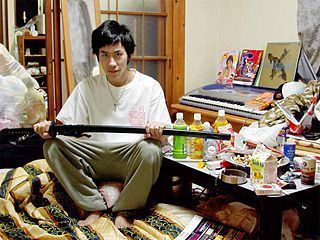
i may be hikkikomori, but i'm still japanese
srsly, the work is about the "Lost Generation" of Japan, not in the Speed Tribes or in the meth users or the other fantastic ways to go back, but the unique, distinctly Japanese way of withdrawal and disappearance from society. hence, 'hikkikomori' (pulling inward). not a diagnosed mental illness, but simple generation-wide social change. this process invites unintentional comedy. Mr. Zielenziger notes that "cuddling and showing affection to a young man inspires coo-cooing from him and infantile happiness." okay, good point. if we go to a mentally deranged twenty-five year old and stroke him, he may respond to such treatment with childlike joy. but why exactly should we hire people to do this or like consider society's obligation to provide such treatment? affection ain't free, baby.
with the exception of this issue, and Zielenziger's blindness to something he wrote early in the book, the upscale education, lifetime in journalism, and forthright open American style are strong points. I certainly put in the extra cash to ship this book when I had to move a library across countries, so that is an endorsement of sorts. (I did not choose to transfer 'daughter of the samurai' for example)
professional, terse, journalistic, truth-seeking. 4/5
25 April 2019, reiterate 4 although maybe it's 4.5. terse and skillful writing on the "dark side" of Japan.
it's like 3% are on antidepressants now. tripling by 2020, according to professionals. by 2030, will be 30% of the population? we'll all be nerve stapled? so yeah, Zielenziger, innocent of the world, completely doesn't notice that some of the people around him are completely deranged. one is, well, i shouldn't spoilt it. but any child could figure it out.
zielenziger: "hey I know what to do! let's affection japan! then she'll stop moping all the time."
i may be hikkikomori, but i'm still japanese
srsly, the work is about the "Lost Generation" of Japan, not in the Speed Tribes or in the meth users or the other fantastic ways to go back, but the unique, distinctly Japanese way of withdrawal and disappearance from society. hence, 'hikkikomori' (pulling inward). not a diagnosed mental illness, but simple generation-wide social change. this process invites unintentional comedy. Mr. Zielenziger notes that "cuddling and showing affection to a young man inspires coo-cooing from him and infantile happiness." okay, good point. if we go to a mentally deranged twenty-five year old and stroke him, he may respond to such treatment with childlike joy. but why exactly should we hire people to do this or like consider society's obligation to provide such treatment? affection ain't free, baby.
with the exception of this issue, and Zielenziger's blindness to something he wrote early in the book, the upscale education, lifetime in journalism, and forthright open American style are strong points. I certainly put in the extra cash to ship this book when I had to move a library across countries, so that is an endorsement of sorts. (I did not choose to transfer 'daughter of the samurai' for example)
professional, terse, journalistic, truth-seeking. 4/5
25 April 2019, reiterate 4 although maybe it's 4.5. terse and skillful writing on the "dark side" of Japan.

April 19, 2017
I picked up this book because I was interested in gaining some insight into the lives of Japan's hikikomori, but was severely disappointed.
The book starts out promisingly, with Zielenziger offering some good framing of the problem, but it quickly devolves into a breakdown of everything that he thinks is wrong with Japan, and the various ways in which the country apparently fails to live up to the standards upheld by other developed countries, specifically the United States.
The focus on the hikikomori themselves is soon lost, as Zielenziger devotes pages and pages to macro analysis of Japan's economy and all of the ways in which its businesses are falling behind the rest of the world.
While I'm one of the first to admit that Japan has some serious economic and social problems, Zielenziger's analysis is nothing but doom and gloom, as he cherry picks evidence that supports his bleak perspective.
One of the most bizarre parts of the book is when Zielenziger offers up South Korea as an alternative model for Japan, claiming that this small Asian country has avoided many of the ills that its larger neighbor is plagued by. While there are certainly some things that South Korea does better than Japan, this analysis doesn't hold up. Afflicted by the same workaholic culture that Zielenziger criticizes Japan for, South Korea also has some of the world's highest rates of alcohol consumption and suicide.
For someone who self-identifies as a secular Jew, Zielenziger is quick to praise Western Christianity, even going so far as to identify the spread of the Christian faith in South Korea as the reason for the country's relative prosperity. This theory is flimsy at best, and is also tinged with an inherent bias that implies that Christianity, along with the Western values associated with it, are fundamentally better than those of Japan's own Buddhism or Shinto. Then again, this kind of Eurocentrism is hardly surprising given the attitude that Zielenziger adopts throughout the book.
This book is over ten years old, but it feels even more dated than it is. Part of this is Zielenziger's stuffy writing style. He frequently employs old-fashioned writing conventions that have long been out of style, like the generic "he". He frequently talks about hikokomori as if they are all male, despite the existence of female hikikomori (one of whom he even interviewed for this book!).
All of this is a shame, because many of the social issues that Zielenziger addresses deserve attention, but he covers them with such alarmism and bleak pessimism that it's difficult to take much of what he says seriously.
This book is a good example of everything that's wrong with journalism about Japan. It's best left on the shelf.
The book starts out promisingly, with Zielenziger offering some good framing of the problem, but it quickly devolves into a breakdown of everything that he thinks is wrong with Japan, and the various ways in which the country apparently fails to live up to the standards upheld by other developed countries, specifically the United States.
The focus on the hikikomori themselves is soon lost, as Zielenziger devotes pages and pages to macro analysis of Japan's economy and all of the ways in which its businesses are falling behind the rest of the world.
While I'm one of the first to admit that Japan has some serious economic and social problems, Zielenziger's analysis is nothing but doom and gloom, as he cherry picks evidence that supports his bleak perspective.
One of the most bizarre parts of the book is when Zielenziger offers up South Korea as an alternative model for Japan, claiming that this small Asian country has avoided many of the ills that its larger neighbor is plagued by. While there are certainly some things that South Korea does better than Japan, this analysis doesn't hold up. Afflicted by the same workaholic culture that Zielenziger criticizes Japan for, South Korea also has some of the world's highest rates of alcohol consumption and suicide.
For someone who self-identifies as a secular Jew, Zielenziger is quick to praise Western Christianity, even going so far as to identify the spread of the Christian faith in South Korea as the reason for the country's relative prosperity. This theory is flimsy at best, and is also tinged with an inherent bias that implies that Christianity, along with the Western values associated with it, are fundamentally better than those of Japan's own Buddhism or Shinto. Then again, this kind of Eurocentrism is hardly surprising given the attitude that Zielenziger adopts throughout the book.
This book is over ten years old, but it feels even more dated than it is. Part of this is Zielenziger's stuffy writing style. He frequently employs old-fashioned writing conventions that have long been out of style, like the generic "he". He frequently talks about hikokomori as if they are all male, despite the existence of female hikikomori (one of whom he even interviewed for this book!).
All of this is a shame, because many of the social issues that Zielenziger addresses deserve attention, but he covers them with such alarmism and bleak pessimism that it's difficult to take much of what he says seriously.
This book is a good example of everything that's wrong with journalism about Japan. It's best left on the shelf.

Read
August 30, 2019Shutting Out the Sun introduces itself with what readers will assume is its subject: the plight of an increasing number of young people who, for whatever reason, choose to withdraw into their bedrooms and cease to communicate with the outside world, ignoring even their parents. These persons, called hikkikimori, are merely part of Shutting Out the Sun, however, and readers who venture forward expecting a study of them will find that most of the time they are out of sight, mentioned a few times after the first chapter but never examined in fine detail. The true subject of Shutting Out the Sun is Japan, which in 2006 was still mired in economic stagnation and rapidly being overshadowed by India and China. Japan is a country in a profound cultural crisis, writes Michael Zielenziger, and if it does not adapt to the realities of 21st century globalization, it faces the danger of becoming a hikkikimori nation: one so withdrawn from economic and diplomatic activity it may as well not exist.
In the 1980s, Japan’s economic prowess was such that many in the west feared its future influence. People drove Japanese cars, their kids were obsessed with Japanese video games, and their homes were increasingly filled with goods from Sony. And then…in 1989…the future fell to pieces, at least for Japan, and it entered a recession that was still going in 2006 when Zielenziger published Shutting Out the Sun. But it wasn’t just the economy that was struggling. Japan’’s entire society was stagnating, argues Zielenziger; the same factors that had undermined its economic growth were also driving its young people to isolate themselves from the world, and skyrocketing Japan’s suicide rates.
The root of the probem, Zielenziger believes, is that Japan never really embraced liberal democracy; its prewar order simply adopted democracy as the new way that traditional authority asserted itself. Democracy was imposed from on high, from the American military authorities and Japan’s own leaders. Democracy was never conceived as a challenge to existing order, the way it was in America, England, and France; and the bones of democracy like a widespread belief in human rights distinct from government never developed. Elements of Japanese culture which had previously bound the nation together – immense social pressure towards conformity, for instance — continued. This time, the Japanese people were marshalled to rebuild Japan and flourish economically.
The urgent need to recover economically produced a distortion in Japanese culture, however; Japanese men became obsessed with work, developing a ‘salaryman’ approach that meant they were out of the home for the majority of the day: they worked long hours, then socialized with their business partners late into the evening, retiring home only to sleep. The intense pressure to succeed drove many men to drink in excess, and their constant absence from the home didn’t do their marriages any favors. Zielenziger goes so far as to suggest that for the Japanese salaryman, his traditional fealty to his family has been displaced, and is now centered on his firm.
Kids were likewise pressured to succeed, and to conform; many of the hikkimori introduced in the opening relate tales of persistence bullying enabled by authority figures who assumed verbal and physical abuse meant that the kid in question had done something to disrupt the group. As Japan connected to the outside world through television and the internet, however, kids who were abused were also tortured by the fact that there were other societies out there where things weren’t like this – where people weren’t obsessed with academic excellence all the time, where there was room in life for leisure. The intense pressure from their peers and family, however, meant that young Japanese who wanted something different were constantly suppressed in their efforts to find it. Unable to conform and unable to stand and resist, many chose to flee – into their rooms, or if they were old enough, into neighboring countries like Thailand or South Korea. Even those who wanted to conform often found they couldn’t: how could they succeed as Japan entered a recession that went on for a decade?
That recession was largely caused by Japan’s culture of conformity, Zielenziger suggests: Japan focused so much on itself that it did not watch the world around it, and those who wanted to try new ideas were generally suppressed. Because Japan’s status quo was so successful – growing GDP, little crime, no underclass — any perceived challenges to it, like a poor-performing company or a new firm that threatened to disrupt things – were actively mitigated. Firms that would have gone bankrupt for failing to adapt in the western world were instead propped up, and up and comers suppressed by the government. So change-resistant was Japan, writes Zielenziger , that even in the early 2000s many businesses were still circulating interoffice memos by paper and only grudgingly tolerating the entrance of computers into their offices. Email was dismissed as unprofessional.
Zielenziger finds Korea as useful counter-example; westerners who first visited Korea as missionaries and doctors were not driven away; they stayed and their interactions with Korea changed it. Korea grew in response to its interactions with the outside world, and despite his secular Jewish status, Zielenziger finds Korea’s embrace of Christianity particularly interesting, contending that it promoted a view of people as individual persons, not merely members of a collective, and that it further set limits to the state by defining it as something separate, instead of conflating it and society. Korea’s democracy grew from below, instead of being imposed from above by a military hierarchy. While he does not suggest that Japan should convert to protestant Christianity, he does wonder if Japan would have gone another way had it had more substantial interaction with the western world rather than merely taking its tools to use on behalf of a chiefly feudal order.
As the length of this review suggests, Shutting Out the Sun offers a lot to consider. The problem in evaluating it, for me, is that I know very little about modern Japanese culture, either from personal experience or from other reading, so I don’t know if this is insightful or completely off the mark. I do know it makes for disturbing reading, between the kids walling themselves off from the world, the parents drinking or killing themselves from prolonged misery, and the looming hints that Japan is actively dying and no one can shake the stupor.
In the 1980s, Japan’s economic prowess was such that many in the west feared its future influence. People drove Japanese cars, their kids were obsessed with Japanese video games, and their homes were increasingly filled with goods from Sony. And then…in 1989…the future fell to pieces, at least for Japan, and it entered a recession that was still going in 2006 when Zielenziger published Shutting Out the Sun. But it wasn’t just the economy that was struggling. Japan’’s entire society was stagnating, argues Zielenziger; the same factors that had undermined its economic growth were also driving its young people to isolate themselves from the world, and skyrocketing Japan’s suicide rates.
The root of the probem, Zielenziger believes, is that Japan never really embraced liberal democracy; its prewar order simply adopted democracy as the new way that traditional authority asserted itself. Democracy was imposed from on high, from the American military authorities and Japan’s own leaders. Democracy was never conceived as a challenge to existing order, the way it was in America, England, and France; and the bones of democracy like a widespread belief in human rights distinct from government never developed. Elements of Japanese culture which had previously bound the nation together – immense social pressure towards conformity, for instance — continued. This time, the Japanese people were marshalled to rebuild Japan and flourish economically.
The urgent need to recover economically produced a distortion in Japanese culture, however; Japanese men became obsessed with work, developing a ‘salaryman’ approach that meant they were out of the home for the majority of the day: they worked long hours, then socialized with their business partners late into the evening, retiring home only to sleep. The intense pressure to succeed drove many men to drink in excess, and their constant absence from the home didn’t do their marriages any favors. Zielenziger goes so far as to suggest that for the Japanese salaryman, his traditional fealty to his family has been displaced, and is now centered on his firm.
Kids were likewise pressured to succeed, and to conform; many of the hikkimori introduced in the opening relate tales of persistence bullying enabled by authority figures who assumed verbal and physical abuse meant that the kid in question had done something to disrupt the group. As Japan connected to the outside world through television and the internet, however, kids who were abused were also tortured by the fact that there were other societies out there where things weren’t like this – where people weren’t obsessed with academic excellence all the time, where there was room in life for leisure. The intense pressure from their peers and family, however, meant that young Japanese who wanted something different were constantly suppressed in their efforts to find it. Unable to conform and unable to stand and resist, many chose to flee – into their rooms, or if they were old enough, into neighboring countries like Thailand or South Korea. Even those who wanted to conform often found they couldn’t: how could they succeed as Japan entered a recession that went on for a decade?
That recession was largely caused by Japan’s culture of conformity, Zielenziger suggests: Japan focused so much on itself that it did not watch the world around it, and those who wanted to try new ideas were generally suppressed. Because Japan’s status quo was so successful – growing GDP, little crime, no underclass — any perceived challenges to it, like a poor-performing company or a new firm that threatened to disrupt things – were actively mitigated. Firms that would have gone bankrupt for failing to adapt in the western world were instead propped up, and up and comers suppressed by the government. So change-resistant was Japan, writes Zielenziger , that even in the early 2000s many businesses were still circulating interoffice memos by paper and only grudgingly tolerating the entrance of computers into their offices. Email was dismissed as unprofessional.
Zielenziger finds Korea as useful counter-example; westerners who first visited Korea as missionaries and doctors were not driven away; they stayed and their interactions with Korea changed it. Korea grew in response to its interactions with the outside world, and despite his secular Jewish status, Zielenziger finds Korea’s embrace of Christianity particularly interesting, contending that it promoted a view of people as individual persons, not merely members of a collective, and that it further set limits to the state by defining it as something separate, instead of conflating it and society. Korea’s democracy grew from below, instead of being imposed from above by a military hierarchy. While he does not suggest that Japan should convert to protestant Christianity, he does wonder if Japan would have gone another way had it had more substantial interaction with the western world rather than merely taking its tools to use on behalf of a chiefly feudal order.
As the length of this review suggests, Shutting Out the Sun offers a lot to consider. The problem in evaluating it, for me, is that I know very little about modern Japanese culture, either from personal experience or from other reading, so I don’t know if this is insightful or completely off the mark. I do know it makes for disturbing reading, between the kids walling themselves off from the world, the parents drinking or killing themselves from prolonged misery, and the looming hints that Japan is actively dying and no one can shake the stupor.

September 9, 2025
As I have done a lot of reading about the issues Zielenziger discussed in Shutting I can confidently opine that he did a credible job in some respects in this book. Readers who are unfamiliar with the country will learn a great deal about the ‘disturbing social trends’ he described. They will also learn about the social, cultural, economic, and political dynamics which at the time of its publication in 2006 had fueled and were perpetuating such problems as the young men who shut themselves in their rooms (Hikikomori) and the young women who refuse to marry or have children (parasite singles). He also informed readers to a lesser extent about the unreported depression and alcohol abuse, the high suicide rate, and the sudden seemingly inexplicable deaths of healthy appearing middle aged men (karoshi).
The author put ‘a human face’ on his presentations by using his skills as a journalist. Ie, he largely utilized direct, declarative prose; gave extensive, nuanced summaries of some of the individuals he had interviewed; and used timely quotations from these people. Thus, readers will gain a palpable sense of the poignant, at times very painful struggles they were having.
Additionally, Zielenziger has taught at the Institute of International Studies at the University of California, Berkeley. Thus, he also reviewed, assimilated, and integrated information from a very wide array of primary and secondary sources. These are referenced in the text and disclosed in 27 pages of Notes at the end of Shutting. As with any good scholarly book there is a 12 page Selected Bibliography. There is plenty for interests readers to follow up on should they wish to.
The author also enhanced reader engagement through the timely use of Japanese language terms to describe the individuals he presented and to explain the dynamics. These were always translated carefully and accurately in the text. And there is a 6 page Dictionary of Japanese Terms at the end of the book.
I must note that Shutting has some flaws. On a few occasions Zielenziger failed to reference the information he disclosed. He claimed that it was South Korean Christians living in Japan who fed victims of the 1995 Kobe earthquake but made no references to sources for that fact. He also claimed that South Korea did not have any Hikikomori (circa 2006) because young men were (still are) required to perform military service after high school graduation. This is not true nowadays and probably was not true when Shutting was published in 2006:
https://www.abc.net.au/news/2024-05-2...
https://ssir.org/articles/entry/solut...
These observations about South Korea are part of two chapters in which he compared the two countries’ responses to economic pressures and turmoil. The author attributed South Korea’s more successful response to its own financial crisis in 1997 to its having adopted Christianity. But he offered little proof for that argument.
There are two aspects Zielenziger described in his narrative which he failed to analyze more thoroughly. Had he thought through the implications of his argument about how consensus driven Japanese society is he might have recognized that it is also exploitative. The educational system grooms children to be compliant at the cost of their individuality and creativity. Corporate Japan with the support of the bureaucrats and politicians demands complete adherence to its policies. It pays women and new graduates much less than long time, mostly male employees by hiring the former on a part time, temporary renewable contract. Thus, young people and women have little prospects for a successful future. Longtime male employees sometimes literally drop dead from the cumulative stress of 60 hour work weeks, socializing well into the evening, and little vacation time. This book made the argument about the history and ongoing exploitation taking place in Japan quite effectively. As it was published in 1982 it was unfortunate that Zielenziger did not refer to it.
https://www.goodreads.com/book/show/6...
Second, the author insightfully depicted how the interaction between what he called ‘the iron triangle’ in Japan (corporations, bureaucrats, and politicians) stifles individual development and prevents any real change in the status quo. He failed to note, however, the extent to which this was fueled largely by corruption between the corporations and politicians. This book which outlines this issue very thoroughly was published in 2002 but Zielenziger failed to note it.
https://www.goodreads.com/book/show/2...
With any book like this that was published almost 20 years ago discerning readers should ask if it is dated. I did see a documentary on NHK recently about a new experimental school trying to help child and teenage hikikomori re-enter the academic world. The program even noted that there are plans to open 300 such schools around Japan.
https://www3.nhk.or.jp/nhkworld/en/sh...
Unfortunately, the other social trends noted in Shutting continue unabated. PM Abe’s so called Abenomics and Womenomics lacked sufficient substance to really impact the struggles men and women faced. He country has not been in deflation for about 2 years now but wages still fail to keep up with inflation. The price of rice has almost doubled in the last year. So far the government’s efforts have stopped the steep increase in price but not brought it down. Abe’s ruling Liberal Democratic Party has lost two recent elections because of allegations of corruption.
I recommend Shutting for those with a deep interest in modern day Japan. Despite its flaws it offers a foundation of information on which someone can base further study.
The author put ‘a human face’ on his presentations by using his skills as a journalist. Ie, he largely utilized direct, declarative prose; gave extensive, nuanced summaries of some of the individuals he had interviewed; and used timely quotations from these people. Thus, readers will gain a palpable sense of the poignant, at times very painful struggles they were having.
Additionally, Zielenziger has taught at the Institute of International Studies at the University of California, Berkeley. Thus, he also reviewed, assimilated, and integrated information from a very wide array of primary and secondary sources. These are referenced in the text and disclosed in 27 pages of Notes at the end of Shutting. As with any good scholarly book there is a 12 page Selected Bibliography. There is plenty for interests readers to follow up on should they wish to.
The author also enhanced reader engagement through the timely use of Japanese language terms to describe the individuals he presented and to explain the dynamics. These were always translated carefully and accurately in the text. And there is a 6 page Dictionary of Japanese Terms at the end of the book.
I must note that Shutting has some flaws. On a few occasions Zielenziger failed to reference the information he disclosed. He claimed that it was South Korean Christians living in Japan who fed victims of the 1995 Kobe earthquake but made no references to sources for that fact. He also claimed that South Korea did not have any Hikikomori (circa 2006) because young men were (still are) required to perform military service after high school graduation. This is not true nowadays and probably was not true when Shutting was published in 2006:
https://www.abc.net.au/news/2024-05-2...
https://ssir.org/articles/entry/solut...
These observations about South Korea are part of two chapters in which he compared the two countries’ responses to economic pressures and turmoil. The author attributed South Korea’s more successful response to its own financial crisis in 1997 to its having adopted Christianity. But he offered little proof for that argument.
There are two aspects Zielenziger described in his narrative which he failed to analyze more thoroughly. Had he thought through the implications of his argument about how consensus driven Japanese society is he might have recognized that it is also exploitative. The educational system grooms children to be compliant at the cost of their individuality and creativity. Corporate Japan with the support of the bureaucrats and politicians demands complete adherence to its policies. It pays women and new graduates much less than long time, mostly male employees by hiring the former on a part time, temporary renewable contract. Thus, young people and women have little prospects for a successful future. Longtime male employees sometimes literally drop dead from the cumulative stress of 60 hour work weeks, socializing well into the evening, and little vacation time. This book made the argument about the history and ongoing exploitation taking place in Japan quite effectively. As it was published in 1982 it was unfortunate that Zielenziger did not refer to it.
https://www.goodreads.com/book/show/6...
Second, the author insightfully depicted how the interaction between what he called ‘the iron triangle’ in Japan (corporations, bureaucrats, and politicians) stifles individual development and prevents any real change in the status quo. He failed to note, however, the extent to which this was fueled largely by corruption between the corporations and politicians. This book which outlines this issue very thoroughly was published in 2002 but Zielenziger failed to note it.
https://www.goodreads.com/book/show/2...
With any book like this that was published almost 20 years ago discerning readers should ask if it is dated. I did see a documentary on NHK recently about a new experimental school trying to help child and teenage hikikomori re-enter the academic world. The program even noted that there are plans to open 300 such schools around Japan.
https://www3.nhk.or.jp/nhkworld/en/sh...
Unfortunately, the other social trends noted in Shutting continue unabated. PM Abe’s so called Abenomics and Womenomics lacked sufficient substance to really impact the struggles men and women faced. He country has not been in deflation for about 2 years now but wages still fail to keep up with inflation. The price of rice has almost doubled in the last year. So far the government’s efforts have stopped the steep increase in price but not brought it down. Abe’s ruling Liberal Democratic Party has lost two recent elections because of allegations of corruption.
I recommend Shutting for those with a deep interest in modern day Japan. Despite its flaws it offers a foundation of information on which someone can base further study.

December 14, 2014
This book is about the 1 million Japanese, who shut themselves off from society for years. Per Zielenziger, hikikomori is a unique phenomenon in Japan, where its victims are smart and articulate, but at the same time paralyzed, lack energy and enthusiasm. The first half of the book is fascinating, analyzing socials causes, such as amae (parents helping their kids too much), lack of community, concept of God, and a rigid society and government system that has no contingency for their plan of having everybody work together. The second half of the book reads more like a modern history of Japan, and does little to tie anything back to its initial subject matter.
My biggest critique though, is like the Japanese culture which he is writing about, ultimately Zielenziger does fantastic job in analysis with very little on the side of solutions.
My biggest critique though, is like the Japanese culture which he is writing about, ultimately Zielenziger does fantastic job in analysis with very little on the side of solutions.
August 17, 2007
The content of this book was very interesting, but the execution is flawed. Shutting Out the Sun was written by an American journalist living in Japan, and while the outsider's perspective is really needed to tell the story, the fact that the book is written by a journalist is both obvious and a problem. The book reads less like a study of the problems of modern Japanese society and the causes that led to them than a series of articles about it. I think the book's editor really fell down on the job here in not forcing Zielenziger to write this as a book. It's disjointed rather than a coherent narrative. That said, the topic itself is fascinating and it would be nice to see a more scholarly examination of the topic.
Displaying 1 - 30 of 144 reviews