Jump to ratings and reviews
Rate this book

A History of the Ostrogoths

Rate this book
"Thorough and convincing... likely to become the standard work on the subject." â Library Journal"Highly readable." â Medieval Literature"A major work of synthesis." â Walter E. Kaegi "Burns has achieved much for the modern study of Ostrogoths." â Antiquaries Journal

320 pages, Hardcover

First published January 1, 1984

8 people are currently reading
176 people want to read

About the author

Ratings & Reviews

What do you think?
Rate this book

Friends & Following

Create a free account to discover what your friends think of this book!

Community Reviews

5 stars
10 (19%)
4 stars
15 (29%)
3 stars
22 (43%)
2 stars
3 (5%)
1 star
1 (1%)
Displaying 1 - 8 of 8 reviews
Profile Image for Jan-Maat.
1,692 reviews2,530 followers
Read
October 13, 2019
An irrelevant introduction?
I bought this book from the Indiana University Press website. I well remember the days when actual bookshops were rare and an internet was not even imagined in Science-Fiction so I am alert to the usefulness of the online book retailers but the big ones I find are just boring. I find book buying on them dull. Yes, I get the book I want, but it is a mechanical drudge-like experience.

Somehow, somewhere, I got a link to this university press website and loved it. It was like going to a real book shop in that I could see books about things that I had no idea that people were writing about. I may not want to buy the weird and the wonderful, ok actually I do if I am strictly honest with myself, however there is pleasure in knowing that they are available, sometimes fantastically discounted, those on sale for less than ten United States Dollars I find particularly hard to resist. One of the books I bought was this history of the Ostrogoths.

The Ostrogoths
The Ostrogoths set up a kingdom of sorts in Italy between about 490 and 552ish AD after defeating Odovacar who had been enjoying being king over semi-demi-post-Roman Empire Italy since 476. Both Odovacar and the Ostrogoths were barbarians which is to say neither Roman nor Greek, and by this time Rome had been sacked twice (in 410 and again in 455) however a Roman way of life continued. Even under these barbarian rulers there was still a Roman Senate complete with senators giving speeches, there were tax farmers who collected Roman taxes, and Roman courts were still in session. The last Roman Emperor, who had the good luck to be called Romulus Augustus, in the west had been packed off into retirement by Odovacar but a recognisably Roman way of life continued under these barbarian rulers.

Anyhow Sic transit gloria mundi as those old Romans frequently liked to say. In 535 the Byzantines invaded Italy, fought the Ostrogoths up, down and round Italy until the last of them surrendered, utterly exhausted, in 553. However the Byzantines didn't get to enjoy their victory for long either since in 568 another barbarian people, the Langobards, began to push the Byzantines out, working from north to south. And so it goes.

So given my occasional interest in the end of the Roman Empire (the original decline of the West) and thanks to the website of Indiana University Press I found myself the reader of Thomas Burns' book.

A History of the Ostrogoths
My problem with this book is that after reading I don't know who it's intended audience is. It neither explains things in a thorough or helpful way to make the subject understandable for somebody coming to the Ostrogoths for the first time, yet nor does it offer particularly interesting insights in the main text (the endnotes are a different matter), an engagement with the historiography or sources to entertain somebody who is already comfortable with the difference between an Ostrogoth and a Visigoth. This book occupies an awkward space between the novice and the reasonably read in Gothic affairs.

Burns has what I found to be an annoying taste for purple writing: Despite their cravings, the Ostrogothic soldiers abstained from rapine, which was so frequently the victor's tax upon the conquered (p210) or, Equally vivid was the fear and trembling that a mere glance from Attila could strike in the leaders of the subject peoples (p45). I can imagine a whole book written like that, but I can't imagine taking it seriously.

Some of his interpretations came across to my mind as simplistic. For instance: The result was mistrust so deep among the Ostrogoths that they held back from joining the the Gepid king Ardasic at Nedao despite the fact that his cause of freedom was also theirs. (p109) This was pure Braveheart, because naturally the predominant drive of all political groups in any situation is towards FREEDOM.

Likewise perhaps his implicit thesis that the Ostrogoths were the most successful post Roman people, because the Ostrogoths were one of the few peoples capable of creating a synthesis of Germans and Romans within the framework of late antiquity (p219). Well, maybe, but they did conquer an area with an apparently more or less functioning (post/late) Roman society, that was delivering taxes even if the aqueducts weren't always kept in regular repair. The first (and longest reigning) king, Theodoric had spent much of his youth as a hostage in Constantinople so the exercise of authority in the fifth century Imperial style presumably seemed natural to him. Like Odovacar before him he sought a title from the Byzantine Emperor, one of his successors Theodahad was apparently happy with the idea of surrendering to the Byzantines in return for a pension and a life of leisure (his fellow Ostrogoths were less keen). These weren't people who wanted to uproot and chop down the Imperial system, instead they wanted to enjoy its fruits. I imagine they were very like those people from northern Europe who still buy villas in Umbria, keen to enjoy the olive oil, the wine and the Italian way of life, modern invaders I suppose are slightly less likely to have moustaches, pudding bowl haircuts and swords though. But since the Ostrogoths managed to have their own king on Italian soil for only sixty-two years, while their Visigothic cousins had a kingdom in Spain for about two hundred years, I felt the want of some alternative metric to measure success (ok I know that Cassiodorus brown nosed the Ostrogoths in the Senate, but that's a soft metric), because judging by length of existence the Ostrogoths don't look particularly successful.

The first three chapters seemed to me to be the weakest and never to my mind satisfactorily discussed basic kinds of issues such as who or what was an Ostrogoth - it is only on page 108 (the main text ends on page 220) that we are told that The Ostrogoths were never a very cohesive people, and they were always ready to accommodate new allies into the confederation. The farther back in time we search, the less complex was their organisation and the more difficult is our task. Or why the Amali were significant among the leaders, the conversion of the Ostrogoths to Christianity is brushed over, although once they get to Italy it was significant that they were Arians and not orthodox believers in the Nicene Creed.

However the second half of the book was ok. The chapter on religion was reasonable, tucked away in the endnotes was the suggestion that the pagan Ostrogoths had been followers of a common cult which sounded interesting, even if unprovable. The chapter on the end of the Ostrogothic kingdom was well done - raising the issue of the defence of Naples against the Byzantines as showing some preference among the Italians for Gothic rule rather than Byzantine. But overall the book was a middle of the road account of the Ostrogoths. It does however have some illustrations of coins and jewellery, although I didn't feel that the discussion of the archaeology was particularly strong. I had the persistent feeling that Burns was holding back information and not including everything that he could have. He doesn't seem to have been under any pressure to be concise - the expansive prose style seems to suggest the opposite. The font is large. Integrating the substantive material from the endnotes into the main body of the text would not have been a problem.

He does bring out some of the distinctive and interesting features of Italy under the Ostrogoths: it was an Ostrogothic king that organised the last Games held in Rome, while Theodoric hoped to get a title and be legitimised in his position as king of Italy by the Byzantines at the same time he was looking to the rest of the Barbarian world and marrying his children into the ruling houses of the Visigoths and Thuringians. The impression is that the regime was a mid point between Roman and non-Roman, using the Hospitalitas system to attempt to preserve both the agricultural productivity of the villa estates with the fighting power of the Ostrogoths. Since this involved Ostrogoths being awarded a third or a half of the property of a Roman it is surprising that it was at all acceptable to the Roman population, but I suppose it was better than the sharp edge of the alternative. Interestingly it acted to preserve the late Roman system - the Ostrogoths were keen to keep the slaves on the estates. No revolution here, just a change at the top.

One of the problems here was highlighted for me in this talk by Averil Cameron. There is an unhealthy interest in the idea of the kind of big political collapse that we see in the Western half of the Roman Empire and in seeing the new political units like Ostrogothic Italy as forerunners to the later nation state,s which overlooks the Byzantine Empire with its thousand year history of Imperial adaptation and survival. The Ostrogoths unlike the Byzantines were not great at adapting. Despite Burns' approval of their ability to synthesize Goths and the Romans, the Ostrogothic system relied on segregation. The two were meant to be kept apart. The one providing the military force, the other the management capability (broadly defined: running the estates, collecting taxes, neglecting the repair of aqueducts and so on). The Byzantines were better at exploiting everybody equally, over a long period of time. In this way the History of the Ostrogoths seems like a brief interlude, with their society and Italian kingdom lacking the ability to survive in the face of a persistent opponent. On the other hand of course there's a no less unhealthy - in my view - desire to imagine that modern Europe (and by extension various creole states like the USA too) springs from the heritage of Greece and Rome when that lineage is indirect, via peoples like the Ostrogoths.

Burns writes here that he wanted to show that the history of the Ostrogoths was more than the history of king Theodoric. So it was all the stranger than he didn't discuss Ulfila and the translation of the Bible into Gothic particularly since most of the surviving fragments were apparently written in Ostrogothic Italy, Cassiodorus is mentioned, but not really in regard to the Gothic History that he wrote, Jordanes who wrote a condensed version of Cassiodorus' history isn't discussed - although to be fair he wasn't living in Ostrogothic Italy. Boethius, forced to come to an appreciation of The Consolation of Philosophy as a result of being imprisoned by the Ostrogoths (and eventually executed) does get a look in. I was left wondering whether it actually made sense to write a history of the Ostrogothic kingdom without discussing the Visigoths or the short-lived regime of Odovacar, not the best recommendation for a book. Still, forward, lets see what Herwig Wolfram has to say in Die Goten und ihre Geschichte.


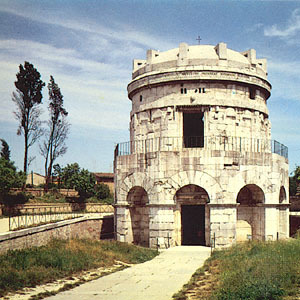
mausoleum of theodoric
Theodoric's Mausoleum, Ravenna (well, kind of, the building was intended to be his mausoleum but the body was removed with just the sarcophagus left until the building was converted into a church)
Profile Image for Tony Gualtieri.
526 reviews32 followers
January 3, 2023
I'm not sure why this has gotten a few negative reviews. While the basic materials is fragmentary, Burns is able to organize it into a credible whole. His prose is more literary than is now common, laced with the irony that was almost de rigueur for histories written in the 20th century. He assumes a familiarity with the history of late antiquity -- this shouldn't be the first book one reads about the era -- and he's a bit hasty in covering the period after the death of Theodoric.
Profile Image for Joseph Toth.
21 reviews3 followers
November 14, 2013
`A History of the Ostrogoths' by Thomas Burns attempts to survey the Ostrogoths, rather broadly at times, through their short but eventful history. What I mean by rather broadly is that we are forced to use approximations from literary and archaeological sources because Ostrogothic history is not well documented, as the author himself states... "Combining archaeological data and the Greco-Roman literary sources can never produce a truly uniform and consistent historical vision." (Introduction XV) A goal of this book is to look at the Ostrogoths as a group rather than individuals and their long-term interaction with Rome. According to the author "... This study is a history of the Ostrogoths, not of the late Roman Empire. Nor is it an archaeological survey; rather it is a history based on a synthesis of traditional sources and relevant archaeological materials. The emphasis on the Ostrogoths is clear and deliberate. Roman developments set the stage for much of Ostrogothic history, but only in that respect do purely roman events and personalities enter the narrative. The Ostrogoths merit their own history." (Introduction XVI) That being said I found that most of the book had more references to Visigoths, Romans, and non-Germanic groups like the Huns, and Alans, than the Ostrogoths. For an example the first reference to the Ostrogoths does not come until the eleventh page of the first chapter, when they are mentioned in passing... "Another source of influence was the cultural ganglion of central Asian groups in the area of south-central Russia. The artistic influence of the Steppes was most prominent among groups in direct contact with this area, for example, the Ostrogoths in their early period." (Page 11) I did find this book to be really informative and I cannot begin to list all I garnered from this book in such a short paper, so I will give a condensed version. By 375 A.D. the Huns had conquered the Gruethingi/Ostrogoths ruled by Ermanaric, who committed suicide rather than lead his people into Hunnic slavery. The Ostrogoths were subject to the Huns until the death of Attila in 453 A.D. "The memories of their subjection were bitter long after they had escaped from the Huns following the decisive battle of Nedao in 454." (Page 45), But Burns also says that "The Ostrogoths had been fortunate, for Attila had favored the Amali Valamir and his brothers Thuidmir and Vidmir. In fact, it seems that despite occasional hunger and growing animosity, at least the Ostrogothic nobility, and presumably their personal followers, did reasonably well under the Huns." (Page 45) The Ostrogoths spent the next 34 years after the battle of Nedao engaged in securing the Balkans for Rome and finding a permanent land to settle. By 489 A.D. the Emperor Zeno and Theodoric the Great were severely at odds with each other and the Ostrogoths began the final phase of their history as they began a trek to Italy. They entered in 489-490, and by 493 Theodoric had killed his rival Odacer and set up the Ostrogothic kingdom, with Ravenna as his capitol. After Theodoric's death in 526 A.D. his daughter Amalasuntha became regent for her son Athalric after his death in 534 A.D., she mistakenly placed herself under the protection of her cousin Theodahad. Her death in 535 A.D. gave the Emperor Justinian a pretext for sending Belisarius to reconquer Italy. "When Justinian launched his armies against the Ostrogoths, he may have envisioned a quick victory of Belisarius, like that he had achieved over the Vandals. If so, the Emperor was gravely mistaken but not foolishly naïve." (Page 204) In 552 A.D. the Byzantine general Narses defeated Totila, who died in battle. The survivors of the Ostrogoths chose Teja (or Teias) as their king, but were practically wiped out in the battle at Mons Lactarius in which Teja was also killed. "By 554 the Ostrogothic Kingdom was gone." (Page 215) The few survivors mingled with other peoples and nations; some were romanized in Italy, and others wandered north where they disappeared among the various Germanic tribes. In conclusion, again I cannot state everything I have taken away from this book but I think the author Thomas Burns says it best in his introduction, "The Ostrogoths developed as a people over the course of at least three centuries of direct and indirect contact with the Roman Empire. In essence, Rome nourished Gothic civilization throughout a long life and ultimately destroyed and buried her mature creation." (Introduction Xiii)
Profile Image for Loring Wirbel.
381 reviews100 followers
May 14, 2013
Thomas Burns faces the problem confronted by many historians writing about dimly perceived, partially-literate tribes. Even with the advent of modern archeological studies, there remains much we don't know about the Ostrogoths, and the gaps will probably persist, absent new major finds under the earth or in a forgotten ancient library somewhere.

Burns can turn a phrase very eloquently, but in some ways, his writing is too dense to be called a clarification. He assumes too much of his readers. For example, if this is general history, most readers may not know the difference in tribal oppression between such Roman emperors as Valens and Diocletian. Burns also does not give us much detail on how the Ostrogoths and Visigoths related to each other - Visigoths clearly were vassal-like, but did they pay tribute? Maybe this is not known, but Burns leaves too much to the imagination.

Burns is at his best describing the reign of Theodoric, and the disappointments faced in the attempts by his offspring to extend his rule. We get a sense of what the Ostrogoths in power were like as they tried to rule a crumbling Italy from Ravenna, applying the Roman rules of law they knew only partially. He gives a sense of how the assumption of power by Witigis in 536 AD almost represented a nostalgic "return to form" for the Ostrogothic tribe. What does not come through in the description of Belisarius's and Narses's assaults on Italy, is what the Byzantine emperors, particularly Justinian, claimed for being able to determine the fate of both Eastern and Western Roman empires. Sure, might makes right, but did Justinian simply assume he could use armies to put the barbarians back in their places?

The conclusion of the book was a disappointment because there was not a good analysis of the rule of Totila (Baduila), the final great king of the Ostrogoths. If we are to believe Gibbons, Totila was one of the most critical people of sixth-century Europe. Here he exists only as a two-dimensional figure challenging Narses. Maybe there is no way to make a fuzzy, dimly-remembered character like Totila snap into focus. In any event, Burns is too indirect and dense-prose of a writer to bring clarity to these final years. This book has some fascinating moments, but it is not the definitive work on the Ostrogoths.


Profile Image for Frigg's Daughter.
21 reviews
March 23, 2021
A dense, but good, book. I recommend having a good working knowledge of the late Roman Empire and the Dark Ages to make sense of the convoluted historical twists and turns, and in order to get more value out of the sections on things like cults and material culture.
Profile Image for Walt.
1,223 reviews
July 24, 2008
This is a very dense and thorough examination of the Ostrogoths. Burns clearly studied them in every possible light and discussed nearly every study then available to him. Certainly one of the best available on this group.
Profile Image for Goethicus.
26 reviews1 follower
February 2, 2011
Informative, but dense as unleavened Hefezopf! Not to be undertaken lightly!
Displaying 1 - 8 of 8 reviews

Can't find what you're looking for?

Get help and learn more about the design.