

What do you think?

The Tulip Poplars
Not yet published
Expected 13 Oct 26The Tulip Poplars is an epic and lush story of forbidden love set in the early 1900s and across decades, for fans of Tom Crewe and Heated Rivalry.
Amos and Tom fall in love while working in the tobacco fields during the hot summers of the early 1900s, but it will be decades before they can truly be together.
Tom cannot shake the strict religious code he was raised by nor the responsibilities of his family’s farm, and he ultimately marries his longtime friend Maeve; while Amos goes to New York City to find the anonymity required to live his life openly.
And though Maeve pines for Paschal rather than Tom, the strict Jim Crow laws prevent her and Paschal from being together.
The Tulip Poplars is a sweeping novel--intimate in its storytelling and epic in its scope--spanning most of the 20th century, centering on four people trying to find happiness in a world that demands conventional choices. It is an examination of faith and doubt, race and class, and desire—not just sexual desire, but also the longing to be good when the whole world is telling you are evil for loving who you love. Deeply moving and based on both his ancestors and his own life, as well as the history of the small Kentucky towns he knows so well, House’s new novel will leave you with a bigger heart.
Amos and Tom fall in love while working in the tobacco fields during the hot summers of the early 1900s, but it will be decades before they can truly be together.
Tom cannot shake the strict religious code he was raised by nor the responsibilities of his family’s farm, and he ultimately marries his longtime friend Maeve; while Amos goes to New York City to find the anonymity required to live his life openly.
And though Maeve pines for Paschal rather than Tom, the strict Jim Crow laws prevent her and Paschal from being together.
The Tulip Poplars is a sweeping novel--intimate in its storytelling and epic in its scope--spanning most of the 20th century, centering on four people trying to find happiness in a world that demands conventional choices. It is an examination of faith and doubt, race and class, and desire—not just sexual desire, but also the longing to be good when the whole world is telling you are evil for loving who you love. Deeply moving and based on both his ancestors and his own life, as well as the history of the small Kentucky towns he knows so well, House’s new novel will leave you with a bigger heart.
384 pages, Hardcover
Expected publication October 13, 2026
About the author
Silas House
40 books1,736 followersSilas House is the nationally bestselling author of six novels--Clay's Quilt, 2001; A Parchment of Leaves, 2003; The Coal Tattoo, 2005; Eli the Good, 2009; Same Sun Here (co-authored with Neela Vaswani) 2012; Southernmost (2018), as well as a book of creative nonfiction, Something's Rising, co-authored with Jason Howard, 2009; and three plays.
His work frequently appears in The Atlantic, The New York Times, and Salon. He is former commentator for NPR's "All Things Considered". His writing has appeared in recently in Time, Ecotone, Oxford American, Garden and Gun, and many other publications.
House serves on the fiction faculty at the Spalding School of Writing and as the National Endowment for the Humanities Chair at Berea College.
As a music writer House has worked with artists such as Kacey Musgraves, Jason Isbell, Lee Ann Womack, Kris Kristofferson, Lucinda Williams, The Judds, Jim James, and many others.
House is the recipient of three honorary doctorates and is the winner of the Nautilus Award, an EB White Award, the Storylines Prize from the New York Public Library/NAV Foundation, the Appalachian Book of the Year, and many other honors.
His work frequently appears in The Atlantic, The New York Times, and Salon. He is former commentator for NPR's "All Things Considered". His writing has appeared in recently in Time, Ecotone, Oxford American, Garden and Gun, and many other publications.
House serves on the fiction faculty at the Spalding School of Writing and as the National Endowment for the Humanities Chair at Berea College.
As a music writer House has worked with artists such as Kacey Musgraves, Jason Isbell, Lee Ann Womack, Kris Kristofferson, Lucinda Williams, The Judds, Jim James, and many others.
House is the recipient of three honorary doctorates and is the winner of the Nautilus Award, an EB White Award, the Storylines Prize from the New York Public Library/NAV Foundation, the Appalachian Book of the Year, and many other honors.
Ratings & Reviews
Friends & Following
Create a free account to discover what your friends think of this book!
Community Reviews
Displaying 1 - 30 of 33 reviews

September 18, 2026
4.5
This story starts off in the early 1900’s and ends in the 1970’s.
It is about a group of four young people growing up as friends in the Appalachian Mountains of Kentucky.
There is Tom, Maeve, Amos and Paschal, … forbidden love affecting their lives through many years.
The story follows them through their entire lives.
Much of their first three decades were spent unable to live as they would have liked due to gay relationships and black/white relationships actually being illegal, and damning in the eyes of their religion.
It’s a beautiful story.. I love this author’s writing and have read several of his books..
His books are an automatic read for me.
Thank you to NetGalley and Algonquin Books for the free ebook in exchange for an honest review!
This story starts off in the early 1900’s and ends in the 1970’s.
It is about a group of four young people growing up as friends in the Appalachian Mountains of Kentucky.
There is Tom, Maeve, Amos and Paschal, … forbidden love affecting their lives through many years.
The story follows them through their entire lives.
Much of their first three decades were spent unable to live as they would have liked due to gay relationships and black/white relationships actually being illegal, and damning in the eyes of their religion.
It’s a beautiful story.. I love this author’s writing and have read several of his books..
His books are an automatic read for me.
Thank you to NetGalley and Algonquin Books for the free ebook in exchange for an honest review!

June 29, 2026
I was lucky enough to receive an ARC of this masterpiece.
Mr. Silas House, I was not familiar with your messy game, but I am absolutely here for it. Once again, you've written a love letter to my beloved Appalachia.
This book is a journey filled with so many highs and lows. My favorite kinds of stories are the ones that span years because they feel more intimate, allowing me to truly know the characters as they grow. This novel is, at its heart, about longing and pining—the ache of yearning for someone you can't have because of law, faith, and the expectations of the world around you. Yet it beautifully reminds us that true love cannot die, no matter how hard people try to bury it.
The characters were beautifully three-dimensional. Tom and Amos's love was unbreakable, and I found myself rooting for them through every season of their lives. Paschal's story was fascinating, but my dear Maeve stole my heart. She was, without question, my favorite character.
What struck me was how unflinchingly this story portrays the suffering the LGBTQ+ community has endured throughout history. There were so many heartbreaking chapters that, while fictional, undoubtedly echo experiences that countless real people lived through. The novel also shines a light on the experiences of Black Appalachians, showing how racism could force someone to leave the only home they had ever known, separating them from their home and sense of belonging. Those realities make this story all the more powerful.
Silas House has written another unforgettable Appalachian novel—one that honors the beauty of the region while refusing to look away from its painful history. This is a story that will stay with me long after I turned the final page.
Mr. Silas House, I was not familiar with your messy game, but I am absolutely here for it. Once again, you've written a love letter to my beloved Appalachia.
This book is a journey filled with so many highs and lows. My favorite kinds of stories are the ones that span years because they feel more intimate, allowing me to truly know the characters as they grow. This novel is, at its heart, about longing and pining—the ache of yearning for someone you can't have because of law, faith, and the expectations of the world around you. Yet it beautifully reminds us that true love cannot die, no matter how hard people try to bury it.
The characters were beautifully three-dimensional. Tom and Amos's love was unbreakable, and I found myself rooting for them through every season of their lives. Paschal's story was fascinating, but my dear Maeve stole my heart. She was, without question, my favorite character.
What struck me was how unflinchingly this story portrays the suffering the LGBTQ+ community has endured throughout history. There were so many heartbreaking chapters that, while fictional, undoubtedly echo experiences that countless real people lived through. The novel also shines a light on the experiences of Black Appalachians, showing how racism could force someone to leave the only home they had ever known, separating them from their home and sense of belonging. Those realities make this story all the more powerful.
Silas House has written another unforgettable Appalachian novel—one that honors the beauty of the region while refusing to look away from its painful history. This is a story that will stay with me long after I turned the final page.

July 24, 2026
Oh I loved this beautiful coming of age/life in review. Silas House gives us two pairs of star-crossed lovers in early 20th century Kentucky: Tom and Amos, and Maeve and Paschal. Tom and Amos are in love, but can't be together because they're both men. Maeve and Paschal are in love, but can't be together because Maeve is white and Paschal is Black. I loved each of them.
There's a lot of stolen moments and yearning in their youth, and our four main characters end up not quite alone, but not with the ones they want to be with. Tom and Maeve are lifelong friends who decide to get married, but of course they're not satisfied. Amos explores the more open lifestyle opportunities of New York City, but always feels called back home. Paschal finds love, but his wife doesn't want the same things out of life that he does. Silas House weaves historic events like race riots and raids on queer and gender non-conforming spaces into the storyline. There are villains, beautiful landscapes with the titular tulip poplars (one of my favorite trees), and a lovely mule named Daisy.
Without spoiling anything, I will say that this is not an overall tragic story, despite the hardships. I only cried a couple of times. Recommended for fans of historical fiction like Kristin Hannah, sweeping stories of a life lived like John Irving, or emotional historical queer romances like Brokeback Mountain.
There's a lot of stolen moments and yearning in their youth, and our four main characters end up not quite alone, but not with the ones they want to be with. Tom and Maeve are lifelong friends who decide to get married, but of course they're not satisfied. Amos explores the more open lifestyle opportunities of New York City, but always feels called back home. Paschal finds love, but his wife doesn't want the same things out of life that he does. Silas House weaves historic events like race riots and raids on queer and gender non-conforming spaces into the storyline. There are villains, beautiful landscapes with the titular tulip poplars (one of my favorite trees), and a lovely mule named Daisy.
Without spoiling anything, I will say that this is not an overall tragic story, despite the hardships. I only cried a couple of times. Recommended for fans of historical fiction like Kristin Hannah, sweeping stories of a life lived like John Irving, or emotional historical queer romances like Brokeback Mountain.

June 29, 2026
“Love without acceptance is not love at all.”
This was my first Silas House novel, but it certainly won’t be my last. In this captivating yet heartbreaking novel, House does an incredible job of showing the duality of human beings. A tale of four friends set to the backdrop of early 1900s Appalachia, this story begs us to consider what we give up when we are forced to hide our true selves.
*** Special thanks to the publisher for sending a physical ARC to the bookstore I work at. ***
This was my first Silas House novel, but it certainly won’t be my last. In this captivating yet heartbreaking novel, House does an incredible job of showing the duality of human beings. A tale of four friends set to the backdrop of early 1900s Appalachia, this story begs us to consider what we give up when we are forced to hide our true selves.
*** Special thanks to the publisher for sending a physical ARC to the bookstore I work at. ***

Review of advance copy received from NetGalley
this is yearning done right!!

Review of advance copy received from NetGalley
This was my first encounter with a Silas House novel, and I found “The Tulip Poplars” quite engaging. If you were a fan of “Buckeye” by Patrick Ryan, you’ll love this book!
The narrative follows two couples—Tom and Amos, Pascal and Maeve—weaving a complex tale of forbidden love across the first seven decades of the twentieth century.
I anticipated a more historical tone, yet the writing felt contemporary despite the era depicted.
Overall, I appreciated the book; it might have earned five stars, but I felt less connected to Pascal and Maeve’s storyline. Amos and Tom’s story seemed stronger, so greater focus there might have improved the novel.
Thank you to NetGalley and Algonquin Books for the advance copy of this upcoming novel releasing on October 13, 2026.
The narrative follows two couples—Tom and Amos, Pascal and Maeve—weaving a complex tale of forbidden love across the first seven decades of the twentieth century.
I anticipated a more historical tone, yet the writing felt contemporary despite the era depicted.
Overall, I appreciated the book; it might have earned five stars, but I felt less connected to Pascal and Maeve’s storyline. Amos and Tom’s story seemed stronger, so greater focus there might have improved the novel.
Thank you to NetGalley and Algonquin Books for the advance copy of this upcoming novel releasing on October 13, 2026.

Review of advance copy received from NetGalley
What a journey this book was. A love letter to place as much as people, it followed the lives of Maeve, Paschal, Amos, and Tom as they grew up in Bright Star. A historical novel, initially I felt the characters were a bit too modern, but as the story unfolded, it felt right. Reading the afterward, put things in more perspective why he chose the particular journey for this group. Maeve is in love with Paschal, but their color keeps them apart. Amos and Tom are also struggling with forbidden love. Things get more complicated when Maeve becomes pregnant out of wedlock. The book spans almost their entire lives. It switches perspectives from each of the four protagonists, which provides a sweeping view of their lives, but limits seeing the full depth of each of them. It is a beautifully written, emotional love story.
Thank you to Netgalley and Algonquin Books for the advance reader copy.
Thank you to Netgalley and Algonquin Books for the advance reader copy.

Review of advance copy received from NetGalley
This year has been filled with extraordinary books for me, and this one may have just topped the charts. This was my first Silas House novel, and after reading it, I’m ready to work my way through his entire collection.
The writing is incredible, and the descriptions of the Kentucky landscape, the small-town atmosphere, and the people who call it home are so vivid that I finished the book feeling like I’ve been there. The author explores the hardships so many people have endured, and continue to endure, simply to exist as themselves and openly love the person they love. He perfectly describes how our external identities, internal struggles, and personal experiences affect how we view (and oftentimes treat) others. Some are capable of change; others struggle against it. Some grow to accept and even appreciate the many differences in people, while others remain constrained by fear, tradition, religion, prejudices, or societal pressure and expectations.
One quote that seems so simple on the surface but will stay with me for a very long time is
"Love without acceptance is not love at all."
Now that I've finished, I have a new problem. One of my current top ten books of all time must be demoted, because there is no chance this one isn't earning a place there. I'm not an influencer or a well-known book reviewer but trust me when I say either pre-order or put this one on your library's hold list asap!
Thank you to NetGalley, Algonquin Books, and the author for an advanced digital copy of this remarkable book!
The writing is incredible, and the descriptions of the Kentucky landscape, the small-town atmosphere, and the people who call it home are so vivid that I finished the book feeling like I’ve been there. The author explores the hardships so many people have endured, and continue to endure, simply to exist as themselves and openly love the person they love. He perfectly describes how our external identities, internal struggles, and personal experiences affect how we view (and oftentimes treat) others. Some are capable of change; others struggle against it. Some grow to accept and even appreciate the many differences in people, while others remain constrained by fear, tradition, religion, prejudices, or societal pressure and expectations.
One quote that seems so simple on the surface but will stay with me for a very long time is
"Love without acceptance is not love at all."
Now that I've finished, I have a new problem. One of my current top ten books of all time must be demoted, because there is no chance this one isn't earning a place there. I'm not an influencer or a well-known book reviewer but trust me when I say either pre-order or put this one on your library's hold list asap!
Thank you to NetGalley, Algonquin Books, and the author for an advanced digital copy of this remarkable book!

July 19, 2026
I finished this on a plane, and had to ask a flight attendant for a napkin to sob into. Such a beautiful portrait of four young people who struggled to be who they were and love who they loved. Most of us have no idea how difficult that can be in a time and place different from our own. The writing is simple and gorgeous. Very highly recommended.

Review of advance copy received from NetGalley
The Trees Have Better Archival Instincts Than the Institutions
Silas House’s “The Tulip Poplars” follows people misread by churches, hospitals, laws, and neighbors until songs, letters, paintings, graves, and a stubborn grove preserve the record more faithfully
By Demetris Papadimitropoulos | October 3rd, 2026
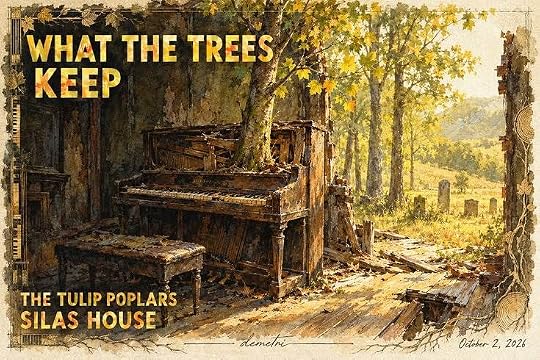
“What the Trees Keep” – An abandoned piano, a young tulip poplar, and the graves beyond the missing wall turn Bright Star’s ruin into an archive of what outlives the institutions that tried to define these lives.
Dead towns make excellent archives because they cannot object to what survives them. “The Tulip Poplars” opens with Bright Star, Kentucky, collapsing into weather. A wall has fallen from an abandoned house. An upright piano stands exposed inside it. From the soundboard grows a young tulip poplar. Older trees circle graves descendants still visit, and a child presses a blossom into a book. House gives us the relics first. Nearly everything that follows explains how they got there.
Everything looks, briefly, like a machine we know how to operate. In 1918, farmer Tom Foster falls for Amos Lewis, an orphan taught by clerical abuse to distrust divine authority. Tom’s lifelong friend Maeve Day loves Paschal Collins, the only Black boy at her father’s Episcopal institute, for whom being seen with a white woman can be lethal. Race, law, church, family, and fear scatter the four into marriage, exile, and return. House’s larger gamble is to keep following them after reunion would satisfy a smaller novel.
Most of what prejudice steals here is measured in years. Paschal is hurried out of Bright Star after the 1919 Corbin Expulsion. Police violence reaches Amos’s queer life in New York. Tom enters an asylum where doctors induce insulin comas to cure his “unnatural desire,” a treatment House acknowledges moving earlier than its widespread American use. Yet the harsher loss is breakfasts never eaten together, fields not worked side by side, evenings never shared. Tom and Amos lose decades before they can become boring together. Giving them back is the book’s boldest repair.
Early on, Amos slips away from a square dance and tells Tom, “Just walk with me a ways.” The modesty is almost funny. Walk makes love a motion. With me asks for company. A ways leaves forever suspiciously unmentioned. They move from the bright room into woods dark enough for the kiss. House tells us Tom will carry the phrase through separation, asylum, and death. The recurrence works, though the advance notice exposes one habit: sometimes a good image gets its own porch light.
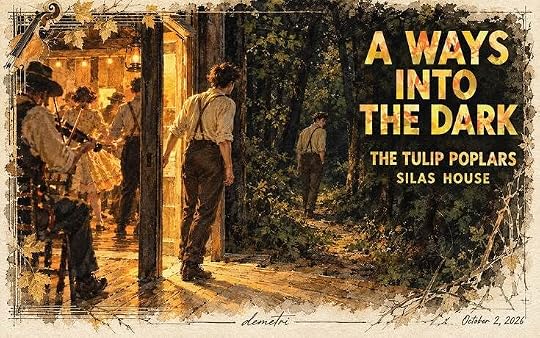
“A Ways Into the Dark” – Tom pauses between square-dance light and the dark path where Amos waits ahead, making the threshold itself carry the danger and promise of their first kiss.
Tom’s problem can be heard in five words: “I want to be good, Amos.” Amos answers, “Why is being who we are not good?” Tom has inherited a vocabulary in which desire and goodness cannot occupy the same body. Amos, whose religion includes abuse alongside Scripture, discards the premise earlier. “I do. I want to be myself,” he says. The book does not let that become sufficient. Tom’s sexuality is not a wrong. Keeping Maeve inside a marriage built around what he cannot tell her still wounds her. Innocence of desire does not cancel responsibility.
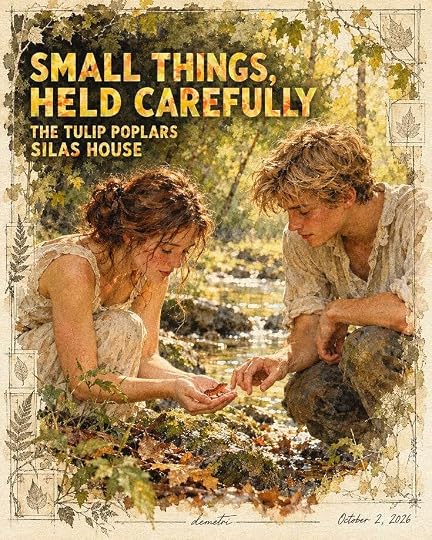
“Small Things, Held Carefully” – Maeve and Paschal bend toward a red-spotted newt, their almost-touching hands making Caleb’s ethic of small things briefly visible as tenderness.
Race makes the two central love stories unequal in ways the book does not blur. Tom and Amos can sometimes pass through the world unread; Paschal cannot hide what makes Maeve dangerous to him. The Corbin interlude follows a white mob terrorizing Black residents and forcing hundreds onto trains. Paschal is removed before dawn. Maeve finally understands that his warning described his odds. House’s historical material works best when it changes an earlier scene.
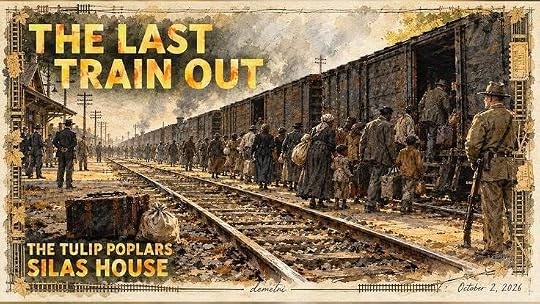
“The Last Train Out” – Rails narrow toward forced departure as Black residents are driven from Corbin, letting infrastructure bear the historical pressure rather than turning violence into spectacle.
If Tom and Maeve existed only to delay Tom and Amos, their marriage would be dead weight with good table manners. Instead it produces Finch, companionship, resentment, work, tenderness, and years neither can revoke. They sleep together beneath the poplars associated with Tom’s desire for Amos, and their daughter comes from an encounter both know is incomplete. When the marriage ends, House does not retroactively empty it. A later truth does not make an earlier truth a lie.
Paschal’s marriage to Genevieve gets similar dignity. Lexington gives him a Black professional and Episcopal world larger than Bright Star. Genevieve is educated, ambitious, and alert to the vanity of benevolence. Their life matters. So does the moment Paschal assumes his rural ministry should become her future too. She will not disappear into his calling. The mountains that protect him feel like prison walls to her. A place does not become home by majority vote.
Amos discovers that New York is too complicated to function as a clean escape hatch. It gives him Bethesda, music, work, queer nightlife, and proof that people like him exist in public. During a police raid, Marcus runs while Amos stays with the beaten Bethesda, who later dies. The city gave her room to become herself and housed the authorities capable of killing her for displaying that self. Amos’s return to Kentucky carries neither defeat nor simple homecoming. He leaves one dangerous freedom for another.
Play Satie once and it is simply music. Let Amos describe “Gymnopédie No. 1” as longing, then let Maeve find Tom listening alone and crying, and the record changes without changing. No confession occurs. Maeve has acquired the noun capable of reorganizing years of evidence. The scene is one of House’s best because it withholds the explanatory speech he often supplies elsewhere. The revelation belongs to Maeve’s interpretation and ours.
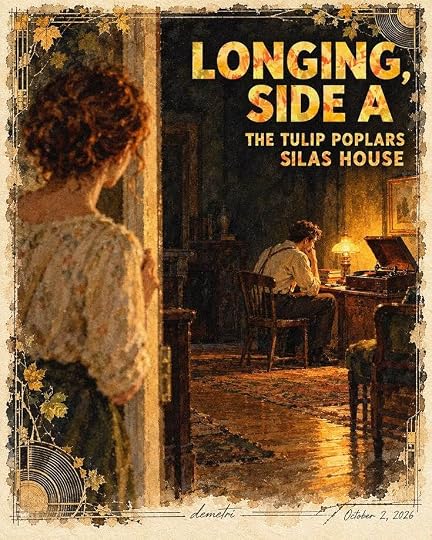
“Longing, Side A” – Maeve watches from the doorway as Tom listens to Satie alone, the room’s empty distance giving longing a shape before either of them can name it.
Amos later writes Tom a long confession, destroys it, and replaces it with “I’m coming home to you.” Before mailing the note he blacks out to you. Maeve finds the page and reconstructs the missing words. The erasure becomes evidence. Much of “The Tulip Poplars” works this way: postcards, records, paintings, flowers, songs, graves, letters. They carry relationships across gaps where public language fails. An archive need not be official to outlive officials.
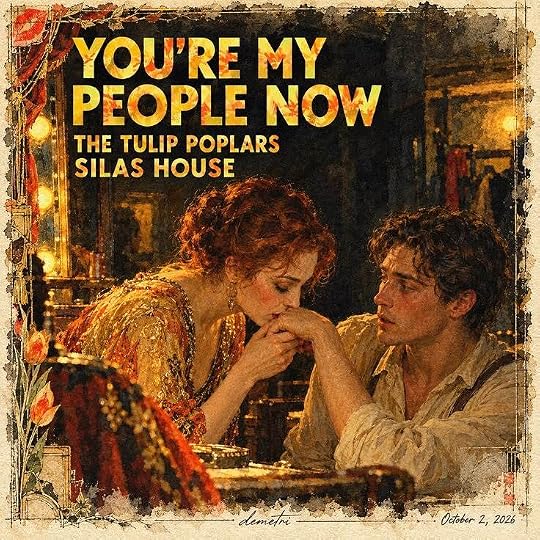
“You’re My People Now” – Bethesda’s kiss above Amos’s thumb turns chosen family into a small, luminous gesture held against the larger darkness of the room.
Dr. Spector tells Tom what he has wanted his whole life to hear: “There’s nothing wrong with you. You are just as you were made.” Then he gives him the less comforting half: Tom must commit honestly to Maeve or let her build another life. That distinction is one of the book’s cleanest ethical moves. Sexuality is not wrongdoing; deception can still have casualties. Spector also reveals House’s instinct to install an interpreter when the moral weather grows complicated. He is persuasive and extremely convenient.
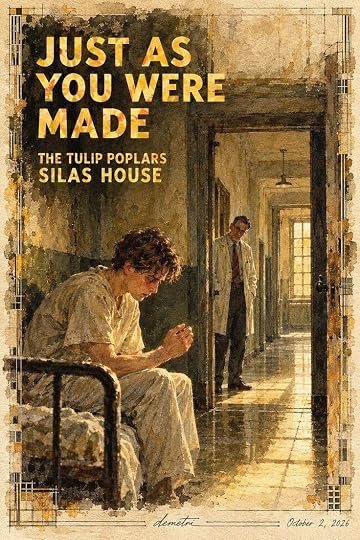
“Just as You Were Made” – Tom’s exhausted body and trembling hand are dwarfed by asylum geometry while Dr. Spector’s affirmation opens the first narrow space not organized around cure.
In sentence after sentence, House prefers accumulation to abrasion. Rootstocks, sorghum, newts, wet earth, spring water, Daisy’s aging back: his prose likes things that can be touched, planted, carried, eaten, sung, or buried. Description gathers until feeling rises from matter, then a plain sentence names it. Sometimes that cadence is exact. Sometimes the explanation reaches the platform after the train has already gone.
Much of the book’s ethic sits inside Caleb’s rule that a person is revealed by the treatment of small things. House makes it stylistic. The narrative eye keeps dropping toward a newt, bees, seedlings, a mule, a flower, Tom’s tremoring hand. Dignity enters through scale. The prose keeps spending sentences on supposedly minor lives until “minor” becomes inadequate.
In one early scene Tom deals with Amos’s departure by grafting fruit trees. He cuts two living pieces, fits their wounds, seals the joint, waits for growth. House does not explain this one. He does not need to. Tom cannot yet imagine two men constructing a joined life, while his hands practice the proposition on wood. Two separate things meet at injury and continue. House’s symbols are often strongest when he leaves them alone.
The chapter headings make an argument of their own. “The Tulip Poplars” begins by separating Tom, Maeve, Amos, Paschal. Later the headings become “Tom and Amos,” then “Maeve and Paschal,” and finally “The Grove.” Self gives way to couple; couple to place. The shift is simple enough to miss, which is its pleasure. The table of contents understands something the explanatory passages occasionally labor to say.
Read time differently in Part IV. Earlier chapters linger over kisses, funerals, train rides, letters, meals. Later, years fall through the prose. When Tom and Amos are young and do not possess a future, an afternoon bears enormous weight. Once they share a life, decades can pass. The compression is meaningful and costly. Paschal’s later vocation, Finch’s adulthood, wartime changes, and Bright Star’s decline sometimes arrive as biography rather than experience. Sweep is purchased with detail.
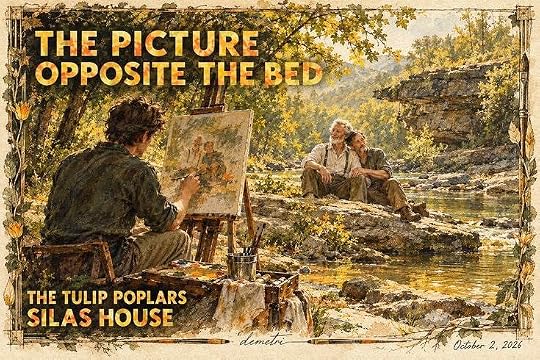
“The Picture Opposite the Bed” – Finch paints the older Tom and Amos at Turtle Rock, making ordinary duration – bodies aged together, landscape behind them, image within image – into an alternative archive.
Once Tom and Amos share the farm, House refuses to turn cohabitation into a curtain call. They cook, work, read, host Finch, age beside Daisy, and privately declare themselves married beneath the poplars. Decades after their first hidden kiss, they dance at Lexington’s Gilded Cage and kiss publicly for the first time. The scene lands because so much uneventful life sits behind it. What was denied to them was not simply a lover. It was enough repetition for a life to acquire habits.
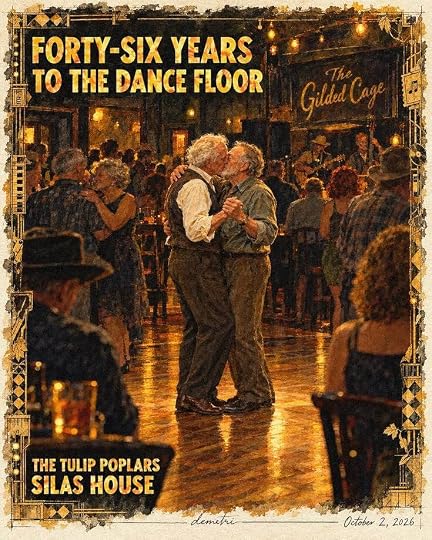
“Forty-Six Years to the Dance Floor” – After forty-six years, Tom and Amos enter public light together, their first public kiss isolated not by blur but by the breathing room a crowded room finally grants them.
Providence creeps in when the arrangements grow too exact. Thatcher is racist, homophobic, greedy, unfaithful, violent, environmentally destructive, manipulative, and willing to blackmail Tom. Eventually he holds so many of the book’s evils that he stops feeling entirely load-bearing. Eliza’s death raises a related question. After years of cruelty, she poisons Thatcher and herself to save the grove. The act cannot restore Caleb, Marty, or Tom’s childhood. Still, the moral geometry is suspiciously tidy.
One reunion follows another. Maeve and Paschal recover a life together. Tom and Amos do the same. Finch tells Tom that people have to be who they are and that the trick is to “let people be.” All four eventually rest beneath the same trees. That generosity is also House’s temptation. He refuses the old bargain in which marginalized characters earn seriousness through suffering, and rightly so. Yet abundance can become providence when every damaged line bends toward meaningful shape.
Unfortunately for any perfectly consoling reading, several wounds stay open. Bethesda, Marty, and Caleb remain dead. Tom’s left hand keeps shaking. Maeve cannot recover her surrendered education. Genevieve cannot recover years built around a vocation never hers. Paschal’s church burns. The ancestor whose records inspired the novel did not receive Tom’s old age. Fiction can rearrange possibility. It cannot make the original loss fictitious.
Lexington’s Faulkner Morgan Archive gives House’s recovery project a factual edge. Its collections document a Kentucky queer past long before Stonewall became the default starting gun, including Black queer performer Sweet Evening Breeze, associated with public drag performances beginning in the 1920s. House credits the archive in his acknowledgments. The frame changes: he is not planting queer people in a Kentucky past where they were absent. He is giving interior duration to lives the inherited record often preserves in scraps.
One of House’s measuring sticks is Thomas Hardy. In a September 2026 essay on his Substack, “A Country Boy Can Surmise,” he describes an Appalachian novel shaped by Hardy’s pressure of social rules, sexuality, and place; elsewhere he calls the bond between people and home ground one of this novel’s three love stories. Hardy matters less as pedigree than as craft standard. House admires fiction that lets social argument emerge from circumstance. “The Tulip Poplars” often does. Occasionally it solves the problem and then writes the answer twice in the margin.
Satie returns near the end, but so do simpler things. Amos has a piano. Paschal dies. Maeve dies. Amos dies in Tom’s arms. Tom follows a year later. Near death, he says again, “Walk with me a ways,” and Finch understands he is not speaking to her. Afterwards she remembers her father saying birds, crickets, frogs, and katydids sing “I am here.” Early, the phrase belongs to small creatures in the woods. Here it belongs equally to people repeatedly hidden, diagnosed, expelled, or denied.
Decades before we knew any of this, House had shown us Amos’s piano in ruins. Now its transformation can be read. Wood became instrument; the instrument made music; decay opens it to weather; a tulip poplar grows through what remains. The sequence is stranger than a simple triumph of nature over culture. Human making enters another material cycle. Piano becomes relic, ruin, ground, archive. Nothing stays intact, which is not the same as saying nothing lasts.
Each return to the tulip poplars adds another claim without exhausting the trees. They are Tom’s refuge, the site of sexual secrecy, threatened property, a private wedding place, a cemetery. Thatcher sees timber. Caleb sees stewardship. Tom sees holiness. Amos sees home. Finch inherits the memories attached to them. The symbolism can become officious, but the poplars survive because they remain stubbornly botanical, growing while everyone else argues about what they mean.
My rating is 88/100, or 4/5 Goodreads stars. The novel’s structural intelligence, emotional generosity, ecological thinking, and long view of queer and interracial lives outweigh its over-explanation, schematic villainy, and late compression. The distance from five stars is mostly a question of trust. House constructs images capable of carrying ambiguity, then sometimes verifies that we read the label correctly. His quietest scenes suggest he could trust us more.
Endings this circular risk sealing the book too neatly, but one contradiction stays open. Bright Star never becomes worthy of the people who love it. Kentucky never becomes a sanctuary for either couple. They claim the place anyway. Home here is not approval but attachment that survives the evidence against it. The four do not return because home has learned to deserve them. Rejection, House understands, does not automatically void belonging.
The quietest reversal is temporal. A novel about people struggling to remain visible ends by accepting that everyone will disappear. The answer is not immortality. It is enough life to leave traces another person may not know how to read: a grave, melody, creased postcard, painting above a bed, flower tucked into a book. For years these characters ask permission to exist. Their traces no longer need permission.
Ruins cannot testify, but they can hold evidence. By the time a tulip poplar rises through Amos’s piano, the authorities that presumed the right to define these lives have mostly disappeared with Bright Star: church, hospital, segregated order, watching neighbors, laws that refused certain marriages. The tree is not a tidy victory. It is still there, drawing another season out of what has decayed. “The Tulip Poplars” is most convincing when it trusts that continuation – not repair as erasure, simply the chance that something once forced into hiding may remain long enough for somebody else to find it.
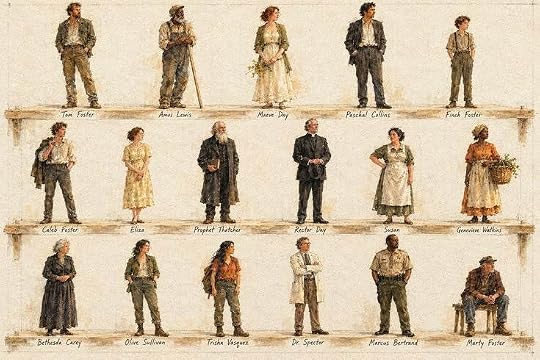
Full-Body Shelf-Style All-Character Watercolor One-Sheet
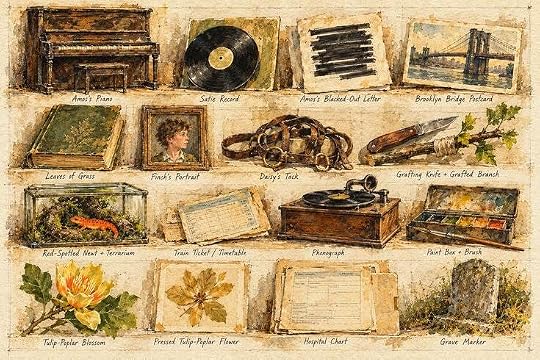
Shelf-Style All-Most-Important-Items Watercolor One-Sheet
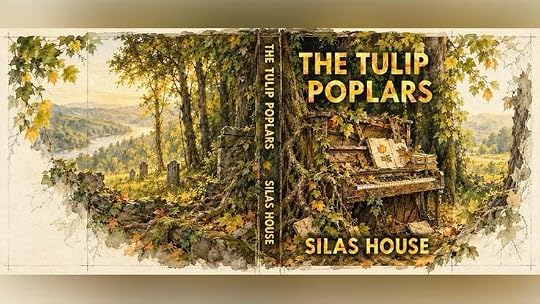
Alternate Book-Cover Full Dust Jacket with Flaps Watercolor
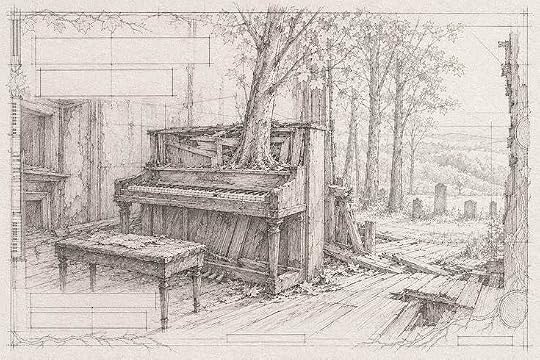
First Underdrawing Pencil Drawing – “What the Trees Keep”
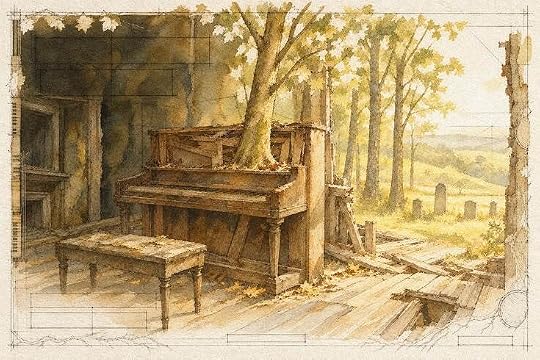
First Underdrawing with First Wash – “What the Trees Keep”
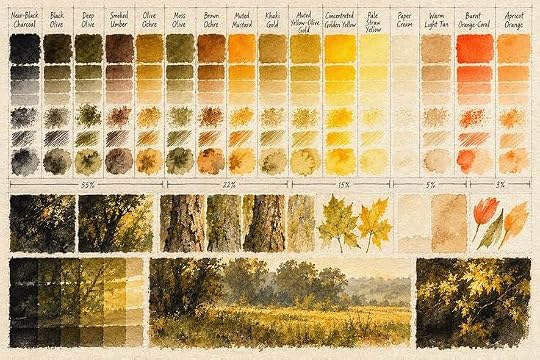
Cover-Derived Palette and Wash-Behavior Study
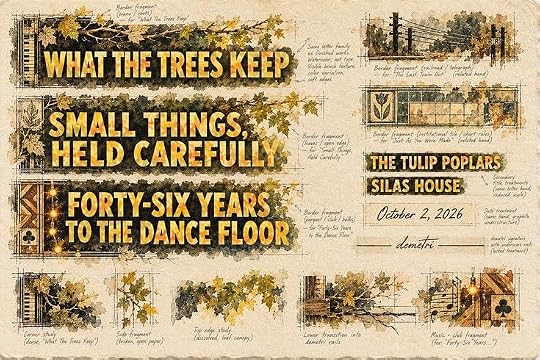
Series Typography + Border Architecture Study
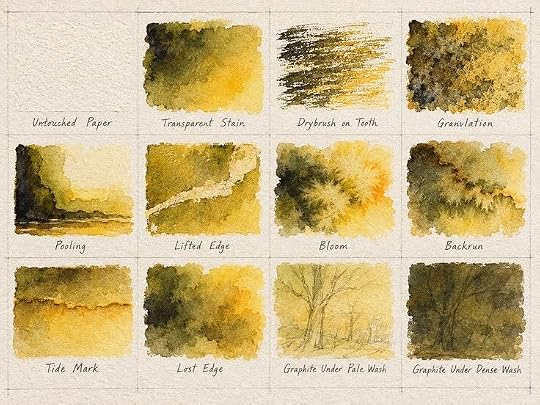
Cold-Pressed Paper + Pigment + Graphite Material-Behavior Study
All watercolor illustrations by Demetris Papadimitropoulos.
Watercolors are done on 140lb vellum and then scanned into the computer using an Epson scanner. From there, they are finalized in Procreate. No AI was used in writing this review — all art and opinions are my own.
Silas House’s “The Tulip Poplars” follows people misread by churches, hospitals, laws, and neighbors until songs, letters, paintings, graves, and a stubborn grove preserve the record more faithfully
By Demetris Papadimitropoulos | October 3rd, 2026
“What the Trees Keep” – An abandoned piano, a young tulip poplar, and the graves beyond the missing wall turn Bright Star’s ruin into an archive of what outlives the institutions that tried to define these lives.
Dead towns make excellent archives because they cannot object to what survives them. “The Tulip Poplars” opens with Bright Star, Kentucky, collapsing into weather. A wall has fallen from an abandoned house. An upright piano stands exposed inside it. From the soundboard grows a young tulip poplar. Older trees circle graves descendants still visit, and a child presses a blossom into a book. House gives us the relics first. Nearly everything that follows explains how they got there.
Everything looks, briefly, like a machine we know how to operate. In 1918, farmer Tom Foster falls for Amos Lewis, an orphan taught by clerical abuse to distrust divine authority. Tom’s lifelong friend Maeve Day loves Paschal Collins, the only Black boy at her father’s Episcopal institute, for whom being seen with a white woman can be lethal. Race, law, church, family, and fear scatter the four into marriage, exile, and return. House’s larger gamble is to keep following them after reunion would satisfy a smaller novel.
Most of what prejudice steals here is measured in years. Paschal is hurried out of Bright Star after the 1919 Corbin Expulsion. Police violence reaches Amos’s queer life in New York. Tom enters an asylum where doctors induce insulin comas to cure his “unnatural desire,” a treatment House acknowledges moving earlier than its widespread American use. Yet the harsher loss is breakfasts never eaten together, fields not worked side by side, evenings never shared. Tom and Amos lose decades before they can become boring together. Giving them back is the book’s boldest repair.
Early on, Amos slips away from a square dance and tells Tom, “Just walk with me a ways.” The modesty is almost funny. Walk makes love a motion. With me asks for company. A ways leaves forever suspiciously unmentioned. They move from the bright room into woods dark enough for the kiss. House tells us Tom will carry the phrase through separation, asylum, and death. The recurrence works, though the advance notice exposes one habit: sometimes a good image gets its own porch light.
“A Ways Into the Dark” – Tom pauses between square-dance light and the dark path where Amos waits ahead, making the threshold itself carry the danger and promise of their first kiss.
Tom’s problem can be heard in five words: “I want to be good, Amos.” Amos answers, “Why is being who we are not good?” Tom has inherited a vocabulary in which desire and goodness cannot occupy the same body. Amos, whose religion includes abuse alongside Scripture, discards the premise earlier. “I do. I want to be myself,” he says. The book does not let that become sufficient. Tom’s sexuality is not a wrong. Keeping Maeve inside a marriage built around what he cannot tell her still wounds her. Innocence of desire does not cancel responsibility.
“Small Things, Held Carefully” – Maeve and Paschal bend toward a red-spotted newt, their almost-touching hands making Caleb’s ethic of small things briefly visible as tenderness.
Race makes the two central love stories unequal in ways the book does not blur. Tom and Amos can sometimes pass through the world unread; Paschal cannot hide what makes Maeve dangerous to him. The Corbin interlude follows a white mob terrorizing Black residents and forcing hundreds onto trains. Paschal is removed before dawn. Maeve finally understands that his warning described his odds. House’s historical material works best when it changes an earlier scene.
“The Last Train Out” – Rails narrow toward forced departure as Black residents are driven from Corbin, letting infrastructure bear the historical pressure rather than turning violence into spectacle.
If Tom and Maeve existed only to delay Tom and Amos, their marriage would be dead weight with good table manners. Instead it produces Finch, companionship, resentment, work, tenderness, and years neither can revoke. They sleep together beneath the poplars associated with Tom’s desire for Amos, and their daughter comes from an encounter both know is incomplete. When the marriage ends, House does not retroactively empty it. A later truth does not make an earlier truth a lie.
Paschal’s marriage to Genevieve gets similar dignity. Lexington gives him a Black professional and Episcopal world larger than Bright Star. Genevieve is educated, ambitious, and alert to the vanity of benevolence. Their life matters. So does the moment Paschal assumes his rural ministry should become her future too. She will not disappear into his calling. The mountains that protect him feel like prison walls to her. A place does not become home by majority vote.
Amos discovers that New York is too complicated to function as a clean escape hatch. It gives him Bethesda, music, work, queer nightlife, and proof that people like him exist in public. During a police raid, Marcus runs while Amos stays with the beaten Bethesda, who later dies. The city gave her room to become herself and housed the authorities capable of killing her for displaying that self. Amos’s return to Kentucky carries neither defeat nor simple homecoming. He leaves one dangerous freedom for another.
Play Satie once and it is simply music. Let Amos describe “Gymnopédie No. 1” as longing, then let Maeve find Tom listening alone and crying, and the record changes without changing. No confession occurs. Maeve has acquired the noun capable of reorganizing years of evidence. The scene is one of House’s best because it withholds the explanatory speech he often supplies elsewhere. The revelation belongs to Maeve’s interpretation and ours.
“Longing, Side A” – Maeve watches from the doorway as Tom listens to Satie alone, the room’s empty distance giving longing a shape before either of them can name it.
Amos later writes Tom a long confession, destroys it, and replaces it with “I’m coming home to you.” Before mailing the note he blacks out to you. Maeve finds the page and reconstructs the missing words. The erasure becomes evidence. Much of “The Tulip Poplars” works this way: postcards, records, paintings, flowers, songs, graves, letters. They carry relationships across gaps where public language fails. An archive need not be official to outlive officials.
“You’re My People Now” – Bethesda’s kiss above Amos’s thumb turns chosen family into a small, luminous gesture held against the larger darkness of the room.
Dr. Spector tells Tom what he has wanted his whole life to hear: “There’s nothing wrong with you. You are just as you were made.” Then he gives him the less comforting half: Tom must commit honestly to Maeve or let her build another life. That distinction is one of the book’s cleanest ethical moves. Sexuality is not wrongdoing; deception can still have casualties. Spector also reveals House’s instinct to install an interpreter when the moral weather grows complicated. He is persuasive and extremely convenient.
“Just as You Were Made” – Tom’s exhausted body and trembling hand are dwarfed by asylum geometry while Dr. Spector’s affirmation opens the first narrow space not organized around cure.
In sentence after sentence, House prefers accumulation to abrasion. Rootstocks, sorghum, newts, wet earth, spring water, Daisy’s aging back: his prose likes things that can be touched, planted, carried, eaten, sung, or buried. Description gathers until feeling rises from matter, then a plain sentence names it. Sometimes that cadence is exact. Sometimes the explanation reaches the platform after the train has already gone.
Much of the book’s ethic sits inside Caleb’s rule that a person is revealed by the treatment of small things. House makes it stylistic. The narrative eye keeps dropping toward a newt, bees, seedlings, a mule, a flower, Tom’s tremoring hand. Dignity enters through scale. The prose keeps spending sentences on supposedly minor lives until “minor” becomes inadequate.
In one early scene Tom deals with Amos’s departure by grafting fruit trees. He cuts two living pieces, fits their wounds, seals the joint, waits for growth. House does not explain this one. He does not need to. Tom cannot yet imagine two men constructing a joined life, while his hands practice the proposition on wood. Two separate things meet at injury and continue. House’s symbols are often strongest when he leaves them alone.
The chapter headings make an argument of their own. “The Tulip Poplars” begins by separating Tom, Maeve, Amos, Paschal. Later the headings become “Tom and Amos,” then “Maeve and Paschal,” and finally “The Grove.” Self gives way to couple; couple to place. The shift is simple enough to miss, which is its pleasure. The table of contents understands something the explanatory passages occasionally labor to say.
Read time differently in Part IV. Earlier chapters linger over kisses, funerals, train rides, letters, meals. Later, years fall through the prose. When Tom and Amos are young and do not possess a future, an afternoon bears enormous weight. Once they share a life, decades can pass. The compression is meaningful and costly. Paschal’s later vocation, Finch’s adulthood, wartime changes, and Bright Star’s decline sometimes arrive as biography rather than experience. Sweep is purchased with detail.
“The Picture Opposite the Bed” – Finch paints the older Tom and Amos at Turtle Rock, making ordinary duration – bodies aged together, landscape behind them, image within image – into an alternative archive.
Once Tom and Amos share the farm, House refuses to turn cohabitation into a curtain call. They cook, work, read, host Finch, age beside Daisy, and privately declare themselves married beneath the poplars. Decades after their first hidden kiss, they dance at Lexington’s Gilded Cage and kiss publicly for the first time. The scene lands because so much uneventful life sits behind it. What was denied to them was not simply a lover. It was enough repetition for a life to acquire habits.
“Forty-Six Years to the Dance Floor” – After forty-six years, Tom and Amos enter public light together, their first public kiss isolated not by blur but by the breathing room a crowded room finally grants them.
Providence creeps in when the arrangements grow too exact. Thatcher is racist, homophobic, greedy, unfaithful, violent, environmentally destructive, manipulative, and willing to blackmail Tom. Eventually he holds so many of the book’s evils that he stops feeling entirely load-bearing. Eliza’s death raises a related question. After years of cruelty, she poisons Thatcher and herself to save the grove. The act cannot restore Caleb, Marty, or Tom’s childhood. Still, the moral geometry is suspiciously tidy.
One reunion follows another. Maeve and Paschal recover a life together. Tom and Amos do the same. Finch tells Tom that people have to be who they are and that the trick is to “let people be.” All four eventually rest beneath the same trees. That generosity is also House’s temptation. He refuses the old bargain in which marginalized characters earn seriousness through suffering, and rightly so. Yet abundance can become providence when every damaged line bends toward meaningful shape.
Unfortunately for any perfectly consoling reading, several wounds stay open. Bethesda, Marty, and Caleb remain dead. Tom’s left hand keeps shaking. Maeve cannot recover her surrendered education. Genevieve cannot recover years built around a vocation never hers. Paschal’s church burns. The ancestor whose records inspired the novel did not receive Tom’s old age. Fiction can rearrange possibility. It cannot make the original loss fictitious.
Lexington’s Faulkner Morgan Archive gives House’s recovery project a factual edge. Its collections document a Kentucky queer past long before Stonewall became the default starting gun, including Black queer performer Sweet Evening Breeze, associated with public drag performances beginning in the 1920s. House credits the archive in his acknowledgments. The frame changes: he is not planting queer people in a Kentucky past where they were absent. He is giving interior duration to lives the inherited record often preserves in scraps.
One of House’s measuring sticks is Thomas Hardy. In a September 2026 essay on his Substack, “A Country Boy Can Surmise,” he describes an Appalachian novel shaped by Hardy’s pressure of social rules, sexuality, and place; elsewhere he calls the bond between people and home ground one of this novel’s three love stories. Hardy matters less as pedigree than as craft standard. House admires fiction that lets social argument emerge from circumstance. “The Tulip Poplars” often does. Occasionally it solves the problem and then writes the answer twice in the margin.
Satie returns near the end, but so do simpler things. Amos has a piano. Paschal dies. Maeve dies. Amos dies in Tom’s arms. Tom follows a year later. Near death, he says again, “Walk with me a ways,” and Finch understands he is not speaking to her. Afterwards she remembers her father saying birds, crickets, frogs, and katydids sing “I am here.” Early, the phrase belongs to small creatures in the woods. Here it belongs equally to people repeatedly hidden, diagnosed, expelled, or denied.
Decades before we knew any of this, House had shown us Amos’s piano in ruins. Now its transformation can be read. Wood became instrument; the instrument made music; decay opens it to weather; a tulip poplar grows through what remains. The sequence is stranger than a simple triumph of nature over culture. Human making enters another material cycle. Piano becomes relic, ruin, ground, archive. Nothing stays intact, which is not the same as saying nothing lasts.
Each return to the tulip poplars adds another claim without exhausting the trees. They are Tom’s refuge, the site of sexual secrecy, threatened property, a private wedding place, a cemetery. Thatcher sees timber. Caleb sees stewardship. Tom sees holiness. Amos sees home. Finch inherits the memories attached to them. The symbolism can become officious, but the poplars survive because they remain stubbornly botanical, growing while everyone else argues about what they mean.
My rating is 88/100, or 4/5 Goodreads stars. The novel’s structural intelligence, emotional generosity, ecological thinking, and long view of queer and interracial lives outweigh its over-explanation, schematic villainy, and late compression. The distance from five stars is mostly a question of trust. House constructs images capable of carrying ambiguity, then sometimes verifies that we read the label correctly. His quietest scenes suggest he could trust us more.
Endings this circular risk sealing the book too neatly, but one contradiction stays open. Bright Star never becomes worthy of the people who love it. Kentucky never becomes a sanctuary for either couple. They claim the place anyway. Home here is not approval but attachment that survives the evidence against it. The four do not return because home has learned to deserve them. Rejection, House understands, does not automatically void belonging.
The quietest reversal is temporal. A novel about people struggling to remain visible ends by accepting that everyone will disappear. The answer is not immortality. It is enough life to leave traces another person may not know how to read: a grave, melody, creased postcard, painting above a bed, flower tucked into a book. For years these characters ask permission to exist. Their traces no longer need permission.
Ruins cannot testify, but they can hold evidence. By the time a tulip poplar rises through Amos’s piano, the authorities that presumed the right to define these lives have mostly disappeared with Bright Star: church, hospital, segregated order, watching neighbors, laws that refused certain marriages. The tree is not a tidy victory. It is still there, drawing another season out of what has decayed. “The Tulip Poplars” is most convincing when it trusts that continuation – not repair as erasure, simply the chance that something once forced into hiding may remain long enough for somebody else to find it.
Full-Body Shelf-Style All-Character Watercolor One-Sheet
Shelf-Style All-Most-Important-Items Watercolor One-Sheet
Alternate Book-Cover Full Dust Jacket with Flaps Watercolor
First Underdrawing Pencil Drawing – “What the Trees Keep”
First Underdrawing with First Wash – “What the Trees Keep”
Cover-Derived Palette and Wash-Behavior Study
Series Typography + Border Architecture Study
Cold-Pressed Paper + Pigment + Graphite Material-Behavior Study
All watercolor illustrations by Demetris Papadimitropoulos.
Watercolors are done on 140lb vellum and then scanned into the computer using an Epson scanner. From there, they are finalized in Procreate. No AI was used in writing this review — all art and opinions are my own.

September 9, 2026
I received this ARC from a Goodreads giveaway, thank you! This was also my first Silas House Novel and it definitely didn’t disappoint!
This is a wonderful coming of age novel with intertwined plot lines about loving everyone and being true to yourself and your own desires even if they may not fit the norms of the time. At times is hard to read about the abuse and racism but overall it’s a great read. It’s set in the mining area of Appalachia in the 1900’s and 4 friends growing up in a small town, first loves, growing up, moving away and coming back together and ultimately all dying but being buried in the same tulip poplar grove together surrounded by those they loved.
Please be warned to have some tissues ready the last 50-ish pages.
This is a wonderful coming of age novel with intertwined plot lines about loving everyone and being true to yourself and your own desires even if they may not fit the norms of the time. At times is hard to read about the abuse and racism but overall it’s a great read. It’s set in the mining area of Appalachia in the 1900’s and 4 friends growing up in a small town, first loves, growing up, moving away and coming back together and ultimately all dying but being buried in the same tulip poplar grove together surrounded by those they loved.
Please be warned to have some tissues ready the last 50-ish pages.
September 9, 2026
I have no idea how The Tulip Poplars ended up on my dashboard, and I certainly don't remember requesting it. To be completely honest, this is definitely not my kind of book. By page 30, I was so bored and frustrated that I almost gave up on it entirely.
Once the story got going, it completely turned around. It ended up being one of the absolute best books.Let me emphasize again: romance is not the type of book I normally enjoy, but this easily became one of my favorite reads of the year. Don't let the slow start or the genre fool you.
It’s not for everyone
Once the story got going, it completely turned around. It ended up being one of the absolute best books.Let me emphasize again: romance is not the type of book I normally enjoy, but this easily became one of my favorite reads of the year. Don't let the slow start or the genre fool you.
It’s not for everyone

Review of advance copy received from Publisher
Silas House is an insta-read/buy author for me and this book reinforced why I love this author so much. I have a feeling that this book came from the beautiful story that House wrote to go with Tyler Childer's music video "In Your Love".
Two men fall in love during the 1920s in rural Kentucky and this book spans the years after Tom & Amos met, fall in love and how their lives play out. Alongside their story you meet Maeve & Paschal, a white woman and a black man, that fall in love as well. These four people are complex characters, sometimes I loved them and sometimes I hated them...but House is able to write so well that at the end of the book I was crying and hugging the book, I loved it so much. You can tell that House is a poet because his writing is so lyrical, beautiful and clear....I hope that makes sense. I could go on and on about this book and author, but I'll stop...just buy this book from your local Indie when it comes out..you won't be disappointed.
Thanks to Hachette for the ARC!
Two men fall in love during the 1920s in rural Kentucky and this book spans the years after Tom & Amos met, fall in love and how their lives play out. Alongside their story you meet Maeve & Paschal, a white woman and a black man, that fall in love as well. These four people are complex characters, sometimes I loved them and sometimes I hated them...but House is able to write so well that at the end of the book I was crying and hugging the book, I loved it so much. You can tell that House is a poet because his writing is so lyrical, beautiful and clear....I hope that makes sense. I could go on and on about this book and author, but I'll stop...just buy this book from your local Indie when it comes out..you won't be disappointed.
Thanks to Hachette for the ARC!

August 27, 2026
Silas House has done it once again. The Tulip Poplars continues his streak of engrossing, beautiful Appalachian storytelling. These characters are so likable (even when they make questionable decisions). While I do not think that this novel quite lives up to some of his other works, I find it to be a worthy addition to his bibliography.
Review of advance copy received from NetGalley
What can I say about this novel? The Tulip Poplars was such an immersive reading experience, taking me through decades of complex relationships between Maeve, Tom, Amos, and Paschal. The setting, primarily in rural, mountainous Kentucky, is painted in haunting imagery. The characters face incredible hardship and injustice as they navigate life in the 1920s and beyond. The focus on nature and a soul-deep connection to the land where one grows up is also key to the book.
It’s a sweeping story of young people coming of age during a time when their personalities and true selves clashed with societal norms. I felt for each of these main characters and ached for the choices they did not have. The author skillfully weaves documented historical fact with fictional details and his own ancestry, and brings the reader along to observe a harrowing yet beautiful life.
Common beliefs about morality, particularly regarding LGBTQ+ people, are integral to the story and show how devastating the prevailing social code was to individuals who didn’t fit the mold. And although freedoms for that community have come a long way in the US, it’s heartbreaking that these harmful stereotypes and judgments are still promoted by so many. This novel would be a wonderful one for those who would judge others to read with an open mind and be able to see that we are all not so different from one another.
I am so grateful that I got the chance to read this novel that above all is a novel about being human and loving one another. I simultaneously wanted to tear through it and not let the reading experience come to an end. Thanks to NetGalley and Algonquin Books for the ARC.
It’s a sweeping story of young people coming of age during a time when their personalities and true selves clashed with societal norms. I felt for each of these main characters and ached for the choices they did not have. The author skillfully weaves documented historical fact with fictional details and his own ancestry, and brings the reader along to observe a harrowing yet beautiful life.
Common beliefs about morality, particularly regarding LGBTQ+ people, are integral to the story and show how devastating the prevailing social code was to individuals who didn’t fit the mold. And although freedoms for that community have come a long way in the US, it’s heartbreaking that these harmful stereotypes and judgments are still promoted by so many. This novel would be a wonderful one for those who would judge others to read with an open mind and be able to see that we are all not so different from one another.
I am so grateful that I got the chance to read this novel that above all is a novel about being human and loving one another. I simultaneously wanted to tear through it and not let the reading experience come to an end. Thanks to NetGalley and Algonquin Books for the ARC.

September 30, 2026
Well, if this wasn’t exactly the kind of sweeping, character-driven novel I was in the mood for. I loved the sense of place, the writing, the tension and longing between the characters, and the feeling of witnessing their lives unfold over decades.
It gets a little saccharine toward the end, which I was kind of expecting, and the resolution feels a little too easy. I found one relationship much more convincing than the other and overall wish there’d been more nuance. But it scratched an itch.
A story of forbidden love and self-determination, definitely for fans of Buckeye by Patrick Ryan or even The Prophets by Robert Jones Jr.
It gets a little saccharine toward the end, which I was kind of expecting, and the resolution feels a little too easy. I found one relationship much more convincing than the other and overall wish there’d been more nuance. But it scratched an itch.
A story of forbidden love and self-determination, definitely for fans of Buckeye by Patrick Ryan or even The Prophets by Robert Jones Jr.
Review of advance copy received from NetGalley
Silas House’s *The Tulip Populars* has deeply affected me, both destroying and rebuilding me. This novel spans the last century and is mostly set in a small town in Kentucky. In this fictional setting, we follow the lives of four individuals connected by love and societal constraints.
Like the Tulip Poplar trees that are grafted and raised, this story explores possibility, the passage of time, and growth. House’s atmospheric prose provides a beautiful backdrop for this transformative era marked by changing social norms, economic shifts, war, and civil rights.
Much like Erik Satie’s Gymnopédies, House evokes a haunting sense of longing—a struggle between fulfillment and safety. While some elements are based on his real-life ancestor, it serves as a reminder of how fresh and relevant this history remains. Given recent SCOTUS rulings and our current political climate, it prompts us to consider how much we can take our freedoms for granted. It underscores the importance of staying vigilant and grateful for our rights and loved ones.
Read this if you enjoy films or stories like Train Dreams, Brokeback Mountain, and Another Country. I will be thinking about this book for quite a while. Thanks to Algonquin Books and NetGalley for providing this beautiful, well-written book in exchange for an honest review.
Like the Tulip Poplar trees that are grafted and raised, this story explores possibility, the passage of time, and growth. House’s atmospheric prose provides a beautiful backdrop for this transformative era marked by changing social norms, economic shifts, war, and civil rights.
Much like Erik Satie’s Gymnopédies, House evokes a haunting sense of longing—a struggle between fulfillment and safety. While some elements are based on his real-life ancestor, it serves as a reminder of how fresh and relevant this history remains. Given recent SCOTUS rulings and our current political climate, it prompts us to consider how much we can take our freedoms for granted. It underscores the importance of staying vigilant and grateful for our rights and loved ones.
Read this if you enjoy films or stories like Train Dreams, Brokeback Mountain, and Another Country. I will be thinking about this book for quite a while. Thanks to Algonquin Books and NetGalley for providing this beautiful, well-written book in exchange for an honest review.

Review of advance copy received from NetGalley
The Tulip Poplars is a poignant, inspiring, and tragic book, all in one. It follows two sets of star-crossed lovers, each yearning for a forbidden relationship. Amos and Tom have known each other most of their lives and are in love but, living in Appalachian Kentucky in the early 20th century, gay love is forbidden and considered sinful. Maeve loves Paschal but she is white and the daughter of a preacher. Paschal is black and an orphan. These four characters share their POV"s throughout most of the 20th century, mostly in Appalachia.
Maeve is a beautiful woman and dreams of going to college. She and Tom are good friends, but friends only. Their community expects them to marry. Tom, however, has other ideas as he is in love with Amos, an orphan who also happens to be Paschal's best friend. Amos is more self-accepting of his homosexuality than is Tom. Tom is ever-fearful of being caught and labeled as a homosexual, Tom loves the grandiosity of the tulip poplars, the majestic trees that have grown on his land for much of time. He fights to preserve them from developers and longs for peace in his soul.
This novel explores the experiences, travels, and desires of these four protagonists, with each chapter told from one of their viewpoints. I felt like Tom and Amos were more fully developed than Maeve and Paschal. Amos, especially, with his grit, talents, and love of poetry, touched me deeply. Maeve's strength and desire to be more than a traditional wife and mother was very well wrought and I enjoyed the narrative of her time at Berea College. Paschal's personal growth and spirituality were very inspiring. Tom's stalwart love of his land and willingness to defend it with his life was one of the most dramatic themes of this novel.
Racism in the United States, especially during the early 20th century, is portrayed in all its horrific manifestations. Some of the renderings, however, felt out of place thematically. While I enjoyed the temporal transition from the early 1900's to the 1970's, I felt like the latter dates were not as carefully celebrated. Overall, I enjoyed this novel and appreciated its messages. Im will look further into the writings of Silas House, the author.
Thank you to NetGalley and Algonquin Books for allowing me to review an advanced review copy. The opinions expressed are solely my own.
Maeve is a beautiful woman and dreams of going to college. She and Tom are good friends, but friends only. Their community expects them to marry. Tom, however, has other ideas as he is in love with Amos, an orphan who also happens to be Paschal's best friend. Amos is more self-accepting of his homosexuality than is Tom. Tom is ever-fearful of being caught and labeled as a homosexual, Tom loves the grandiosity of the tulip poplars, the majestic trees that have grown on his land for much of time. He fights to preserve them from developers and longs for peace in his soul.
This novel explores the experiences, travels, and desires of these four protagonists, with each chapter told from one of their viewpoints. I felt like Tom and Amos were more fully developed than Maeve and Paschal. Amos, especially, with his grit, talents, and love of poetry, touched me deeply. Maeve's strength and desire to be more than a traditional wife and mother was very well wrought and I enjoyed the narrative of her time at Berea College. Paschal's personal growth and spirituality were very inspiring. Tom's stalwart love of his land and willingness to defend it with his life was one of the most dramatic themes of this novel.
Racism in the United States, especially during the early 20th century, is portrayed in all its horrific manifestations. Some of the renderings, however, felt out of place thematically. While I enjoyed the temporal transition from the early 1900's to the 1970's, I felt like the latter dates were not as carefully celebrated. Overall, I enjoyed this novel and appreciated its messages. Im will look further into the writings of Silas House, the author.
Thank you to NetGalley and Algonquin Books for allowing me to review an advanced review copy. The opinions expressed are solely my own.

Review of advance copy received from NetGalley
I requested and received an eARC of
The Tulip Poplars
by Silas House via NetGalley. Amos and Tom fall in love while working in the tobacco fields in the early years of the 20th century. But Tom is unable to shake the moral fear of his religious upbringing nor the responsibilities of his family's farm and eventually marries his longtime friend Maeve. Amos decides to move to New York City, where he can live with greater freedom. Meanwhile, Maeve herself pines for Paschal rather than her husband, but the strict Jim Crow laws and threat of violence prevent them from being together.
There are so many reasons that I fell in love with The Tulip Poplars, but first and foremost is the fact that I always love seeing Appalachian fiction. House names many cities and towns that are familiar to me. The dialect and phrases used by his characters felt like home to me. And then you mean to tell me I’m getting queer Appalachian fiction on top of that? Sold. I was instantly drawn to Amos and Tom’s stories. House writes their connection and struggles with a wonderful sensitivity that doesn’t ignore the ugly side of life. Instead, it attempts to find beauty in it. I fell in love with Tom’s inner turmoil just as much as I fell in love with Amos’ tenacity. Their separate characters are rather difficult at times, but House manages to make them narratively rewarding.
Maeve and Paschal were equally fascinating to read about. Like Amos and Tom, their stories are also impacted by historical injustices. Both experience different forms of bigotry and historical injustice. Maeve is a woman who finds herself backed into a corner and limited by her sex, and I really appreciated the way that House handled her marriage. Paschal’s life is constantly affected by racism, another difficult topic that the author doesn’t shy away from. All of the different character arcs are woven together seamlessly, making The Tulip Poplars the perfect sort of book to sink into as the story carries you away. The pacing was great and I often found it difficult to put the book down. The prose is lush, full of really evocative and beautiful descriptions as well as precious gems of wisdom that the characters pick up along the way. The ending was absolute perfection and the cherry on top of a really great read.
There are so many reasons that I fell in love with The Tulip Poplars, but first and foremost is the fact that I always love seeing Appalachian fiction. House names many cities and towns that are familiar to me. The dialect and phrases used by his characters felt like home to me. And then you mean to tell me I’m getting queer Appalachian fiction on top of that? Sold. I was instantly drawn to Amos and Tom’s stories. House writes their connection and struggles with a wonderful sensitivity that doesn’t ignore the ugly side of life. Instead, it attempts to find beauty in it. I fell in love with Tom’s inner turmoil just as much as I fell in love with Amos’ tenacity. Their separate characters are rather difficult at times, but House manages to make them narratively rewarding.
Maeve and Paschal were equally fascinating to read about. Like Amos and Tom, their stories are also impacted by historical injustices. Both experience different forms of bigotry and historical injustice. Maeve is a woman who finds herself backed into a corner and limited by her sex, and I really appreciated the way that House handled her marriage. Paschal’s life is constantly affected by racism, another difficult topic that the author doesn’t shy away from. All of the different character arcs are woven together seamlessly, making The Tulip Poplars the perfect sort of book to sink into as the story carries you away. The pacing was great and I often found it difficult to put the book down. The prose is lush, full of really evocative and beautiful descriptions as well as precious gems of wisdom that the characters pick up along the way. The ending was absolute perfection and the cherry on top of a really great read.

Review of advance copy received from NetGalley
My thanks to NetGalley and the publishers for an ARC of this title in exchange for an honest review.
Sentimental in the positive sense of the word.
At its heart, The Tulip Poplars is about four characters, Tom, Amos, Maeve, and Paschal navigating the strictures of small town life in early 1900’s Kentucky. Each of them desires something not permitted by their society, and they feel stifled by the social mores of the town of Bright Star, even as they relish the vibrant natural beauty of the land they call home. It’s a double bind familiar to many inhabitants of socially oppressive rural communities. They can’t quite be themselves there, yet nowhere else feels quite like home. Trying to build a life amid this tension, to be true to themselves while not losing their sense of place, is the crux of the novel.
The writing is picturesque and fluid. It’s really more of a character study than a plot driven narrative. Though there were a handful of unexpected moments, generally the tone of the book was contemplative and wistful, a love letter to Appalachia wrapped in historical fiction. It may not be to everyone’s taste, but I found it worked well. Particularly since the author portrays each character so distinctly and adeptly. I really felt like I knew these people after only a few chapters and it was riveting to see them conflict with the outside world and even amongst themselves. I appreciated as well that each character was genuinely trying their best almost all the time, yet none of them were perfect caricatures. They each had moments of messy jealousy, episodes of thoughtlessness; just like real people.
This was my first book by this author and I would gladly try anything else by this author. 3.5 (Bright) Stars.
Sentimental in the positive sense of the word.
At its heart, The Tulip Poplars is about four characters, Tom, Amos, Maeve, and Paschal navigating the strictures of small town life in early 1900’s Kentucky. Each of them desires something not permitted by their society, and they feel stifled by the social mores of the town of Bright Star, even as they relish the vibrant natural beauty of the land they call home. It’s a double bind familiar to many inhabitants of socially oppressive rural communities. They can’t quite be themselves there, yet nowhere else feels quite like home. Trying to build a life amid this tension, to be true to themselves while not losing their sense of place, is the crux of the novel.
The writing is picturesque and fluid. It’s really more of a character study than a plot driven narrative. Though there were a handful of unexpected moments, generally the tone of the book was contemplative and wistful, a love letter to Appalachia wrapped in historical fiction. It may not be to everyone’s taste, but I found it worked well. Particularly since the author portrays each character so distinctly and adeptly. I really felt like I knew these people after only a few chapters and it was riveting to see them conflict with the outside world and even amongst themselves. I appreciated as well that each character was genuinely trying their best almost all the time, yet none of them were perfect caricatures. They each had moments of messy jealousy, episodes of thoughtlessness; just like real people.
This was my first book by this author and I would gladly try anything else by this author. 3.5 (Bright) Stars.
Review of advance copy received from NetGalley
Silas House became one of my favorite authors with “Lark Ascending“ and “A Parchment of Leaves.” I will now add his newest title to these books that I enjoyed immensely. “Tulip Poplars” has four main characters: Maeve, a minister’s daughter: Paschal, an orphaned Black youth; Amos, who lives with Paschal in the church-run orphanage and Tom, son of a local farmer who falls in love with Amos. But their relationships are far more complex than that simple summary. House traces their stories through the rising South after WWI through the 20th century with stops in the countryside, the dynamics of NYC, the Midwest and places in between. His descriptions of the land are a homage to its beauty and the effect it has upon those willing to acknowledge its importance. But the author is far from satisfied with only that. Beneath the beauty there is racism, classicism, church doctrine , education, women’s roles and social movements. House always returns to the characters who forge new ways of learning about themselves, their relationships and how to become the persons they were meant to be through love and understanding. A masterpiece! Highly recommended. Thanks to the publisher and Netgalley for providing this title.

Review of advance copy received from NetGalley
I loved Lark Ascending by Silas House and requested this ARC just based on that even though the subject was totally different (that was a near future climate apocalypse). And I'm so glad I did. What we have now is a quiet, aching story across decades of four people in a small Kentucky town - starting as children, two orphans, a rector's daughter, a farm boy. There is feeling out of place, there is love that can't be recognized in that time without dire dire consequences, there's loss, there's the inability to live as yourself. I was sucked in on every page and watched and hoped for a happy ending for these 4 people. But there really is no happy ending to be had, just a happy enough given the circumstances, and not ever being yourself truly and all that lost time. Whew, I was absolutely sobbing by the end.
Thank you to Algonquin and NetGalley for the arc. The Tulip Poplars is out Oct 13, 2026
Thank you to Algonquin and NetGalley for the arc. The Tulip Poplars is out Oct 13, 2026

Review of advance copy received from NetGalley
I was so excited to be approved for this an advanced copy of this title through Netgalley.
Silas House has such a beautiful and descriptive way of placing you in moments of time and space, especially in the beloved Appalachians of Eastern Kentucky.
This is a moving tale of forbidden loves beginning in the late 1800s/ early 1900s and ending in the 1970s.
I really appreciated House providing a moving story within a greater historical context of racial tensions, the lasting issues related to World War I and the Spanish Flu. This isn't a time period that receives the majority of attention for historical fiction which made it even more interesting than I had imagined.
We have two couples that cannot be together for different reasons - Tom and Amos because of the stigma and hostilities against homosexuality and Maeve and Paschal because of bans against interracial couples.
There were times when I wanted the story to break away from the actual history of the time, but House keeps the issues, tensions, and resolutions of these two couples within the realm of possibilities at the time.
And then there is the land with the Tulip Poplars that paint a vivid picture of the world that all of these characters of Bright Star inhabit and which also serve as the arena in which several plot points are determined.
I would highly recommend this novel for people who love historical fiction, and books such as Buckeye.
Silas House has such a beautiful and descriptive way of placing you in moments of time and space, especially in the beloved Appalachians of Eastern Kentucky.
This is a moving tale of forbidden loves beginning in the late 1800s/ early 1900s and ending in the 1970s.
I really appreciated House providing a moving story within a greater historical context of racial tensions, the lasting issues related to World War I and the Spanish Flu. This isn't a time period that receives the majority of attention for historical fiction which made it even more interesting than I had imagined.
We have two couples that cannot be together for different reasons - Tom and Amos because of the stigma and hostilities against homosexuality and Maeve and Paschal because of bans against interracial couples.
There were times when I wanted the story to break away from the actual history of the time, but House keeps the issues, tensions, and resolutions of these two couples within the realm of possibilities at the time.
And then there is the land with the Tulip Poplars that paint a vivid picture of the world that all of these characters of Bright Star inhabit and which also serve as the arena in which several plot points are determined.
I would highly recommend this novel for people who love historical fiction, and books such as Buckeye.

Review of advance copy received from Goodreads Giveaways
I am so lucky to have received an advance copy of this novel prior to its publication in October. This is my first book by Silas House, and it has easily become one of my favorite novels. It made me laugh, smile, and cry. I couldn’t help but be reminded of my loved ones and feel grateful that the world has started to be more accepting.
The novel centers around four individuals growing up in a rural southern community in the early twentieth century. Tom is in a forbidden queer romance with Amos, while Maeve, Tom’s childhood friend, is in love with Amos’ colored friend Paschal. The four of them navigate their queer/interracial relationships in secrecy amid a world that does not accept them and a religion that forsakes them for being who they are.
This novel has little action and is mostly advanced by events that are essential for driving the character development. If you are one that relies on heavy action to get through a book, this may not be the book for you. However, if you are a lover of character studies or often find yourself disagreeing when people say, “that book was unnecessarily long and had too much character development,” this is the perfect novel for you. I implore those individuals to read this book!
The novel centers around four individuals growing up in a rural southern community in the early twentieth century. Tom is in a forbidden queer romance with Amos, while Maeve, Tom’s childhood friend, is in love with Amos’ colored friend Paschal. The four of them navigate their queer/interracial relationships in secrecy amid a world that does not accept them and a religion that forsakes them for being who they are.
This novel has little action and is mostly advanced by events that are essential for driving the character development. If you are one that relies on heavy action to get through a book, this may not be the book for you. However, if you are a lover of character studies or often find yourself disagreeing when people say, “that book was unnecessarily long and had too much character development,” this is the perfect novel for you. I implore those individuals to read this book!

Review of advance copy received from NetGalley
A beautiful love story told through four POVs across time. House writes as though he’s painting a poem, creating a story that is both lyrical and deeply moving. I found myself cheering for each character as they navigated their own journeys of life and love, never quite knowing which story I loved most.
There are moments of heartbreak and hope, loss and promise, that will truly move your heart. Absolutely beautiful and well worth the read. I can’t wait to discover more books by this author!
Thank you Netgalley for this ARC in exchange for my unbiased review.
There are moments of heartbreak and hope, loss and promise, that will truly move your heart. Absolutely beautiful and well worth the read. I can’t wait to discover more books by this author!
Thank you Netgalley for this ARC in exchange for my unbiased review.
Review of advance copy received from NetGalley
Tulip Poplars is a lovely book about the secrets we keep, the longings we endure, and the responsibilities that bind us. Set mostly in rural Kentucky during the early part of the 20th century; the feeling of time and place was palpable and lush and my favorite part of this novel. While some of the characters were deeply engaging throughout their development over the years, a couple were somewhat flat throughout, even with their change of hearts. All said, a very enjoyable read for this reader. Thank you netgalley.

Review of advance copy received from NetGalley
This story swept me away and left me hanging onto every word on every page. The story of Amos and Tom was amazing and so realistic. I loved seeing how over the years they tried to go the “normal” route but still couldn’t help their true feelings inside. The time period and overall setting was really amazing and really captivated me. I couldn’t stop thinking of this book and the characters after I finished it. I received an advance review copy for free, and I am leaving this review voluntarily.
Review of advance copy received from NetGalley
A beautifully written story set in Applachian Mountains beginning in the early 1900's. The reader meets the four main characters, Tom, Amos, Maeve and Paschal and follows their lives throughout the years. Forbidden love, religious taboos, race and class are among the topics explored in this wonderful story, I loved the characters and the descriptions especially of rural Kentucky and its tobacco fields. A book to be treasured; congrats to the author for a great read.

Review of advance copy received from NetGalley
This book tells the story of four people. It starts in Kentucky in the early 1900s. Tom and Amos, who are in love but dare not show it, and Maeve and Paschal, who cannot be together because Paschal is Black. Their stories intertwine over the years.
This was a lovely book. I could almost feel myself back in the tulip poplar grove. It was beautifully written and I highly recommend it.
This was a lovely book. I could almost feel myself back in the tulip poplar grove. It was beautifully written and I highly recommend it.
Review of advance copy received from Publisher
A beautiful story of love and yearning. Filled with the beauties of nature and told with the utmost respect.
Displaying 1 - 30 of 33 reviews