America’s favorite astrophysicist has written the most entertaining and universally appealing book of his stellar career: a practical guide for dealing with Alien visitors, an exploration of how it might happen, and a cultural history of our fascination with extraterrestrials.
“Ever since childhood,” writes Neil deGrasse Tyson, “I’ve wanted to be abducted by Aliens.”
Take Me to Your Leader is the culmination of a lifetime of fascination, speculation, and the amassing of scientific data about the possibility of Aliens visiting Earth. Drawing on a wealth of depictions from history, literature, pop culture, and film, Tyson applies the universal laws of physics to make the case for what Aliens might look like, act like, how they might travel through the universe to reach us, and what they might think of us upon arrival. Should such an event occur, Tyson further offers useful etiquette tips for your first close encounter.
If you’ve ever wondered why there are so many UFO sightings, or whether Aliens might already be among us, Tyson offers an informed perspective that is both factual and fun. Take Me to Your Leader is a tantalizing exploration of what would be the most mind-blowing experience of your life—the book for anyone who has ever wondered: Are we alone?
Neil deGrasse Tyson was born and raised in New York City where he was educated in the public schools clear through his graduation from the Bronx High School of Science. Tyson went on to earn his BA in Physics from Harvard and his PhD in Astrophysics from Columbia.
In 2001, Tyson was appointed by President Bush to serve on a twelve-member commission that studied the Future of the U.S. Aerospace Industry. The final report was published in 2002 and contained recommendations (for Congress and for the major agencies of the government) that would promote a thriving future of transportation, space exploration, and national security.
In 2004, Tyson was once again appointed by President Bush to serve on a nine-member commission on the Implementation of the United States Space Exploration Policy, dubbed the “Moon, Mars, and Beyond” commission. This group navigated a path by which the new space vision can become a successful part of the American agenda. And in 2006, the head of NASA appointed Tyson to serve on its prestigious Advisory Council, which guides NASA through its perennial need to fit ambitious visions into restricted budgets.
In addition to dozens of professional publications, Dr. Tyson has written, and continues to write for the public. From 1995 to 2005, Tyson was a monthly essayist for Natural History magazine under the title Universe. And among Tyson’s fifteen books is his memoir The Sky is Not the Limit: Adventures of an Urban Astrophysicist; and Origins: Fourteen Billion Years of Cosmic Evolution, co-written with Donald Goldsmith. Origins is the companion book to the PBS NOVA four-part mini-series Origins, in which Tyson served as on-camera host. The program premiered in September 2004.
Two of Tyson’s other books are the playful and informative Death By Black Hole and Other Cosmic Quandaries, which was a New York Times bestseller, and The Pluto Files: The Rise and Fall of America’s Favorite Planet, chronicling his experience at the center of the controversy over Pluto’s planetary status. The PBS NOVA documentary The Pluto Files, based on the book, premiered in March 2010.
In February 2012, Tyson released his tenth book, containing every thought he has ever had on the past, present, and future of space exploration: Space Chronicles: Facing the Ultimate Frontier.
For five seasons, beginning in the fall of 2006, Tyson appeared as the on-camera host of PBS NOVA’s spinoff program NOVA ScienceNOW, which is an accessible look at the frontier of all the science that shapes the understanding of our place in the universe.
During the summer of 2009 Tyson identified a cadre of professional standup comedians to assist his effort in bringing science to commercial radio with the NSF-funded pilot program StarTalk. Now also a popular Podcast, for three years it enjoyed a limited-run Television Series on the National Geographic Channel. StarTalk combines celebrity guests with informative yet playful banter. The target audience is all those people who never thought they would, or could, like science. In its first year on television and in three successive seasons, it was nominated for a Best Informational Programming Emmy.
Tyson is the recipient of twenty-one honorary doctorates and the NASA Distinguished Public Service Medal, the highest award given by NASA to a non-government citizen. His contributions to the public appreciation of the cosmos have been recognized by the International Astronomical Union in their official naming of asteroid “13123 Tyson.” And by zoologists, with the naming of Indirani Tysoni, a native species of leaping frog in India. On the lighter side, Tyson was voted “Sexiest Astrophysicist Alive” by People Magazine in 2000.
More recently, Tyson published Astrophysics for People In A Hurry in 2017, which was a domestic and international bestseller. This adorably readable book is an introduction to all that you’ve read and heard about that’s making news in the universe—consummated, in one plac
__________________________ A Close Encounter of Some Kind
Yes, I have had a close encounter of some kind. It was in 1972. My girlfriend lived with her parents about two hours west of Chicago as the Unidentified Flying Crow flies. Around midnight, Kathie and I had driven down a dark and lonely country road and pulled into the drive of a cornfield owned by her father. We had gone there to …ah… inspect the crop…yeah, that’s it. There we were. I had a jug of cheap wine, a loaf of gourmet cheese and my now-frau beside me inspecting corn in the wilderness. We needed the wine because inspecting is thirsty work.
As I sipped from my jug of moonlit merlot, I noticed how crowded the sky was. There were many of what I assumed to be passenger planes passing directly over us, heading for Chi-town, their landing lights a blazing. I had just brought this interesting fact to Kath’s attention when one of the lights coming from the west started to sport a fiery tail. It had come from due west of us and was heading in a northeasterly direction––its dragon’s breath tail stretching longer and longer across the sky.
Kath and I had time to get out the car and gawk. When this mystery object was due north of us, it broke into 4 or 5 pieces and fell from the sky. This is all true––well, except for the gourmet cheese part, which was actually Velveeta.
Now, you are one of my extremely bright GR friends and I know you are thinking, “Pseudo, you must have stumbled across an entire nest of aliens.” And I totally agree with you. However, Neil DeGrasse Tyson, says that you are misinformed and lacking the proper scientific mindset. You should demand an apology from him. He claims that what I saw was actually just a giant rock that fell out of the sky and caught fire. Really, Neil? Burning rocks falling from the sky! Can you imagine? And this man claims to be a scientist!
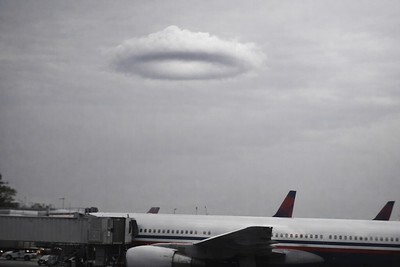
Tyson has an entire section explaining that most sightings that are reported as being UFOs are actually just perfectly normal phenomena that people don’t know about or have misinterpreted, like flaming rocks falling out of the sky, swamp gas, rare cloud formations, or huge passenger planes hovering in place as it attempts to land.
On November 7, 2006, more than a dozen witnesses reported seeing this gray, saucer-shaped object hovering silently over Gate C-17 of O’Hare Airport in Chicago. Witnesses described the object as remaining fixed in the sky for several minutes. According to authorities it was a rare cloud formation.
I live just 10 miles or so from O’Hare. I didn’t see the flying saucer cloud, but I have seen the hovering 747s. It’s true. When planes are circling the airport and then turns and starts to descend, they occasionally actually do seem to stop in midair and just hover there for a few seconds without moving. Tyson says this is just an optical illusion and I have seen it several times. And yes, it is spooky.
Tyson’s book also devotes a very large section to critiquing fictional Aliens like Superman and pontificates on whether their powers could actually exist in our universe. For instance, he claims that Superman couldn’t actually see through walls with X-ray vision. Well, obviously Tyson has never read Superman comics. I started reading Superman when I was 6 or so and I have seen the Man of Steel looking through walls hundreds of times. Case closed.
🌟🌟🌟 Stars While the book is about Aliens, it is not what I expected. I had hoped that it would be a discussion in which Tyson uses his expertise to evaluate government hearings and other recent “evidence” about UFOs. He does spend a few pages such items, but that is a small percentage of the book.
My favorite observation of Tyson’s was about a statement a member of the Pentagon’s Unknown Aerial Phenomenon Task Force made during a Congressional hearing. This official stated that there were “non human biologics” at an alleged UFO crash site. That sounds like proof of Aliens to me, but Tyson points out non-human biologics just means non-human. They could be raccoon droppings. My interpretation of that remark is that raccoons are aliens, but you can draw your own conclusions.
In addition, Tyson also demands a Writ of Habeas Corpus. He says will not be convinced that there are aliens among us unless the government can produce an alien body or a flying saucer the size of Chicago. Eyewitness accounts, no matter how sincere they may be, are not scientific proof.
Tyson did say enough about the evidence presented by the government to make me wonder if the Congressional hearings are just political Twight Light Zone circuses, meant to entertain the masses and distract their attention.
If you are interested in a light-hearted but scientifically sound approach to aliens, I can mildly recommend this book. If you want to do some research on your own, the next time you see a raccoon, ask it to take you to its leader and see what happens. You may be surprised by the results.
Neil deGrasse Tyson says he was not abducted by aliens, but he doesn't mention if he is an alien. This distinction is critical. Science in America is going back into hiding. But somehow Neil deGrasse Tyson has been out there, with the people, unafraid to give knowledge to whomever seeks it. He humorously breaks down the anti-science thinking in a way that a 6-year-old, a 16-year-old, and a 60-year-old can all understand and relate to. He is an earthly treasure not from this earth. When we inevitably do find out that Neil deGrasse Tyson was a benevolent alien (no matter how much he overwhelmingly crushes this idea with fact, logic, and reason) we will realize he came from the planet of Aristotle, Archimedes, Fibonacci, Magellan, Copernicus, Galileo, Newton, Sagan, and Nye. The wise men, the elders, the healers of the mind. Bonus: The author also signed some hard copies of this book. Can you image what our great-great-great-great-great great grandkids are going to be able to show their friends? NBD, just a signed book from one of the greatest teachers of science of the turn of the millennia
I really enjoyed reading Neil deGrasse Tyson's thoughts and perspectives on the existence of alien life and the probability of their visitation to our planet. As usual his perspectives are very logical and based on fact.
A little all over the place -- critiques or appraisals of alien life in pop culture, musings on how varied alien life might be from our perspective, lens-switching as Tyson muses on how ET might review/dismiss us, and then UFO sighting/abduction debunking. A very casual but quotable read.
In science, there’s no such thing as a credible claim or a credible witness, only credible evidence. (Remember Percival Lowell claiming that Mars had canals?
Take Me To Your Leader was a very interesting book about what a meeting with alien species might look like and how aliens have been represented throughout the history of popular culture. Very insightful, funny at times and very enjoyable to read, another excellent book by Neil DeGrasse Tyson.
Neil deGrasse Tyson’s Take Me to Your Leader: Perspectives on Your First Alien Encounter reads like a survival manual written by a cosmologist who has spent equal time studying quasars and scrolling through internet comment sections. The book’s central conceit—a hypothetical guidebook preparing humanity for contact with extraterrestrial life—allows Tyson to fuse scientific literacy with cultural satire in a way that is both informative and delightfully self-aware. Reading it feels less like attending a formal lecture and more like being cornered at a planetarium reception by the one astrophysicist charismatic enough to explain the Drake Equation while simultaneously roasting humanity’s inability to cooperate over parking spaces.
What makes the book compelling is its refusal to indulge the usual Hollywood fantasies surrounding alien contact. Tyson does not present extraterrestrials as either benevolent saviors or laser-eyed conquerors descending upon Earth for dramatic cinematic effect. Instead, he frames first contact as a sociological and philosophical stress test for civilization itself. The true subject of the book is not aliens—it is humanity’s astonishing capacity for irrationality under pressure. If extraterrestrials ever arrived, Tyson suggests, our first instinct would likely not be scientific curiosity but bureaucratic confusion, geopolitical competition, and a media frenzy somehow sponsored by a fast-food chain.
The satirical tone works because Tyson understands that humor often succeeds where technical exposition fails. He examines the likelihood of alien communication through the lens of scientific realism while simultaneously poking fun at our deeply anthropocentric assumptions. Humans, after all, tend to imagine extraterrestrials as suspiciously humanoid beings who conveniently speak English and possess a dramatic sense of timing. Tyson dismantles these assumptions with the calm patience of a professor grading a particularly ambitious but catastrophically wrong essay.
One of the book’s strongest themes is scale—both cosmic and intellectual. Tyson repeatedly reminds readers that the universe is incomprehensibly vast. The Milky Way galaxy alone contains somewhere between 100 and 400 billion stars, many of which likely possess planetary systems. Modern astronomy has identified thousands of exoplanets, including several in potentially habitable zones. The implication is mathematically humbling: if life emerged on Earth through natural processes, there is little reason to believe the cosmos performed that experiment only once. Tyson uses this statistical reality not to sensationalize alien life, but to emphasize humanity’s relative smallness. It is difficult to maintain nationalistic arrogance when confronted with distances measured in light-years.
The astronomy woven throughout the book provides some of its most engaging moments. Tyson has a gift for translating intimidating astrophysical concepts into language accessible enough for casual readers without sacrificing intellectual rigor. Discussions of radio signals, interstellar travel, and the limitations imposed by relativity are handled with clarity and wit. He notes, often indirectly, that even if intelligent life exists elsewhere, the universe’s enormous distances make spontaneous encounters improbable. Space is not merely big; it is offensively big. If Earth were reduced to the size of a grain of sand, our nearest stellar neighbor would still be miles away. Tyson’s explanations consistently reinforce the reality that science fiction frequently understates the logistical nightmare of traversing interstellar space.
What elevates the book beyond speculative entertainment is its exploration of human behavior. Tyson cleverly frames extraterrestrial arrival as a mirror reflecting Earth’s existing political and cultural dysfunctions. Who would speak for humanity? Governments? Scientists? Billionaires with suspiciously dramatic rocket launches? The United Nations? A social media influencer livestreaming the apocalypse with discount codes? Tyson’s satire works because none of these possibilities feel entirely impossible.
The hypothetical scenarios also expose humanity’s fragile relationship with evidence and expertise. Tyson subtly critiques anti-scientific attitudes by imagining how conspiracy theories and misinformation would spread during first contact. One suspects he wrote portions of the book with the exhausted expression of a man who has spent decades explaining basic astronomy to people convinced the moon landing was filmed in Nevada. His broader point is difficult to ignore: humanity may possess extraordinary technological achievements, but intellectually we remain alarmingly vulnerable to panic, tribalism, and pseudoscience.
Despite the satire, the book is never cynical. Tyson clearly retains faith in scientific inquiry and humanity’s potential for curiosity. That optimism becomes one of the work’s defining strengths. He portrays science not merely as a collection of facts but as a method for confronting uncertainty responsibly. In Tyson’s worldview, the appropriate response to alien contact would not be fear or worship, but careful observation, critical thinking, and perhaps an internationally coordinated committee meeting that runs only slightly overtime.
As someone who already admires Neil deGrasse Tyson both as a scientist and as an internet personality, I found the book especially enjoyable because it amplifies the qualities that have made him such a recognizable public figure. Tyson occupies a peculiar cultural role: simultaneously an astrophysicist, educator, meme participant, and cosmic motivational speaker. His public persona occasionally invites criticism for theatricality, yet that same theatrical instinct makes complex scientific ideas accessible to audiences who might otherwise avoid them entirely. In this book, his conversational style becomes an asset. The prose carries the cadence of someone enthusiastically explaining the universe while trying very hard not to laugh at humanity’s collective absurdity.
The book’s satirical academic tone also invites comparisons to earlier speculative writers who used hypothetical scenarios to critique society. Much like Jonathan Swift used absurd voyages to expose political folly, Tyson uses extraterrestrial contact to dissect human vanity and institutional incompetence. The difference is that Tyson’s satire emerges from astrophysical plausibility rather than pure fantasy. His arguments are grounded in genuine scientific understanding, which gives the humor additional weight. The jokes land because the science beneath them is credible.
Ultimately, Take Me to Your Leader succeeds because it treats alien contact not as escapism, but as an intellectual exercise in self-examination. Tyson asks readers to consider what humanity values, how we process uncertainty, and whether civilization is emotionally mature enough to survive confirmation that we are not alone. The answer, according to the book, is probably “not entirely,” but we would certainly produce fascinating television coverage along the way.
In the end, Tyson leaves readers with a paradox both amusing and profound: humanity spends enormous effort imagining aliens, yet the greatest mystery may still be ourselves. The universe, vast and ancient beyond comprehension, may someday introduce us to another intelligent species. Tyson’s book suggests that before such an encounter occurs, we might benefit from learning how to communicate more effectively with the intelligent life already here.
Tyson gives a sound arguement that Carl Sagan would be proud of. In the current public conversation on UFOs (UAPs), I'm reminded of the Carl Sagan quote that he attributed to the space engineer James Oberg, "It's important to keep an open mind, but not so open that your brains fall out." To me, it feels like there is a lot of brain seepage going on in the mainstream debate of UFOs!
This book is a much needed plug to stop the leakage. As a species, we crave answers. And when we don't have good explanations to our questions, we will settle for bad ones. This book does an excellent job at keeping an open mind, but not settling on bad explanations while doing so.
As some of the other reviews point out, Tyson does jump around quite a bit. But I do think this is well worth the read if you're genuinely curious (as I am) about the potential that an extraterrestrial civilization evolved elsewhere in the Universe.
I've come to really enjoy Neil's thoughts and how he makes things fun to learn, interesting, and also easier for the everyday person to understand.
I enjoyed this one, it was fun to see how he contradicted some of pop cultures thoughts on aliens and other pieces along the way. I will say it did feel like it bounced around quite a bit, but it still was entertaining to read.
Perhaps better titled Aliens In Pop Culture: A Review, this short book is disappointing in its lack of serious discussion of extraterrestrial life, its probability, and its possible paths of evolution. Although Dr. deGrasse Tyson does tip his hat at those subjects, it doesn’t take long before he diverts the discussion towards The Day The Earth Stood Still, The War Of The Worlds, E.T. the Extraterrestrial, Close Encounters Of The Third Kind, and even the as of yet unreleased Disclosure Day. Thank goodness for Steven Spielberg, for without whom this book would have been a pamphlet.
I really want to like this book. It's full of fascinating anecdotes and tangents into the theoretical nature of alien life. I could not get past the lack of a clearer throughline. Maybe if I had listened to it, I would have liked it more, given Neil deGrasse Tyson's voice is what it is. That said... I read it. Did I like it? Not particularly. Do I think others will like it? Yes probably. Wish I had more constructive things to say, but this read (for me) simply exists, not unlike the likelihood of alien life.
A nice balance of looking at alien representation in pop culture, hypotheses on if/how we would actually encounter extraterrestrial life, as well as informative (but not dry) science behind these hypotheses. It was thought provoking, but also entertaining.
I went into this hoping for actual astrophysics and theory, but got pop culture fluff instead. There are a few scientific niceties scattered throughout the chapters, but not nearly enough to make it a worthwhile read. Tyson spends most of the book coasting on analogies from movies and streaming shows, almost like he assumes the audience is too dumb to grasp a concept without a sci-fi reference to hold their hand. If I wanted media analysis, I would go read a blog. I wanted hard science and grounded assumptions, and this was just a massive letdown.
A pathetic book which gives a brain dump of everything related to science and aliens but does not talk about the subject at all - what happens when an alien meets you and asks you to take it to your leader. I needed 200 pages on that, not on human history.
This book didn't seem like anything more than a fireside chat with your buddies about who knows more about Alien movies. I didn't learn anything particularly interesting which is the whole point of a Tyson book. The conversational quality of it feels like he could have dictated this in an afternoon and cashed a check. Im sure it took more effort, but it didnt really feel worth my time. I did give it 2 stars because at least it was easy to read and short.
I've spent most of my life finding the idea of aliens more creepy than fascinating.
As a child, even the aliens on Sesame Street unsettled me. E.T. was not a beloved classic in my house, and Signs only reinforced my conviction that extraterrestrials were best kept far away from Earth.
So ...I did not expect a book about alien encounters to become one of my favorite nonfiction reads of the summer.
"Take Me to Your Leader" works so well is that it isn't really a book about aliens. It's a book about us, human beings. Neil deGrasse Tyson explores how different cultures, religions, scientific eras, and pop culture traditions have imagined extraterrestrial life and why those imaginings often reveal more about us than about any hypothetical visitors from another world.
The book is surprisingly funny.
Tyson has a gift taking complex scientific concepts and presenting them with humor, curiosity, and just enough detail to make readers feel smarter without ever making them feel inadequate. His voice comes through so strongly on the page that if you've heard him speak before, you'll likely find yourself hearing the narration in his voice.
It feels less like a lecture and more like a fascinating conversation with a very knowledgeable friend.
Some critics have suggested the book is too light or not scientific enough. I would argue that is precisely its strength. Tyson understands his audience. He doesn't require readers to have a background in astrophysics, nor does he assume familiarity with decades of science fiction lore. Instead, he strikes an excellent balance between science, history, culture, and entertainment.
This book made me want to read more of Tyson's work, which is perhaps the highest compliment I can give any author.
If you can imagine a science book about aliens functioning as a beach read, this is it.
Accessible, thought-provoking, humorous, and endlessly engaging, "Take Me to Your Leader" is a reminder that learning can be joyful.
First, a confession. This reader would go all fan-girl if she ever got to meet Neil DeGrasse Tyson. Oh, and an Alien. Take Me To Your Leader is a delightful read which marries astrophysics with pop culture. Tyson's primary thesis is "why do we imagine aliens as humanoids." He blames humankind's hubris that can't seem to imagine any sentient thing looking like a version of itself. He blames movies for perpetuating the imagery, taking the reader on paths that lead to movies and television with their ample examples of large headed, big eyed, skinny Aliens, many of which have multiple appendages. Tyson so badly wants to meet an Alien, although he warns that the appendages might not be arms and hands. He advises against mistaking one for a hand. I hope you enjoy this book for what it is: a book of etiquette on how to behave if you meet an Alien.
The premise of this book is simple. Is there alien life elsewhere the universe? Probably. Have they come for a visit? Probably not. There is a lot of grounded, logic thinking throughout the book. It won’t convince a true believer otherwise because, well, they’re a true believer. If you are a skeptic, there are some great arguments. Some seem obvious, but are not something I had thought about. For example, objects that appear to make a right angle turns and then zip off at incredible speeds. Even if a craft could do that, it would create a massive sonic boom going through the air and…they never do. Tyson’s scientific explanations remind me of Isaac Asimov’s non-fiction books and are delightful to read. He injects a lot of sarcasm and humor into this as well as scientific thought. Where else can you read about Plank Length and Superman’s farts (and their potential consequences) in the same book?
I’ve seen Neil DeGrasse Tyson on TV enough that I read this book in his voice. For much of it he discounts Aliens shown in movies or television. Pointing out the flaws of made by Hollywood about how the ship or the aliens could not exist as shown and the physics and biological errors. He must take all the fun out of watching movies when viewing them with friends!
There is nothing new here. I’ve heard most of these points before.
I didn’t expect anything particularly groundbreaking but this was largely fluff.
There's something really cool about reading from an expert with such a passion for what he's rambling about.
Take Me To Your Leader is nothing like a guide for an extraterrestrial encounter, nor is it an essay on whether or not we should look for them. This is clearly a passion project where the author exposes not só random thoughts he has about what it would be like to actually connect with an alien species. You came for the aliens, and by the time you notice it, you are reading about how much people spend on their pets.
This is a book that covers so much of what we take for granted knowledge and shakes it on its head. I love when a book widens my horizons and makes me ponder about stuff that I had never deeply thought about and this definitely accomplished that goal. Neil DeGrasse Tyson is one of the best science communicators from our age.
Not what I was expecting. It was more talk about aliens in pop culture. Every now and then he sprinkles in a sentence like, "aliens might not shake hands like us"...duh.
Neil deGrasse Tyson’s “Take Me to Your Leader: Perspectives on Your First Alien Encounter” reads like a briefing book for the Joint Chiefs—if the Joint Chiefs were stand‑up comics and the NSC met on the holodeck. Tyson’s core gimmick is simple: treat first contact not as a Hollywood spectacle, but as a policy problem with tentacles, antennae, and possibly better lawyers than ours. He walks through scenarios—aliens as tourists, missionaries, colonizers, scientists—and asks the question every staffer dreads: “So… what’s our plan?” The result feels like a Red Team exercise run by a guy who can’t resist dad jokes and thought experiments in the same paragraph. The humor lands because Tyson alternates between cosmic scale and human pettiness. One page you’re contemplating civilizations a million years ahead; the next, you’re imagining a U.N. subcommittee arguing over the font on Earth’s official welcome plaque. He skewers our bureaucratic instincts with the precision of someone who has testified before Congress and knows exactly how many acronyms it takes to kill an idea. Where the book shines is in reframing alien contact as a mirror, not a window. Tyson relentlessly asks: if an advanced species showed up tomorrow, what would they infer from our climate policy, our nuclear posture, our social media habits, or the fact that we still argue about wearing masks on airplanes? It’s less “Will they probe us?” and more “Will they respect us?”—which, frankly, is a much more unsettling question. Stylistically, it’s classic Tyson: breezy, conversational, and occasionally corny. If you demand footnotes like a Pentagon white paper, you may grumble at the pop‑science gloss. But if you enjoy briefing‑book energy wrapped in late‑night‑show charisma, this hits the sweet spot. It’s the rare book that makes you want to both update your planetary‑defense posture and reconsider your Twitter feed. In short: it’s a clever, funny, surprisingly sharp strategic primer on the day the UFOs stop being “unidentified” and start asking for a meeting—and Tyson is already standing at the podium, laser pointer in hand, saying, “Let’s walk through the second‑order effects.”
I haven't had this fun with a nonfiction book in a long time. What I learned and what I can't stop thinking about:
* Aliens wouldn't "crash land" on earth- they would have better technology and be smarter than us so they wouldn't be crashing anywhere. * If we share 98% of DNA/genetics with apes and we say that they can be as smart as a 9 year old, what if we shared the same amount of DNA with aliens, but we are 2% less than them??? * Why hasn't anyone in a plane flying in the sky ever seen a UFO? * Speaking of UFO.. aren't they really IFO? (identified?) * Superman should have taken advantage of shooting lasers out his butt.
It is very difficult to write a book about Aliens without getting too scientific about it and losing the reader.
Tyson begins with taking references from pop culture and then peppers these chapters with his version of the science, making it accessible and great joy to read.
I read almost half of it yesterday in a 2 hour flight and was mesmerized by the theories that he brings forward, the way that he debunks them with alternate explanations and the fun that I had along the way.
Very highly recommended. For those who have any interest in the topic. You would be blown away by the satisfaction that it would give.