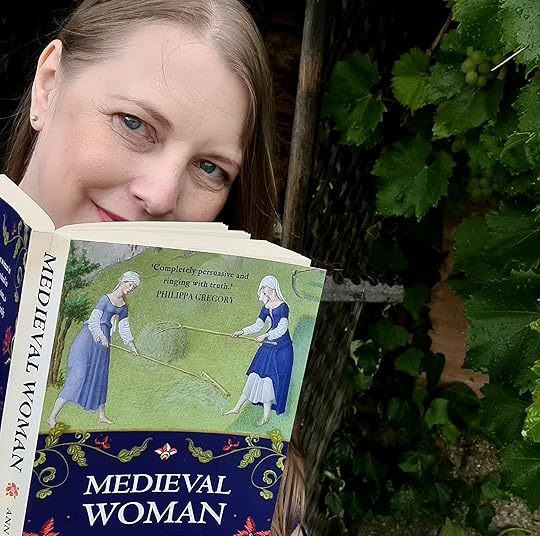
Gifted with the ability to see beauty when others only see hunger, brutal work, and disease, Marion becomes her medieval English village's salvation, in an evocative celebration of Everywoman.
Ok, this is NOT the best book ever written. In fact it is pretty simplistic. However it is the 1st historical fiction book I've ever read - and I read LOTS of them to talk about what the life a common everyday womand was like.
Marion is not a beautiful woman, I'm guessing her age at somewhere between 20-30 (her 1st child had lived to be 12). She has no one to dress her or put her hair up or make her food... The wife of a carpenter still puts her pretty high up on the food chain, but what she goes through just to keep her family alive is amazing. Lets not even talk about the lack of hygiene - 1 dress, all year, chilren vommiting & peeing as you hold them, and that's just the polite stuff!
I think this should be required reading for every teenager today. They're bitching because Dad only gave them a Ford instead of a Lexis, but if they lived back in Medieval times, at 6-8 yrs old, they would be out finding fire wood to keep the house warm, feeding the livstock (if there was any) watching the younger siblings (and there were usually lots) and learning a trade.
The amount of deprivation - not just food, but everything is something that might be glossed over in another book on the times, but here are people trying to decide if they will be warmer going barefoot in winter or wearing the boots that are already soaked through & half frozen at that - Marion decides on barefeet. Her amazement at Sir Hugh's ownership of 2 pairs of boots is like one of us looking at some movie star walking down the red carpet in a dress that cost hundreds of thousands of $$$$.
Depsite all the hard work and hard times, Marion and the others in her little town find much to be happy about, the arrival of a tinker from someplace that they can't even imagine (It's farther away then the next largest village). His description of the ocean they take as we might take the description of Mars. It might really be there, but you just can't wrap your mind around it.
Some of the reading is hard. I can't imagine leaving a child under the age of 2 sitting next to the fire pit (no fire place, just a circle of stones!)in the house (and boy do I use that word loosly!). Going out to the stream to get water and leaving her daughter sitting outside the cottage would be called child abuse today. Yet, if you stop to think about it, nothing would get done if there was the constant attention we deem necessary for our children.
The description of her son Peterkin's accident with a hot soup pot which the cat tips and eventually cripples both his arm and leg is told matter of factly. Marion wishes that it had not happened, but there's nothing to do about it now except try to figure out some chore that he can do so that when he is old enough he can make a living. Life here is pretty raw.
Anyway, the book is just over 200 pages and a very easy read. If you are like me and have always wondered what goes on down the road from the castle, this is your answer. As bad as most castles were, this is MUCH worse! Be glad you were born when you were!
This book is simply amazing. It is an account of everyday life in a medieval village through the eyes of an ordinary woman who is married to the village carpenter. There are no battles, no kings and queens, no pilgrimages or Crusades. In fact, not a lot happens in this novel. The narrator never even tells us what year the story is set in and the events are just everyday happenings in a medieval village. The book is split up into months and is more of a diary about village life than anything else.
This book fascinated me. There are no great action sequences but the book is not a thrill-seeking ride, but more of a social history of the time. Ther book doesn't glamourise the past and you certainly wouldn't want to live in this time from reading the book! The one thing that really struck me was how hard life must have been, especially for a woman, and how hungry the villagers are all the time. Really small things that happen in the book are a big deal to the people.
However, that is not to say there is no plot and there is still plenty to interest the reader, with some interesting, very real characters. I would certainly recommend this to anyone interested in this period; this book does what it sets out to and provides a well written, well imagined picture of what it must have been like to lead an ordinary life during the middle ages.
Loved this book and it was all the better for being about an ordinary everyday woman of the time. We get a glimpse of past regrets as well as her feelings for her family and her life. Anyone who likes Medieval history will enjoy this.
One of the reasons I adore historical fiction so much is because I am absolutely fascinated by how people lived well before modern times. Even something as recent as the 1930s and 1940s are fascinating to me because of how quickly our world has changed with the advent of televisions, telephones, the internet, and smartphones.
But usually historical fiction stays in pretty safe waters, generally no earlier than the 1700s because people didn't really start writing down what life was like until they had a bit more leisure time. So to find a book that details the everyday life of people in medieval England was so very intriguing to me.
This novel is incredible. It might not be the best written, but it brings to life the daily grind lived by Marion Carpenter and her family so very well. A friend of mine read this in college, and according to her professor this is a very accurate portrayal of life in medieval England. We see how interconnected everyone's lives are in the village, how they owed tribute to the Hall, who would in turn protect them and care for them if disaster struck. We're even treated to some of the stories the old folks tell at festivals, times of true famine when babies and the elderly died so frequently, when even hale men who had been healthy a season before were reduced to a shadow of their former selves. We see through Marion's eyes how close these people lived to starvation; they were just one crop, one harvest away from not surviving. The intense worry and anxiety caused by the lack of a salt delivery, which would allow the villagers to put up meat for the winter, is proof of this.
After finishing this book, done while I listened to my modern washer and dryer clean my towels for me, I became very thankful that I live in a time when life is so easy. For Marion, nothing ever smelled sweet or clean; clothes were worn regardless of the spills and stains on them (including bodily excretions) because it was either too wet or too cold to wash them. My home is snug and dry on this crisp fall day, where Marion could do nothing more than to sit in near stupefaction through the winter days because she could never get warm enough to stir herself. We had a cord of wood delivered to our home a couple of months ago, allowing us a fire whenever we feel like it; I don't have to send my small child out to gather firewood in the forest, without which we would freeze with no other heating source. My own bed, that I share with just my husband and not my children, is warm and dry, even with the slight draft coming in from the window above our head; it's not sodden and wet and mildewy, and the straw underneath broken down. I have food aplenty in my fridge, my freezer, my pantry, and all I have to do is head to the grocery store to get more. I don't have to glare at my husband for having an extra piece of bread and cheese because our flour is running so low that I might not be able to make another batch of bread.
While there's a lot of tragedy that touches Marion's life (deaths of babies and children and friends), she also manages to enjoy the beauty of her surroundings when she can. She sees a beautiful feather and marvels over it, feels the warmth of a spring breeze and enjoys it, takes pleasure in the amusement her baby girl finds for herself. It's definitely eye-opening to think of a life where most of the scholarly pursuits mean very little, that all of one's energy and brainpower is solely focused on survival from one season to the next.
I would highly recommend this book to anyone who enjoys a story about a strong woman persevering in the face of tough odds, or anyone who has a curiosity about life in the Middle Ages.
While this is not an action-packed thriller it is a great way to learn what it was like to live in a Medieval village in England back in the day. Marion is a wife and mother. Her husband, Peter, is the village carpenter. Some of her precious children died but she still has two to take care of: a two-year-old girl named Alice and an injured, disabled boy named Peterkin.
The village is well-organized. Sir Hugh leads and owns the property and peasantry, a situation all are satisfied with. If someone wants to marry it is done only by permission of Sir Hugh. A man's career depends on the decision of Sir Hugh. Nobody minds being controlled by Sir Hugh - in fact, they like him and treat him like a friend. Leadership has been vested in his family for generations and everyone has their roles in life.
I read this as part of Booktube's Historathon 2023. Yes, I know all the scholars are reading nonfiction, but I found this title and was attracted to it before I realized it is fiction, and I am no scholar. I do love learning from historical fiction and found this an intriguing and creative way to learn about poverty stricken peasants in Medieval England.
The book is divided into twelve chapters aptly named for the months of the year. The first chapter is March and the last is February. I couldn't read this book straight-through, non-stop, but enjoyed reading one chapter daily for a while.
Clean-reads folks... yes, this novel is clean. It is more of a learning experience than a fictional masterpiece, but eventually I became attached to the characters and enjoyed learning what they were up to each month of the year.
This book delivers on what it promises to do: takes you into the realistic day to day life of a medieval woman and tells you more about their way of living and the way they viewed the world in that age. If you're looking for a dramatic, actionfilled story, this is not the book for you. If you, like me, were always interested in history and medieval times, it's a very compelling and entertaining book. To me, that's worth the 5 stars.
This novel describes a year in the life of a medieval woman. Each chapter covers one month. This is not a plot-driven page-turner of a book, but something of importance happens to Marion or to someone else in her little village each month.
Marion and her husband Peter are young by our standards, probably in their 30s, so middle-aged by their standards. They have a daughter, Alice, who is about two as the story opens in the month of March, and an 8-year-old son Peterkin, whose foot and hand are deformed from an accident with fire when he was a toddler. They have also lost five children.
One of the things I like in an historical novel is detailed description of how people did their work, and this book provided just enough of that to satisfy me without bogging down in too much detail.
Marion's life is, to put it mildly, hard. Winters are cold and damp. Imagine having only one pair of boots and one outer garment in the winter and no way to dry them between wearings. And food is scanty in late winter and early spring. The peasants constantly battle mice, rats, foxes and owls to protect their meager food supplies.
The villagers owe rents in the form of cheese, eggs, spun wool, and work to the lord who owns the land that they live and work on. The lord and lady in Marion's village, Sir Hugh and Dame Margaret, are relatively kind, though. The village mostly thrives under their leadership. And the village shepherd, Dick, is so expert that the village always has extra wool to sell to neighboring villages in exchange for goods such as salt, pottery and iron ware. The arrival of a tinker who can mend tools is a big event.
Neighbors who don't pull their weight are bitterly resented and minimally helped. Justice is rough and harsh. But, Marion and her neighbors also form warm friendships and look out for one another.
I loved the slow pace of this book, which matched the slow pace of medieval life. I found it comforting and relaxing to read, as each month steeps the reader more deeply into the life of the unnamed village. I would definitely not want to live in such a rough, poor era. I like my indoor plumbing and central heating, and I liked my nice, clean hospital childbirths that both ended with a living baby. But I enjoyed reading about an earlier time when people lived closer to nature and relied on each other more.
A diary well, no, not really, but this novel of a woman and her family in the Middle Ages has that feel. Each chapter is an account of a day in the life of Marion, and the twelve chapters take her through a year. There is not much plot in the chapters; I hesitate to call them short stories, but the joys and sorrows and harshness of their lives come through loud and clear. This is a very human novel. Marion's husband is the village carpenter, and their two children are Alice, a toddler, and Peterkin, about 12, who has a crippled foot and hand because of an accident with fire years ago. Other children have died as infants or as older children; she particularly mourns Toddy, a son who had showed much promise. Incidents in the book involve feasts at the Great Hall at holiday times, Marion's care and concern for her father, a very old man who still lives at the mill he once ran, now run by Marion's brother, and the death of the husband of one of Marion's near friends and neighbors. The star of the story, to me, was Alice, a typical toddler no matter what age she lived in.
First things first: there’s no bibliography or footnotes, so I’m not sure if it’s down to the state of research at the time this was written or a lack of research to begin with, but this is NOT historically accurate at all. I won’t list all of it, but the extremely modern names and Baer’s apparent belief that medieval people never washed were probably the worst offenders. The latter is one of those myths I remember from the 90s, but modern research (and common sense) suggests it’s far from true, even if the medieval understanding of cleanliness would still seem shocking to us compared to modern hygiene standards. I also have no idea when this was supposed to be taking place - even the lord of the manor lives in a thatched one-room building and has a rather informal relationship with his serfs, soooo we’re in the 7th century or something like that? But then other details make it sound like they’d almost be from the Tudor era, a thousand years later.
What the book does better is the vibes. Almost all of us are descended from peasants and their day-to-day lives for most of human history post Neolithic revolution probably would’ve looked like a version of what this book describes. It’s unrecognisable compared to our daily lives in the 21st century. So don’t come for accurate historical research (or plot, to be honest), but stay for the peasant drudgery vibes and the gratitude for not having been born in the pre-modern era.
Despite starting off slow, this historical fiction about the life of a woman in her obscure English medieval village was a good read, packed with verifiable details. I would definitely have given it at least a 4, if it weren't for a single big mistake that skews the entire experience for me. The author writes as though linen cloth were rare and in fact unknown in this village. Without basic linens-- swaddling, underdresses, bandages, menstrual cloths, etc-- that could be rinsed and dried in a timely fashion, of course no one would ever have clean clothing, and the discomfort of medieval life would be even more uncomfortable than it was. But linen, whether made from flax, or other bast-fiber fabrics made from hemp or nettle, was available all over England. So, despite the popularity of wool for trade, there's no reason to postulate a lack of linen, and there are plenty of references to baby wraps made of linen that could be washed out a good deal more easily than the woolen swaddling this author postulates. There's also an unhealthy emphasis on nails for the carpenter, though most heavy carpentry would have been done with hole-and-peg fasteners. One good spoiler for those familiar with Barbara Hanawalt's work:
The title sums up the book. Starting with March, a slice of daily life for Marion Carpenter is given from month to month for a year.
The manor in the book is not some grand holding. It seems like it's just a very large farm. It's also difficult to determine exactly in what year the story is set. The author doesn't give you much more than what Marion herself would have known or understood and it's apparently a VERY remote little village.
Still, it's the details of her everyday life that pull me to books like this. (Makes me sound like a voyeur, doesn't it?) If nothing else it makes me appreciate my modern comforts. In comparison with the other villagers, the Carpenter family would probably be average. There is no money, but wealth can be measured by possessions. Her family is not as well off as her brother, who is the village miller. They own no cow just a goat. Yet they are far better off than the one whose children are starving and forced to beg food from the other villagers.
While I did find Marion a dull woman who plods along for the most part, other characters had much more personality and I would have loved to have seen the same story told from the eyes of M'dame, Sir Hugh's wife. That would have added some very interesting contrast.
This book takes you through the year of a woman, Marion, and the cycle of that year. It starts in March which is because that's when the year of people's life when they are completely dependant on nature and the world around them begins. I found it hard going to start with - not particularly smoothy written - but I think that's an unfair judgement on my part as I enjoyed the book more as I read. Marion is married to Peter. They have a seven year old son, Peterkin, who has a withered hand and clawed foot because of a burn sustained when sitting in front of the fire. They have a wee girl, Alice, of two who is surprisingly bright and interactive. I say this is surprising because all the other people in the book really are just getting by. And that's what I took away from this message. Life wasn't really about living; it was just about getting by. You worked hard on the land and the only celebration was marked by a good meal at The Hall (the landowner's house) but the rest of the time life was hard. Rarely enough to eat and when food was limited it was the women that missed out. Wet, cold, never able to clean and never a thought that that would be normal. Get out of the family bed and get going ; no ablutions before the day started. Alice wet herself, her clothes got soiled, so did Marion's as Alice was sitting on her lap and they both use got up and carried on. There really was no other choice. I found the way that all members of the community were talked about quite touching. Marion's father was elderly, infirm and confused. He lived with Marion's brother and his family but when it was the festivals at The Hall he was put in a wheelbarrow and taken down to the Hall. He was then given a chair almost as pride of place by M'Dam and even special food was prepared. Knowing that the elderly wouldn't have teeth and couldn't chew meat he was given mushed up liver. The cycle of life kept being drive home - babies due, mother die during and shortly after delivery, the elderly died in the winter, in the cold, men and children were injured and killed whilst at their daily work. Children didn't really have a childhood. Once they were up and about they had jobs. Out in the fields, picking various other messages, running errands. All important roles but no real time for play or being a child (as we would see it now). The winter months were about 'getting by' which really was a bit like hibernation. Sleeping. Snoozing. Not really having enough to eat. Constantly wet/damp. Cold. Little light. And hoping that the family could survive until the spring sprung. I'd never really truly considered how absolutely awful life for Medieval people would have been. That's pejorative. You live the life you had. If you dropped someone into medieval Britain from the 21st century obviously it would seem awful but that's an unhelpful comparison. It does make me particularly grateful though that I didn't have to endure that type of life
Kai nusipirkau šitą knygą britų muziejuj, galvojau bus gana nuobodi, nes ji iš muziejaus, nors santrauka gale ir buvo sudominusi. Bet buvau maloniai nustebinta. Pats kūrinys gana paprastas, jame pasakojama apie pagr. veikėjos Marion gyvenimą viduramžiais viename Anglijos kaimų, jame daug aprašoma apie kasdienius to meto darbus, baimes, pavojus, kaimo gyvenimą, gyventojų santykius. Mes viduramžius dažnai matome kaip ir per miglą: įvairiausius kūrinius, paveikslus - šie dažniausiai būna susieti su religija. Tačiau šiame kūrinyje galime matyti pagr. veikėjos abejones dėl Dievo egzistavimo ir apskritai jos nepilną atsidaviną bažnyčiai - ji ten ėjo vien dėl pareigos. To visai nesitikėjau. Taip pat pasakojama apie kasdienias baimes, labiausiai apie mirtį: apie mirtį gimdymo metu, apie mirtį sušalus žiemą ar pritrūkus maisto. Kaimely dažnai mirdavo vos gimę kūdikiai ar maži kelių metų vaikai... Be siužeto pats rašymo stilius irgi patiko. Kūrinio anglų žodynas buvo labai platus, sakyčiau, parašytas tokiu vos ne senovišku stiliumi (kaip kokio Šekspyro bet paprasčiau???), tai buvo gal šiek tiek sudėtingiau skaityti nei kokį pop romaną, bet suprantama. Taigi, ši knyga nėra pilna veiksmo ar siužeto posūkių, tačiau ji pilna ne vien tik to meto kasdienio gyvenimo, bet ir gilesnių apmąstymų ir filosofinių temų.
4.5⭐️ This book is not something I would typically be drawn to. I’m a very plot-driven reader, and I wouldn’t describe this book as action-packed. Yet for some reason, I found this simplistic, a year-in-the-life story quietly fascinating.
What can I say about a fictionalised account of a mediaeval woman’s life over the course of a year as written in this book? I can’t say how accurate- I don’t know. I can’t say how detailed, I don’t know. How true is Marion’s life? I don’t know. What I do know is that the amount of reading and research that went into this book was enormous. From baking to shearing, from coppicing to gravedigging, the education of priests to the supply of salt to a small inland village. Did she have a time machine and nip back to visit, I don’t know, but at points the very aching strangeness of the life led by the women rang true. Strip back our lives to the bare bones physically and you still cannot fully appreciate or comprehend the lives of mediaeval peasantry. Their very minds and souls were different, and the author has conveyed this so well, the best I have ever read. By the time you have read this, you will be glad for a well stocked larder, rain proof walls & roof, heating, weatherproof shoes, medicine.... I LOVED this book. I am now begging her to write another. Unfortunately it will probably take years to amass enough research, I can wait if it is as good as this.
All too often, our glimpses into the past are all about the movers and shakers of the time. That is only to be expected since they were the people who shaped their times. However, whatever the age, there were always common people who lived and died along side them, usually without any notice given to them. This book changes that. It is a chronicle of a year in the life of a common woman and her fmily. The year is not explicitly given, neither is the location. All the better to tell the story of Everywoman during a distant and difficult past. One of my all-time favorite books because it deals with the nitty gritty of daily life and its struggles for the "real" people.
I absolutely loved this book, which chronicles a year in the life of a medieval peasant woman. All romantic notions I had about medieval life were dispelled. It made me realise how incredibly hard, unpleasant, unfair and exhausting life was for families like this. But it was far from depressing, it was utterly absorbing. And I went to sleep at night feeling so grateful for my bed, my warm house, my baby’s health, my doctors’ surgery, my financial independence and my free time - previously, as a new mum, I would have complained about being so busy and tired and how I never have any real time for myself. Now I realise how pampered and lucky I am.
Ann Baer writes a terrific and sensitive book about the life of a serf in England during medieval times. Using one day each month for a year, she almost diaries Maggie's life. We get an honest picture of the daily struggle to survive for that era. Both heart wrenching and joyous, we get to know her friends, family and contemporaries. Totally from her viewpoint, we watch her deal with sorrow , adjust and then oddly enough grow to notice things that will be passed onto the next generation. I wish she wrote another book. I keep looking, but I think this is it.
This is a remarkable book. Told from the perspective of Marion, a woman married to a carpenter, who has borne several children of which two survive, it paints an extraordinarily vivid picture of life in a medieval peasant village. It has very little in the way of plot; it takes the form of 12 loosely-connected vignettes over the course of one year. The author, Ann Baer, was 82 years old when she wrote this, her first and only novel. It utterly unlike most novels I've read and I recommend it absolutely and without reservation.
This truly brings history to life. I was fascinated by the day to day existence of a medieval woman. By the end of this novel, I felt as if I had been through the year with her and felt grateful for being born in the twentieth century. Even though it is fiction, it brought affirms that people have had the same feelings, frustrations, and hopes no matter when they lived.
Originally published in 1996 as Down On The Common, Ann Baer’s Medieval Woman is a novel that covers a year in the life of Marion, a peasant woman living in an unspecified rural English village during medieval times, with her husband Peter Carpenter and their two children. Baer’s novel was considered so accurate that it is now – at least in Australia – being marketed as a non-fiction reference book.
Medieval Woman is a simple, pleasant read. The book is divided into twelve chapters, one for each month of the year and these chapters usually cover a couple of days. There is not much in the way of plot, each “month” focuses on what each month would mean to a medieval peasant – for example, the cold and risk of starvation in December alleviated briefly by the Christmas feast. Baer works well to make the characters sympathetic and their fears, hopes, dreams and perils feel very real. The landscapes are vividly rendered and come to life.
There are details left unresolved, which can frustrate the reader, but I rather think that uncertainty is the point. Uncertainty would be a large part of a medieval individual’s life and it’s quite clever to reflect that in a story about their lives rather than giving an answer to all of Marion’s worries and concerns. I, however, would have gladly kept on reading to find out what becomes of Marion and her family.
This is not a brilliant, transformative work of historical fiction. But it is a good and gentle read and I did love it, even if I do not stand in awe of it.
*This is a fictional account of a medieval woman* I just wanted to make that distinction to start with. It's not non-fiction, and yet it's not a novel either as it doesn't follow the 'beginning, middle and end' structure and has no inciting incident etc. It's more of a fictional journal. A year in the life of Marion, wife to the village carpenter.
And it's a hard life! We're never told which year, but it's early Middle Ages by my reckoning. The villagers all pull together to sustain their livelihood under the feudal system. Money doesn't change hands, but produce does. This village mainly trades in wool and there's a wonderful festival to celebrate sheep shearing day!
There's a few too many bodily fluids mentioned for my taste. And I'm pretty sure that, given there's a shallow part of stream, the women would have had a wash day and wouldn't have been quite so rank.
But it's definitely very well researched. You really get a look into the daily grind of these people's lives; more down than ups. Every day is a constant struggle and death is ever waiting. The lord of the manor is a bit feckless, but he has a sensible wife who knows what's what. And the village keeps ticking on, overseen by a severe Rollo with his counting sticks.
It's a lesson in taking pleasure from the simple things in life and realising just how lucky we are with our modern day luxuries. An intriguing read for history buffs.
I’m not sure how accurate this book is in portraying medieval village life. That’s not really a usual area of interest for me, but I do love how this is one of those rare books where ‘nothing’ happens, and yet there isn’t a part of it that bores you.
“Medieval Woman” is a snapshot of several months centered around Marion, wife to a modest carpenter and mother to two living children. The book is divided into month-by-month chapters, with each chapter representing around a single day or so.
For as much hardship as Marion endures, it’s mostly rooted in the mundane. She survives, and it’s oddly relaxing to read about someone doing endless toil and hard labor under a provincial backdrop.
I did not know what to expect, but I loved this book. It is the story of Marion, her family, and the village where she lives. There are many struggles for women of that era, they are expected to do what is expected of them, and defer to men at all times. An extremely interesting history, if a little depressing if you are a female reader!
DNF p. 54. I had seen this book used as a reference for another book I read recently, and my library read it in book club. It is just as advertised, description of daily medieval life without plot. Some might find more interesting, but it didn't hold my attention enough to continue. But this type of book always makes me grateful I did not live during those time periods.
Beautifully observed book, full of fine detail about the English year - and of course what the turn of the seasons meant to the average village woman. Going straight on my research shelf.