The trailblazing scientist who pioneered the concept of sophisticated communication between trees returns with a book that places nature’s own cycles of renewal at the center of a powerful vision for the future of our forests
With her bestselling book Finding the Mother Tree, forest ecologist Suzanne Simard introduced the world to the profound intelligence and interconnectedness of trees. Now, with When the Forest Breathes, she uncovers the ways that nature’s deep-rooted cycles of renewal can ensure the longevity of threatened ecosystems.
Raised in a family of loggers committed to sensible forest stewardship, Simard has watched as timber companies leave forests at higher risk for wildfires, water crises, and plant and animal extinction. But her research has the potential to chart a new course. The forest, she reveals, is a symphony of finely honed cycles of regeneration—from mushrooms breaking down logs to dying elder trees passing their genetic knowledge to younger ones—that hold the key to protecting our forests. Working closely with local Indigenous communities, whose models of responsible forestry have been largely dismissed, Simard examines how human interventions—particularly destruction of the overstory's mother trees—endanger new growth and longevity. If we can honor the tools that trees have honed for sharing intergenerational wisdom, she argues, we can protect these sacred places for many years to come.
As she considers how older living things facilitate the conditions for new growth to flourish, Simard faces parallel rhythms of loss and regeneration in her own life, watching her two daughters grow into adults and savoring her final days with her ailing mother. Animated by wonder for our forests and the intricate practices of caretaking that have long sustained them, When the Forest Breathes is a vital reminder of all the natural world has to teach us about adaptability, resilience, and community.
She is a pioneer on the frontier of plant communication and intelligence; and has been hailed as a scientist who conveys complex, technical ideas in a way that is dazzling and profound. Her work has influenced filmmakers (the Tree of Souls in James Cameron’s Avatar) and her TED talks have been viewed by more than 10 million people worldwide.
Suzanne Simard is a remarkable person; she and her colleagues and friends' research and scientific investigation into the lives of trees; the communication between them and their life cycles is truly astounding- forever changing the global view of the natural world.
However, the journey she has taken to try and fight against the climate crisis and ensure that we fully understood the benefit to human kind of ancient woodlands has not been ( and still isn't ) an easy one- the continual battle from logging companies, governments and scientific bodies ( jealousy and funding by big business? ) who undermine her views and evidence has made for a difficult time. But she has persevered.
This book describes her research and the challenges she and her team encountered whilst trying to develop the Mother Tree Project - the work alongside First Nation people of Canada and the cultivating of ancient wisdoms is very powerful to read. When such proven knowledge of centuries is disregarded by so many , insanity prevails- Scientists are perceived as the new Gods. The need to de-mechanise forestry work and the clear understanding that ancient trees are needed for clean air and water and rebirth of new trees is paramount.
This is part autobiography, travelogue, compendium to her previous book and a plea to all readers that we must try to show solidarity against the shocking outcomes of clear cutting in Canadian forest land and forests globally- the impact of the destruction is clear but still prevails( but there are some small steps in the right direction.)
Incredibly readable, full of information that you will want to tell others but most of all a book about humanity's need to wake up NOW before our planet is irreversibly ruined. You'll also be seething with frustration .Very moving and also heart breaking too as Suzanne also reflects upon personal grief..
If there were world leaders with a gram of Suzanne's Simard's understanding and knowledge of the impact of forest destruction and what can be done to reverse the decline and save global forest then the world might stand a chance... we can but hope a new generation of young politicians will see what needs to be done before it's too late. Suzanne's work should be a manifesto for the future.
"Nature is waiting for us to listen and to learn."
4.5 stars. This is an incredibly important book, deeply rooted in vital research and a powerful message. 🌲🌲
Suzanne Simard describes the forest as a connected, intelligent living system. Drawing from her 2015–2020 research in British Columbia, the book beautifully honors Indigenous land and traditional ecological knowledge.
"Mother Tree" itself is an Indigenous concept that inspired Simard's Mother Tree Project, pushing for a regenerative mindset, reminding us that humans need to learn, adapt, and live in tune with the land. I was fascinated by the 'experimental forests' designed to determine how these vital trees can survive changing climates—especially since these ancient giants are so necessary for forest regeneration. Ultimately, it highlights the profound interdependence of the ecosystem, showing how Mother Trees nurture the next generation through vast, underground mycorrhizal fungi networks.
Simard also details the devastating effects of the climate crisis and widespread logging. She explains how rising beetle populations lead to tree death, shockingly flipping forests from normal carbon sinks into net-positive CO2 emitters that escalate forest fires and flash floods.
Because it's on the longer side and gets heavily academic in the middle, I found it best to consume in dribs and drabs. Ultimately, the author does a beautiful job connecting humanity to the life of trees— my nature-loving, science-oriented brain was completely captivated.
We have enjoyed a rare blast of scorching weather here in Ireland this week, and I have really enjoyed reading this. As I stroll round my garden in the evenings, watering my thirsty plants, I reflect on the beautiful passages from this book with awe and wonder. Despite all the knowledge Suzanne shares, with her pioneering and scientific background, this didn't feel like I was reading a educational textbook. It was far more personal than that. It felt more like I was walking slowly through an ancient forest with someone who truly understands how alive it all is.
The book explores the hidden relationships within forests, how tress, fungi, soil, water, and wildlife exist in an intricate web of connection, constantly adapting, communicating, and supporting one another. She blends cutting-edge ecological science with reflections on resilience, renewal, and the lessons nature quietly offers us, if we take the time to pay attention. Rather than seeing forests as static landscapes, she reveals them as breathing, responsive communities full of intelligence and cooperation.
What I appreciated most was how naturally Simard balances deep scientific knowledge with genuine wonder. Simard clearly knows her field inside out, but she never loses the emotional heart of why this work matters. Her writing carries the voice of someone who has spent a lifetime not just studying forests, but truly being with them. That comes through beautifully on every page.
A nature lover myself (and as someone who simply loves being outdoors), walking through woods, feeling the open air, and hearing the wind through the trees, this book resonated with me in a very personal way. The author's writing captured something I've often felt in nature but could never fully explain: that forests have a presence to them, almost a quiet wisdom. Simard gives scientific grounding to that feeling without ever taking away the magic.
There's also something deeply hopeful about the book. Even while addressing environmental loss and climate pressures, Simard focuses on resilience, on the way natural systems heal, adapt, and endure through connection. It made me look at forests differently afterwards, not just as beautiful places to escape into, but as living communities we are part of and responsible for.
What makes this book special is that it speaks both to the mind and to the senses. It's thoughtful, grounding, and quietly inspiring. I came away learning something profound about ecology, but also with a renewed desire to get outside more often, breathe deeply, and pay closer attention to the natural world around me. It's a wonderful book!
Early thoughts: I read this author's first book on forestry and I was so impressed. I'm delight I was offered an ARC of this one, though I am very late with my read! Unfortunately that means tracking down another accessible copy, which isn't always easy.
Feeling: Gorgeous science, gorgeous trees
I’m curious about: theme. There are several in this book, which I didn't really expect. I'm wondering if I will like the treatment here. Please see content notes for triggers.
This book is part research findings and part memoir, which I thoroughly appreciated. I enjoyed reading about Simard's experiences with her colleagues and family; she describes the forest so incredibly well to the extent that I felt like I was experiencing the Douglas firs with her despite being here in Texas. Simard's research is easy to understand, especially with regard to the devastating effects of clearcutting. Even with my environmental science background and research on enzymatic activity in riparian soil for carbon sequestration, I was delighted to learn even more about carbon sinks.
I also appreciated Simard's reverence for the wisdom of Indigenous peoples who are interconnected with the Canadian forests. Simard mentions tribal law and sovereignty in relation to Canadian provincial law, as well as lasting impacts of colonialism, though I would have liked more discussion about how those interact (or do not) for readers to have a better understanding of jurisdictional issues in forestry management. Perhaps that is an idea for further study for readers interested in the legal and historical aspects of forestry. I was also fascinated by Simard's note of a forest defender using generational trauma as a potential mitigating factor in sentencing and the complexity of protests to prevent logging old growth when some First Nations have an agreement to log their land to avoid loan default.
The last section of the book is Simard's defense of the term "mother tree" in her research. Whether or not peer reviewers decide "mother tree" belongs in scientific literature for objectivity reasons, the term conveys the familial, cooperative interactions between trees in a way that the general public may better understand. Further, it follows Simard's holistic approach to researching the forests and contrast that view to research that shows competition among species. After researching the debate to better understand this part of the book, I do not agree with the critique that this term implies Simard is anthropomorphizing the trees; instead I interpreted her use of "mother tree" as the descriptor of how trees are generational and work together clearly aligning with her research. Excluding "mother tree" would exclude critical insight on the issue when communicating with the public. Of course, now I need to read Simard's debut book, Finding the Mother Tree. I expect I will add both books to my shelves.
Thank you NetGalley and Knopf for the advanced copy. All opinions are my own.
This second book from Simard continues in the same vein as her first (Finding the Mother Tree) - lots of forest and trees, some science, and some memoir. This volume is more a plea for recognizing the interrelatedness of biology on earth - in the context of the arboreal forests of Canada - than the earlier book, which recounted the stunning and novel insight of her life's work - recognizing that trees communicate with each other via mycorrhizal networks. Here she goes a little more Robin Wall Kimmerer-ish to the relationships between all things growing on earth and human stewardship (mostly bad, some good).
She writes well, but it is perhaps a little taxing to be continually recording the beautiful things which we are not seeing whilst reading (does lead to a little skimming). Simard leans in, once again, to memoir, which is a little overdone (though clearly meaningful to her). But what she says sticks, and she has scientific evidence for it. She is a real scientist, doing real science. She knows more than you do.
And yes, her forestry studies are controlled - the teams run studies at multiple sites, with multiple checks and multiple controls - many details in the book. This is real science (knowing that all science has its critics). What Simard found, I think, has been proven many times over since she wrote her first papers. Criticisms of her "new agey-ness" or anthropomorphizing trees - c'mon !! let it go! I am sympathetic to Simard when she says many criticisms come from people wanting to put down "feminine" - or "indigenous" - or "holistic" thinking. Meanwhile, ignoring her findings allows clearcutting, climate change, the no going back.
The world is one bowl, and we are all eating from it. Since humans are gluttons, there will be no feast left if we don't check ourselves. So cheers to Simard. She remains one of my true heroes.
When the Forest Breathes examines the fascinating Mother Tree project orchestrated by Suzanne Simard. I really enjoyed the mix of scientific process with personal stories. It results in a read that makes you feel grounded in our role in the greater natural world and eager to protect forests from not just the dangers of clear-cut logging but also the smaller acts of forest degradation that lead to unhealthy, carbon-limited, and carbon-sequestering forest ecosystems.
A very welcome follow-up to Simard's Finding the Mother Tree, which should be read in tandem with Richard Powers' The Overstory. Like Mother Tree, When the Forst Breathes is a heart-felt science-driven plea for humanity to honor its dependence on our tree kin before we take down the ecosystem. Her portrait of the communal networks linking Mother (and Grandmother) and Daughter trees of interlinked species is vibrant, lyrical, and at times angry as hell over the way our culture ignores environmental realities in the service of corporate greed.
Beyond the arboral core, When the Forest Breathes also provides a moving portrait of Simard's commuhnities--the scientists and students she works with, the animals and fungi and mushrooms that link the forest together, her blood family, the indigenous nations whose wisdom she recognizes. I'm particularly happy to see the evolution of her connection with the tribes of British Columbia, which is a model for would-be non-Native allies, accomplices.
Some heart-breaking moments of personal loss tilt the book towards sadness in the later sections, but Simard does her damndest to heed the lessons of the forest and locate the resilience deep within.
Like pretty much all environmentally-centered books, When the Forest Breathes carries undertones of desperation, sometimes verging on dread. But Simard never gives up and even when the corporations and their political allies do their best to deny the truths, we shouldn't either.
I feel like this book could’ve been so much more. It has a family’s title which had me intrigued, but the actual telling of information became blah at times. Partly due to the narrator’s lack of enthusiasm as she read, partly due to the author repeating themself quite a bit, and partly out of anger and frustration. The author having reached and obtained quite a bit of compelling evidence about how damaging the logging industry is on the environment just sort of accepted nothing was going to change from her data any time soon. The way it reads, there’s a sense of lackadaisical about the situation despite entire 1000 years old forests being killed in the name of affordability and greed. There goes earths lungs. No big deal.
However, there was a lot of really cool tidbits that I think would’ve been a better focus. For example, the yew tree produces a toxin used to treat certain cancers. Trees have their own way of speaking and communicating with one another. Forests remain strong and stay healthier when they grow around their families. All compelling information I want to know about way more than the unchecked murders of said forest families.
“When the forest breathes out, we breathe in. When the forest thrives, we thrive. When the forest lives, we live.”
Rating 5 stars for sheer importance. More people need to be talking about this, raising awareness of the clear cutting that is happening to the last remaining old growth forests across BC. But I will say that if you’re looking for a happy story, you won’t find it here.
Suzanne Simard weaves her own tales of loss with those of the forests. In excruciating, heartbreaking detail, she outlines how BC’s poor forest management practices (fire suppression, monocultured forest plantations, clear cutting, etc.), along with increasing effects of climate change, have led to more and more forest fires. She explains the vicious cycle of how logged forests become carbon sources instead of carbon sinks, releasing excessive amounts of carbon into the air and actually furthering the impacts of climate change instead of helping to mitigate it.
“Our forest management practices had created a province-wide stack of kindling just waiting for a spark to come along.”
This book serves as a reminder of just how interconnected forests are. How the natural world has evolved to produce the best adaptations for flora and fauna in each local area. And how we as humans are disrupting every part of that connected ecosystem.
The descriptions of clear-cut forests are absolutely devastating, and even more difficult to listen to as Simard narrates them in her own voice. It’s very clear what state of mind she was in when she wrote this. I’m not sure what her first book was like, as I haven’t read it yet, but given what she divulges about of her personal life at the time of writing When the Forest Breathes, it’s no surprise that her grief intermingled and made its way onto the pages of this book.
If you’re already sad about trees, this book won’t make you less sad. But hopefully it will inspire you to take action. To speak up for old growth and sustainable forestry practices and Indigenous knowledge systems. And to connect with your community. Because, as Simard explains, “Community is what makes a forest, and a person, whole unique, and resilient.”
Suzanne Simard is the pioneering scientist who discovered the extent of the underground fungus system that trees use to communicate with each other and share resources. This book extends her work from the Mother Tree Project to talk about how forests are degraded, how they operate, and what we can do to harvest wood and yet preserve the forests and prevent the release of huge amounts of carbon.
Simard and her assistants work with foresters to set up experimental plots with control groups, and with Indigenous people to understand how their ancestral methods anticipated the findings that Simard was proving scientifically.
The horrifying thing in this book is her finding that industrial logging with heavy equipment destroys the forest floor and releases more carbon than what's in the trees. In fact, they estimate most of the carbon stored in forests are in the floor and underground, not in the trees themselves. This means that more selective and gentler methods of harvesting can prevent huge releases of carbon.
The hopeful thing in this book is that Indigenous people are winning back their rights to manage their ancestral lands, piece by piece and through hard fought legal battles. Conservation groups are realizing the value of working with these people to advance common goals.
Simard has been criticized for anthropomorphizing her work, but her basic findings of interdependency and communication in the forest seem sound. There is a spiritual nature to her approach in the book that may lead some to discount her approach, but her scientific work is rigorous and peer reviewed. I would compare her to other scientists like physicists who are awed by the nature of things as they dive deeper into their scientific studies. A sense of awe and reverence is not necessarily a hindrance when encountering new truths about the interconnectedness of things.
Lots of technical stuff that I skimmed over. I finished thinking that we are basically f*ked. I am increasing my donation to Forest Alliance today! And hugging all the huge trees in my yard 🌲
I love trees. I’ve read many books about trees. In When the Forest Breathes, Suzanne Simard jumps right in with language like, “At our costal forest, Pseudotsuga menziesii var. menziesii predominated, its emerald needles able to rapidly photosynthesize in the lush maritime climate.” and “Whether acting as a mycorrhiza or a saprotroph, most of the fungus lives in the duff, where its mycelium – long hyphal threads – explore the soilcrumbs and pores for nutrient-rich fibers and minerals.”
In my opinion, When the Forest Breathes is not the follow up to Simard’s previously published book. This book is a ranting mess. Somewhat understandably as Simard had gone through the death of her mother (through Canada’s MAID process) and the tragic death one of her favorite students. Also understandable, “I’d been interviewed and profiled in dozens of national and international magazines and newspapers, and requests for speaking engagements were flooding in.” Her TED Talk in 2016 had made (her) something of an internet celebrity.
(The all knowing and wise Suzanne Simard) … “I had become interested in common mycorrhizal networks, because I saw them as a system of relationships and connections that underscored forest health and resilience. The interdependencies these linkages represented mad intuitive sense to me. I knew the forest from a holistic perspective, understanding the whole first and then seeing the parts. I had inherited this way of seeing the forest from my ancestors. I understood the complexity …”
Over-exaggerating things like, “The last of the great trees were being felled, limbed, and loaded, stacked up like dollar bills.”
Only Suzanne Simard can save the day! If only everyone would just listen to her! As she is an internet sensation! Big business needs to quit using their huge machines and start felling trees by hand! They need to step back and let her review their plans and only cut the trees she tells them that they can cut! The government NEVER does the right thing and they have tricked the Indian tribes into giving up their rights to the land. And all of this is mixed in with a semi autobiographical rant of her ancestry, childhood memories, her daughters, her student projects and visiting their study plots, every wrong ever committed against Canadas indigenous population.
Do I think that clear cutting is the answer? No. Do I think the huge machines decimate the understory? Yes. Do I think that this book does anything to convince big business to operate differently? No.
One of the most annoying books I’ve ever read.
My suggestion, don’t read this book. Reread Finding the Mother Tree instead.
Many thanks to NetGalley and Knopf, Pantheon, Vintage, and Anchor Publishing for approving my request to read When the Forest Breathes in exchange for an honest review.
This is the 2nd of her books I have given an honest effort in and failed. There are nuggets of good information but I just don't like her writing style. It meanders too often into the personal that is more than half a memoir and maybe 25% scientific and educational. She should really consider her titles.
When the Forest Breathes by Suzanne Simard is one of those rare books that completely changes how you see the world around you.
In this blend of science and storytelling, Simard explores the hidden networks that connect forests, how trees communicate, share resources, and support one another through intricate underground systems. What could easily feel dense or overly technical instead reads as deeply human, grounding complex ecological concepts in real-world impact and lived experience.
What stood out most to me was just how interconnected everything is. This book makes it impossible to see forests as just collections of individual trees, they are communities, constantly communicating and adapting. That understanding makes the stakes of climate change feel even more urgent. The devastation of old-growth forests isn’t just environmental loss; it’s the unraveling of entire living systems.
At the same time, there’s something quietly hopeful in Simard’s work. Even in the face of destruction, there’s resilience woven into these ecosystems and a reminder of how much we still have to learn from them.
This was such an eye-opening and thought-provoking read, especially if you’re interested in nature, climate, or just want a book that will genuinely shift your perspective.
Thank you to Knopf for an Advanced Reader Copy of this book!
I read Simard’s book, “Finding the Mother Tree” in the summer of my second year of high school, which inspired me to pursue a path centering around the forest. This book, “When the forest breaths” came to me during my second summer of college as a Natural Resource Management/Environmental Science major. Reading this made me realize just how much Suzanne Simard’s work has influenced my career path. After learning more about this field and gaining field work experience, this book resonated with me even more. Seeing the process behind how her and her grad students experiment’s are designed and carried out is very enlightening. It also raises many new questions for me about the forest. I’ve also have had the privilege of seeing forests in many different stages of growth, from clear cuts, plantations, natural regeneration, and all the way to old growth. I loved reading about what I was experiencing out in the field. It was devastating reading about the old growth that was cut down in Canada, but it made me hopeful for the future. Hopefully, Simard’s work will inspire the change that we need to see.
I am glad to read yet another inspiring and hopeful book by author Suzanne Simard about the Mother Tree and its nurturing practices and its kinship and alliances with other forest life. I have visited an old growth forest that has been preserved to ensure its trees will live their full lives. To look upon those giants filled me with such wonder and awe.
The ending lines of the book read
“Go into the nawalakw, the supernatural forest, and you too, will feel the wisdom of the trees. When the forest breathes out, you breathe in. When the forest thrives, you thrive. When the forest lives, you live.”
I think I need to walk in the woods and feel grateful.
Simard is a scientist who has devoted her career to understanding the way trees and forests form interconnected webs. Her scientific work and personal belief system focus on the ways that one species influence the well being of others. In When the Forest Breathes, she details her work understanding the way various logging strategies impact both regrowth as well as carbon storage. While heavily scientific, the work also has elements of memoir as she speaks to the impact of her mother's end of life and the influence of loss in her personal life. I really appreciate Simard's perspective and her respect and care for the world we live in is evident throughout her work.
*Book Bingo Read Challenge - (A book published in 2026)
This was a thoroughly Interesting read. I have read some of Suzanne Simard's previous works and this didn't dissapoint. Always so well researched and informative. I was hoping to go to a book event for the launch of this book but sadly wasn't able to due to a family emergency. I'm thankful I got the chance to read the book before the release (even tho my review is late). Overall a very timely and important book for our current and future climate. Thank you NetGalley, Suzanne Simard and Allen Lane publishers for the chance to read this book in an exchange for an honest review.
You should read this if you're interested in: Nature, reciprocity in ecosystems, legacy and inheritance, climate adaptation and hope, biological memory, forest sentience
An emotional journey through forest protection and regeneration, and the scientific studies led by Suzanne's teams and colleagues that are finding that Indigenous Nations land stewardship practices and knowledge systems are deeply rooted in fundamental truths of nature that the western world is only now beginning to understand.
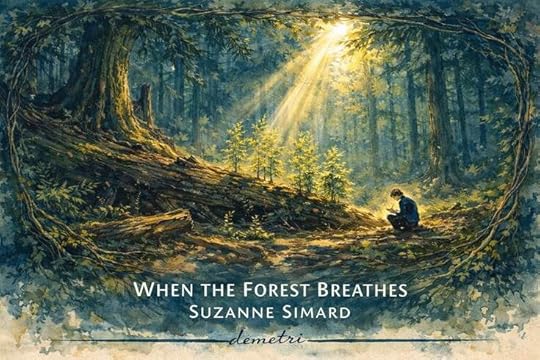
The Work of Inheritance In “When the Forest Breathes,” Suzanne Simard writes of forests, mothers, and the fraught labor of continuation By Demetris Papadimitropoulos | March 18, 2026
A fallen giant opens the canopy; light and burden pass downward together.
Most books about forests ask us to look up. Suzanne Simard keeps asking what happens after the giants fall.
That shift matters because “When the Forest Breathes” is not, finally, a book about trees behaving wisely while humans come panting after them with clipboards, guilt, and a management plan. It is a book about succession under pressure. Logging, wildfire, carbon, kinship, stewardship – all of that is here, often vividly, often persuasively. But the quieter book inside the louder one is about who carries life forward when the elders begin to go: the old trees, the mentors, the mothers, the dead. From its opening field plot in British Columbia, where Simard works among towering conifers with her daughters nearby, the book keeps returning to inheritance as ecological process, family drama, and moral burden. The question is not only how a forest regenerates. It is who keeps the system alive when the beings that once held it together are stripped out.
Neatness is not among its ambitions, and thank goodness. In form, “When the Forest Breathes” refuses to choose between field report, memoir, elegy, and argument, so it braids all four. Simard tells readers as much in the Author’s Note: this is not a scientific paper in trade dress, but an interpretive account of research, fieldwork, memory, ancestry, and one scientist’s way of seeing. That clarification matters because it tells you where her authority comes from. Not from floating above the landscape in the scrubbed prose of someone who has never had mud in a boot tread, but from knowledge earned in place, revised in place, and argued from inside the damage. The book wants to be read as situated witness rather than neutral dispatch. Most of the time, it earns that right.
The Mother Tree Project is the trunk everything else branches from. Simard and her collaborators establish experimental forests across British Columbia and test what happens when logged sites retain varying amounts and arrangements of old overstory instead of being flattened and replanted according to clearcut reflex. It is large, collaborative, expensive, muddy, and honorably unglamorous. She wants to know what those retained elders do for carbon, biodiversity, regeneration, mycorrhizal exchange, wildlife, and survival in a hotter, drier, more fire-prone future. Around that long study she winds her daughters’ growing lives, the mentorship and later death of her student Amanda Asay, her mother’s final years, old-growth blockades, cedar forests, village-site gardens, and the increasingly explicit argument that colonial forestry has confused extraction with stewardship for so long that it can barely recognize a living system unless it arrives in a spreadsheet and leaves as a stump.
Plot, though, is only the shell. The real force lies in where Simard teaches you to look. The forest is never scenic wallpaper. It is workplace, archive, graveyard, classroom, protest site, family system. She writes best when thought rises directly from touch: slash piles, soaked sleeves, conifer resin, fungal threads, smoke-thick air, seedlings in punishing heat, bark scarred by earlier fires, duff storing water and carbon. She likes species names, and thankfully so. Saskatoon berry, soopolallie, baldhip rose, woodmoss: that habit of naming keeps the prose from drifting into perfumed green fog. Even her larger claims about reciprocity and renewal usually arrive with some grit still on them. One of the book’s quieter pleasures is that it trusts the reader to care about exactness. A forest described only as “lush” is already halfway dead on the page.
Her sentences often move by accumulation – one clause, then another, then another – as if the syntax were trying to mimic forest floor and canopy in the same breath. Then she cuts the growth with a short sentence and lets it bite. The riskier wager comes at the level of diction. Silvicultural and ecological vocabulary shares the page with kinship language and ritual language: mycorrhizal fungi, carbon pools, xylem, mother trees, grandmother trees, blood, wisdom, life energy. In weaker hands, the blend would sound like two separate books trying to outtalk each other over bad coffee. Here it mostly works because Simard is making a hard argument about what counts as seeing. She is not prettifying science with intimacy. She is insisting that the language we permit ourselves shapes the relations we can recognize at all. When she is strongest, cadence and image do the persuading. When she is weaker, the sentence arrives already wearing its own halo.
Still, the prose is rarely inert. It has weather in it. It can move from explanatory science to sensory description to family memory without sounding as if it has changed channels. Simard knows how to let a line of thought gather pressure, and she knows when to puncture that pressure with plainness. The book is never embarrassed by feeling, which is not the same thing as being sentimental. Its anger, when it appears, is one of its best instruments – especially in scenes of forestry damage, in the old-growth chapters, and in those moments when systems language gives way to the bodies living, or dying, inside the system.
Its structure works because it thinks the same way the prose does – by return, pressure, and connection. The Mother Tree Project asks one version of the central question scientifically. The chapters on Indigenous stewardship ask it historically and morally. The chapters on Hannah, Nava, Amanda, and Simard’s mother ask it domestically and existentially. What sustains life? What happens when older beings are removed? What sort of intelligence lives in relation rather than isolation? The book keeps sending those questions through different terrain – greenhouse, cutblock, village site, blockade camp, hospital room, Amazon clearing – and each return usually adds pressure rather than padding. The best sections feel cross-pollinated. The weaker ones show their stitching. Even then, one senses a mind trying to make different orders of experience answer to one another rather than stack up politely in adjacent chapters like guests avoiding eye contact at a strained dinner party.
That ambition is also the source of the book’s finest achievement. “When the Forest Breathes” makes care look like a way of knowing. Plenty of environmental books put rigor in one jar and feeling in another, as if the reader must choose between a graph and a pulse. Simard refuses the split. The opening field plot with her daughters is not there to make the science cuddly. It establishes that attention is inherited. Amanda’s work on kin recognition is not merely a clever research lane. It becomes part of the larger claim that support and reciprocity are functions, not ornaments. Even Simard’s mother showing up at an old-growth protest under a sign reading “Old people for old growth” lands because it is funny, exact, and wholly in character. This book believes elderhood carries public duties, not just private poignancy. The old are not here to glow softly in the background while the future takes tasteful notes. They are structural. Remove them and the whole arrangement changes.
Amanda Asay’s death is where Simard earns the right to that belief. Amanda dies suddenly in a tree well while skiing, and the book does something crucial with the loss: it refuses to redeem it quickly. She does not reach for forest wisdom like a scented candle. She says the death feels “out of sync, out of cycle,” that it has “no conceivable meaning,” and she lets that stand. Here the book is under maximum strain, and here it is strongest. A weaker version would have pressed Amanda’s death into service as proof of some beautiful lesson about renewal. Simard does the opposite. She lets grief wreck the neat version of the argument first. Only later, and only partially, does she place Amanda’s legacy within a longer pattern of mentorship, community, and work someone else now has to carry. That sequence gives the book moral weight. If a philosophy of relation cannot survive senseless loss, it is just well-lit décor. Amanda matters here not because her death provides tragic ballast, but because it tests whether Simard’s organizing belief can withstand the one thing no theory metabolizes gracefully: the abrupt extinction of a singular person.
That seriousness saves “When the Forest Breathes” from becoming a climate lament with good bark detail. The broader relevance does not need to be bolted on because it is already in the weather of the book. Wildfire, old-growth logging, carbon loss, hydrological damage, plantation logic, colonial simplification – none of this feels tacked on for timeliness. Simard is writing from inside a forest crisis, not gesturing toward one from a ridge with a good view and a clean windbreaker. Her point is not simply that clearcutting is ugly, though she is very sharp on ugliness. It is that clearcutting is destructive at every scale: bad for stored carbon, bad for seedlings, bad for water, bad for habitat, bad for the older trees whose shade, seed, and system role cannot be replaced by nursery stock and a silvicultural pep talk. When she reaches village-site forest gardens and Indigenous stewardship systems, she sharpens the point further. The alternative to extraction is not a museum. It is use governed by memory, restraint, reciprocity, and time. That is a harder proposition than “save the trees,” and a much more interesting one. The book’s most durable political claim is not merely that forests need defending, but that many official definitions of management already assume the damage they claim to mitigate.
The old-growth blockade material matters for the same reason. It is not there merely because it is topical or combustible. It matters because it forces the book’s abstractions to stand in public. Here are the trees. Here are the roadblocks, the camps, the fatigue, the police, the stubbornness, the daughter watching, the mother refusing to disappear politely into retirement. Succession stops being a reading strategy and becomes a public argument about who is trained, by grief and by example, to stand where.
It will divide readers precisely where it is most itself. Simard’s quarrel with reductionist science is real, but she sometimes files it down too smooth. Industrial forestry gathers simplification, greed, and ruin; relational ecology and Indigenous stewardship gather complexity, reciprocity, and abundance. Much of that contrast is deserved, and often powerfully so. Even so, the moral sorting done in advance can look too neat. The book’s preferred words – relation, reciprocity, cycles, wisdom, stewardship – recur so often that some later passages feel less like discovery than like the same point in greener vestments. The strongest chapters dramatize tension. The weaker ones announce it. If you distrust metaphor in scientific prose, or bristle when a forest appears to teach rather than merely exist, you will find material here to resist. Simard knows this. In some ways the book is daring you to decide what counts as seriousness: the pose of detachment, or the risk of saying plainly that grief, politics, language, and ecology belong to the same damaged world.
The critique, though, should not come out tidier than the messy ambition it is measuring. “When the Forest Breathes” is not slack, vague, or coasting on virtue. Its overreach comes from pressure, not laziness. Simard is trying to hold together research, memoir, colonial history, Indigenous learning, activism, grief, and a defense of metaphor as a legitimate tool of perception. Sometimes she carries all of it gracefully. Sometimes you can hear the load shift. But the shifting is part of the record. The book is not pretending one can move through this material without strain. It is showing the strain. That matters, because the strain itself becomes evidence. A smoother book would almost certainly be a duller one, and likely a less honest one.
Nothing tests the book’s nerve quite like the late Amazon chapters. Some readers will lean in. Others will throw something soft. There are kapok grandfather and grandmother trees, visionary passages, and the sense of Simard asking whether she can still speak in the language of renewal after illness, backlash, wildfire, Amanda’s death, and her mother’s chosen ending. On paper, it should be too much. In practice, it is more earned than not. Not flawless. Not subtle in every paragraph. Earned. The point is not that the rainforest hands her mystical closure. It is that she is trying to decide whether she can keep going without shrinking into a woods prophet in field boots. The answer is yes, but not brightly. More like yes with ash in the lungs, grief in the pack, and no illusions left about what forests owe us. Those chapters do not resolve the book so much as enlarge it one last time: British Columbia’s forests become not just local sites of damage and memory, but part of a planetary argument about what sorts of relations endure and what sorts are burned out of the future.
This is part of the book’s oddness and part of its strength. It is not content to be a persuasive forestry book, a nature memoir, a grief book, an environmental argument, or a public account of science. It wants to be all of those, and sometimes several at once in the same paragraph. That ambition produces strain. It also produces range. At its best, “When the Forest Breathes” does not merely tell you that systems are connected. It makes connection feel like a problem of form, sentence, memory, kinship, and survival. That is much harder than saying trees talk to one another, and much more interesting than simply repeating that they do.
I’d place “When the Forest Breathes” at 88/100, or 4 stars on a Goodreads scale: clearly excellent, often beautiful, emotionally and intellectually ambitious, though not always as formally controlled as its best pages suggest it might have been.
When the smoke thins, one thought keeps standing. Simard’s hardest and most haunting insight is not merely that forests are connected. By now, that idea can arrive sounding almost domesticated. Her sharper point is that knowledge is a living system too. It depends on elders. It can be stripped out faster than it can be rebuilt. It survives only if somebody keeps carrying what the old giants, in their slow extravagant labor, were trying to pass along. Because that transfer never feels easy, the book stays under the skin. It is a book about forests, yes. More lastingly, it is a book about what remains in our hands after the giants fall and the canopy opens.
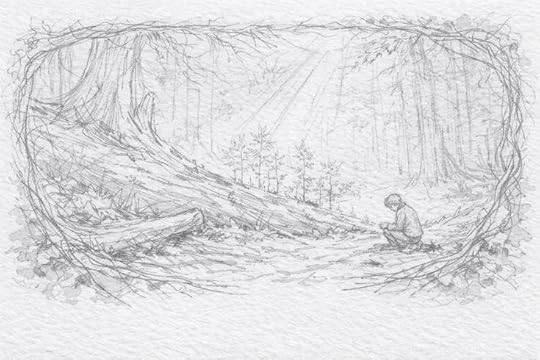
Underdrawing for the closing watercolor: structure before atmosphere, line before light.
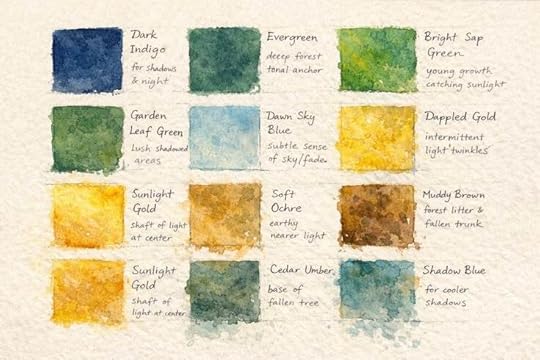
Palette study for the finished watercolor, drawn from the book cover’s shadow blues, forest greens, and shafts of gold.
All watercolor illustrations by Demetris Papadimitropoulos.
First of all, Suzanne Simard is a hero. I love her work, philosophy, and dedication. Where the mother tree book that precedes this was revolutionary and floored me, this book was sobering and unnerving. To put it simply, I am worried about mother Earth and the forest more after reading this and rather discouraged. It seems like there are numerous parallels between Dr. Simard's personal life and the increasing slippage of the vitality of global ecosystems. To sum up, this book felt like a lament over numerous deep pains for Dr. Simard, where the only solution is to be resilient like an old mother tree. I am in immense admiration of Dr. Simard for her tenacity and addressing the scientific criticism and cancellation of her work. I can't imagine that rollercoaster. I'm just glad she hasn't quit. Heaven forbid we anthropomorphize another species to better contextualize and relate to it. Though the future looks bleak, I hope there are more people like her than I know.
Earth sciences have always held my interest. Dr. Simard is a leader in her field and reading about her life and her professional work is fascinating. Her passion and dedication to her research and students is inspiring. This book is more personal than her previous, Finding The Mother Tree. It also demonstrates the author's personal growth in understanding the ecosystem of forests from the perspective of first nations people. Great book and well written!