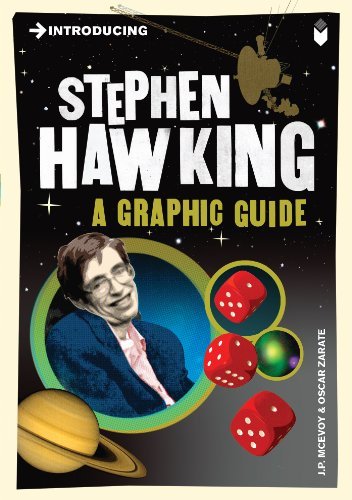
This is a frustrating book. Key ideas are tossed out without much or with no explanatory text about how the authors got to their bottom line.* Much of the illustration and text is about Hawking as a personality, functioning at the highest intellectual level despite his disability, with the text breezing through his ideas.
Hawking’s singularity theory, the authors write, is “a point at which time comes to an end and the laws of physics break down.” Does this mean that time is the movement/dissipation of heat energy which stops under a singularity event? Presumably, the same goes for “space” (the authors introduce the idea by referencing “space-time” but then revert just to “time”) because it is bound up in some ultra-contraction event. Interestingly, does this mean that the big bang is not an explosion into pre-existing space, but rather, an explosion that creates space as energy and matter moves outward? This is an interesting question because the authors’ diagram (pp. 82-83) of a big bang scenario has the explosion going outward “into space,” begging the question as to what lies outside the lines of the diagram indicating the explosive expansion.
In a singularity event (“gravitationally collapsed stars,” renamed now as black holes), Hawking says that the “laws of quantum gravity take over.” This is where Einstein’s general relativity (gravitational collapse into a singularity) is a last bastion of classic physics, though the authors are not clear why this is so unless it’s meant that under singularity conditions, gravity pulls matter and energy so tight that no other gravitational effect is possible (no further room to go; is this the infinity of physicists?). One might think that this is too much for energy and matter to handle (a forcing together of sub-sub particles/energy quanta), resulting in an explosion, but Hawking does not go there. But neither does he say that energy and matter remain bound up forever (as the big bang name itself conveys). This moves the discussion into Hawking’s theory on black hole radiation where energy is released and eventually the black hole disappears, its energy having been reintegrated into the cosmic energy field.
The authors describe particles and anti-particles interacting at the boundary of the black hole, with one being absorbed and the other bouncing out and they say that this is the Hawking radiation. How does one make sense of this? The black hole per se does not disappear; rather, the radiation occurs at the black hole boundary, the event horizon. How absorption of “one of the particles into the hole” reduces the black hole’s mass density the authors don’t say.** This all has something to do with entropy and the dissipation of heat energy (movement from hot to cold), though it is not clear how that works. But clearly something is missing from that explanation as the authors later state, simply, that it is in fact the black hole itself that disappears. Quoting Freeman Dyson, the authors write that “A black hole is not absolutely permanent but will ultimately evaporate into pure radiation.” In any event, whatever happens at the event horizon, the authors describe it as the boundary between classical physics (gravity, the pulling of matter-energy into itself under the general theory of relativity) and quantum physics (uncertainty principle and what happens inside of the event horizon) and that it was Hawking, not Einstein, who unites classical and quantum physics.***
The book mentions at the end that the then pope (John Paul) was ok with modern physics to a point. Quoting what the pope reportedly said, the authors write: ‘“ It’s all right to study the evolution of the universe after the big bang, but don’t inquire into the big bang itself, because that’s the moment of creation and therefore the work of God.’”
*E.g., The authors state, for example, that Einstein dismisses the force of gravity, which made it unnecessary therefore “to explain the odd coincidence that inertial and gravitational mass are exactly the same.” The book is filled with these leaping statements that makes it hard for the lay reader to follow its key arguments.
**“Hawking considered what might happen at the surface of a black hole (i.e., at the event horizon), “where the intense gravitational field interacts with these virtual pairs [particle and antiparticle]. It seems the intense gravity at the surface of the black hole can attract one of the particles of the virtual pair into the hole (negative energy), reducing the mass of the black hole, while the other unpaired particle (positive energy) escapes in the form of radiation and can be detected by an outside observer….”
***Hawking “was in effect combining quantum mechanics and general relativity in a single calculation for the very first time.”