From two-time National Magazine Award winner Tom Junod, a searching, brilliantly-stylized memoir about a charismatic, philandering father who tried to mold his son in his image, the many secrets he hid, the son’s obsessive quest to uncover them and, ultimately, the true meaning of manhood
Big Lou Junod dominated every room he entered. He worshipped the sun and the sea, his own bronzed body, Frank Sinatra, and beautiful women. He was a successful traveling handbag salesman who carried himself like a celebrity. He’d return from the road with stories of going to nightclubs where the stars—Ava Gardner, maybe Liz Taylor—“couldn’t keep their eyes off . . . your father.” He had countless affairs and didn’t do much to hide them.
Lou was cruel to Fran, his wife of fifty-nine years, but he loved his youngest son. Tom was a skin-and-bones, nervous boy, devoted to his mother, but Lou sought to turn him into a version of himself. He showered him with advice about how to dress (“A turtleneck is the most flattering thing a man can wear”), how to be an alpha male, and especially, how to attract and bed women. His parting speech when Tom went to college “Do yourself a favor and date a Jewish girl. They’re all nymphos.” When Tom started seeing his future wife Janet, Lou’s efforts to entice Tom into his version of manhood accelerated on nights in New York, L.A. and Paris.
Tom wrestled with Lou’s imposing presence all his life. When one of Lou’s mistresses stood up at his funeral and announced “Can we all . . . just agree . . . that this . . . was a man” Tom set off to learn the facts of his father’s life, and why he was the way he was. The stunning secrets he uncovered—about his father, his father’s lovers, and deceptions going back generations—staggered Tom, but in the process allowed him, at last, to become his own man, by his own lights.
In the Days of My Youth I Was Told What It Means to Be a Man is an intensely emotional detective story powered by a series of cascading revelations. The book is a triumph of bravura writing; it is a tale of a son reckoning with the consequences of his father’s life, and in the end, of the son’s redemption.
I didn't know what I was getting into when I first read about this upcoming title, but I devoured it in the course of a few days. Absolutely incredible tour de force writing of the story of a man, his father, and their families.
Knowing a bit about Tom Junod's authorial pedigree, reading about his father, here for the first time *everything* about him, has been enlightening. Especially after earlier depictions of their relationship on the page and screen weren't even close to his entire story.
This sprawling dual memoir (I hesitate to say dual, since it really covers so many lives) contains some nearly unbelievable moments and drops names here and there, but in the end I never doubted the veracity or at least the presumed veracity of any of the events and people encountered within.
It's truly a remarkable read: a family saga that hooked me instantly, and as it spiralled further away and then coiled back to its roots, I never wondered why I was learning about secondary or tertiary players; they all came together to create a whole, beautiful, messy picture.
What starts out as a memoir of his father that every man envied, and every woman wanted quickly becomes an investigation into what Tom’s father really got up to gallivanting around the world selling handbags. From the son that feared his father as his polar opposite and his mother’s protector…comes the unraveling of shocking secrets abound.
Tom Junod's captivating, just-released book, In the Days of My Youth I Was Told What it Means to Be A Man, is a memoir wrapped around a mystery. Who was Tom Junod's father, Lou, really? To a young Tom, Lou was a gregarious and handsome enigma, a handbag salesman with style and swagger who inspired both awe and fear in the family home. Deeply tanned and always dressed to impress, Lou Junod espoused a certain mid-century brand of East Coast masculine bravado. He loved beautiful women and had many affairs, that was clear to Tom from a young age. But when Lou dies, Tom discovers a more complex web of emotional entanglements and family secrets that extend beyond his father's numerous dalliances. With the focus and intensity of an intrepid detective and the writing chops to carry the story, Tom Junod sets out to uncover what has been hidden, sometimes in plain sight: the truth. It's riveting.
The audiobook of this memoir is narrated by Tom Junod himself and gives the reader a stellar understanding of the cadence and tone of Lou Junod. For audiobook listeners, this one is... "gold" (written in the voice of Lou Junod).
Sun Worship, Sinatra, and the Cost of Being Seen: Reading “In the Days of My Youth I Was Told What It Means to Be a Man” Now By Demetris Papadimitropoulos | March 1st, 2026
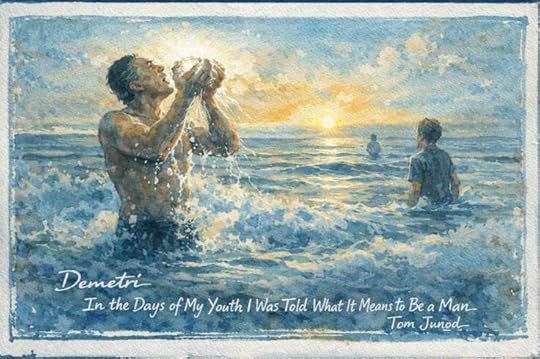
Watercolor Piece by Demetris Papadimitropoulos “Nectar…of the gods!” In newborn ocean light, Lou cups seawater like a chalice and drinks as the boy watches – awe, baptism, and the seduction of the father’s myth.
Tom Junod’s memoir, “In the Days of My Youth I Was Told What It Means to Be a Man,” begins where the stories of men so often end: with a room full of people claiming they knew him. The Prologue is a funeral parlor lit by the odd glare of performance – the kind of light that makes grief feel like theater, and memory feel like testimony. The son – Junod himself – is seated close enough to the front to believe he can control the narrative. He has curated the music, the tone, the meaning. He has arranged his father’s exit the way his father arranged his entrances, with a sense of staging, a sense of “my way.” And then a woman rises – one of the father’s lovers – and delivers a line that lands like a hand on the lectern, like a gavel, like a verdict and a provocation: can we all just agree that this was a man.
It is a moment of destabilization. Not because the son doesn’t recognize the claim – he has been drafted into it his entire life – but because he recognizes the speaker. She is evidence, walking. She is a biography that does not belong to the family, and therefore cannot be managed by the family. She is the reminder that manhood, as a cultural category, is often adjudicated by spectators, not intimates; by desire, not truth; by performance, not interiority. In a time when the public life of men is forever being re-litigated – in courtrooms, on social media, in the haunted afterlives of “context” versus “cancellation” – Junod’s first move is both old-fashioned and bracingly current: he refuses to argue the case in the abstract. He goes looking for the facts, and then he goes looking for what facts cannot quite explain.
His father, Lou Junod – Big Lou, a nickname that carries the whole book’s double meaning (bigness as size, bigness as ego, bigness as appetite, bigness as myth) – is the sort of American character who feels at once specific and archetypal. A traveling handbag salesman with the aura of a celebrity, he worships the sun and the sea, Frank Sinatra and the idea of himself. He is bronzed to the point of self-invention, as if the body can be revised by exposure, as if an identity can be lacquered on. He has a private language of adjectives – “gorgeous,” “magnificent,” “built” – that turns women into architecture and weather into applause. He is convivial in the way some men are convivial as a form of dominance: he connects across rooms, he pulls people into orbit, he makes proximity feel like elevation. He is the kind of man who takes up space so fully that everyone else becomes a supporting cast.
Junod’s early chapters are exquisite in their ability to conjure this world as atmosphere – the split-level suburbs of Wantagh, Long Island; the cocktail hour as religion; the beach as Olympus; the father’s body as icon. The prose has the hot shine of memory, but also the careful chill of a narrator who knows the tricks of reverie. The sentences move the way a man like Lou moved: with swagger, with rhythm, with the confidence of someone who expects the room to listen. Yet that confidence is always counterpointed by the son’s nervousness, his sickliness, his alertness to threat. The father’s ankle cracks in the morning like a starter pistol. The father owns the mornings; the mother owns the nights. The house is divided like a small occupied city. It is a brilliant rendering of childhood as governance: you do not merely live with a parent like this, you live under him.
What gives “In the Days of My Youth…” its unusual propulsion is the way it refuses to remain a portrait. Junod is too experienced a reporter – and too canny a stylist – to settle for the static satisfactions of a strong voice recounting a formative relationship. The memoir has the forward pull of a mystery, and its central mystery is not, at first, the lurid one (how many affairs, which women, what secrets), but the quieter, more corrosive one: why did this version of manhood feel so persuasive, even sacred, to a child? Why did it imprint so deeply? Why did it take a death to make the son look back and think: I missed something essential.
Book One functions as an origin story not only for Lou, but for the son’s sense of masculinity as a script. Lou teaches as he lives: by demonstration, by maxim, by spectacle. He trains his son in the outward signs – grooming, posture, the firm handshake, the unblinking eye contact – the small rituals that turn anxiety into choreography. He also trains him in hierarchy. Manhood, in Lou’s world, is not an interior quality; it is a social position you must hold through domination, through refusal of weakness, through the conversion of desire into proof. The son absorbs these lessons the way children absorb weather: as background, as inevitability, as reality itself.
One of the memoir’s most unsettling strengths is its refusal to keep the son morally pure. Junod writes about the birth of cruelty the way he writes about the birth of longing: with clarity, with shame, with precision. A fifth-grade classroom becomes a pressure chamber. The fear of being placed among the “slow” kids threatens the boy’s sense of worth, and so he does what the culture teaches boys to do when they are about to cry: he turns outward. He finds a target. He builds a private case against a new classmate, not because the classmate deserves it, but because contempt is a quicker anesthetic than tenderness. In this moment – small, almost banal, devastating in its recognizability – Junod shows how masculinity reproduces itself: not only through fathers, but through the social economy of boys. The father’s lessons echo not as explicit instructions, but as reflex.
If Book One is the construction of the myth, Book Two is the beginning of its decomposition. Lou’s public charisma starts to reveal its private cost. The affairs – once told as stories in which the father is always the hero, always desired, always the man whose life is more interesting than anyone else’s – begin to read as repetition, as compulsion, as appetite unmoored from intimacy. The mother, too, comes into clearer focus, not as a foil but as a moral counterweight: the one who endures, who holds the household’s quiet structure together while the father treats structure as optional. The family becomes a system organized around one man’s needs, and Junod is unsparing about what such organization does to everyone else’s nervous system.
This is where the book begins to feel especially relevant to our current moment – and not in the cheap way of name-checking headlines, but in the deeper way of diagnosing a pattern that contemporary culture keeps circling. We live in an era increasingly suspicious of the charismatic man who “dominates every room,” and increasingly interested in the invisible labor that makes such dominance possible. We also live in an era fascinated by the mechanisms of self-curation: the social media persona, the brand, the myth a person builds and maintains. Lou is a pre-digital influencer of the flesh. He does not post; he performs. He does not cultivate followers; he cultivates witnesses. And as Junod’s investigation progresses, the memoir becomes a study of what happens when performance collides with archive.
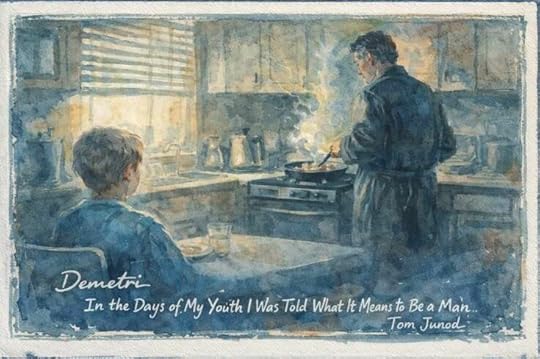
Watercolor Piece by Demetris Papadimitropoulos “Kidneys” in the Kitchen: Dawn stripes the kitchen with blinds-light as Lou, ribboned in smoke, sizzles kidneys and gravy – love served warm with vigilance.
Book Three is where the book’s title begins to glow with extra meaning. “In the days of my youth I was told…” – told, not shown; told, not discovered; told, not proven. The “told” suggests doctrine, and doctrine suggests inheritance. Yet what Junod ultimately uncovers is that inheritance runs deeper than instruction. It runs through bloodlines, through omissions, through names altered and branches cut from the family tree. In the age of DNA kits and genealogical databases – when countless people discover hidden siblings, donor conceptions, old adoptions, the family secrets that were once meant to stay buried – Junod’s revelations feel eerily contemporary. He finds cousins. He finds long-suppressed histories. He finds that the self-made man is, like every man, made by others and by what those others refused to say.
There is a temptation, in memoirs that turn investigative, to treat discovery as climax. Junod is smarter than that. He understands that facts are not redemption; they are only context. Context can be clarifying, but it can also be destabilizing. It can rearrange the past without making the present easier. In some of the book’s most striking passages, Junod writes about the bodily impact of revelation – the way knowledge can knock you down, the way the nervous system responds as if to threat. The memoir is full of these physiological truths. It is not just that the son learns new information; it is that he learns it with his whole body, the way he learned his father’s presence as a boy – as crackle, as scent, as alarm.
If one were to place this book on a shelf of literary kin, it would sit comfortably among works that treat fathers not as sentimental icons but as complicated engines: Geoffrey Wolff’s “The Duke of Deception,” Tobias Wolff’s “This Boy’s Life,” Mary Karr’s “The Liars’ Club,” J. R. Moehringer’s “The Tender Bar,” Dani Shapiro’s “Inheritance.” It also carries a faint fictional echo of mid-century American male restlessness – the erotic dissatisfaction and self-mythologizing that haunt “Rabbit, Run,” or the suburban performance anxieties that shadow “Revolutionary Road.” Yet Junod’s sensibility remains distinct. He is not writing a sociological treatise, and he is not writing a revenge narrative. His gift is to hold the father’s glamour and his damage in the same palm, to show how a man can be magnetic and harmful without resorting to either sanctification or annihilation.
The question at the center of the memoir is deceptively simple: what does it mean to be a man? Lou answered it with a script: look good, dominate, desire, be desired, never appear weak. Junod answers it with an audit. He tests each inherited premise against lived consequence. He finds, repeatedly, that performance cannot substitute for intimacy, that conquest cannot substitute for self-knowledge, that charisma cannot substitute for accountability. And because he writes as a son who once wanted to be his father – and who, in small ways, became him – the book’s critique carries the weight of complicity. He is not standing outside masculinity throwing stones. He is inside it, describing the architecture from within.
That interiority is what gives the memoir its literary authority. Junod’s prose has an old pool shark’s English on its English; it is capable of comedy without becoming cute, capable of lyricism without becoming ornate. He understands that a sentence can seduce, and he also understands the danger of seduction. The book’s finest passages have a double movement: they draw you into Lou’s spell, then show you the cost of being spellbound. This is not simply a memoir about growing up with a larger-than-life father. It is a memoir about the seductions of bigness itself – the way a boy can confuse bigness with truth, and the way a culture can do the same.
What keeps the book from perfection is, paradoxically, the very exuberance that makes it so readable. Junod is a master of rhetorical accumulation, and occasionally he presses a point more than once, as if unwilling to leave an insight unillustrated. There are moments when you can feel the writer’s delight in his own cadence, in the way a phrase lands, in the way a scene can be framed for maximum impact. A slightly greater willingness to let silence do the work – to trust the reader to feel the ache without being escorted to it – would sharpen the book’s already potent restraint.
Still, the memoir’s closing movements feel earned in the way the best memoirs feel earned: not by providing catharsis, but by providing clarity. Junod does not offer a tidy absolution. He does not cancel his father, nor does he rehabilitate him into a saint of charisma. He contextualizes him – which is a different, rarer form of mercy. In the end, Lou is reduced to scale: not small, not enormous, but human. The son’s own identity shifts in response. He is no longer “number two son” auditioning for his father’s approval. He becomes the adult in the room, the one willing to hold contradiction without flinching.
The most radical thing “In the Days of My Youth…” does is not the exposure of secrets, but the redefinition of strength. In Lou’s model, strength is dominance, appetite, and certainty. In Junod’s model, strength is perception – the willingness to see what you do not want to see, including yourself. In a culture still caught between swagger and vulnerability, between performance and authenticity, between the seductions of the “alpha” and the slow work of emotional literacy, this memoir arrives as something like an antidote. It does not preach a new masculinity. It demonstrates the process of revising one.
Junod’s final achievement is to make a story about one man’s outsized life feel like a story about the lives that orbit such men – the wives who endure, the sons who absorb, the friends who flatter, the lovers who puncture the narrative at the funeral. The book suggests that manhood, for better or worse, has always been a public category: it is bestowed, contested, withdrawn. The son begins the memoir believing he can settle the matter with a eulogy. He ends it understanding that the question is not whether his father “was a man,” but what kind of manhood we are willing to celebrate, inherit, and transmit.
That is why the book lingers. Not because it exposes a philandering father – literature has done that for a century – but because it exposes the machinery of admiration. It shows how a boy becomes a witness to a performance and calls it love, how he later becomes a witness to the truth and calls it liberation. If masculinity is, as Lou believed, partly a matter of looking and being looked at, Junod’s memoir proposes an alternate economy: look closely, even when it hurts, and let the gaze become not conquest but comprehension. For a book so drenched in sunlight, it is, finally, an argument for seeing in full light – and for accepting what that light reveals. My rating: 89/100.
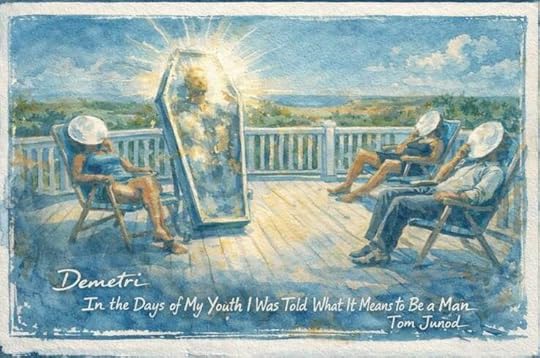
Watercolor Piece by Demetris Papadimitropoulos Sun Religion: On a white Westhampton deck in brutal noon glare, the family tilts toward the sun while Lou lies “entombed” in a coffin-shaped reflector, stealing fire from the sky.
I have to admit, the deck was stacked. I've long been a fan of Tom Junod's magazine writing, some of which has stuck with me for decades. But I could not have predicted how moved I would be by his achievement with this book. Okay, yes, I should have known, since Junod has a gift for imbuing unanswerable questions with ... how to put it? The feeling of facing an unanswerable question as well as the fullness of possibility.
What I'm trying to say is Junod is a master of duality, and that is no small feat. In his memoir, the story of his adored father and all his father's complications and contradictions, he manages to place the reader in a place of love. He does this despite detailing his research into his father's tangled romantic past and the tangled --- or, at last, untangled --- web of DNA that results from it.
Junod creates indelible characters and settings from the 60s and 70s, then brings them forward into the 21st century without judgment. He simply paints and presents them to us. But there is an edge to the writing, as well. And there's not a hint of sentimentality in the work. Junod, the journalist, does the work he knows how to do so masterfully... on himself.
If you've ever had a father, read this. And if you've had a complicated father, read it now.
Tom Junod’s father, Lou Junod, might be the most interesting character I’ve ever read about in a memoir.
Lou was a WW2 veteran and traveling salesman, obsessed with his own looks, clothes, tan, and ability to dominate a room. He was a real life Don Draper who lived a secret life as a philanderer. Early on in the book, Tom tells about the time as a child when he figured out the combination on his father’s hidden work briefcase and discovered items he had no words for at the time: dildos, vibrators, German BDSM tapes, and more. Tom never mentioned what he found to anyone, his mother or his siblings—the first secret of his father’s that he buried and kept to himself. The book is focused on how these secrets affected Tom and the rest of his family.
The first section of the book is a pure memoir of everything Tom remembers about Lou, growing up and the lessons his father tried to teach him, and Lou’s decline. The second half dives into other family secrets and tries to understand the origins of his family’s trauma.
Tom Junod is an amazing writer. It’s not surprising that he waited this long to tell this story.
IN THE DAYS OF OUR YOUTH takes us through the years as the author grows up in the shadow of his father’s huge personality. Junod’s father seems to have that undefinable “it factor,” a magnetic pull that draws people toward him, while leaving no room for others to shine.
One of the things that struck me as I read was how, when we’re young, we have little sense of our parents as people. When we first start to understand they’re more than just mom and dad, but in fact lead entire lives outside of our orbit, their flaws and behavior can bring a sense of disillusionment or even dislike. Reckoning our love for a parent with the full dimensions of the person they are can be difficult.
I’ve never been a young man, and my family’s dynamics were quite different from Junod’s, yet I still related to his journey. His writing is honest and engaging, and one I will remember.
*Thanks to Doubleday Books (#DoubledayPartner) for the free copy!*
...Junod’s stemwinder of a title comes from a Led Zeppelin track, and the book, too, moves like a song, drawing you in with its melody before delivering an emotional wallop. Some of the revelations in this book are truly startling, even if the outsize figure of Lou Junod and his caginess about his family’s history should alert you from the beginning that some unnerving surprises are in store.
But at the core of the memoir is the persistent hum of a simple truth. Junod’s father may have led a full life, but it wasn’t a whole one; he was always juggling so many secrets that he could never integrate his disparate selves. Junod, for his part, and despite his own mistakes, resolves not to fall for the same clichés of masculinity that bedeviled his father and wreaked havoc on the family: “I have to figure out a way to be a man by becoming a human being.”
In the Days of My Youth I Was Told What it Means to Be a Man has an unwieldy title, but despite the length of the book, it doesn't feel overly long. The story is intriguing and the writing is beautiful. I was totally captivated by the way Tom Junod told his story. I often enjoy memoirs, but with the caveat that the story is good but the writing just okay. This one is different. The writing is excellent. I read and listened to this one, and finished it in only two days.
This is a family saga. A look at history. An examination of trauma. A reckoning with the past. It is messy, complex and complicated story, which is completely appropriate because families are messy.
Thank you @DoubledayBooks & @PRHAudio for the #gifted ARC & ALC.
Junod's FALLING MAN essay is one of the most transcendent reading experiences I've ever had. I am going to re-read his Mr Rogers essay soon, remember loving that as well.
I was not able to put this book down for the first two days I had it (and yes, I ordered it immediately on publication). Without going into spoiler territory, the second half goes deep into 23 and me territory. No doubt this is my shortcoming as a reader, but I got a bit lost navigating the expanding cast of characters and relationships here.
Anyone with difficult family experiences -- and does that translate into most people???-- will relate to some aspect of this memoir.
This felt somehow too long and detailed and not detailed and long enough.
There were a lot of dates but at the same time, I had a hard time figuring out how old and where the author was when some of the events were going on. I didn’t get a good feel for his life either. He went from being in what seemed like remedial school to being a writer at a major magazine? How?? Why did he choose that profession? I have some ideas but I would have liked to have read his.
I think it should have been just a book about his dad or a book about himself. He tried to do both and I don’t think it worked that well.
Tom Junod's whole life was impacted by the actions and personality of his father Lou Junod. This memoir is Tom's attempt to explore the conflicting feelings this relationship caused, and we come to understand the love, fear, disgust and admiration he feels. Lou Junod is a manly man who dresses beautifully, keeps his body in excellent shape and works as a salesman in New York City. He also is a Casanova, and his wife and children suffer silently due to his open dalliances. Family history comes to light that brings forward dark secrets and painful truths. This memoir is well done!
Tom Juno’s is one of the best writers I’ve ever read. His descriptions of people and their features make it seem as if you know them. He can describe a photo he’s seen and you feel like you’ve seen it too. This book is an amazing feat of writing and research that comes together in a tale that cannot be put down. I took my time reading it so I had something to look forward to. Thanks, Tom, for this masterpiece.
This is nothing short of an absolute masterpiece. Every memoir should aspire to this level of depth and research. I don’t want to spoil a thing about Tom Junod’s decades long journey to understand his father and his family. Settle in and enjoy this one. Without hyperbole the best thing I’ve read this decade.
Tom Junod's memoir is ostensibly about his father and influence the older Junod had on the younger, but it becomes so much more: a family history and something of a genealogical thriller come the end. A book of reckoning and combining love and truth telling. A masterpiece.
a once in a lifetime book or biography that is real
The writing is remarkable. Every page is alive , vibrant and textured. I read a lot and this story is written by a genius. The detail of the time, places, and emotions is like a movie unraveling before your ears and eyes..
a memoir that reads like a novel. the last part lost me a little in the beginning though--not sure if the deep dive into the family tree had to be as long-winded as it was. overall though i really enjoyed!!