Jump to ratings and reviews
Rate this book

Fear and Fury: The Reagan Eighties, the Bernie Goetz Shootings, and the Rebirth of White Rage

Rate this book
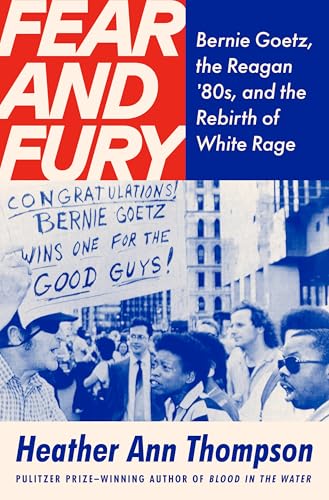
In this masterful, groundbreaking work, Pulitzer Prize-winning author Heather Ann Thompson reveals how the infamous New York subway shooting of 1984 divided a nation, unveiling the potent cocktail of rage and resentment that ushered in a new era of white vigilante violence.

On December 22, 1984, white New Yorker Bernhard Goetz shot four Black teenagers at point-blank in a New York City subway car. Goetz slipped into the subway tunnels undetected, fleeing the city to evade capture. From the moment Goetz turned himself in, the narrative surrounding the shooting became a matter of extraordinary debate, igniting public outcry and capturing the attention of the nation.

While Goetz's guilt was never in question, media outlets sensationalized the event, redirecting public ire toward the victims themselves. In the end, it would take two grand juries and a civil suit to achieve justice on behalf of the four Black teenagers. For some, Goetz would go on to become a national hero, inciting a disturbing new chapter in American history. This brutal act revealed a white rage and resentment much deeper, larger, and more insidious than the actions of Bernie Goetz himself. Intensified by politicians and tabloid media, it would lead a stunning number of white Americans to celebrate vigilantism as a fully legitimate means for addressing racial fear, fracturing American race relations.

Drawing from never-before-seen and archival interviews, newspaper accounts, legal files, and more, Heather Ann Thompson sheds new light on the social and political conditions which set the stage for these events, delving into the lives of Goetz and his four victims—Darrell Cabey, Barry Allen, Troy Canty, and James Ramseur. Fear and Fury is the remarkable account and searing indictment of a crucial turning point in American history.

560 pages, Hardcover

First published January 27, 2026

126 people are currently reading
8559 people want to read

About the author

Heather Ann Thompson

10 books233 followers
HEATHER ANN THOMPSON is an award-winning historian at the University of Michigan. She has written on the history of mass incarceration, as well as its current impact, for The New York Times, Time, The Atlantic, Salon, Dissent, New Labor Forum, and The Huffington Post. She served on a National Academy of Sciences blue-ribbon panel that studied the causes and consequences of mass incarcerations in the United States and has given Congressional briefings on this subject. Thompson is also the author of Whose Detroit?: Politics, Labor, and Race in a Modern American City and editor of Speaking Out: Activism and Protest in the 1960s and 1970s.

Ratings & Reviews

What do you think?
Rate this book

Friends & Following

Create a free account to discover what your friends think of this book!

Community Reviews

5 stars
26 (44%)
4 stars
25 (42%)
3 stars
6 (10%)
2 stars
1 (1%)
1 star
1 (1%)
Displaying 1 - 24 of 24 reviews
Profile Image for Demetri Papadimitropoulos.
286 reviews16 followers
January 27, 2026
“Fear and Fury” and the Subway as Moral Theater: How One 1984 Shooting Became a Blueprint for America’s Politics of Panic
By Demetris Papadimitropoulos | January 27th, 2026


~Watercolor Piece by Demetris Papadimitropoulos~

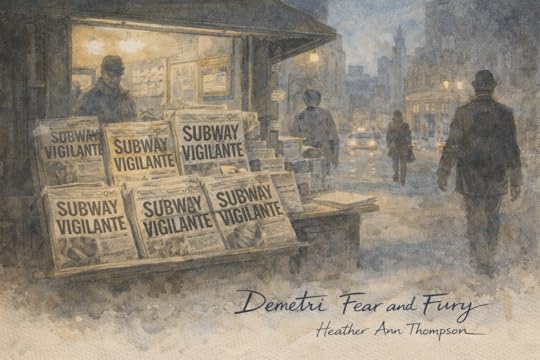
In New York, the subway is a confessional without a priest. It asks you to sit close to strangers and invent a story that explains your proximity. In the 1980s, when the city’s fiscal hangover hardened into a civic mood, those stories began to run on a single fuel: suspicion. Heather Ann Thompson’s “Fear and Fury” takes one of the era’s most overfamiliar flashpoints – Bernhard Goetz’s 1984 shooting of four Black teenagers on a downtown train – and performs the rarest feat in American nonfiction: it makes a myth feel newly dangerous by returning it to the lives it flattened.

Thompson begins by declining the usual center of gravity. Most retellings of the Goetz case start with the gun: the glint of metal in fluorescent light, the jolt of violence that makes a narrative “go.” Thompson starts with what violence interrupts. She introduces Darrell Cabey not as a future headline but as a boy in the South Bronx, shaped by the blunt mathematics of disinvestment and the private heroism of a mother trying to keep a household upright when the city itself seems to tilt. The move is both moral and aesthetic. By restoring the victims’ interiority first, Thompson changes what the reader can tolerate later. When the tabloid machinery begins to grind, you feel the reduction as an additional injury – the second shooting, this one in language.

That language is one of Thompson’s true antagonists. “Fear and Fury” is a book about an event, but it is also a book about the stories that make events usable. In Thompson’s telling, fear is not merely an emotion or an instinct. It is a credential. It grants permission – to preempt, to harm, to be believed. Fury, meanwhile, becomes a civic performance, a proof of seriousness, a substitute for policy. The case matters not only because bullets flew, but because the city watched those bullets and decided what they meant. Thompson is after the interpretive moment: the instant when a violence becomes a parable and a parable becomes governance.


~Watercolor Piece by Demetris Papadimitropoulos~

Her South Bronx chapters are unsparing without being fetishistic. Thompson does not ask the reader to admire “grit” as a retro aesthetic; she asks the reader to understand what grit costs. Public housing appears not as a colorful backdrop but as an engineered environment: buildings allowed to decay, systems that fail at the exact frequency required to drain a family’s bandwidth, stairwells and lots that teach the body a permanent vigilance. Thompson has the historian’s gift for making conditions feel intentional. The borough’s suffering is not weather. It is policy, maintenance choices, budget lines, and a broader cultural willingness to treat certain neighborhoods as expendable.

Yet Thompson refuses the other temptation: turning the South Bronx into a saintly community of pure victims. She acknowledges the violence residents endured from multiple directions – street crime, the drug trade, the everyday risks of a city that had stopped caring about some of its own arteries. Cabey is not presented as spotless, because spotless is another form of stereotype. The book’s point is subtler and more bracing: you do not need perfect victims to have an unjust world. You only need a world that confuses disadvantage with deviance and then calls its confusion “realism.”

Goetz, too, is rendered with a steady refusal of caricature. Thompson does not make him a monster imported from a different moral universe. She makes him a man who found, in the city’s ambient panic, a private ideology that felt like survival. He moves through Manhattan as if the public has failed him, nursing the sense that he is perpetually owed protection and perpetually denied it. Thompson shows how fear can be practiced: rehearsed in the mind, narrated as identity, hardened into a worldview. The book is careful not to conflate explanation with excuse. Goetz is understandable without being exonerated – a distinction American culture often struggles to maintain, especially when the figure at the center is white, male, and willing to brandish grievance as virtue.

If the book stopped there, it would still be valuable: a restorative narrative that returns complexity to the characters most history has treated as props. But Thompson’s ambition is larger, and it is what makes “Fear and Fury” feel like a companion piece to her earlier “Blood in the Water,” another work that treats a single violent episode as a prism through which a broader system can be seen. Thompson understands institutions the way good novelists understand families: as bodies with habits, grudges, and incentives. Police departments, courts, city agencies, newsrooms, and political machines appear not as abstractions but as cultures that reward certain behaviors and punish others.


~Watercolor Piece by Demetris Papadimitropoulos~

This is where the book’s title becomes diagnostic. Thompson traces how fear and fury were amplified in the 1980s, then monetized. Crime coverage becomes an industry, and an industry needs product: simple villains, repeatable story arcs, villains who look the same each night. Thompson shows how animalizing metaphors about Black youth – the rhetoric of packs and predators – did not merely describe a perceived threat but manufactured a social permission structure. The city’s panic became a commodity, and once commodified it began to demand constant replenishment. The result is a feedback loop: fear generates stories, stories justify policing, policing produces new images of threat, threat generates more fear.

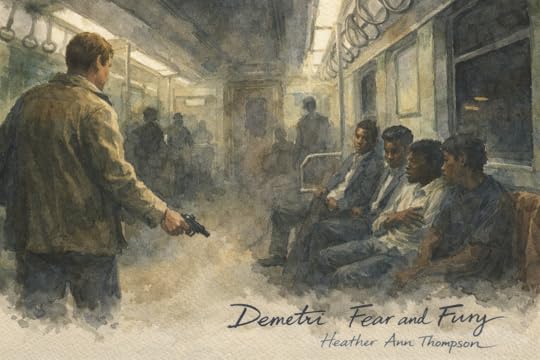
The shooting itself is written with a restraint that feels like a moral choice. Thompson knows the seductions of violence on the page. She keeps the scene close enough to feel its suddenness, but she refuses to choreograph it into entertainment. The aftermath, meanwhile, becomes a study in narrative violence: how quickly the victims are put on trial in the court of public imagination, how swiftly nuance is treated as betrayal. Goetz becomes a symbol – the “vigilante” figure the city’s tabloids can sell, the folk hero for those who want the reassurance that someone is finally doing what “the system” refuses to do.

Here Thompson’s cultural intelligence is sharpest. She understands that the Goetz story took hold because it fit a prewritten script: the righteous citizen, the urban savages, the helpless bureaucrats. It was a script Americans already knew from movies like “Death Wish,” from the moral grime and lonely masculinity of “Taxi Driver,” from the broader genre in which the city is a jungle and the white man’s fear is treated as anthropology. Thompson does not overstate the point. She simply shows how easily that aesthetic becomes politics. A fantasy of individual punishment becomes a substitute for structural repair.

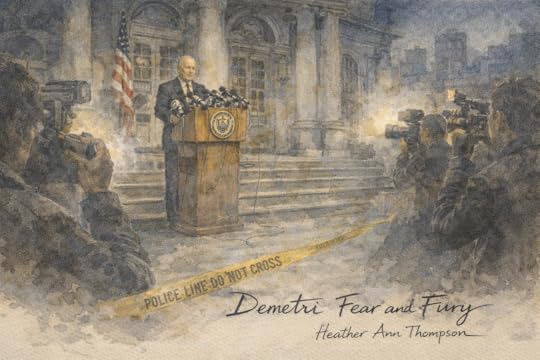
The courtroom chapters reveal how law can function as an amplifier rather than a corrective. Thompson is attentive to the way legal language – “reasonable,” “necessary,” “imminent” – depends on shared cultural assumptions about whose fear is credible. The law promises neutrality, but neutrality is only as fair as the social imagination that feeds it. Thompson’s account makes the reader feel how “reasonableness” operates as a kind of racial Rorschach test. What would a “reasonable person” perceive in a subway car? What does threat look like? Who is allowed to claim panic as proof? These are not merely legal questions. They are questions about citizenship.


~Watercolor Piece by Demetris Papadimitropoulos~

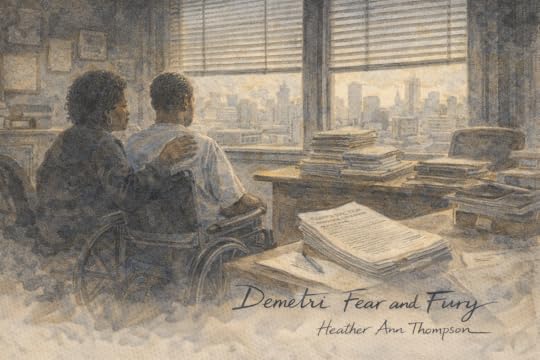
Throughout, Thompson keeps returning to the human cost of being turned into an emblem. Darrell Cabey’s paralysis is not treated as a narrative consequence that “raises the stakes.” It is treated as a life – a daily reality that persists after the headlines move on. The book refuses to let the case end where public attention ends. Thompson follows the long afterlife: civil litigation, political transformations, reputational rewrites, the slow institutional digestion of outrage. The reader begins to understand that one of the most insidious forms of power is the ability to outlast other people’s grief.

This refusal of catharsis is one of the book’s most rigorous qualities. Many works of contemporary nonfiction depend on a moral arc that provides release: revelation, condemnation, a gesture toward reform. Thompson is skeptical of that structure, and her skepticism feels earned. She does not offer redemption because redemption would be a lie the system tells itself. The city’s story about Goetz did not resolve with a neat moral consensus; it continued as precedent, as rhetoric, as policy. Thompson’s writing, disciplined and sometimes relentless, mirrors that continuation. The reader may occasionally wish for more silence, more trust that the evidence has already done its work. But the book’s insistence feels like a strategy against a culture that has insisted, for decades, in the opposite direction.

If “Fear and Fury” has a weakness, it is the one that often accompanies moral and archival ambition: a tendency, in places, to press hard on points the narrative has already made with devastating clarity. Thompson wants every wire visible in the circuit. She is determined that the reader not escape into nostalgia or the comforting belief that the past was simply rougher, crazier, less enlightened. At times, that determination can heat the prose. Yet the cumulative effect remains powerful: Thompson’s insistence feels like a rebuttal to the way American culture treats violence as episodic rather than systemic, as isolated rather than infrastructural.

The book’s relevance to the present does not depend on cheap parallels, and Thompson is too serious a historian to play that game. Still, it is impossible to read “Fear and Fury” without feeling the tremor of now. We live in a moment when public safety rhetoric again thrives on compression, when the idea of “reasonable fear” continues to operate as a moral solvent, dissolving accountability with a single phrase. We live amid a media ecosystem that can turn resentment into content and content into power, amid renewed debates about vigilantism, self-defense claims, and the policing of “disorder.” Thompson does not say history repeats. She shows how history trains reflexes, how certain narratives become so familiar they pass for instinct.


~Watercolor Piece by Demetris Papadimitropoulos~

In that sense, “Fear and Fury” belongs in the lineage of books that treat punishment as a political project rather than a natural response. It pairs fruitfully with “Locking Up Our Own,” which complicates the comforting story that only one side built the carceral state; with Elizabeth Hinton’s “From the War on Poverty to the War on Crime,” which traces how social policy mutated into policing; with “The Condemnation of Blackness,” which reveals how crime statistics became racial ideology; with “Ghettoside,” which interrogates the uneven distribution of protection; and, in its city-making scope, with “The Power Broker,” another work that shows how governance remakes daily life while insisting its choices are merely pragmatic. Thompson’s distinctive contribution is her blend of intimate restoration and systemic indictment. She makes the victims human first, then shows how the system profits from making them less than that.

Ultimately, Thompson’s great subject is permission: permission to assume, permission to preempt, permission to punish, permission to confuse fury with virtue. She shows how that permission is conferred not only by laws but by headlines, by political theater, by the steady repetition of stories that teach a public whom to fear and whom to forgive. “Fear and Fury” is not simply a history of an infamous subway shooting. It is a moral history of a civic habit: the habit of treating certain lives as threats before they act, and treating certain fears as wisdom without question.

As both history and literature – for its narrative propulsion, its archival rigor, its refusal to aestheticize harm, and its bracing clarity about how stories become policy – I would rate “Fear and Fury” a 91 out of 100.
Profile Image for Susan.
191 reviews4 followers
January 11, 2026
I was 17 years old and living in Canada when Bernhard Goetz shot 4 black teenagers on a NYC subway car. I remember the case, but it turns out that, like so many, what I remember is largely misinformation. This excellent account not only walks the reader through the event itself and the subsequent trials, but also puts all of this into the sociopolitical context of 1980s NYC.

The racism wrapped up in this case is astounding and probably shouldn’t be surprising, and yet I was surprised nonetheless. The author also explores how this instance of so-called vigilante justice has reverberated since (Stand Your Ground laws being just one example). An informative, illuminating read that I found quite discouraging in our current moment.

Thank you to NetGalley and Pantheon for allowing me to read an ARC of this title.
Profile Image for Derrick Contreras.
238 reviews8 followers
January 15, 2026
Such a thorough and in depth look at the Bernie Goetz case. Truly will make you go crazy as everything unfolds. Heather Ann Thompson is an expert at keeping you on the edge of your toes with suspense. The final section was not needed and really was a let down to an otherwise solid 5 star book. 4.5 stars because of the ending
43 reviews
January 31, 2026
First, thank you to Pantheon and NetGally for the ARC of such an enlightening book. I had never heard of this shooting prior to reading the blurb about this book. This book is meticulously researched regarding the shooting, the perpetrator, its victims and the subsequent trials. But I was particulary impressed by the intersectionality of the author's explanations. There is ample commentary of how systemic injustice and poor economic agendas, like trickle down economics, contributed to the shooting and the social climate. The author also did a great job explaining how conservative media and its growth, fueled by Rupert Murdoch, created both the political and social climate around the time of the shooting and the climate today. I especially appreciated how the author traces the connection between white rage in the 80s and Donald Trumps's current presidency and policies. My only critique is that the title should not refer to the "Rebirth" of white rage, because reading this book begs the question- when did white rage ever die?
Profile Image for Brian Shevory.
358 reviews13 followers
Review of advance copy received from Netgalley
January 9, 2026
Many thanks to Knopf, Pantheon, Vintage, and Achor and NetGalley for allowing me to read an advanced copy of Heather Ann Thompson’s detailed and compelling new book Fear and Fury: The Reagan Eighties, the Bernie Goetz Shootings, and the Rebirth of White Rage. I was floored by the events in this book, and I’m glad that Thompson has re-examined the facts of this case, including the lives of Goetz’s victims, James Ramesuer, Darrell Cabey, Barry Allen, and Troy Canty. While Thompson’s book accomplishes many things, one of the most important is to humanize these victims who were degraded and criminalized for being young Black men in NYC not only by the violent judgement of Bernie Goetz, but also by the emerging NYC tabloid press, The NY Post, which was acquired by Rupert Murdoch in the late 1970s. Thompson details how Reagan’s cultivation of white resentment through targeting civil rights and poverty initiatives from the 1930s through the 1960s led to his election and mandate to cut government waste, with the unstated consequences of easing taxes for the aristocracy and corporations. Whether it was magical thinking or just a kind of splashy statement that would silence critics, the trickle down economics never happened, and income inequality worsened as those in big cities and those who lived below the poverty line saw reductions in services and aid that helped with everything from accessing food, housing and education. Sound familiar? In reading this, it was hard to stomach the ways that conservatives have repurposed Reagan’s failed ideas, ignoring the damage it wrought to all Americans, but in particular the injustices and inequalities that deepened for Black Americans. However, while Thompson draws parallels between society and politics in America today and America 40-45 years ago, the main focus of this book is on how this context set the stage for the kind of vigilantism that Bernhard Goetz was allowed to perpetuate on 4 Black teenagers in a NYC subway in 1984.
While I don’t remember when this even occurred, I do remember some aspects of the trial, which occurred significantly after it happened. I also think that Wu-Tang Clan’s “Clan in da Front” helped to remind me about “Bernhard Geotz what he deserves,” shouting out the kind of injustice and violence that was a part of being young and Black in NYC in the 80s and 90s. Regardless, it was shocking to learn more about this case and the way that it played out in the media, which ended up shaping not only public opinion, but also that of the jury. A majority of the book details the actual shooting, its aftermath, and the trial, which took place nearly 3 years after the shooting. Thompson’s research and retelling lets us know about the lives of both the teenage victims and their shooter. It was interesting to learn about Bernie’s own troubles with authority, his inability to hold a job, and his disgust with NYC. Although his family moved to Orlando after his father was revealed to have inappropriate relationships with young boys, I was surprised that Bernie never moved there since he seemed to really despise the city. Furthermore, Thompson shares the challenges that the boys experienced as NYC slipped into debt and in particular the Bronx experienced a series of fires in the late 70s. The city takes on its own important role in Thompson’s book, noting how crime, cuts, politics, economics, race, and growing diversity with urban flight all played roles in heightening tensions and distrust among different groups of people. In fact, as Thompson presents the shooting and the trials of Goetz, we see how biases and beliefs were already shaped based on the perceptions of the events, rather than the actual evidence or outcomes. I was shocked to see the ways that these boys were convicted in public without any kind of trial. There was no presumption of innocence for them, and yet, the man who actually pulled the trigger, who shockingly went back to shoot Darrell Cabey, telling him he didn’t look so bad, was applauded, rewarded, and treated as a hero in the city, although not by all. The boys were repeatedly referred to as criminals, violent thugs, whose intention was to rob, yet they were not even tried or charged with any crimes. It was shocking, but also not surprising in the examination of the history of white rage and vigilantism, which Thompson presents more recent examples of Trayvon Martin, Ahmaud Arbery, and most recently Jordan Neely, whose killer was invited to watch the Army Navy football game with the president and vice president. Thompson also mentions other prominent extrajudicial killings, including acquitted murderer Kyle Rittenhouse, to show how Goetz’s trial and acquittal on more serious charges wasn’t a bug, but rather a feature of the American justice system that often allows for violence and a wide berth of “self-defense” for some citizens, but not others. Thompson’s book helps to highlight how Goetz’s trial was conducted not just in the courtroom, but also in the court of public opinion, and helped to leverage the kind of white rage and fear that presented him as a sympathetic figure to many in NYC, rather than the violent, paranoid thug he was.
The entire book was shocking, especially when we consider the consequences of Goetz’s decision to shoot these boys, and how it impacted their lives, as well as the lives of those around them. Darrell Cabey, who was paralyzed and as a result of injuries to his spine and lungs, experienced oxygen deprivation that led to brain damage, is given the most attention in the book. However, all of the boys experienced physical and psychological consequences as a result of Goetz’s violence. In one of the most shocking moments of the book, Thompson details Cabey’s family’s attempts to sue Goetz in civil litigation mainly to help cover costs of the constant care required for him. Darrell was not only paralyzed, but had limited memory, which required help with daily tasks and bodily functions. Goetz, now serving as his own lawyer, requested to depose Cabey (and his mom), believing that Cabey was faking his injuries and brain damage for money. It’s hard to believe that someone who purposefully shot an unarmed teen, leading to paralysis and brain damage, would be so cynical and callous. What was even more shocking was that the judge, after several reports from physicians detailing Cabey’s mental capacity, would allow this deposition to occur. I’m curious to learn other’s perspectives on how utterly inhumane and degraded Goetz is after thinking that someone would fake brain damage for money.
In addition to Goetz’s disgusting behavior, it was also shocking to learn that he not only went on the run for more than a week after the shooting, fleeing to New Hampshire, but also that he eventually turned himself in, making a full confession after waiving his right to counsel. Despite acknowledging the boys posed no real threat and that he intended to violently harm and kill these boys, Goetz was acquitted of murder. Thompson provides a postmortem that goes through the jury’s reasoning, based on interviews and one of the jurist’s memoir of the trial. I won’t get into those details, but it was shocking to see the kinds of inferences they make to lead to an acquittal. Thompson’s book is a shocking, but important read today, especially as violence, both institutional and physical, continues to escalate. In the last section, Thompson details the more modern analogues for the Goetz shooting and trial, and how other cases and more recently racial violence and white rage have been increasing under Trump. While it’s not the main focus in the book, it does serve an important reminder and as a warning about how marshalling this kind of resentment and rage can have violent and dire consequences. Truly an important book to read in 2026. Highly recommended!
Profile Image for Logan Kedzie.
405 reviews45 followers
Review of advance copy received from Netgalley
January 23, 2026
There is a universe where this gets a bland review, the book being a summary of the crimes and trials of the 1984 NYC subway shooter Bernhard Goetz, that puts his story into the context of a media ecosystem that led to the racist Nationalism of the moment in the United States. It is good, though overlong.

That this review is not is predicated on a red flag that showed up early in the book, where the author describes someone (Goetz’ father) getting off on a technicality. What this consists of is not explained, and my research has not turend up the answer.

This is relevant for the book. To quote Justice William Brennan:

You in the media ought to be ashamed of yourselves to call the provisions and the guarantees of the Bill of Rights 'Technicalities'. They're not. We are what we are because of those guarantees.


Berine Goetz is a monster. No hedging. The book describes his evil comprehensively.* It is moral to consider Goetz a monster, motivated by racial animus, and the sort of response that he provoked in the white community at large equally racist and monstrous.

But in a book holding itself out as being about a failure in the justice system, the authorial choices here frustrate the message.

I hesitate to catalog my gripes because I have a deep sense of empathy with where the author is going here and what she is trying to do. You could write a book that tells the story from the perspective of the righteous outrage at it. But in this book feeling more like an audition for the next season of American Crime Story, the criteria for what constitutes a well-argued book on the topic has a different weight. To paraphrase Ken White, there is an odd function that happens when people look at the carceral state and end up feeling that the problem is that it is not more unjust, and if only the right people got hurt things would be okay, rather than it being a system that structural inequities elsewhere poison the process.

...which is a big problem for the book, because it wants to make an argument concerning structural inequities, so there is a whole separate argument plastered over the more narrative history. The text treats the Goetz assault as the cornerstone of a sociological argument about the birth of the contemporary Nationalist movement in the United States. In short, white people, having benefited the most by government social programs, 'pulled up the ladder' in the eighties, cutting those same programs or otherwise not expanding them. Thus, criminality is better understood as a structural, rather than behavioral, but things like the story of Goetz become a way for white Americans to justify denying others the advantages that they themselves received: criminality not poverty is the problem.

The irony in this is that the focus on Goetz to make this argument concedes too much to its detractors. The author's interpretation is one I share, or close enough for government work. But instead of constructing a sociological argument to establish it, the book treats Goetz as a sort of proof in and of itself. I get why this sort of thing happens, first and foremost because the Goetz story is one we keep seeing of someone doing something bad and instead of appropriate condemnation, various grifters come into the scene and turn the figure into a profit center, but also because with Goetz, some of the more notable figures are still around; still grifting.

But to make the argument, you have to make the argument. The closest we come here is more narrative description of the media enterprise creates and perpetuates spectacle like this, and misinformation around these events. The book tacitly accepts the Hillbilly Elegy myth, and while amply describing racist moments, overt and covert, this bigger goal to explain contemporary Nationalism is unfinished. It is frustrating to live in a world where people are urging media to take moral stands, the media not doing so because they have literally been bought, but to have a book make one, yet in a manner that subjects it to criticism.

My thanks to the author, Heather Ann Thompson, for writing the book, and to the publisher, Knopf, Pantheon, Vintage, and Anchor, for making the ARC available to me.

* - I wish that the trope about how white men get to be crazy while Black men must be criminals was not a trope. Goetz reads as particularly mentally ill to me, in a way that makes himself a danger to himself and others. The paradox of Goetz perhaps is that the same sort of forces that this book suggests created him - Regan's destruction of social services - might have provided him with the actual help he needed. As opposed to an illegal firearm.
Profile Image for Richard Derus.
4,246 reviews2,281 followers
January 30, 2026
Real Rating: 4.5* of five

The Publisher Says: In this masterful, groundbreaking work, Pulitzer Prize-winning author Heather Ann Thompson reveals how the infamous New York subway shooting of 1984 divided a nation, unveiling the potent cocktail of rage and resentment that ushered in a new era of white vigilante violence.

On December 22, 1984, white New Yorker Bernhard Goetz shot four Black teenagers at point-blank in a New York City subway car. Goetz slipped into the subway tunnels undetected, fleeing the city to evade capture. From the moment Goetz turned himself in, the narrative surrounding the shooting became a matter of extraordinary debate, igniting public outcry and capturing the attention of the nation.

While Goetz's guilt was never in question, media outlets sensationalized the event, redirecting public ire toward the victims themselves. In the end, it would take two grand juries and a civil suit to achieve justice on behalf of the four Black teenagers. For some, Goetz would go on to become a national hero, inciting a disturbing new chapter in American history. This brutal act revealed a white rage and resentment much deeper, larger, and more insidious than the actions of Bernie Goetz himself. Intensified by politicians and tabloid media, it would lead a stunning number of white Americans to celebrate vigilantism as a fully legitimate means for addressing racial fear, fracturing American race relations.

Drawing from never-before-seen and archival interviews, newspaper accounts, legal files, and more, Heather Ann Thompson sheds new light on the social and political conditions which set the stage for these events, delving into the lives of Goetz and his four victims—Darrell Cabey, Barry Allen, Troy Canty, and James Ramseur. Fear and Fury is the remarkable account and searing indictment of a crucial turning point in American history.

I RECEIVED A DRC FROM THE PUBLISHER VIA NETGALLEY. THANK YOU.

My Review
: The most powerful, privileged, cosseted, spoiled class of people in the entire history of the planet feel aggrieved and put-upon by those hugely less fortunate than themselves. It is the single biggest victory ever won by a lie over the truth. This is the story of one of the most important moments in the long campaign to weaponize class struggle...downwards.

A similar, racialized effort has been just as stunningly successful, much of it supercharged by the crime committed by Goetz. There are now "stand your ground laws" in many states, one of which got George Zimmerman off a murder conviction in the case of Trayvon Martin. Zimmerman is now 42; Martin died at seventeen. Goetz is 79. Darrell Cabey is a paraplegic with the functional capacity of an eight-year-old. But Goetz is a hero to a lot of (mostly) white people because he shot a bunch of aggressive, stupid teenagers because he "felt threatened."

In reading this careful, unimpeachably sourced story of how this came to pass and the world that's followed the crime it details, I got angrier and angrier. It was my New York, the one I moved to, that was being described; yet I felt unfamiliar with it, unable to imagine myself in this city. I was admittedly young; I had little more than the rudiments of a social conscience, or an honest awareness of racial injustice; but to learn so very much I absolutely had no idea about or access to? Humbling. Infuriating, because of what I was learning.

If you're willing to go on a long, well-footnoted trip into the ugliest part of US white mens' psyches, if you'd like to know why I cheered and clapped when Hinckley made his attempt to rid us of Reagan, if you weren't even born when these events transpired and just wonder how shit got so fucked up in this country, read this book.

It's not light reading. It's serviceable writing, it never ignited my excitement; but it's not poorly done, not boring, not awkward. It does what this kind of non-fiction is meant to do. That's a good thing, if not a toe-tingling one. I hope you'll keep it in mind, get it from the library, see if you find a sale on it in one format or another. It's well worth your time.
Profile Image for SuzeishReads.
4 reviews
Review of advance copy received from Netgalley
January 18, 2026
I think it’s possible that the Bernie Goetz subway shooting of 1984 may be one of the most significant misremembered, misunderstood events of its decade, “You’re Wrong About” style.

I also think that, now more than ever, it’s important that we remember and understand the causes and conditions of the social and political explosions of our past, so that we can do our best not to repeat them, or at the very least use them to help us understand how we got here and what might be done next.

It was for these two reasons that I wanted to read Heather Ann Thompson’s Fear and Fury: The Reagan Eighties, the Bernie Goetz Shootings, and the Rebirth of White Rage.

Fear and Fury is really, I think, several parallel stories. It’s the more or less straightforwardly factual detailing of the actual shooting, immediate aftermath, and trial revolving around Bernhard Goetz’s shooting of four Black teenagers on a NYC subway train. It’s a story about people: partly about Goetz, but also, thankfully, about the four young men whose lives he changed by his assault. And it’s also about how social and political pressures made the shooting possible, and how they affected the legal outcome and the public reaction to the case; how the Reagan policies of the 80s cut social safety nets, increased crime rates, put people who were already struggling on edge; and how the New York media stoked the flames of already simmering racial and economic tensions. Lastly, it’s about why this story still matters: how it’s easy to look at this event from 40 years ago and understand how we still feel its reverberations, how some things may have changed but others painfully haven’t; there’s no way we can hope that something like this won’t happen again if we fail to internalize why it happened in the first place, and why current events still flow from that moment in time.

I think Thompson is an excellent writer who demonstrates both thoroughness and care in telling an important story. I’m always drawn to the stories of the things that have shaped New York and its inhabitants, and in turn how New York’s actions and reactions have impacted the rest of the country, so to me, this is definitely a book worth reading and recommending. For fans of true crime, politics, and sociology, this one will keep you pissed off and on the edge of your seat.
Profile Image for Jackie McCarthy.
69 reviews1 follower
Review of advance copy received from Netgalley
December 31, 2025
Thank you to NetGalley and the publisher for the Advance Reading Copy. This is a dense, thorough and comprehensive review of the 1980s crime in which Bernhard Goetz (a subway vigilante carrying an illegal firearm) shot four teens, critically injuring all and paralyzing one, and claimed self-defense after the teens requested money (to tried to rob, depending on who you believe) Goetz. Thompson reviews the political, economic, social and media context of the crime and how it divided the city and the country. Thompson's repeated references to Goetz's statement of "You look okay. Here's another..." before shooting one victim a second time is a jarring but effective level-set throughout this book that, even though tabloid journalists, politicians and Donald Trump used the incident to advance their own narratives about race and crime, the victims bore the brunt of Goetz's actions, and each had heartbreaking codas to their life post-shooting. It is particularly chilling to think about how figures from the past decade (Trump, Giuliani, Rupert Murdoch) exhibited some of the same tendencies in the 1980s. It's not a light read, and goes into significant detail about the meandering criminal and civil legal actions spawned from the crime, making this as much as anything a courtroom-based story. Thompson effectively threads the consequences of this incident to current political and societal movements like Black Lives Matter, and to the onset of a national political dynamic fueled by declining working class prospects.
1 review
February 5, 2026
It appears that many of the reviews are from people who were gifted a book.
I live in New York City and rode the subway system daily during the time period of this incident.
The author recounts the history leading up to the incident talking about Goetz’ grievance with the garbage in nyc. That’s a history that means all New Yorkers. Goetz had been robbed twice previously. She is an apologist for the upbringing of the would- be robbers who had the tables turned on them. An upbringing in the Bronx not unlike mine. She mentions Goetz having possession of marijuana in his home as if that is something to consider when she all but dismisses the prior criminal history of the teens. One of who robbed someone with a shotgun and then failed to appear in court after being released on bail. This happened prior to the Goetz robbery. It would be interesting if she had imagined what Goetz should have done that day. Hand over his wallet? Get beat up for refusing. Maybe stabbed with the screwdrivers in their pockets. One of the victims subsequently rapped a girl. She seems outraged at the jury’s nullification but they understood what she doesn’t. She conflates other more recent events and attempts to make a relationship that doesn’t exist in each of these fact specific cases.
A major flaw is her not interviewing Goetz. Or the others who remain alive from the shooting.
Author has a major bias for a “historian.”
Do not recommend buying this book.
Profile Image for Chrystal Mahan.
Author 7 books22 followers
December 2, 2025
ear and Fury by Heather Ann Thompson is an intense and meticulously researched account of the 1984 subway shooting that shaped conversations about race, fear, and violence for decades. Thompson does an excellent job placing readers right in the middle of the sociopolitical climate of the Reagan 80s and showing how that climate fueled public reaction to the case.

The most impressive element is her focus on the lives of the four teens who were shot. Their voices and experiences are brought forward with respect and nuance. This alone makes the book feel groundbreaking, since so much of the original coverage erased their humanity.

Thompson also breaks down how media narratives elevated Bernhard Goetz to folk hero status while vilifying the boys. Her analysis of how coverage from outlets like the New York Post and later Fox News helped shape modern racial tension is sharp and eye opening. It is sobering to recognize how much of that narrative still echoes in current conversations.

This is not a light or quick read. It is dense, thorough, and emotionally heavy. But it is also essential reading for anyone who wants a deeper understanding of how the United States arrived at the political and racial climate we see today.

Highly recommended for readers of true crime, history, sociology, and political analysis.

ARC reader review.
74 reviews1 follower
December 22, 2025
In 1984 I was a student in the Divinity School at Duke University. I remember the terrible tragedy that took place on a subway in NYC on December 22, 1984 (41 years ago today). What I remember, and the story that Heather Ann Thompson painstakingly puts together and presents in Fear and Fury have very little to do with each other.

What I really appreciated is the way that Thompson has told the story of the four teens who were shot by Goetz on that Subway in December. How decisions made in Washington and NYC shaped their lives in ways that they had no control over. She made them real by giving the four of them life. I was able to see them in a way that was never presented in the media at the time.

What I do remember is how Goetz became a folk hero by the media and the teenagers became thugs at best. The work that Thompson has done brings the media coverage into a whole new light. And she reminds us how much the media can shape a story and our perception of what happened.

So much of Thompson's deep narrative is applicable to today. I appreciate the care and depth that she researched this case and brought to light how pervasive racism is in our society.

I highly recommend this study of a tragic time in American history.

Thank you Netgalley and Pantheon for an ARC for my opinion.
Profile Image for Chrissy.
22 reviews
Review of advance copy received from Netgalley
January 21, 2026
I found this book very informative, as I was unaware of the events and subsequent trials related to the victims: Darrell, Troy, James and Barry. I found I felt a different kind of rage than what the author was describing as 'white rage'. I felt an overwhelming empathy for the victims and rage at the unfairness of the system. Even though I was unfamiliar with this story, I knew the outcome. I did find some of the middle sections about the trial, especially the civil case a bit repetitive. I found the way that the author weaved politics into the book added context and helped to create a through line to the ending and the current political issues surrounding the Trump administration. While I agreed with all of the context laid out and the reasoning behind the author's arguments, the book was very politically one sided, which I'm sure is the point but left me wondering if the message would make it to anyone not already in agreement. However, in my opinion, this is an important story and has implications in the context of the current political climate. Thank you to NetGalley and Knopf, Pantheon, and Vintage for the advanced copy.
Profile Image for Maggie.
184 reviews4 followers
Review of advance copy received from Netgalley
January 26, 2026
Shortly before Christmas 1984, Bernie Getz, a man obsessed with taking the matter of NYC crime into his own hands boarded a downtown bound train in the Bronx and shot four black teenagers. What followed was nearly two decades or reconciling what Goetz's shooting meant for the city of New York and for the families of the kids involved.

Heather Ann Thompson does an amazing job setting up what NYC during the Reagan years looked like, showing how those kids ended up on that train and the frustration that had been building with pockets of white New Yorkers. Following the events of the shooting, Thompson also clearly shows how broken windows policing, austerity, and the war on crime brought us to the point where Donald Trump was elected. Her argument is clear and well-backed up by facts and I enjoyed that she used the Goetz shooting to illuminate the broader societal woes of that era. An exceptional read, my first five star of 2026. The narration was amazing and I would highly recommend the audio version to prospective readers.

Thank you to Netgalley and the publisher for the advance audio copy in exchange for a review. Fear and Fury comes out January 27.
Profile Image for Paul.
215 reviews2 followers
February 5, 2026
Looking for a "how we got here" book? This one makes a pretty compelling case... the vicious circle by which America gives up on supporting those in need then blames them for being in need while consistently rewarding those who lack for nothing is powerfully illuminated by Bernie, later in life busted for dealing pot and ultimately released without charge, feeding squirrels in the park while his victims, "guilty" mostly of being poor and black, spend their later lives branded as "criminals" largely BECAUSE he shot them. That Thompson can end on a positive note is also a good reminder that true love of country still lives with those who remain compassionate, empathetic, and eager to create a better world for all.
Profile Image for Reader Ray.
279 reviews4 followers
January 29, 2026
Fear and Fury: The Reagan Eighties, the Bernie Goetz Shootings, and the Rebirth of White Rage
Heather Ann Thompson


Date of Publication: January 27, 2026


Digital galley courtesy of Knopf, Pantheon, Vintage and Anchor, and NetGalley.


Heather Ann Thompson’s Fear and Fury is a masterful work of investigative journalism and narrative non-fiction, expertly reexamining one of the most notorious hate crimes in American history. The prevalent racism involving the shooting and the case itself is shocking, and doubly chilling with the current events in America.

This is a strong non-fiction offering to kick off 2026. A definite must-read.
Profile Image for Bookish_Browngirl.
77 reviews12 followers
Review of advance copy received from Netgalley
December 28, 2025
This book offers a captivating glimpse into a lesser-known chapter of New York's history. It delves into a challenging era that can only be truly understood by those who lived through it. Before reading this book, I wasn’t familiar with the topic at all. The writing is polished, and the author clearly put in a great deal of effort into the research.
Profile Image for Traci Thomas.
884 reviews13.4k followers
Review of advance copy received from Publisher
January 11, 2026
Heather Ann Thompson is such a brilliant historian who is committed to telling compulsively readble stories centered on pieces of history that have been under explored and reported. This book is so good and rage inducing. It is very detailed and still feels like a great narrative. The ending wasn't my favorite, I didn't think we needed it, but overall loved this one.
35 reviews4 followers
Review of advance copy received from Publisher
December 29, 2025
Phenomenal must read - page turning, infuriating and an excellent analysis of our current state of politics and how we got here. But also a very sad commentary on how someone can point blank shoot people and walk away a hero with almost no consequence. Unbelievable
Profile Image for Designsk.
627 reviews17 followers
Review of advance copy received from Storygraph
January 7, 2026
Nice
359 reviews19 followers
February 5, 2026
4.25⭐️

I found the sections on Trump interesting, but the middle sections that were more true crime orientated kind of dragged
Profile Image for Kate Hergott.
225 reviews34 followers
Review of advance copy received from Netgalley
January 27, 2026
Heather Ann Thompson combines narrative feeling chapters with well researched informational chapters in a way that depicts the Reagen Eighties and the Bernie Goetz Shootings in a very digestible manner.

This documentation of New York in the 80s is a profound explanation of how racial tensions have always been shaping cities, states, and the United States at large, making it even clearer how we got to where we are today. At times, the unfairness of it all was infuriating, but that's also the point of this section of history.

Anyone interested in the ongoing social injustices of America, or the history of New York City itself, should read this one.

*Side note - I'm in the middle of listening to The Gods of New York: Egotists, Idealists, Opportunists, and the Birth of the Modern City, 1986-1990 and I think the two pair well together for getting a comprehensive understanding of the New York City and United States we know today.
Profile Image for Morgan.
217 reviews133 followers
Review of advance copy received from Publisher
January 23, 2026
Fear and Fury was such an engrossing read about how media outlets weaponized anger and fear to justify the shooting of four Black teenagers while lionizing, the shooter, Bernie Goetz. Using legal documents, interviews, and more, Thompson brings the four young men's stories to the forefront. Thompson does such a fantastic job keeping the balance of research, historical context, and narrative easy and clear to follow. It's hard to put this book down and not notice the echoes of how events similar to Goetz are covered in the present moment.
Displaying 1 - 24 of 24 reviews

Can't find what you're looking for?

Get help and learn more about the design.