Flames of the Faltine! Is it getting hot in here, or is it just Mephisto? When Doctor Strange joins Reed and Sue Richards in battle with the Lord of Lies, the enchanting sorceress Topaz is freed from hell. But half her soul remains in torment. Can Strange complete her - or will he fall prey first to a siren's song? Or perhaps to a feral feline demon? With a key part of his costume clawed to pieces, Stephen's going to need a new Cloak - but when the unholy Urthona strikes, he might need a new body too! The old saying goes: don't pay the ferryman until you get to the other side. But before Strange can reach it, there might even be a new Sorcerer Supreme! COLLECTING: Doctor Strange (1974) 75-81
Doctor Strange battles Mephisto in Hell with Reed and Sue Richards, setting the realm in torment. Strange also has to mend his shredded cloak of levitation and battle the Sorcerer Supreme of a neighboring dimension.
This volume was a disjointed collection of tales. Doctor Strange and the Richards family battle Mephisto for Franklin Richards' soul. Topaz emerges from hell with half a soul. Strange's doubts cost him the Cloak of Leviatation, making him seek out the original weaver. Strange gets impaled and uses Morgana Blessing's body while his lays dying. All of that and a lot more make for a diverse volume.
Overall, I was not wowed by this. A lot of stuff happened but most of it was forgettable, although I won't forget Strange being impaled by Urthona's minion's spear any time soon. The supporting cast is growing and now I'm left waiting for the next volume. The status quo was somewhat upset at teh end of this one and I'm curious what happens next, even if this volume didn't tickle my moons of Munnopor.
The art by Chris Warner was pretty good but I missed Paul Smith and Bret Blevins. For that matter, I also missed Roger Stern since he only wrote the first two issues of this.
After Into the Dark Dimensions, this volume had a lot to live up to and was not up to the challenge. 2.5 out of 5 stars.
This was not that great. Doctor Strange constantly battles doubt, which gets really monotonous in a comic book real quick. Roger Stern only writes the first issue which is a shame. Peter Gillis didn't wow me. All the issues are more or less stand alone stories with Topaz's missing soul being the only throughline in the story. Chris Warner (of early Dark Horse fame) draws all but the first issue. His art is more or less the Marvel house style.
Maybe this Doctor Strange saga not really aged for good, sexism abound and so on, but I liked very much how storyline went epic with isssue #79 and Urthona is an hell of a villain.
Ah, Doctor Strange in the mid '80s. This is a perfectly OK volume. We get strange monsters, a strong supporting cast, and a Doctor Strange with one foot still in the medical world. It's an appealing combination.
The writing is a bit stiff and wordy, like a lot of '80s comics, and it's obvious that there's no overarching plot, just the Doctor bumping form one problem to another. Still, it's an interesting read.
Having enjoyed the original 70's series this came across as, well just think old style Doctor Who versus the the new version. The older ones will always be better.
Spectacular art by Chris Warner and an abundance of strange and novel ideas from Peter Gillis makes up for some frustrating characterisation and uneven plotting in this volume. I may be in the minority, but I enjoy Rintrah, Topaz, Khat, and the other weird expansions to the Strange universe and Warner's art is a personal favourite so far surpassing Smith and even Colan in my taste. We are starting to approach the Dr. Strange I read the most in my teenage years and the familiarity probably figures into my preference for the art and ideas in these issues which continue in the STRANGE TALES run to come and SORCERER SUPREME.
A lengthy arc plays out through this collected edition, with side quests interrupting its progression. It’s nice that there’s a common theme to tie it all together. The interruptions seem soap opera-ish. They add drama, but not weighty, consequential drama. Mostly, the drama seems to make Dr Strange question his gifts — is he powerful enough, can he overcome, and the like. These doubts seem out of character, in my opinion.
Reprints Doctor Strange (2) #75-81 (February 1986-February 1987). Doctor Stephen Strange is full of doubt…has he lost his way again? With failures to protect a former friend and a ward of patients, Stephen wonders if he is the right man to be the Sorcerer Supreme. When an alien being attacks Dr. Strange in an attempt to wrestle the title from him, Stephen must fight to protect his name, his friends, and the universe from the threat of Urthona.
Written by Roger Stern and Peter B. Gillis, Dr. Strange: Don’t Pay the Ferryman reprints the last seven issues of Dr. Strange’s second series. The series features art by Sal Buscema, Chris Warner, and Mark Badger.
This is a kind of weird collection…even for Marvel. With an upcoming movie, Doctor Strange needs to build some hype around himself and I’m guessing that it is part of the reason behind the release. The collection lacks a real hook though it does carry a tone throughout.
The story boils down to Doctor Strange’s doubt in himself. Before being the “Sorcerer Supreme”, Strange was a surgeon and kind of a jerk. This series question if he just traded surgery for magic and remained a self-centered jerk (the obvious “no” is pretty much the answer). It doesn’t hold much of a theme other than this and starts and ends weirdly incomplete. It does feature Strange’s first meetings with Topaz and Rintrah who both factor in to Strange’s life in the following series.
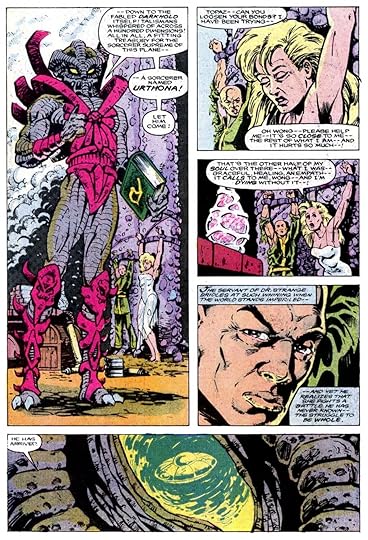
I will say that Strange is an artist’s dream. The style of his costume and the mystic powers really give the artists on the book a great base for fun art. I don’t however like the character designs of the demons in this book very much and Urthona resembles one of the Alien “engineers” (aka the creature they found in the first film which was later expanded upon in Prometheus). It feels more goofy than threatening…especially when fighting a giant cow (Rintrah).
Doctor Strange is a tough character for me. I think he is kind of interesting and almost an anti-hero in that he’s older and big and buff like most of Marvel’s characters. The problem of Dr. Strange lies in his abilities. Magic is always a hard sell for me in that there is no definition and no limits. If Dr. Strange is in a pinch, the writers can just make up some garbled language and say a spell saved him…it is almost like a cliffhanger with no drama.
The Doctor Strange series ended with this volume. Doctor Strange’s story continued with the second volume of Strange Tales (which he shared with Cloak and Dagger). The third series of Doctor Strange continued out of Strange Tales. Most of the storylines set up in this volume continued throughout Strange Tales and the new Doctor Strange series…which leaves this volume also “strange”-ly feeling unfinished.
A well-written and well-illustrated series that is loosely organized around Topaz and her partially displaced soul. Each issue forms a solid, standalone story, while introducing the title character -- a lost art these days.
The series is slightly more mature than most comics that I've read, in that it's also a little mushy. Sara (Stephen's secretary and business manager) has an unrequited crush on Wong. Stephen's past loves and lack of a love life showcase his vulnerability, and indeed his self-centered arrogance is even exploited by a Khat the demon. Stephen is shown as not a whole person, and he knows it.
In a parallel to his former life as a surgeon, Doctor Strange must overcome his own ego as he eventually realizes that life is more than being a with a consumerist sorcerer with a house full of magical stuff. Friends, and love for them, are what truly matters.
While the series does contain some twists -- Stephen's cloak is shredded at one point, and even the Sanctum Sanctorum is swept into another dimension -- the stories follow a pattern I'm starting to see in Doctor Strange comics. Basically, a demon (or some other malign entity) shows up, and Stephen beats it. Even so, these creators manage to tell entertaining, distinct stories within that framework, and even manage to develop Stephen and friends as characters in the process.
This is sort of the archetypal early eighties Marvel comic before the knotty world of crossover events really took root and meant Marvel comics struggled to just be comics again: a constant resetting of events after big crossovers means the individual comics feel like little eddies in a bigger body of water rather than the other way round
This is on the one hand pretty perfunctory stuff: nothing huge happens, just events enough to kick the story from one issue to the next. But it’s entertainingly perfunctory and for all the fact the creators struggle with the cosmic Dr Strange stuff (because few can do Ditko unless they massively lean into the weird like Brendan McCarthy with Fever) they lean a lot more into Strange’s medical career than I was expecting. The biggest problem (aside from Topaz who just feels like a placeholder here) is that the cosmic stuff isn’t really weird and instead feels more like duff SF villains donning the mantle of the weird. There’s a lot very good here but there’s also an incredible amount of page filler
Really great book. A reminder to myself that all was not sweetness and light back in the 70's. This book tells a great story and some of the twists are hard-hitting, even shocking if I'd read it as a child. Even as an adult, I was surprised but that is part of what makes it so good. Dr Strange damages his cape and his travels through dimensions to get it fixed lead him into some seriously weird place. Throw in a young girl missing half of her soul and even the Fantastic Four briefly, you've got a great story. I might also add that there is underlying human drama throughout, as Strange is filled with self-doubt, always unsure if his decisions are the best. It's always what Marvel has done so well, they take powerful characters and give them human flaws. If possible, it makes them real, and the stories and jeopardy is better for it.
This collection is so different from Dr. Strange stories from the past and at the same hold to the spirit of DS's fight against the dark magics and demons that are the enemies of humankind. Roger Stern is listed first on the cover. He only had issue 75 to write. Gillis and Warner wrote most of this collection. Weird stories, art that felt magical and bizarre--both, which worked. It's not the best collection, but it is solid and creative and worth reading.
It's true that the main story is the story of Topaz. And the point seems to be that Dr. Strange is ignoring Topaz. So it's really a series of things that are happening other than the main story.
Still, there's a real commitment to tone that makes this an unusual superhero read.
There are a lot of seemingly dated elements (especially regarding race).
My comic book club pick this volume as assigned reading in the lead up to the new Doctor Strange movie ... but I won't comment on how much this volume is or is not reflected in the movie. Instead I will caution any reader to stick it out past the first story of the collection, which our club members agreed was very average. The subsequent stories in the volume are far more interesting story-wise as well as visually. Thank goodness! The volume went from Meh to Fascinating within pages.
Personally this volume gave me the most interesting déjà vu: I had almost forgotten that at some point I had read #76 with the Medusa-like Iuriale. What I can't quite recall is if I had picked up the issue second-hand from a trash-or-treasure, or if I had read it at someone's house. I vaguely recall choosing the issue because of the presence of a non-damsel female on the cover. The stories after this issue also seemed familiar but I'm not sure if that's due to their resemblance to parts of the first Doctor Strange movie.
Presumably the publication of this volume is brought about by the upcoming release of the film later this year. As I had been wanting to read some of the classic Doctor Strange for some time now, I was quite interested to get a chance as a lot of the earlier collections have proved tricky to get my hands on. Then this one shows up in Kinokuniya in Shinjuku, so I thought it was a great opportunity even if was not illustrated by Ditko and I had heard interesting things about his visualisation.
However, while it is not dreadful, the whole plot, artwork and characterisation is very, very dated. It is certainly interesting to take a peek back at the way things were in comic book writing, but if you already know or even have read probably anything else from that same period whether it be Spiderman or the Fantastic Four, you do not need to bother with this for more research. Doctor Strange is a cool character and I thoroughly enjoyed Doctor Strange, Vol. 1: The Way of the Weird which is a modern telling of tale of the Sorcerer Supreme - but there is really no special reason to pick this up.
Comics have come a long way, in pretty much every sense.
Exactly what a Doctor Strange book should be - eerie corridors too long for the house which contains them, uncanny creatures, other worlds, and at the centre of it all a mage tormented by the steep price of his every intervention. Peter B Gillis, an underrated writer I started investigating after Al Ewing named him as an influence, has a great line in proto-Vertigo purple prose: "And the rainbow rears up and births suns, and the wind finds talons of dark lightning, and the dreams of worlds rise up in fevered ballistics!" Penciller Chris Warner is new to me, but excellent - his faces recall the sort of classic cartoonists Dave Sim homaged in Glamorpuss, especially once Strange is in his monochrome astral form, but he's just as good at psychedelic monstrosities and occult devastation. The only problem is that, to get to these riches, the reader must first deal with one tedious issue which opens the collection, wherein hacks of the era Roger Stern and Sal Buscema remind us just how drab and tangled eighties Marvel could be. It does glancingly introduce one plot element for Gillis' story, but could easily and profitably have been omitted.
This is a particularly earnest attempt at doing Dr. Strange. Gillis has the unenviable position of following Roger Stern on the book. And that means Dr. Strange is questioning himself and exploring new avenues of power as he (and the book) struggle for an identity.
What doesn't necessarily work here is that, in that identity search, its often up against a female protagonist / antagonist. As such, every woman is a villain/ harpy. Maybe this is an early stage of the "women in refrigerators" phenomenon, but the careless character work comes across as incredibly sexist/ dated.
On art, Warner's pencil work is competent, but again, when following greats like Paul Smith and Marshall Rogers, it had to be a stressful job to take on. Overall, this is just mediocre. Nothing too challenging or interesting, seemingly treading the water of a monthly deadline.
This was an ok read. I do really like classic Dr. Strange, this was a little bit more on the tail end of "classic" and closer to modern. One thing I really liked was the almost easter-egg like callback to when the good Doctor killed Dracula and expelled vampires from the marvel universe.