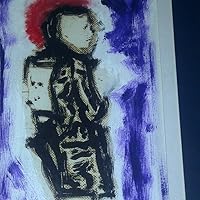
Using the pseudonym Penny Rimbaud, Jeremy John Ratter has long been a thinker, artist, musician and activist within British counterculture. Opening Dial House in Essex in 1967, an 'open house' for visitors interested in alternative living which exists and is a centre of activity to this day, for example for permaculture courses, he then found himself with like-minded individuals who coalesced into the anarchist punk band, Crass, also forming their own Crass Records label and becoming central to the large underground 'anarcho punk' or (as called in the USA 'peace punk') movement that still exists in its more obvious forms here and there, but also was influential way beyond, in terms of plain-speaking political and personal expression, severe criticism of and opposition to the political status quo and dominant patterns of culture, egalitarian, non-commercial and d.i.y. approaches to music making, record labels, distribution and any other resulting 'business', as well as in simply creating a massive network centred on the record label for small d.i.y. punk bands, records, concerts, related artistic projects, information distribution, activism, graffitti campaigns, media manipulation and tricksterism, etc., etc., etc. Since the band's break up in 1984 he has carried on with writing and his own artistic and musical projects, as well as continuing to live in and help maintain the function of Dial House.
I first encountered 'Last of the Hippies' in 1982 when it was issued as part of Crass' Christ the Album. This little book was an influential text for anarcho-punk - feeding the fire of anger, passion and defiance in a fight for true parity and freedom.
Nearly thirty years on sadly most of my anger, passion and defiance has been knocked out of me one way or another but this scripture still has the ability to ignite a flame. As we watch globalisation crank up to destruction mode many of our fears and portents have already been realised, Penny Rimbaud's words remain so pertinent. Its terrifying so little ground has been gained against the power of greed but there's still time - little by little.. it didn't happen in Wally's time and probably won't in mine and Penny's but... Hope...
3.5+ stars. As Rimbaud notes in the introduction, written much later than the majority of the following text, this essay against State power is occasionally naive but still rings as true today as it did in 1982. The thesis of coercive State power being used as a corrective for social ills, in particular those it creates through indifference and greed, is well constructed and forcefully argued. The death of one young man as a byproduct of treatment - being honest, abuse - in a State institution is something with which we are becoming too familiar.
Escrito por Penny Rimbaud, baterista de la gran banda de punk Crass, diría que es casi mi libro favorito. Lo leí y releí incontables veces, e hice a muchas personas leerlo. Uno de los ejes centrales, que es la historia del hermosísimo Wally Hope, es angustiante al punto de hacerme quebrar en llanto sin importar que ya esté completamente familiarizada con ella y con la manera en que Penny la relata. Es un libro muy emocionante, sus páginas destilan ideales, esperanza, y por sobre todo un enorme amor que se antepone a toda adversidad que este mundo y su sistema nos colocan en el camino a la utopía. Lo recomiendo, si puede ser, con el prólogo de Patricia Pietrafesa. Wally Hope no murió <3 (A)
Re-read, 11/2024: Wally Hope’s tale is bleak, but the inspiration drawn from it, by Penny Rimbaud and others, is where the romance, and the hope, arises.
Although a lot of this material has been printed elsewhere, between Shibboleth and Crass album notes, this is an essential document to have all in one piece. A depressing story that inspires hope.
Hopeful and shockingly tender read. I’m no anarchist but I am very sympathetic to my brothers in arms and this was good. The foreword is right, it is naive to think rock and roll was gonna start a revolution.
2.5* Moments of brilliance, truly genuine expression through writing, but as Penny says in the introduction, there's still a naivety, especially when espousing the virtues of pacifism. Having said that, there are large parts of this that are probably more relevant today than when it was first written.
Interesting book about anarchism and pacifism through the lens of Crass founder Penny Rimbaud. It shows how utopia can collide with reality after the pain of losing a friend because of state violence. I agree to some extent with the vision of the author, although I think his philosophy has one major flaw: the assumption that mankind is inherently good.
good apart from the anarchist obsession w/ putting down marxists ... real interesting book i just disagree w/ some of the conclusions, sometimes excessive indivualism and pacifism gets you nowhere
In general I liked this short book quite a lot with a few caveats. The main one being that this falls into the same anarchist pattern of not actually proposing any concrete changes at all. It's so vague. The book describes well the many ills of the world, some that have existed for as long as "civilization" has and some that are more unique for our "modern" society.
The tragic story of Wally Hope exemplifies the oppressive state of the world, although I think (hope?) that things have improved a bit since the 70s, at least in some countries. In any case there are many other ways where the endless consumerist war machine churns on to this day and beyond, which the book describes well. However, I already know most of these things. I can't fault the book for writing about the horrors of our unequal society but I need real proposals for change and not yet another text on how horrible many things are and incredibly vague ideas on how to change things like starting a coop and rejecting money.
These texts never really lead to anything. Some small movements may sprout up, linger for a few years or decades and then fade away. If we want meaningful change in our world we need much larger participation, at least half of any given country's population have to buy in and commit. Are we really expecting a large percentage of the population to quit their jobs, start cooperatives, barter with labor instead of money and make the system collapse?
Maybe in the 19th century it would have been possible. But now in our post-industrial society where we're neck deep in consumerism, weekly (social) media frenzies and lying numb on our sofas devouring endlessly pointless netflix shows? It's hard to imagine.
Having said that the book did move me and it has a lot of good points. It just leaves me wanting more, like every other anarchist text I have read. Maybe that's the point I guess, in which case it did its job.
Radical way of thinking but I think he is right most of the time and I think he really gets what Anarchism stands for, even if i sometimes disagree with him. However, it's a good way not to forget people like Phil Russel (A.k.a. Wally Hope), that were killed because they were trying to make the world better !
Rabiosamente vigente y texto fundacional de la enérgica intersección de la anarquía y el punk, pero del genuino, no ese otro que está apoyado por multinacionales detrás. Punk es energía y consciencia, no solo un 'estilo' abigarrado de música.
Started strong but died off as it went. The story of lost-hero Wally was great and a cautionary tale for how brutal the mental prison can be. Much of the anarcho-pacifist diatribe falls flat though. Slipping into anti-leftwing individualism and general naiveity for systemic change.
Escrito por Penny Rimbaud, baterista de la gran banda de punk Crass, diría que es casi mi libro favorito. Lo leí y releí incontables veces, e hice a muchas personas leerlo. Uno de los ejes centrales, que es la historia del hermosísimo Wally Hope, es angustiante al punto de hacerme quebrar en llanto sin importar que ya esté completamente familiarizada con ella y con la manera en que Penny la relata. Es un libro muy emocionante, sus páginas destilan ideales, esperanza, y por sobre todo un enorme amor que se antepone a toda adversidad que este mundo y su sistema nos colocan en el camino a la utopía. Lo recomiendo, si puede ser, con el prólogo de Patricia Pietrafesa. Wally Hope no murió <3 (A)
originally given away as part of a booklet as part of the crass lp, christ the album this is a book about wally hope who was part of the free festival movement in the uk and his treatment by the authorities,