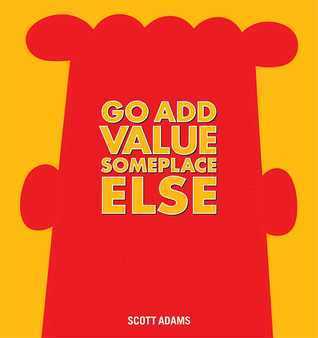
He's the icon of millions of corporate workers, the most popular cubicle dweller on this planet. He spends his days in endless meetings with incompetent supervisors, performing perfunctory tasks mixed with the occasional team-building, brainstorming, or management fad-of-the-day session. He has entertained us for more than two decades: He's Dilbert.
Does Dilbert creator Scott Adams have a hidden camera in your office--or is he just completely in tune with the inept managers, wacky office politics, and nonsensical leadership practices that seem to run wild at your company?
Stop looking for the camera. Dilbert has become a hugely successful strip because Adams feels your pain. How? Because this former employee of a major telecommunications company has been there. He's seen the road to failure firsthand. And he knows that to successfully navigate the ludicrous world of business, you can't expect common sense to prevail, you need to keep a sense of humor, and above all, you must always be ready to blame the other guy.
The strip's enormous popularity stems from the fact that its millions of readers easily identify with the crazy plots and wacky characters found within the corporate environment. Sure, most companies don't have a bespectacled engineer with a tie permanently curled up, a cynical talking dog, and a manager with two pointy tufts of hair. But it's the outrageous things Dilbert characters do and say that leave readers knowingly nodding their heads and, of course, laughing uproariously. The antics of Dilbert's cast are based not only on Adams's own corporate experiences, but on the numerous e-mails he receives each day about the office dramas of his devoted fans.
Scott Adams was a defining voice of the American white-collar experience who transitioned from a prominent cartoonist into a polarizing political commentator. After earning an MBA from UC Berkeley and spending years in management at Pacific Bell, Adams launched the comic strip Dilbert in 1989. The strip’s sharp satire of corporate bureaucracy and the "Dilbert Principle"—the idea that incompetent employees are promoted to management to minimize their damage—resonated globally, eventually appearing in 2,000 newspapers and winning the prestigious Reuben Award. Beyond the funny pages, Adams explored philosophy and persuasion in works like God's Debris and Win Bigly, the latter of which analyzed Donald Trump’s rhetorical strategies during the 2016 election. His career took a dramatic turn during the mid-2010s as he shifted focus to his daily "Real Coffee" livestream, where he combined his background in hypnosis and corporate strategy to comment on the "culture wars." This period of independent commentary culminated in 2023 when he reacted to a poll regarding racial tensions with a series of inflammatory remarks. Labeling Black Americans a "hate group" and advocating for racial segregation, Adams faced immediate and widespread repercussions; hundreds of newspapers dropped his strip, and his publisher canceled his upcoming projects. Undeterred, he moved his work to the subscription-based platform Locals, rebranding his comic as Dilbert Reborn. In his final years, he faced severe health challenges, including stage IV prostate cancer and vocal cord issues, yet he remained a prolific presence on social media. He eventually announced the end of his hand-drawn work due to focal dystonia but continued to direct the strip's vision. Adams’s legacy remains a complex study in the power of branding, the evolution of digital influence, and the volatile intersection of creative genius and political provocation in the modern era.
In our post-Google, post-Jobs, post-Bezos world, I would argue we need Dilbert more than ever.
A few of my favorites from this latest collection:
---I thought you said it went better than expected. ---It did. I go into every human encounter expecting to be framed for a crime I didn't commit.
---I heard you got booted off the management fast track. ---I fell asleep during the small animal snuff film and failed the sociopath module. ---That seems harsh. ---I offered to punch a squirrel but they don't allow extra credit.
---How'd you get the black eye? ---I was pulling up my blanket in bed. My hand slipped and I punched myself in the face. ---Okay. Let's make some billion-dollar technology decisions
---Our A-B tests show that orange buttons get 13% more clicks than green. ---I have now officially lost all faith in human intelligence. ---Stick with the green. It looks better.*
I’ve been a fan of Dilbert for several years now; I have a couple volumes at home and I loved the TV show. While reading “Go Add Value Someplace Else” I felt that the general Dilbert atmosphere was a bit off. Rather than being witty, reflective of real life, and hilarious I found that many of the comics appeared to be quick jabs at the Pointy Haired-Boss (PHB). There was a general cynicism that permeated the book and set-ups appeared more insulting than funny. This also is the most recent Dilbert book I have read with it being published in 2014. There was a section of about 30 pages in the middle of the book that I found to be rather funny, but I would recommend sticking to Adams’ other books.
Part of me wondered if Adams’ relatability has decreased with him not actually having a PHB for many years. And with one of the comics I immediately thought of him writing it about himself:
“[Dogbert says,] ‘I like a lot of things about being rich, but I like the income inequality the best. It makes me happy to know that my net worth is about a thousand times more than yours.’ [Dilbert replies,] ‘It’s actually closer to 800 times my net worth.’ [Dogbert shouts,] ‘You ruined it!!!’“ (p.163)
When I think about the comic in the context of corporation CEOs I think “yeah that is funny,” but then I think about how Adams’ estimated net worth is $50 million USD which is 1000x what most normal people have. It’s good for Adams for achieving the dream life, but it might be time that he takes a step away from representing the proletariat.
This was my first Dilbert collection. I've read the strip a few times, mostly on cubical walls, but never sat down to focus on it. Like the movie Office Space, the comic strip Dilbert perfectly captures the mundanity and inanity of working in a technological office environment.
Not every strip is a home run. In fact, the funny gag rate is far below something like Pearls Before Swine. But the highlights are spectacular.
I don't know if it's because more of it hits close to home than before, or if it's a change in the comic itself, but this volume feels a lot more cynical and biting than before. It's all about power dynamics, with Dilbert and the employees getting the upper hand more often, but all seeming more depressed about it than anything else. There are still laughs to be had, and the occasional insightful moments, but there's a lot more filler of pointy haired boss (or his boss) being horrible and being called on it. I think the funniest thing in the book was the end where it mentions that businesses can get a volume discount on Dilbert books - really, would they want to?
Addressing the content and the quality, this is yet another delightful collection of Dilbert cartoons. Adams keeps returning to the same well and manages to keep coming up with with gold. There aren't a lot of good cartoons that focus so well on the indignities foisted by management on the workplace, Norm Feuti's Retail being another. Dilbert, Wally, Asok, Alice and the Pointy Haired Boss are always good for a few reliable laughs and there are more than enough quips and insults to go around.
As for complaints about the extra cost that go with this being a hardcover, it's really not that expensive compared to the cost of a paperback. Its good quality threaded binding and strong bond paper makes it durable for library purchases and, in time for the holiday season, a solid "secret Santa gift" for the office party that won't look too cheap. No doubt for the truly stingy a paperback version will be released in the new year. :-)
I read all the Dilbert collections & I thought this one was especially good. A lot of the collections have the same strips over and over, but this one didn’t have any that I remember from other books. These books always make me literally LOL.