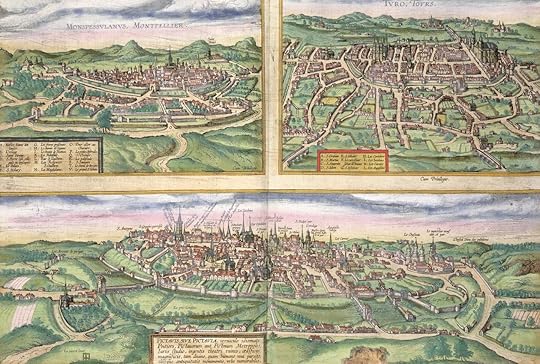
A Francia história a XVI. századi Franciaországban, a hugenották viharos századában játszódó nagyszabású, hatkötetes történelmi regényfolyam. Főhőse, Pierre de Siorac, a szenvedélyes és gáláns lovag, a reneszánsz típusú, okos és nemes lelkű katona-polgár-értelmiségi-arisztokrata figura, aki lépten-nyomon veszedelmes és lebilincselő kalandokba és nem kevésbé érdekfeszítő szerelmi cselszövésekbe keveredik. Mindig ott van, ahol a korabeli történelmet alakítják, ezáltal Merle-nek alkalma nyílhat rá, hogy roppant mesterségbeli tudással életközelbe hozza a francia történelemnek ezt az érdekes és mozgalmas időszakát, fontos személyiségeket - királyokat, hadvezéreket, főpapokat, főurakat, költőket, muzsikusokat és persze szépasszonyokat - elevenítve meg. A Csikóéveinkben hősünk, a hugenotta nemesifjú és balkézről való szépséges öccse, Samson Montpellier-be mennek tanulni. Pierre orvosnak készül, Samson gyógyszerésznek. A délfrancia város színes és veszélyes világában orgyilkosok és világhíres tudósok jönnek-mennek, vad tivornyák és poétikus vagy kísérteties szerelmek dúlnek, orvosnövendékek éjféli temetőkben titkon anatómiát tanulnak, s közben folyik tovább az áldatlan testvérharc, buzgó pápisták és derék kálvinisták gyilkolják egymást.
Born in Tebessa located in ,what was then, the French colony of Algeria. Robert Merle and his family moved to France in 1918. Merle wrote in many styles and won the Prix Goncourt for his novel Week-end à Zuydcoote. He has also written a 13 book series of historical novels, Fortune de France. Recreating 16th and 17th century France through the eyes of a fictitious Protestant doctor turned spy, he went so far as to write it in the period's French making it virtually untranslatable.
His novels Un animal doué de la raison (A Sentient Animal, 1967), a stark Cold War satire inspired by John Lilly's studies of dolphins and the Caribbean Crisis, and Malevil (1972), a post-apocalyptic story, were both translated into English and filmed, the former as Day of the Dolphin. The film The Day of the Dolphin bore very little resemblance to Merle's story.
He died of a heart attack at his home La Malmaison in Grosrouvre near Paris.
This is the second of a thirteen volume series of historical novels titled “Fortunes of France” written by Robert Merle. This book covers the years 1566 to 1567; the other books in the series go from 1547 to 1661. This period of history in France is the time of the French Wars of Religion (1562-98). It was NOT a good time to be alive. However, it provides a setting rich in potential drama for a historical novel.
This book begins with the main character’s narration of his memories as a 15-year old traveling in 1577 with his half-brother and body guard from their home in the Perigord region of southwest France to the southern city of Montpellier to study medicine. This particular time was a period of truce in the war between the Huguenots and the Catholics. But feelings are tense on both sides with extremists on both side maneuvering for advantage.
The book weaves a complicated plot within the city of Montpellier and provides a thorough description of life at that time. The book portrays the tenuous positions of various minorities and social classes in society including Sephardic Jews, atheists, and prostitutes. Public executions are frequent for varied and often for trivial reasons.
This is a long book that seems to go on forever. At one point I wondered if the author had introduced the variety of characters for the sole purpose of exposing the variety and complexity of city life at that time. However, all plot developments did converge and lead to a point where the main character and compatriots are forced to leave Montpellier and flee to Nimes where they hoped to find a more peaceful setting.
Unfortunately, when they arrive in Nimes it is the first day of the Michelade(September 29, 1567) which is the label given by historians to an uprising in Nimes when protesters attacked and massacred Catholic laymen and clergy. The book provides a grim account of the killing spree.
Our novel's main characters consider returning to Montpellier, but within several weeks a similar rebellion occurs in Montpellier. It's obvious at this point that the religious wars are heating up so they decide to return to their home in Perigord. The book ends with them setting out for their return journey.
This is the second volume in the series of thirteen novels La Fortune de France, that cover the second half of the sixteenth century in France, during the period of the Wars of Religion.
In this volume we follow Pierre de Siorac, second son in the Siorac state and who, not being the heir to the domain in Southwestern France, must find his own path in life. He decides to study Medicine and proceeds therefore to Montpellier, where the university was at the time famous for this scientific faculty.
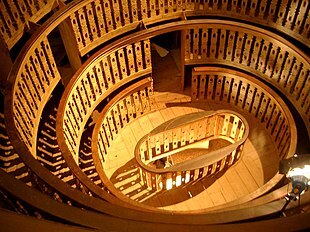
We follow him on his Eastern path, stopping at Montauban, Toulouse, Béziers until he finally arrives in Montpellier, a rather liberal city, where Protestants and Catholics get along until they stop doing so. Pierre, always a courageous lad, does get into trouble and eventually must flee. But before that we get an interesting portrayal of the practice of Medicine during those times, with debates on whether bleeding was a suitable method, the opposition between the Vesalius and Galen, the parallel pharmaceutical practice and the use of the very particular ‘anatomical theatre’ in the university. Reading about this latter I particularly enjoyed since I visited recently the one in Padua:
I enjoyed reading about Étienne de la Boétie, a friend of Montaigne, and of Montaigne himself, given that we have read the Essais by the latter in a group here in GR.
Although Robert Merle was a Catholic, he has made the Sioracs Huguenots, showing generally the Protestant religion under a more positive light than the Catholic, but Merle keeps a convincingly neutral standpoint and makes his protagonist, Pierre de Siorac, very critical of the Huguenots when the latter engage in violence. May be by presenting the “opposition”, in religion and politics, in the forefront, the author is aiming at creating a more critical viewpoint of the tumultuous age.
I will soon proceed with the third volume, Paris, ma bonne ville which as the title indicates, will most probably take me to Paris, following the footsteps of Pierre de Siorac.
Bien aimé mais quelques moments de lassitude, notre Pierre étant particulièrement bouillant-lapin en ses vertes années (et s'il n'y avait que lui) du coup on n'était pas loin du journal de l'obsédé sexuel, entouré de bêtes en rut, hommes et femmes incluses, j'exagère à peine.:) J'ai beaucoup aimé en revanche les chapitres consacrés à la médecine, les considérations, mentalités et croyances de l'époque. Très instructif et à la fois très amusant (et assez effrayant aussi - heureusement que je suis une femme du 21e siècle^^).
Imadnivalo konyv, Pierre es Samson de Siorac immaron Montpellierben tanuljak az orvoslas es patikussag rejtelmeit. A szoknyavadaszat es diakcsinyek mellett tovabbra is ott lappang a vallashaboruk hattere, nem egy kellemetlen kalandban van resze a szereploknek. Rengeteg ismeret, tortenelmi teny, fun fact az elolvasas jutalma, a remek tortenet mellett.
Merle has a particular way to portray the French history which makes the plot flows naturally.
In this volume, the author covers the period of 1563 to 1567, when peace still exists between catholics (papists) and protestants (huguenots).
The brothers Pierre de Siorac and Samson are sent to Montpellier in order to study medicine. In the meantime, a new bloodily civil war erupts which calls what is coming next, St. Bartholomew's Day massacre.
Not quite James Bond in 16th Century France, but that feels like the spirit. Rollicking adventure yarn with numberless wenches and little accountability for the hero's sins. Although no Bond girl ever said this to 007: "What! You did it with a witch? And on a gravestone?"
The second volume of Merle’s Fortunes of France weighs in at a little short of 600 pages. This homage to Dumas focuses on the French wars of religion and its protagonists are Protestant Huguenots. In this novel the reader follows Pierre De Siorac’s journey to Montpellier to study medicine and concludes with a sectarian massacre in Nimes.
The first half of the book focuses rather too much on Pierre’s Rabelaisian amatory adventures, but the plot takes a much darker turn from the half way point following some injudicious grave-robbing and the subsequent consequences. The massacre at Nimes and Pierre’s intercessions set things up nicely for the third volume in which the St Bartholomew’s Day Massacre will feature strongly.
Characterisation, historical context and use of language all combine to make this an absorbing read.
I can’t wait to start the next one! The lack of plot development almost lost me in the middle of the book (after a fairly interesting one third of the book in the beginning) but the last may be again one third of the book was so captivating, now I anticipate with great pleasure to see what happens next in Pierre de Siorac’s life. I particularly like the personal take from Pierre’s perspective on big historical events and the seemingly effortless combination of personal development of the characters and the unfold of major historical events.
Sehr schöner, französischer historischer Abenteuerroman aus der Zeit der Religionskriege in Frankreich, wobei die Abenteuer gleichermaßen amouröser wie kämpferischer Natur sind und ebenso zurückhaltend wie eindeutig in der Darstellung. Viel Witz und Ironie, liebevoll gezeichnete Charaktere, ein Ich-Erzähler, der sich selbst nicht so ernst nimmt und drastische Darstellungen bietet ebenso wie pointierte Dialoge über Gott, die Wissenschaft und die Welt, und die Liebe. Auch dieser 2. Band war toll geschrieben. Das macht Lust auf die weiteren Erlebnisse des Pierre de Siorac und seiner Familie.
I hardly ever give up on a book but I have on this one. I enjoyed the first in the series but this, the second, I found very hard going. Endless verbiage about beauteous women and tedious philosophical, medical and religious disputes of the time. The plot never seems to get going. I have the audio version for the car. Maybe I'll listen to a little more but for now I've had enough.
Der zweite Band der großen Romanfolge über das dramatische Jahrhundert der französischen Religionskriege spielt im Jahr 1566/67. Diesmal begleitet der Leser den jungen Pierre de Siorac und seinen Halbbruder auf ihrer Reise nach Montpellier, wo sie studieren sollen. Aber die wieder aufflackernden Auseinandersetzungen zwischen den Hugenotten und Katholiken haben auch diese Region erreicht und so heißt es bald wieder aufzubrechen. Während der erste Band sehr spannend und kurzweilig geschrieben war, bietet die Fortsetzung doch eher schwülstige Dialoge und an den Haaren herbeigezogene Abenteuer. Da ist ein 15 jähriger Zweitgeborener aus einer kleinen Baronie im weit entfernten Perigord, der schon auf dem Weg in die Universitätsstadt Montpellier unzählige Herzen bricht - vom Schankmädchen bis zur Edelfrau, in Heldenmanier marodierende Räuberbanden besiegt und in den höchsten Kreisen der beiden verfeindeten Lager verkehrt und listenreich sein Überleben sichert. Nachdem in Montpellier der Boden zu heiß wird, fliehen die Brüder nach Nimes, wo aber bereits offener Krieg herrscht und sie abermals nur mit viel Glück davon kommen. Es ist eine geschichtlich hochinteressante Zeit die Robert Merle für sein Hauptwerk gewählt hat, doch leider geht in diesem Teil seine sonst so flüssige, mitreissende Erzählweise etwas verloren und er driftet in teilweise banal schwülstiges und übertrieben edelmütig heroisches Geschwafel ab. Ich gebe aber die Hoffnung nicht auf, das der nächste Band wieder besser wird.
Autant j’avais adoré le premier tome de Fortune de France, autant la première partie de En nos vertes années m’a semblé assez ennuyeuse. La temporalité n’a pas joué en sa faveur : alors que le tome précédent couvrait plusieurs décennies, celui-ci s’attarde sur quelques mois seulement de la vie de Pierre. L’accent est moins mis sur l’enchaînement des événements historiques et davantage sur la vie personnelle du personnage principal. Malheureusement, son intérêt pour la médecine m’a laissé complètement indifférent, à tel point que j’ai cru ne jamais réussir à surmonter les chapitres consacrés à l’école. Heureusement, j’ai persévéré, et j’ai trouvé la seconde partie bien plus rythmée, centrée cette fois sur les guerres de religion. Les dernières péripéties sont incroyables, et à partir de là, il m’a été impossible de lâcher le roman.
This felt completely different to the first book in the series - when reading that initially I struggled with lots of the dry historical detail. This second book however felt like a lighthearted and bawdy romp through the maidservants, brothels and lady folk of 16th century Montpellier with a bit of distressing religious intolerance and conflict thrown in occasionally for good measure. I’m not sure yet if I will persevere with the third in the series - the first book grew on me and I felt that I learnt a lot about an interesting period, so I may just give one more a go and hope that the focus changes as Pierre matures.
Quelques longueurs dans les 500 pages de ce roman historique qui est la suite de "Fortune de France" mais peut parfaitement être lu indépendamment. On y suit quelques années de la vie du très jeune adulte Pierre de Siorac et (beaucoup moins) de son timide frère Sanson. Pierre est très impétueux et très attiré par les femmes. Ces 2 traits de caractère lui vaudront de nombreux moments agréables mais lui attireront aussi pas mal de problèmes. Il est intéressant d'entrevoir ainsi comment on pouvait vivre en France au XVIe siècle !
Le jeune héros, Samson, intelligent, aventureux et d'une gaité exceptionnelle, accompagné de son frère et de leur valet, quittent le Périgord pour Montpellier, pour y faire des études de médecine. L'écriture est belle, le langage est ancien, la fiction se mêle à la réalité de ce XVIème siècle où règnent mort, horreur et affrontements entre catholiques et huguenots.
Historically fascinating, but I found Pierre's sexploits tedious and the general structure somewhat repetitive. Some incredible parts though-the massacre at Nimes is brilliantly described. I will keep reading the series since it is so damn interesting, but I hope it matures.
wxcellent translation from french. love reading about montpellier in the 16th century and the sexually progressive and classily explicit prose is brilliant
Très bon tome 2 où le héros Pierre de Siorac s’en va apprendre la médecine à Montpellier et plonge dans les heures de religions mais aussi dans le lit des « garces ». Vivement le tome 3...
J’ai adoré le livre 2! Tous les événements sont bien racontés on suit la vie de Pierre en sentant toutes ses émotions. Les guerres de religion sont vraiment bien raconté.
In Book 1, The Brethren, Robert Merle has written an intensive historical novel set in France during one of its most turbulent periods. In 16th century France, battle rages between the Huegenots and the Catholics with murderous results from both sides. At the heart of the story are two compelling protagonists - Siorac and Sauvterre who try to hide their Protestant roots from the world as they amass their fortune. They swore an oath to become brothers, hence the title of the first book - The Brethren.
Merle does an excellent job of interweaving accurate historical detail with an interesting plot. This is pure historical fiction - with a strong focus on historical fact! This novel teaches as well as entertains. There are violent scenes throughout, a testament to the times, as well as struggles each character faces.
Book 2 takes the reader a little further into the future. The point of view character is a Huguenot nobleman named Pierre. With his half-brother, Samson struggle to study in Montpellier which is predominantly Catholic. The religious battles and troubles continue in the second volume.
Robert Merle's strength is in his character development. His characters literally leap off the pages because they are so authentic, so complex, so human! And he likes to throw in the odd humorous scene which only serves to endear one to the characters more fully.
The main theme throughout the books is the religious conflict that plagued France during the 16th century. Merle's novels are very strong in historical detail which sometimes overpowers the plot/storyline. For those who love rich historical fiction, this series is definitely for you!
Thank you to the author and publisher. I received a free copy of this book in exchange for an honest review.
This is a well-intentioned book that failed to touch a cord with me. "En nos vertes années" is a the second of a thirteen volume cycle on France's age of religious wars. It is hard not to agree with Merle who shows both sides being guilty of fanaticism, brutality and hypocrisy. The problem is ultimately the smug perspective of the author.
Pierre de Siorac who will be the protagonist for the first six volumes of the series has a Catholic mother of the old noblesse and a Protestant father who has earned his title during the seige of Calais in 1558. Obliged by his father to become a Huguenot, Pierre's greatest desire is for tolerance and an end to conflict between the two religious groups. During "En nos vertes années" Pierre is a medical student at the University of Montpellier where Rabelais also studied medicine. Our hero then becomes a proxy for the joie de vivre, good will and rationalism of Rabelais.
I found it all too comfortable. Today of course everybody has a horror of religious conflict. Similarly everyone admires the charming and brilliant Rabelais. Merle in the series always allows the reader to imagine that he or she like Pierre would be a partisan of reason in an age of murderous intolerance. Who would would want to think otherwise?
"En nos vertes années" is a very well documented work of fiction about a dreadful time in history. Many people will enjoy reading because it encourages the reader to fell justifiable outrage. The book however never asks the reader to pose any questions abut what he or she would have done in the situation.
This is volume 2 of Merle's Fortunes de France famous series. In the first one we read the backstory and early years of the protagonist Jean de Siorac, the younger son a recently minted aristocrat, soldier, farmer and Huguenot in mid-sixteenth century France. In volume 2 Jean is sent to study medicine to the famous university of Montpellier accompanied by his handsome, seemingly autistic halfbrother Samson and his page Miroul. University life at the time is beautifully rendered in all its gory, bawdy glory. Jean is a ladies' man, his loves cover the social spectrum. There is perhaps more sex than necessary but it is never raunchy, sometimes comedic and sometimes poetic. The book includes many references to actual events and characters, with the high point being Jean and his group barely surviving the Michelade, when radical Huguenot took over Nîmes and massacred dozens of priests, monks and lay Catholics. The reality of religious divisions in France's worst era since the fourteenth century, is very vividly rendered as well as the beginnings of the skepticism that will bloom two centuries later in the Enlightenment. The story's alternating lightness and darkness (including tortures, murder, executions, grave robbery and dismemberment) hide very well the author's deep learning and engagement with the ideas of the time. This is a book that touches all registers and is therefore very satisfying. At the end the stage is set for Catholic counterattack against the Protestants in the famous Saint Bartholomew massacres. I am looking forward to reading "Heretic Dawn".
In this second of the Fortunes of France series, Pierre de Siorac is now about 16 and sets off for Montpellier where he is to learn the art of medicine. With him is his half-brother Samson, handsome but disconcertingly moral when set against Pierre’s own youthful spirits. The two young men take on the opposing roles of Jean de Siorac and Jean de Sauveterre in the first book with their blood-brother friendship and their opposing characters.
Alongside the ‘wisdom’ that the young men learn en route to adulthood is lots of ‘blood’: that of both the medical world but also, more importantly, the blood spilled through the religious wars that tore apart sixteenth century France: this book is set about 5-6 years before the infamous St Bartholomew Day Massacre, but Pierre’s narrative is always looking forward to it – and this part of the story offers a Huguenot massacre to offer a neutral view.
Overall, though, this is a fairly light-hearted book which sees our young men, especially Pierre, romp in various women’s beds. When we re-meet Jean at the end it’s almost like seeing an old friend – and the novel offers a temporary closure which makes this fine to read as a standalone book. Like the first book, this is Rabelaisian in tone (and Rabelais gets a name-check via the Montpellier connection), a delightful romp that also has serious things to say about the politics of religion.