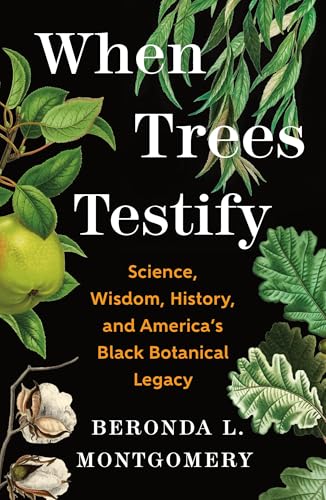
How the Word Is Passed meets Braiding Sweetgrass in a cultural and personal reclamation of Black history and Black botanical mastery, told through the stories of long-lived trees.
The histories of trees in America are also the histories of Black Americans. Pecan trees were domesticated by an enslaved African named Antoine; sycamore trees were both havens and signposts for people trying to escape enslavement; poplar trees are historically associated with lynching; and willow bark has offered the gift of medicine. These trees, and others, testify not only to the complexity of the Black American narrative but also to a heritage of Black botanical expertise that, like Native American traditions, predates the United States entirely.
In When Trees Testify, award-winning plant biologist Beronda L. Montgomery explores the way seven trees—as well as the cotton shrub—are intertwined with Black history and culture. She reveals how knowledge surrounding these trees has shaped America since the very beginning. As Montgomery shows, trees are material witnesses to the lives of enslaved Africans and their descendants.
Combining the wisdom of science and history with stories from her own path to botany, Montgomery talks to majestic trees, and in this unique and compelling narrative, they answer.
"Trees hold the transformed breath of decades of human life... and testify to history and those of their past"
I learned so much American history and botany through this book. The recency of Jim Crow and sharecropping was something that really struck me while reading this book. Montgomery is GenX (she talks about being in high school in 1989) and in the cotton chapter she talks about how her mother was forced to miss school during the spring to go work the cotton fields supporting her family.
Montgomery featured 8 different plants: Pecans, sycamore, willow, poplar, mulberry, oak cotton and apple trees. With each chapter she wove together (1) her own personal history (and sometimes a travelogue) (2) the botany and biochemistry of the plant and (3) the history of the plant specifically with respect to Black Americans.
I found this structure extremely effective. I learned a lot of botany that I didn't know in an accessible and interesting way! I particularly enjoyed learning about how plants are grafted. I didn't know how that worked!
In general I was struck by the number of Black botanists who were enslaved that held so much botanical knowledge.
It reminded me a bit of the book BLACK IN BLUES where Imani Perry talks about the enslaved botanists who made the cultivation of indigo possible.
A few parts of history that will stick with me: (1) Enslaved women chewing cotton roots to prevent pregnancy (2) Blackdom, New Mexico as a Black settlement outside Roswell, NM where Jim Crow was not in effect. In Blackdom, Black Americans grew Apple Trees for their crop. (3) I had no idea that Mulberry trees were cultivated for silk production!
One small note is that there is a brief HP reference in the Willow chapter.
The setting of this book is primarily Little Rock, Arkansas, but the author also travels to many locations including Charleston, South Carolina and Blackdom, New Mexico (outside of Roswell, NM).
I highly recommend this book! Thank you for Holt books for the ARC in exchange for an honest review.
When Trees Testify is Beronda L. Montgomery’s exploration of trees that are a prominent part of Black history in the United States.
Montgomery delves into a mix of personal connections to these selected species of trees, Black history connected to them, and information about the scientific makeup of the trees themselves.
Over the course of the book she introduces us to the pecan, sycamore, willow, poplar, mulberry, oak, and apple trees as well as the cotton shrub. Some of these trees share many similarities, some are very different. Many can be found not just in the southern United States but across the country and in other parts of world. They all have a shared history with those who breathed the oxygen they respirated, something given freely that was one of the only things given to Black people that suffered the indignity of having so much taken away.
Montgomery explores how the trees could bring Black people together and drive them away. How Black people used their knowledge for better farming and harvesting practices that often didn’t benefit them and medicinal and healing practices that did. Stories about the man who grafted pecan trees to commercialize them, how enslaved women would use parts of these trees to prevent pregnancy, the massacre of a Black community in Arkansas, and Blackdom, a community of Black people in New Mexico who grew apples as part of their crops are all fascinating stories.
Throughout the book she provides personal touches, tying in her own memories of gathering pecans and mulberries, holiday fruit bags with apples and oranges, and hiding away under a massive willow tree appropriately named Willow. I have my own memories of an apple tree that I was devastated to see die the first year it bore fruit. A maple tree I grew from a seed that had grown massive by the time we moved away from my childhood home. The blossoms and picking cherries from the cherry tree in our front yard. The oak tree my grandfather put a wooden swing on, and a pine tree near my grandparents’ home my brother and I would hide under, nestled in the fallen needles and enjoying the scent of the tree mixed with the nearby honeysuckle.
Occasionally it does feel like Montgomery strays too far away from the interconnected theme of trees to focus more heavily on Black history or her own personal connection to a tree. The chapter on poplars, I suspect, was particularly difficult to write and features heavily on the tree’s close connection with the many lynchings that have taken place over the years. It doesn’t seem to explore the tree itself to the same detail as other chapters.
In the chapter about apples and the conclusion, Montgomery starts exploring the role of Black people and their relationship with trees in modern times. I think doing this for each type of tree, as a form of looking to the future while exploring the past and present would have added an extra layer of depth that would have made the book even more interesting.
You probably weren’t expecting a book that combines trees and Black history, but this book makes it work, providing a unique approach to learning more about a group of people who haven’t often had their story told.
A complimentary copy of this book was provided by the publisher. All thoughts and opinions are my own.
I was eager to read Beronda Montgomery's second book following her first, "Lessons from Plants", one of my personal favorites. I had high hopes for "When Trees Testify" and was not disappointed! I absolutely savored every chapter and consider it one of my top favorite reads of this year. "Braiding Sweetgrass" by Robin Wall Kimmerer is also one of my all-time favorites and "When Trees Testify" is a fantastic companion read. I love how both Montgomery and Kimmerer recognize that they are often under-represented as women of color in their field, but are inspired by ancestral knowledge and childhood experiences to share why plants and nature can foster both a meaningful and scientific sense of wonder in our lives. I am a big fan of Montgomery's writing style of grounding each tree reflection to a personal experience and historical context for Black Americans, while still including the science background. I personally crave learning about science, but also enjoy drawing deep meaning from it. Unfortunately, Montgomery shares about her lifetime journey of carrying the weight of horrific injustice inflicted upon her ancestors, which the trees are often witness to. She shares important lesser-known history and leaves the reader with a sense of hope that ancestral reverence and knowledge is also the key to self-emancipation and healing. Montgomery's second book has solidified her as one of my favorite authors!
Thank you to NetGalley and Macmillan Publishers for allowing me to read an advanced copy in exchange for an honest review.
I have not read this book, but I’m giving it 5 stars in anticipation of a fantastic read. Trees are the unsung heros of our planet and the stories of those who tend to them are always interesting.
Review: When Trees Testify by Beronda L. Montgomery Publisher: Henry Holt Format: ARC courtesy of the publisher
Montgomery’s When Trees Testify is part memoir, part botanical history, and part cultural reclamation, an elegant and meaningful examination of the way America’s trees carry the untold stories of Black survival, ingenuity, and resistance.
The premise is deceptively simple: explore the ties between eight species of trees (and one shrub) and Black history. But the result is something expansive and resonant. Montgomery treats each tree as a witness, letting its presence in history shape the narrative. The pecan becomes a symbol of both agricultural mastery and economic theft. The poplar, in contrast, is a silent onlooker to horrific violence. The sycamore, willow, cotton shrub, each adds another layer, another thread in this rich tapestry of memory and loss.
What makes this book particularly effective is Montgomery’s ability to blend scientific insight with personal reflection. She brings academic rigor, yes, but also deep vulnerability, folding in childhood stories, ancestral echoes, and generational wisdom. There’s a rhythm to the writing that feels meditative and at times elegiac. Some chapters, like the one on poplars, are emotionally heavy, intentionally so. Others, like the one on apples or mulberries, offer space for sweetness and personal connection.
If the book falters, it’s only in moments where the narrative meanders slightly away from its botanical anchors. A few chapters spend more time on the sociopolitical context than the tree itself, but this seems more a reflection of how entwined human history is with landscape than a structural misstep. Still, there’s a sense that even more future-facing reflection, especially in relation to climate justice and modern Black communities, could have rounded the work more fully.
When Trees Testify is not a fast read, but it is a necessary one. It asks us to listen not just to people, but to the land. To remember that what grows beside us holds memory, too.
If you’re drawn to books like How the Word Is Passed or Braiding Sweetgrass, this belongs on your shelf.
Recommended for: Readers interested in nature writing, Black history, and cultural studies.
Not recommended for: Those expecting a pure botany or science-forward nonfiction read without narrative elements.
Both fascinating and illuminating, this book weaves nature, history and memoir so seamlessly. The chapters are organized by different trees and, each tree is interesting in its own right. So many of these majestic trees witnessed the worst in humanity and guided the enslaved with hope to freedom. But also, each of these trees have a personal meaning to the author as she goes into American History and her family roots through a black lens. I loved this.
I received an arc from the publisher but all opinions are my own.
This is a story of African American slaves who domesticated several variety of wild American trees, such as pecan trees etc. Very interesting and informative. Highly recommend.