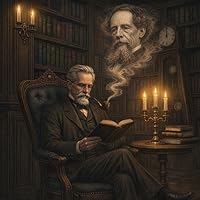
Imagine, if you will …
It is the evening of Christmas Day. You are safely ensconced in your favourite armchair by the fire. The logs crackle, and fronds of fragrant wood smoke fill the air; a feeling of contentment surrounds you. Joyful sounds come from the near distance; the murmur of adult voices, the excited squeals and chatter of children. Meanwhile you doze and dream; replete with special festive fare, your choice of drink at your elbow. The lights are dim, but the Christmas tree sparkles, and happy memories reach out to you. You gaze fondly at the Christmas tree, and once again live those wonderful moments.
The mood is set for A Christmas Tree, by Charles Dickens.
The tradition of bringing a fir tree into our houses at Christmas seems to date from time immemorial, at least in England, but that is not the case. It began comparatively recently—in Queen Victoria’s reign—when Prince Albert, her German consort, introduced the Christmas tree into this country in 1840.
Only a mere ten years later, in 1850, Charles Dickens penned A Christmas Tree. Before then, nobody in England had ever placed a Christmas tree in their home. How surprised they might have been, to know what a solid tradition it would become; at the heart of the Christmas festivities. And now, we are more likely to associate a Christmas tree with Charles Dickens. Along with plum puddings, a sumptuous repast, old-fashioned sweets, family games and theatricals and the exchanging of small gift, these all seem to comprise a typical “Dickensian” Christmas.
It is strange in a way then, that this story is not better known. Certainly there can be few people who do not know the story of “A Christmas Carol”—at least from the many dramatisations, films, and book adaptations, if not from reading the original text. It is a perennial delight, to countless people. And even though Dickens dashed it off in six weeks, he knew it was something special at the time.
“A Christmas Carol” was originally published in the Christmas of 1843, and was an overnight success. So much so, that the public clamoured for a Christmas story from Charles Dickens every year. Each year for five years, he duly wrote a new “Christmas book”: a novella, and included these in the Christmas issue of his weekly magazine, “Household Words”.
But by 1850, after the last one, “The Haunted Man”, Dickens had begun to tire of writing yet another Christmas story. So he abandoned the “Christmas Books”, although, being the canny businessman he was, and with an eye to his audience’s tastes, he continued his tradition of writing an annual story at Christmas. He published these shorter stories in his new magazine “All the Year Round”. The first of these is A Christmas Tree.
A Christmas Tree has a very different feel from any of its predecessors, and barely counts as a “story” at all. It is a series of impressions, or fantastical images. Just as “A Christmas Carol” is not a song, as one might expect, A Christmas Tree is not really about a literal tree. Certainly a tree is central to the piece, but the title is more of a metaphor in the same way as “A Christmas Carol”. A carol tells a story, but this “tree” is more of a concept, or linking device, serving to hold Dickens’s dreams together, as his images grow clear.
We are thrust instantly into his vision:
“It was brilliantly lighted by a multitude of little tapers; and everywhere sparkled and glittered with bright objects”
and into our minds come all our own Christmas trees; all those we have ever experienced through the years. They are all special. Ask any five year old if they remember the Christmas tree, and their face will light up. Nostalgia is not just for the elderly.
Yet nostalgia is what this delightful piece is about. As I read on, with the narrator describing in detail the toys on the Christmas tree, I am thrust in my mind back to my grandmother’s tree. On Dickens’s tree there were little dolls, watches and dolls furniture “as if in preparation for some fairy housekeeping”, little wooden men full of sugarplums, tiny musical instruments, books and paint boxes, weapons and witches, “real fruit, made artificially dazzling with gold leaf” —a veritable cornucopia of toys, as well as what Dickens thought of as dainty objects. Enough of a motley assortment to make a child remark in delight: “There was everything, and more.”
Dickens’s power of description is such that I was enchanted by the early part of this tale. It was not only the vividness of Dickens’s detailed descriptions of the the ornaments, but the veracity of them too. So many of them I recognised with wonder and joy, and was immediately transported in my mind to my own childhood.
My grandmother was born in 1880, just thirty years after this story was written. She had many of these wooden tree ornaments—which were more like toys than any now—and sweets, and even fabric bows and flowers. Reading Dickens’s descriptions was a delight; giving me a powerful surge of nostalgia. My parents’ tree also had some more contemporary ornaments. There was tinsel, and my favourites: bright metallic coloured glass balls and torpedos, with shimmering concave insides. And beautiful multi-coloured fairy lights; electric miracles I am sure Dickens would have appreciated. The first time the the switch was fired, we would all hold our breath. Would the magic work?
And as I look at my own tree now, (yes, I am writing this on Christmas Day), I see that it may be fibre-optic wizardry, but with a few special ornaments. With a jolt, I see golden apples, and miniature musical instruments, much as Dickens would have had. And of, course, the fairy, in her old tattered pale blue dress. She sparkles benignly down on us. I am not sure why she is a “fairy” and not an “angel”, but this is what we always called her, and Dickens too loves his fairies and sprites.
Alone, the narrator’s musings become less pleasant, resulting in frightening images. Perhaps like his predecessor, Ebeneezer Scrooge, he has succumbed to the unfamiliar rich festive fare, and his mind is affected by “an undigested bit of beef, a blot of mustard, a crumb of cheese, a fragment of underdone potato.” Blearily the toys become ghastly grotesques in his mind, and he quavers: “When did that dreadful Mask first look at me?”
Dickens understands the feelings and sensations of a child so intimately. I too had a “toy” of which I was terrified. It was a night light—something designed to make me less fearful of the dark—but this hideous yellow glowing pig with its ghastly grin gave me nightmares. Sobbing, I confessed my fears to my parents, who removed it for evermore. I completely understood Dickens rejecting any reassurance that the mask was made of paper, or to have it locked up so that no one wore it. “The mere recollection of that fixed face, the mere knowledge of its existence anywhere, was sufficient to awake me in the night all perspiration and horror, with, “O I know it’s coming! O the mask!”” Logic has no part in a child’s fears.
My toys were “real” little people to me, as they are to many children. My fairy was a remote but beautiful glittering presence, and a little doll on the Christmas tree, for Dickens: “She was my first love. I felt that if I could have married Little Red Riding–Hood, I should have known perfect bliss.” He immerses himself in the world of story and myth; his fears becoming the fears of fables and stories. Dickens dreams of many worlds, many imaginings familiar to us too; of giants and potentates, images from the Arabian Nights melding with Robinson Crusoe, or those from Biblical tales. All is grist to Dickens’s mill in his imaginative horror:
“My very rocking–horse,—there he is, with his nostrils turned completely inside–out, indicative of Blood!—should have a peg in his neck, by virtue thereof to fly away with me, as the wooden horse did with the Prince of Persia, in the sight of all his father’s Court.”
And in our mind’s eye we see the small child, quivering in a terror of his own making. This is real, as real as the detail we can almost smell and touch:
“Consider Noah and his family, like idiotic tobacco–stoppers; and how the leopard stuck to warm little fingers; and how the tails of the larger animals used gradually to resolve themselves into frayed bits of string!”
And we wryly recognise the the familiar devices to teach the alphabet: “A was an archer…” Of course he was. He was an apple–pie also, and there he is! He was a good many things in his time, was A, and … Y, who was always confined to a Yacht or a Yew Tree; and Z condemned for ever to be a Zebra …”.
We have more fantastical images and impression of tales, of merchants and genies, peasants and ghouls—a hideous and indistinct, “immense array of shapeless things” which as with Scrooge, may be “the result of indigestion, assisted by imagination and over–doctoring—a prodigious nightmare.”
And “I descry remembrances of winter nights incredibly long; of being sent early to bed, as a punishment for some small offence, and waking in two hours, with a sensation of having been asleep two nights; of the laden hopelessness of morning ever dawning; and the oppression of a weight of remorse.”
Oh yes, the cardinal sin of being sent to bed. And in my case, the intermittent call upstairs of “Are you sorry yet?” and my firm stubborn reply “No!” I was not one to be cajoled and bribed into lying by the thought of joining in the throng, tempting though it was. How my parents must have smiled to themselves.
How was Dickens lifted from his sadness? Why, by the theatre!
“And now, I see a wonderful row of little lights rise smoothly out of the ground, before a vast green curtain. Now, a bell rings—a magic bell, which still sounds in my ears unlike all other bells—and music plays, amidst a buzz of voices”
The theatre was to remain his first love, all through his life. To be sure he wrote novels to earn enough to pay the bills for his large family, (and those of his squandering parents), and had his hands in many ventures, but it was his love of the theatre which ran through his veins, and directing and acting always drew him back. Here we see his childhood visions; his; “toy–theatre,—there it is, with its familiar proscenium, and ladies in feathers, in the boxes!” and glimpse all his favourite scenarios, including of course, his fairy amour: “wanting to live for ever in the bright atmosphere I have quitted; of doting on the little Fairy, with the wand like a celestial Barber’s Pole, and pining for a Fairy immortality along with her.”
Gradually Dickens meanders down to the lower levels of the Christmas tree, remembering school days from which:
“We all come home, or ought to come home, for a short holiday—the longer, the better … to take, and give a rest … going a visiting … starting our fancy from our Christmas Tree!”
One section of “A Christmas Carol” describes the third spirit taking Scrooge across the ocean, to view the sailors celebrating. And now, A Christmas Tree mirrors those impressions and thoughts. We fly in our imaginations to a great house—but what a house—full of “grim portraits (some of them with grim legends, too)”. And we have yet another voice for the narrative.
No longer are we the elderly man, nor the young child, but a middle–aged nobleman, in a very old room, hung with tapestry. “We don’t like the portrait of a cavalier in green, over the fireplace”. It is a forbidding country house, with great black beams in the ceiling, and a bedstead, complete with carved black figures, reminiscent of those on tombstones. “But, we are not a superstitious nobleman, and we don’t mind.”
Thus the scene is set for ghostly visitations and visions. The nobleman from history tosses and turns, unable to sleep. He—we—get more and more nervous. A young woman, pale as death, enters and glides across the room, sitting down and wringing her hands. We learn her story, and relate it to our host, who gives us more details of this tragic tale. Our host wants it hushed up; and so it is. “But, it’s all true; and we said so, before we died (we are dead now) to many responsible people.”
From an old man, to a child, to a nobleman to a ghost.
Other ghost stories follow, in which Dickens dispels some of the terror by using absurdly frivolous names, such as: “Charles Macdoodle of Macdoodle”. These echo other ghost stories, which pepper the works of Charles Dickens, or his friend Edgar Allan Poe. “… a certain bad lord, baronet, knight, or gentleman, shot himself, has certain planks in the floor from which the blood WILL NOT be taken out.” A clock, striking thirteen at the midnight hour, when the head of the family is going to die. The sounds of carriages, driving round and round the terrace overnight, presaging death. An agreement between two young fellows, that the first to die would visit the other “from another world”. A beautiful girl, just seventeen years of age (Dickens’s heroines are almost always “just seventeen years of age” as this is the age at which his much-loved sister-in-law, Mary Hogarth, tragically died; an episode from which he never recovered) residing in a picturesque Elizabethan house, who came face to face with herself one twilit evening, and died that very night. A visitation from a cousin, known to be in India, but who had died at the precise time of the vision. The sensible old maiden lady, who “really did see the Orphan Boy”.
Are we still the persona of the ghost, recalling all these gothic tales? We seem to have drawn back a little, thinking of German castles, and sitting up alone to wait for the Spectre. But Dickens reins us in, reminding us of the Christmas tree: “Vast is the crop of such fruit, shining on our Christmas Tree; in blossom, almost at the very top; ripening all down the boughs!” We are mortal once more, nearly back at its base, and ready to reenter the real world.
We look once again back up the tree, and see some blank spaces, representing those we have loved who have died, or visions which can no longer be seen. But fully present, and glad to be alive with all his memories, the narrator hears a “whisper going through the leaves”, a realisation which appeals to all despite their faith. We have a wonderful human ability to remember and conjure up such images, triggered by the Christmas tree.
Dickens’s power of persuasion is at its peak in this piece. If you expect a story you may be disappointed. But there is something here to appeal to everyone, whether it is nostalgia you crave at this time of year, or ghost stories. Dickens weaves them together, using an ingenious range of different voices. Simply wonderful!