Jump to ratings and reviews
Rate this book

Measure for Measure: An Anthology of Poetic Meters

Rate this book
This comprehensive and joyous celebration of metered verse brings together some of the best rhythmic lines in literature.

After a century dominated by free verse, there is a new excitement about rediscovering poetry’s ancient musical and performative roots. Iambic pentameter is the most familiar meter for most readers, but it only scratches the surface of the extraordinary diversity of rhythmic patterns that poets have employed over the ages. That astonishing variety is fully explored in this one-of-a-kind anthology, packed with great poems that beg to be read aloud. Measure for Measure is organized by meter, with brief explanatory headnotes covering accentual meter, trochees, anapests, dactyls, iambs, ballad meter, and more exotic species like amphibrachs, dipodics, hendecasyllabics, sapphics, and more. The entrancing examples of each meter are drawn from a wide range of poetic traditions, from Ovid and Sappho to Shakespeare and Milton, encompassing the Romantics, the Victorians, ballads, folk songs, poets of the Harlem Renaissance, and modern-day poets. Whether performed aloud or enjoyed in silence, Measure for Measure is a treat for the ear, the heart, and the mind.

256 pages, Hardcover

First published March 1, 2015

11 people are currently reading
232 people want to read

About the author

Annie Finch

51 books103 followers
Annie Finch is the author of six books of poetry, including Spells: New and Selected Poems, The Poetry Witch Little Book of Spells, Calendars and Eve (both finalists for the National Poetry Series), and the verse play Among the Goddesses: An Epic Libretto in Seven Dreams (Sarasvati Award, 2012). Her poems have appeared onstage at Carnegie Hall and in The Penguin Book of Twentieth-Century American Poetry. Her other works include poetry translation, poetics, poetry anthologies, and a poetry textbook. She is also the editor of Choice Words: Writers on Abortion (Haymarket Books, 2020). Annie Finch holds a Ph.D from Stanford, served for a decade as Director of the Stonecoast MFA Program in Creative Writing, and has lectured on poetry at Berkeley, Toronto, Harvard, and Oxford. In 2010 she was awarded the Robert Fitzgerald Award for her lifetime contribution to the art and craft of Versification. Finch has collaborated on poetic ritual theater productions with artists in theater, dance, and music and has performed as Poetry Witch on three continents. She teaches poetry and magic at PoetryWitchCommunity.org. 

“My poems harness the magically diverse and deeply rooted craft of poetic rhythms and forms. Like spells, they enjoy being spoken aloud three times." —Annie Finch

Annie on Twitter @poetrywitch
Annie on Instagram @thepoetrywitch

Annie connects with readers and facilitates seasonal rituals and classes in poetry and meter in her online community,
PoetryWitchCommunity.org, open to all who identify as women or gender-nonconforming.

Want more info? Updates, videos, poems, spells, spellsletter signup, and more at anniefinch.net

Blessings to all my beautiful readers!

Ratings & Reviews

What do you think?
Rate this book

Friends & Following

Create a free account to discover what your friends think of this book!

Community Reviews

5 stars
32 (44%)
4 stars
23 (31%)
3 stars
10 (13%)
2 stars
6 (8%)
1 star
1 (1%)
Displaying 1 - 18 of 18 reviews
Profile Image for Ulysse.
411 reviews228 followers
October 2, 2024

I could have taken up yoga
I could have lived in a toga

I could have made my own wine
I could have started to whine

I could have gotten so buff
I could have collected stuff

I could have bought a nice car
I could have smoked a cigar

I could have gotten divorced
I could have married a horse

I could have earned so much cash
I could have grown a moustache

I could have been covered in tats
I could have bought and sold flats

I could have fussed over death
I could have brewed crystal meth

I could have joined a great cause
I could have known all my flaws

I could have all manner of vices
Poetry is my midlife crisis
Profile Image for BJ Lillis.
346 reviews304 followers
February 25, 2024
For years, I've wondered why contemporary poetry and I get along so poorly. I’ve wanted to love it, I’ve enjoyed attending readings now and then—but on the page… My problem, as it turns out, is not the content of contemporary poetry—certainly not the fact of it being contemporary—but the form, or lack thereof. It isn't contemporary poetry that leaves me cold, but free verse. Too often, it feels, to me, like eccentrically type-set prose. Measured against such stalwart residents of my bedside table as the Emilys Dickinson and Brontë, with their lovely lilting ballad meters, or Shakespeare’s hypnotic, infinitely variable blank verse…

The abandonment of meter—it’s as if nearly all musicians simultaneously decided against keeping time. For any one musician, it makes perfect sense—a solo guitarist obsessed with stretching time signatures to the breaking point, an ambient artist exploring fluid sonic landscapes—but for most musicians to do it, for percussion itself to become a rarity—that would be madness! And the turn away from meter in English poetry over the last century has been madness. Free verse can be stunningly beautiful, but it is simultaneously the easiest form (if we can even call it a form, this form that is the absence of form) in which to write bad poetry, and the hardest in which to write great poetry. Each line must justify its length; the entire poem must justify its structure.

So, Measure for Measure. Although the brief poems (and excerpts from insufficiently brief poems) that fill this lovely little volume certainly deserve to be savored, the book itself asks to be raced through headlong, or at very least taken in long chunks. For the real joy of this collection lies not in the poems themselves, but in their arrangement. The book is arranged by meter, and within each meter by chronology—which makes each section into a pocket history of English poetry from its origins to the present. First, the birth of a form. Then, like a flower blooming in stop-motion, the 19th-century blossoms, at once more formal and more psychological, more romantic and more precise, than what came before. Quickly modernity arrives, with its strange juxtapositions and familiar preoccupations. And then, after a mere 15 or 20 minutes of reading, we begin again with a new meter, a new set of potentials to follow across centuries.
Profile Image for Maru Kun.
223 reviews581 followers
March 20, 2018
When I was young, before my education tailored to a seat in a cubicle or (if I was lucky) an office with a window really got going and destroyed all love of art and learning, I used to enjoy reading poetry. What child with any sense of music or language could not like this? Masefield:
QUINQUIREME of Nineveh from distant Ophir,
Rowing home to haven in sunny Palestine,
With a cargo of ivory,
And apes and peacocks,
Sandalwood, cedarwood, and sweet white wine.

Or a when a little older, this? W H Auden and included in the anthology:
As I walked out one evening,
Walking down Bristol Street,
The crowds upon the pavement
Were fields of harvest wheat.

And down by the brimming river
I heard a lover sing
Under an arch of the railway:
‘Love has no ending.

‘I’ll love you, dear, I’ll love you
Till China and Africa meet,
And the river jumps over the mountain
And the salmon sing in the street,

‘I’ll love you till the ocean
Is folded and hung up to dry
And the seven stars go squawking
Like geese about the sky.
Not modernist free-verse I know but to a young child it was like magic. How did anyone get this stuff sounding so good?

But thinking that poetry was what girls did, beguiled by the promises of future happiness through a mastery of double-entry bookkeeping and unaware that song writers (although, to be honest, not poets) could become multi-millionaires I put aside my “Penguin Anthology of Children’s Verse” albeit with a vague feeling for many decades after that there wasn’t enough poetry in my life.

Well in the last few years, thanks mainly to a crisis of capitalism and global economic collapse, I have had the chance to read a few more poetry books or books on poetic meter and re-discover some of the poetry I was missing, including this book which takes a very decent selection of poems and arranges them by meter.

What a radical idea! We have our Anapestics and our Dactylics, our Hendacasyllabics and our Lesser Ionics all together in one place so at last we can really understand why they sound different and what they are getting at.

Like all poetry anthologies “Measure for Measure” contains some poems that leave you glancing downwards to see how soon they will end, but these are relatively few and balanced by new and inspiring discoveries that get you adding the poet to your to-read shelf.

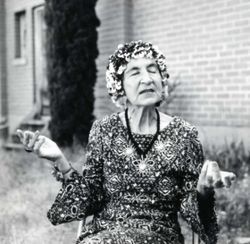
Another pleasure in this regard is looking up the unknown poet on Wikipedia. The wizened spinster-poet you imagined in fact looks like the hippy grandmother you wished you’d had. This is Helen Adam

Helen Adam
And this is from her poem “I Love My Love”, written in a typical ballad meter:

There was a man who married a maid. She laughed as he led her home.
The living fleece of her long bright hair she combed with a golden comb.
He led her home through his barley fields where the saffron poppies grew.
She combed and whispered, “I love my love.” Her voice like a plaintive coo.
Ha, Ha!”
Her voice like a plaintive coo.

He lived alone with his chosen bride at first their life was sweet.
Sweet was the touch of her playful hair binding his hands and feet.
When first she murmured adoring words her words did not appall.
“I love my love with a capital A. To my love I give my All.
Ah, Ha!
To my love I give my All”.


The ballad, as ballads are wont to do, continues with various murders and supernatural events and needless to say does not end happily.

The books also includes a few old favorites - relatively few for this type of anthology - but even these are given new life by being placed where they can be compared against other poems with the same metrical form

For me the real discovery was the Sapphic verse form. For reasons I can only guess at and having roots in music or in human psychology this verse form really does sound distinct. The key, as the book explains, is in the beautiful, captivating last line of a Sapphic stanza – the “adonic” - the sound of which is meant to be hauntingly sad. Amazingly, if done well, it does sound sad.

Here is an excerpt from “Sapphics Against Anger” by Timothy Steele – also an example of how “Measure to Measure” includes many excellent modern works as well as more familiar names:
That fellow, at the slightest provocation,
Slammed phone receivers down, and waved his arms like
A madman. What Attila did to Europe,
What Genghis Khan did

To Asia, that poor dope did to his marriage.
May I, that is, put learning to good purpose,
Mindful that melancholy is a sin, though
Stylish at present.

Better than rage is the post-dinner quiet,
The sink’s warm turbulence, the streaming platters,
The suds rehearsing down the drain in spirals
In the last rinsing.

For what is, after all, the good life save that
Conducted thoughtfully, and what is passion
If not the holiest of powers, sustaining
Only if mastered.

For the very keen, Sapphic form comprises three lines of trochee-trochee-dactyl-trochee-trochee with the last line being Dactyl-trochee.

It is a tribute to the success of this book that it has already got me searching the internet for more Sapphic poetry, although I should say during the course of my search for the Sapphic I came across many un-expected and eye-opening websites that the HR department will soon be asking me about, but that is a story for another day.
Profile Image for Aaron.
25 reviews1 follower
July 15, 2024
This book provides something I've always wanted but never found written before: a brief (very brief, a page and a half at most) description of various poetic meters and then a bunch of examples. Looking at a stress/unstress pattern chart is all well and good for an initial introduction to a poem. But (at least for me, a learn-by-doing minded person), the FEEL of the pattern only becomes clear when you've read a dozen poems in that meter and you internal monologue starts slipping into it.

I, for example, never got hendecasyllables until I read this collection. When you encounter one example among a collection of poetry, it feels like a mistake. Like a misstep in the rhythm, or a lesser poem that the poet couldn't quite get right. But when you've red 5-10 of them in a row, you can sense the stutter step in the middle that the writer is creating intentionally.

If you're already quite adept at reading poetry this is probably all very basic, but if you're a beginner it really drives itself home.
Profile Image for Kem White.
347 reviews1 follower
February 21, 2016
This is another great volume in the Everyman's Library Pocket Poets series. What makes this anthology so good is not the poetry, per se, but its approach to selecting the poems: carefully illustrating poetic meter. Iambs, trochees, dactyls, and other poetic feet and poetic meters are all explained with examples given.

As with most anthologies, there are some poems I really liked and others I disliked. My favorite was probably W. S. Gilbert's "I Am the Very Model of a Modern Major-General," a song lyric, I know, but still great fun to read this dipodic gem. "Mud Soup" by Carolyn Kizer (trochaic), "Effort at Speech" by William Meredith, and "Dusk: July" by Marilyn Hacker (both Sapphics) are all wonderful poems. I had little use for Charles Martin's "Vermeer at the Frick" (Sapphic), Arthur Golding's "Ovid's Metamorphoses" (fourteener) was very hard to understand, and Annie Finch's "Wild Yeasts" (dactylic) turned bread-making into a holy experience, which left me wanting. Most fun were the hendecasyllabic poems, which are poems with 11 syllables per line. It must be a challenge to the poet to compose in this meter. There is a useful index of metrical feet at the end of this book.

Meter is very important in poetry so it is extremely useful to have a poet explain various meters and then present poems in that meter. Highly recommended.
Profile Image for Grady.
737 reviews52 followers
June 8, 2015
This is a short book, but the diversity of the selections, and the clear explanations of how the poems use meter, make it a wonderful introduction (or reintroduction) to meter in English language poetry. I suppose it would likely be a waste for a practicing poet - a glossary or encyclopedia of poetics would serve better as a comprehensive reference - but it has opened the door to a renewed interest in poetry for me. One of the pleasures of the book is that a bunch of the poems are by poets I'd never heard of before, probably including some students of the editor - they are fine, moving selections, and I'd have been unlikely to stumble across them any other way.

It's also interesting to compare Finch's translation of a portion of the Anglo-Saxon poem the Seafarer, the first poem in the book, with Ezra Pound's 1912 translation. Pound makes an almost hypnotic use of alliteration - it's gorgeous - but his chosen words are often obscure and archaic. In Finch's version, the sense comes through much more clearly, while the rhythm is reliable in both.
Profile Image for Robin Helweg-Larsen.
Author 16 books14 followers
November 15, 2018
This anthology clarifies and extols the delights of the variety of metres available to the poet, from the accentual verse of our Anglo-Saxon roots, through the familiar and natural iambs, dactyls and trochees, to the more obscure sapphics and so on based on Greek and Latin forms.

The book is edited by Annie Finch and Alexandra Oliver, two of the most accomplished formal poets of North America writing today. The preface by Annie Finch and the introductions to the various sections include encouraging exercises for developing skills in both reading and writing poetry, and the tone of the anthology is more expository than a mere collection of poems would be.

The selections for each metre are enjoyable in themselves, and by being grouped in that way they drive a fresh awareness and insight into their nature. The only negative for me came towards the very end, where the section on Sapphics and Alcaics confirmed for me that they are not really relevant for English verse.

Overall, an extremely interesting and informative anthology.
3 reviews
December 18, 2025
I like the idea of this anthology but the reality is mixed. Each section is one of the major poetic meters, and within that section the order is chronological, moving from early recorded examples of the meter in English to modern takes on it. I found that when I get to about the 1950s or so I should just skip to the next section, because the poet and poem selection for the most modern era is quite disappointing and frankly a bit cringe-worthy. That's not to say there aren't gems in it, but it's a lot of predictable topics forced into meter in a way that doesn't sound very engaging. There are modern poets who use meter that I like, they're just not really here. It doesn't help that the editor name drops herself by putting MULTIPLE of her own poems in here
13 reviews
Read
November 25, 2021
This is a small anthology of poetry based on the theme of poetic measure which is a concept that I have struggled to fully comprehend since grade school and that I disregarded when I discovered free verse. This small volume has broadened my understanding of the rhythm of poetry
Sections are organized by meter with a brief forward explaining the specific meter and examples of poetry, old and contemporary in that meter.
It is a book that is best read and re-read to appreciate the variety of the rhythms of the English language. It is a book that I will go back to again and again.
Profile Image for Drew.
651 reviews25 followers
November 2, 2019
Enjoyed this for the descriptions of the various meters but the selections mostly didn’t engage me. Perhaps me at this moment rather than the selections themselves. I did perk up and love Poe’s Raven.
Profile Image for Jason Cady.
325 reviews1 follower
January 18, 2026
This is a great anthology. The introductory sections are illuminating, and the selection of poems are mostly great. Although some of the meters are, of course, very common, this collection also includes some obscure meters and forms I had never heard of.
Profile Image for Marda.
460 reviews
December 30, 2025
I learned some new types of meter from this; however, I wasn't a fan of MANY of the poems that were selected as examples. This was rather a disappointment.
Profile Image for Ci.
960 reviews6 followers
August 11, 2016
As an amateur reader of poems, I am interested in the poetic meters only derivatively. Having bought this slim book as a reference in case I need a reference for poetic meters, I have set the most modest ambition to understand the variety of poems collected as meter exemplars.

However, I am delighted to discover poets that I have not read before. Even though my initial enthusiasm for Edward Lear’s “The Owl and The Pussy-Cat” turned cold, this book is beyond just play of sounds and spastic wit in sounds. Here are my notes for future reading (and why):

Derek Walcott, “A Lesson for This Sunday”, a dark anger well-contained with the taut poetic image followed by his prophetic fury:
“Heredity of cruelty everywhere,/And everywhere the frocks of summer torn,/ The long look back to see where choice is born,/ As summer grass sways to the scythe’s design”.

Maura Stanton, “The Ballad of The Magic Glasses”, in which the wear of a pair of eye glasses “Eager to peer and spy/ Beyond the cheerful chatter/ To see each naked lie.” The glasses promised, at the cost of losing one’s cosy self-delusion, “In return, you have knowledge/ Bitter, black, weighty,”.

Marilyn Hacker, “Dusk: July”, a melancholy meditation of love, the aging of body, the changing of memory, and meaning of it all “Seize the days, the days, or the years will seize them,/ leaving just the blink of a burnt-out lightbulb/ With a shard of filament left inside that / ticks when it is shaken.”

Opposite to Hacker’s quiet meditation on love and marriage, we have another person trying do control his anger in domestic frustration. Timothy Steele, “Sapphics Against Anger”, invoked Plato and Dante to dissuade his anger “What Attila did to Europe, /What Genghis Khan did to Asia, that poor dope did to his marriage.”

Yet the height of my discovery of poets is Swinburne, of whom I have heard but yet to read. Look at his glorious, lyrical imagery in this “Hendecasyllabics”

“In the month of the long decline of roses
I, beholding the summer dead before me,
Set my face to the sea and journeyed silent,
Gazing eagerly where above the sea-mark
Flame as fierce as the fervid eyes of lions
Half divided the eyelids of the sunset;
Till I heard as it were a noise of waters
Moving tremulous under feet of angels
Multitudinous, out of all the heavens;
Knew the fluttering wind, the fluttered foliage,
Shaken fitfully, full of sound and shadow;
And saw, trodden upon by noiseless angels,
Long mysterious reaches fed with moonlight, “

Isn’t lyric poetry a lifting-up device so we can see such sea, such light, and imaging the feet of angels?

Profile Image for Jane.
145 reviews3 followers
October 7, 2024
I picked this up one year after university ended as I really miss those times of being a student and exchanging thoughts about literature and poems with my batch mates. Loved this so much and will continue to read each section for pleasure. Also isn't the cover art really beautiful?
Displaying 1 - 18 of 18 reviews

Can't find what you're looking for?

Get help and learn more about the design.