Sleep better, live longer with the groundbreaking information and step-by-step program in this revolutionary book.
Healthful sleep has been empirically proven to be the single most important factor in predicting longevity, more influential than diet, exercise, or heredity. And yet we are a sleep-sick society, ignorant of the facts of sleep--and the price of sleep deprivation. In this groundbreaking book, based on decades of study on the frontiers of sleep science, Dr. William Dement, founder and director of the Stanford University Sleep Research Center, explains what happens when we sleep, when we don't, and how we can reclaim the most powerful--and underrated--health miracle of all.
Taking us on a fascinating tour of our sleeping body and mind, Dr. Dement reveals the price we have paid for ignoring sleep--an epidemic of heart disease, 33 percent of traffic-fatigue-related accidents, and immeasurable mental and psychological disadvantages. And he offers a hands-on prescription for vibrant good health and longevity, including...self-tests to determine how much sleep you really need...the role of prescription and over-the-counter sleeping aids...the latest research on how sleep affects the immune system...how to combat insomnia, snoring, and jet lag...plus information on sleep disorder clinics nationwide, Web sites, and more.
Taking readers on a fascinating tour of our sleeping body and mind,
Dr. William C. Dement reveals the price paid for ignoring sleep--an epidemic of heart disease, traffic-fatigue-related accidents (responsible for a full third of all traffic accidents), and immeasurable mental and psychological disadvantages. Offering a hands-on prescription for vibrant good health and longevity, THE PROMISE OF SLEEP includes self-tests to determine how much sleep you really need, full information on the role of prescription and over-the-counter sleeping aids, the latest research on how sleep affects the immune system, helpful methods for combating insomnia, snoring, and jet lag, plus information on sleep disorder clinics nationwide, sleep disorder Web sites, and more. -->
The simplest and easiest way to live longer is by sleeping more. William Charles Dement is referred to as the father of sleep medicine. He also developed polysomnography which uses blood oxygen levels, breathing rates and patterns, heart rates, leg movements, and snoring apart from brain waves and eye movements to study sleep. This book is considered the bible of sleep medicine. Even though certain new developments happened in sleep medicine after he wrote this book, it is still the best book you can read to clarify your doubts regarding the myths surrounding sleep medicine.
A decent book by a longtime sleep researcher. There was a lot of content about sleep in general, maybe a bit too much, which made me skim some of it and wish I had picked up the abridged version. I had a few takeaways:
* If your eyes ever feel heavy or you seem fatigued while driving, pull over immediately and rest... you're possibly minutes or seconds away from killing yourself from falling asleep. Do not drive if you don't feel quite alert.
* You can "sleep" for seconds at a time, even with your eyes open.
* Your brain doesn't "relax" during sleep, but rather is extremely active in processing the day among many other things. The most important is Rapid Eye Movement (REM) sleep, that typically takes 15 minutes to get to.
* It is extremely obvious to tell if you're sleeping using an EEG monitor (sort of like an EKG for your brain waves) and there are very characteristic stages of sleep (about 4)
* The author chided the practice of "sleep snob"-ery where people brag about how little sleep they get. In his opinion, these people are doing damage to their body and robbing themselves of quality of life, alertness, creativity, and even duration of life.
* You need about 7-9 hours of sleep each night. Being fully rested on less than 7 is quite rare. Most people who say that do really are just piling up sleep debt.
* Each person is carrying around a "sleep debt" that is very real and usually takes awhile to pay down. If you fall asleep easily in less than 10 minutes in a dark, quiet room, you probably have a high sleep debt. You don't want to "pay off" the debt per-se, because that would mean it'd take over 20 minutes to fall asleep. However, it's a good idea to reduce it. It's not uncommon to have well over 25-50 hours of debt in normal people that aren't aware of their debt. The last chapter shows a 3 week plan to assess your debt and pay down the debt.
* Naps are a good thing.
* Our bodies have biological-clock type alerting mechanisms that help us wake up at a certain time. It's sort of like an adrenaline rush. It dies down after a few hours. This is the typical reason why you feel tired after lunch (you're feeling your real sleep debt minus extra alerting you had in the morning).
* Insomnia is very often a byproduct of something else rather than the thing itself.
* "Restless Leg Syndrome" is a very debilitating, but treatable condition where you get a sensation of "creepy-crawly" feelings in your legs.
* If you're constantly tired, even after getting a full night's sleep, you could have sleep apnea that is causing you to go without oxygen for brief intervals and constantly waking you up even though you don't remember it.
* Sleep affects the moving of short-term memories to long-term. This is often the reason why you can't remember actually falling asleep.
If nothing else, the book made me quite aware of the value of sleep and to not at all feel ashamed for striving to get at least 8 hours a night.
To put it mildly, this book will forever change the way I feel about sleep. I cannot recommend it highly enough. You may think that sleep is boring, but it is quite the opposite. If you think you might not want to read this book, all I ask is that you pick it up at your local library and read the introduction. If your not hooked just from the introduction, check your pulse.
Here is my stump speech on this book: "We've all heard that to be healthy one must eat well, exercise, and get a good night's sleep every day. Well most of us have a good idea about good eating, and about eating disorders. We know about exercise, and we know about illnesses associated with not exercising or exercising too much. But what do you know about sleep? What is 'a good night's sleep'? What are some sleep disorders beyond the popular insomnia? How does sleep affect your health and how can you use sleep to optimize your entire life? Read this book and I swear your life WILL improve."
I didn't read every page of this book, but lots of it, and I liked it. The author is seeped in the silly practice of explaining every facet of humanity in Darwinist terms. But putting that aside, it's an enlightening look at sleep: the most universal aspect of humanity!
I decided to just mark this as read because it's the kind of book where you don't necessarily need to read every word to have read it. I also read an older edition because it was cheapest on eBay, but it definitely is sufficient for my needs although I recommend other people read the more up to date edition.
Many (most, if not all) sleep books focus largely on insomnia, which makes sense since it is much more common than other sleep disorders. That's fine. But I have narcolepsy, and it's so rare to find books that talk about it. Most physicians rarely encounter it, and on Tuesday I had an anesthesiologist tell me it was considered a bit scary among doctors. I don't doubt it! It can be at times intensely predictable and at others wildly unpredictable, but it's still my brain and my life so I deserve more than ¯\_(ツ)_/¯. This book has a chapter on narcolepsy (spoil me!) and matter-of-factly addresses the day-to-day difficulties of living with the disorder. For me, tracking is the name of the game. I track my night time sleep, any daytime sleep, and all my narcolepsy-specific symptoms. I have so many apps and biometric trackers and notebooks and medications and alarm clocks, and it's a lot of work but I kind of don't have a choice.
Aside from the chapter on narcolepsy, the last two chapters are the most broadly useful. They go into great detail about tracking your sleep and a plan for improving your sleep. It's definitely not an easy process, but altering our lives to get better sleep is, in many ways, imperative. You sleep badly, you live badly. You sleep better, you start living better.
Stanford’s Dr. William Dement is the world’s foremost authority on sleep and an ardent sleep evangelist. He co-discovered REM and first defined the human sleep cycle. For decades he has directed the Stanford Sleep Laboratory; most of the other prominent sleep researchers in the world are former colleagues or students. He has spent a great deal of time publicizing sleep needs because he considers sleep deprivation the major unrecognized health problem in the U.S. Since this book is aimed at the lay public, it is a mix of scientific data, anecdote and exhortation.
What is Sleep? There are two distinct types of sleep—REM (Rapid Eye Movement) and non-REM. The sleep cycle always includes both types. The average sleep cycle for a 10-year-old goes something like this:
1) wakefulness—beta brainwaves 2) calm wakefulness—alpha waves 3) stage 1 sleep—light sleep, theta waves—lasts about 5 minutes 4) stage 2 sleep—“sleep spindles” and “K complexes”—lasts 5 to 10 minutes 5) stage 3 sleep—short transition to deep sleep, from theta to delta waves 6) stage 4 sleep—deep sleep with delta waves—lasts about 45 minutes 7) back to stage 3 for 10 minutes 8) first REM sleep, with dreaming and a mixture of beta, alpha and theta waves—lasts about 10 minutes.
This overall cycle repeats throughout the night, with REM stages growing longer. The sleep cycle changes with age. Babies sleep up to 16 hours a day, 60-80% in REM. Adults average about 8 hours a day, with only 25% in REM. Old folks average about 7 hours a day, with 15-20% in REM and much less time spent at levels 3 and 4 (in other words, they sleep lighter).
Why Sleep? Why do humans need to sleep at all? Not, as most people think, to restore basic tissues—the heart muscle, for example, never stops beating. Dement thinks we have non-REM sleep for one reason and REM for another. Non-REM sleep allows humans to conserve energy during periods when they weren’t designed to be active—during the night. REM, on the other hand, facilitates brain growth (wiring) in infants and repair (and memory wiring) in adults. It does this with bursts of auto-stimulation that simulate signals from the real world. Dreaming occurs primarily during REM sleep.
Sleep Debt Every time you fail to get the sleep you need, your body builds up an hour-for-hour sleep debt. On average, babies seem to need 16 hours a day, children and teens 10 hours, adults 8 hours, and old folks 7 hours. When you consistently get less sleep than you need, your mental and physical performance suffers and your mood drops. The rule of thumb is, if you feel drowsy any time during the day, you’re carrying a sleep debt. How can you measure your sleep debt? If you go to bed in a comfortable, darkened room and fall asleep within 5 minutes, you probably have a serious sleep debt. If it takes 15 to 20 minutes to fall asleep, you’re probably well rested. A small sleep debt (10 to 20 hours in a healthy young adult) is actually beneficial because it allows you to sleep efficiently—you fall asleep in a reasonable time. A large debt is dangerous—a hazard generally ignored by society at large and by the medical profession in particular. What is a large debt? Dement claims that 50 hours is about the maximum debt anyone can stand. In our hustle-bustle society many carry a large debt.
Some years ago in an anonymous survey, 42 percent of the house staff of a San Francisco hospital, admitted to killing at least one patient by making a fatigue-related mistake.
According to recent estimates a third of all vehicular accidents are caused by sleep deprivation. In a recent study 82 percent of truck drivers said they pull over only when their heads drop or when they experience visual hallucinations—in other words, after they’ve already fallen asleep. Seventy percent of these drivers turned out to have sleep apnea, a serious disorder, 13 percent of the cases severe. Many airline accidents have been caused by pilot fatigue: one study within an airline cockpit showed that pilots and co-pilots were falling into short “microsleeps” even while landing the airplane (lab observations show that drooping eyelids usually indicate microsleep, whereas if your eyes close you’re actually sleeping for awhile—usually without knowing it). Many highly-publicized disasters, including Chernobyl and Exxon Valdez, were caused by fatigue. In the press, the Exxon Valdez oil spill was attributed to the captain’s drinking problem, but the official report concluded that the real cause was poor judgment by the pilot—who had had only 4 hours sleep in the 48 hours before the accident.
Biological Clock According to Dement our normal condition is sleep. The minute we wake, the sleep debt starts building. Then why don’t we sleep all the time? Because we have a sleep-opposing function called clock-dependent alerting (CDA). CDA overrides the drive to sleep. It’s a “two-wave” function: it wakes us in the morning, and it gives us a charge of alertness in the late afternoon (around 5 o’clock). The late afternoon charge tends to be more intense (presumably to compensate for the day’s new sleep debt). Some people are naturally morning people or “larks,” while others are naturally night people or “owls.” As owls age, they often turn into larks. The biological clock can be reset by light, melatonin or vigorous physical activity. Light causes a problem because the human system did not evolve to operate optimally in a post-Edison environment. Much insomnia is triggered when clocks are reset by artificial light—as little as 180 lux. (Incidentally, one of Dement’s protéges developed a special room for NASA that completely resets astronaut clocks in three days—so they won’t be in the least bit “lagged” or disoriented during missions in space.)
Sleep Disorders Dement: “95 to 99% of sleep disorders remain misdiagnosed or untreated.” What disorders? Following are four major ones.
Insomnia. The best-known sleep disorder, insomnia is not a disorder at all—it’s a symptom. It’s primary clock-related causes are hyperarousal (good or bad stress), rapid changes of schedule or time zone, and disturbances in the environment. Insomnia’s main physical (non-clock-related) causes are restless leg syndrome (RLS—legs don’t want to settle down, want to get up and move; 15-20 million Americans suffer from this disease: “Restless leg syndrome has got to be the biggest completely unaddressed health care priority in America.”); gastroesophageal reflux (acid backing up from the stomach into the esophagus); and fibromyalgia (pain in muscles and tendons—10 million sufferers in America). Treatment for insomnia: improve sleep hygiene (regular schedule, avoid caffeine, etc.), apply relaxation techniques, control over-stimulation (for example, set aside a 30-minute “worry time” in the early evening), use cognitive techniques (counting sheep, refusing to go to sleep), and employ sleeping pills—Ambien, for example, works well, is short-acting and non-addictive, and has no side effects.
Apnea (“The Midnight Strangler”). Dement: In a stunning evolutionary failure, nature endowed us with throats that tend to collapse during sleep and stop air flow but did not endow our sleeping brains with the ability to start breathing again calmly. So what happens with apnea sufferers? Over and over again during the night their throats collapse—they stop breathing—the buildup of carbon dioxide sends out a panic signal—they wake up (usually without remembering it) and start breathing with an explosive inhalation—and then start the cycle again. Typically, this cycle repeats 45-100 times an hour. Needless to say, during the daytime the apnea victim is always tired, and thus subject to fatigue-related accidents—their rate of driving accidents is ten times the national average. Not only that, apnea causes high blood pressure, heart disease and stroke: one study indicated that in 1992, apnea caused 38,000 fatal heart attacks and strokes. According to Dement, 40 percent of the U.S. population suffers from apnea, half of the cases clinically significant. The main risk factors: enlarged tonsils or lymph nodes, obesity (fatty tissues in the throat), and naturally small airways. Apnea’s primary symptoms: snoring and daytime fatigue (“Snoring is not normal and should always be cause for concern.”). Other symptoms: frequent nocturnal urination, esophageal reflux, heavy sweating at night, morning headache, raspy throat, loss of hearing, and personality change (irritability, etc.). Treatments for apnea: 1) tracheostomy (cut hole in windpipe), or 2) pump air into mouth at night (mask connected to Continuous Positive Airway Pressure [CPAP:] machine, or 3) have surgery to remove excess tissue at back of throat and move tongue forward, or 4) a more recent technique of shrinking fatty tissue with RF radiation—a painless outpatient procedure.
Narcolepsy. In this sleep disorder, sufferers have “sleep attacks” in which they slip directly from waking into REM sleep—it can happen anywhere and anytime, even in the middle of a sentence. In REM sleep the muscles are partially paralyzed, so during sleep attacks narcoleptics often fall, and are thus in danger of hurting themselves. The disorder usually starts in adolescence. Attacks are often triggered by strong emotions (either positive or negative). Apparently narcolepsy is caused by some defect in the clock-dependent alerting function. There is no cure for it, but it can be effectively treated with stimulants—in particular with the “somnolytic” drug called modafinil (brand name Provigil), which produces no side effects.
REM Behavior Disorder. During REM sleep, muscles are mostly paralyzed for a very good reason: if they weren’t, people would act out their dreams, sometimes with injurious (even homicidal or suicidal) consequences. In REM Behavior Disorder this is exactly what happens: paralysis fails and the dreamer acts out his dreams. Ninety percent of the sufferers are male and the progressive disease usually sets in after age 50. In the elderly it is usually accompanied by a degenerative neurological disorder like Parkinson’s. The dreams of sufferers are often violent or frightening, but ironically the autonomic nervous system (which controls “fight or flight” responses) remains calm and the sufferer often wakes up refreshed. In 9 out of 10 cases, this disorder can be successfully treated with the drug clonazepam. There have been a few headline murders in which REM Behavior Disorder has been used as a defense—in a 1990s TV newscast I saw a case in which a young Mormon father of two with a non-violent past stabbed his wife 47 times and then drowned her while (he claimed) suffering from this sleep disorder; he said that in the dream he was actually attempting to save his wife from an attacker. The jury wasn’t buying: he got life.
Improving Sleep Dement gives a lot of advice on how to make sure you get a good night’s sleep. First you must thoroughly analyze your own sleep habits and needs. For this he recommends keeping a sleep diary (he provides a sample). Define how much sleep you actually get, how much you seem to need, and also when your clock-dependent alerting kicks in and how intense it is. After keeping a diary for a week, he suggests spending a week getting rid of your excessive sleep debt and changing bad habits and bad environment. Get rid of sleep debts? Go to bed earlier and take nap(s). Bad habits? They’re obvious: too much caffeine, too much booze, stimulating yourself with TV or your computer before bedtime, arguing before bedtime, etc. Bad environment? Make sure your bedroom is dark and quiet, that the temperature is right (he says that for most folks 65 degrees F is about right), that your bed and pillow are comfortable, etc. In a third week, he says, start living normally with improvements, moderately indulging in things you feel you cannot do without—like coffee or chocolate. The object is to feel better, not worse.
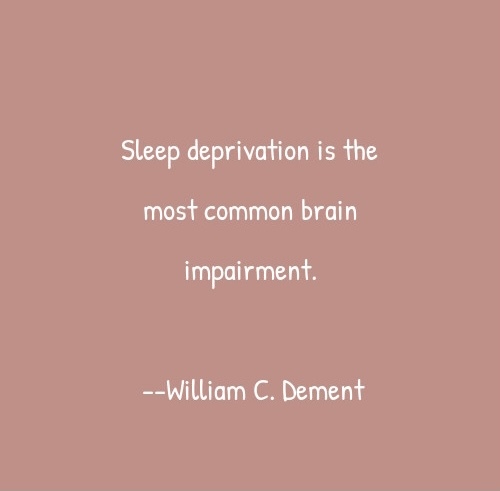
The Importance of Sleep What does good sleep do for us? Obviously it improves our alertness; it also increases our mental and physical performance, lifts our mood, and makes us more lively, more optimistic, and happier. As a bonus, it increases longevity and, by boosting our immune systems, makes us less susceptible to disease. What does sleep debt do against us? Fatigue, accidents, sickness, pessimism, violence, shorter and more brutish lives. And unfortunately: “Sleep deprivation is the most common brain impairment.” And sleep debt adds up fast: for example, if you’re on a hot project and sleep only four hours a night for two weeks, it’s the equivalent of staying up for 3 days and 3 nights straight. Does anyone ever permanently adapt to short sleep? Dement and his colleagues say no. They have investigated many “exceptions” and have not been convinced by any of them. He is especially concerned about teenagers, for this reason: contrary to popular belief, teens need about the same amount of sleep as children—10 hours a night. Furthermore, most teens are natural owls—their afternoon clock-dependent alerting kicks in late in the evening, so they tend to be full of energy at night—for socializing, computer, homework, etc. The problem is that virtually all high schools operate on a lark schedule: teens have to cut sleep, get up and go to school way before they’re ready—and are therefore almost universally sleep-deprived. This accounts not only for many teen accidents and ailments, but (says Dement) may even account for some teen rebelliousness, crankiness, and lack of motivation (with excessive sleep debt, motivation is one of the first things to go). Teenage owls are, we might say, not having a lark. To repeat: Dement considers sleep deprivation the major unrecognized (and underfunded) health problem in the United States. His message: WAKE UP, AMERICA! Which would have been a good title for this book.
"The Promise of Sleep" is the eminent Dr. Dement's magnum opus for the masses. It contains more information than most of us will ever want to know about sleep. It is a long and intricate book, and it reads like a grant proposal. Most of us will read the sections that apply to us, and will use the book as a reference. I didn't read the whole thing and neither did any of you. So if you plan to read the whole thing... you are dreaming. But I find myself returning to this book repeatedly, for various health-related reasons. Here I discuss the people I think will benefit from this book, and why. Then I discuss what I believe to be Dr. Dement's biases, for better or worse. Finally, I discuss some other books which you might consider in addition to, or instead of, this one.
Here are the people who will benefit from this book, and why.
1) PEOPLE WHO WANT TO TURBO-CHARGE THEIR SLEEP. You want to optimize sleep's restorative powers, and to optimize your mental functioning while awake. I believe that you are unlikely to find a better source of practical information than this book, though of course there are free sources available online. The fourth part of the book (about 125 pages) is devoted to "The Principles of Healthy Sleep." This section includes 6 chapters that include self-assessment procedures, ways to set priorities and seek professional advice, strategies for dealing with specific situations (e.g., driving, flying, difficult work schedules), ways to optimize sleep across the lifespan, ways to manage caffeine, alcohol, other drugs, diet, and exercise to improve the quality of sleep, and more. Personally, I found the tips for dealing with jet lag to be very helpful, and non-intuitive in some instances. And I've reduced my "sleep debt" significantly. And... I've used tips to optimize creativity.
2) PEOPLE WHO SUSPECT THAT THEY HAVE A SLEEP DISORDER. You want to diagnose yourself or someone you know. First off, let me assure you that you are right to try to educate yourself in this way. Managed care medicine (which dominates the US) is not exactly geared toward diagnosing and treating sleep disorders, and you are likely to know more about sleep disorders and their consequences than many medical professionals. So go for it. Have the facts ready when you go to battle with clinical professionals who can't or won't do their jobs. I'm not advocating that you diagnose yourself without proper medical assistance. But knowing what to look for, and knowing implications for diagnoses makes plenty of sense. Appendix A lists the menu of sleep disorders. I found this list very helpful relative to sources that I use professionally, as a psychotherapist. Therapists typically use the DSM-IV diagnostic scheme, which is OK but highly limited. Dr. Dement's list is MUCH more comprehensive than the diagnostic schemes that I've seen elsewhere, but his list seems credible because HE is so credible. Additionally, Part 2 of the text (about 100 pages) is titled "When Sleep Fails." This section contains 5 chapters with considerable information about diagnosis and treatment. It contains sections on (among other things) the insomnias and their causes (e.g. mood issues, fibromyalgia), snoring and sleep apnea (a hugely important chapter; obstructive apnea is vastly under-diagnosed but treatable), narcolepsy, sleepwalking and sleep terrors, and chronic fatigue syndrome.
3) PEOPLE WHO HAVE A SLEEP DISORDER, AND WANT TO LEARN MORE. There's plenty in the book about theory, methods, and applications. If you want to become a walking encyclopedia on your (or your loved one's) sleep disorder, this book is an excellent place to start. Moreover, Dement provides websites which provide good information. You'll want to consult these websites to find out about new developments. For instance, CPAP machines for sleep apnea continues to improve, so find out the latest.
4) MEDICAL AND HEALTH PRACTITIONERS. Many clinicians don't know much about sleep disorders, and so this is a good place to start. Diagnostic tools like the DSM-IV are highly limited. (see 2 above). As a mental health practitioner who asks about sleep and who teaches group stress reduction courses, I've found that I'm in a good position to screen for things like sleep apnea. For instance, I'll sometimes have a room full of people doing a "body scan" or "progressive relaxation" and a fair number of people will fall asleep, and begin to snore. When I mention sleep apnea to these people, they usually haven't heard of it. But more than a few of them got the official diagnosis, and are benefiting from treatment. If you refer your clients to a sleep lab / sleep study, Appendix A gives you a language and classification scheme that you'll find very helpful.
5) INSTRUCTORS WHO WANT TO TEACH ABOUT SLEEP. I can imagine this book being used as a textbook for a course on sleep. There's plenty of theory, methods, and clinical interventions discussed in this book.
Here are Dr. Dement's BIASES, as I see them.
1) Dr. Dement has a bias that causes him to emphasize some treatments while dismissing (more or less) other treatments. The reader will want to be aware of these things. I'm not saying Dement is right or wrong, but if your bias differs from his, you should know the following. Dr. Dement tends to favor the judicious use of medicines like sleeping pills in some instances, and he's less enthusiastic about many "alternative" strategies, such as herbs.
2) I've heard some people suggest that sleep treatments (like CPAP machines for sleep abnea), have become something of a racket. The suggestion is that if you go for a sleep study, it is worth it to the practitioners to diagnose you and sell you a CPAP machine. If that's the case, then perhaps Dr. Dement feeds into this conflict of interest, which leads to unnecessary treatments. Personally, I don't buy this. I think Dr. Dement is on to something BIG, and that we'll be better off if we diagnose and treat sleep disorders, with greater frequency.
This book had been out nearly 20 years by the time I read it in July of 2019, but it is even more relevant today than it was when it was published. I found it to be hugely informative and a great foundation for learning more about sleep. I enjoyed it so much that I have decided to acquire a copy for my personal library so that I can refer to it again and again. I highly recommend this book to anyone, really, we all have something to gain from the knowledge within its pages.
In the 1990s, Dr. Dement had run a sleep study sponsored under the auspices of the National Health Institute and was required to issue a report to congress, which he did. After more than five years of waiting for congress to act, he grew impatient, and wrote this book in an effort to to directly communicate with the public about a serious national health problem, sleep deprivation. Keep in mind, that was 20 years ago, before computers with high-speed internet service and smart phones were ubiquitous parts of modern life, not to mention the increasing commute times of suburban workers. Imagine how much worse the problem is now!!!
The author, who is considered the father of American sleep medicine, takes us through the history of sleep study, and effectively uses anecdotes from his career spanning more than 4 decades to highlight the importance of making sleep a priority in our lives and the serious impacts sleep problems have on our health and on our lives.
I️ found this book really helpful. The author is passionate about sleep and after 50 years of research has a lot to share. I️ found understanding sleep debt to be very insightful. I️’m learning to treat sleep as something that gives focus and clarity to life rather than as something I️ feel the need to fight against.
I'm gonna have to thoroughly reread this when I don't have a paper due.
//////////
"Like most teenage girls, she wants to keep weight off for cosmetic reasons." (pg. 25)
I'm sorry??? Like I get that this was published in 1999 (not so long ago) and the author was born in 1928. But I'm kind of annoyed? Am I being unreasonable? I know a lot of teenage girls (and guys for that matter-) struggle with body image etc, but that seems a little over the top, or insensitive, or something. I think?
i mean, the book isn't about the girl who wants to keep weight off for cosmetic reasons, so I'll ignore it, but It BoThErS mE.
I am forever grateful to Dr. Dement for awakening a passion in me for sleep medicine. Because of his powerful masterpiece, I'm seriously considering becoming a sleep specialist.
The subject is presented with just enough anecdotes from Dr. Dement's life to keep you entertained and still pressing through all the scientific explanations (it has nearly 500 pages, so sometimes you wonder if you'll ever finish). The author has a humorous, engaging writing style. I read one chapter one night while I had insomnia, and then after finishing his description of night terrors, I had trouble sleeping for a couple nights afterward. But overall I think the information I gleaned from this book is helping me be a more self-aware, healthy individual--and it could probably help anyone else in the same way.
Interesting account of the results of sleep research by one of the founders of this discipline, with personal anecdotes and guidelines for discovering your own sleep debt and developing healthy sleep patterns. The reason for rating this as 4 stars is the age of the book, so that the contents are not current. But it is still valid including the repeated warning never to drive drowsy.
Published in 1999 it still serves as a foundation in the study of sleep and sleep disorders. In particular, Dr. Dement's definition of sleep latency and sleep debt has become universal within the clinical world and I routinely talk about those two concepts with my students.
A book that changed the way I think about sleep. I have been diagnosed with Sleep Apnea and have a difficult time with excessive sleepiness the day after I sleep. This book has given me hope and a goal to fix this situation.
Highly outdated, wish there was an updated version of this book! Otherwise, it is an excellent read, you truly get to know the basics of sleep science in an enjoyable way.
Although not always well written, the information in this book may well change your life. Dr. William Dement was one of the seminal figures in sleep research in the United States. The Promise of Sleep represents his attempt to convey what he's learned about sleep in his 50+ years of study.
The first section of the book deals with some fundamental concepts of sleep, including the biological clock and sleep debt. The second section of the book deals with sleep dysfunctions such as insomnia, restless leg syndrome, and sleep apnea. The third section tries to explain what sleep actually does for the human animal (a subject still only vaguely understood) and the fourth and final section takes on the topic of "sleep hygiene" - those things that any of us can do to improve the quality and amount of our sleep.
I found the scientific information in this book invaluable. Dr. Dement's warnings about a chronically sleep-deprived culture should give anyone in the industrialized world some cause to pause and reevaluate. If we're all walking around with a huge amount of sleep debt, as his research seems to show, what is the cost to us in productivity, health, safety, or even civility? I confess that I didn't go through the recommended three week "sleep camp" he recommends in the final section, but based on his dire warnings I have changed a few of my habits and am using my Fitbit to monitor my sleep quality. The changes in my sleep habits over the last month or two thus far have been small, but the effects are noticeable.
I only wish that the book had been a little more well written. Dr. Dement falls into the trap of going on long tangents that involve personal anecdotes he finds amusing, or aspects of the sleep research he finds particularly interesting, or just ranting about things he thinks need to change (e.g. pilots on long-haul flights who are falling asleep in the air). If I were having lunch with the man, these digressions might not be so bad. But in a written volume of popular science, they feel like distractions, and Dr. Dement himself comes across as a cranky old man.
I also think the book could have been about 100 pages shorter, as some information across sections is redundant.
Still, this book should serve as a wake up call to all of us. The concepts of sleep debt, micro-sleeps, undiagnosed sleep ailments, and even sleep hygiene, are relevant to all of us at some level. We would do well to heed Dr. Dement's advice.
Scratch what I just said. This book is not a wake up call. It's a loud exhortation to go to bed . . . right now!
To start - if it is 22:00+ (10PM+) when you are reading this - go to sleep and read the rest in the morning. Its most likely due time already! On top of that, you are most likely sleep deprived...
I'm a biased reader, as after having read Matthew Walkers "Why we sleep" this is "kind of OK", but not more. Did get a few more hints to my sleep related notes, that I will trial, but thats about it.
If you are choosing between these 2 - go for the longer one. If you are short on time, this will be better than nothing, as sleep "secrets" (why, when and how much should one) are still really not well known to general population.
Tot nu toe mijn eerste boek over het belang van slaap maar een boek met veel impact op mijn leven en slaapgedrag. Het lezen heeft mij het belang van goede slaap kenbaar gemaakt en heeft geholpen met het ontwikkelen van een beter redenerend vermogen over de effecten van acties overdag op mijn slaap en andersom van slaap op mijn fysieke en mentale gesteldheid. Een aantal maanden na het lezen van de laatste bladzijde (het moment waarop ik deze review schrijf) merk ik nog steeds vaak de voordelen van het gelezen hebben van dit boek. Het enige kritiekpuntje wat ik zou kunnen geven is dat er nieuwe boeken zijn met recentere onderzoeken. Toch zou ik ook hedendaags mensen nog dit boek aanraden.
Sleep is the most vital overlooked aspect of pur lives that contributes to preventable death and major health issues. Recognizing sleep debt and undiagnosed sleep disorders (and working towards correcting them) could go a long way to extending life span and leading to a more fulfilling, filly alert and energizing life. This book by a lifelong sleep researcher and physician (though 21 years old at this point) contains the foundations for understanding and remedying it.
In this 500+ page tome on the misunderstood world of sleep, William C. Dement assures me that I now know more about sleep than most of the people in the world. He might be right. I do know that my life will be better because of this book. The Promise of Sleep should be required reading for everyone.
I was really looking forward to this book. However, it was disappointing. It was too scientific, and I was looking for advice or answers on how to achieve better sleep routines.
Its author spends too much time on the history of the science of sleep depravation, and it was not until the final two chapters that one was able to find an indication on how to achieve better sleep.
I learned a lot about the sometimes life-and-death importance of sleep. At some time in the future I will probably annoy you by talking excitedly about sleep, or by having to bail early to go to bed. But this book is overly long and fairly repetitive. The actionable "sleep camp" is tucked away in the last chapter, taking 435 pages (!) to reach. I'm sleepy just thinking about it. Nap time.
Very informative book and after reading it I think differently about the importance of sleep, and not just for myself, but for my family. The book feels like it drags on a bit and becomes repetitive, hence 4 starts.
A detailed history of sleep science intertwined with stories from personal professional career of the author. The book is great for those interested in a general overview of sleep science and topics that are being studied in this field.
The author marvels about how something that is so important, sleep, could be so overlooked by the medical community and by the public. By the time you have read this book you will be amazed by how little you knew about something so important as your sleep.