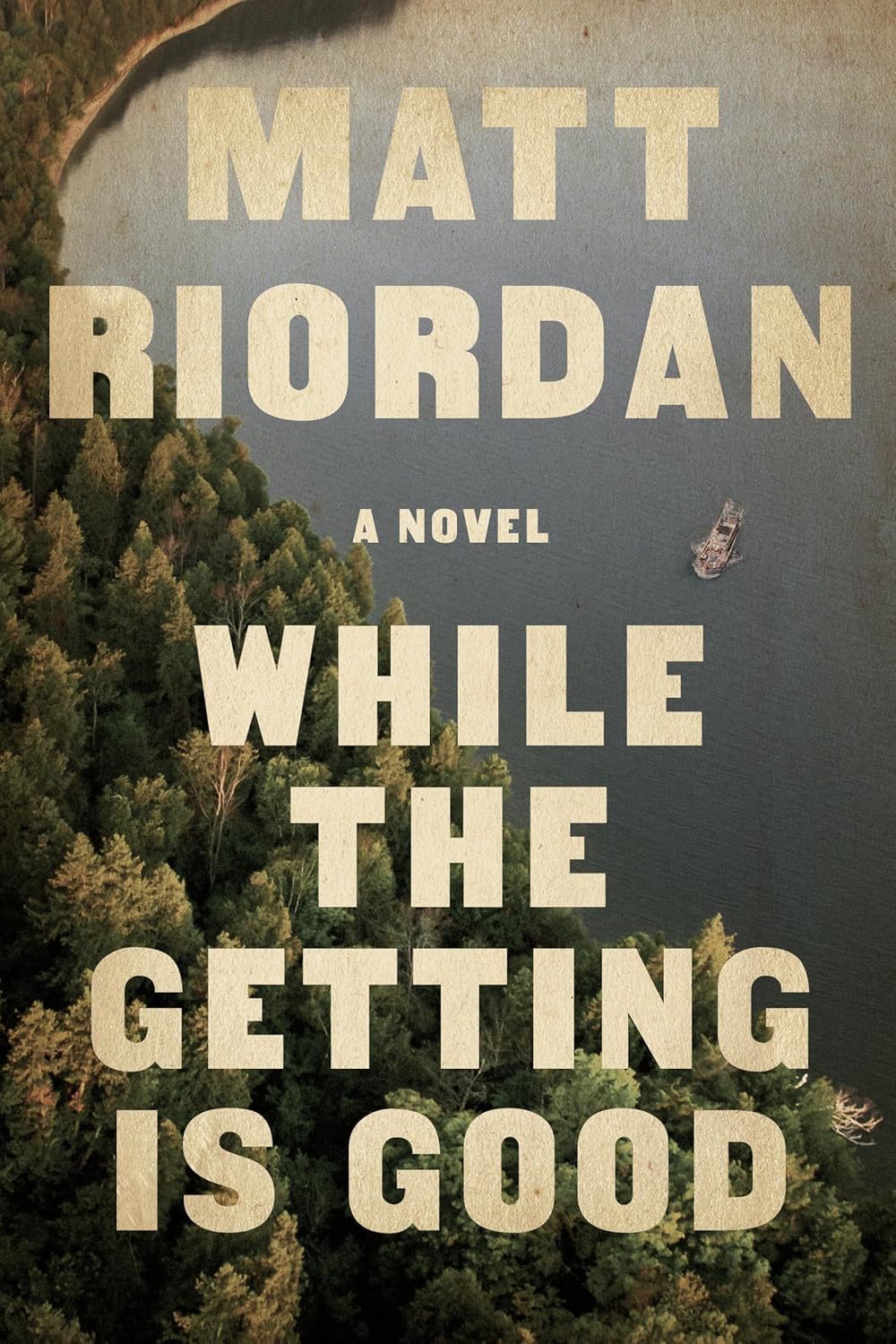
Amid the gangland wars of Prohibition, one fisherman’s long-shot play to secure his family’s future brings disaster to everyone he loves.
Based partly on family lore, Matt Riordan’s follow-up to The North Line is for readers of Jeannette Wall’s Hang the Moon and S.A. Cosby’s All the Sinners Bleed.
Eld should’ve known better. Hell, he did know better. But watching lesser men hit big paydays—men who didn’t fight in Europe—grew unbearable. So, when the opportunity arises, he reaches for a little something extra for his family, and even more for himself. With Prohibition expiring in a matter of months, his turn from fisherman to rumrunner was supposed to be temporary. It seemed the perfect plan. Even Maggie, Eld’s normally sensible wife, is on board.
Things don’t go to plan. Amid the region’s players battle to capture the biggest piece of a shrinking pie, Eld’s tiny family operation is caught in the crossfire. One bitterly cold night packing whiskey across Lake Huron costs Eld dearly, and his family even more.
Hunted by gangsters and squeezed by the Depression, Eld, Maggie, and the children are Eld to Canada on a doomed quest, Maggie and her daughter forced into finding sanctuary in a faith more cult than religion. When they finally reunite, they may not even recognize each other as the same people who crossed their fingers and threw the dice for a shot at a better life.
I love the title! The idiom suggests that there’s a window of opportunity that won’t last forever and readers set off on a mission to discover the nature of this time-sensitive chance.
I knew going in that I needed to expect a risk, and Riordan delivered. I read about a man who pivoted from fisherman to rumrunner to secure his family’s future. The imminent expiration of prohibition, the idea of the risk being temporary, and the dream of a big payout had the main character take a chance on time and opportunity. We all know that the important thing about a risk is knowing when to get out - ideally before ‘the getting is good’ turns bad. This is where Riordan’s storytelling shines. It isn’t pulse-pounding tension. That’s not needed. Readers already know what’s at stake. What Riordan does well is bridge the gap and show us ‘why’. Readers have all had the experience of something sounding too good to be true; Riordan keeps us reading to find out if this is one of those times.
Riordan’s character had an understandable motive and relatable flaws, encouraging me to follow his quest to see if the payout was worth it. If you enjoy Riordan’s style, you’ll want to read this one, too. There’s a great balance between historical fiction and suspense.
I was gifted this copy by Hyperion Avenue and NetGalley and was under no obligation to provide a review.
Very slow start but couldn’t wait for the next page or the next. The very last sentence was quite the drop off and I want a bit more but I understand there can’t be anymore.
This one was a hard one to get through. It switched following characters a lot and usually not when it made sense to switch. I wish the author would have focused on following one character instead of 3 that skipped around. Did not really make sense the way it was written and ended with no conclusion. 🫣
I’m honestly not sure what I just read. The writing was simple, but compelling enough that I kept turning the pages. Still, by the end, I was left wondering what the book was really about.
It starts off strong — a promising setup with mobsters, Prohibition, and Canadian whiskey running. I was fully on board for that story and hoped it would continue down that path. But then the narrative starts to shift… and keeps shifting. What began as a gritty historical drama slowly turns into something else entirely — a commentary on cults and anti-religion. The transition didn’t feel natural. It was like the book couldn’t decide what it wanted to be.
The structure also felt uneven. We begin by following Eld, then suddenly we’re with his wife Maggie, and eventually their daughter Bea. Eld’s storyline disappears for a huge portion of the book and only reappears briefly toward the end — before the focus shifts again, and Maggie and Bea abruptly close out the story.
It felt like three different books loosely strung together — and I never felt like any of them fully landed. I was left with a lot of questions, mostly about what the point of it all was. I wish the story had stayed rooted in the world it introduced at the beginning. That’s the book I wanted to read.
I received a complimentary copy of this audiobook. Opinions expressed in this review are completely my own. Thank you to Hyperion Avenue and NetGalley for the ARC.
Thank you to Hyperion and Net Galley for the ARC of this book.
In an incredibly odd twist for me, this book started out pretty good and then just fell apart. I just finished it and honestly am wondering, as this was the advanced reader copy, whether this book was actually finished. I honestly looked at how many pages I had and was shocked to see I was 6 pages from the end. How could it possibly wrap up in 6 pages? It couldn’t, that I found out.
The book is divided into three parts. The first part was decent, but slightly predictable. The second part was a little confusing at first - it jumps ahead with little explanation. And the third part is just a whirlwind of plot twists and no resolution at all. Maybe it’s supposed to set up a second book? But there is no indication of that. It just…ends.
I wish there had been more development of the time/setting as reading a book set during prohibition but NOT set in Chicago or New York was really intriguing to me. I would have liked to see the rural Michigan setting used more.
Overall, strong sections but overall just not a win for me.
This book digs into some tough subjects like morality, corruption and complex relationships. Sometimes people don’t think fully about their morally ambiguous choices until it’s too late.
Eld was tired of fishing and living paycheck to paycheck, so he made a choice to go into business with folks who he knew darn well were doing the wrong thing. But he’d only do it long enough to pay off his house and put a little aside. He even managed to get his wife on board. But things quickly escalated and he was in too deep.
This book has many characters, it can be hard to keep track, but it was a solid 4-star book that I thoroughly enjoyed.
This debut novel aims for emotional depth, but ultimately stumbles under the weight of its own introspection the narrative, while lyrical at times often feels slow and meandering with characters that remain frustratingly under developed the plot, lacks momentum, leaving readers with a sense of detachment
Well I tell ya what this book done whooped me sideways an back again I aint read nothin this gripin since I done found a soggy Louis lamour in the bait shed one summer when my cousin Dave got his truck stuck in the catfish pond
While the Gettin is Good by Matt Riordan is one hell of a ride yall it aint no sweet little Sunday church read it’s more like a shotgun blast in the dark with moonshine breath and a whole lotta bad luck
This feller Eld he aint no fool but Lord knows he made a fool move tryin to jump into the rumrunner game with Prohibishun fixin to end he just wanted to feed his youngins and maybe feel like a big man for once cause he done served in that Europe war and come back to nothin but broke dreams and fish guts
It starts out all right I mean Maggie his missus even say alright Eld lets go for it and that woman is smarter than any book I ever cracked but it all goes to hell fast like a raccoon in a corncrib they got gangsters up north in them coats with the shiny guns and everyones stabbin each other in the back tryin to make a dollar and Eld he done got caught right in the mess
Aint just whiskey and bad deals neither this book got heart yall it got that sad feelin when you look at your youngins sleepin and wonder if you done failed em it got them cold nights on the lake where even your bones wanna give up it got Maggie tryin to hold her babies together with nothin but spit and grit and faith in a church that aint quite right if you ask me
By the end of it I was sittin there starin at the wall wonderin if I still had my own soul left cause them folks went thru it I tell ya Eld and Maggie and the whole crew they aint come out clean but they come out real
So if you like books with guts and hurt and a good man makin bad choices for the right reasons get your hands on this one dont matter if you cant read good you’ll feel it in your bones
5/5 Stars — A Gritty, Heartbreaking Tale of Ambition and Consequences
While the Getting is Good is a masterfully written story that explores the high cost of ambition, especially when it’s fueled by desperation. Set against the backdrop of Prohibition-era gangland wars, this novel follows Eld, a fisherman who, lured by the chance of a better life, steps into the dangerous world of rumrunning. What starts as a fleeting decision for a temporary gain spirals into a nightmare that affects not just him, but his entire family.
Matt Riordan’s writing is rich with atmosphere, pulling you into the cold, unforgiving world of Lake Huron, the tension of gang wars, and the harsh realities of the Depression. The characters are complex and deeply human, especially Eld, whose internal struggles and failures resonate long after the book ends. Maggie, his wife, is a quietly fierce character who navigates unimaginable challenges with strength and grace, even as the world crumbles around her.
The story itself is a heartbreaking journey of loss, survival, and the consequences of seeking a life beyond one’s means. Riordan’s pacing keeps the tension tight, while his emotional depth makes you care about each character's fate. The ending is devastating but profoundly real, showing how the pursuit of a better life can sometimes tear us apart.
Fans of historical fiction with a sharp focus on character and consequences will find While the Getting Is Good is a compelling, unforgettable read. #WhileTheGettingIsGood #NetGalley
I received an advance reading copy (arc) of this book from NetGalley.com in exchange for a fair review. As a Michigander, I am always interested in books that take place in the Great Lakes State. This one in particular caught my eye because it was set during Prohibition when rum-running from Canada was especially profitable and involved some pretty tough gangsters. This book, however, fell short. The story of Eld, a World War I veteran, is a fisherman who lives in a rural area. He gets involved with rum-runners, smuggling illegal hootch from Canada to the U.S. His son, Doc, is caught up in the violence, and Eld goes off to look for him, leaving his wife and daughter behind. The story then picks up with Eld's wife, Maggie. The writing is choppy, the story is scattered, and there is no end. Literally, no end. It just stops as if the author got tired of writing it. The characters were not likeable, and I was very disappointed as I was hoping for a good tale of gangsters during the days of Prohibition.
Matt Riordan's "While the Getting Is Good" plunges readers into the economic and moral cauldron of the Great Depression, when whiskey smuggling across Lake Huron offered both risk and reprieve for those cornered by poverty. The novel follows Eld Mackey, a war-scarred fisherman, and his wife Maggie, whose "mania for commerce" drives their family's transformation from precarious honesty into the volatile underworld of Prohibition. Riordan's rendering of the 1930s is strikingly immersive—readers smell the "earthy kind of rot" of herring boats, hear Fred Allen's voice crackle from a Philco radio, and feel the desperation of "five hungry souls out there looking for every open job." This sensory density transforms economic desperation from abstract historical fact into the sharp pressure driving Eld toward crime.
At the heart of the novel lies the corrosion of morality under the pressure of survival. Riordan returns often to this theme through terse, unsentimental prose. Eld reflects on himself as "an instrument of fate, his visit random and lethal, like a tuberculosis bacterium, a German artillery shell, or a button man hired by Detroit rumrunners." Maggie, more pragmatic, embodies the novel's title when she declares, "The getting is good. Time to get mine." These moments distill Riordan's central argument: opportunities are fleeting, and survival requires compromise, even if it involves corruption. The book's refusal to romanticize either its gangsters or its working-class strivers is one of its sharpest strengths.
Yet the novel stumbles with several plot conveniences. Eld's entry into organized crime feels too smooth for a story otherwise anchored in harsh economic realities. Certain developments strain credibility in a narrative that elsewhere observes human behavior with such care and precision. Secondary figures, such as the hypocritical preacher Dan Honeycutt, veer toward caricature, their transparent motivations at odds with the psychological complexity Riordan achieves with his protagonists.
The characters, especially Maggie, grow into people whose contradictions feel earned rather than imposed. Her progression from resourceful wife to state official entangled in bribery is rendered with clarity and empathy. Secondary figures such as Georgia, a worldly nurse turned gangster's sister, offer both contrast and camaraderie, grounding the story in bonds of loyalty forged in hardship. The result is a narrative that, while steeped in its historical moment, resonates with contemporary questions of power, survival, and ethical relativism.
Maggie's growing prominence reveals Riordan's more ambitious plans. While Eld's repeated insistence that nothing he ever did would matter captures the nihilism of shell-shocked veterans, Maggie's fierce pragmatism drives much of the story's energy. Her willingness to manipulate corrupt officials and exploit bureaucratic weaknesses demonstrates how the era's pressures could forge unexpected forms of female agency.
Still, Riordan's achievement lies in crafting a world where history and character are inextricably linked, each driving the other into corners where survival ultimately supersedes morality. The result is a narrative that is not uplifting but unflinching, asking what compromises people are willing to make when getting while the getting is good becomes the only protection they can offer those they love.
This review is of an advance reader's edition provided by Edelweiss and Hyperion Avenue.
Matt Riordan’s While the Getting Is Good is a tense, atmospheric portrait of desperation, ambition, and survival set against the backdrop of Prohibition’s final days and the depths of the Great Depression.
The novel begins with Eldridge Mackay, a fisherman on Lake Huron who is struggling to provide for his wife, Maggie, and their children. When rumrunners offer him the chance to smuggle whiskey from Canada, Eld convinces himself it’s just a temporary gamble—one last shot at a better future before Prohibition ends. What follows is a steady unraveling, as Eld and his family are pulled deeper into a world of gangsters, betrayal, and devastating consequences.
What makes this book stand out is the way Riordan splits the narrative between Eld and Maggie. Eld’s chapters capture the dangerous allure of quick money, while Maggie’s sections showcase her resilience and transformation as she navigates a fractured family, shifting loyalties, and impossible choices. For me, Maggie became the emotional center of the story—her strength and quiet evolution resonated long after the final page.
Riordan’s prose is evocative and immersive, transporting the reader to the icy waters of Lake Huron and the harsh realities of Depression-era Michigan. The historical detail feels authentic without being heavy-handed, and the tension builds with each chapter as choices made for survival spiral into tragedy.
That said, the structure won’t work for everyone. The shift in focus from Eld’s bootlegging to Maggie’s journey changes the novel’s rhythm, and the ending may feel abrupt or unresolved to readers expecting neat closure. Still, the open-endedness underscores the novel’s themes of loss and survival—it’s less about tying everything up than about showing the lasting cost of ambition and desperation.
While the Getting Is Good is not just a crime story; it’s a meditation on the blurry line between right and wrong, and how ordinary people are shaped, and sometimes broken, by extraordinary circumstances. Gritty, emotional, and deeply human, Riordan’s debut will stay with you long after you close the book.
Review for While the Getting Is Good by Matt Riordan
While the Getting Is Good by Matt Riordan is a rich and character-driven novel that delves into the complexities of personal choices, morality, and corruption. The story follows Eldridge, a World War I veteran turned rum-runner, and his son Doc, whose mysterious disappearance sets the stage for the emotional and psychological unraveling of the characters left behind.
Maggie, Eldridge’s wife, is forced to reckon with the aftermath of her husband’s disappearance, including the consequences of their past actions. Though she initially ceases her involvement in bootlegging, the shadow of her previous choices continues to haunt her. As Maggie navigates the challenges of her changing life, she becomes increasingly entangled in the corrupting influence of the city’s power structure, aided by Georgia, Eldridge’s mistress. Their complex relationship raises questions about vulnerability and corruption, forcing readers to consider whether Maggie’s moral descent was a result of her own choices or the world around her.
As Eldridge reappears, seeking to reconnect with his son, the story moves toward its resolution. However, the third part of the novel feels noticeably faster-paced and somewhat rushed compared to the more carefully developed earlier sections. While the conclusion ties together the major narrative threads, it might leave readers wishing for a little more time spent on the emotional fallout and final character developments.
At its heart, this novel is more about Maggie’s journey than about Eldridge. Her transformation from a woman struggling with her past to one grappling with power and corruption is a central theme, making her a fascinating and dynamic character. The book explores how individuals are shaped by their environment and decisions, leaving a lasting impression on readers.
Disclaimer: I received an advance copy of While the Getting Is Good by Matt Riordan from NetGalley and High Period Publishing in exchange for an honest review. All thoughts and opinions are my own.
A fisherman struggling to support his family during the Great Depression makes a bad decision.
Eldridge Mackay came home from the Great War to marry the woman who presented him with a toddler born while he was in France. A decent man, Eld tries to live a good life despite the creeping nihilism of the 1920s. With the idea that Prohibition would end soon, he decides to provide a nest egg for his wife, Maggie, and their children, Doc and Bea, by smuggling whiskey from Canada.
When Eld's choices destroy what he has worked so hard to protect, Maggies makes some bad decisions of her own. The Mackays have never thought of themselves as saints, but they end up turning themselves into monsters.
While the Getting is Good is well-written and offers a fascinating picture of life in America between the world wars. Eld and Maggie are interesting characters and I cared what happened to them.
Unfortunately, being invested in these people left me vulnerable to feeling profoundly depressed by their nihilism. It is no spoiler to say that the book just ended. Nothing was resolved or fixed or even left open to a future resolution. It just ended. After over three hundred pages, I think the reader deserves more. The only thing I felt was disappointment. If the point of this book was "crime doesn't pay", I didn't need the lesson.
I would like to thank NetGalley and Hyperion Avenue for the opportunity to read a free advance copy of this book in exchange for my honest review.
I grew up hearing my mom shout for us to “Get while the gettin’s good” as a summons to come eat dinner, so the title of this book struck me from the start.
It’s the 1930’s in cold Michigan, where Eld lives as a fisherman who bites off more than he can chew trying to hustle whiskey across the Canadian border. All he wants is security for his family- a wife and two kids. When the lines between what’s right and what’s easy get a little too muddled, Eld and his wife Maggie lose the family they had and evolve into people they hardly recognize.
This book has a CAPTIVATING premise. Gangs? Prohibition? A family on the run? Morally grey, well, Everyone??? Let’s just say that it didn’t disappoint. The story is told in 3 major sections, by both Eld and his wife. It has vital cliffhangers in the middle of the book that leave you digging through chapters for the answers. It is well written, raw, and full of gripping crime. The characters are relatable and likable (shoutout Georgia). While there are one or two areas that trod a little slower, this book is the perfect fit for anyone interested in historical fiction, complex families, and truly questionable decisions. And the ending- HOW to even explain the ending. Climatic, infuriating, concerning, makes-you-want-to-jump-in-and-interfere.
*Thank you NetGalley & Hyperion Avenue for this ARC*
Thanks to NetGalley and Hyperion Avenue Books for the eARC of this novel!
Eld is a herring fisherman in Michigan during the Prohibition. When he notices alcohol smugglers are using other fisherman to move whiskey from Canada to the US, Eld senses an opportunity improve his family’s financial circumstances. Despite not wanting to get overly involved in the criminal underworld, Eld soon finds himself heavily involved in the alcohol smuggling business.
For me, the first 40% of this book was great. It was at this point that the story changes focus from Eld to his wife Maggie and doesn’t focus as heavily on the bootlegging but rather changes gears to focus on the Great Depression. My personal preference would have been for this book to stay with Eld’s story the entire time and not change main characters.
I liked the writing style in this book, and it was a relatively quick read. It just wasn’t what I was expecting for over half the book. If you are looking for a novel that focuses on the world of bootlegging in the 1920s, this book will probably leave you frustrated. However, if you are looking for a book that discusses bootlegging, the Great Depression, and people who can’t seem to catch a break, you might enjoy this.
Thank you to NetGalley, Hyperion Avenue, and Matt Riordan for the opportunity to read While the Getting Is Good prior to publication.
I really enjoyed While the Getting Is Good. The atmosphere is so vivid you can almost feel the cold off Lake Huron, and I thought the historical detail was excellent. Eld’s journey as a fisherman turned rum-runner was both tense and believable, and Maggie especially stood out for me as a quietly strong and evolving character. The writing does a great job of showing how desperate circumstances can push people into choices that blur the line between right and wrong.
That said, I can see why some readers had mixed feelings about the pacing and structure. The shifts in perspective—from Eld to Maggie and beyond—sometimes felt abrupt, and the ending is more open-ended than I expected. It didn’t ruin the story for me, but it may leave some readers wanting a bit more closure or better pacing.
Overall, I’d still recommend this one, especially to anyone who enjoys character-driven historical fiction with a gritty edge. It’s thought-provoking, immersive, and full of moral complexity. Definitely worth picking up if you’re in the mood for something atmospheric and a little different.
Thanks to NetGalley, the author and publisher for an advanced copy of this book
Most of this book is excellent and well worth a top rating, but for me, parts sort of lost direction and the ending was “huh” The story begins in Michigan during prohibition. A decision is made to supplement income by running liquor across the lake from Canada. times are good until the mobsters discover and stop the running. After that, the family falls apart, the son decides he can handle a run on his own and sets off for Canada and dad tries to catch him before he is hurt or killed but he has disappeared and he ends up arrested. Meantime in Michigan, daughter and mom disagree, daughter disappears and mom ends up conspiring with her husband’s mistress! She and the mistress are also arrested and after some years the husband breaks mom out of jail and the start to hunt for the daughter but he is shot and killed in the way and she continues on, and that’s were the “huh” ending comes in!!
This entire review has been hidden because of spoilers.
Prohibition presented opportunities for quick but risky money moving liquor from Canada to Detroit and Southeast Michigan in the 1930's. This book drew my interest as a lifetime Michigander interested in its history. Following the Great Depression, Eld is a fisherman struggling provide for his family. He gets the chance to move bootleg liquor from Canada via his simple fishing boat. Prohibition will end soon so the opportunity is now or never. Is it worth the risk and what will be the cost? Desperate times sometimes lead to desperate measures. Overall, it’s an enjoyable read and includes interesting information about the trials and tribulations of the post depression time period, prohibition, bootlegging, and crime syndicates. Thank you NetGalley and the publisher for the ARC of While the Getting is Good. 3.5 rounded up to 4.0
While the Getting Is Good is a gritty, suspenseful story set during Prohibition-era on the Michigan-Ontario border, and I absolutely loved it. The author captures the time and place so vividly—the cold, unforgiving waters of Lake Huron, the danger of rum-running, and the hard choices people had to make during the Depression.
What made this book even more special for me is that much of it is set in and around my hometown. The sense of place felt spot-on and pulled me right in. Eld’s story as a fisherman turned reluctant smuggler is compelling, but it was Maggie’s perspective that really stuck with me—her determination and resilience gave the book its heart.
It’s raw and beautifully grounded in history. If you like historical fiction with grit and complex characters, this one’s well worth picking up.
Woven through with many factual events from the last few months of Prohibition, WHILE THE GETTING GOOD is an epic story of a family broken into pieces that survives to come back together. Eld has worked his whole life to keep his family housed and fed, while his neighbors have become rich running liquor. He knows prohibition is being lifted in a few months and has decided to grab a piece of the gold while he can. What he doesn't know is the gangs that control the pipeline through this area and the penalties his family will pay for his actions. Matt Riordan has done an excellent job of building Eld, his family, and his neighbors into a community living on the edge of everything with no way to climb higher. The era was known for its violence and poverty, which is a visible characteristic in Eld's story. I know so many people who are going to LOVE this book.
While the Getting is Good creates a rich tapestry of moral complexity, danger, and family drama against the historical backdrop of Prohibition, It is the end of prohibition, and Eld, a herring fisherman who lives in a small town off Lake Huron in Michigan.discusses the possibility of making some extra money with his wife, Maggie by smuggling Segram’s whiskey from Ontario,Canada.
The idea is to make a lot of extra money fast, and pay off debts and create a better life for their children, Doc and Bea.
Things don’t go well! Eld becomes consumed with finding Doc who has disappeared on a run, and Maggie and Bea become involved with KCR, a cult like faith (obviously a reference to LDS).
Prohibition and the Great Depression force many a good man to make bad choices. When fishermen Eld and his son start running rum over the border from Canada to Michigan it seems like their luck has changed for the better. Rival gangsters put a wrench in the operation and suddenly the family is violently split apart. Unlikely friendships are formed as family is lost and the survivors do what they must to survive. Amidst the violence is the quiet realization of what you had and what was lost was not worth the cost of a better life. Moody writing and tragic characters that leave you heartbroken add up to a story that readers of Jeanette Walls and Lisa Wingate's BEFORE WE WERE YOURS will love. My thanks to the publisher for the advance copy.
A dark story for a dark period of time and Matt Riordan tells it well.
Eld has returned "from France" - his analogy for his time spent fighting in the war. The Depression is on as well as Prohibition. He and his family are just getting by with his income as a fisherman, so he begins a new career as a whiskey runner from Michigan to Canada. He decides he needs to do this "while the getting is good" and there is money to be made. The decision sends his family n a downward trajectory, forcing them all to make life changing choices.
Raw and realistic, this book has an occasional laugh but will draw all your emotions to the surface. The ending is rather abrupt leaving the reader to their own conclusions (or maybe to leave way for a sequel?)
Many thanks to NetGalley and Hyperion for the free e-ARC in exchange for my honest review.
Eld, tired of fishing and living paycheck to paycheck, made a choice to go into business with folks who he knew were doing the wrong thing. But his plan was to only do it long enough to pay off his house and put a little aside. But things quickly escalated and he was in too deep. Hunted by gangsters and strangled by the depression, Eld and his family had to make tough choices.
This is a fast paced story about prohibition in the Midwest and a family's struggle to make ends meet. There are so many adult themes tacked in this story. I loved the atmosphere and scenery which are vivid. Overall, a very interesting and entertaining read!
This book was hard for me to get into—the beginning felt slow and scattered, and I struggled to connect with the story at first. Around the middle, though, it really picked up. The tension, setting, and characters became engaging, and I found myself eager to see what happened next.
Unfortunately, the ending was a big letdown. It felt abrupt and left too many threads unresolved, which made the strong middle feel wasted. Overall, it’s a well-written historical novel with vivid atmosphere, but it stumbles at the start and finishes without satisfying closure.
This was a giveaway book from Goodreads that’s actually now published but I was reading an arc copy! I really enjoyed this but it did not play out the way I had expected it to. Based on the synopsis I expected more time to be spent on the prohibition and smuggling portion of the story, kinda shocked when the second part wasn’t like that. Really wanted more from that part.
Now when it comes to characters? I STRONGLY disliked Maggie. In the first part I saw her as this strong independent woman but in the second part I could only see her as insanely selfish. I absolutely hated how she handled Bea getting more involved with KRC, especially because Maggie herself is the reason for it?!?! Like come on lady it’s your fault this happened?
The ending/whole third part felt kinda rushed in terms of pacing and general timeline, made it a little confusing. I am not sure how I feel about the ending? I’m happy with it but also wish Maggie suffered more…. Sorry not sorry.
This entire review has been hidden because of spoilers.
This was an interesting book. It had a little bit of everything: action, smuggling, suspense, gangsters, shootouts, jail, teenage drama. It was easy to read and follow and it kept my attention. It did start out slow but the last 70% of the book was definitely fast paced. I felt like there were some things at the end that could’ve been wrapped up better, but overall, I liked it.
(3.5/5 stars) I enjoyed the midwest prohibition setting and following Ed & Maggie POVs even tho Georgia was my favorite character. the ending felt a bit rushed (I wanted like 2 more chapters) and the switch in POV was abrupt at times. but overall was an interesting quick read, gives off dad book vibes lol
*received adv copy from goodreads giveaway thanks!!*
All money isn’t good money. A simple life is a safe life. Greed…the love of money is the root of evil. It only takes one decision to change the course of your life. The question I’m left with…was it worth it? Eld, my heart. I was really rooting Maggie though she made me mad a few times. However, the determination was truly what I would expect from any mother.