Invariably known as Captain W.E. Johns, William Earl Johns was born in Bengeo, Hertfordshire, England. He was the son of Richard Eastman Johns, a tailor, and Elizabeth Johns (née Earl), the daughter of a master butcher. He had a younger brother, Russell Ernest Johns, who was born on 24 October 1895.
He went to Hertford Grammar School where he was no great scholar but he did develop into a crack shot with a rifle. This fired his early ambition to be a soldier. He also attended evening classes at the local art school.
In the summer of 1907 he was apprenticed to a county municipal surveyor where he remained for four years and then in 1912 he became a sanitary inspector in Swaffham, Norfolk. Soon after taking up this appointment, his father died of tuberculosis at the age of 47.
On 6 October 1914 he married Maude Penelope Hunt (1882–1961), the daughter of the Reverend John Hunt, the vicar at Little Dunham in Norfolk. The couple had one son, William Earl Carmichael Johns, who was born in March 1916.
With war looming he joined the Territorial Army as a Private in the King's Own Royal Regiment (Norfolk Yeomanry), a cavalry regiment. In August 1914 his regiment was mobilised and was in training and on home defence duties until September 1915 when they received embarkation orders for duty overseas.
He fought at Gallipoli and in the Suez Canal area and, after moving to the Machine gun Corps, he took part in the spring offensive in Salonika in April 1917. He contracted malaria and whilst in hospital he put in for a transfer to the Royal Flying Corps and on 26 September 1917, he was given a temporary commission as a Second Lieutenant and posted back to England to learn to fly, which he did at No. 1 School of Aeronautics at Reading, where he was taught by a Captain Ashton.
He was posted to No. 25 Flying Training School at Thetford where he had a charmed existence, once writing off three planes in three days. He moved to Yorkshire and was then posted to France and while on a bombing raid to Mannheim his plane was shot down and he was wounded. Captured by the Germans, he later escaped before being reincarcerated where he remained until the war ended.
The three friends were just settling down to their tea when Biggles came in. He was carrying a slim volume, and it was obvious at a glance that something about it displeased him.
"Turning literary critic are we, old bean?" asked Bertie cheerfully. But his quip fell on deaf ears.
"Take a look at this," Biggles replied grimly.
He put the book down on the table, and the others examined it.
"Biggles in Australia," said Algy. "Well, I don't see what the fuss is about. That business in 1955, if I remember correctly? Von Stalhein's unsuccessful attempt to foment a Mau Mau style uprising among the Australian aboriginals. Nasty business, touch and go for a moment, but we managed to foil his dirty tricks! Most of his men got speared by their own blacks, serve them jolly well right, and our Hun friend slunk off with his tail between his legs..."
"Indeed," said Biggles. "And then what happened?"
"Well, nothing," said Bertie after an uncertain pause. "Old W.E. wrote it up for us as usual. Perhaps not his best effort, but dash it all, they can't every one be a masterpiece, what? I thought it was a bally good read. It's coming back now, we were in Shanghai when we got the package and I stayed up until--"
"Take a closer look at the cover," Biggles interrupted, his jaw muscles visibly clenching. "Do you notice anything?"
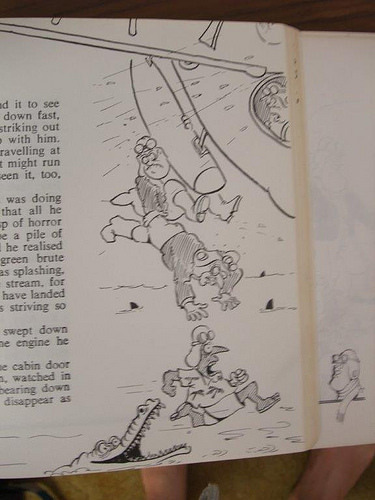
"Dash it all, chaps, what am I looking for?" mused Bertie as he screwed in his monocle and peered at the offending item. "Illustrated by Patrick Cook... some Australian johnny, I think? Let's see what he's done, eh?" He opened the book, flicked through it for a moment, then stopped, thunderstruck.
"By Jove!" he breathed heavily. "The bounder! The rotten little colonial oik! After all we've done for them..."
Ginger and Algy came round the table to peer over his shoulder. Wordlessly, Bertie indicated Cook's illustration.
"'Ere!" yelped Ginger. "That's where we rescued 'im... what's 'is name... Cuzens... from them crocs! 'E's made us look bleedin' ridiculous!"
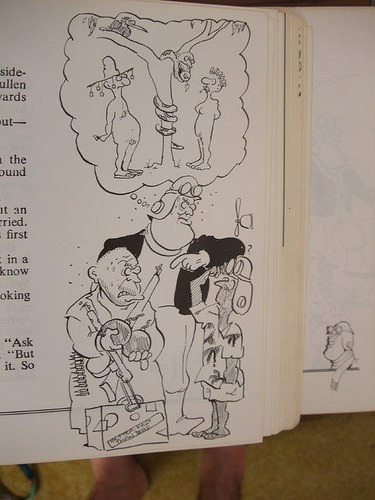
"You think that's bad?" replied Biggles, his brow darkening. "Look at this!"
He turned back a few pages.
Ginger goggled at the picture. "Blimey, guv!" he said weakly. "'E's drawed them bleedin' starkers! What's 'is game, that's what I wants to know?"
"That's what I want to know too," said Biggles. "My guess is that he's another Commie agitator. You can recognize those Ironcurtainmongers after a while. We need to act fast, before things get out of hand."
He paused and thought for a second, then snapped his fingers triumphantly.
"Goodreads! That'll do it. I'll ask Manny Rayner to post a review at once. We go back a long way, I know he's trustworthy."
"Are you sure?" asked Algy dubiously.
"If you can't trust Manny, you can't trust anyone," said Biggles. "Leave this to me."
Acknowledgements
I would like to thank my friends at Pioneer Books for giving me this wonderful book. What they don't know about Biggles isn't worth knowing.
Interesting insight into 1950 novel set colonial Australia written be a British writer in the language of the day. No longer politically correct, by jove. Not a jolly good read but an interesting reread after 60 years ago of reading Biggles books. Not that I remember this particular one but as an Australian thought this gym share library book of no cost would be an interesting read. Jolly good show, hey what, not really. Interesting the spy/espionage influence is the similar destabilisation influencing as what is happening in Australia today.
Novel of aeronautical adventure set in northern Australia; includes numerous accounts of wild, ferocious Aborigines.
As the Biggles books are children adventure books from the middle of the last century, I don't have complicated expectations on these books, and those that have read my previous reviews know that I am willing to overlook quite a lot, but this book, just not good.
This book is from 1955, in a time when Australia is breaking its dependency on Britain and trying to figure out its future as a western Asian country, and Erich von Stalhein has been seen in Australia. Biggles and his friends rush there to figure out what Stalhein is up to. As we have learned, Stalhein is a slippery eel of a villain, and the question becomes if this is the time when he'll finally meet his end.
So far, a normal Biggles book, but the part that I didn't like at all is how the 1955 W. E. Johns treated the aborigines in this story. He seems bitter and upset about concurrent events in Kenya and takes it out on the Australians. This is a Biggles book to skip.
First Published in 1955, 'Biggles in Australia' is one of the shorter Biggles books with plot set around the coast of Australia involving some very unsubtle Cold War style antics involving agitators fomenting rebellion amongst the natives, clearly inspired by the recent Mau-Mau situation. Heavy stuff for a children's novel, made more so by its clumsy handling and seriously compromised by the blatantly racist attitude to aboriginals, and only partly redeemed by the usual fast-paced plot with some excellent aviation elements.
Definitely not the best Biggles out there. Action is nil, a lack of understanding about Australia in general causes the author to be too hesitant. Also, you do not get to see Von Stalhein at his best. One more thing that annoyed me was the violence toward aborigines, however that is not through latent cruelty in the author but through ignorance of his writing topic. Probably two star.
Not a bad book, but somewhat disappointing. As an Australian Biggles fan, I wish his Australian adventure had taken him to places more familiar to most Australians than it did. Nothing to do with the quality of the book, but a personal thing.
I have always enjoyed Biggles but they are definitely old fashioned. The biggest problem is the horribly racist portrayal of the Aboriginal people. The flying scenes are quite good and adventurous. I would recommend others before this one.
Found a copy of this book and read biggles book for the first time since the mid 1050's, an interesting read, and still enjoyed it as much as I remember reading the series more than 60 years ago
I am reviewing the series as a whole, rather than the books individually The Biggles series is great adventure fiction: we get high stakes, aerial action (in most of the books), and a hero who is endlessly loyal, competent, and calm under pressure.
I love the dogfights, recon missions, and wartime scenarios.
Where the series falls short is character depth. Some attitudes and simplifications reflect the period in which the books were written. There are very definitely dated elements, but considering the era the books were written - overall the series performs well. More than a few of the stories defy plausibility, but who doesn't love to curl up with a good adventure book or 10?
A good adventure book for young boys- maybe max age 13. Some of the vocabulary might be a little advanced since it was written in the 1950s by a Brit. But I enjoyed it. Reminded me of an early James Bond type book.
Biggles (or should I say Captain W E Johns) never lets us down as our hero and his chums feature again in an all-action, fast-moving adventure. Escapist reading at its best!