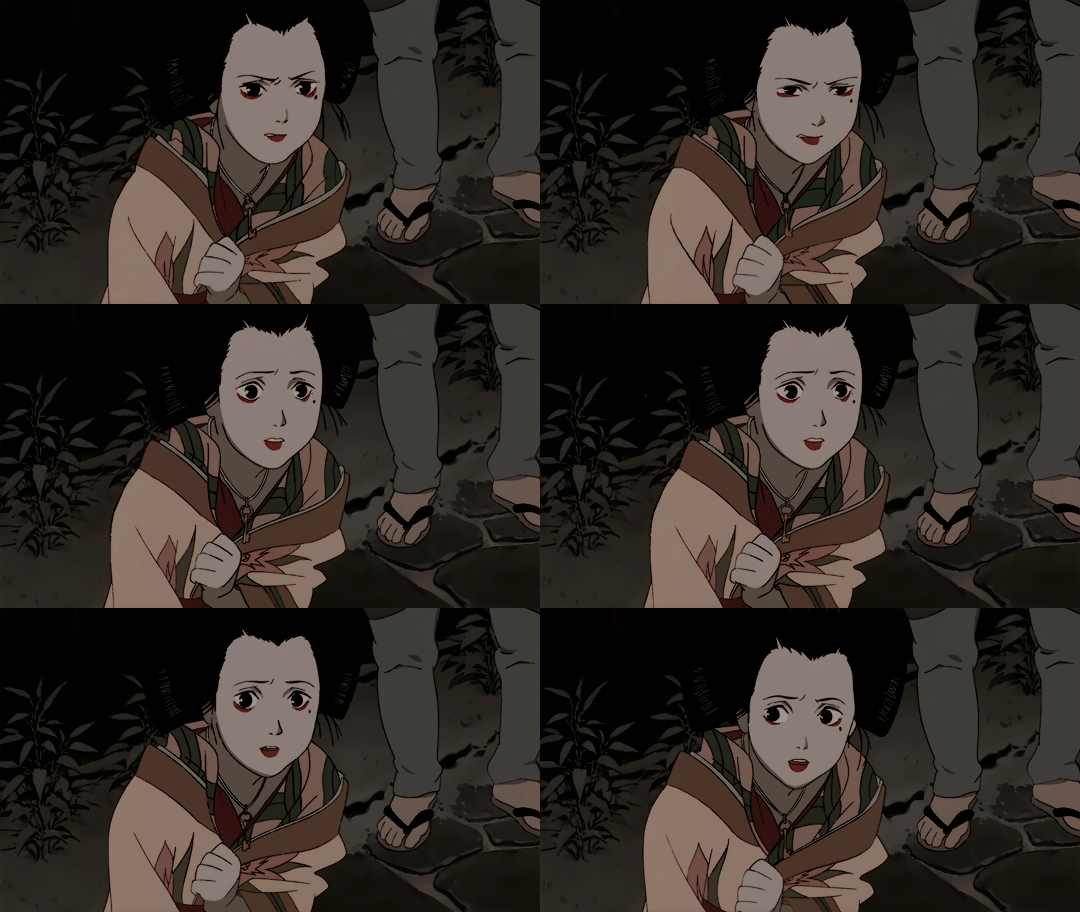
A pair of mandarin ducks, separated by a cruel lord who wishes to possess the drake for his colorful beauty, reward a compassionate couple who risk their lives to reunite the ducks.
Katherine Womeldorf Paterson is an American writer best known for children's novels, including Bridge to Terabithia. For four different books published 1975–1980, she won two Newbery Medals and two National Book Awards. She is one of four people to win the two major international awards; for "lasting contribution to children's literature" she won the biennial Hans Christian Andersen Award for Writing in 1998 and for her career contribution to "children's and young adult literature in the broadest sense" she won the Astrid Lindgren Memorial Award from the Swedish Arts Council in 2006, the biggest monetary prize in children's literature. Also for her body of work she was awarded the NSK Neustadt Prize for Children's Literature in 2007 and the Laura Ingalls Wilder Medal from the American Library Association in 2013. She was the second US National Ambassador for Young People's Literature, serving 2010 and 2011.
If my parents had ever paid an artist to draw a caricature of me as a child (they didn't), I'm sure the end result would have been a portrait of a little girl with brown hair, reading a giant book that was bigger than she was, while little red cartoon hearts sprang from her eyes.
I have loved LOVE always. Stories of love, a romance unfolding (and any story involving a mystery or a beloved pet, too).
But, when I was a kid, the love stories were always crap. It was either fairy tales where the girl was dim-witted or poor (or both) who needed a man to solve all of her problems, or a Disney story of a dim-witted, poor, but beautiful young woman with a murderous stepmother and a man who was needed to kill that awful woman and then enjoy monogamy with his new bride while the pheromones lasted.
How could the average girl relate?
It seems like I didn't discover any real explorations of adult love, written for children, until the 1990s, and even still, they are scarce. (I credit Paul Goble, a British writer, for penning a few).
But, yesterday, we found a new one, by Newberry Medal winner, Katherine Paterson.
And it is. . . so lovely. So very lovely. It's not only a love story between a man and a woman, it's a story of romance being provoked when a woman reveals her true character when she risks her life to prevent animal cruelty.
No wicked stepmother or covert misogyny or unrealistic endings here.
Just a delectable love story between two flawed people and one necessary tissue at the end.
When a cruel and greedy lord imprisons a colorful drake, intent on displaying his gorgeous plumage to the neighbors, he cares nothing for the fact that he has separated a devoted pair of mandarin ducks, and that his captive is slowly losing his will to live. It falls to Yasuko the kitchen maid to do what is right, and return the drake to his mate, thereby bringing down the wrath of her master, not just upon her own head, but also upon that of Shozo, the lord's one-eyed samurai. All seems lost when the pair are sentenced to death, until two most unexpected messengers arrive...
This engaging Japanese folktale, retold by two-time Newbery Laureate Katherine Paterson, and illustrated by two-time Caldecott Laureates Leo and Diane Dillon, is one that will appeal to folklore lovers of all kinds. The classic themes of cruelty, compassion, and the human relationship to the natural world, are ably explored in the narrative; while the watercolor and pastel artwork - inspired by traditional Japanese ukiyo-e prints and paintings - is simply breathtaking. I thank my friend Chandra for pointing this one out to me - it really is a gem!
This is such an a beautifully illustrated tale of two ducks in love and a samurai and the girl that he falls in love with. I'm in shock and awe at the classical paintings and the delivery of the story.
I enjoyed the illustrations and the fable, but, felt the need to knock a star off because of the author not being of the culture she's writing about. Made to look and read like an old Japanese folktale, but, without any information crediting source materials.
It is an excellent fable though and the 18th century Japanese woodcut style is pretty cool looking. Just wonder if anyone from Japan would see it that way or if this would be offensive in some way.
The charm of this book was twofold for me. The story is simple and heartwarming and the art truly lovely but the biggest bonus was the reaction of my seven year old granddaughter. She chose this book one night to read prior to bedtime at grandma's house. Since she is very drawn to animals, I wasn't surprised because this book is about Mandarin ducks. However, her emotions were drawn into the book immediately as the beautiful drake duck is captured by an evil ruler. She was genuinely concerned about the duck's welfare and she kept asking to see the pictures which she loved.
We wouldn't have read this book if it had ended sad because I would never have been able to get her to sleep. Sleep she did, but the interesting thing is that the next morning she immediately wanted to look at it again and then before going home asked ever so politely if she might be able to take the book home. Victory.
Katherine Paterson's retelling of the classic Japanese folktale, "The Tale of the Mandarin Ducks" (1990), is perfectly encapsulated in the form of a children's picture book, with richly toned traditional illustrations (olive greens, sunflower yellows...) by Leo & Dian Dillon. In it, a masterful story of a stolen drake unfolds. Deep in nature, a beautiful, colorful drake lives with his wife. But when he is taken from his home to the lord's manor (to be on display within a cage), the drake grows weary and utterly depressed, unable to sustain himself, only thinking of his worried wife. Luckily, a sympathetic and wise person intervenes, and from there, the story blossoms into one of magic, divine oversight, and karmic fruition, all stemming from a continuous surging of two people's kindness towards the rest of the world. You'll find out how a little touch of compassion, shared by humans and animals alike, is enough to outweigh those terribly hurtful impositions of strife caused by vanity and power. (A good book to celebrate Asian American & Pacific Islander Month: May.)
I first read this many years ago, and have read it a couple of times since then, including this time. The blurb was most helpful in describing the artwork as watercolor and pastel paintings that are done in the style ukiyo-e Japanese woodcuts, and IMO, are simply gorgeous and outstanding. I also loved the story of the mandarin ducks repaying the kindness of Shozo and Yasuko. But, I was disappointed that Paterson did not include a source for her telling of this popular Japanese folktale (according to the blurb).
This book is about a duck that goes away from his wife to get food but gets captured. When one of the people in the village is keen on setting it free the king gets mad. Will the duck ever get out? Read this book to find out.
This book was ok. This book has romance and care.
I recommend this book to girls who like fairy tails.
I like this story because, as the author explains, mandarin ducks mate for life and are very loyal to each other. This is a charming tale with beautiful illustrations.
This is a sweet fable where mandarin ducks repay the kindness shown them by two servants. The illustrations are detailed and beautiful. I do wish there were notes on the origin of the story.
The Tale of the Mandarin Ducks by Catherine Patterson, Illustrator Leo & Diane Dillon- Children’s Illustrated Colour Picture Book- This is a Japanese folktale. A beautiful mandarin duck couple reside in their nest in the deep forest. Male moves out in search of food. A greedy Lord views him and orders his men to lay seeds on the ground and catch the drake by throwing a net over him. Shozo is his samurai who has lost one eye while fighting for the lord. Shozo advices him not to catch the drake but he ignores his advice. Drake is captured, caged and shows the magnificent plumage to friends, during a party. The Drake pines for his mate. Yasuko is a kitchen maid. She is kind and understands that the wild bird is yearning for her mate and does not wish to live. Yasuko releases the bird against her lord's command. Lord comes to know about this event. Shozo takes the blame that he has released the drake. Yasuko falls in love with Shozo for his kindness. The Lord enquires and finds that Yasuko is also involved. He sentences both of them Shozo and Yasuko to death. Just then, two Messengers from the King’s court arrives and shows an order that Death sentence has been banned and justice to such persons who have been sentenced shall be reviewed by the King. Lord ties the hands of Shozo and Yasuko and sends them with his men to the King’s capital. The road to the forest leads from the same deep forest where the drove resides. Droke is grateful to both Shozo & Yasuko and plans to return their kindness. It is a dark night in the deep forest. King’s messengers are afraid of the dark and leave Shozo & Yasuko there. Droke opens their bound hands, provides warm water for both, proves fresh cooked food and a warm blanket and bed for them. They live in the forest together and have children. The classic themes of cruelty, compassion, and the human relationship to the natural world, are ably explored in the narrative; while the watercolor and pastel artwork - inspired by traditional Japanese ukiyo-e prints and paintings. I have read this book in Hindi language. Coloured illustrations help the reader to relate to the story.
Here is a book that kind of gave me a fit to find just since the author as well as its age are older. As a result I almost gave in to have to hear my first audiobook but fortunately they do have readers of it on Youtube, which means I can cut the audio then pause the film to read the book on my own. This not only saved me from the need of hearing an audiobook but also gave me a chance to experience the illustrations from this book.
Although the book appears to be a children's book given to the amount of writing on the page and some of the suggestive comment I would suggest it for older aged children. There is a bit of a flow to the story even while it also seems dry at other points but the author most definitely makes up for it with her descriptive word choices.
What is really charming about this story is the actual illustrations. They are brightly colorful and detailed yet also a bit mute at the same time. There is more told in the photographs - the suggestive fact that the Emperor's retainers looks like human-transformed ducks, the manor court and the showing of the various landscapes throughout the book.
It is a sweet story but one full of lessons and could make for a great read with others if you choose to explore these lessons together.
Paterson and Dillon created this wonderful book with great sensitivity. Too bad there aren't notes, but I trust the creators' respect. Paterson has an understanding & love for Japanese history (see Of Nightingales That Weep, The Sign of the Chrysanthemum, and most especially The Master Puppeteer). The Dillon's have written and illustrated many books from many cultures over many decades, and one can always feel that they put their honor & soul into their work.
1. Boston Globe/Horn Book Picture Book Award 1991, The New York Times Ten Best Illustrated Books, American Bookseller Pick of the Lists, Booklist Editors’ Choice 2. Guided Reading: PreK-Kindergarten Appropriate Reading Level: 1-2 3. Two mandarin ducks are separated one day. The male duck is captured by a greedy lord who wishes to keep him because of his beautiful colors. A reward goes out to anyone who can bring the twin ducks back together. 4. I enjoyed the originality that the tale possesses, but I found the part about the possibility of the drake being killed off-putting. 5. This book is great for multi-cultural awareness. I also think it would be interesting to use this book when discussing what animals are native to different parts of the world.
Gorgeous illustrations are the highlight of this retelling of an engaging and popular folktale from ancient Japan. The pictures are "watercolor and pastel paintings in the style of eighteenth-century Japanese woodcuts" and they really help to bring the story to life. I really enjoyed reading this tale.
The lord of the district spots a beautiful drake and orders it capture. Shozo, his chief steward, tries to talk him out of capturing such a beautiful creature. But the drake is captured and caged. It soon loses its beauty and the lord, refusing to let the drake go, instead banishing it to the kitchen corner. Yasuko, the kitchen maid, sees the drake languishing and releases it. The lord blames Shozo and strips him of all rank. Yasuko confesses to Shozo that it was her. The two keep their secret and fall in love. But the lord accuses them of conspiring against him and condemns them to death. However, mysterious messengers from the Emperor appear with a reprieve.
I picked this book, because, to be honest, I love ducks. But the imagery in this story is so beautiful. The story itself is fairly simple and has been told again and again in many cultures, but it still shares a valuable lesson with students. I can see this book being great to keep in a classroom library. It's a good read, and as I said, the pictures in this book are just gorgeous. The patterns drawn are intricate, and you see a different color or pattern everywhere you look on each page. I also could use this book for my text set, which will probably be about ducks.
Based on a Japanese folktale, this book focuses on how acts of kindness are ultimately rewarded, and a punishment shared is easier to bear. When one servant takes the fall for another servant's disobedient yet kind act, and she wants to come forward with the truth, he responds with, "Why should two suffer for one crime?" The story ends with this universal truth: "Trouble can always be borne when it is shared."
This story is set in Japan and in it mandarin ducks are captured and brought before the lord. The lord locks up the ducks and they lose their beauty because of it. It is proposed that they be released however the request is denied. One day the ducks are released. The lord punishes the man who suggested their release believing him to be the culprit. Eventually after being demoted to being a servant the man is rewarded by the ducks and is set free.
Lovely! Nicely illustrated tale of a greedy lord who mistreats his servants and only wants to keep something if it is beautiful. He insists on capturing the gorgeous male drake, separating him from his mate. Two servants want the drake released and are punished because of this. The servants fall in love and are saved by the Mandarin ducks who are able to change themselves into humans. I love books that teach lessons, especially the lesson of respecting nature and fellow creatures.
This entire review has been hidden because of spoilers.
If you do not know what a mandarin duck looks like, find an image. Then, read this book. It is such a lovely story but when you can truly see the beauty of the duck and relate to its caged sorrow and separation from its mate, it is that much more powerful. This story has so many important lessons woven into it - the value of all creatures, the ugliness of cruelty and the rewards of kindness.
I have just discovered the illustrations of Leo and Diane Dillon and they are superb in the simple but beautiful Japanese fable. I discovered this book in an antique shop in Leura in a hardback form and it is a treasure. I am now searching for more books illustrated by this talented couple.
Wonderful morality tale and gorgeous Japanese-styled illustrations make this story of human goodwill and pettiness come alive. As soon as I saw the book jacket, I realized I had read this book to one of my sons when he was in grade school. Nice to revisit this one as a grownup!