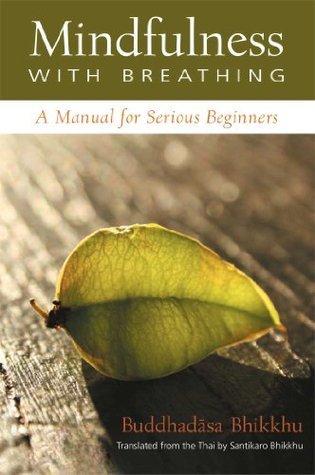
Any practitioner, after meditating for some time, inevitably wonders what meditation method the historical Buddha Shakyamuni himself used while beneath the Bodhi Tree. Many people understand that prior to his realization, Shakyamuni Buddha studied with many of the great yogis of his time, but most do not know what method he ultimately found leads most directly to nirvana. In Ajahn Buddhadasa Bhikkhu's book, Mindfulness With Breathing , the Thai meditation master provides practitioners with penetrating insights into the Anapanasati Sutta , the canonical text which many believe is the most direct transmission of Shakyamuni Buddha's breath meditation methods. Combined with a concise translation of the sutta itself, Mindfulness with Breathing is one of the best guides to Buddhist meditation practice available in the English language.
Buddhadasa Bhikkhu was a Thai Buddhist monk and an influential ascetic-philosopher of the 20th century. Known as an innovative reinterpreter of Buddhist doctrine and Thai folk beliefs, Buddhadasa fostered a reformation in conventional religious perceptions in Thailand as well as abroad. Buddhadasa developed a personal view that those who have penetrated the essential nature of religions consider 'all religions to be inwardly the same', while those who have the highest understanding of dhamma feel 'there is no religion'.
This book discusses in detail the 16-step method of meditation based on mindfulness with breathing first presented by the Buddha in the Anapanasati Sutta, which is here interpreted and explained by Buddhadasa Bhikkhu for the benefit of modern-day meditators. Budhadasa's presentation follows the Buddha's original formulation closely; he interprets the steps and tries to make them clearer for the practitioner. Like all inspired teachers and orators, he also adds great commentary to the practice, employing innovative and entertaining ways of characterizing human psychology that are at once down-to-earth, stunningly accurate and painfully humorous. Supplementing Buddhadasa's presentation and commentary is the commentary of the translator Santikaro Bikkhu which gives more points for managing practice which are useful.
The 16 steps of Anapanasati proceed from the observation of kaya (body) to the observation of vedana (feeling), citta (mind) and finally dhamma. There are 4 steps of observation in each of the 4 categories, making 4 tetrads. For those who think 16 steps might be too much, Buddhadasa recommends doing just eight steps, focused on the 1st and 4th tetrads. Note that those who take this "shortcut method" of Anapanasati will be practicing something akin to the "bare insight" styles of vipassana that do not focus on the development of higher levels of concentration, and their factors of enlightenment will correspondingly be weaker, whereas those who develop all 4 tetrads will be able to utilize the combined power of (highly developed) concentration and mindfulness to achieve insight with perfected factors of enlightenment. This is because the 16 steps of Anapanasati actually help meditators to develop the factors of enlightenment to a very high degree - specifically, in the 2nd tetrad, rapture and tranquility are developed and perfected; in the 3rd and 4th tetrad, mindfulness, investigation of states, effort, concentration and equanimity all achieve perfection.
Towards the end of the Anapanasati Sutta, the Buddha explained how Anapanasati perfects Satipathana, which perfects the Seven Factors of Enlightenment, which perfects Knowledge and Liberation. So, Buddhadasa is quite right in pointing to Anapanasati as a core method of Satipathana practice. Buddhadasa considers the Anapanasati Sutta as the authoritative text on meditation practice because the Anapanasati Sutta actually lays out an easily practice-able method of meditation, unlike the Sattipathana Sutta which he deems as "just a list of names or dhammas...more than can be remembered." I think Buddhadasa's practical prioritization of the Anapanasati Sutta very wise, however, his dismissal of the Satipathana Sutta should not lead meditators to overlook this Sutta. In fact, the Satipathana Sutta actually gives the larger framework within which the Anapanasati Sutta should be understood. In the Satipathana Sutta, the Buddha was concerned with laying out a meditation method based on "Sati" or "Mindfulness", which can be applied to 4 categories of phenomena (body, feeling, mind, dhamma) taken as meditation subjects. Such "mindfulness meditation" can be developed in various ways. In the Anapanasati Sutta, the Buddha explained in detail one particular way in which meditators can develop their Satipathana practice by combining Mindfulness (Sati) with Breathing (Anapana), a combination that actually improves mindfulness and gives a compact way of practicing all 4 satipathanas.
This original 16-step Anapanasati method of the Buddha is indeed both more concise and more comprehensive than other popular methods of satipathana vipassana being taught today. First, these other contemporary methods might not necessarily highlight or make clear the practical way of progressing from one satipathana to the next like this presentation does. Second, the teachers of these methods often categorize Anapanasati as "samatha meditation" dividing it from "vipassana proper", ignoring the fact that the original Anapanasati method that arose out of the enlightened wisdom of the Buddha is the most perfect and skillful conception of samatha-vipassana ever, with serenity concentration playing an integral part all through the progressive development of insight. Third, unlike contemporary methods that borrow either too narrowly or too comprehensively from the Satipathana Sutta, the original Anapanasati practice is neither too truncated nor too long-winded; the 16 steps cover all essential bases and lead straight to the goal. Therefore, all Buddhist meditators will benefit greatly from studying the Anapanasati Sutta, which is explained so well by Buddhadasa here.
Buddhadassa Bhikku was a wise teacher, an accomplished yogi and a master of the Dhamma. This kind friend points out an authentic path that yields authentic fruit; a path practiced, praised and taught by the Buddha himself. Have faith in the the Fully Enlightened One in whose footsteps Buddhadasa follow - Anapanasati as taught here can lead to the final goal.
I read the first chapter after a retreat. Then I read the rest overnight on a guard gig. I think it's best to read this kind of book on retreat. I read it to try and jumpstart my practice. St. John of the Cross says reading a lot of books is a sign of spiritual immaturity. Rosenberg's book Breath by Breath is the gold standard and this would be a good book to read a second time.
I did read this a second time later, and it was very helpful.
Supposedly people get really angry if you bring up Buddhadasa wasn't feeling rebirth, as a monk who didn't disrobe. He's a bright shining light in the sangha that called out his truth and people only like orthodoxy from the sangha.
Though the information on the Anapanasati sutra seemed solid, the presentation was not helpful to me. It was too technical, full of Pali words, and it was too rigid. Buddhadasa's Buddhism doesn't align well with how I practice meditation and think about the world; I did not enjoy the unforgiving structure or how certain it seemed that there was only one right way to do Vipassana meditation. I definitely learned from the book (a lot of terminology, some helpful), but I don't feel it translated into my practice at all.
Everything by Buddhadasa Bhikkhu is a classic. He has a way of presenting the teaching of the Buddha in a simple yet profound, non-religious way. Do yourself a favor, just read it. Then do yourself a bigger favor and practice it. Four stars because it is unfortunately incomplete. Buddhadasa's failing health kept him from completing the talks that were the source material.
If you are serious about starting mindfulness and meditation, then I would highly consider giving this book a try. However, as the title suggests, it really is for the “serious beginner”; you will gain the most value and insight by treating this book like a teacher, and not just a book for reading and absorbing the contents as quickly as possible. Like many modern Buddhist teachings and literature, this book is not overly prescriptive on the religious aspects, but it is still highly spiritual. This may or may not be to your liking, but when approached with an open mind, you will find that the teachings of this book are still valuable and highly applicable.
Along with Thich Nhat Hanh's 'Transformation and Healing,' this is the best introduction to the yogacara technique of zazen and practice. However, it is useless without a commitment to taking it slow and practicing each step thoroughly. Not for the faint of heart.
So hard to "rate" dharma books! This one delivers a lot of material in a short space. A Thai meditation master expounds the Anapanasati Sutta, the only discourse of the Buddha in which he sets out a complete method and path of meditation.
Interesting and helpful in my meditation practice in some ways, but also a bit dry. Too rigid in instruction...I think some of this is probably lost in translation and culture.
"Mindfulness with Breathing..." is a book on the technique of anapanasati meaning "mindfulness of breathing," a form of Buddhist meditation, taught by Gautama Buddha in primarily the Anapanasati Sutta. Buddhadasa Bhikkhu outlines sixteen contemplations of this sutta which are composed of four sets (tetrads) of four contemplations. The four objects of contemplations are kaya (body), vedana (feeling), citta (mind), and Dhamma (Truth). Although the author's presentation of the Anapanasati Sutta is thorough, I believe, it appears way to technical and involved for the average reader and most aspirants would not be able to progress through the first tetrad. However, this is a very hopeful and encouraging book. The author speaks to the beginner practitioner and offers alternative simplified versions of this practice. I would highly recommend this book.
This book is presented in 3 parts: the author's teachings, the translator's additional thoughts on the author's teachings, and then the text of the Buddha's teachings. I wish I had read the parts in reverse order, because I found the author's teachings to be dry, rigid, and too reliant on Pali words. But then the translator's notes and the Buddha's words brought more clarity.
My final thought is that this is "a manual for serious beginners"... of one particular Thai Buddhist monk. Not a manual for serious beginners who want to learn about Buddhism.
I'm encouraged to keep meditating by this book, but mainly by Santikaro Bikkhu's "Translator's Conclusion," which also encourages me to revisit Buddhadasu Bhikku's teaching from the Anapanasati Sutta and to not be discouraged by it's seemingly demanding sixteen step analysis of the path through meditation to liberation.
A bridge in my journey from mindfulness as provided by Headspace (the app) to something deeper.
I looked to this text to find the roots of breathing practice as taught in many contemporary contexts. It is a skillful unpacking of and experiential guide to the Anapanasati Sutta. Very helpful in support of actual practice, a reference manual.
In the usual no fluff just stuff style of Venerable Buddhadasa Bhikkhu, a simple and direct practical commentary of the Anapanasati Sutta. Some familiarity with the Theravāda Buddhist tradition may be required though to fully appreciate the contents.
Mindfulness with Breathing offers valuable insights into the relationship between the breath, body, emotions, and mind. I especially appreciated its discussion of awareness, attachment, and how our reactions can create suffering.
Although I found the content worthwhile, the sixteen-step practice feels too complicated for me. Trying to remember each stage and evaluate whether I was doing it correctly would likely add stress to my meditation. My own practice benefits from a simpler approach: being present, noticing what arises, and gently returning to my anchor.
Still, a method doesn’t have to suit me perfectly for the book to be valuable. I’m glad I read it and will carry several of its insights into my daily life. Four stars for thoughtful content, even if I won’t adopt the full practice.
I really appreciate the frankness of this book as a manual, as it says. I met Santikaro (translator) at MABA a number of years ago, and was relieved to find a merger of the social experience of living in a culture with many social oppressions and the personal experience of being alive. Most spiritual or buddhist things I encounter don't speak directly to the social, and that's too close to ignoring it, for me. This book doesn't reflect on that, but knowing it comes from that root is helpful to me. The techniques are straightforward and don't rely on woo woo mystique to convince you.
I found this book to be very helpful. It is clearly written and is easy to understand, although I'm sure there are deeper insights to be gained from further contemplation of its content. I've gained many insights from a first reading. It goes deeper than the basics of meditation, I feel.
Almost 5 stars. Comprehensive and thorough book for anyone interested in learning mindfulness meditation in depth. Best read in conjunction with a teachers advice, beginners mind, and time to practice the techniques