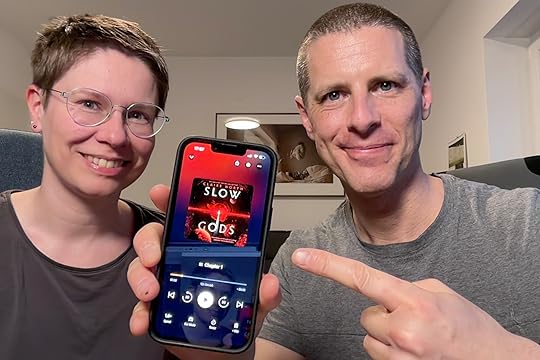
My name is Mawukana na-Vdnaze, and I am a very poor copy of myself.
Slow Gods is the galaxy-spanning tale of one man's impossible life charted against the fate of humanity amongst the stars—a powerfully imaginative space opera from multi-award-winning author Claire North.
In telling my story, there are certain things I should perhaps lie about. I should make myself a hero. Pretend I was not used by strangers and gods, did not leave people behind.
Here is one out there in deep space, in the pilot's chair, I died. And then, I was reborn. I became something not quite human, something that could speak to the infinite dark. And I vowed to become the scourge of the world that wronged me.
This is the story of the supernova event that burned planets and felled civilizations. This is also the story of the many lives I've lived since I died for the first time.
Claire North is actually Catherine Webb, a Carnegie Medal-nominated young-adult novel author whose first book, Mirror Dreams, was written when she was just 14 years old. She went on to write seven more successful YA novels.
Claire North is a pseudonym for adult fantasy books written by Catherine Webb, who also writes under the pseudonym Kate Griffin.
It's difficult to make a god-like main character sympathetic, but Slow Gods made me feel compassion and understanding for not one but two godlike characters making their way through the science fiction world of this fascinating novel.
We follow the life of Mawukana na-Vdnaze (Maw for short) who is born into the Shine, an ultra-capitalist hellscape of planets where you are born into debt, charged for your own birth, every breath you take, every bit of sustenance you consume, and are expected to rise by your own merits or sink into debt labor, a euphemism for slavery. Maw is just trying to make do, struggling to survive, when a world-shattering event occurs: a mysterious AI entity known as the Slow enters the Shine's region of space and announces that in less than two centuries, a nearby set of twin stars will implode, wiping out all life in that part of the galaxy.
The Shine's response is to suppress the news, disappear any scientists who try to raise the alarm, and carry on with business as usual. This leads to revolts and unrest, and Maw is unwittingly caught up in these events. Through a series of misadventures and bad luck, he is eventually conscripted to be a Pilot on an arc-space ship, which is normally a death sentence, as arcspace is a dark, quasi-sentient reality, the stuff of nightmares and monsters, that drives Pilots insane and sometimes makes entire ships disappear.
During his first jump . . . something happens to Maw. He is changed. Replaced? Badly copied? No one understands exactly what has occurred or why, but Maw's humanity has become fluid and unstable. At times, he seems to be part of the Dark, able to fly through arc space with never a problem, but not always able to maintain his grip of what it is to be human. Physical laws bend around him, especially when it is dark. He cannot die -- at least not permanently -- and he does not age. Is he a monster? A cursed man? A god? No one knows, and everyone fears him. Even scarier: Maw's nature changes depending on how people see him. If they believe he is a monster, he tends to become one. If they believe he is a good man, he acts like one. And he will only die if they believe he can be killed, but as soon as they forget about him, he rises again.
From here, we follow Maw across several centuries, through the explosion of the twin stars and beyond, as he is drawn into a strange long-range series of intrigues that involve his old home the Shine, the worlds of the Accord, and the god-machine known as the Slow. There is sufficient mystery and action to keep the pages turning, but the real force driving the narrative is Maw's voice, and his journey to understand who is he, who he has become, and what it means for himself and for the galaxy. Can he love? Can he find happiness? Is he even allowed to be human? The author balances the character's human frailties with his godlike powers perfectly, and we eventually come to understand that Maw shares more common ground than he realizes with the Slow, another unknowable and super powerful force.
In religion, one of the oldest questions is why God allows suffering, if He is truly good. This book made me see things from the perspective of a godlike creature, and feel sorry for them for the choices they must make that are perceived as cruel, dispassionate, or heartless, though in the very long run -- eons -- they may in fact be the choices most driven by love.
The world-building (galaxy-building) is both complex and believable. One thing the author does to challenge earth-centric thinking is to use a wide variety of pronouns to reflect gender, or lack thereof, in a galaxy full of cultures that don't always have a rigid male-female binary. You will need to get comfortable with xe, xim, que, quim, Hé, hím, and many other demarcations, but I found that after a few chapters, this really wasn't an issue. As Maw tells us in an interlude on the subject of gender:
"Some off-worlders complain (about the many pronouns), say that it’s too complicated, there’s too much here for them to ever understand.
How odd, the Adjumiris reply. You can remember the difference between innumerable different types of sausage or sporting teams, but you cannot hold in your mind a mere half-dozen or so categories of people? That must make navigating the nuances of human experience extraordinarily taxing for you."
Fair point! One of the reasons I like science fiction is that it forces me to think in new ways about the vast possibilities in the galaxy. It would be quite boring if everything in the galaxy was exactly the same.
That said, the novel explores themes that are very timely and very, shall we day, down-to-earth. How does a society respond to massive disasters? To injustice? To naked aggression? When does one have to act, and what acts are justifiable?
When the Shine tells the Accord that they don't need any assistance because of the imminent star explosion, everything is fine, Maw wonders: "What do you do when someone lies to your face so calmly, so repeatedly, so blithely?" This feels quite relevant to our time and place.
On the subject of other people's suffering, Maw is forced to come to terms with the limits of empathy. When the Shine invades a neutral world, using it as an escape for its elite corporate executives, who know very well that their home planets are doomed, Maw is drawn into the resistance to this planetary occupation, but finds that fear of the Shine's powerful 'black ships' is more potent than the Accord's vows to help those suffering. The Accord is able to turn off their sentiments, look away, and assume that there is nothing they can do. "Fascinating, how easily people will assume that one person’s emotional landscape is less valid than their own."
Maw also struggles with the atrocities committed by the resistance in response to the atrocities committed by the oppressors. What is justified? He finds that he gets little sympathy when he tries to see things from the occupiers' and collaborators' point of view: "that the thing that was forbidden – the thing that is always forbidden in all wars, especially the longest – is thinking of your enemy as people." This, again, is an issue both timely and eternal.
On a more personal level, Maw's struggles are incredibly relatable, even for those of us without godlike powers. Maw is affected, changed depending on how people see him and think of him. Aren't we all? As he says, "I wonder whether it is possible to exist as a person at all without measuring yourself against others. I wish sometimes that I was strong enough to be myself in company without company turning me into something else. I wonder who that person would be, and am sometimes grateful never to find out." I also love his occasional rants about how hard small talk is, and how easy it is to make errors with social niceties and be labeled as 'other.' I can definitely sympathize, and I don't have the excuse of being a re-made being from the arc space.
All in all, a fascinating and mind-blowing adventure that will scratch your itch for great space opera, but also asks important questions and explores the humanity of our characters while challenging readers to think about their own nature and morals. Like the Dark of arc-space, this is a book that whispers to you, is voraciously curious, and may haunt your dreams.
DNF'd at 12%. I wanted to like this, I really did. There's a lot of cool sci-fi stuff going on, and Claire North's prose is great, but every time I came up against one of the several neo-pronouns (Qe/qis? Hé? Do you pronounce qe as "quee" or is it "kee"? Is hé pronounced "hay"? What are we doing here? I tried mentally replacing all of it with they/them but then I was just thinking about that too much.) it just totally ruined any and all sense of immersion. I'm sure there will be those who love this, but it's just not for me (as much as I could have sworn it would have been). I loved The First Fifteen Lives of Harry August, so this will not be the last time I give North a shot. I've heard Touch is phenomenal.
I'm always delighted when I read a book that makes me think, "gosh, that was a hard thing you tried to do, and boy did you do it."
Books about more-or-less-immortal characters are difficult things; there's a real joy in reading a powerful narrator, a lot of fun in a power fantasy, but once your narrator hits a certain level of power, you run the risk of them becoming too alien to identify with or of having the stakes lowered by the lack of consequences. Slow Gods threads that needle well, giving us a protagonist that is powerful but constrained, unknowable but examined. This is something North has done before with her The First Fifteen Lives of Harry August, which was another book I really enjoyed, but this time the consequences are amped up, the philosophy is amped up, the weirdness is amped up. It was great.
I think that any good, expansive space opera will involve widely different cultures, any sufficiently different cultures that are competently imagined will have different ideas about gender or sexuality, and therefore, any sufficiently well written space opera will be inherently queer. Slow Gods is a very well written space opera, and the range of imagined systems of genders are a delight. We see systems with 8 or more genders, with no genders at all, all reflecting and making sense in the context of their imagined cultures. I greatly appreciated that we never got even a smidge of a hint of what sort of body our narrator's sexual interest had; it wasn't relevant to that character's gender identity in ter society, and so it wasn't worth sharing with us. Even the Shine, the hyper-capitalist debt slavery society, which by law only allowed two genders based on your genitals, acknowledged that some men were more manly and deserved hé/hím, some women more feminine and deserved shé/hér, which is a great analogy for how even the most conservative in our current society understand that gender is at least a spectrum, even if they won't talk about it that way.
In fact, there's plenty ways to read the thematic meat of the analogies here. It's pretty easy to read this as an allegory of what it's like for the EU to deal with the US in the way that the Accord cannot call out the slavery practices of the Shine for fear of the nukes pointed at them. It's easy to see invasion and occupation as echoes of any number of Earth events, historic and present. I tend to read any story of someone finding people different as an autism analogy, and I thought this one was deftly done, both in the subtle ways that Maw describes feeling different from the people around him and in the obvious ways, like when Maw specifically asks another character about his inability to read when someone is being performative and is told it will make social relationships difficult.
In a bunch of ways, I would describe this as a book that does genre conventions well, not a book that invents new conventions. I've read books before that imagine an unknowable space outside the universe filled with unknowable inhabitants that we can use to travel through (most recently, The Outside, and before that Shards of Earth), but Slow Gods does the things that the best books that involve unknowable Lovecraftian horrors do (I'm thinking of American Elsewhere as one example) by making those entities relatable without ever being fully knowable. I've also read books before that try to engage with the philosophy of how you find meaning in a massive universe (The Hydrogen Sonata and Lucky Day come to mind), but it's not an easy thing to do in a cohesive or un-schmalzy way.
All this requires a light touch, but that's Slow Gods through and through. It's a book that leans into the subtleties, that doesn't make evil less banal or boring than it is, that uses an imagined future to illustrate today, all with lovely prose and propulsive plot. It's a delight.
I haven’t been this enthralled, confused and delighted by a sci-fi book since I read Ann Leckie's Ancillary Justice. I can safely say this is my favorite book I've read this year in this genre.
Slow Gods contains many of the elements I love in space opera. A rich world building, a queernormative universe. Political conflict and an impending intergalactic war, very much inspired by real life conflicts. Sentient AIs and other impossible beings that pose some interesting philosophical, ethical and moral questions. A dash of eldritch horror.
The first half of the book was definitely my favorite, the way the world building slowly unfolds as we get further into the plot was really well done. Even when the narrator stopped to explain how this universe works it didn’t feel like info-dumping. I had no idea where the story was going to go next and I really enjoyed that.
The second part of the book centers on the war and I admit I found it less interesting than the beginning of the story. In spite of that, this is an excellent example of sci-fi done right.
This was the first book I read from this author and I was blown away!
Thanks to Orbit via NetGalley for providing an eARC
Slow Gods is the type of book I can admire, but not one that I loved. That's not to say that its entire 440-odd pages is a slog, simply that there were many times I wished North would cut the fat and get along with the plot.
Indeed, plot is not the immediate thing that comes to mind with Slow Gods which is preoccupied with concepts and philosophical musings more than cracking planets, unknowable gods, and starfighter battles. Of course, those things are all in the novel, but delivered at an emotional and consequential remove by our protagonist, Mawukana na-Vdnaze.
What a name, hey? Mawukana joins a cast of characters and planets with bizarre naming conventions further complicated by an absolute deluge of pronouns. I love seeing sci-fi explore different ways of experiencing gender and self, but Slow Gods takes it over the top to the point where it actively detracts from the reading. Qe, te, Xe, he, she, hé, shé, and others abound. They are explained, but are smothered under an avalanche of exposition.
This, I suppose, is where the rubber both hit and skidded off the road for me. North brings in some fantastic and compelling concepts to bear, but it often feels like we bounce from one idea to another without exploring what has come before. It's a bit reminiscent of a Grant Morrison or Jonathan Hickman comic where the ideas are so fertile that they compel the reader to imagine what might be just out of textual reach. In Slow Gods, the reading experience suffers from too many ideas too often.
The unknowable dark/arcspace remains an elusive concept to both Mawukana and the reader for the entirety of the novel. While Mawukana's incredible power in relation to the dark seems fundamental to the story, his particular origin and nature never gets a proper explainer. Instead, the dark works as a FTL transport system and massive part of Mawukana's existential crisis. Other societies, like the not-quite-hivemind Accord, the Shine, and the doomed Adjumiri are interesting and do manage to eek out enough conceptual time to be noteworthy.
The First Fifteen Lives of Harry August is, no doubt, the book by which North's output will be judged. Slow Gods is so drastically different from that novel that it seems totally bananas that it is written by the same author. By the same token, I really appreciate the range she demonstrates. This novel is a weirdo in the sci-fi space: slow, philosophical, and ultimately quite pacifist in its messaging. I'm not sorry to have read it, but I'd suggest proceeding with caution.
unfortunately, dnf @ 32% which is disappointing because this was my first book by claire north, and i was so excited to read her work. i had seen so many amazing reviews for this sci-fi novel, but i was just completely confused for what i read/listened to.
i’m not completely turned off by north, so hopefully her other work is more accessible to me!
——
don’t mind me, slowly making my way through my 2025 arcs… still😅🩵 very excited to dive in after seeing so many mutuals enjoy their read!
I’ve read many (most) of Claire North’s books, and so I know she will always deliver “something.”
She never writes the same thing twice, but always makes her story something new and slightly different. Her writing is always excellent, and has a particular intelligence and intensity that always appeals to me. That said, there is also a darkness and density to her work that means it won’t be an easy or light read.
Slow Gods is no exception to that darkness and density. It’s a thoughtful book, with some wonderfully imaginative elements, but it deals fundamentally with the calculus of death and destruction on a social and global scale.
I loved how both the minutiae of individual acts and cultural particulates played as important an element in the story as the deconstruction of an entire planet. Cultural survival, how it can be achieved and what it means, judgments about entire systems of social organization, as well as small groups of people and individual action, all play a part in the narrative.
The story of the whole congregation of societies is also the story of its individual sentient members.
Slow Gods leans far more into the introspective and metaphysical than the traditionally thrilling, offering expansive ideas and genuine moral complexity. Its immortal, Jekyll-and-Hyde-like protagonist - fully aware of the monster and pariah he has become - serves as a compelling lens through which to explore thorny questions of humanity, morality, curiosity, love and the futility of it all. This against the backdrop of an interstellar calamity spurred by a supernova and the resulting upheaval and conflict throughout the nearby worlds - worlds rich with a myriad of cultures - human, alien and artificial.
The concepts North introduces on the fluidity of reality, and on how belief, perception, and especially others' expectations can fundamentally reshape a person, are particularly striking. Her prose remains rich, thoughtful, and emotionally resonant, though I did find it dense and a little confusing at times.
I went into Slow Gods with reasonably high expectations. I’ve read Claire North before and usually enjoy the precision and intellect she brings to her worlds. This time, though, I bounced hard. It’s an adult space sci-fi novel centred on our protagonist, Maw, and while the premise had promise, the execution left me feeling like I’d been locked in a beige room with a damp cloth for company.
The narrative structure is… peculiar. Let’s be generous and call it “experimental”. Less generously, it’s dry and oddly monotone. The story leans heavily on character-driven momentum, which would be fine if the central character had any interesting thoughts or qualities. Maw, bless him, has the personality of stale bread. Not freshly stale, either, the kind that’s been left out for days and could probably be used as a weapon. Not mouldy either - that would give it flavour - just dry.
The result is a book that moves with the glacial urgency of drying paint, but without any of the visual intrigue. I kept waiting for something- *anything* - plot, character growth, thematic spark … to ignite. Nothing did. Instead, I found myself wrestling with a story whose purpose I could never quite decipher. It isn’t badly written, it just… exists in a state of perpetual narrative shrug. Given the glowing reviews elsewhere, I’m clearly the outlier, so take this as one of those deeply subjective misfires. I’ve loved other books by Claire North and still recommend exploring her catalogue if this is your first encounter. This one, though, was not it for me. There were a few tiny moments where I saw the social commentary and wit I’m used to from her but otherwise I came away with nothing.
Two stars. One of those is for the pretty book. The other is me being polite. The rest is silence.
This book was a mess. I had to force myself to finish and was miserable the last 50% of the book.
When I first started reading I thought the plot was interesting. We have an almost eldritch horror situation, stars colliding leading to worlds being destroyed and corrupt governments and societys. Sounds great but then I realize I’m halfway into the book and nothing is happening. It’s reading like plain toast and is giving nothing. I finished it and was left asking what was the point?!
This entire review has been hidden because of spoilers.
From one novel to the next, Claire North effortlessly leaps across genres, crafting unique, engaging, and consistently satisfying stories. Slow Gods is no exception—an imaginative and fresh space opera fronted by a self-deprecating pilot with infinite lives, staring down a universe-spanning cataclysm.
I loved luxuriating in North’s language and her worlds: living ships, distinct gender systems, and the unknowable deep black of space that seems to lurk at the edge of our waking consciousness.
It’s less a tightly plotted, propulsively paced piece of fiction and more a high-stakes drama filled with expansive ideas and a singular protagonist. I enjoyed my time with it all the same, and I’ll gladly follow North wherever she jumps next.
My thanks to the publisher and NetGalley for an advanced reader copy in exchange for an honest review.
Gorgeous, evocative, deeply contemplative, this is a novel that is meant to stay with you. The world-building is expansive and detailed, but the reader only needs to understand pieces of it, and in that we see the glimpses of a whole that is beautifully textured and complex but never feels out of control. Across the planets and cultures we meet there are a host of ideas about society, community, government, language, and identity that are absolutely wonderful to wrestle with. Nothing is didactic or forced, it is just an amazing array, a sampling of things that all bring something new to the table and to our main character’s attempts at understanding their place in the world. The characters, too, are complicated and engaging and feel like they have weight to them. This is especially true for our main character, who exists as a type of cypher, even to himself. Someone that lives a life apart, unable to really understand the who, how, or why of themselves, and in that way no different than anyone else. The ideas North is tackling are heavy, there are about what it means to be alive, what gives life meaning, what defines humanity and can we do/be something better, and they are all explored in ways that feel organic and inviting and open-ended.
All that said, the writing is where this novel really shines. Or, at least, how the writing serves the characters and ideas. It is more literary than not, and she uses a decent amount of repetition, really putting us in the minds (and tongues) of the characters as they face the void and grasp at meaning, if not joy, in the face of existential dread. The writing feels confessional; it is inquisitive, it is raw and filled with longing. “I have tried so hard to belong in this place that I belong nowhere at all. I was not wrong. I was not wrong. how strange it is, the things we shape ourselves to be, without even noticing what we do.” The writing and tone shift and evolve along with our character but it always carries this sense of openness, of uncertainty that is not entirely uncomfortable. Wonder and awe in the most primal senses of those words, struggling with ideas that preexist the language trying to capture them. It is not thick or luscious prose; it is descriptive and paints the scenes well without ever lingering or feeling opulent. In fact, in the writing has a sense of being open, and being filled with space, with spaces, with meaning and ideas that exist between the words on the page. It is not flowery or overly philosophical, it is just one person struggling to discover how to be, and the writing beautifully reflects that struggle, that journey, that dance.
The plot is somewhat secondary to the story. There is a very clear narrative throughline, a constant tugging you in a direction, along with some incredibly tense moments, a bit of action here and there, too. But the plot is spacious. Sometimes decades pass between chapters. The plot is there to service the character and his emotional inquiry, not the other way around. It never feels slow, it is constantly moving and there is a consistent sense of direction, but it just isn’t the primary focus. The primary focus seems to be mystery, and all that lies unknowable within it.
Big thanks to the publisher Orbit for gifting the eARC through NetGalley in exchange for an honest review.
This is a wonderful space opera, jam-packed with cosmic politics, dying stars, and questions about what it really means to be human. The story follows Maw, a man who’s basically a “copy” of himself after death and rebirth into a universe where empires rise and collapse while people argue over who gets saved when a supernova threatens entire worlds.
The writing is full of big ideas and moral complexity wrapped in beautiful prose. Easy to read while still being dense in substance.
The world building was immense but not overbearing and the story still managed to include character relationships with a quiet emotional core. It’s not a fast read, though. The pacing is slow, and the world is dense. But it still felt fulfilling, and I once I committed, I was hooked.
Overall, this is a smart, ambitious, and haunting sci-fi novel that rewards patience and thought. Yes! 👍 I highly recommend this book.
Don't make me curious. You wouldn't like me when I'm curious. - The Ghost of Hasha-to (probably)
Slow Gods is equal parts Expanse and Le Guin. It's a high-stakes space opera, a detailed character study, and a sprawling ethnography wrapped in one. The best sci-fi will experiment with humanity by introducing variables only possible through imagination. Claire North's experiment adds in deep worldbuilding and a handful of brain-tickling eldritch elements to create something special.
At the center of it all sits Maw, our protagonist and narrator. He's lived a long life, and this story reads like a memoir examining a particularly eventful stretch. The way he tells it, he never quite has a grasp on his own choices or his relationships with others. But of course, his account is biased, and there are several moments where his late revelations completely re-contextualize what’s come before. He's a clearly flawed character, and his writing is deeply self-conscious. He's not always proud or confident in his decisions. That internal conflict makes Maw compelling to read about, whether or not you agree with what he's done.
Around Maw is a galaxy full of different peoples with a spectrum of philosophies about society, the self, and everything in between. They all mirror or contrast Maw's thoughts as he wrestles with his own place in the universe. This layering of plot, worldbuilding, and ideas is where Slow Gods really shines.
And then there's the Sci-Fi of it all. Beyond human perception is an eldritch dimension in which lives some dark and incomprehensible terror. Anybody who travels through it is not the same when they come out... but it's the only way to travel faster than the speed of light. This is the backdrop of our book. The implications are always there, lingering. It's a wonderfully unique metaphor for the unknowable vastness of space and the parts of ourselves we can't ever fully comprehend. Maw's relationship with this darkness only strengthens the intrigue.
My one complaint is that Slow Gods sometimes spells out its own ideas a bit too directly. I tend to appreciate it more when a book gives the reader room to draw conclusions on their own. Still, the book is plenty thought provoking, and it hits on some poignant questions about what it means to be human.
In the end, the "slow gods" were really the friends we made along the way: death, grief, the struggle for meaning. I kid, but only a little bit. The book adeptly explores many of these themes: it's what we do with the time we have that matters.
I really enjoyed Slow Gods, and it's stuck with me since I put it down. If you're a fan of sci-fi, give it a read!
I truly find it surprising that none of the other reviews I've read mentioned that this book is not written in a traditional way. It jumps between timelines and events with seemingly little rhyme or reason and brushes over important events while drawing out things that are less so. At times it's written like a textbook, and others follow a more traditional structure with characters and dialogue, but still without a completely cohesive narrative. I wouldn't say it was necessarily a struggle to figure out what was going on, but rather that it was so utterly boring with no clear idea of what the actual plot of this book was going to be. At this point in the book, we barely even know main character let alone and side characters (even the one whose research he's going to save from a planet before the effects of the supernova hit it).
This book was so dry and the experimental style made it feel like the reader wasn't allowed to know anything concrete. There's a chance something would have been explained as the story went on, but with what I read so far, I wouldn't be surprised if it wasn't.
I will say I do want to know what happened to Maw and how he's been alive for over a hundred years after his mysterious presumed death on his first flight as a pilot. I want to know what the darkness is and how and why it's in the ships (and how it killed Maw). I want to know what the Slow is. But alas, nothing I read so far in this book truly hooked me, and I didn't care about the characters or the plot enough to even want to pick it up again to continue. The writing style was a real detriment to my enjoyment and ultimately made the book not be for me.
Claire North is a genuinely talented writer, and I love her prose - there’s something crisp and atmospheric about it that really works for me. Slow Gods also has a lot going for it: the worldbuilding is imaginative and expansive, and I admire how philosophically ambitious the book is, taking big swings at questions about meaning, belief, and what lasts.
But overall, it didn’t quite click. The story often felt a bit unfocused, and the pacing could be uneven, with stretches that dragged more than they drew me in. And while I could appreciate what the novel was doing on an idea level, I never fully connected with the protagonist, which made it harder to feel invested in what was happening. I finished the book impressed by the craft and the scope, but wishing it had been tighter, faster-moving, and more emotionally engaging. 3.5 stars from me.
Slow Gods was an interesting one for me. There were points where I felt it teetered on the edge of getting really good, but it always seemed to fall off just before it did. As such, I don’t think this book ever broke out of 3-stars for me and, towards the end, I might even have been tempted to lower it further. I didn’t, if only for the fact that I did derive some enjoyment from reading it for the most part.
The story follows our main character, Mawukana na-Vdnaze, who is caught up in a raid of dissidents by his oppressive, dictatorial and capitalistic government, and sentenced to become a pilot of ships. For reasons which are somewhat vague, but we must bear with, piloting ships involves connecting someone’s mind to the mainframe and therefore drives people mad, eventually. Which is why only criminals do this job in the Shine (that’s the capitalist society which is, not exactly subtly, an allegory for the U.S.). Mawukana dies in the pilot’s chair, but actually survives (or a copy of him), and since he’s now quite dangerous, everyone leaves him alone on a little island in the middle of a sea, except for someone to supervise him. Simultaneous to this, a creature/mind/thing known as the Slow informs a bunch of planets that the imminent collision of two stars is going to cause the collapse of the universe about it, and they have approximately 100 years (at most, for the planets furthest away) to prepare for that.
So far, so good. The concept is interesting, if maybe not subtle. The Shine is, being a voraciously capitalist society, not interested in helping anyone but themselves. Other planets take different positions. There’s an impending war, some political intrigue, a wee bit of blackmail. You get the idea. Lots happening.
There are two reasons why this book didn’t end up being that good for me. First of all is the lack of agency that the main character gets. Throughout, it feels as though he’s just there to let the plot pass him by. He’s not part of the story, it simply happens around him. There’s a point about halfway through where it seems like he could start to exert some influence on events, only for that to fizzle out rapidly and leave him, again, being manoeuvred about by other characters. He had such potential and yet. I wonder if it was for fear of having a too powerful character that this happened – if he had started to act, maybe it would have been too easy to resolve issues, but even so. If that’s the case, just make him fallible.
The second reason is probably associated with the first which is that This probably explains why it felt like the main character never had any agency, though it’s not revealed until the end (and is likely a key factor in why I felt like the end dragged). Combined with the fact that the story just happened around the main character, it all contributed to such a damp squib of an ending that I found it something of a letdown.
Of course, YMMV on all of this. Everyone has their own tastes after all. If this is a book that interests you, I have no hesitation in recommending you pick it up.
Phenomenal book doing one of the things I love most about sci-fi: letting us explore humanity and what it means to be a person, maybe even a good one.
The setting is a far future with many colonised planets, where The Slow, a mysterious and god-like inorganic being, arrives to alert several of these planets to the imminent (100 years) supernova of their nearby binary star system that will also annihilate them.
Our narrator is Mawukana na-Vdnaze, who is forced to become a Pilot of the fastest spaceships, where that process tends to very quickly drive pilots mad and where ships are often lost. Maw does not go mad, perhaps, and becomes something else, perhaps. His ability to fly without detriment becomes increasingly important as the century passes and civilisations take different approaches to the impending destruction.
I saw another reviewer describe this as "Piranesi in space" and that is an excellent comparison for Maw himself, and the vibe of this story. It's slow-paced but not dull, and allows the reader to have their own opinions throughout (a LOT of them, in my case) without either being unsatisfying or shallow in how it responds to the questions raised.
LOVED IT! HIGHLY RECOMMEND if you like complex, thought-provoking space opera!
This review is based upon a complimentary advance reading copy provided by the publisher.
I am a sucker for a space opera with a funky premise, so I slammed the “request review copy” as soon as I saw the opening line “My name is Mawukana na-Vdnaze, and I am a very poor copy of myself.” I barely know where to start with Slow Gods, so let’s start here--this book is firing on all cylinders. At every level you could want a space opera to be working on, this one is working. The sentences? Absolutely beautiful, worthy of calligraphy. The characters? Fascinating. The aliens and the computers felt like non-human consciousnesses. The plot? Perfectly balanced on that knife's edge between familiar sci-fi tropes and surprising innovation. Mark my works, this one has the makings of a classic.
Mawukana na-Vdnaze is an average man, living in a cruel, hierarchical society, when he is plucked into the space between stars and comes back not quite as himself. As the multi-species and multi-cultural Accord makes preparations for the imminent collapse of a binary star system, the fragile peace begins to unravel. Mawukana na-Vdnaze finds himself at the center of events and his decisions will shape the future. Is he a monster, or is he a god?
I’ve spent a lot of time talking about how much I love this book--it’s likely to be my favorite read of the year, but my favorite thing is that this book has the confidence to let you draw your own conclusions. It’s definitely of the moment, and it has a political point of view, but it’s not clearly an allegory that fits neatly on the present moment or the past. If you read carefully, you’ll have plenty to think about, but North has the confidence to let you figure things out for yourself. And I have to say again, those sentences, just beautiful. I’m not generally a crier, but the prose in this book did move me to tears at least twice.
Recommended for fans of Ann Leckie, Bethany Jacobs, and Arkady Martine.
I received an ARC in exchange for this honest review.
2.5 but 3 because I'm a sucker for an eldritch horror-like being. I really appreciate the general idea of this story, its very ambitious, but the writing fell flat for me. I'm sure a lot of folks will really like this one though, I think its just a 'me vs style' issue. Thank you to Orbit and NetGalley for the ARC!
I am just so utterly bored. This book really could’ve used another few rounds of editing. There is just way too much repetition. We get who you’re talking about, you don’t need to say their name 20 times in a row. Pronouns exist.
This was one of those books that kind of had me wanting to highlight every line. There’s a quiet sort of beauty and sadness within this book that could have come across as too “on the nose” but I found it to be extremely compelling. A standalone about a stand alone being, Slow Gods tells a story set across unique worlds covering the span of generations.
I am often not a fan of heavy world-building, especially when being told so much of it, but in this case it really worked for me. The way that the world-building is delivered is through our narrator, Maw, and it ends up feeling like someone across a darkened room telling you a story throughout the course of the night and no one gets up to turn on a light.
One of the things I appreciated most about this book is that it paints horrible situations and choices and circumstances in a way that feels very real. I can see the echoes of generations of the strife of our real world across these pages, and it pours out in a way that makes me want to scream and rage, and then it even identifies that.
I think it is very likely that some readers will absolutely not enjoy the way this story is told, but for me, it’s going to nestle its way into my brain for a long time to come.
2.5 stars. Halfway through I was sure it would be 4 or 5 stars, but at 60% the story stopped dead for seemingly hours (of the audiobook) and became a massive slog to push through to the end. It picked up a bit near the end, but how SLOW it got in the middle knocks off at least two stars worth of book-reading enjoyment.
Full review on the podcast, SFBRP episode #583:
Luke talks to Juliane about Slow Gods by Claire North, a book with so many nods to The Culture series that Luke’s head almost fell off nodding in recognition.
Slow Gods by Claire North is a scifi space opera epic in scope, replete with deeply meaningful character moments, and with an eerily reflective look at the challenges and state of our own present day society. North manages to write a novel packed full of intriguing science fiction concepts without bogging down the reader with a feeling of doing “too much” with one story. The futuristic concepts never take the spotlight from the character driven plot and the themes within the story. This is a novel about death and life, love, and individual meaning in a vast and uncaring universe.
The story follows Mawukana na-Vdnaze, or Maw, for short, a disregarded citizen of the oppressive Shine polity of worlds. When Maw is used as a throwaway pilot for an arcspace mission, he comes back replaced by…something else. Maw died and was reborn from the darkness, a darkness that gives him unique abilities and everlasting life. With this rebirth, he is able to travel through arcspace without the normal consequences on organic life, and so becomes a valued pilot. Then a machine entity known as The Slow arrives in space and announces to all the nearby planets that a binary star system is going to go supernova and destroy all the planets within range. Thus begins Maw’s tale as he becomes a pivotal member to the evacuation effort.
Slow Gods is a story with an impressive display of philosophy. Philosophy of government, philosophy of life and death, and the philosophy of meaning and love in a chaotic universe. All told through the eyes of Maw as his character grows and develops. This novel also boasts an incredible amount of interesting scifi concepts, including but not limited to, machine intelligence, organic ships, FTL travel, orbital habitats and multiple-planet spanning societies.
This was a great read, and sure to be one of the best of the year. If you are looking for a well-written and thoughtful science fiction novel, with plenty of fantastic concepts to keep you interested, I would recommend Slow Gods by Claire North.
Claire North’s Slow Gods is a sprawling and humane space opera told in the voice of Mawukana na Vdnaze, a pilot who dies in the void, is remade, and becomes drawn into a galaxy on the brink of an astronomical disaster. The novel packs in a huge range of ideas: complex cultures, abuses of power, AI, and political tension. It is a standalone that feels large enough for a trilogy, and at times, I wished for more space with some of the concepts North introduces. One example is the question of how a culture can preserve its meaning by saving artifacts and memory in the face of extinction. There are so many ideas at play that the world can feel crowded but never dull.
One of the strongest threads is the portrayal of neurodivergence. Maw’s way of processing the world and navigating emotion is drawn with care, grounding the story in something deeply human even as the scale widens. That intimate lens strengthens the book’s central metaphor. Slow Gods confronts climate change through an impending catastrophe and shows how those in power have known of the danger for generations yet have chosen delay, denial, or desperate half-measures instead of direct action. The parallels to real life are unsettling and resonant.
Despite the density of its worldbuilding, this is an engaging and thoughtful standalone that rewards readers who enjoy science fiction with big ideas and even bigger heart.
2.5 stars, maybe. I didn't like the beginning of this, and I didn't like the ending, but there's a long stretch in the middle that I enjoyed pretty well.
The protagonist is a weird immortal being, a sort of corporeal remnant left behind after he was killed in a space incident. He's lonely and socially awkward and might accidentally on purpose kill everyone in the room if he gets too distracted.
One plot point concerns a blast wave from a supernova which is going to wipe out life on several densely populated planets. The enjoyable section in the middle has the protagonist helping to rescue historical artifacts from one of the doomed planets, and forming a relationship with one of the local historians.
This is quite dark, in a remote way, with a body count literally in the billions, and not all from the supernova. It's also very preachy.
I wouldn't have minded the multiple sets of pronouns (each species/culture seems to have their own set) if the author hadn't pulled me out of the story by dedicating a snarky chapter to discuss them, and if the rest of the prose hadn't been so absolutely colloquial contemporary English that a simple "they" would have sufficed.
I wanted to like this...but all the silly names/terms annoyed me and it was too factual, i couldn't seem to find any kind of story. I give a book 20% if it hasn't hooked me by then it just isn't going to. Disappointing
Besser all die anderen Space Operas die ich in den letzen paar Jahren gelesen habe.
Das Buch glänzt druch Buntheit und generell einen besseren Schreibstiel: keine langezogene Handlung, schöne geschichtliche Einschübe, generell hat man das Gefühl im richtigen Maase informeirt zu sein.
Und ich nehme der Hauptfigur eine moralischen Bedenken ab! Passiert auch nicht offt.
Eines Manko: es gibt ein paar Stielelemente, die kenne ich schon aus "Die 15 Leben..." aber geschenkt.
North ist zweifellos eine gute Autorin, ich erwäge "Ithaka" zu lesen.
Honestly somehow feels the same vein as final architecture series by Tchaikovsky…. But different.
A beautiful cover but a bit of a mixed bag. At times felt like a instruction manual in certain emotions and others felt like just on cusp of something brilliant. Overall, Doesnt quite live up to all the promises it makes in the beginning and left me a bit confused never quite deciding what it wanted to be.
We follow a character Maw, whose culture is abusive and does not value individual human life and sacrafices Maw without mercy—- but Maw doesnt die and instead becomes something…. Else and he has to decide who that is and where his loyalties lie.
The problem with this summary is it felt like the main character was extremely passive and didnt make too many decisions for himself and if made based on passion rather than plan. I have lots of questions about why his loyalities stayed even a moment to the culture who created him. I felt disgusted with the character the ENTIRE book and the payoff wasnt worth me spending time with him…. 🤷🏼♀️ Sadly.