(Review in English below)
Comienzo con lo negativo: es un libro divulgativo, con todo lo que ello implica: generalizaciones arquetípicas, escasez de matices y cierta tendencia a un discurso unívoco. Además, en ocasiones resulta algo precipitado; los numerosos asuntos que aborda (religiosos, políticos, climáticos…) merecerían, para ser tratados con mayor rigor, una bibliografía más amplia y una argumentación más desarrollada.
Sin embargo, resulta llamativo que, cuando autores como Steven Pinker —y legiones de seguidores, especialmente de corte cientificista— defienden la tesis contraria, esto es, la del Progreso (en mayúsculas), con su sesgo eurocéntrico, estadístico y carente de perspectiva plural, las críticas suelan ser mucho más indulgentes. Y ello pese a que, en no pocos casos, sus errores pueden ser incluso más graves, menos responsables y más falaces que los de Miller McDonald, como cuando sólo toman en consideración estadísticas locales o caen en falacias de falsa equivalencia (comparaciones entre realidades muy distintas).
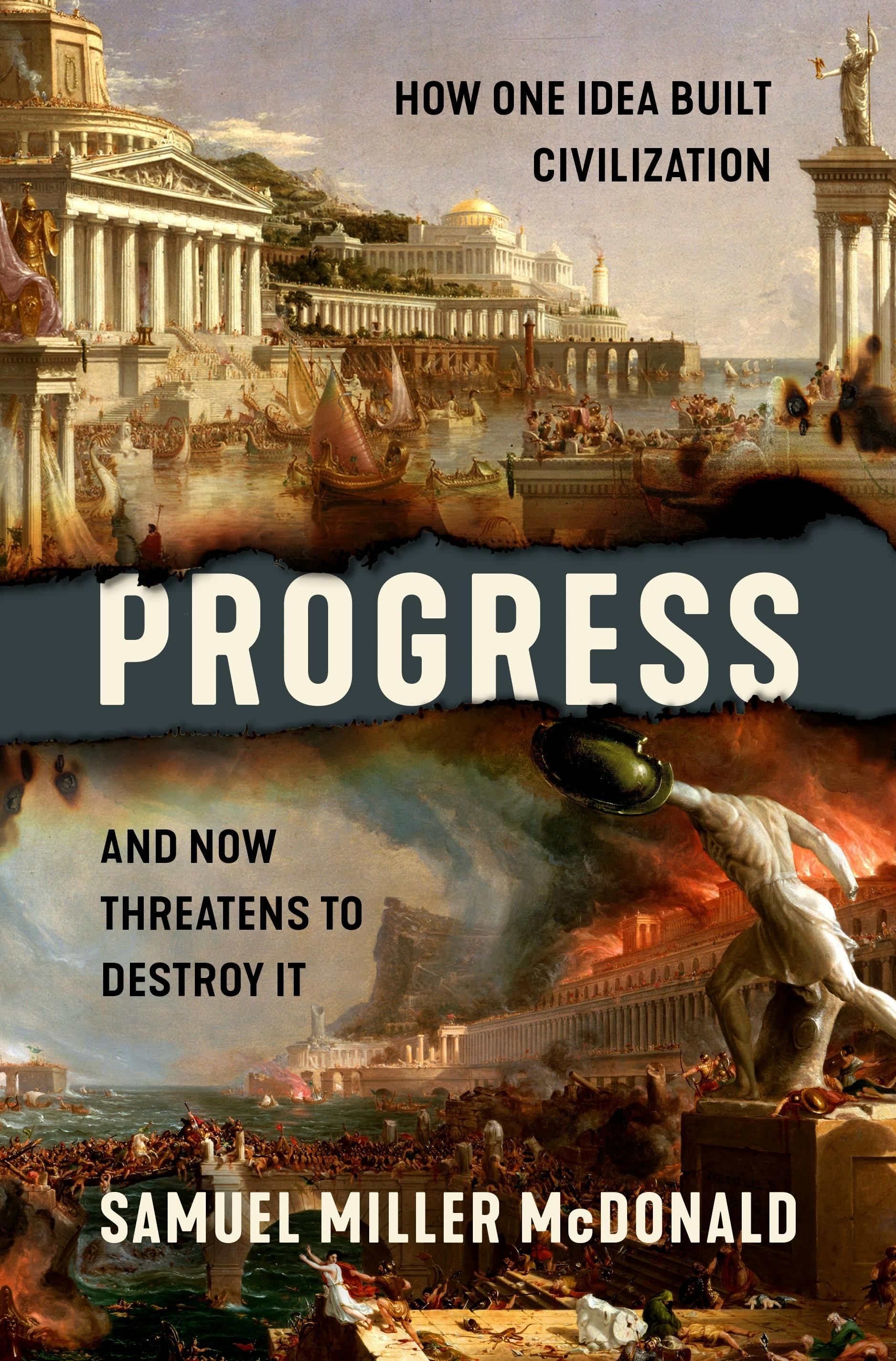
Este ensayo, a pesar de sus limitaciones, posee un innegable interés pedagógico, didáctico y político: el de sacudir conciencias. Aspira a modificar la percepción dominante en una sociedad adormecida que, al tiempo que se pierde en debates sobre inmigración, feminismo u otras polémicas superficiales, rara vez identifica las raíces del problema: las clases parasitarias, las estructuras sociopolíticas injustas y petrificadas, la destrucción de nichos ecológicos, la falta de empatía hacia los países empobrecidos, el encumbramiento de las élites económicas, la propaganda ideológica de carácter casi opiáceo y el espectáculo tecnológico. A esto es, precisamente, a lo que el autor denomina “la narrativa del progreso”, haciendo una nítida diferencia entre un progreso moral y otro de tipo técnico o económico.
El autor no niega la existencia de mejoras a lo largo de la historia —sanitarias, tecnológicas, sociales o políticas—, y en ello muestra una postura matizada: evita tanto el pesimismo radical de David Benatar como el tono corrosivo de John Gray (fascinante, por otro lado). Su tesis, más bien, apunta a que tales “mejoras” suelen ser circunstanciales, parciales y, en ocasiones, dependientes del deterioro de las condiciones de otros seres humanos —y también de los animales—. Asimismo, recurre a la antropología y a una historia de largo alcance —no restringida a los últimos 150 años de Europa— para mostrar hasta qué punto se repiten dinámicas de vigilancia, dominación, destrucción y engaño, sin dejar de señalar momentos históricos valiosos que, sin embargo, tienden a ser invisibilizados.
Por todo ello, no puedo sino recomendar su lectura, aun reconociendo algunas fallas e imprecisiones. Y, de hecho, conforme se avanza en su lectura, mejora la sensación de gratitud hacia el autor. Me parece un libro necesario, aunque también revelador en otro sentido: muchos lectores lo rechazarán no tanto por lo que dice, sino por lo que pone en cuestión.
En última instancia, el valor del libro no reside tanto en la solidez irreprochable de cada uno de sus argumentos como en su capacidad para interrumpir una narrativa hegemónica que rara vez se somete a examen. Frente a la fe casi automática en el progreso, Miller McDonald introduce una duda incómoda pero necesaria: la de si aquello que celebramos como avance no es, en parte, una forma más sofisticada de dominación, olvido o autoengaño. En este sentido, su ensayo no debe leerse como una refutación definitiva, sino como un gesto crítico imprescindible: el de reabrir preguntas que una época satisfecha consigo misma había decidido clausurar.
ENGLISH REVIEW-------------------------------------------------------
To begin with the negative aspects: yes, it is a popular science book, with all that this entails: archetypal generalizations, a lack of nuance, and a certain tendency toward a univocal discourse. Moreover, it can at times feel somewhat rushed; the many issues it addresses (religious, political, climatic…) would require, to be treated with greater rigor, a broader bibliography and a more developed line of argument.
However, it is striking that when authors such as Steven Pinker—along with legions of followers, especially of a scientistic bent—defend the opposing thesis, namely that of Progress (with a capital “P”), with its Eurocentric, statistical bias and lack of a plural perspective, the criticisms tend to be far more lenient. This is so even though, in many cases, their errors may be more serious, less responsible, and more fallacious than those of Miller McDonald—for instance, when they rely solely on local statistics or fall into false equivalences (comparisons between very different realities).
Despite its limitations, this essay possesses undeniable pedagogical, didactic, and political value: it seeks to shake consciences. It aims to reshape the dominant perception within a society that is largely anaesthetized, one that, while becoming absorbed in debates about immigration, feminism, or other superficial controversies, rarely identifies the roots of the problem: parasitic classes, rigid and unjust sociopolitical structures, the destruction of ecological niches, the lack of empathy toward impoverished countries, the elevation of economic elites, ideologically opiate-like propaganda, and the technological spectacle. This, precisely, is what the author calls “the narrative of progress,” clearly distinguishing between moral progress and technical or economic progress.
The author does not deny the existence of improvements throughout history—sanitary, technological, social, or political—and in this he adopts a nuanced position: he avoids both the radical pessimism of David Benatar and the corrosive tone of John Gray (fascinating, incidentally). Rather, his thesis suggests that such “improvements” are often circumstantial, partial, and, at times, dependent on the deterioration of the conditions of other human beings—and animals as well. Furthermore, he draws on anthropology and on a long-range view of history—not limited to the last 150 years of Europe—to show the extent to which patterns of surveillance, domination, destruction, and deception recur, while also highlighting valuable historical moments that nevertheless tend to be obscured.
For all these reasons, I can only recommend the book, while acknowledging its flaws and imprecisions. As you advance in the reading, you feel gratitude towards the author. It seems to me a necessary work, though revealing in another sense as well: many readers will reject it not so much for what it says, but for what it calls into question.
Ultimately, the value of the book lies not so much in the flawless solidity of each of its arguments as in its ability to disrupt a hegemonic narrative that is rarely subjected to scrutiny. Against the almost automatic faith in progress, Miller McDonald introduces an uncomfortable but necessary doubt: whether what we celebrate as advancement may, in part, be a more sophisticated form of domination, oblivion, or self-deception. In this sense, the essay should not be read as a definitive refutation, but rather as an essential critical gesture—one that reopens questions a self-satisfied age had chosen to close.