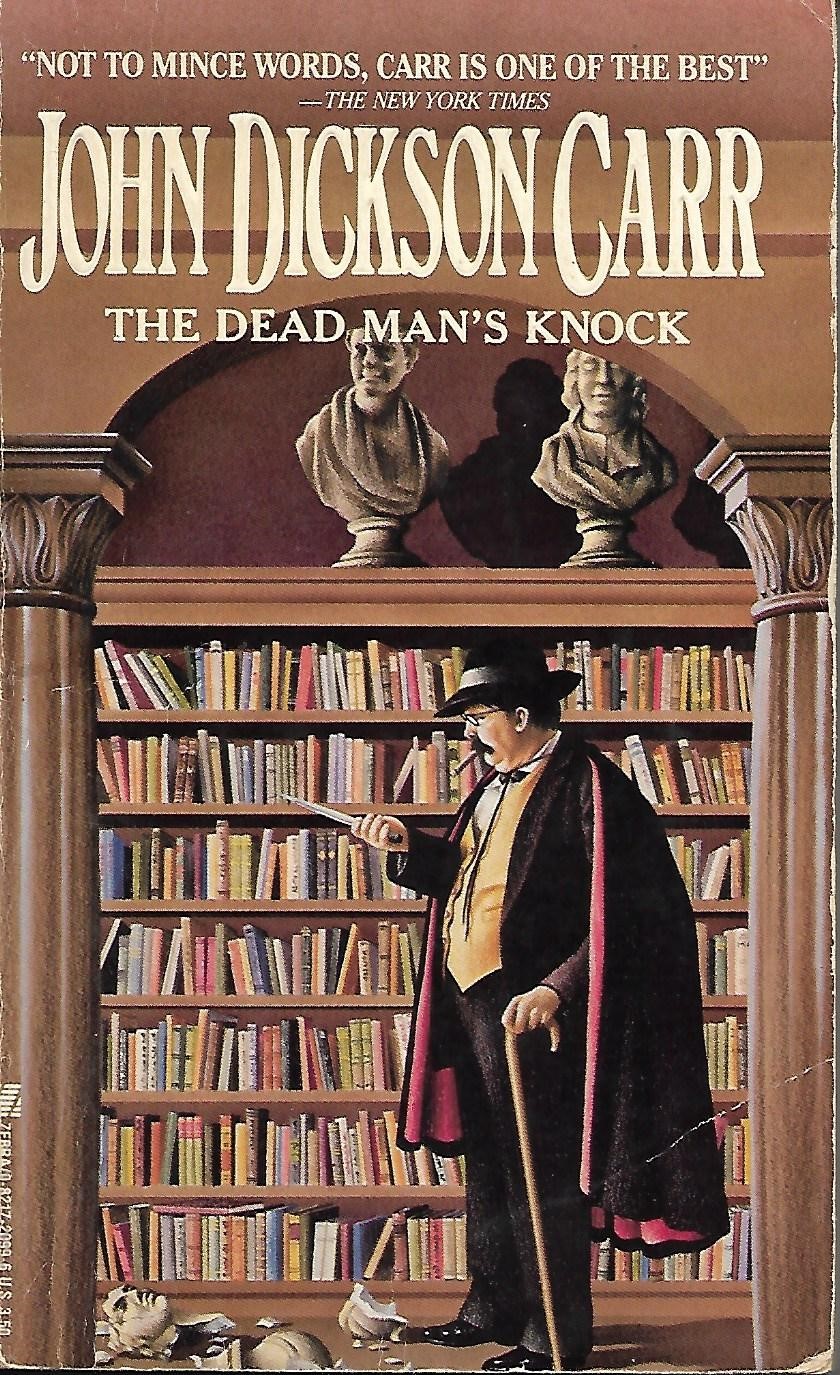
Who was she? Where had she come from? Nobody was sure. But everyone agreed Rose Lestrange had had a morbid streak, an undefinable atmosphere of evil and depravity about her. She had meddled in other people's business, toyed with other people's husbands, laughed at other people's torments. But what were Rose Lestrange's own secrets? Behind a garish death mask of frozen violence lay the answers.
John Dickson Carr was born in Uniontown, Pennsylvania, in 1906. It Walks by Night, his first published detective novel, featuring the Frenchman Henri Bencolin, was published in 1930. Apart from Dr Fell, whose first appearance was in Hag's Nook in 1933, Carr's other series detectives (published under the nom de plume of Carter Dickson) were the barrister Sir Henry Merrivale, who debuted in The Plague Court Murders (1934).
Archons of Athens! Well it started well. The locked room, murdered woman and lots of suspects. Dr Gideon Fell only appeared halfway through the book and the ending was weak or so farfetched just unbelievable. Talk of morals, justice and then the murderer gets off. Why? The victim was a horrible woman and blackmailer. For Pete’s sake that is ridiculous.
The actual story is good. An apparent joker playing pranks in the gym and pushing people into pools and scaring an elderly caretaker. Then Rose Lestrange apparently a promiscuous woman is found dead of suicide but then it is found to be murder. Mark an academic thinks his wife Brenda did it. Judith, Toby or Caroline the daughter of Dr Kent are all possible suspects along with Frank Chadwick.
In the end the murderer escapes justice and after a weird duel no-one is prosecuted. Bizarre and odd ending.
SPOILERS AHEAD
Weirdly the victim Rose who was a gossip ended up being murdered by Caroline who is not prosecuted. Why? Apparently gossips are punished with death in the name of justice. A duel between Toby and Chadwick ends with a misfire and Chadwick faints.
This entire review has been hidden because of spoilers.
Ancora una volta John Dickson Carr [1906-1977] come un prestigiatore mostra quello che il lettore crede di vedere ma la verità ce la racconta solo alla fine di questa intricata vicenda da lui scritta nel 1958 in cui la logica è implacabile.
More of an homage at times to Wilkie Collins, than a murder mystery, and many times a bit more of a suspense novel- this story while short didn’t feel short. A woman who is considered a “loose woman” who seems to easily lure men and then leave them is murdered. The technique is this mysterious last locked room puzzle that had been intimated in Wilkie Collins unfinished mystery. (Which is a locked room mystery.)
The first half we follow Mark R. Who has been studying Collins work, and is also of interest to Rose Lestrange (soon to be victim). Not giving lots away to say she is a victim here, it’s like she’s got a bullseye on her.
There’s a lot of love life angst throughout the story, and much of the mystery revolves around them not being able to talk to each other well, so no one really knows who is telling the truth. Then finally, Dr. Fell arrives and then things really start popping.
Fell dives right into the mix, and starts at the scene of the crime helping put some real perspective on the event. From here you get bit by bit of clues (on how to see) and get a clearer idea of who their murderer could be. I was close... since I narrowed it down to a couple people.
A nice ending as it was a bit of a surprise, but worth seeing someone else get a bit of comeuppance.
"Young and voluptuous Rose Lestrange walked into her bedroom and plunged a razor-sharp dagger through her heart. At least that's what the police said -- it would have been impossible for a killer to pass in and out of her bedroom because the windows and door were securely locked and bolted from the inside!
"But master detective Gideon Fell was never one to find the impassable impossible. He knew Rose Lestrange had been savagely and brutally murdered, and if blackmail was indeed the motive, other lives were surely in danger, It was up to the indomitable Fell to latch onto the locked-room killer before he bolted for freedom -- and lock him away for good!" ~~back cover
Ah, yes -- the ever-popular locked room mystery. Not my favorite cup of tea, and this one, set in the 1930s -- seemed dated. But it was entertaining nonetheless, and the solution was ingenious.
Justice? I don’t think it means what either marquee detective Dr. Gideon Fell or investigating officer Lt. Henderson think it means in The Dead Man’s Knock by John Dickinson Carr. I refer to Fell as the marquee detective because, of course, in all of the Gideon Fell stories that I’ve read, the good doctor is the one who eventually solves the crimes. Yet, the doctor could rarely be called the protagonist since the story generally follows another (usually) male character more thoroughly. The actual protagonist usually solves most of the mystery, but there is always a gap which, as they might say in Gideon Fell’s homeland, the good doctor “minds.”
The Dead Man’s Knock refers to a letter purportedly written by mystery (and sometimes supernatural thriller) author Wilkie Collins to his friend, Charles Dickens. In this letter, Collins outlines his plan to create what would ostensibly be the first “locked room” mystery with the same title as Carr’s present volume. The protagonist, Mark Ruthven (pronounced in the British “Riven”), is an academic who is a specialist in Collins’ work and managed to acquire the letter. So, the reader is led to expect a murder in the style of Wilkie Collins mystery. And, one is pretty well granted that—eventually.
But the set-up begins with a troubled marriage where both Mark and his wife, Brenda, threaten to cheat on each other. Even if this weren’t a murder mystery, one senses that this could go bad. But before any of this can be resolved, another faculty couple (including Caroline, the affianced daughter of the head of the history department, and a Pentagon consultant named Toby Saunders) arrives and a conversation ensues about a mysterious prankster, possibly a potential murderer. In the midst of this conversation, the woman Mark threatened to have an affair with, Rose Lestrange, arrives at the house and enters into the conversation. The conversation becomes heated, but nothing like what happens when Brenda returns unexpectedly from her threatened rendezvous with her lover and finds Rose Lestrange there.
With the expected fireworks, there is soon a double mystery and the locked-room mystery from the old letter proves to be a very good one. There is some misdirection toward the end, but it was quite adequately foreshadowed by a mere phrase earlier in the book. And, of course, everything hinges on the serendipitous arrival of Dr. Gideon Fell who, as is his wont, solves the full mystery while our narrator only solves a portion of it. Frankly, I only solved part of the mystery—even though the clues were fairly planted for an alert reader to find.
#19 in Gideon Fell series, and I fear that I am falling out of love with John Dickson Carr. This book was awful! It’s as if Carr stopped trusting his own voice and started trying to write the kinds of books that either he or his publisher thought were more popular at that time. So there are books where I feel as if Carr was trying to write something noir-ish or hard-boiled—or times like this when he was trying to write some psycho-sexual thriller. And those books are not Carr’s forte. I can’t say much about this book without giving the story away, but I found it all to be implausible and almost outlandish, both the characters and the plot resolution. I didn’t like any of the characters either, and felt that Dr. Fell went too far in his famously idiosyncratic sense of justice at the end.
Note that this book was published in 1958, a full nine years after the previous book in the series. I wonder why Carr took a hiatus in the series. And in another change, this book is set in the US, at a fictitious college in Virginia just outside Washington DC. Note that the book is actually set in 1948, however.
An excellent and believable locked room mystery, without any far fetched and complicated solutions. In fact, the solution is quite simple. But the story itself is quite cracking and has lots of good points. The somewhat increasingly caricature Dr Fell, is left til at least half way through to really make much of a contribution, and most of his is towards the end as he explains the solutions to the various puzzles and motivations.
Марк Рутвен — профессор, преподающий в Квин-колледже в Вирджинии. Живет он рядом с колледжем, так же, как и другие преподаватели с семьями. У Марка выдается насыщенный вечер — его лучший друг Тоби рассказывает ему о шалостях, которые неизвестный устраивает в спортзале колледжа. Бренда, жена Марка, устраивает ему сцену ревности к пользующейся дурной славой в городе Роз Лестрейндж и уходит из дома. А на следующее утро Марк, Тоби и тесть Тоби обнаруживают мертвую Роз — она заколота кинжалом. Заколота в запертой изнутри комнате своего дома.
Тучный старый доктор Гидеон Фелл впервые появился в романе «Ведьмино логово» 1932 года. За последующие 17 лет Карр написал об этом персонаже еще 17 романов. Но после романа 1949 года «Вне подозрений» Карр «распрощался» с Феллом. Он переключился на написание исторических детективов и Фелл ему был не нужен. Прошло целых 9 лет прежде, чем тучный старый доктор Фелл снова появился на страницах очередной книги. Случилось это в 1958 году в романе «Стук мертвеца».
Карр годами писал о 17-19 веках — с напомаженными мужчинами и мелодраматичными женщинами — и, к сожалению, перенес эти черты персонажей в «современный» роман. (Действие «Стука мертвеца» происходит в 1948 году.) Все персонажи в романе недоговаривают, истерят, умалчивают, перебивают, перескакивают в разговоре с одного на другое, дамы падают в обмороки. Галерея невротиков, а не профессорский состав. Чтобы донести хоть какую-то мысль до читателя, автор тратит непозволительно много времени и места. Если бы Карру понадобилось сообщить, что 2 плюс 2 равно 4, то в этом романе он потратил бы на это не менее 3 страниц.
И ведь это Карр. Который всегда отличался «легкость» прозы. Чьи романы всегда читались «для удовольствия». Через «Стук мертвеца» приходилось же буквально продираться. Концовка — это отдельная песня. Столько чуши, собранной в одном месте — еще поискать. Если кратко — все посовещались (включая полицию) и решили, что не стоит выдавать убийцу властям. Ведь он «всего лишь убил» нелюбимую никем в городе Роз.
Что особенно жалко, что для столь беспомощно написанного романа Карр придумал хорошую «легенду». Решение очередной «загадки запертой комнаты» более чем элегантное. А подсказывает эту загадку преступнику вымышленная переписка между Уилки Коллинзом и Чарльзом Диккенсом. («Стуком мертвеца» Карр назвал выдуманный им роман Уилки Коллинз��.) Всё красиво. Надо было только к этой красоте написать хороший роман. А Карр этого не сделал.
Ah, crazy events are happening in a college community — a 'joker' paints images of the school's founder at various locations, scaring the ancestor of the college founder and nearly drowns a 16-year-old boy; a professor and his wife argue and she flees their home, convinced that her husband is having an affair with Rose Lestrange, who happens to turn up dead the next day.
The faculty debate what is happening and who could be the guilty party, and admittedly, a couple of them are pretty sharp, even as they try to arrange the facts of the death to protect said institution. But its when Dr. Gideon Fell comes to visit that things come together, leading to the solution of how the murder occurred, who was involved and who was guilty.
Gideon Fell, created by the clever and talented writer John Dickson Carr, is one very interesting protagonist. He is heavy, so much so that in this book, he gets around with the aid of two canes, but his brain is lightning quick and he is very good at pulling the key strings to solve mysteries, most of whom involve locked room or so-called impossible crimes. And the stories — I've read several in this 23-book series — are just plain fun to read!
Dickson Carr writes in such a way that the reader even gets pulled into the action — and is kept guessing. That's good writing.
This is another Carr novel where the differences in morals between then and now become more obvious. It's only been 66 years since this was published, but I still found the end pretty shocking. The ? Actually I feel like all the characters in this one were bad people. The actual mystery and solution is good but the ending is so unsatisfying.
Having enjoyed at least one other Doctor Fell story, I picked up this nicely-kept vintage copy planning to enjoy it. Unfortunately, this post-WW2 outing disappointed, with poor "psychological" insights and easy - ridiculously easy - villains and very, very odd behavior by too many characters - up to and including the police. The Washington, DC area academic setting provided most of the pleasure there was.
I think other I read were circa the 1930s, and much more fun, in their period flavor. This one? No. Rather sorry I wasted the time.
It’s interesting that Fell and Merrivale both end up in the States in their 19th outings, even though Dead Man’s Knock and A Graveyard to Let were published 9 years apart. Another similarity, the final books of both Fell and Merrivale are supposed to range in quality from terrible to atrocious but I’m finding them pretty decent diversions and not at all as bad as they’re made out to be.
(Many times in JDCs the course of true love—who should end up with who—hints at the resolution, but in this case it doesn’t because it isn’t ever resolved in itself.)
3 1 /2 stars. I enjoy Carr's novels. This was complicated and difficult to figure out who did the deed. I thought the ending was too unlikely. The police aren't going to allow the modern equivalent of a duel to take place.
A side note: The association with Wilkie Collins and his possible second book being a locked room mystery years before the first one of that that type was interesting.
È uno degli ultimi Carr, considerati quasi unanimemente come le opere meno riuscite del Re della camera chiusa, eppure mi ha colpito. L'atmosfera del romanzo è piacevole, cone anche i riferimenti ad un eventuale romanzo di Dickens con camera chiusa. Il colpevole forse non è così complesso da individuare, ma la camera chiusa è molto carina nella sua ssemplicità.
Typical Carr novel with lock door, romance, and of course Dr. Gideon Fell. Just all round easy read-period piece. Sleuthing without a lot of gore. Reread after sitting on my shelf for over 20 years.