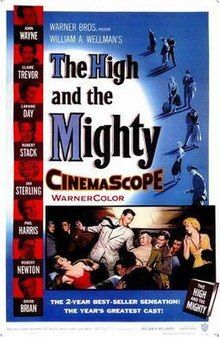
An outstanding look at midcentury commercial aviation, published fifty years after Kitty Hawk.
The High and the Mighty is beautifully executed, and each of its twenty characters are given their own rounded dignity, warts and all.
* * *
Notes:
Here is the information you requested about the novel:
Plot: The novel follows a group of passengers and crew on a trans-Pacific flight from Honolulu to San Francisco. The flight encounters trouble when one of the plane's propellers breaks off, causing a fire and fuel loss. The captain and crew must work together to make a safe emergency landing.
Setting: The setting of the novel is the 1950s, during a time of rapid technological advancement in aviation.
The story takes place primarily on board a commercial airliner flying over the Pacific Ocean.
Characters: The novel features a diverse cast of characters, including:
* Dan Roman: A veteran pilot with a troubled past, serving as the first officer.
* Captain Sullivan: The experienced but initially insecure captain of the flight.
* Hobie Wheeler: The young and eager third pilot.
* Leonard Wilby: The dedicated and meticulous navigator.
* Spalding: The stewardess, who is calm and collected under pressure.
* Various passengers, each with their own personal stories and struggles.
Location: The story takes place on a flight from Honolulu, Hawaii to San Francisco, California. The plane flies over the Pacific Ocean and passes near several islands and ocean stations.
Themes: The novel explores several themes, including:
* The nature of fear and courage: The characters confront their fears and insecurities in the face of danger.
* The fragility of life: The near-death experience forces the characters to re-evaluate their priorities and values.
* The power of human connection: The passengers and crew find strength and support in each other during the crisis.
* The changing world of aviation: The novel reflects on the rapid technological advancements in aviation and their impact on pilots and passengers.
Style: The novel is written in a descriptive and suspenseful style, with detailed accounts of the technical aspects of flight and the emotional states of the characters. Gann uses vivid imagery and metaphors to create a sense of realism and immediacy.
Point of View: The novel is written in the third person, shifting between the perspectives of different characters throughout the story. This allows the reader to understand the thoughts and feelings of multiple individuals involved in the crisis.
* * *
Here is a brief synopsis of each chapter of the novel:
Chapter 1
* A forecaster in Honolulu discusses the weather with Captain Sullivan, the pilot of the flight.
* The forecaster is condescending and arrogant, highlighting the tension between pilots and weathermen.
Chapter 2
* Sullivan meets with his crew, including the copilot Dan Roman, navigator Leonard Wilby, and third pilot Hobie Wheeler.
* They discuss flight preparations, including fuel calculations, passenger manifests, and preflight inspections.
Chapter 3
* The passengers check in for the flight, each with their own background and story.
* Spalding, the stewardess, interacts with the passengers and observes their personalities.
Chapter 4
* The air traffic controller in Honolulu guides the flight for take-off and initial ascent.
* The controller is hungry and irritable, waiting for his relief to arrive.
Chapter 5
* The flight takes off and climbs to its cruising altitude.
* The crew settles into their routines, checking instruments and making adjustments for optimal flight performance.
Chapter 6
* The passengers settle into the flight, some enjoying the experience while others are anxious or preoccupied with personal thoughts.
* Ken Childs, a successful businessman, reflects on his past and a chance encounter with Dan Roman.
Chapter 7
* Leonard Wilby, the navigator, calculates the flight's course and position using various methods, including celestial navigation and loran.
* He contemplates his life and his relationship with his wife Susie.
Chapter 8
* The flight passes over the Coast Guard Cutter Gresham, which provides a radar fix and weather report.
* The crew of the Gresham yearn for the excitement of the flight compared to their monotonous duties.
Chapter 9
* The sun sets and the flight continues smoothly.
* Sullivan becomes aware of a growing fear within himself, a common experience for aging pilots.
Chapter 10
* The flight encounters turbulence and the crew notices an unusual vibration.
* Sullivan investigates but cannot find the cause of the vibration.
Chapter 11
* The vibration worsens and Spalding, the stewardess, reports it to the flight deck.
* Dan Roman investigates the tail of the aircraft but finds nothing unusual.
Chapter 12
* The passengers become aware of the vibration and grow concerned.
* Spalding tries to reassure them and maintain order in the cabin.
Chapter 13
* The crew discovers that the number-one engine is losing fuel rapidly.
* They realize they may have to ditch the aircraft in the ocean.
Chapter 14
* The crew contacts the Cristobal Trader, a nearby freighter, to relay messages to San Francisco.
* San Francisco Air-Sea Rescue is alerted and begins mobilizing rescue efforts.
Chapter 15
* The crew prepares for a possible ditching, instructing the passengers on emergency procedures.
* The passengers react to the news with varying degrees of fear and acceptance.
Chapter 16
* The Coast Guard dispatches a B-17 to intercept the flight and guide rescue efforts.
* Leonard Wilby struggles to maintain his composure and accurately calculate their position.
Chapter 17
* The flight descends into an overcast and encounters St. Elmo's fire.
* The crew feels isolated and uneasy in the turbulent atmosphere.
Chapter 18
* The flight makes contact with the Coast Guard B-17.
* The crew is relieved to have support and guidance.
Chapter 19
* Leonard Wilby discovers a critical error in his navigation calculations, further jeopardizing their situation.
* Sullivan decides to ditch the aircraft
Chapter 20
* Dan Roman confronts Sullivan and convinces him to attempt a landing in San Francisco despite the risks.
* They begin a desperate descent, battling low fuel and challenging terrain.
Chapter 21
* The flight successfully lands in San Francisco, narrowly avoiding disaster.
* The passengers and crew disembark, forever changed by their experience.
* * *
Here is a list of all the characters in the novel, along with the paragraph where they are introduced:
* Captain Sullivan: "The forecaster caressed his bald head and then swept his bony fingers across the course from Honolulu to San Francisco. His contemptuous gesture embraced over two thousand miles of water and sky. On the paper beneath his hands, delicate lines had been drawn connecting the areas of equal atmospheric pressure. They fell into a strangely rhythmic design, swirling together across the paper as if the Pacific winds had blown them into shape. The forecaster rubbed his long nose while he regarded the lines suspiciously."
* Dan Roman: "On the other side of the airport, beyond the sound of the easy Hawaiian music, yet exposed to the sun and the soft easterly wind, Dan Roman moved deliberately through the ritual of preflight inspection. He was a lean, rock-faced man whose erect carriage made him seem taller than he actually was. As the copilot it was his duty to make certain the plane was ready for the flight. The mechanics had fueled the plane and run the four engines; now Dan Roman had over fifty items he must personally observe. He was well aware that many of them, though insignificant when considered against the big ship as a whole, were potential murderers. They could kill Dan Roman and they could kill many other people with him. Therefore he regarded each item with suspicion, as a skilled detective might contemplate known prisoners in a morning line-up. The years had taught Dan Roman the criminal histories of the various mechanical contrivances; he knew only too well how the most innocent of them might combine with circumstance to kill. He could seldom remember the dates, or even the time of year, but it took only a moment’s reflection to recall a specific accident in which he had lost a friend or a friend of a friend—“accidents” which were mysteries only to the newspapers. Usually the murderer, and accomplices if any, had been identified, though the search for them might require months. When they were known, word of them was passed quickly through the tight society of flying."
* Leonard Wilby: "When he left the weather room, Sullivan descended a long flight of stairs. At the bottom he almost collided with Leonard Wilby, his navigator. "Sorry I was late, Skipper. I got hung up buying a present for Susie."
* Hobie Wheeler: "Hobie Wheeler, the third pilot, came into the operations office. He was a dark-skinned, wiry young man with eyes that slanted in such a way he might have passed for an Oriental. He licked thoughtfully at an ice cream cone and joined Sullivan before the bulletin board."
* Spalding: "The last of the passengers surrounded Alsop like grapes on a stem. Because they were a trifle late they were more eager than the others, as if they feared the plane might leave without them. They were hot and tense, fanning themselves periodically and trying to push a little ahead of each other. Alsop had left his counter momentarily to process a sick man named Frank Briscoe who now sat waiting patiently by the souvenir stand and would require help to board the plane. He had also sent the Bucks, Milo and Nell, on their way—the newlyweds who had come before him in a haze of endearing whispers and floated away from the counter still speaking as softly to each other as the eastern wind.
Alsop was talking to a woman named May Holst. She gave her age as fifty and her birthplace as Rockland, Ohio. Spalding thought she was a very well-preserved fifty except for her eyes, which were pouched until they were only slits in her face. But what could be seen of her eyes spoke merrily and her voice was the kind that should only be heard through a bedroom door—sensual and chuckling, knowing, and to Spalding a secret delight. "Will I be glad to get on that airplane!"
* Donald Flaherty: "A neatly dressed man with a grey bristle of mustache mopped the perspiration from the bags beneath his eyes. "Yes?"
* Mr. and Mrs. Joseph: " "Righto. The Waikiki kids!” Edwin Joseph seemed to force his way toward the counter although there was nothing to hinder him.
Alsop’s eyebrows arched slightly as he examined the man and woman who faced him with almost pathetic eagerness. They tumbled into his mental card file as two very small people almost entirely obscured by flower leis. Only their painfully sunburned faces emerged from the floral display.
“Just put us down as a float for the Rose Bowl parade,” said Edwin Joseph."
* Sally McKee: " "My name is Sally McKee." As she stepped closer Alsop noticed that her eyebrows consisted entirely of paint and the line of her face make-up matched imperfectly her strawlike hair. The total effect was of a mask, worn slightly askew. It is Halloween, Alsop thought."
* Mr. and Mrs. Pardee: " “Mr. Gustave Pardee and wife Lillian?”
“Right here!” The voice came from an enormous, sloppily dressed man. His eyes bulged and his small mouth gasped heavily for air as he rearranged the elaborate photographic equipment hanging from his shoulders and sought uncertainly for his tickets."
* Ken Childs: "A deeply tanned man with his grey hair brushed in a tight pompadour pushed his tickets toward Alsop. His face was lined and beefy, and again the odor of whisky drifted across Alsop’s papers.
“Ken Childs . . . fifty-three . . . born Philadelphia.” Every word was a brusque command."
* Dorothy Chen: "Alsop consulted his list again. He went through the motions of checking the names as if it were impossible to guess the name of the girl who had moved so quietly to the counter. He had noticed her standing almost immovable behind the others, looking strangely out of place in her black silk dress and white gloves. Alsop found her patience and dignity a matter of such rare pleasure he let her wait before him a moment longer, reluctant to disturb the tranquility of her face."
* Humphrey Agnew: " "Can I help you, sir?" Alsop asked. He was still thinking of Spalding, and his voice was indifferent.
"San Francisco! I got to go to San Francisco. Your plane hasn’t left yet?"
"We’re departing in five minutes . . . butour manifest doesn’t show—"
"Mr. Kenneth Childs is on your flight, isn’t he?"
"Why, yes. Mr. Childs—"
"You must have room. I must get on that plane!"
"Very well, sir. Fortunately we have space today. If you are an American citizen we have just time."
"I am . . . oh, I am! . . . for sure!" He mopped frantically at rivulets of perspiration streaming down his face. His long nose drooped over his wisp of a mustache as if exertion and the heat had melted it. His eyes bulged and the whites were flecked with yellow. Only his large ears seemed to be holding his sagging cheeks from complete collapse. He looked like a sick gargoyle, Alsop thought, and without reason he found himself disliking the man. "What is your name, sir?"
"Humphrey Agnew."
* May Holst: " "If it’s so funny, the least you could do is share it with a fellow passenger . . .” He turned to see the woman across the aisle leaning toward him. “I’m bored stiff,” she said. He liked her eyes. They were full of fun.
"My name is May Holst. I hope you don’t think I was prying, but the sight of a man laughing to himself is bound to arouse any woman’s curiosity." "
* Frank Briscoe: "The pain began at the base of Frank Briscoe’s skull, then daggered down his spine until it passed through his arms and flowed out of his fingertips like rivulets of molten metal. Yet he held perfectly still in his seat, gripping the chair arms with all the strength remaining in him, hoping no one would notice the heavy beads of perspiration on his forehead. His face was grey and his lips trembled as he sought desperately to ignore his agony. No one must know about Frank Briscoe, because if they did find out, then there would be the obligation of sympathy, and that emotion in itself could hasten the destruction of Frank Briscoe. Not that cancer of the bones, multiple myeloma, as the doctors called it, needed any hastening. The bones were already only fragile casings with no more resistance to a shock or an overquick twisting, than an egg shell. Frank Briscoe, who only five years ago could bend a silver dollar with his bare fingers. Oh God, please give me a minute’s peace . . . just one. Or take me now and let’s have it over with."
* Milo and Nell Buck: "The newlywed Bucks were away up forward, huddled together in silent pleasure."
* Lydia Rice: "Little Lydia Rice, her doll-like head barely level with his waist, moved in almost exact unison with her husband. They could have been dancing, Spalding thought—to the tinkle of her bracelets."
* José Locota: "Now a small dark man was standing patiently at the counter. There was a look of abject apology in his large brown eyes. He was wearing a cap and a cheap green suit, and though his shirt was freshly laundered,
* * *