With a new purpose in life, Thorfinn promises himself to not take another life whilst he and his fellow slave Einar worked hard on Ketil’s farm to achieve their freedom. However, there are many obstacles that will come their way, whether it is domestic troubles or the Nordic political situation led by King Canute.
Returning to his homeland to see his older brother, King Harald of Denmark, who has fallen ill with no heir, Canute is suddenly given the crown that was worn by his late father, King Sweyn, the man he conspired to kill. In his determination to expand his conquest, Canute hallucinates by seeing his father’s rotting head, taunting him about how the son has become like his father.
The parallels to Macbeth are there, in terms of how royal conquest can lead to backstabbing results, in this case, poisoning his own brother. Considering how the story can lead to moments of fantasy, these moments oddly bring out the most compelling exploration towards humanity at its most honesty, such as the irony of despite Canute hating his father, he’s the only person he can talk to through his hallucinations.
As Ketil and his younger son Olmar arrive at Jelling, the capital of Denmark, to see King Harald without realising of his passing, Ketil hopes to win favour with the new king, despite the latter having dastardly plans with his farm. Meanwhile, Olmar is still trying his worth as a warrior, despite his constant screw-ups, such as a meeting with Canute, who allows Olmar the chance to prove his worthiness by cutting up a dead pig that will be cooked for dinner, a task he ultimately couldn’t do.
From the previous volume onwards, the series has gone through a transition that isn’t relying much on action, but that is not to say there is some bloody mayhem along the way. What starts off as comical with Olmar getting into a violent scuffle with the King’s messengers, it ends up being a key moment in where the story is going, particularly how it’s possibly setting up a number of reunions.
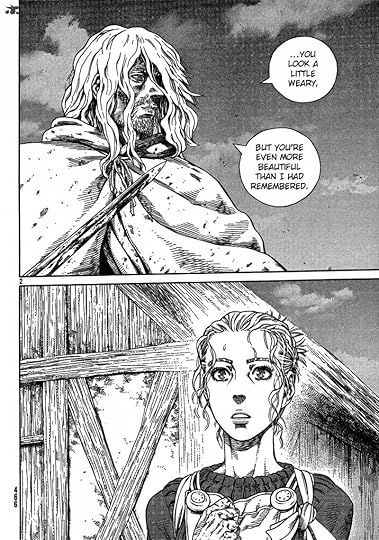
Halfway through the volume, the drama goes back to the farmlands where a murderous slave escapes, only to be reunited with his wife, who turns out to be Arnheid, Ketil’s concubine. This sets up a dilemma for Thorfinn and Einar, as the former worries his participation could lead to breaking his new vow, whilst the latter wishes Arnheid for her freedom that he might ruin his chance for his own freedom. This is the most intense the series has been since Askeladd’s demise, where the outcome can go in any direction, whilst delivering some of the best characterisation from multiple players. We certainly see more of what Thorfinn wishes, which is find a place where there is no war and slavery, evoking the place that the sailor Leif called Vinland.
At this point in the series, in terms of publication, but Vinland Saga has proven itself to be one of the greatest manga of all time, in terms of deep characterisation, dark exploration of humanity and stunning art, all of which by Makoto Yukimura.