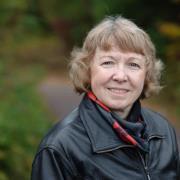
Kathleen Norris was born on July 27, 1947 in Washington, D.C. She grew up in Honolulu, Hawaii, as well as on her maternal grandparents’ farm in Lemmon, South Dakota.
Her sheltered upbringing left her unprepared for the world she encountered when she began attending Bennington College in Vermont. At first shocked by the unconventionality surrounding her, Norris took refuge in poetry.
After she graduated in 1969, she moved to New York City where she joined the arts scene, associated with members of the avant-garde movement including Andy Warhol, and worked for the American Academy of Poets.
In 1974, her grandmother died leaving Norris the family farm in South Dakota, and she and her future husband, the poet David Dwyer, decided to temporarily relocate there until arrangements to rent or sell the property could be made. Instead, they ended up remaining in South Dakota for the next 25 years.
Soon after moving to the rural prairie, Norris developed a relationship with the nearby Benedictine abbey, which led to her eventually becoming an oblate.
In 2000, Norris and her husband traded their farmhouse on the Great Plains for a condo in Honolulu, Hawaii, so that Norris could help care for her aging parents after her husband’s own failing health no longer permitted him to travel. Her father died in 2002, and her husband died the following year in 2003.
I love Kathleen Norris. She was the town librarian in the South Dakota town where I grew up, and I was fascinated even then by the fact that she was a writer (as was her brilliant and eccentric husband, David Dwyre). I used to go to her house to sell greeting cards just so I could peer into the life of these two intellectuals, settling for some reason in our little town. I was drawn to this book because of my own struggle with faith and my sense that she, too, has agonized over many of the same questions. Norris ultimately seems to embrace her faith and understand it in a way that I have not yet managed. My favorite is A Prayer to Eve, "mother of fictions and of irony."
Here's a quote: "Now it begins: the search for a God who has moved on, the God-please-help-me need you still can't imagine; strangely twisted landscapes in which you may not rest. The pillar of cloud you saw march across the plain will pass you by; some younger child will see it.
It was given so easily, and now you must learn to ask for it back. It's not so terrible; it's like the piano lessons you love and hate. You know you want the music to sound but have to practice, half in tears, without much hope."
Little Girls in Church is a quiet, tender collection, a deeply affecting blend of poetry and practical theology. Norris masterfully weaves the everyday and seemingly simplistic with the deeply spiritual. I particularly enjoyed the way this collection married science and mysticism, with one of my favorite lines being from the poem, "Vision: A Note on Astrophysics." This section reads, "Heisenberg shrugs/ and says, 'I am not sure/ what an electron is,/ but it's something like a cloud of possibilities.'// Hildegard/ saw it plain,/ in the monastery at Rupertsberg,/ midway through her life, in 1140 or so:/ Eve/ as a cloud,/ leaf-green, shining,/ containing stars..." My God, that's so beautiful.
The only thing keeping me from giving this collection five stars is one or two poems that felt a bit average (nowhere near bad, just average) compared to the rest, but this is still one of the better collections I've read all year.
While on vacation in Taos, I popped in to Op.Cit Books and knew I'd save this collection to read during Advent and Christmas. It felt like a homecoming — I heard Kathleen Norris speak at Baylor University back in 2003. Back then, I thought I would write fiction. Nope, turns out, I've got that poetry bent. Also, back then, I didn't know I had that Catholic bent too. So to read was to delight in all those seeds that were sown two decades ago, now a mess of colorful roses.
Would you believe the copy I bought is signed? It is. A sign indeed.
Here is a cento, drawn from words and phrases I highlighted in "Little Girls in Church."
Big Girl in Church
in the Mary chapel in the blue light between psalms silence I kneel down glad to be yellow again
muse of exile – mother of the road – yeah
explore the poem how beautiful, hidden where only God can find it
Norris finds the sacred in the “secular,” weaving together doubt and even disdain with the steady rythmns of the monastic and liturgical life. Women are the major players and voices in this collection, and a prairie landscape often the backdrop. Altogether solid collection of poems with some truly glowing and arresting lines.
I liked a lot of the imagery and spiritual allusions in this poetry collection. Sometimes the title threw me off and at other times it was enlightening. The titular poem had some of the best images, but my favorite poems were toward the end where sacraments come to the forefront.
Masterful work. A bleakness was settling over me through the middle section that almost took me out, but I persevered because of the poet’s mastery of craft. The turn for me Came with the poem “A Letter to Paul Carroll.” Then it was all astonishing. Well done, Madame Norris 👌🏻
Wonderful stories and practical theology packed in glimpses. And a few where I didn’t know the allusions and felt outside looking in on something I wasn’t a part of.
I had only read Kathleen Norris's books on spirituality but had not read her poems. I found that these poems provided me with new thoughts as well as a range of emotional responses. Poetry seems so much more intimate than prose in that it exposes the author's feelings rather than just their thoughts. I found some of them surprising in that the mental picture I had built up of the author was challenged when I read her poems as opposed to her prose. She is so much more tender than I am. I love poetry both ancient & modern & this little book is a gem.
Like her prose, Norris' poems are well crafted and moving, devoid of maudlin sentimentality, but filled with plenty of honest feeling. These address the sort of real life grace Flannery O'Conner brought to life in her stories. I found myself grinning as I read several of these poems, particularly those with children at the center, as I recognized the innocence and earthy faith one sees in kids. I already felt Kathleen Norris was an important writer before having the chance to read her poems. This book only solidifies that opinion for me.
another great poetry collection, i stumbled on this while picking books out from a public library in ND. I randomly picked this one out and it became one of my favorites. The author really is an amazing writer and you can feel that in every part of the book. I loved it so much i kept the book and payed for the lost fee at the library. She does a good job at displaying the feeling of being a little girl a church funny enough and i just fell in love with her writing, with my favorite being persephone. Something about it just has stuck with me for year and continues to be one of my favorite poems.
I learned that my friend Kathleen is as good a poet as there is writing in America today. Her commonplace observations are stunning. I especially loved the title poem, "Little Girls in Church". There is another one written while observing a young boy and his little sister as they look out the airplane window as the plane descends into the Minneapolis airport. If you would like to get your feet wet on the poetry of Kathleen Norris, I would recommend this to do. You don't have to be either brave or poetic to appreciate it. All you have to be is human.
This is a book of very solid poetry. Some of it is clearly inspired, some more standard and just simply acceptable. I met Norris as a senior in college and was lucky enough to talk poetry with her for hours, discovering that she is hugely modest about her talent. This modesty and the intensity I felt in her are evident in her poetry itself, as is her faith in a Christianity and, simultaneously, her frustration with it. That faith and frustration aid her in crafting some very good and a few great poems in this book.
Kathleen Norris is one of my inspirations - her spiritual writing has taught me much and moved me even more. This is the first book of her poetry that I have read. There are such wonderful poems in here, poems about her family, her faith her life.
I know that reading poetry is not everyone's cup of tea, but when I find the right poem at the right time my heart sings. If you don't think you like poetry, I say you haven't found the right poem yet.
Extremely real, using images that are not remote or obscure, but tangible and easily relatable. As a woman of faith, Norris' poetry speaks to a female experience of 'Church' in a powerful way, as well as relating the experience of 'Church' to the female in ways not often talked about in 'higher' religious circles. Recommended as a good companion to a study of feminist theology, or to women of faith (or those women questioning faith) who are looking for a poet to be in conversation with.
I liked this book of poems. At first it felt more uneven. But as I read my way through it - at the end - it felt like it made sense and it flowed. I could hear the rhythm of the poems. I liked many of the poems and it felt like they got stronger throughout the book. Her use of imagery was mostly good. It was all certainly rich. Some of it I didn't feel - but most of it I did.
Collection of poetry in which spirituality and religion play a part, both as a common thread and as a metaphor for life, and for death.
Excellent poems, although at times it feels as if the poet is taking a step back from her own spirituality, as if she is afraid to feel, and is regarding her own faith with a far too critical eye.
Kathleen is a special poet and writer who through her simple quiet life in the Dakotas manages to tap into the spiritual and mystical in a very profound manner. Great and strange little book of poetry.
I love how this author views people and the world. Such kindness in her poetry and spirituality for the landscape, God's creatures and human relationships. A beauty of a book.