

What do you think?

Hansel and Gretel
Lesser and Zelinsky retell the story of a pair of children lost in the woods who run into a witch with a very tasty house.
48 pages, Hardcover
First published January 1, 1984
About the author
Rika Lesser
21 books8 followersRika Lesser, twice the recipient of translation prizes from the Swedish Academy, is the author of four books of poems and seven books of poetry in translation.
Ratings & Reviews
Friends & Following
Create a free account to discover what your friends think of this book!
Community Reviews
Displaying 1 - 30 of 217 reviews

May 28, 2019
This is a beautiful edition of Hansel and Gretel. I tell you something; it’s a cruel world when parents are starving and they want to ditch their children. Usually, a mother would die to save her children, so something must be wrong with the mother of Hansel and Gretel. She is the driving force to ditch the children in the woods. Living next to a forest, you would think they could find some game to eat first. It’s a rough story.
The children must face down death and then they are given great wealth. The artwork is beautiful. I assume this is still the Italian Renaissance style that Paul has been using. It looks similar.
I have always enjoyed this story. It is rather dark. The children must face so many of their fears at once. I suppose it is part of becoming an adult.
Both children loved the gingerbread looking house, only here it was made out of pancakes and pastry. They thought it was funny to eat a house. The niece gave this 3 stars and the nephew gave it 4 because he liked the witch.
The children must face down death and then they are given great wealth. The artwork is beautiful. I assume this is still the Italian Renaissance style that Paul has been using. It looks similar.
I have always enjoyed this story. It is rather dark. The children must face so many of their fears at once. I suppose it is part of becoming an adult.
Both children loved the gingerbread looking house, only here it was made out of pancakes and pastry. They thought it was funny to eat a house. The niece gave this 3 stars and the nephew gave it 4 because he liked the witch.

May 3, 2016
Rika Lesser's retelling of the Brothers Grimm Hansel and Gretel (with Paul O. Zelinsky's glowing, expressive and indeed painterly illustrations) is what I humbly would call an absolutely perfect marriage of text and images. Often, retold fairy tales can be rather pale, barely adequate (if not even lifeless) reflections of their original, but Lesser's rendering is really and truly as close to and as authentic an adaptation of the Grimms' original text as possible without being a word-for-word translation, capturing ALL of the original, both thematically and stylistically. And Zelinsky's accompanying illustrations, aside from being an evocative, descriptive visual treat, they also seize and actually at times even seem to expand on the feel, the cadence, the geography and culture of Lesser's narrative, and therefore by extension the original Grimms' tale as well, visually reminding me of late 18th and early 19th century Germany, with authentic costumes depicted, as well as glowingly showing not only the beauty and mystery, but also the always inherent creepiness and potential danger of the German Wald of the German forest of culture and lore (not to mention that I also most heartily and appreciatively enjoy that Zelinisky's witch has NOT been depicted in Hansel and Gretel as some green-skinned, crooked nosed, frightening and visually abhorrent crone, but as an on the surface harmless and actually even quite pleasant appearing elderly grandmother-like woman, because in my opinion, much of the danger and horror of the Grimms' Hansel and Gretel story rests with the fact that the children, that Hansel and Gretel are at first all too easily duped by the evil witch simply because she both talks compassionately and looks fair and harmless on the outside, but is vile, disgusting, cannibalistic and evil on the inside). But for me personally, what has moved Hansel and Gretel from simply an appreciated five star fairy tale retelling to a cherished place on my favourites shelf is Rika Lesser's descriptive and informative storyteller's note, a detailed and academically sound, educational analysis which not only describes the genesis of the Hansel and Gretel tale in minute and meticulously researched detail, but thankfully and glory be, there are also no spelling mistakes with regard to the German language words used (which so often does seem to happen in and with both children's and adult literature and yes, often does tend to drive me to distraction). Highly recommended, and in my opinion, this is the hands-down BEST Hansel and Gretel adaptation in English I have read to date (and indeed most deserving of its Caldecott Honour Medal for Paul O. Zelinsky's illustrations).

April 1, 2013
Hansel and Gretel had a much more challenging life than I realized. I knew they got lost in the woods and were almost cooked and eaten by an evil old witch, but what I did not know was that it was their own mother's idea to abandon them in the woods to begin with. Crimony, talk about emotional scarring!
The kids had a bit of a hard time reconciling themselves to the cruelty of Hansel and Gretel' s parents (mother in particular), but they finally figured it out. The illustrations in the edition that we read lead the reader to the conclusion that . This observation helped the kids deal with why Mom was such an awful protector. I am awful at picking up on nuance and detail in illustrations, so it was the kids who pointed out the slickness of this story to me. They both liked this story--I think they rather enjoyed the menace, the bad characters' comeuppance, and they liked that the story was about a sister and a brother watching each other's backs. My niece's reaction made me think that she may be ready for A Tale Dark & Grimm. My nephew's reaction made me think that I'd hate to meet him by an oven if he was angry! In his opinion, Gretel was too easy on the witch!
The kids had a bit of a hard time reconciling themselves to the cruelty of Hansel and Gretel' s parents (mother in particular), but they finally figured it out. The illustrations in the edition that we read lead the reader to the conclusion that . This observation helped the kids deal with why Mom was such an awful protector. I am awful at picking up on nuance and detail in illustrations, so it was the kids who pointed out the slickness of this story to me. They both liked this story--I think they rather enjoyed the menace, the bad characters' comeuppance, and they liked that the story was about a sister and a brother watching each other's backs. My niece's reaction made me think that she may be ready for A Tale Dark & Grimm. My nephew's reaction made me think that I'd hate to meet him by an oven if he was angry! In his opinion, Gretel was too easy on the witch!

January 1, 2012
Some of the issues in this story include poverty, famine, starvation, abuse, abandonment and cannibalism, so this version of Hansel & Gretel is pretty dark. It is dark because the plot is as true as possible to the tale as it was first published by the Brothers Grimm. Despite all its macabre violence, Hansel & Gretel is one of the best fairy tales out there that emphasizes on the love, loyalty and trust between siblings. Children should read this. However, if your child is very young you might have to explain why the children's mother wanted to abandon her children in the forest.
Paul O. Zelinksy's illustrations are simply beautiful! They create a rustic feeling which complements the plot.
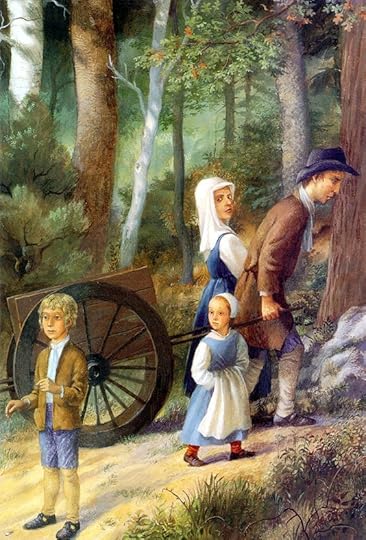
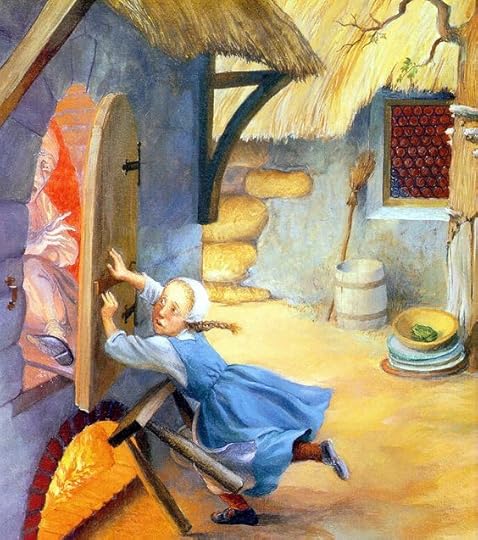
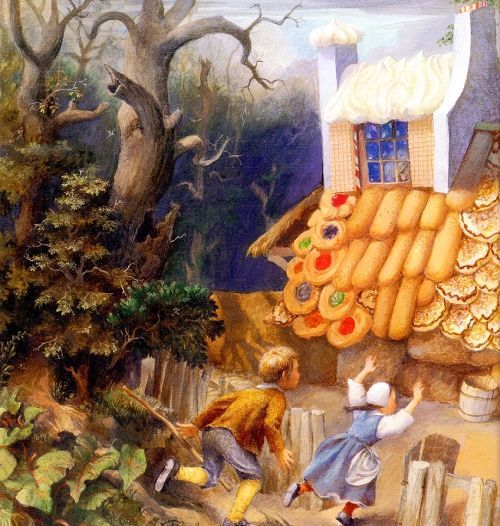
Paul O. Zelinksy's illustrations are simply beautiful! They create a rustic feeling which complements the plot.

September 11, 2013
This was an fascinating variation of the traditional Brothers Grimm tale, "Hansel and Gretel". Rika Lesser used an early version of the folktale as the basis for her story, which makes it a bit darker than newer interpretation, but is more like the story that the Grimm Brothers orginally transcribed. In the book, Hansel and Gretel's family is starving, and their mother (though I have sometimes heard the story as their stepmother, depending on the translation) says the father that they must take them out into the woods with a bit of bread, build them a big fire and leave them there. The children overhear and Hansel saves them by dropping small white pebbles on the way out to the forest. They find their way back home and the mother suggests they do it again, but drag them out deeper into the forest, which the parents do the following day. They are unable to gather pebbles, so Hansel drops bread crumbs, which the birds eat and the children are trapped in the forest. Eventually they wander around and find the witches house, topped with pancakes and with candy-glass windows and begin eating, as they probably hadn't eaten for days. The witch finds them, imprisons Hansel and puts Gretel to work fattening up her brother so the witch can eat him, giving Gretel next to nothing to eat. Eventually the witch tries to cook Gretel, but she is shoved in the oven instead. They loot the witch's house and from there somehow manage to make it home where they find their father (their mother has since mysteriously died). Aside from story, the other great thing are the illustrations. Though I prefer his version of "Rapunzel" better for the artwork, this one is well-done. He does this one in a Renaissance-style as well, and very detailed. According to this website (http://reading-blogging-journey.blogs...
"He used a modified Renaissance painting technique. He used watercolors, on watercolor paper, to paint an underpainting all in grays and browns. This process is called grisaille. Then he sealed the paper so he could paint on top of it with oils, transparently. The illustrations had a lot of dark colors to set the mood and tone, but I also noticed a lot of light which signified hope for the children. As Hansel was gathering stones, there was a full moon for him to see. When they are coming out of the forest and returning home, they are running in the direction of the rising sun. Even as they encounter the witch there is a lot of light and bright colors."
Recommended for ages 5-9, 4 stars.
"He used a modified Renaissance painting technique. He used watercolors, on watercolor paper, to paint an underpainting all in grays and browns. This process is called grisaille. Then he sealed the paper so he could paint on top of it with oils, transparently. The illustrations had a lot of dark colors to set the mood and tone, but I also noticed a lot of light which signified hope for the children. As Hansel was gathering stones, there was a full moon for him to see. When they are coming out of the forest and returning home, they are running in the direction of the rising sun. Even as they encounter the witch there is a lot of light and bright colors."
Recommended for ages 5-9, 4 stars.

October 27, 2014
This wonderful book is beautiful.
We all know the story. In this version, the mother seems to be their real (i.e., birth) mother, although I am not entirely convinced. The father, surely their real father, doesn’t seem to come out much better. (Take away his man card!)
Oddly, the starving family doesn’t look very poor in the illustrations. They have a solid looking, well-furnished house in a lovely location near a forest. They could do a reverse mortgage and raise some cash. Apparently feudal Germany was crying out for some financial wizardry. A good loan originator could have saved these children, at least gotten this beleaguered family through a dry patch until the factory was hiring again. Of course, after a number of years, they would have to move out, but they would have needed to do that anyway.
Here is a thought exercise. Assume this story is loosely based on fact. Where do the facts end and fantasy begin? The second time they are taken out into the forest? When the children are wandering for days in the forest, and instead of starving to death, they are apparently saved?
What is the message of this story? Trust no one but yourselves? Trust your instincts? Do the pebbles and then bread crumbs signify anything, or are they just a plot device? The role of the birds differs from other Grimm’s tales in which animals offer succor to humans. Here, nature is oblivious to man. The cannibal granny’s house is a symbol of the danger of temptation, of the need to look through facades to discover their true nature.
Do children understand it? I hope so.
We all know the story. In this version, the mother seems to be their real (i.e., birth) mother, although I am not entirely convinced. The father, surely their real father, doesn’t seem to come out much better. (Take away his man card!)
Oddly, the starving family doesn’t look very poor in the illustrations. They have a solid looking, well-furnished house in a lovely location near a forest. They could do a reverse mortgage and raise some cash. Apparently feudal Germany was crying out for some financial wizardry. A good loan originator could have saved these children, at least gotten this beleaguered family through a dry patch until the factory was hiring again. Of course, after a number of years, they would have to move out, but they would have needed to do that anyway.
Here is a thought exercise. Assume this story is loosely based on fact. Where do the facts end and fantasy begin? The second time they are taken out into the forest? When the children are wandering for days in the forest, and instead of starving to death, they are apparently saved?
What is the message of this story? Trust no one but yourselves? Trust your instincts? Do the pebbles and then bread crumbs signify anything, or are they just a plot device? The role of the birds differs from other Grimm’s tales in which animals offer succor to humans. Here, nature is oblivious to man. The cannibal granny’s house is a symbol of the danger of temptation, of the need to look through facades to discover their true nature.
Do children understand it? I hope so.

September 27, 2013
This is probably one of the creepier versions of this story, complete with child in cage and old lady falling into the fire. The artwork is the real triumph here: incredibly stylized, lush, and disturbing throughout. I think that is why the illustrator is listed first and in bigger font than the writer/reteller! Still only 4 stars because I can't bring myself to rate Hansel and Gretel a 5, with

July 8, 2012
Gorgeous illustrations by Paul O. Zelinsky are the highlight of this retelling of the classic story by Jacob Ludwig Karl Grimm and Wilhelm Karl Grimm. They are certainly worthy of a Caldecott Honor nod.
The narrative appears to be a fairly traditional version of the classic story and the illustrations are very detailed and expressive. We really enjoyed reading this story together.
This book was selected as one of the books for the May 2016- Caldecott Honors discussion at the Picture-Book Club in the Children's Books Group here at Goodreads.
The narrative appears to be a fairly traditional version of the classic story and the illustrations are very detailed and expressive. We really enjoyed reading this story together.
This book was selected as one of the books for the May 2016- Caldecott Honors discussion at the Picture-Book Club in the Children's Books Group here at Goodreads.

January 22, 2011
We've been reading folk & fairy tales lately, both for the entertainment and the cultural reference. While Logan didn't enjoy Sleeping Beauty, he really liked Hansel & Gretel. It was interesting to read it to someone who had no idea what was going to happen and had never heard the names. He thought it was very funny when the old witch said, "Nibble, nibble nubble, who gnaws my house to rubble?" A year ago, when he was almost 6, I think this would have scared him. But at almost 7, he was riveted by the story but not scared. The illustrations by Zelinsky are beautiful, as his always are. The witch isn't too creepy looking. The house is amazing, with its pancake roof and candy stained glass windows.
February 16, 2017
Absolutely stunning illustrations, but the story is the original Grimm/creepy version I remember from my childhood fairytale book. Not for very young or sensitive children. Recommended for elementary-aged students.

January 7, 2016
3.6
This isn't a critique of the story (which is very dark), but rather comments about this translation and the art.
Examples of details in the art that I liked: chamber pot under the bed, split door, straw roof, full moon that isn't a smooth globe, head coverings for females, bracket fungi on trees, a 'witch' that looks like an elderly grandma (not a black-hatted Halloween witch).
Questions specific to this version of the story:
So the mother wasn't a stepmother?
Why don't the people look emaciated if they're starving?
Why did Hansel have to look back every time he dropped a pebble or crumb?
In one illustration, the family seems to be following a heavily used road/path, so Hansel would not have needed to drop his markers.
Witch's house changes from tasty materials to stone and straw.
The witch knowingly let Gretel push her into the oven!?
Everywhere they looked were precious gems and sparkling jewels. ... ?
Bottom line: I have problems with both the text and the art.
Very dark story. Examples: "Tomorrow morning, ... I am going to slaughter and boil him. ... We'll bake bread while he's cooking." and "Inside the oven, the old witch screamed and howled ... burned to ashes"
This isn't a critique of the story (which is very dark), but rather comments about this translation and the art.
Examples of details in the art that I liked: chamber pot under the bed, split door, straw roof, full moon that isn't a smooth globe, head coverings for females, bracket fungi on trees, a 'witch' that looks like an elderly grandma (not a black-hatted Halloween witch).
Questions specific to this version of the story:
So the mother wasn't a stepmother?
Why don't the people look emaciated if they're starving?
Why did Hansel have to look back every time he dropped a pebble or crumb?
In one illustration, the family seems to be following a heavily used road/path, so Hansel would not have needed to drop his markers.
Witch's house changes from tasty materials to stone and straw.
The witch knowingly let Gretel push her into the oven!?
Everywhere they looked were precious gems and sparkling jewels. ... ?
Bottom line: I have problems with both the text and the art.
Very dark story. Examples: "Tomorrow morning, ... I am going to slaughter and boil him. ... We'll bake bread while he's cooking." and "Inside the oven, the old witch screamed and howled ... burned to ashes"

April 22, 2018
This is a retelling of the famous fairy tale, Hansel and Gretel. I enjoyed reading this book to my students since it introduced new vocabulary while providing an engaging story that sticks very closely to the original. I would definitely recommend using a read-aloud for students in grades 2-4.

January 24, 2018
Gorgeous pictures with a somewhat gruesome story. However, Hansel and Gretel, by definition, is a fairly gruesome story.

October 11, 2021
This rating is for the edition retold by Rika Lesser and illustrated by Paul O. Zelinsky.

July 17, 2021
Hansel and Gretel is not my favorite folktale. It is extremely creepy and I stand by that. However, Zelinsky's version of it brings a lovely medievalism that made it more palatable to me this time. At first glance, his figures, especially faces, seem off, and the perspectives feel like they're tumbling off the page into the reader's lap. But of course, this is exactly how medieval manuscripts and iconography appear. My one complaint is that the witch's house is made of goodies that look fresh from Little Debbie's kitchen, rather than homemade in a small medieval or early modern village, whose offerings Hansel and Gretel would have recognized as sweet treats. I'm sure contemporary children won't mind, since they will recognize the sweets and relate better to Hansel and Gretel. They may mind the odd little old-people faces of Hansel and Gretel, but a brief sojourn into medieval portraits of baby Jesus as an old man* could help young readers understand this particular art style. Honestly, I'd recommend this more as a sojourn into late medievalism before I'd recommend it as a Hansel and Gretel retelling in particular. Zelinsky continues to delight!
*Infant Jesus was often portrayed with an old man's face, or simply as a tiny grown-up on Mary's lap, to illustrate that his incarnation encapsulated the entire human experience. As Gregory of Nazianzus said, "The unassumed is the unredeemed." There's another quote from a church father, I think Athanasius or Tertullian, about him going through every physical age of humanity before the crucifixion, but I can't recall it now, and this is only a picture book review, after all.
*Infant Jesus was often portrayed with an old man's face, or simply as a tiny grown-up on Mary's lap, to illustrate that his incarnation encapsulated the entire human experience. As Gregory of Nazianzus said, "The unassumed is the unredeemed." There's another quote from a church father, I think Athanasius or Tertullian, about him going through every physical age of humanity before the crucifixion, but I can't recall it now, and this is only a picture book review, after all.

June 13, 2014
Forgot how nasty the mother is. The father is a coward who will not stand up and resist her order to abandon their children.
As is the case in many mythologies, legends, and fairy tales, Hansel and Gretel must use their wits to survive. Hansel secretly drops white pebbles (later, bread crumbs) to find his way back home, and later he sticks out a bone when the witch wants to feel his chubby fingers. Gretel asks the witch to demonstrate how to crawl into the oven, both to avoid being cooked herself, and to destroy the witch.
Provided an opportunity to discuss appropriate times for deception/violence. For example, is Hansel justified in deceiving his parents when he says (as his parents are leading them into the forest to abandon them) that he keeps turning around to see his cat or pigeon (he is really leaving a trail)? Is Gretel justified in burning the witch in her own oven?
As is the case in many mythologies, legends, and fairy tales, Hansel and Gretel must use their wits to survive. Hansel secretly drops white pebbles (later, bread crumbs) to find his way back home, and later he sticks out a bone when the witch wants to feel his chubby fingers. Gretel asks the witch to demonstrate how to crawl into the oven, both to avoid being cooked herself, and to destroy the witch.
Provided an opportunity to discuss appropriate times for deception/violence. For example, is Hansel justified in deceiving his parents when he says (as his parents are leading them into the forest to abandon them) that he keeps turning around to see his cat or pigeon (he is really leaving a trail)? Is Gretel justified in burning the witch in her own oven?

May 10, 2011
Beautiful illustrations, true to the original Brother's Grimm tale, and it's the perfect length for my 6 six old.

June 20, 2018
1985 Caldecott Honor book
March 20, 2024
Are you teaching folklore in your classroom, or simply teaching your children the classic stories of our past? Then this picture book is perfect for your home or school library. The illustrator, Paul O. Zelinsky, is a Caldecott award winner, who uses paint to portray the story classically and interestingly. The story involves two children being sent away because their mother thought they were too poor to afford the children. They find themselves at a witch's home and are almost eaten. One Spread in the book I enjoy is pages 4 and 5. It depicts the young boy picking up glow-in-the-dark pebbles from the ground for their journey the next day. It highlights how witty the young boy is, and the illustrations lend well to the writing. Another spread I enjoyed was pages 22 and 23. These pages depict once again how smart the boy is because he shows the witch a bone instead of his finger every day so she doesn’t know how fat he is becoming. This book would be perfect in the classroom for oral response during reading, and having students work on predictions of what will happen to the siblings next.

September 30, 2019
This is a beautiful illustrated book of the fairy tale story of Hansel and Gretel. A brother and sister that are cast off to fend for themselves into the woods from whence they encounter a witch in a house made from sweets.

February 21, 2020
The 1984 edition i believe to be closest to The Grimm Brothers
Read
March 19, 2019داستان هانسل و گرتل از بچگی توی ذهنم بود ولی هیچوقت داستان رو کامل به خاطر نداشتم، برای همین یهویی تصمیم گرفتم داستانش رو بخونم. فک میکردم با یه داستان حدودا 100 صفحه ای روبرو باشم ولی 11 صفحه بیشتر نبود. ازونجا که معلومه کتابش داستان کودکانه، پیچیدگی خاصی نداره ولی در تلاشه مفاهیم زندگی مثل عشق، همبستگی، اتحاد، ذکاوت، توکل، اعتماد به نفس و شجاعت رو به کودکان یاد بده.
در عین سادگی، برای چند لحظه هم ورود به دنبال بی تکلف و زیبای کودکانه برام لذت بخش بود و یه لبخند در تمام داستان، از شروع تا آخر، باهام همراه بود.
در عین سادگی، برای چند لحظه هم ورود به دنبال بی تکلف و زیبای کودکانه برام لذت بخش بود و یه لبخند در تمام داستان، از شروع تا آخر، باهام همراه بود.

October 6, 2022
Are you looking for a classic story that reminds you of your favorite childhood books?
A retold folklore book that tells the story of two characters that are siblings with their dad and the secondary antagonist, their mother. The family ventures out into the setting of the story, the woods. An evil plan set by their mother to leave them there as there is not enough food in the house for every family member. Can the children outsmart their mother and the main antagonist, the witch? It presents an important theme of resilience.
Wonderfully oil-painted illustrations by the 1998 Caldecott Winner!
A retold folklore book that tells the story of two characters that are siblings with their dad and the secondary antagonist, their mother. The family ventures out into the setting of the story, the woods. An evil plan set by their mother to leave them there as there is not enough food in the house for every family member. Can the children outsmart their mother and the main antagonist, the witch? It presents an important theme of resilience.
Wonderfully oil-painted illustrations by the 1998 Caldecott Winner!

October 23, 2018
"Hansel and Gretel" is a classic tale that has been told for many years. It received the Caldecott Honor in 1985 and has since continued to be a popular children's story. I gave it four stars because I have always loved the unique story line and detailed illustrations. The recommended age for this book is 7+ because of the possibility for it to be frightening to young readers. Although the story is meant to be lighthearted, the subject matter could be dark for young children. It might be difficult to explain to a child why Hansel and Gretel's mother and father wanted to abandon them in the woods, or why the old woman in the gingerbread house wanted to eat the children. For this reason, I think that the recommended age range is appropriate, for the story. The artwork itself is beautiful and paints a picture of Hansel and Gretel's experiences in the dark woods. The style of the illustrations is impressionist art that was painted with oil paint. It is evident that oil paint is the medium of the images because of the grainy texture seen throughout. The paintings are made up of mostly neutral colors throughout the story. However, when the children arrive at the gingerbread house, the colors become more vibrant. I think that the increased vibrancy of colors correlates with the feeling of increased excitement. In addition, the colors also correlate with the mood at different parts of the story. For example, when the children are wandering through the woods alone, the colors are dark and forlorn. However, when the children find their way back to their father at the end of the story, the colors are much brighter and happier. The layout of the book is very straightforward. The text is typically on the left page while the illustration is on the right page in a single page spread. There are a few double page spreads with the words paneled at the bottom, but there are not very may pages structured this way. The end papers are significant because They portray beautiful paintings of the grassy landscape and the forest. The end papers at the front of the book contain a biography of Paul O. Zelinsky, the illustrator of the book. The end papers at the back of the book contain a biography of Rika Lesser who retold the story. This is a great book for story time with children because there are elements of surprise, suspense, and excitement! Overall, this book is a fun read and is well-deserving of the Caldecott Honor that it received.
September 3, 2018
Hansel and Gretel are the children of two very poor parents. One day, when all of the food was almost gone in their house, their mother tells their father about her plan to take them out to the woods and leave them there so that they will not have extra mouths to feed. He reluctantly agrees, but Hansel overheard their plan and collected pebbles to leave behind him as the family ventures out into the woods. After being abandoned the first time, the children follow the pebble trail back home. Their mother discovered what Hansel had done, and prevents him from collecting pebbles the next time. The two children are abandoned in the woods after birds eat Hansel's trail made of breadcrumbs. They stumble upon a candy house in the woods, where an old woman lives. At first she seems sweet, but she too has poor intentions for the children. After Gretel heroically locks the witch in the oven, the two of them return home to their father.

May 8, 2016
And the award for worst parents in the world goes to... The Woodcutter and his Wife.
I never understood why the father agrees to abandon his children. Then at the end when they come back rich, everyone is happy? Awful parents!
I feel this retelling could have been better. I did not feel the drama of the witch wanting to eat the children.
The illustrations were wooden and wanting. It reminds me of my teachers telling me that it does not matter how much time you spend on the pretty painting, if the structure is not solid underneath. The gingerbread house was not made of gingerbread! Nor marzipan. It did not look appetising at all. Instead of being made of delicacies that most poor people of that time would never have seen, it is made of bread and pancakes?
Disappointing.
I did like the page at the end about the origin of the story.
I never understood why the father agrees to abandon his children. Then at the end when they come back rich, everyone is happy? Awful parents!
I feel this retelling could have been better. I did not feel the drama of the witch wanting to eat the children.
The illustrations were wooden and wanting. It reminds me of my teachers telling me that it does not matter how much time you spend on the pretty painting, if the structure is not solid underneath. The gingerbread house was not made of gingerbread! Nor marzipan. It did not look appetising at all. Instead of being made of delicacies that most poor people of that time would never have seen, it is made of bread and pancakes?
Disappointing.
I did like the page at the end about the origin of the story.
October 11, 2018
This is a story of two young children, Hansel and Gretel, who are forced out of their house by their mother. Reluctantly, the father abides by her plans and takes the two into the middle of the forest and leaves. Even though they trace their way back, they are placed in the forest again and find themselves at a house full of tasty treats. Inside resides an old witch, who plans to boil and eat the children. Gretel outsmarts the witch and throws her in the cauldron, and Hansel and Gretel return home. Their father has been widowed in the absence, but the story teaches readers about striving to get what you want in life and being relentless.

October 26, 2012
I was always disturbed by this story as a kid, and therefore have not read it in years. This retelling is as good as any, but the illustrations don’t strike me as very kid-friendly. The faces of the characters are kind of creepy, and even the candy house doesn’t look that inviting. I had no memory at all of the story’s happy ending - I’m glad things do turn out okay, but I will never quite get over my childhood fear of that witch.

April 26, 2016
1985 Caldecott Honor - Favorite Illustration: After the kids have triumphed and are gathering jewels and treasure from the witch's house.
I'm not a huge fan of these illustrations. The details are so rich and varied, but the faces on the kids are weird and annoying! Also, not a fan of this story. It really bothers me that everything is okay in the end with the dad even though he was persuaded to abandon his kids.
I'm not a huge fan of these illustrations. The details are so rich and varied, but the faces on the kids are weird and annoying! Also, not a fan of this story. It really bothers me that everything is okay in the end with the dad even though he was persuaded to abandon his kids.

February 20, 2016
I liked the illustrations, but the retelling is not my favorite.
Displaying 1 - 30 of 217 reviews