Jump to ratings and reviews
Rate this book

Vermeer: A Life Lost and Found

Rate this book
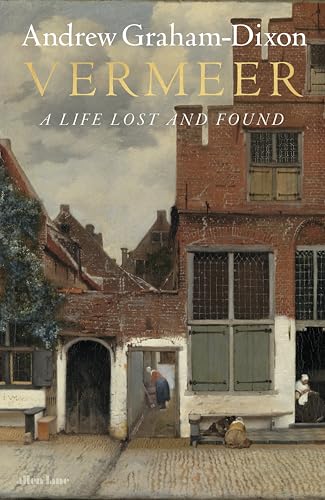
The paintings of Johannes Vermeer of Delft are some of the most beautiful, even sublime, in the history of art. Yet like the life of Vermeer himself, they are mysterious and have for centuries defied explanation. Following new leads, and drawing on a mass of historical evidence, some of it freshly uncovered in the archives of Delft and Rotterdam, Andrew Graham-Dixon paints a dramatically new picture of Vermeer, revealing many of the painter’s hitherto unknown friendships as well as his previously undetected allegiance to a radical movement driven underground by persecution.

He also vividly evokes the world of the Dutch Republic as it was in its so-called Golden Age. This was a watery world of fortresses and flood plains, taverns rocked by argument and cities stunned by devastating attacks and all linked by a network of canals where a uniquely efficient public transport system, operated by horse-drawn passenger barge, enabled people, goods and ideas to glide effortlessly from one place to another. The author sets Vermeer firmly in the context of his time, revealing the patterns of patronage that make sense of his work, and also exposing the difficulties posed by his home life, which was dominated by his Jesuit mother-in law and disturbed by the psychotic behaviour of her only son.

In the past Vermeer has been imagined as a remote and enigmatic figure, but he emerges from this new account as a man deeply engaged with his own well-travelled, a reader of books, a man personally connected to many of the most interesting people of his time, including merchants, philosophers, preachers, bankers and regents, as well as his childhood friend, a philanthropic baker named Hendrick van Buyten. Vermeer was also deeply affected by the struggles that shook his world, the Eighty Years War for Dutch independence and the yet more terrible Thirty Years War, which ravaged the neighbouring German lands and resulted in the deaths of millions. The author shows how he was moved to become a pacifist by such atrocities, and thereafter made many of his closest friends in the ranks of Europe’s first peace movement. A further revelation is that Vermeer’s closest collaborator and chief patron was a woman, as were many others in his immediate circle. These are all previously untold stories.

The many piercingly direct descriptions of Vermeer’s pictures, which are the heart of the book, shed new light on the intentions of the artist. Nearly all of his best loved works, Graham-Dixon shows, were originally painted for a single significant location in Delft. In light of such discoveries every one of Vermeer’s major paintings, including The Girl with a Pearl Earring, A View of Delft and The Milkmaid, are reassessed and their meanings rethought. As a result the two great unresolved questions about Vermeer – why did he paint his pictures, and what do they mean? – are persuasively answered here for the first time.

416 pages, Hardcover

First published October 23, 2025

50 people are currently reading
3337 people want to read

About the author

Andrew Graham-Dixon

28 books153 followers
Andrew Graham-Dixon has presented six landmark series on art for the BBC, including the acclaimed A History of British Art, Renaissance and Art of Eternity, as well as numerous individual documentaries on art and artists. For more than twenty years he has published a weekly column on art, first in the Independent and, more recently, in the Sunday Telegraph. He has written a number of acclaimed books, on subjects ranging from medieval painting and sculpture to the art of the present, including Caravaggio: A Life Sacred and Profane, Art: The Definitive Visual Guide, and Michelangelo and the Sistine Chapel.

Ratings & Reviews

What do you think?
Rate this book

Friends & Following

Create a free account to discover what your friends think of this book!

Community Reviews

5 stars
38 (46%)
4 stars
30 (37%)
3 stars
10 (12%)
2 stars
1 (1%)
1 star
2 (2%)
Displaying 1 - 17 of 17 reviews
Profile Image for Lieke.
61 reviews4 followers
January 8, 2026
I read this with great interest, well-written, well-researched. It's a great account of Dutch religious history. The consequential interpretations of Vermeer's works... Well, I def. need some time to think about those a little more...
Profile Image for Basil Bowdler.
126 reviews4 followers
February 21, 2026
I don't know what a Vermeer scholar would say about this, but I found this a really convincing interpretation of his life based on some solid archival work and well-reasoned inferences. But it's the analysis of the artwork which is the real highlight: elegant and convincing argument that Vermeer (and Dutch art in general) isn't just a celebration of the material surface of the world but a spiritual meditation on love, revelation and the apocalypse (!!). Maybe takes a bit too long to get set up, but personally I don't mind reading about the Dutch Republic
3 reviews
January 17, 2026
This is a fantastically researched and written history around Dutch religious and political turmoil in the Seventeenth century, as a background and influence on the artist Vermeer. The author interprets his work in the context of the marriage he made and his leaning towards enlightened thought in his choice of friends and patrons. He reveals a fascinating interpretation of his paintings as almost biblical moral messaging not necessarily in line with Catholic thinking, but with the Collegiant enlightened thinking of his time.
Profile Image for Helen Castle.
228 reviews5 followers
January 28, 2026
As Graham-Dixon states, many people are ‘entranced’ by the ‘magic’ of Vermeer’s paintings without being able to explain why.

Though little is known about Vermeer, the man or the artist, beyond a few documented facts - no personal writings or accounts of him and his ideas survive - Graham-Dixon builds up a rich and detailed account. This is through the wider history of the times and the specific context of the enlightened Remonstrant Church and the associated Collegiant movement.

The wider history is fascinating in itself. The level of destruction brought about by the Eighty Years War, between the Spanish snd the Dutch, and the even more ruinous and barbaric Thirty Wars is revelatory.

The main historical document that unlocks the meaning of Vermeer’s work is an inventory of his paintings made on the death of the daughter of his main patrons, the Van Ruijvens. For 21 out of 34 of Vermeer’s known paintings were painted for the Van Ruijven family, who played a leading part in the Remonstrant church in Delft.

Graham-Dixon puts forward a compelling argument, founded on decades of research, that the enigmatic luminosity of Vermeer’s paintings have their source in the Remonstrant faith, with major paintings commissioned as devotional images.

The book’s historical rigour and ideas reignited my passion for art history. It’s a rare and intriguing read.
Profile Image for Clare Boucher.
212 reviews2 followers
February 8, 2026
I was lucky enough to see the landmark Vermeer exhibition at the Rijksmuseum in 2023. There is something almost magical about his paintings, yet so little is known about his life. I was therefore very interested in reading this book. Building on earlier work, Andrew Graham-Dixon tracks down documentary references to Vermeer and his family and situates the artist in the religious context of the 17th-century Dutch Republic. I found this part of the book fascinating. As expected, Graham-Dixon writes well about the paintings themselves. My hesitation relates to the interpretation of each of them. Biblical or other religious meanings are attributed to each of the paintings, but I am not wholly convinced. Other interpretations seem plausible too. But perhaps the elusiveness of the meanings is part of the magic.
50 reviews2 followers
January 5, 2026
Thorough investigation of Vermeer’s life - due to the frustrating lack of evidence, albeit with some new findings, it’s a life defined by implication and supposition. AGD does a fine job of piecing together a cohesive and reasonable overview, but it’s still frustrating to not know with more certainty. It’s also a great primer on Dutch 17th century history and religion.
As with AGD’s biography of Caravaggio, there still remains so much more, that maybe we will never know.
Profile Image for Imogen Martin.
Author 4 books69 followers
February 4, 2026
The subtitle is significant: A life lost and found.

Vermeer was not widely known as an artist during his lifetime, and fell out of sight completely after his death. But according to Andrew Graham-Dixon, there was a group of people who were intimately connected with his work. They were a small pacifist faith community, preaching direct experience of the spirit through regular reading of the bible.

There are few records to go on. It's assumed Vermeer was a Roman Catholic because he lived with his wealthy and staunchly catholic mother-in-law.

Graham-Dixon tells a different story, and tells it brilliantly.

In the first chapter, he sets out the context of the Dutch Republic, the Eighty Years War with Spain which was just coming to a close with Vermeer's birth; the catastrophic Thirty Years War that made much of what is now Germany a living hell; the free-thinking, liberal Dutch with new religious ideas. Theologian Arminius led to the Remonstrants and a smaller sect of the Collegiants. There were later connections to the Quakers, a similar movement in Britain, which similarly allowed women to take a prominent role during worship.

The important thing is this: Graham-Dixon tells us (and he should know, he's an expert in this), that Vermeer is unique in almost all art history in that he was retained to paint for one couple, the Van Ruijvens. And probably the works were commissioned by the wife, Maria. We have evidence that 21 of the most important paintings were still in a single collection until they were auctioned on the death of Maria's son-in-law in late 1695. All this is unusual, Graham-Dixon tells us. His thesis is that the paintings were devotional and were hung in the Van Ruijvens house to inspire quiet prayer by groups of women.

Graham-Dixon interprets each painting through this lens, and makes a convincing job of it. I would have liked more detail on Vermeer's technique - how did he achieve that extraordinary detail, how did he get the paint to create light, or the multiple colours in a single white wall? There is some other research he didn't draw on. For example, Dutch restorers have established that Vermeer painted, and then painted out, a man standing in the doorway to the alley that Graham-Dixon says led to the Hidden Remonstrant church in The Little Street. I would have liked his interpretation of this.

Graham-Dixon makes a strong case that the luminous painting now called Girl With a Pearl Earring (remember ALL these names were given to paintings afterwards, and many are misleading) is of Maria Van Ruijin's daughter Magdalena, aged about 13. She inherited the paintings and it was after the death of her husband that they were auctioned.

But think for a moment. Imagine growing up in a house where the walls are hung with The Milkmaid, the View of Delft, The Music Lesson. Imagine having the miniature picture of The Lacemaker tucked in a corner space on the wall (although I'm not convinced by the reference to a womb, telling us that the sitter is pregnant). And imagine living with The Girl with A Pearl Earring.

I've stood in front of these paintings and, honestly, they are astonishing. Miraculous. They touch you deep inside.

And the supposed Catholicism? Graham-Dixon reminds us the Vermeers had eleven children, most of whom survived early childhood. That was a big family, even at the time. Graham-Dixon suggests they lived with the Catholic mother-in-law for financial reasons, as she was one of the wealthiest people in Delft. It would have been hard for him to earn a sufficient living as a painter to support so many children. But living with his mother (another Maria), he would have had to toe the line. Graham-Dixon gives many, many examples of Vermeer's strong and lifelong connections with the Remonstrants and Collegiants.

Although it feels that Vermeer produced few paintings in his short life (he died in December 1675, aged 43), Andrew Graham-Dixon celebrates that so many of them have survived after the collection was auctioned - plus the around ten other paintings commissioned by others, or that ended up in other hands (his baker possibly had the best payment of a bread bill ever). Graham-Dixon explains this:
He produced something so beautiful that it insisted on being preserved, persuading all who saw it to recognise, instinctively, that it was too precious to be lost... Like the women he painted long ago, he leapt the bounds of here and now to dwell in eternity.

Profile Image for Nancy.
1,957 reviews488 followers
February 25, 2026
One of the main aims of this book has been to show that Vermeer was a painter not of things but of ideas. From Vermeer by Andrew Graham-Dixon

This book is more than a biography. There are limited facts to be found about Vermeer in the records. But we do know the bulk of his work were purchased by one family. Andrew Graham-Dixon presents a well researched argument asserting that Vermeer and his patrons were part of a small religious select and that his paintings hold religious iconography reflecting the sect’s beliefs.

He begins with a detailed history of the Dutch Republic with horrendous stories of Catholic Spain’s Thirty Years War against Protestant Holland. The history is not for the faint-hearted. Entire cities were destroyed and all inhabitants brutally murdered.

The Dutch practiced religious tolerance although only the strict Calvinist Reformed Church was recognized. Followers of Arminius accepted core Christian beliefs but allowed people to interpret the Bible for themselves and they tolerated all religions. Labeled Remonstrants, they particularly denied the Calvinist belief in predestination. They met in small groups secretly.

Graham-Dixon connects this religious group to Vermeer’s family, showing that they had close ties to the Remonstrants. And Vermeer’s patrons, Pieter and Maria van Ruijen, were members of the sect.

Based on the earliest paintings attributed to Vermeer, the author believes that he was influenced by art he had to have seen in Italy. He also painted genre pictures popular at the time. But the paintings he created for the Ruijen are different, original, mostly featuring women in their daily lives.

…he was able to translate radical Protestant theology into movingly human pictorial terms. from Vermeer by Andrew Graham-Dixon

Graham-Dixon carefully analyzes each painting for hidden messages, such as a nail in a blank wall meant to recollect the crucified Christ.

Frankly, I am not completely convinced, but I like the challenge to think outside the box. For instance, I like the idea that the pearl in A Girl with Pearl Earring connotes purity. But I question the assertion that The Little Street shows a hidden Remonstrant church and his patron’s residence.

I was enthralled by the tragic history of the religious wars and enjoyed learning more about an aspect of Protestant church history I knew little about. It was fascinating to learn where Vermeer sourced some of his images, like the painting of a cupid that appears in several paintings.

A deeply researched and well presented argument for a new understanding of a beloved and mysterious artist.

Thanks to the publisher for a free book through NetGalley.
Profile Image for Ruthie.
499 reviews11 followers
Review of advance copy received from Netgalley
February 28, 2026
Weird. Goodreads tells me this book hasn't been released yet, so I've had to pretend I got it through NetGalley. I didn't. It was a Christmas present from my lovely daughter.

In 2022, I spotted that the Rijksmuseum was going to exhibit as many Vermeers as they could get their hands on. I went on their mailing list and booked as soon as possible, and spent a magical morning in February 2023 staring at about 30 extraordinary paintings. I cannot begin to tell you how jealous I am that Graham-Dixon had pretty much a free hand to visit as much as he liked. Grrr.

The Girl With the Pearl Earring touched me deeply, despite her face appearing on tea-towels and mugs. Actually, I bought a shopping bag, and every time I use it I'm reminded of the experience. So maybe we should be less sniffy about "exiting through the gift shop" and acknowledge that these souvenirs can take us back to an experience.

The book will be precious to me. It contains excellent reproductions of all the works. Andrew Graham-Dixon tells us the historical context (and I love history) and convincingly makes a case for the paintings being meditative and spiritual. I would have liked a bit more on technique, but I quibble.

A wonderful book for anyone who wants to know more about some of the greatest works ever painted.
Profile Image for Hilary.
340 reviews
March 10, 2026
This is clearly a work of love and passion for Vermeer’s paintings by Graham-Dixon. It is difficult not to get swept away by the insistence of his arguments for the painter’s inspiration from the Remonstrant/Collegiant sect of the Dutch church. But sometimes I felt that he was trying too hard to see an underlying meaning in the paintings and I was not always convinced. Is the beautiful Girl with a Pearl Earring a representation of Mary Magdalene as she perceives the risen Christ? Does A View of Delft depict the new heaven and earth from Revelations? It obviously matters a great deal to Graham-Dixon that the answer is yes, but I will continue to love Vermeer’s paintings as extraordinary works of art in my own way. I took photos of all the paintings at the 2023 Rijksmuseum exhibition, and I loved revisiting them as I read the book.
I also enjoyed finding out about the historical context in which Vermeer was painting - I knew very little about 17th century Netherlands, and it was both fascinating and horrifying to learn about the wars and religious intolerances that shaped it.
Profile Image for Valerie.
281 reviews1 follower
March 4, 2026
This is what I love about art history - learning history through art and culture. The author poses new and interesting theories about Vermeer's life and paintings, supported by extensive research and a book filled with illustrations, maps, family trees and other supplemental information. An absolutely beautiful book, both physically and in its inspiration.
430 reviews
February 10, 2026
Bought this after hearing the author lecture on how it came about. It lives up to expectations - a certain amount of conjecture but plausible. There is a lot of (necessary) scene setting history in the first half, so many names to remember. Good pictures.
Profile Image for Hollie Toft.
351 reviews3 followers
January 10, 2026
2.5/3⭐️

I did enjoy this for the most part, it just felt a bit information heavy on the historical context and religious influence.
Profile Image for Fernando Pestana da Costa.
578 reviews29 followers
March 9, 2026
This book is an extremely interesting biography of the seventeen century Dutch painter Johannes Vermeer. Beautifully illustrated with colour reproductions of Vermeer’s paintings, accompanied by maps and family trees, the book provides extremely detailed information about the complicated political, military and religious situation in the Netherlands from the second half of the sixteenth century to Vermeer's time. It gives an extremely compelling analysis of his paintings in the context of the political/religious life in Delft at the time, but what I found somewhat unsettling is that a lot of the arguments seem to be based on educated guesses and in reasonable but not document supported evidence: after the initial part about the historical context informing Vermeer's time, phrases including “it may have been”, “likely purpose”, almost certainly”, “seems possible”, “unlikely to be true”, “would make sense”, “he was probably”, start to be abundant beyond measure and after a while they turn the reading rather unsettling as we are no longer sure if we are reading a biography or a biographical fiction work. In any case, I found it a very enjoyably work.
Profile Image for Kai.
10 reviews3 followers
November 15, 2025
worth it overall but at some points a bit tedious with the religious history. necessary context for the author to make his point though and I can see why it's included.
Displaying 1 - 17 of 17 reviews

Can't find what you're looking for?

Get help and learn more about the design.