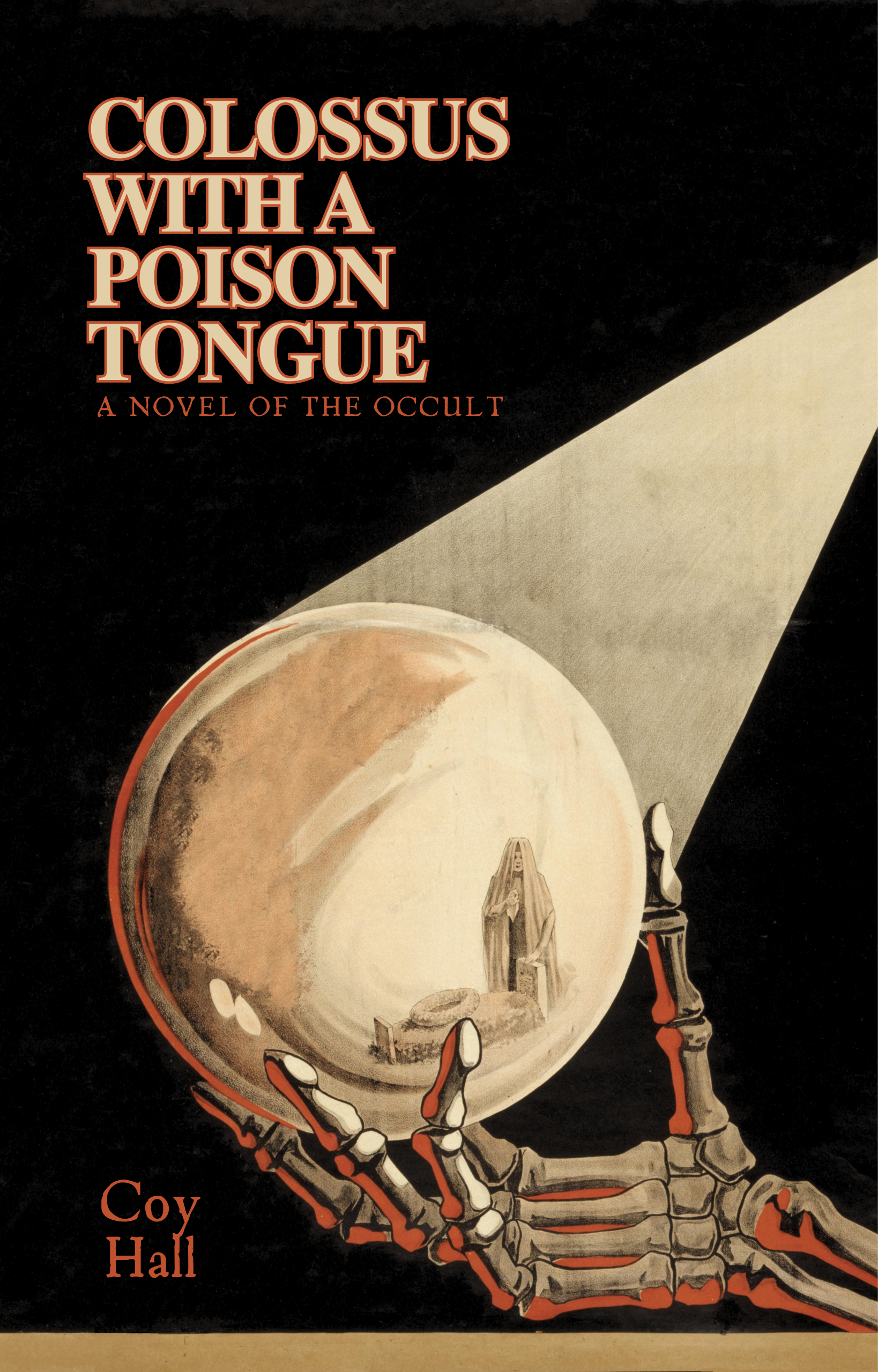
Coy Hall is an author who often gets lumped into the horror genre; while this isn't an entirely unfair descriptor for some of his work, it also doesn't quite illustrate his style. In fact, I've yet to read anything he's written that strikes me as "pure horror". Rather, Hall belongs to a certain tradition of authors--I would argue Clark Ashton Smith as suitable point of origin--who ignore the commodification of genre fiction entirely, and instead write stories that simultaneously blend tropes from a variety of genres, while ignoring other, expected conventions, to deliver the story they want to tell (as opposed to writing what they think will sell to an existing fanbase). This is both a blessing and a curse: A blessing because, as readers, we are gifted with the work of a true artist. A curse, because it becomes a challenge to determine how to promote/market such books in an era when so much is driven by blink-and-you'll-miss-it social media trends.
In the case of Colossus with a Poison Tongue, a high-level summary alone is enough to make you realize you aren't getting a typical sort of book: in the Earth's future, in the city of Saint Ghost, society has reverted to a religion based upon old, occult ideas (think Aleister Crowley, Dion Fortune, and the Hermetic Order of the Golden Dawn). Driving this is a fanatical priest and his followers, who worship a giant Colossus statue as their god. Opposing this is a rebel Magus and his band of associates; and stuck in the middle is Calpurnia, Mistress of the Temple of Bastet, who journeys from one side of the conflict to the other... revealing the truth/faults of both extremes.
As expected with Hall, the prose is phenomenal. It is clear he is very deliberate in his word choice, and that he spends a great deal of effort to ensure there are no typos/grammatical errors (which is not a knock against indie publishing: lately this seems to be an issue plaguing releases both indie AND traditionally published).
Those who know my tastes know my enjoyment of a book primarily comes down to its characters. And here, the author has delivered a cast of real-feeling, complex characters. Calpurnia is the MC (although hers is not the only POV we get), and following her development from the starting point to where she ends up - THAT is the heart of Colossus with a Poison Tongue. One of the greatest compliments I can give this novel is that a chill went down my spine while reading the last chapter. To clarify, this was not a chill of horror. Instead, it was a raw emotional response to the notions of hope and possibility felt in the aftermath of the climax.
So who should read this book? Well, calling it "science fantasy" might be the easiest way to sum it up, despite my hesitation to attach any label to the work. Fans of the previously mentioned Clark Ashton Smith will enjoy this, of course. And if names like Jack Vance, Frank Herbert, Gene Wolfe, and N.K. Jemisin give you a tinge of excitement - you are probably the right audience for this novel, as well.
Additionally, it's a relatively short book, only about 210 pages, but not a sentence is wasted, and so it is a complete, satisfying tale (not coming across as trivial or underdeveloped). In a way, this is another slap in the face of genre expectations. So many readers of fantasy and science fiction have come to expect doorstopper-length novels, which in turn are only individual installments within a seemingly never-ending series. When a book like this comes along, it's refreshing proof that length does not necessarily equate to quality.
Although I no longer assign star ratings to my reviews, I give my highest recommendation to Colossus with a Poison Tongue.