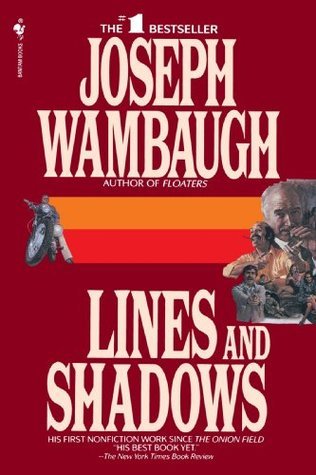
The line is visible in some places, invisible in others. Sometimes, there is a wall, or a fence; elsewhere, nothing presents itself to the observer’s gaze but long stretches of desert. Yet that line is a very real one – the international border that separates San Diego, California, U.S.A., from Tijuana, Baja California, Mexico. Every day, people from Mexico and Central America who want to break out of the cycle of Third World deprivation seek to cross the border into the United States of America; and in the late 1970's, a compassionate San Diego police officer saw how these unfortunate 20th-century campesinos were being preyed upon by border bandits, and decided to try to do something about it, as Joseph Wambaugh chronicles in his 1984 book Lines and Shadows.
Wambaugh served as a Los Angeles police officer for more than a decade before he turned to writing, achieving success as an author of both novels (The New Centurions, 1971) and true-crime stories (The Onion Field, 1973). Lines and Shadows falls into the latter category, telling as it does the story of the San Diego Police Department’s formation of a Border Crime Task Force whose members disguised themselves as pollos ("chickens," a slang term for vulnerable undocumented immigrants) and walked out into a desert landscape of rattlesnakes and scorpions and tarantulas and cacti, with the goal of decoying robbery-minded border bandits into attacking them.
Wambaugh focuses well on the psychological impact of this particular brand of undercover work on the Mexican-American officers who constituted this unit. One officer, an eight-year S.D.P.D. veteran who had done plenty of difficult and unpleasant law-enforcement jobs in his time, reflected that
that was another odd thing about those hills: dressing, talking, smelling like an alien was very very strange. Really, trying to think like someone else for the first time in his life. It made you understand that you are not a real Mexican, not even close. And yet the white majority thought of you as one. It was very hard out in those hills for some of them. It produced a culture clash in their heads. (p. 104)
The success of the Border Crime Task Force in protecting pollos and arresting the criminals who prey on them drew media attention – something that changed the dynamic among the officers. Those officers who were less enthusiastic for violent confrontation with border criminals might be criticized as “cowards” by their more gung-ho peers – officers who became media darlings for their “mediatic”, Dirty Harry-style qualities.
As Wambaugh grimly puts it, “Perhaps it was best unsaid that network news teams are not interested in ball-clanging mythic heroes who go around arresting bandits like ordinary cops” (p. 200). And the media publicity seemed to accelerate the pace of action and conflict in the borderland: “It was as if someone were playing a record at the wrong R.P.M. Things were speeding up. It was happening in the canyons faster than they could arrange for the media to cover it” (p. 201).
The pressures that these police officers faced only accelerated. A number of Border Crime Task Force members started drinking heavily, in response to constant stress. Marriages were strained as the celebrity status of these modern "gunslingers" drew groupies. And there was always the fear that the border bandits would accelerate their own violence in response to the police pressure against the bandits’ illegal and lucrative work. Wambaugh describes well the way the fear grew and took its toll, as officers
started fearing impossible things: that the bandits might lie in wait for them, to rid the canyons of these San Diego cops who had so hurt business. They started in terror every time a jackrabbit rustled the underbrush. A slinking coyote became a man waiting to murder them. Shapes of stunted oak flew at them in the shadows. Their guns were never out of their hands now. Their guns were getting rust-pitted from sweaty palms and aching clenched fingers. (p. 301)
The task force’s work, as mentioned above, resulted in many arrests and much positive publicity for the San Diego Police Department, but also in a number of shootings in which both cops and robbers were wounded, and ultimately two people died. It is interesting to consider the process by which the Border Crime Task Force was formed and was ultimately closed down.
All in all, Wambaugh provides a striking picture of an unusual police experiment that brought into relief the existence of an ongoing problem that no one has yet managed to solve. This book was written almost four decades ago – many years before the Trump candidacy and the crowds chanting “Build The Wall!” (How much wall did the Trump administration actually build? 458 miles, along the 1,954-mile border between Mexico and the U.S.A.)
And the poverty, desperation, and political instability of Mexico and Central America still send desperate would-be U.S. residents northward, wall or no wall. How many undocumented immigrants will try to cross that invisible line in the sand tonight? How many of them will be preyed upon by bandits who are capable of untold cruelty? What officials, either in Mexico or in the United States, are looking out for these poor, vulnerable, stateless people? The answers still seem as difficult to grasp as an invisible line in the sand, or a shadow cast by the moon.