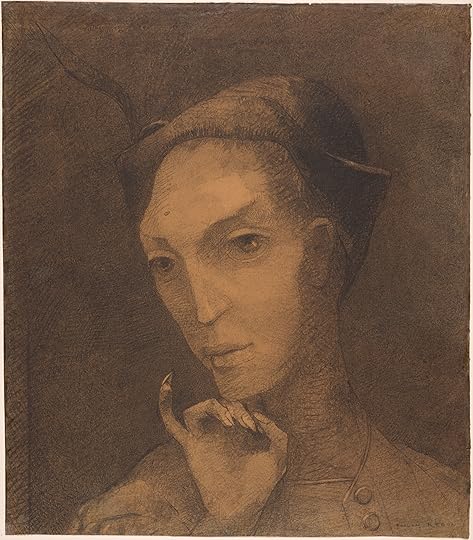
Very much a naturalistic work and yet there is something else in this, something is being brewed up. Some sketches have a style that would be fully developed and featured in A Rebours, one of the most obvious ones is the sketch about Odilon Redon's art (a few of his drawings are featured).
Here's a bit of it:
"It was of a sheet of water, diseased and cloudy, but with no sky this time, a sheet of water filling a huge plain, a gigantic aqueduct supported by columns, like those on the Dhuis and the Vanne. A sepulchral silence fell from the arches; dreary daylight filtered through the frosted glass of hidden portholes; a wind as if from an ice-tunnel shivered your marrow and, in this solitude, an intense, irresistible fear nailed you, breathless, to the stone seat which ran like a quay the whole length of this lifeless water.
Then, from under these fearsome, silent arches, strange beings suddenly sprang up. A head, with no body, hovered, whirring like a top, a head pierced by an enormous Cyclopean eye, complete with a mouth like that of a skate, separated by a wide groove from a nose, the filthy nose of a bailiff, stuffed with snuff! And this white, scalded head was coming out of a kind of skillet, and was radiating its own light, illuminating the waltz of other almost amorphous heads, some like embryos hinting at skulls, some like blurred infusoria, vague flagellates, indefinite monera and bizarre protoplasms like Haeckel’s Bathybius, though less gelatinous and less unformed.
And then this formation of living matter disappeared in its turn, this vile species of head faded away, and the obsession with this motionless water finally ceased.
There was a short respite in this nightmare. Then suddenly, a sun, inky-black to the core, emerged from the shadows, bursting, like a Grand Cross medal, with unequal but regularly spaced rays of gold. At the same time flower petals fell from some unknown space, bulbs in which imperceptible pupils squinted bounced around like billiard-balls, and a coffee-maker’s sieve remained suspended in the air, beneath which undulated the bare arm of a superhuman juggler with terrifying eyes, as if shaped and enlarged by surgery, round eyes with a pupil stuck on like the boss of a cartwheel.
There was in this man who was conjuring with planets, grocer’s implements and flowers, the cruel air of a tough Gaul, the imperious countenance of a bloodthirsty bard; and the awfulness of his dilated eyes, like rings of iron, hypnotised you and made your hair stand on end.
Finally, there was a lull; the mind, carried away by these hallucinations, tried to hang on and moor itself to a bank; but the spectacle continued to unfold, recalling a similar, bygone scene that for years had been almost forgotten. In place of that flower of the marshes, another, more human flower, seen not long since at an exhibition, returned and planted itself, revealing a variant on this dismal conception.
Then the water, that terrifying water, dried up, and in its place rose a desolate steppe, a land broken up by volcanic eruptions and ravaged by swellings and crevices, a land scorified into slag. It was as if one were visiting, on an imaginary journey using a Beer and Mädler map, one of the silent amphitheatres of the moon, the Sea of Nectar, or the Sea of Humours, or the Sea of Crises, and that, in this atmospheric void, in a cold such as one had never felt before, you were wandering in the middle of a dead, noiseless desert, terrified by the immensity of the mountain peaks that rose up all around you to vertiginous heights, their craters in the form of cups, like those of Tycho, Calippus or Eratosthenes.
And on this desolate planet there emerged from the white soil the same stalk that had just sprung from the black water; as before, buds were blooming on its metallic branches and a round pale head also swayed at the top; but its sadness was more ambiguous and melted into the irony of a dreadful smile.
* * *
Suddenly the nightmare completely broke off and a frightful waking ensued, as the inflexible face of Certainty appeared, gripping me again in her hand of iron, leading me back to life, to the waking day, to the fastidious tasks that every new morning brings.
* * *
Such were the visions evoked by an album dedicated to Goya’s glory by Odilon Redon, the prince of mysterious dreams, the landscape artist of subterranean waters and of deserts convulsed by lava; by Odilon Redon the Comprachico Oculist of the human face, the subtle Lithographer of Suffering, the Necromancer of the Pencil, who, for the pleasure of a few aristocrats of art, has strayed into the democratic milieu of modern Paris."