Arnab Ray, better known as Greatbong, is one of India's most widely read bloggers who blogs at Random Thoughts Of A Demented Mind. He is known for his sarcastic takes on the Indian film industry, Indian politics and society in general. His blog was awarded the "Indiblog of the Year" at Indibloggies in 2006[1] and 2008. He has written for several media outlets like the Washington Post, Outlook magazine and Live Mint. He graduated from Jadavpur University as a Bachelor in Computer Science and Engineering and went on to finish his PhD in Computer Science from State University of New York at Stony Brook. He is presently employed as a research scientist at the University of Maryland and resides in the suburbs of Washington DC. His first book "May I Hebb Your Attention Pliss", published by Harper Collins, was on India Today's Bestsellers list.
'The Shakchunni dances tonight, and you shall all drop dead like flies.'
'Shakchunni' is a book that is a slave to its own potential. Being Arnab Ray's recent most paperback, it acted as my first ever gateway to the author's body of work. Something that needs to be lauded for it's eminent ambition while being criticised equally for the same. It does carve out an intriguing premise for itself. Placing the narrative right within the Great Bengal Famine, trying to weave in the intricacies of village politics, with some nifty character drama and the never-ending allure of shady village folklore. Especially that of rural Bengal.
Now, the concept of the Shakchunni is something that every Bengali kid grows up with. If there were to be a Hall of Fame for Indigenous Horror, the Shakchunni—a feminine spirit who possesses married women out of their brazen desire for a married life—will, without a doubt, be a first ballot candidate. It's a trope that's been utilised time and again in children's fiction forever.
And for his part, the author does a really good job in conjuring the promised dread of said entity. There's a distinct sense of ominousness that trickles through the pages of this novel, which works in it's attempt to bolster the horror thriller. However, what bummed me out was the author's reluctance to explore it further. There's only so many prophecies and gory machinations that one can read before the edge is slightly blunted out.
Which is a shame, for the myth of the Shakchunni, paired up with the Gothic confines of a zamindari mansion and the oozing darkness of a remote bengali village, was a perfect conduit to explore dark femininity and supernatural terror. Something that the book shies away from, treating it to be unnecessary in its pursuit of sheer human horror. Thankfully, Arnab Ray is a really easy read. His prose flows like a happy-go-lucky stream, and it took me roughly two days to finish the entire thing.
However, at the same time, I was really annoyed by his insistence to shove in random Bengali words mid-conversation while elaborating the meaning right after. You only do that when it's a descriptive sentence or a paragraph. Colloquial words fit like a glove when there's a narrator taking on an explanatory guise to facilitate world-building. If you must add one in a dialogue, you do not explain it, for the characters are themselves conversing in the same language. It's only the reader who's reading it in English!
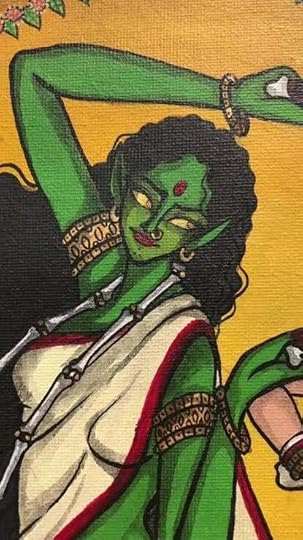
Imagine how weird it'll sound if a person IRL who's conversing in Bengali uses a Bengali term and instantly explains the meaning right beside, again in Bengali. Call me nitpicky all you want. I am all for supporting suspension of disbelief in fiction. But this simply reeks of lazy writing. Something that is slightly pacified by the existence of that beautiful cover art. The bright red colour palette and the popping visage of the Shakchunni, designed by Divine Comedy, that made me buy this thing in the first place.
And, as I noted, I was hooked. The author divides the book into three different chapters, out of which the first one is really well done. A chapter that not only engages the readers with the myths, curses, and epiphanies but also tries to provide gravity to its bubbling storyline. Sure, it reeks of melodrama. The whole book does, for that matter. Aiming for a measured cocktail of cinema with a probable ghost story set within. As such, the first chapter not only introduces the entire ensemble but attempts to flesh them out before the eventual pandemonium ensues. An approach that I sorely missed throughout the rest of the book.
Not that I simply wanted it to go on about Zamindari family shenanigans forever. If that were the case, I'd have read something entirely else. Something like Sunil Gangopadhyay's 'Time Trilogy', rather. I knew what I was getting through 'Shakchunni' here. Especially with that lengthy chapter two, that constitutes the majority of its runtime. However, as a result, the cast is often subjected to rushed character arcs and jarring behavioural gaps. A visible disparity in the author's approach, as he continuously sacrifices the human drama to make room for his thriller, time and again.
An irksome repetition that affects several characters that I wanted to be fleshed out further. However, the biggest offender might just be the so-called heroine of this tale. Soudamini. The meek, subservient poor girl married into a major feudal house. The beacon of the Shakchunni, if you may. A tested trope, from which I expected far more than what the book ended up delivering.
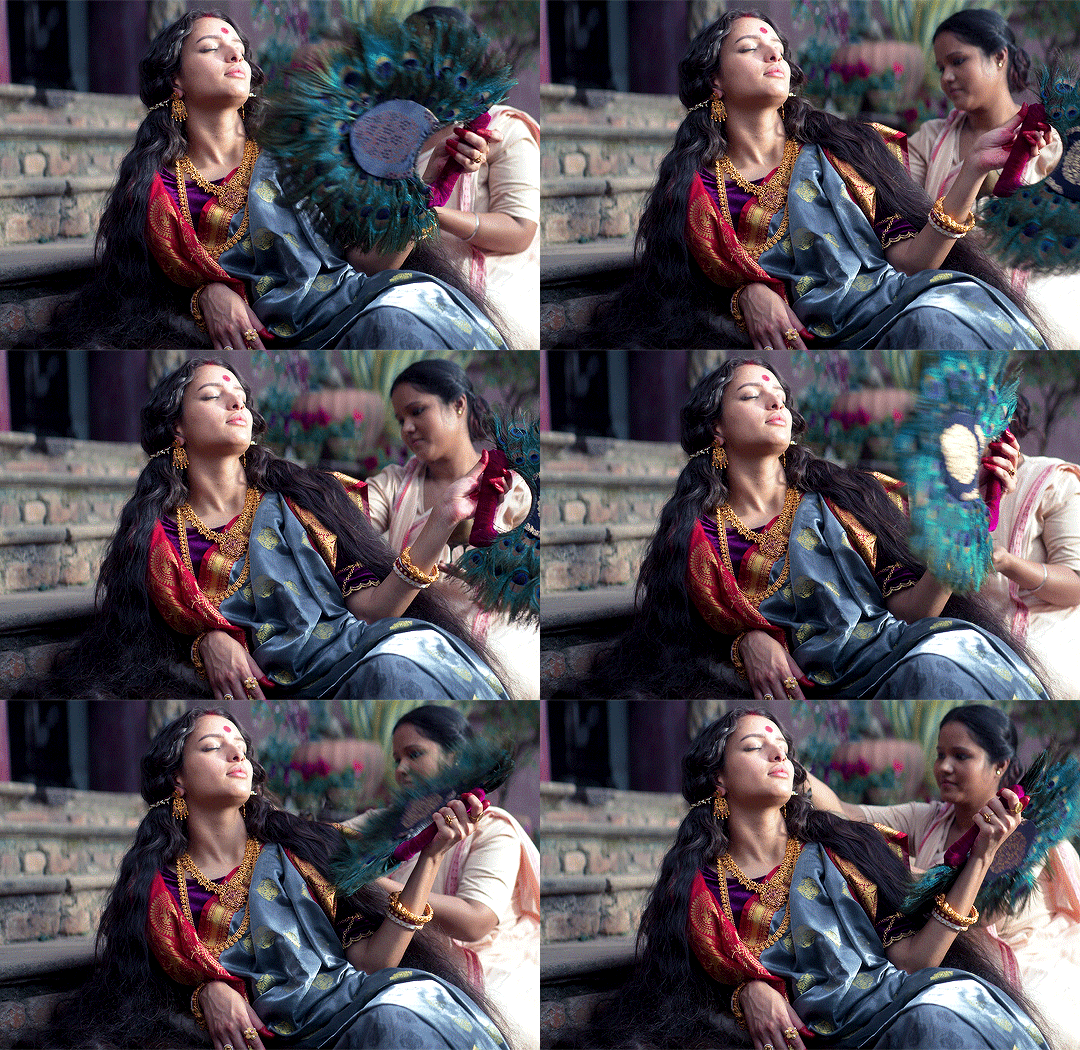
Let's be honest here; we all thought about 'Bulbbul', at least once already. The bright red cover, the Bengali setting, the decaying morality of a Zamindari household, the beautiful bride newly married within. The comparisons are bound to spring up. But what Anvita Dutta's movie had in abundance and what 'Shakchunni' does not, despite all its ambition, is a beating heart. Although both try to actively exploit the idea that men are the scariest beings on planet Earth and that no horror can match up to the cruelty that human beings can usher. 'Bulbbul' was, in its entirety, a woman's tale. Something that 'Shakchunni' promises but cheats the reader out of at the very last minute.
Thus, instead of the riveting duel between Soudamini and Handi, within the broken palatial walls, what we have instead are men parading around being morally questionable, trying to make sense of the superficiality of the horrors beyond their immediate comprehension. But then, it is Colonial India. And maybe this is how Arnab Ray chooses to portray the disparaging shallowness of the 'man's world', and it's footnote-like representation of basic womenhood?
Whatever it is, it still ended up being a storytelling choice, too simplistic for my liking.
Which brings me to the final chapter of the book. The epilogue, that'll surely divide the crowd. Now I'm not entirely against the author's intention here. If nothing, it made for a dark and interesting read. But one cannot help but notice how expository it all sounded in it's desperation to bridge the logical gaps and provide the reader with every answer possible. Almost mimicking a M. Night. Shyamalan movie. Something that fixates upon a twist from the get-go and tries to write the script in accordance with that reveal, limiting the mobility of storytelling. Alongside, the repeat value of said piece.
Some ambiguity would have helped this one in the longer run. Maybe a different author, with differing intentions, could have taken the basics and transformed it into a more delectable broth? Who knows? It's a fun read nonetheless. And I'll recommend this to someone in need of a cheap thrill. A cinematic foray into the bellows of Bengali folklore, written in quickfire prose, perfect to break open a dreadful reading slump.
I have read most of Arnab Ray's books. And yet I was surprised at how good his writing is. The book was thrilling and entertaining for sure. It's been a while since I read a book that can be classed as unputdownable, so I really enjoyed it.
The plot is like a 90s movie. Full of family drama, some flashbacks, a scheming Aruna Irani type maid who drives the plot with her machinations, an ugly loathsome sneering villain and one raees Raibahadur villain.
The plot had a somewhat unexpected twist at the end. I am not sure I liked it.
Warning: what I'm about to write are not exactly spoilers, but might be treated by some as so. Hence, the warning.
Okay, now that we have gotten that out of the way, let's get down to business. Arnab Ray's Shakchunni is horror done right. And that is perhaps the biggest compliment because horror is probably the trickiest genre to get right. There are hardly any jump scares, or demons lurking beneath the bed, waiting to pounce and rip off your flesh. What this book does have is a tense atmosphere, that seemingly becomes palpable at times. The writing is pacy and the dialogues are more or less realistic (one question: why would a central character use the term "Hades" and not "Yamlok" or "Narak", especially when Bengali / Indian terms have been used throughout the book?).
Anyways, it's an enjoyable read. Immensely enjoyable actually.
However the book is not without its problems. And my main beef with the book is the Chapter 3, that everyone else is seemingly going gaga over. Now I'll be the first one to admit that Chapter 3 provides the perfect resolution or conclusion to the book. It completes the brush strokes to the heartbreak that unfolded over the course of the previous two chapters. It does provide closure. But in doing so, it opens up the previous two chapters to a hell lot of inconsistencies. What I mean to say is that if Chapter 3 is right, then a lot of things in Chapters 1 and 2 don't make sense. And the prologue doesn't even make any sense at all.
Which brings us to a bold trope in literature - the unreliable narrator. Now, I have nothing against this trope, but, and this may be a personal bias (reviews always are), I think that an unreliable narrator works much more convincingly in a first person narrative - not a third person one. Think of it in this way. Suppose in the last Harry Potter book, it is revealed that the Durseleys were always loving and caring. How would you feel in that case? But, you would accept any lie or misrepresentations from a character's mouth much more easily.
However, even I am not hundred percent convinced if the author went for the unreliable narrator trope by design or was it an oversight.
Another option is to disregard Chapter 3 as forced rationalization from a man who lost everything. But, as I stated earlier, Chapter 3 does hit you where it hurts the most and you want it to be true, against your better judgement.
Quickly touching upon some other aspects.
The horror of the Bengal famine has been touched upon and has very briefly been peeked beneath the skin. While I wish for a deeper exploration of this theme, I do understand that it might have derailed the central narrative, which would have made the atmosphere less relenting.
The political commentary is wry and never overdone. There are a couple scenes that does remind you of Tripti Dimri from Bulbbul. But that is quite inevitable, as the character has been written in a certain way.
The book doesn't really have "huge surprises and twists" - and that is good, as you know from the beginning that you are in for a heartbreak and a heartbreak you do get (many might disagree about twists not being there).
Absolutely loved the "how the exorcism will happen" part.
Covert art is pretty good.
In conclusion, I enjoyed the book a lot, but did feel a wee bit frustrated at the end due to the reasons stated above. Four stars.
Shakchunni delves into Bengali folklore, featuring a demon known for possessing married women. The story revolves around the Raibahadur family and its two sons, Narayanpratap and Rudrapratap Banerjee, who are quite different from each other.
Narayanpratap, the elder son of the Shyamlapur ruler, returns home after abandoning his barrister studies in London. His return is driven by heartbreak over a foreign woman named Catherine, leaving him despondent. Narayanpratap, an intellectual and poet, is deeply affected by his romantic misfortune.
To alleviate his despair, his parents arrange his marriage to a simple and beautiful village girl named Saudamini. On the wedding day, a tantrik arrives and ominously warns, “The Shakchunni will dance tonight, and you shall all drop dead like flies.”
Rudrapratap, the younger and more exuberant son, dreams of traveling abroad. However, his father refuses to send him to London, and his mother favors Narayanpratap. This favoritism fuels a growing rift between the brothers. Rumors circulate about the Shakchunni’s shadow haunting the family.
The plot and narrative of the book are distinctive. Initially, I found the story somewhat tedious and anticipated a repetitive tale. However, it evolved into an unexpectedly captivating read. I particularly enjoyed the characters of Handi, Bouthakurun, Ramprasad Sinha, and Kalikinkar, and appreciated the author's choice of unique character names.
For readers seeking something different, Shakchunni is worth exploring.
This is a kind of book which is enough to change your perspective about Indian books. It is a perfect horror book to start with. It has represented the Bengali culture and essence perfectly. Each and every character is portrayed very smartly. Each character have their own story to tell and that's the best thing. It is about a rich Bengali family, who's son elder son has returned from abroad with a heartbreak and got married to a poor girl. But something dangerous is on their way. A Shakchunni, a evil spirit has entered their house. Then the series of incidents and lost truth will keep you hooked till end. You will definitely fell for the characters and their pain. I highly recommend you to read this book, if you love reading horror with a twist of mystery.
This is one of my best reads this year. I would say that the initial 1/3rd of the book is quite scary and will give you chills but as the story progresses you'll get more and more engrossed in the plot rather than the spooky elements. I simply loved the ending, it caught me completely off-guard. Highly recommended.
Book: Shakchunni Author: Arnab Ray Publisher: Hachette India Published: 2023 Genre: Fiction-Horror-Thriller ISBN: 9789357318211 Rating: 🌟🌟🌟🌟🌟
"Shakchunni" by Arnab Ray is a haunting and captivating exploration of the supernatural realm woven intricately into the fabric of British Bengal. Amidst the turmoil of the Great Bengal Famine, cries of hunger and Britain's wartime demands, including those on its colonies like India, the village of Shyamlapur finds itself embroiled in a struggle for survival.
The Banerjee family, once esteemed as local zamindars, now faces dire challenges as they grapple with increased zamindari taxes and the relentless pressure to supply grain for the war effort. Arnab Ray's portrayal of the terror and devastation wrought by the Bengal Famine in his novel "Shakchunni" is both haunting and poignant.
Through vivid imagery and evocative prose, Ray transports the reader to the heart of the famine-stricken landscape, where hunger and despair permeate every aspect of daily life. Ray skillfully depicts the stark contrast between the opulence of the Banerjee family's zamindari estate and the stark reality of the famine-ravaged countryside. He paints a vivid picture of the desperation and suffering endured by the villagers as they struggle to eke out a living amidst scarcity and deprivation. The story is so visually portrayed, it is a readymade to be made a movie/web series.
In a thriller novel, it is usually a plot driven medium which authors use to narrate the story, Ray here beautifully used both plot driven and character driven approach to tell the story. All the characters of the story have been beautifully fleshed out from Narayanpratap Banerjee, the heartboken eldest son of the ruler of Shyamlapur, his father Rai Bahadur, wife Soudamini, brother Rudrapratap Banerjee, Superintendent of Police Ramprasad Sinha only to name a few amongst the many characters. The author makes you fall in love with certain characters because of their wry wit and you also start hating some characters due to their darkness which the author has beautifully depicted.
Embedded within the rich tapestry of Bengali folklore lies the ancient tale of the Shakchunni—a spectral entity driven by a sinister desire to usurp the life of a contentedly married woman, lurking ominously in the shadows. For generations, the zamindari family has maintained a fragile truce with this malevolent spirit, appeasing her with offerings of both animal and human sacrifices. However, as the family's prosperity wanes, so too does the frequency and magnitude of these tributes. The zamindar, lulled into a false sense of security by years of uneventful coexistence, grows complacent, allowing the once-ritualized sacrifices to cease. Yet, in the absence of these appeasements, the Shakchunni awakens from her dormant state, her wrath unleashed in a chilling dance of vengeance.
The author is a master of horror story-telling and has experimented with numerous tropes of a spine-chilling thriller. Ray here uses his pen to build an atmosphere of suspense, tension and horror while depicting the characters as well as with the description of landscape and forests of Shyamlapur. Without giving out any spoilers, throughout the book, we are led to believe someone has called the Shakchunni to the Zamindar home, or gone willingly to her and brought the spate of bad luck that afflicts the zamindari family.
The book also delves into the political atmosphere of pre and post independence India, the fall of zamindari system, rise of communist ideas and inspirations, the movement, all have been neatly woven into the plot. A country as poor and fraught with tension as India, drained of its resources by the British, and the citizens who are as unsure of their future as the ruling classes, the novel is set in such a turbulent time in the country’s history that you are swept up in the same emotions as the characters.
Arnab Ray's depiction of gory violence in "Shakchunni" is both chillingly vivid and hauntingly realistic. With a masterful command of language, Ray brings to life the visceral horrors of the Shakchunni's reign of terror, sparing no detail in his portrayal of bloodshed and brutality. Through his evocative prose, Ray immerses the reader in scenes of gruesome violence, painting vivid images of carnage and mayhem that sear themselves into the mind's eye. From the visceral descriptions of mutilated bodies to the gut-wrenching accounts of savage attacks, Ray's narrative leaves nothing to the imagination, thrusting the reader into the heart of the horror.
Yet, what sets Ray's depiction of violence apart is not merely its graphic nature, but its profound emotional impact. Rather than relying on shock value alone, Ray uses violence as a narrative tool to explore themes of fear, power, and the fragility of the human condition. Each act of brutality serves to deepen the sense of dread and unease that permeates the story, heightening the stakes and intensifying the reader's emotional investment in the fate of the characters. In "Shakchunni," Arnab Ray demonstrates a rare talent for depicting the darkest aspects of human nature with unflinching clarity and honesty.
The climax of the story will leave you speechless and the epilogue provided at the end will clear all the doubts and confusion of the readers. A successful thriller demands readers to be thrilled and have a hangover of the story and for me, Ray has ticked all the boxes. It is engaging, dark, fast paced, violent, gory and a page turner. Through his deft storytelling and keen understanding of the human psyche, Ray crafts a narrative that is as thought-provoking as it is terrifying, leaving an indelible impression. In one word, it is a 'masterpiece'.
If you liked my review, I would be grateful if you could show your support by following the blog and subscribing to my social media channels. Your engagement means a lot and helps me continue creating content that resonates with you. Thank you for your support and please do purchase the book from the link given below:
i remember how i picked this one up. i think i was on goodreads when it popped up somewhere on my feed. the cover was what really piqued my interest, and i couldn’t help but check out what this book was about. i was convinced this was some overpriced novel by an international author—but one look at the name, and i knew this was indian lit. i read a little bit of the description, but honestly, i was already sold. the cover was enough. i immediately added it to my amazon cart, along with some other books. but i ended up getting it on padhega india at a discounted price and was really, really excited—for the first time in a while—to read a book.
i remember the days in high school when i used to stay up way past my bedtime, finishing book after book. those were my early days of reading, and i was still quite young. everything felt exciting. i think growing up, i lost that part of me. my attention span was fried and boiled, life was happening all around me, and i guess i really did lose that spark and knack for reading books. so when, 48 hours ago, i found myself up at 3 a.m. with this book in my hands, i couldn’t help but remember those days.
shakchunni, the book, for me, was exhilarating. i was hooked. okay—maybe not right from the beginning. it did take me about 40–50 pages to understand the setting and the characters. the names were a little difficult to get a hold of—raibahadur, rudrapratap, ramprasad... everything felt like a lot. but i promise—it gets better. within the first 40 pages itself, i was comfortable and well settled with the plot. i think this was my first real horror read in indian literature, and i can’t help but want to read more of it now.
the story was amazing—no denying that. i loved shakchunni’s early origin and how it all connected from raibahadur’s childhood to the present day. what i loved most was that we got to see parts of the story from every character’s pov—from bouthkurun to abdul to kalinkir and handi. everyone. it added such dimension to the narrative.
but i’m not sure if i’m the biggest fan of the ending. the book, till the very end, made us believe that there really is a shakchunni. but i hate how they called bluff on their own story. i’d have rather it ended with the mystery and the deaths than this whole uncovering. it felt… kind of insulting to my feelings. and i still can’t get behind certain things—like what suddenly happened to saudamani and why she got so bold all of a sudden. or why she never started sleeping with him in their marital bed. there were many loopholes, which that final 10-page letter just couldn’t answer. maybe that’s the author’s intention. maybe some things really are inexplainable.
but still—despite everything—i think this book was perfect. i haven’t read anything quite like it before. nor will i ever forget how i was up till 3 a.m., shit scared because of it, how my ears would perk up at every noise outside my pg. i was definitely a little disturbed—but i think if a horror piece of literature makes you feel that way, then you know it did a great job. and shakchunni really, really did.
The author takes us on a journey through a period of social, economic and political turmoil in Bengal. The narrative is centered on an upper-class landowner family which struggles to cope with the changing times. A legendary monster jump out of folklores into reality in the form of a shy and young bride who had no say in her marriage. Is she truly evil personified? You have to read the whole story to get to the bottom of this major question.
The author weaves a compelling plot centering on the fundamental premise of a demonic woman. Humans tend to explain the great unknowns using simplistic, and often, biased logic. The "truth" depends heavily on the perception of the observer. It also depends on the dominant forces surrounding the observer. A powerful landowner or an influential policeman exert more control over the day-to-day events in a village. Within a large and prosperous family, a long-time servant may leverage the trust bestowed upon him by the owner to betray the hand that feeds him.
On the other hand, no one is omnipotent. A powerful zamindar can not prevent the havoc that is wreaked on his family by relatively minor characters. The story lays bare a few such "butterfly effects", where seemingly simple actions culminate in major disasters. When challenged to explain such unnatural events, most people conveniently shift to apparently unbelievable folklores.
Setting aside the dramatic main storyline, there are many social issues highlighted in the book. The two obvious elements are deep-rooted patriarchy and casteism in late-colonial India (specifically Bengal). I don't want to dwell on these highly discussed topics. There are themes of sexual repression, homosexuality, impotent masculinity, and unrequited love. These topics are handled with nuance and aggressive narration with equal aplomb.
The main theme that I want to highlight is how the author addresses the power dynamics among the characters. The apparent imbalance of power between two characters, for example - an owner and a servant, a policeman and a fugitive, an heir apparent and a spare, a bride and her mother-in-law, a legitimate bride and an aspirant - flips on its head as the story twists and turns. This in my opinion is the genius of the author's creation.
Of course, the book is not flawless. Some characters are left underdeveloped while others are dissected to bits. It is understandable that the main character, Soudamini, is not illuminated in full glory until the end. I don't blame the author for this - otherwise the mystery would have fallen apart. In many places the author resorts to lecturing - especially when using colloquial words or phrases - presumably to appeal to broader non-Bengali audience. It is debatable whether the first-person narrative of the younger son helped or hurt the script. It is innovative, but at times also restrictive. I wish the final explanation included a few other voices to elaborate their points of view.
Finally, a hearty shout-out to the excellent cover artwork. It enhances the book greatly.
The many horrors of pre-independent rural Bengal- Review of ‘Shakchunni’ by Arnab Ray
Shakchunni stands upon a skeleton of greed. It runs through the story, unifying most of the characters in different pursuit who all go down the road of avarice to achieve the deep, dark desires of their hearts. Banerjees, the zamindars of Shyamlapur, are evil incarnate. Even though, an entity said to reside in the ruins of a temple near Pagli river, haunts the village, it is the zamindars that wreak havoc upon the villagers, extracting interest upon the loan even during a long-drawn famine. The shakchunni, on the other hand, could be lulled into silence with an occasional sacrifice of an animal (some whisper though that it’s a young human boy and not an animal.) The elder son Narayanpratap who had been sent to London to study law so that he could join the elitist politicians and bureaucrats working for the British government comes back a jilted fool, having snubbed by a Caucasian girl who didn’t want him. He leaves his studies and comes back to India, where he is married off to a poor Brahmin girl Soudamini. The younger son Rudrapratap, made to do the dirty work of selling off hoarded grain in the times of the Great Bengal Famine, whiles away his time in Calcutta. This all changes when the family comes under the glare of Shakchunni. Most of the suffering and the horror of the story plays out to serve the bones of greed strewn throughout the story, seeded into the major as well as minor players. Narayanpratap hankers after the girl who dumped him so much that he ruins his marriage. His father Raibahadur covets his wife Soudamini who’s said to be an ethereal beauty behind her veil. The younger son Rudrapratap wants nothing more then to go back to Calcutta to live a life of comfort. Shakchuni, the entity herself is greedy to possess a married woman. But what exactly is Shakchunni? She is said to be neither living nor dead, neither awake nor asleep. Seen only on the new moon's night, she must be fed, or else she will choose her own food. She lusts for innocence but savours pain and fear. If you should meet her in the jungle on a new moon's night, and she wants to dance with you first, you can trade a soul for a soul. But remember, she will consume you in the end, for her hunger is eternal. More than the Shakchunni herself, I think the father-in-law of the young bau to be the chief horror officer of the story. Disgustingly pervert, he lusts after his daughter-in-law, warning her that his husband won’t be able to ‘plant his seed’ And even if he does, he claims, there is no chance it will be a boy because he ‘lacks the masculinity, the pourush, to beget boys’. He is a gone case, talking about seed and fornication and cock and what not at the drop of a hat. Although he appears in his horrifying avatar briefly, it is enough to scar the reader’s mind with his leering.
Set in the time of the Great Famine of Bengal, Shakchunni is a book that utilizes the local folklore of Shakchunni who possesses the bodies of married women. Arnab has developed the story inside the Banerjee family of Shyamlapur. The Raibahadur and his two sons form the protagonists of the story. The elder son, Narayanpratap, is an intellectual person, and has recently returned from London, nursing a broken heart. Seeing his distress and the insistence of the Raibahadur for an heir, he is married off to Soudamini, a poor girl from a far-off village. Things take a turn when a tantrik sounds an ominous warning to the family. What I loved about the book was that it is not your run-off-the-mill horror fiction writing that has jump scares or paranormal entities roaming around the corridors of the Raibahadur home. Arnab’s writing is quite excellent and he has actually written about the social stigmas and a lot about the human psyche. The first half of the book, while setting up the lore of Shakchunni, also sets up the social background of what is happening in Shaymlapur and in Calcutta. Another aspect of the book that I liked was that there are hints that you keep on pulling to understand the real picture but every time you hazard a guess, something flips and you are sucked back into the story. The writing is extremely engaging and the fear that Arnab wants the reader to feel is quite palpable. The language used is easy to understand and you get the feeling that you are living the story as you read.
Coming to the characters, I felt that the characters are the backbone of this wonderful book. The manner in which Arnab creates the characters is quite nice. Starting with Narayanpratap, the lovelorn older son has been described in detail and you cannot help but feel pity for him, and on the other hand Rudrapratap’s character makes you realise that things are not always what they seem. Soudamini’s character and her transformation is one of the best character arcs I have read in recent times, and coupled with the revelations in the climax, you realise the expertise of Arnab as a storyteller par excellence. Last, but not the least, Handi’s character and her development is yet another example of how each and every person in the story is important, and if you overlook them, you do so at your peril.
While I have written about the book from a fictional book perspective, the book also touches upon a lot of social stigmas that were prevalent at that time, and some still are. Arnab explores these concepts in an excellent manner and I must say that one must read this book, if not for the horror, but for the social commentary.
Arnab Ray is a versatile author known for his engaging storytelling and sharp social commentary. He has previously garnered attention for his works across various genres, including fiction, satire, and non-fiction. His debut novel, The One That Got Away, is a poignant exploration of love and loss, while Yatrik offers a humorous yet critical look at contemporary Indian society.
Ray is also well-regarded for his satirical writings, which often highlight the absurdities of modern life and politics. With Shakchunni, he ventures into the horror genre, bringing his unique perspective to a chilling narrative that intertwines folklore and historical events. Ray's past experiences and themes resonate in this new work, promising readers an immersive exploration of fear and the human condition.
Deep within Bengali folklore lies the tale of the Shakchunni, a ghostly figure who seeks to steal the life of a happily married woman. For generations, the zamindari family has lived in uneasy harmony with this vengeful spirit, offering sacrifices—both animal and human—to keep her anger at bay. However, as the family's wealth declines, they begin to neglect these rituals. The zamindar, feeling secure after years of peaceful coexistence, stops the sacrifices altogether. But without these offerings, the Shakchunni awakens, ready to unleash her wrath in a terrifying quest for revenge is what forms the crux of the story.
Ray masterfully brings to life the desolate reality of a famine-ridden landscape, immersing readers in a world where hunger and hopelessness overshadow daily existence. He contrasts the lavishness of the Banerjee family's zamindari estate with the harsh struggles of the villagers, who are caught in a relentless battle against scarcity and despair. The vivid depiction of their plight and the pervasive sense of desperation resonate deeply throughout the narrative. The story's powerful imagery and emotional depth create a cinematic quality, making it an ideal candidate for a film or web series adaptation.
The book examines the political climate in India during the lead-up to and following independence, highlighting the decline of the zamindari system and the emergence of communist ideas. Set against a backdrop of poverty and tension, the story reflects a nation struggling under British rule. As the characters navigate their uncertain futures, readers are drawn into the emotional turmoil of this chaotic time in India’s history, experiencing their fears and hopes firsthand.
Shakchunni, the latest release by Arnab Ray, marks my second experience with his writing. With its dark and eerie tone, making it an ideal read for the Halloween season. The book is weirdly beautiful, delving into the never-ending village folklore of Shakchunni. The story unfolds against the backdrop of the Great Bengal Famine, serving as the focal point of the drama. It intricately navigates the complexities of rural life, the zamindari system, and the timeless village folklore of Shakchunni. Shakchunni is someone who is neither dead or alive, believed to possess married women to led married life; familiar in every Bengali household. The author masterfully brings this eerie entity to life, gradually weaving its sinister presence into the narrative. The dance between the Shakchunni and the zamindar’s family is what keeps the reader captivated until the very end. However, in my view, the author could have delved deeper into the history of the Shakchunni to fully uncover its dark origins. With Ray’s lucid writing style, made it a quick read. The book has three parts; of which the first part is well written and smooth flow of the storyline where the author introduces the Banerjees, the lords of Shyamlapur and the zamindar’s shenanigans. This made quite a buildup before the beginning of chaos. However, such an buildup was missing in the second part while the third part went flat in terms of suspense. The second part of the book deals with family and village politics with chaos, oppression by the banerjees and the dance of the Shakchunni covers most part of the book. Here, I found the events were rushed through not providing vivid details of how Shakchunni leaves her lair. I felt it to be stretchy and slow and less details on the events that happened thereafter. The final part of the book felt somewhat underwhelming to me. While opinions may differ among readers, I found it slightly disappointing as the second part had already hinted at the ending, diminishing its impact. Though the epilogue answered all the questions giving a proper closure to the readers, but I found to be bit flat and simple. As this was my second venture of Ray’s work, I hoped for more ominous and sinister acts in play. As mentioned earlier, it was a quick read for me, keeping me hooked with its compelling theme and the striking line, 'The Shakchunni dances tonight, and you shall all drop dead like flies.' Overall, it was an enjoyable read, and I would recommend it for its engaging drama, sinister village folklore, and suspenseful narrative.
I was looking forward to read some good horror story as I really like that genre. The summary at the back of the book seemed interesting and the cover image spooky! So I got it without hesitation.
The book started really well before it plunged down to being a story of human depravity. After a while the whoring, drinking, cruelty and corruption of the Raibahadur, his family & his henchmen including Inspector Sinha became sickening to read about. It was as if there was not a single decent being in the whole village. And no matter what Pintoo says, I did not find Rudrapratap a good man either. While reading the book and about the vileness of the Banerjees I was constantly reminded of Dean Winchester's dialogue from Supernatural - "Ghosts I get, humans are crazy!" Fits the Banerjees and Sinha perfectly.
But that is just one part of my issue. My other issue is something which happens with a lot of books and movies in the supernatural/ horror genre. Finally it is revealed that the ghost or possession was not a supernatural entity at all. It was just a misunderstanding, a criminal using a ghost to cover his deeds or some foolish local legend. When I pick up a book on horror I want it to have ghosts. True and real ghosts with their stories. If I wanted stories about humans being inhuman I would have picked up a non-fiction. I felt cheated by the end of the book though the final twist in the tale was still interesting. But I will definitely not call this a horror story. There are no spine-chilling moments, and towards the end we even learn there is no ghost, there never was!
Read it as a thriller more than a horror story. Its not that I hated it but its nothing to spend your own money on as I did. Get it from a library & then return it back!
P.S.: Doesn't the cover image remind you of Star Plus's Mahabharata's Draupadi's silhouette?
This entire review has been hidden because of spoilers.
Reading Shakchunni was an epic experience. It was like-"Finally, after a long time, a good Hoichoi series I watched!" This really was amazing and very horrifying at the same time. To think that the amount of torture Soudamini had to bear just because she thought as "The Shakchunni". I mean, what Rudrapratap said in the last part was actually really true. Men really do find it very easy to blame a women. But, they won't think over their mistakes or misconduct, and won't even own up to it. From the starting of the story, I really didn't like Narayanpratap's character. He would make love with her, but only for the sake of having a child. Also a boy child none the less. He also never gave Soudamini the respect that a husband needs to give to their wife. And, Soudamini seduced her own husband because she wanted her husband's attention. Okay, I get it, he is your husband, so you can do this if you want his attention. But, what weirded me out was that just after that night, Narayan was like "You are the only one I love now." He was just a weird little psycho from the starting of the book. Both he and the Raibahadur are just same. I also didn't liked the character of bouthakuron. Like, just what the helllll!!!! She is just tooo much cruel and so heartless. To think that people like all three of them exist in real life is just horrifying! Oh, also the Rakhosh too. I would include him to this list too. To me, I guess the only person I found sane minded was Rudrapratap. Actually from quite at the beginning, I was myself thinking that maybe he was gay and it proved right at the end of part two. Anyways, I really never expected that Narayanpratap would kill Catherine. That was really surprising to me. And, also to think that he killed a horse, shows how much fierce and ruthless and heartless his second personality was. In the last part, what I assumed that Narayanpratap has a personality disorder due to which all this happened.
Anyways, I really enjoyed reading each and every part of the book. It indeed was absolutely fantastic. Loved this read a lot!
This entire review has been hidden because of spoilers.
Shakchunni started well. The setting, rural India in the build up to WWII, is interesting, Ray introduced a cast of characters with a lot of potential, and the central gothic premise held a lot of promise. But then, like a soufflé removed from the over too soon, it all collapsed under its own weight. The plot didn't really go anywhere, and the characters remained as two-dimensional as when we met them. I thought for a while this was the product of misogyny the lust-filled female characters where pastiches of juvenile fantasies (the line "He knew how it would end, with her mating with him, as female predators do..." suggests Ray knows as much about women as he does biology) but I think on reflection it was more a general ineptitude to flesh out any characters, as the males where equally unbelievable. About two thirds of the way in we are treated to a piece of backstory that not only is unnecessary to the main plot, but has zero effect on how the characters have acted thus far, I can only suspect Ray was rather short on wordcount at this point. For some reason Ray decided to have the final showdown with the Shakchunni off camera. And then added in a bizarre final twist that made it even more anti-climactic and was also implausible - leaving one even more bewildered as to why the protagonists had acted how they had.
The author takes us on a journey through a turbulent time in Bengal, focusing on an upper-class family struggling to adapt to change. A mysterious young bride, rumored to be evil, adds to the family's challenges. Through the story, the author explores themes of power dynamics, patriarchy, and casteism in colonial India.
The plot delves into the consequences of seemingly insignificant actions, leading to major disasters. The narrative challenges traditional beliefs and perceptions, showing how truth can be subjective and influenced by those in power. Social issues such as sexual repression, homosexuality, and unrequited love are also portrayed with depth and sensitivity.
One of the key strengths of the book is the exploration of power dynamics among characters, with roles shifting unexpectedly throughout the story. While some characters are well-developed, others may feel underexplored. The first-person narrative of the younger son, while innovative, may have limitations in fully revealing the mystery surrounding the bride.
Overall, the book offers a complex and engaging exploration of societal issues and power struggles within a family. While it may have some flaws, the story's thought-provoking themes and nuanced characters make it a compelling read.
I really liked some of this and had to suspend some (a lot of) disbelief in other parts. However, I really enjoyed all of this. Could not put this book down until the very last page and that's a win imo.
The good stuff: -The writing and pacing of plot really shines through. -Any lit-fic set in pre-independant India has my attention. This book, set during the Bengal famine, really uses the time-period as a character within the story -The vibe is eerily similar to the film Bulbul. This actually made my reading experience a lot more fun tbh. - The ending. I usually hate "flip the plot" endings but this one was surprising and fun in a good way.
The only Meh stuff: -All these one dimensional characters (the greedy zamindar, the cruel mother in law, the sad female lead who get possessed...okay we get it) -Not much of horror and more of a thriller category
In conclusion, the Bengali witch stories of hunting evil men will never get boring.
After a long time, I found a good horror mythology book called Shakchunni by Arnav Ray.
The story is based on Bengali folklore and is set in a town called Shyamalapur. The town is ruled by the Banerjee family, who are believed to be cursed because of a demon from the nearby forest. After a marriage happens in the family, strange things begin to occur, and it is believed that the Shakchuni has returned to their lives.
The book does a great job of building fear and mystery. The slow buildup, the mythology, and the dark atmosphere keep the story interesting and engaging. The tension keeps growing as the story moves forward.
However, I felt the climax was a bit disappointing. It wasn’t bad, but compared to how well the story was built, the ending felt slightly off and didn’t fully match the momentum. Because of this, I would give the book 3.5 stars instead of 4.5. Still, it’s a good read for anyone who enjoys horror mixed with mythology and folklore.
About a quarter of the way into Shakchunni, I was absolutely amazed - it seemed like this might well be the best book Arnab Ray has written so far.
About the halfway mark, I was all but ready to consign it to the unfinished heap - it had degenerated as I thought - into dull paint by numbers Bollyhorror slop, the splattering from the Bhatt of Bollywood which results in cinematic goo like 1920.
And then you are hit over the head with the last act which stands the entire narrative on its head, making the preceding bits not a shocking drop in quality, but a necessary misdirection for the big reveal, even as it - like some of the other books by the author do - stretch the bounds of credibility and coincidence till they almost snap.
At its core, Shakchunni is a very effective little horror novel about the power of myths and stories, how they are used by people to exert control over others, and torment themselves. How guilt eats into the core of people - even those who are apparently blasé about their corruption and revel in it - eventually becoming its own terrible punishment.
Pretty generic/mediocre across the board, in terms of writing, plotting, and characters. This was especially true in what felt like an uninspired, unimaginative way to end the story, by having a confessional style final section that just bluntly explains what happened, fills in any plot holes or doubts from the preceding 300 pages. It felt like lazy writing, to end that way… To spend all this time developing up a story, with its own share of twists and turns, only not to be able to reveal them in any skillful literary way, so they just get purged in this confessional style, direct-address. I enjoyed the setting, the work of making me feel like I was in early 20th century Bengal, but that care was lost with exaggerated, one-note characters and a predictable plot. It wasn’t overly long or bloated, and there were a few nice poetic phrases to suggest that some stronger editing could have made this much more enjoyable to me. As it was I didn’t dislike it, but nothing about it was particularly compelling.
I have always liked Arnab Ray's writings on twitter and his blogpost so I picked up his new book expecting the same kind of precise writing.
But before the epilogue the novel was underwhelming for me because there is a lot of exposition, especially towards the end.
I also feel from a characterisation point of view, the "letter" felt like a coup out. I wish there were some hints in the story about the complete 180° change in characters of both Soudamini and Narayanpratap, some kind of tease that sow the seeds of doubt in the reader's mind (Did I miss it?). Without it, the novel felt like a straight forward retelling of some events.
But what I really appreciate is the idea of the tale, the subtext in the story, the exploration of society's true evil that gets passed on with generations. The setting and atmosphere do felt real. I was invested in the characters, especially Soudamini. I wish I could get her PoV more.
Overall, it was a nice read and will definitely check out more of Arnab Ray's book.
This entire review has been hidden because of spoilers.
Shakchunni is an amazing book by Arnab Ray. I have read two of his books before - The Mine, and Mahabharata Murders, but I must say this book was better than both. This is a horror story set in rural Bengal just before World War II, against the backdrop of the Great Bengal Famine. The premise is simple enough - there is an evil spirit, a Shakchunni, in the forest, and it possesses or kills people who visit it. But what makes this book special is the introduction of an array of memorable characters - the old zamindar Raibahadur, the athletic Rudrapratap, his poetry-loving older brother Narayanpratap, the scheming Handi, and of course, the beautiful Soudamini. Each character is familiar enough to be credible, yet with their own quirks to give them unique personalities. The writing style does not let you stop, and the story progresses at a breakneck speed to its tragic conclusion. And what an ending it was! I have read many thrillers from famous authors, but I can't say I saw this coming. I think this is the best fiction I read this year. I strongly recommend.
"SHAKCHUNI" by Arnab Ray is a horror book set in the pre-independence era about a witch. I had been searching for a good horror book for the last few months, and based on the synopsis and cover, I thought this could be the one. However, to my disappointment, it turned out to be more of a psychological thriller, and not a particularly original one at that. Even the surprise ending, though unexpected, didn’t excite me much because I was already so disappointed with the lack of horror, originality of the story, and the essence of the plot. In the end, it all seemed just ok-ish. Every new story plot and backstory felt like something I had heard or seen before. This book is marketed as a horror story, but for the first 60-70% of the book, it’s just a buildup with no real payoff. The so-called witch doesn’t make an appearance even once. This book is better suited for those looking for a psychological thriller and a fast-paced story, not for someone seeking a genuine horror experience.
I really enjoyed reading Shakchunni for multiple reasons.
Firstly, it has a great story - the characters, the twists and turns, as well as the way it ebbs and flows.
Secondly, it is set in a backdrop which is very intriguing - the Great Bengal Famine of the 1940s. While there are a lot of books in Bangla, both fiction and non fiction, that cover this horror, this is the first book in English that I have read which is set around the great tragedy that befell us Bengalis.
And finally, the feeling of horror that Arnab has aimed to create works at multiple levels - the superficial (the deaths, incidents), the deep seated (the darkness in the characters and the actions they take) and the meta (the sheer state of helplessness that the characters find themselves in when they realize what they have done, but are unable to do anything about it).
I have come to become an Ardent fan of Arnab Ray's. And when I saw that he had dabbled into the much less explored world of Indian folklore, I just knew this book would be amazing. It was simply unputdownable! I loved the characters, how realistic and relatable they felt. Most often, characters in a story tend to have similar or overlapping characteristics. But this book did not disappoint in this matter. Two things I feel could have been improved were that the author did not explore the lore of Shakchunni much throughout Bengal. The stories of Shakchunni in this book were localized to a village. But the shakchunni is much bigger than just a localized village lore. So that could have been explored more. I also did not like the ending. It felt too forced how the author tied the loose ends by providing an alternate explanation for all the events. I preferred the original events more, to stay true to the horror theme.
Nevertheless 5/5 for Shakchunni by Arnab Ray. Will wait eagerly for his next book!
Horror is not really my genre, but I picked up Shakchunni because I am a fan of Arnab’s writing. He does not disappoint, as he weaves a fascinating story in the backdrop of early 20th century rural Bengal, and manages to touch upon several relics of Indian history - the British rule, Bengal famine, World War, zamindari system, rise of communism, etc.
The story in itself is tight and breezy, and the 300-odd pages fly quickly - he manages to bring the village of Shyamlapur to life through his typical narrative style, replete with Bengali references which I loved. The plot is interesting, and while one could always squint for somewhat loose ends, I liked how he brought the tale to its final crescendo.
4 stars instead of 5, only to factor for my negative bias towards the genre.
I have to be honest, I haven't read anything from first to the last page in the last 3 years. It was getting to the point where I began to doubt if I would ever again. This book bought me on track right back. I was slow in the beginning, but as the story progressed I was able to cover more and more page each day. The prose is so well written. I loved the way the story progressed and how each character was so well defined. I could picture the characters so well in my head. This is not even my genre of books I read, but yet I found it very engrossing. The last part of the book presents an epic turn of events and I won't spoil it for you. Thank you Arnab for such a wonderful book and thank you for bringing my mojo back.