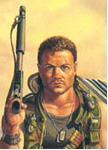
it won’t bring your wife and kids back, but it might help with the nightmares. Patricio Carrera has been waging what amounts to a private world war to bring to justice the murderers of his family. He’s raised an army and air force and used them. He’s raised a fleet and he’s about to use that. He’s suborned one republic and is about to undermine another. He’s tracked his enemies across half a world, breaking, in the process, any notion of international law that stood in his way. Now he’s deployed his legions to Pashtia, penultimate hideout of the Salafi Ikhwan who have made him what he has become. But with each step further from his home, revenge seems no closer. And with each step he leaves behind him a little of his dwindling humanity. Revenge is a dish best served cold. Yet the trail itself grows cold, as cold as the snow-capped, windswept mountains of Pashtia. Only Carrera’s hate still burns hot, and that’s a fire that is slowly consuming him.
This picks up right were the first volume in the series (A Desert Called Peace) left off. Kratman basically has constructed a Hayekian post-apocalyptic somewhat near future, where the Earth is now run by 'cosmos', e.g., cosmopolitan 'liberals', who have basically taxed and redistributed the economy to death (all the while supporting their own lavish lifestyles). For all intensive purposes, Earth is now run by a dictatorship that claims the common good, but the elite (class ones) basically reap all the benefits while the vast majority of humanity are basically slaves. Before all this went down, however, another planet (Terra Nova) was discovered via a space 'rift' and colonized by everyone all the nation states wanted to get rid of.
Flash forward 400 years and a Terra Nova looks, politically at least, pretty much like Earth circa 2000, with one radical Islamic sect waging a terrorist war against the rest of the world. Obviously, Terra Nova is basically a proxy for now, and is rife with political commentary throughout. Kratman seems to revel in making the non-governmental organizations of today (Amnesty, Doctors without borders, etc.) and institutions like the UN basically the bad guys who support the terrorists via funding and propaganda (also toss in the main stream press for that matter). Our main protagonist, Pat Carrera) however, realizes that to fight a war on terror, you need to basically bring the terror to the terrorists, and that means being absolutely ruthless.
In the first volume, Carrera and his mercenary force from Balboa (Panama) have basically won the 'Iraq' war, but Bin Laden (e.g., Mustafa) is still at large in Afghanistan (e.g., Pastia). This volume basically tells the tale of bringing the terrorist movement to heel in a harsh, violent manner. It turns out that the United Earth forces, who maintain several spaceships in orbit over Terra Nova, have also been aiding and abetting the terrorists, hoping to set back progress on Terra Nova before they take to the stars and bring a hurting back to Old Earth.
As I mentioned in my review of the first volume, Kratman excels in pushing as many triggers as he possibly can, so be warned. Yet, I hesitate in calling this 'right wing' science fiction, as it is not simply knee jerk rantings. Kratman in the afterward outlines his (or at least a) moral and philosophical discussion of human identity and community that basically permeate the story. People can only have so many loyalties, and for most, family comes first. Sure, we can abstract to the nation state also, but cosmopolitan liberals also believe people can build abstract loyalties to some idea of a greater good for humanity as a whole. Like The Road to Serfdom, those pushing this agenda, who also tend to be in charge of the agenda, are basically seen as looking out for number one (or maybe their families as well) with their agenda as a proxy for them to amass wealth and power. Once in power, they are no better than the USSR.
Old Earth is moribund, the economy shattered, but the 'Class ones' have achieved immortality treatments and are still living high on the hog as the rest of humanity slaves away as the economy declines further. Expect lots of action, some sleazy sex scenes, and some rather 'old fashion' female character tropes. In a way, this is a homage to Heinlein and his views; if you take exception to Heinlein, you should stay far away from this one. If you like Ringo's or Webber's work, you will probably like this one. It is engaging and thoughtful, but it is on purpose designed to piss people off who hold certain world views. 4 stars.
The second book in the series we continue the process of Carrera taking his revenge on the Salafi terrorists that killed his wife and children. After success in Sumer (Iraq) the Legion del Cid returns home. The Progressives have won their election and as a result have fired the LdC. But...the war still rages in Pashtia (Afghanistan) and eventually the Federated States of Columbia (USA) will have to turn once more to the LdC.
So Carrera extorts a huge sum from the FSC and the Legion deploys to Pashtia. They are able to win, mostly because, as in Sumer, they do not restrain their Area of Operations (AoO), nor their Rules of Engagement (RoE). Meanwhile back home the first ships of the Clasis (Latin for fleet) are deployed on anti-piracy operations in the Mare Furiousa (Pacific) around Uhura (Africa) and in the Nicobar straits (Borneo?).
At the same time back in Balboa (Panama), Parilla, Carerra's partner with the LdC, has decided to run for President in the upcoming election. This is a threat to the status quo and the primacy of the Tauran Union (EU) and current gov't so they, of course, work to prevent it.
Will Carrera find Mustafa the architect behind his family's murder? Will the Salafi terror network defeat an aging WWII escort carrier? Will Parilla win the election? What will the High Admiral of the United Earth Peacekeeping Fleet (UEPF) do to stop Carrera? To find out you need to read the book, of course.
Col Kratman has again penned his "near-Earth" view of current geopolitics and allows us to view the world as it might be instead. As the story grows the depth grows as well and the history is explained. We start to see, even more so, the cracks in the UEPF and its rigid caste system, but we also start to see that Carrera can, and perhaps has, gone too far. It has been almost a decade since the attacks, and how he can manage to maintain such hatred is part of the character study. It is indicative of the nature of the conflict that hatred changes us into something that might very well be as bad as what we fight. Has Carrera stepped over that line? Perhaps...or perhaps not. I am reminded, in part, of the line that Jack Nicholson's character in "A Few Good Men" tells Tom Cruise's character..."we live in a world that has walls, and those walls have to be guarded by men with guns...you want me on that wall, you need me on that wall." Carrera is the man on that wall and he protects those that need protecting from a planet that is desperately trying to kill itself. Is that us? To an extent...I wish it wasn't, but it is. That is partly what makes this book so compelling to read.
Note 1: Fiction though they may be, everything in these books are from the perspective of a US citizen, and a far right one at that.
Note 2: I am giving books 2, 3 and 4 the same review for a couple reasons. First, the story is slow to develop, so much so that it seems unnecessary to review each book individually. There is a lot of world-building in each book, but sensible world building related to the story. Still, world-building does not a story make and so ignoring the world-building leaves the reader with a straight-forward good guys vs. bad guys story. Second, I am pressed for time and have pretty much the same thing about each book to say.
In book 1 of the Carrara Series Mr. Kratman shows how a more militaristic approach would have won the 2003 Iraq war. He does this in a sci-fi setting where earth has sent its unwanted population to the one earth-like planet discovered, Terra Nova. On Terra Nova humans set up equivalents to the countries they knew on earth, the Federated States for the United States, the Republica de Balboa for Panama and Taurus for the European Union.
In book 1 an extremely wealthy Federated States retired officer living in Balboa at the time of the 9/11 equivalent attack manages to create a private army. Thanks to the stamp of approval given by Balboa the army isn’t technically a mercenary army but in practice it essentially is. The MC takes his private army and wins the Terra Nova equivalent of the 2003 Iraq War.
In book two the MC takes his private army and wins the Terra Nova equivalent of the 2001 Afghan war. In book three the MC takes his private army and wins the war on drugs and a Balboan civil war prompted by the interference of Taurus. In book four the MC is largely absent, the perspective switched to female members of the private army (now the Balboan army albeit with many foreign members). The point of book four is essentially to show how women and homosexuals fit into the author’s political philosophy which is (greatly simplified) that only military personnel should be allowed to vote.
Since book four is freshest in my mind a lot of this review is based on that book. Virtually the first 3/4ths of the book is a training montage which is little more than a vehicle for explaining the author’s political philosophy. In the last third combat with the evil Taurans commences. However, the focus is on one small unit involved in the fighting and so the larger events of the war are pretty much lost to the reader. I do plan on moving on to book five and, if that tells the full Tauran war story I will be wishing I had skipped book four altogether (in spite of its interesting characters).
So, this series is essentially far right American propaganda and, from what I’ve read of Mr. Kratman he is aware of that fact. I believe Mr. Kratman to be both intelligent and deserving of respect. So please don’t take anything in this review to contradict the foregoing. Nevertheless I feel compelled to address Mr. Kratman’s overall points: that socialism is evil and the US should combat this through increased militarism. While I don’t believe Mr. Kratman’s blanket condemnation of socialism is supportable I don’t disagree with the author about many of the advantages of a military life. (Note that Mr. Kratman is a retired US Army officer with combat experience whereas I am a civilian.)
Mr. Kratman and I come to a similar conclusion from very different perspectives. For example, I feel that my generation would have been greatly benefited by a more structured school experience, particularly one meant to instill a sense of self-discipline. As a result I actually favor a military high school approach to education. However for many decades improvements to education have been left to liberals in America since all the conservatives are willing to do is cut taxes regardless of the long-term costs of such headline grabbing jingoism. Mr. Kratman, however, comes to this same position from a conservative pro-military position. What Mr. Kratman appears unwilling to credit is that the vast majority of American liberals actually value its military. Liberals tend to be more aware of the shortfalls of military force and value the lives of American soldiers more and so American liberals are less willing to actually send soldiers into combat. Mr. Kratman seems to see that as a negative while I see it as a positive.
Still, where Mr. Kratman and I seem to differ most is in the goals for a military high-school. I see such an education as a way to empower and motivate individuals but, reasoning by analogy from his fiction, Mr. Kratman seems to believe that such an education should be used to point out the flaws of socialism and any possible worldwide government. In other words, indoctrinate students into a conservative mind set.
It also seems to me that Mr. Kratman overlooks the two biggest problem with excessive militarization- the loss of innovation and a possible coup. Regarding innovation: I have heard it said by many current and former military men that one of the greatest weaknesses of the military mindset is its lack of innovation and even today virtually all innovations come from the private sector. In his fiction Mr. Kratman essentially just denies this by having his military continue to innovate. Likewise in his fiction Mr. Kratman has a character state that a coup won’t happen because anyone who wants power can just join the Balboan military. That is, of course just naïve as history is rife with people who want power without having to work for it or, given a small taste, want more.
That’s enough of debating Mr. Kratman’s political philosophy. I’m sure I’ve done a poor job of it but then it is spread out over multiple books and the amount of time it would take to truly analyze it is prohibitive. Bottom line is all the real world examples I have ever come across of military lead governments have failed and so it seems Mr. Kratman’s theory about a military government that would succeed is optimistic and the cost of Mr. Kratman being wrong would be excessive.
Why, you may ask, do I continue to read Mr. Kratman’s books? Two reasons: First, he is a good writer. I found his suggestion of indoctrinating high school age students disturbing to the extreme- that is, after all, the sort of thing that happened in Nazi Germany, but Mr. Kratman is an American and I am certain he does not draw that comparison. Further, given his experience in military education (where I have none) I suspect he is aware of many valid distinctions that can be made to disqualify the comparison. Still, a disquieting suggestion, which brings me to point two: Mr. Kratman has a set of experiences to draw from that I don’t and frankly I am interested in those experiences. I considered joining the army when I graduated high school but, obviously, decided against it. By the time 9/11 came around I was too old for induction, although not too old to have still been in service if I had joined out of high school. My inability to contribute meaningfully at that time disappointed and troubled me and leads me to value the insights of those who did. I believe Mr. Kratman to be one such.
Bottom line: Too political for my tastes and a lot of world building but above average writing by a man with knowledge. Still, should only be read by fully developed individuals capable of evaluating Mr. Kratman’s underlying arguments for themselves.
Tom Kratman is the spiritual successor to Robert A. Heinlein. The author clearly has a deep knowledge of military organisation, strategy, tactics, and the life of a soldier. Having this transposed onto a sci-fi setting gives a degree of believability to war among the stars that is lacking in pretty much all of the sci-fi that isn't written by Heinlein, so it's very nice to see that torch being picked up and carried by someone new.
Carnifex takes up the action right where A Desert Called Peace leaves off, on the planet of Terra Nova. The initial campaigns of the Legions put together by Patricio Carrera (nee Patrick Hennessey) and his colleagues have wound down, and the FSC has tried to mothball them. So, when the time comes that they need to be called back to service, Carrera/Hennessey makes the politicians who fired him in the first place pay through the nose to hire his men.
In the meantime, Carrera and the boys have been building an even more formidable force than before, including the beginnings of a fleet of ships, including a small aircraft carrier, and their first job is to tackle the piracy which is crippling shipping for the FSC and its allies. Then their army is hired to take care of the Salafists who have retreated to a mountainous and tribe-infested area of the planet (sounds like Afghanistan).
After Mr. Kratman was kind enough to comment on my post about the first book in this series, A Desert Called Peace, I feel moved to discuss some of the deeper issues raised in reading his books.
The main protagonist, Patrick Hennessy, enters into this endeavor motivated mostly by vengeance, needing to make the terrorists pay in blood for the death of his family. In the journey, however, we do see some other aspects of Hennessy, such as his intense loyalty towards his men. He'll spare nothing, not even his own health, wealth or sanity, in order to make sure that they get the best training and equipment possible to wage this war. In the beginning, they have little, but after a time, they are the most effective fighting force on the planet. He also endures the dilemma that all commanders face, of sending troops off into situations where they are all likely to be killed, in order to achieve a strategic objective, and this responsibility ages and saddens him, but not past his ability to do what he must.
There's a point in the books when Hennessy, seeing that the opposing forces are not treating prisoners humanely, makes a public statement to the media and to his foes that if they will abide by the rules of war, his troops will continue to treat prisoners well, allow battlefield surrenders, and so forth. But if the Salafists will not abide by the rules, then his forces will be released to be as brutal as necessary to win. This policy appeared to work in the book. It raises some moral questions, though, and one wonders if in lowering our standards to those our enemies follow, we might not become too much like them to bear.
The Legion also maintains a very secretive on-the-water "intelligence gathering' operation. Captured terrorists are both physically and psychologically tortured until they give up the information needed to thwart their organization's ongoing plans. We've just been through a huge public debate on torture in this country, so I've considered it a bit. My gut level reaction is that, if the lives of my family or friends were at stake, and time was short to find out how to stop an impending attack, my first instinct would be to use whatever means necessary to stop it. The needs of the many, or the innocent, outweigh the cost of brutalizing someone who means them harm. Does it make it moral, however?
In the United States, we have long had a mandate that the military forces of the country are ultimately under civilian control, with the President as our commander in chief. The Legion, in these books, is only nominally under civilian control, mostly from a payroll standpoint, though as time goes by Hennessy and his financial wizards come close to achieving financial independence as well. So, is the existence of a superior fighting force, abiding mostly by their own sense of honor and duty, a good thing to have lying around? In this story it may very well be. What responsibility should an army have to their civilian masters when those master become corrupt, incompetent and at times betray their own nation?
Other thoughts...
What happens when the standard of living in a country is so low that joining a mercenary force like the legion provides young men with the highest wages they could ever earn, better training than the could ever have hoped for, a guaranteed retirement and death benefit, and for the truly talented, paid scholarships? When you have such a flood of volunteers that you can pick just the best and the brightest for your troops?
At what point do you regard media workers who are ostensibly neutral or overtly hostile to your cause to be actual enemies? What level of cooperation with your armed enemies makes them fair targets? What about members of NGOs who are providing material aid? What level of retaliation is appropriate? Humiliation or discrediting them, taking them prisoner until the war is over, assassinating them?
If you like hard core war fiction, complete with rape, torture, assassination, violent combat, graphic sex, corruption, and twisty plots, traps and pitfalls, it's a great book. Kratman makes no bones about how he feels about those who view the world as they wish it could be, rather than accepting reality and dealing with treacherous terrorist forces accordingly.
I never really reviewed the first book. I was way behind on my reviews so I just wrote a mention in my End of Year Clean Up in 2019 (yes it has taken me this long to get around to read the 2nd book in the series) but then I wrote: “This is however NOT a book for SJW’s, liberals or anyone remotely left leaning. The easily offended crowd better take special care or else a heart attack or something is about to happen.“
Well, it is equally true for this second book. There’s a lot of political undertones and parallels to today’s geopolitical situations in the book and it is of course all told from the author’s political perspective. This book takes place in the same rather dystopian universe where the UN is, believe it or not, even more corrupt and useless than they are today in the real world. To the point that they are disgustingly depraved. Terra Nova is where UN sent all the undesirables, that is everyone which didn’t support their agenda, when they started to see their utopia crumble around them. Thus Terra Nova is now more like Earth, or like what Earth used to be.
Unfortunately certain religious factions on Terra Nova are also back to their previous fanaticism and shenanigans in general. It of course doesn’t help that UN in a unusual show of wisdom have realised that Nova Terra will crush the depraved and complacent Earth if they retake control of space travel so they do their best to support the religious terrorist scum in their hope of keep Terra Nova underdeveloped.
And in the middle of this Carerra is building his small army and searching for revenge.
Well that is pretty much the story. Politics, army building and action that advances the story at, I wouldn’t say slow but at least, a moderate pace.
I like Carerra and I like that the bad guys and the despicable scum bags usually gets their asses kicked more than the god guys gets it. The book is very well written. Story, characters, world building, military action is all top notch. It’s a long book and sometimes it’s a bit difficult to follow all the threads. In particular, I was not too found of the frequent flashbacks.
Overall it is a very good book but it requires a bit of effort to read. Perhaps that is why I seem to take quite some time between books on this series.
I have interacted with the author a bit on x/twitter, and he indicates that this "A Desert Called Peace" and "Carnifex" were actually written as one single novel, but it was so long that it was impossible to bind into a single book, and he had to break it into 2 just to publish.
So Volume one is essentially the Iraq war, and Volume 2 picks up for Afghanistan all the war through to victory. Wait, Afghanistan, you say? This is about a country called "Pashtia" 400 years from now. Okay, if you say so, it is easier to read if you just go with this being an alternate history book about the present day.
Kratman takes this bloody tale of revenge farther than I would have. Ending the Wahabi movement almost certainly requires putting some people down, and maybe the terror element of how he chose to do it is necessary, but I will leave it to you to decide if it is justified.
Great description of what would happen if you DID let loose the dogs of war--completely off the chain to total victory.
There are lots of good points to this book and the series of which it is a part. However, depending on your politics, you may not be able to appreciate them.
This is written in the tradition of some of Robert A. Heinlein's more political works, with an explicit point of view regarding internationalism and cultural relativism. Kratman basically takes the view that some cultures are objectively better at creating happy lives for the people who live in them. The cosmopolitan view that all cultures are, in some way, equally valuable is anathema to him.
As the second book in the series, this political view is very heavy-handed. Later books stay true to this general theme, but don't emphasize the personally repulsive amoral spinelessness of the "kosmo" ultra-liberal to the same extent.
I enjoy the series for the twist on current affairs, the military action, and the under-dog makes good sense of a small latin american country battling the world.
I enjoyed the military parts of this book. I Did Not enjoy the sex scenes with the children involed To me it was unnecessary. I will not the read the rest of the series.
Second book in the series. Patricio Carrera has built a military force for his adopted country of Balboa that is technically a mercenary company for the express purpose of revenge.
A loosely veiled critique of our world, its countries, and progressives, Kratman shows how a military should prosecute total war to defeat an enemy through his fictional legion led by the honorable and ruthless Carrera who seeks revenge for the death of his wife and children at the hands of Salafi (Moslem jihadist) terrorist.
A solid story that is gritty in its portrayal of the horrors of war. Recommended to aficionados of military SF.
This is the second book in Mr. Kratman's "Carrera" series. In my view it is at least as good, probably better than the first book. In "Carnifex," Kratman continues to use the fiction of "future"events on a planet colonized by Earth, to critique recent military actions in Panama, the Gulf, and Afghanistan. The series is also social commentary on the possible result of current political and social trends. Since the series takes place in the future, "Duque" Carrera has the history of these events to guide him in avoiding the same pitfalls. How he manages to do so, is what makes this series exciting military science fiction.
Another fantastic bit of war-porn and social-political commentary from Mr. Kratman. Ill admit to actually really liking them. I don't necessarily agree with everything, but it occasionally actually gives some pause for thought, which is not something someone expects from this sex and violence riddled romp.
Im torn on some parts there where I like seeing perspectives on how to build and support a "real"-ish army, but sometimes it just drags because of it. Has some of that ponderousness I sometimes associate with great, but dense, traditional "Hard" sci-fi.
Fun series, great escapism, gets annoying at points when he tries to hard to match the nations and politics of the current world era to this future world, but it's not a totally new trick. Piers Anthony did the same thing with Bio of a Space Tyrant. Worth reading and keeping. Kratman's thoughts on warfare, government, the role of soldiers and citizenry have direct tie ins with Heinlein's thoughts on the same subjects.
The second book in the Legion El Cid series. Continues on from A Desert called Peace. Builds on the characters you first met in the first book and develops the concept and worlds brilliantly. This was the fourth book I read as an e-book and will continue to purchase and read more this way. The moral dilemma facing the major character and his protagonist at the end of the story is well written.
As with the previous book in this series, the author takes what might be a valid political point to a ridiculous extreme. Only good storytelling saves this from the waste bin.