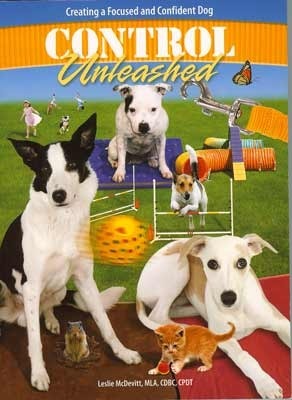
I would give this book 3.5 stars if the option was available. I had very high expectations for this book based on other people's recommendations, but unfortunately it didn't live up to them for me.
I bought the book hoping to find some good advice for working with my very highly driven, motivated younger dog who has too much uncontrolled enthusiasm for agility. The description of the book makes it sound perfect for him. In fact, I found the book offered a lot more advice for my older dog whose stresses and worries made focusing on agility difficult for him. If you have that sort of dog this book is great. I can vouch for the effectiveness of the 'have a sniff' and 'look at that dog' games, because I already knew about them before reading this book. I can't remember where I learnt about these techniques - I suspect a combination of Emma Parson's Click to Calm, Susan Garrett's Crate Games, and Dawn Weaver's Knowledge Equals Speed. A lot of the other techniques in the book have a heavy reliance on ring gates. As a British agility competitor I had to Google Image what one was as we don't use them here! It does mean the exercises are something you will struggle to work on without space, ring gates, and cooperative stooge dogs.
I did pick up some useful points for my over-enthusiastic dog. When warming him up I will make greater use of massage. Currently when warming my dog up I do lots of exciting tricks to hype him up to get him ready to run agility, and then struggle to keep my hyped up dog calm in the queue - this is obviously silly. My heart was in the right place - I want to make sure I warm my dog up so he doesn't injure himself! Nevertheless, lesson learned. Massage and on-off switch games for us. I also liked the point about rewarding your dog for reorienting to you. I already do this when my dog exits his crate, but I realise now that are other situations to reward his behaviour such as when being unclipped from the lead to run agility.
Throughout the book also emphasises the importance of working your dog sub-threshold, and increasing the rate of reinforcement whenever you increase the difficulty of an exercise. These are good take home messages for anyone to remember. The point was made that many people do not use a high enough rate of reinforcement. This is a fact that has previously stood out to me when watching Youtube videos of Silvia Trkman training, because she uses an incredibly high reinforcement rate. Which reminds me, this may not be the best dog training book for those not already familiar with terms such as 'rate of reinforcement' and 'jackpot reward'.
So overall some very good, if not entirely ground-breaking, information for helping stressed dogs that have a habit of going of sniffing, being selectively deaf, or running at half the speed that they do in training.