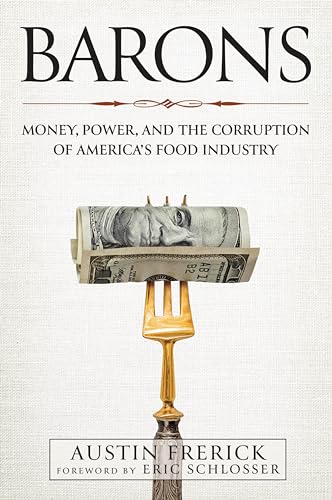
Barons is the story of seven corporate titans, their rise to power, and the consequences for everyone else. Take Mike McCloskey, Chairman of Fair Oaks Farms. In a few short decades, he went from managing a modest dairy herd to running the Disneyland of agriculture, where school children ride trams through mechanized warehouses filled with tens of thousands of cows that never see the light of day. What was the key to his success? Hard work and exceptional business savvy? Maybe. But more than anything else, Mike benefitted from deregulation of the American food industry, a phenomenon that has consolidated wealth in the hands of select tycoons, and along the way, hollowed out the nation’s rural towns and local businesses.
Along with Mike McCloskey, readers will meet a secretive German family that took over the global coffee industry in less than a decade, relying on wealth traced back to the Nazis to gobble up countless independent roasters. They will discover how a small grain business transformed itself into an empire bigger than Koch Industries, with ample help from taxpayer dollars. And they will learn that in the food business, crime really does pay—especially when you can bribe and then double-cross the president of Brazil.
These, and the other stories in this book, are simply examples of the monopolies and ubiquitous corruption that today define American food. The tycoons profiled in these pages are hardly unique: many other companies have manipulated our lax laws and failed policies for their own benefit, to the detriment of our neighborhoods, livelihoods, and our democracy itself. Barons paints a stark portrait of the consequences of corporate consolidation, but it also shows we can choose a different path. A fair, healthy, and prosperous food industry is possible—if we take back power from the barons who have robbed us of it.
Austin Frerick is an expert on agricultural and antitrust policy. He worked at the Open Markets Institute, the U.S. Department of Treasury, and the Congressional Research Service before becoming a Fellow at Yale University. He is a 7th generation Iowan and 1st generation college graduate, with degrees from Grinnell College and the University of Wisconsin, Madison. 🌽🐷🏳️🌈
This is one of three books that I will always have on my bookshelves as not only as a reminder of where food comes from, but also as a reference book. This story follows the rise of seven major food brokers/producers and how they became financially successful because of their exploitation of workers, laws, and the eating habits of manipulated consumers. What are we eating? Where did it come from? At what cost to others and to our health? What price are we paying for convenience and at the same time, unknown health problems? Who, exactly, are we supporting with our purchases? This well written book is not a simple muckraking exposure, but a well researched book that gives warning and information to us about what we are doing to our bodies, and to each other unknowingly. Author Frerick shows his expertise in agriculture and antitrust policy by weaving the intricacies and histories of both to paint a compelling picture of how we are getting it wrong in our food industry.
Barons covers the rise and consequences of seven food industry titans. If you don’t recognize the corporation, I guarantee you’ll recognize their brands. The “coffee baron” alone owns Peet’s, Panera, Krispy Kreme, Caribou, Keurig, Stumptown, and quite a few more 😳.
I’m honestly shocked this is Frerick’s first book. His writing is extremely approachable and the chapters are filled with a lot of information without being overwhelming/too long. I highly recommend this to anyone interested in books like Kochland and Dark Money.
Received this book free as an advanced copy and as part of a giveaway contest. I would have gladly paid for this book. It's an outstanding read highlighting notable individuals and families in the food industry. Only complaint I have is that it wasn't long enough. Hopefully, Austin Frerick writes a sequel!
This left me with the feeling of needing to write a research paper or take a class about it so I can indulge in deeper discussions about the failures of our current food system. I thought I was doing ok at being a conscientious consumer but didn't realize how deep some things go, such as the explotation of animals, laborers, the environment, and the consumer. This book will stay with me for a very long time.
Coming into this book I was pretty well aware of how factory farming & ranching were cruel to both animals and the humans who worked there. I did not understand how dominated the food industry was by a small number of distributors & retailers.
Every chapter of this book brought me to anger, so much so that I finally rejoined a CSA. To me, books like this can help us all better understand how to live a bit more ethically.
Damn it’s almost as if capitalism leads to monopoly leads to tyranny of the toiling masses. It’s the greatest system in the world and it’s the only path moving forward. I, for one, thank our overlords for perpetually increasing prices and diminishing product quality. It’s our god given right as Americans to be pillaged and poisoned 🫡🇺🇸
Excellent and depressing book about the food industry and the monopolies or near-monopolies that dominate it. For all that, I think it does an important job of reframing how we think about food.
For the last twenty years, all the onus has been put on the consumer. The idea is that we must make choices to manage our own food intake, while sidestepping the obvious and catastrophic consequences of the government not governing or managing our food. Like, I shouldn't have to read labels and figure out what ingredients in bread or oatmeal are damaging. I shouldn't have to figure out if food I'm buying off a grocery store shelf is actually poison. But that's where we are and that's something we convinced ourselves was normal!
We should not have to wonder if food is nutritious or not, if it's brought to us by slave labor or unsafe conditions or anything else. These are problems too large for any individual consumer or even a well coordinated campaign of consumers. Especially since the consolidation in food is so severe that you cannot escape these monopolies in any reasonable way.
We need antitrust enforcement and we need it now. And this book is a great argument for why it's so necessary, not only for our food and health, but for our democracy and economy.
It’s always some f*ckface loser (in this case, sentient botched marble statue and complete assbag anti-antitrust legal scholar Robert Bork) that takes a shitty system and makes it infinitely worse.
This was an insightful read that sparked many great conversations with family and friends. Written in a wonderfully readable and engaging style that shares so much information wile being reader friendly, I had the best of both worlds the information and depth of a New Yorker, Atlantic, or Harper's article with the accessibility of mass trade paperback. I won this via a Goodreads giveaway, but I would have bought this at my local bookstore without a second thought.
If you want to understand how our food culture came to be the way it is and even how out tastes and food traditions formed who we are this is a book for you. But, most importantly if you want to see how food has shaped global economics and international politics you can't beat this book.
I grew up outside of Eldora, IA, near Pine Lake State Park, which is the first place the author writes about. My dad worked for Iowa Select for a year after our family farm went under. This book speaks volumes of truth. The water in Pine Lake is so bad, and it makes me sad that my kids can't enjoy it like I used to when I was young. Iowa Select has ruined Iowa in my opinion. When I go home to visit family, all I can smell is pig manure everywhere I go, thanks to the high concentration of factory pig barns. The rest of this book is also so eye-opening, everyone should read it! I feel like there could be an entire book about each baron, individually! Thank you for writing this book, and thank you for the ARC!
An excellent, well researched, and jarring look into the large corporations and entities that control the agricultural and food markets. A damning indictment of our governments repeated failure to reign in monopolies and the reaping of the environment those monopolies have, and are, continuing to do.
Another “required” reading for all frustrated by US life generally and Iowa in particular. An exposé on numerous fronts, this book didn’t shy away from stating the issues and naming those who lie at their root.
This book was recommended by a friend and I will never be the same! If you care about where your food comes from and like history this is an amazing read! I listened to the audiobook and I felt engaged and interested the whole time. One of those books that you won’t stop thinking about!
This was incredibly hard to read, to a degree that honestly surprised me, probably because this is the career path I've chosen for the moment and I am consumed by my concerns about the food industry in America for at least 20 hours a week anyway. That being said, this was a brilliantly reported, well-researched book that I wish I could nail between the eyes of the most evil men to ever walk this Earth; aka every pro-monopoly Wall Street executive and industry baron that have desecrated our financial, environmental, and social systems over the last century with the express intent to amass as much personal fortune as they can before croaking. Assigned reading for everyone!
"One company sells 73 percent of baby food; one company sells 47 percent of pet food. It just so happens that it’s the same company: Nestlé. And the nation’s meatpacking industry is now more concentrated than when Upton Sinclair wrote The Jungle. Four companies, two of which are foreign owned, now slaughter more than half of all meat consumed in the United States.
... Meanwhile, the future of America's dairyland is similar to what has played out in Iowa: industrial, corporate food production that will further hollow out communities and encourage reactionary right-wing politics. More wealth will leave the places that produced it, and anger will fill the void."
as an iowan, this book means a lot to me. i was lucky enough to meet this author and hearing him talk passionately about this topic that he knows so much about was such a privilege! i learned a lot about some crappy people and companies and although i knew our government wasn’t for the people, it was glaringly obvious from the evidence this book provided. i also felt myself impressed with the moves that these leaders made to grow their businesses so successfully… it just sucks that they’re terrible and selfish people. i appreciated the conclusion having some solutions for how to fix this radical system we have in place now, but i did find myself having to step away from the book a few times because it just felt so hopeless with such a huge problem that the little people have no control over. i have similar feelings about this country at times! i’m eager to read more from this author and follow his career as he tries to make the world a better place.
“the environment simply cannot handle so much pig shit” “more wealth will leave the places that produced it, and anger will fill the void” “big boys want to run with big boys“ “the goal of executives is to drive their company toward monopoly - that’s where the real profits are” “markets thrive on transparency; barons thrive in the dark”
i've been leaning away from star ratings to try and give a more rounded review but 5👏🏻stars👏🏻. recommend to all. i would have finished in one sitting if i had the time! it simplifies the histories of food "barons", basically monopolies, & their roles in the american food systems. from hogs, grains, berries,& butchering to their selling point in grocery stores, the reader learns about all the horrible practices & exploitations they began with and continue using to control their markets. and right when you're feeling the burden of doom at the end, the reader is met with an uplifting conclusion with possible solutions & motivation for change <3 simple & effective & extremely interesting
This is a fantastic breakdown of the inequalities in the American agricultural system. Austin Frerick organizes the “Barons” that run monopolies and Duopolies of the different industries and details the exact government policies that enable their unchecked power.
In the end, he specifically lays outs government proposals that could support bettering our food systems. Our food system has never worked to the benefit of the workers, communities, or consumers. Since the 80s it has been working steadily towards enriching a few billionaire families and making everyone else poorer, sicker, and less engaged in their communities.
Arkansas, Walmart, and the Waltons also have a whole chapter.
helps partly answer my continued rants over the taste of tomatoes.
very thoughtful & stark picture of the last 20-40 (+ sometimes) years of consolidation and capitalism across multiple food industries. He does a great job making clear the direct connection of policy or lack thereof to outcomes that affect consumers, producers and workers.
an ideal balance of depth and simplicity for a nonfiction 10/10. and makes you shake your fists!!
"healthy markets are not a natural phenomenon. as a society we make decisions about how markets are structured, about the rules that govern them, ..about who holds power and who does not."
I’ll be stewing on this book for the foreseeable future. It ties together so many societal ills (stagnant incomes, decaying small towns, environmental degradation, obesity) and shows how they lead back to the monopolization of our food economy in the past forty years. I typically struggle to fully engage when reading non-fiction, but this book sucked me in with writing that was academic but still enjoyable. My only critique is that there were some ideas and tangents that could have been explored more. Basically I wish the book was longer!
“Although our political system may feel stuck in the mud, fighting for a more locally oriented food system might be an off-ramp that can appeal to folks on both sides of the aisle.”
So super informative and approachable, I’m already planning to read it again. If you are dreading the division that so often flares up in your family around the holiday table, this is the conversation to unite you.
Enjoyed this one. Talks about how concentrated different agricultural markets have become (berries, grain, dairy etc.) and the negative consequences of this, including lower wages, environmental problems, and poor working conditions. I’m more familiar with the increased appetite for antitrust enforcement in the technology and finance industries so it was interesting to hear the arguments within agriculture. TLDR — decreased regulation predominantly in the 80s makes people worse off. A tale as old as time!
It is good to have a light shed on this important topic and kinda depressing the trajectory - that food barons and consolidation of the food industry is speeding up with a number of the barons just emerging this century. I found the last two chapters on Walmart as the supermarket baron and the conclusion, which brought everything together the most interesting. In earlier chapters, the practices seemed oftentimes repetitive with other barons.
I did feel that a different format of being topic specific rather than baron specific, eg, labour, environment, health, might have been a better way to organise the book and then to offer solutions as a way to better focus on how to bring about change.
Although, yes, this book is in my wheelhouse of interests, I really think it would be a great book for anyone to read. Through discussing food barons, the book captures the current state of the food system. A great mix of facts and commentary, it was an easy read, I found myself wanting to keep picking up!
An excellent and searing indictment of the unchecked consolidation of our food industry, currently controlled by a handful of barons: beef barons, berry barons, coffee barons, etc. The Gilded Age overtones are deliberate, and Frerick ends the book with a rallying cry to attack these powers at the source.
A must-read for anyone that eats in the U.S. This book is incredibly well-researched and timely, explaining in everyday language how economic consolidation has put our communities, health, climate, and democracy in danger.