

What do you think?
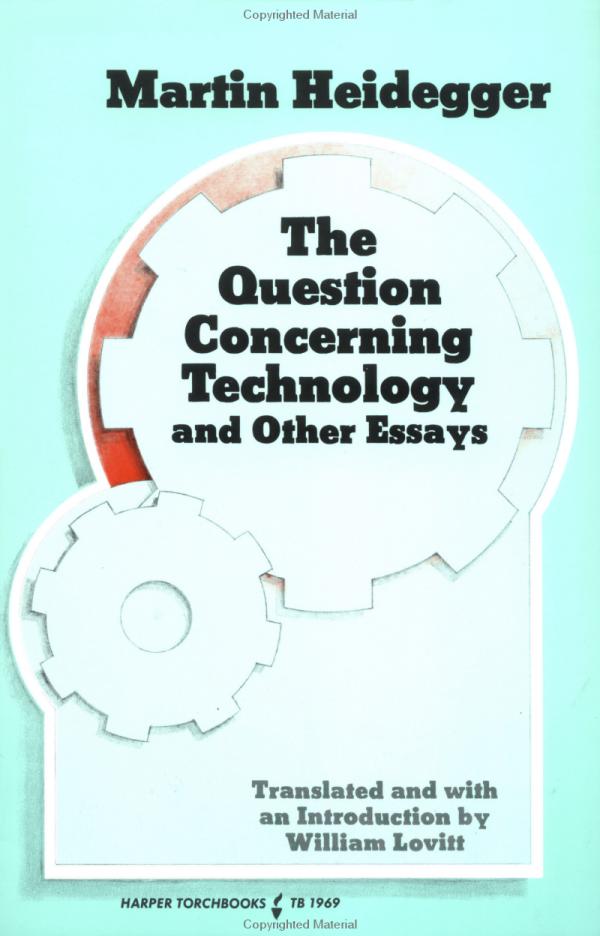
The Question Concerning Technology and Other Essays
"To read Heidegger is to set out on an adventure. The essays in this volume—intriguing, challenging, and often baffling to the reader—call him always to abandon all superficial scanning and to enter wholeheartedly into the serious pursuit of thinking....
"Heidegger is not a 'primitive' or a 'romanitic.' He is not one who seeks escape from the burdens and responsibilities of contemporary life into serenity, either through the re-creating of some idyllic past or through the exalting of some simple experience. Finally, Heidegger is not a foe of technology and science. He neither disdains nor rejects them as though they were only destructive of human life.
"The roots of Heidegger's hinking lie deep in the Western philosophical tradition. Yet that thinking is unique in many of its aspects, in its language, and in its leterary expression. In the development of this thought Heidegger has been taught chiefly by the Greeks, by German idealism, by phenomenology, and by the scholastic theological tradition. In him these and other elements have been fused by his genius of sensitivity and intellect into a very individual philosophical expression."
—William Lovitt, from the Introduction
"Heidegger is not a 'primitive' or a 'romanitic.' He is not one who seeks escape from the burdens and responsibilities of contemporary life into serenity, either through the re-creating of some idyllic past or through the exalting of some simple experience. Finally, Heidegger is not a foe of technology and science. He neither disdains nor rejects them as though they were only destructive of human life.
"The roots of Heidegger's hinking lie deep in the Western philosophical tradition. Yet that thinking is unique in many of its aspects, in its language, and in its leterary expression. In the development of this thought Heidegger has been taught chiefly by the Greeks, by German idealism, by phenomenology, and by the scholastic theological tradition. In him these and other elements have been fused by his genius of sensitivity and intellect into a very individual philosophical expression."
—William Lovitt, from the Introduction
182 pages, Paperback
First published January 1, 1938
About the author
Martin Heidegger
547 books3,472 followersMartin Heidegger (1889-1976) was a German philosopher whose work is perhaps most readily associated with phenomenology and existentialism, although his thinking should be identified as part of such philosophical movements only with extreme care and qualification. His ideas have exerted a seminal influence on the development of contemporary European philosophy. They have also had an impact far beyond philosophy, for example in architectural theory (see e.g., Sharr 2007), literary criticism (see e.g., Ziarek 1989), theology (see e.g., Caputo 1993), psychotherapy (see e.g., Binswanger 1943/1964, Guignon 1993) and cognitive science (see e.g., Dreyfus 1992, 2008; Wheeler 2005; Kiverstein and Wheeler forthcoming).
Ratings & Reviews
Friends & Following
Create a free account to discover what your friends think of this book!
Community Reviews
Displaying 1 - 30 of 146 reviews

December 3, 2020
[Second Reading: still phenomenal!]
To read Heidegger is to set out on an adventure, says William Lovitt. And boy what an adventure it is! It is unbelievably dense and mind-numbing, as is typical of Heidegger; but if you keep at it, it will unfold itself to you the same way the world opens up to those who really look. It is immensely satisfactory and rewarding.
The Question Concerning Technology is one of the very best critiques of modernity I have ever read. The first paragraph establishes the essay's objective: to investigate technology in order to prepare us for a "free relationship" to it. The problem for Heidegger is not so much the existence of technology or the forms it takes, but rather our orientation to technology. How does my existence as a human being find itself revealed in finding out the essence of technology? Questioning in this is a mode of thinking; it is what makes us special, what makes the Dasein special. Heidegger's assertion that "the essence of technology is by no means anything technological" allows him to move his discussion of technology out of the domain of technological "experts." This attempt to "open up" the conversation is at once a democratic gesture and a strategy to shift the discussion to philosophy, to ontology specifically; where he is an expert.
Heidegger does not understand technology as a technological apparatus, but as a way of understanding the world. Our usual conception of technology is one of an exterior system, an entity separate from us; we think about it only in terms of its anthropomorphic utility. Heidegger rejects the separation between object and subject; he believes that our very being is entwined with technology. He sets out to dispel the “neutrality” of technology, since it has literally changed the trajectory of entire societies. Technology is much more than just an instrument to serve humankind; and while this definition is correct, it is limiting; it conceals our way to the truth. Technology is a way of revealing, of introducing meaning where there was incoherence, it organises and structures. It sways our Being as a way of understanding the world, as a way of exposing more.
But technology is not anything new, so how exactly is pre-industrial tech different from modern tech? Technology in an older world cajoled the potential out of nature, where humans were in a fundamental relationship with nature. The trees were our homes; they were used to create houses. But now these very trees and resources have become an abstraction.
This is where Heidegger blew my mind with a remarkable analysis of the reciprocal relationship between modern physics and modern technology. Historically, the former precedes the latter, but in essence, modern tech came before modern physics. Today we, as a species, are in a broad sense permeated by our fascination with physics and mathematics. Physics, in order to understand the world, approaches nature by the injection of quantities into nature. The sciences are usually seen as this unbiased way of studying nature, as a pure way of looking at things, but Heidegger rejects this entirely. Modern physics has entrapped nature as a “calculable coherence of forces”, thereby reducing things to, what he called, Bestand in German, meaning Standing-Reserve . It reduces everything down to its utility, its market-value. The world in this sense is seen as one large resource waiting to be exploited; this kind of thinking has become so ingrained in us that it conceals other ways of thinking from us; we forget that there are other modes of thinking about the world. If the world is a resource to be exploited, what will stop us from looking at people the same way? After all, notice the semantics on which business organisations are structured; partitioning people away into departments, overseen by “human resources”. Inner human affairs are turned into networking, every human relationship today has attained a utilitarian hue; ultimately reducing beings to not-beings. It has damaged the Care Structure of the world; it has created an almost unscientific worship of science. This, in his view, is the ultimate threat; the ultimate danger is that revealing and destining have a way of fatality about it. We lose sight that standing-reserve is just one way of looking at things. In this way, humans also end up reduced to mere calculators, to ciphers and numbers; a subject to our own machinery. The greatest danger is humans losing their essence. Technology has encapsulated our ways of thinking in such a way that it makes us complacent to the threat of existential danger, not just physically, but also onto-logically.
But like Holderlin said, “But where the danger is, there also grows the saving power.” In opening ourselves up to the essence of technology, we also have the potential to change things. We are radically free, and in this sense it is important to understand that Heidegger is not anti-technology. Throughout this little philosophical work, I couldn’t shake off the feeling that this was in a way a very scathing criticism of capitalism as well. It resonates with Marx’s analysis of capitalism in how it transforms human consciousness as well along with the economy; making people permeable to quantification, to being assessed in terms of market-value.
The solution, for Heidegger, is not to do away with the technological way of relating to reality. That is not an option anyway. However, we can do away with its dominance, which is the real problem. We can do so by recognizing that this way of relating to the world is really just one way of relating to the world. Heidegger further suggests an alternate way of relating to the world, one which held sway, he claims, in Ancient Greece. It is the way of the craftsman and the artist. For Heidegger, this way is a counter-part to nature. In the way nature lets a tree come into being out of a seed, a craftsman lets a pot come out of some clay. The pot was potential in the clay and the craftsman allowed nature to present itself in this way. One is more a part of nature rather than set against it, in a symbiotic relationship with it that allows reality to reveal itself to us in a myriad of ways. All in all, what a marvelous little piece of philosophy!
“The closer we come to the danger, the more brightly do the ways into the saving power begin to shine, and the more questioning we become. For questioning is the piety of thought.”
To read Heidegger is to set out on an adventure, says William Lovitt. And boy what an adventure it is! It is unbelievably dense and mind-numbing, as is typical of Heidegger; but if you keep at it, it will unfold itself to you the same way the world opens up to those who really look. It is immensely satisfactory and rewarding.
The Question Concerning Technology is one of the very best critiques of modernity I have ever read. The first paragraph establishes the essay's objective: to investigate technology in order to prepare us for a "free relationship" to it. The problem for Heidegger is not so much the existence of technology or the forms it takes, but rather our orientation to technology. How does my existence as a human being find itself revealed in finding out the essence of technology? Questioning in this is a mode of thinking; it is what makes us special, what makes the Dasein special. Heidegger's assertion that "the essence of technology is by no means anything technological" allows him to move his discussion of technology out of the domain of technological "experts." This attempt to "open up" the conversation is at once a democratic gesture and a strategy to shift the discussion to philosophy, to ontology specifically; where he is an expert.
Heidegger does not understand technology as a technological apparatus, but as a way of understanding the world. Our usual conception of technology is one of an exterior system, an entity separate from us; we think about it only in terms of its anthropomorphic utility. Heidegger rejects the separation between object and subject; he believes that our very being is entwined with technology. He sets out to dispel the “neutrality” of technology, since it has literally changed the trajectory of entire societies. Technology is much more than just an instrument to serve humankind; and while this definition is correct, it is limiting; it conceals our way to the truth. Technology is a way of revealing, of introducing meaning where there was incoherence, it organises and structures. It sways our Being as a way of understanding the world, as a way of exposing more.
But technology is not anything new, so how exactly is pre-industrial tech different from modern tech? Technology in an older world cajoled the potential out of nature, where humans were in a fundamental relationship with nature. The trees were our homes; they were used to create houses. But now these very trees and resources have become an abstraction.
This is where Heidegger blew my mind with a remarkable analysis of the reciprocal relationship between modern physics and modern technology. Historically, the former precedes the latter, but in essence, modern tech came before modern physics. Today we, as a species, are in a broad sense permeated by our fascination with physics and mathematics. Physics, in order to understand the world, approaches nature by the injection of quantities into nature. The sciences are usually seen as this unbiased way of studying nature, as a pure way of looking at things, but Heidegger rejects this entirely. Modern physics has entrapped nature as a “calculable coherence of forces”, thereby reducing things to, what he called, Bestand in German, meaning Standing-Reserve . It reduces everything down to its utility, its market-value. The world in this sense is seen as one large resource waiting to be exploited; this kind of thinking has become so ingrained in us that it conceals other ways of thinking from us; we forget that there are other modes of thinking about the world. If the world is a resource to be exploited, what will stop us from looking at people the same way? After all, notice the semantics on which business organisations are structured; partitioning people away into departments, overseen by “human resources”. Inner human affairs are turned into networking, every human relationship today has attained a utilitarian hue; ultimately reducing beings to not-beings. It has damaged the Care Structure of the world; it has created an almost unscientific worship of science. This, in his view, is the ultimate threat; the ultimate danger is that revealing and destining have a way of fatality about it. We lose sight that standing-reserve is just one way of looking at things. In this way, humans also end up reduced to mere calculators, to ciphers and numbers; a subject to our own machinery. The greatest danger is humans losing their essence. Technology has encapsulated our ways of thinking in such a way that it makes us complacent to the threat of existential danger, not just physically, but also onto-logically.
But like Holderlin said, “But where the danger is, there also grows the saving power.” In opening ourselves up to the essence of technology, we also have the potential to change things. We are radically free, and in this sense it is important to understand that Heidegger is not anti-technology. Throughout this little philosophical work, I couldn’t shake off the feeling that this was in a way a very scathing criticism of capitalism as well. It resonates with Marx’s analysis of capitalism in how it transforms human consciousness as well along with the economy; making people permeable to quantification, to being assessed in terms of market-value.
The solution, for Heidegger, is not to do away with the technological way of relating to reality. That is not an option anyway. However, we can do away with its dominance, which is the real problem. We can do so by recognizing that this way of relating to the world is really just one way of relating to the world. Heidegger further suggests an alternate way of relating to the world, one which held sway, he claims, in Ancient Greece. It is the way of the craftsman and the artist. For Heidegger, this way is a counter-part to nature. In the way nature lets a tree come into being out of a seed, a craftsman lets a pot come out of some clay. The pot was potential in the clay and the craftsman allowed nature to present itself in this way. One is more a part of nature rather than set against it, in a symbiotic relationship with it that allows reality to reveal itself to us in a myriad of ways. All in all, what a marvelous little piece of philosophy!
“The closer we come to the danger, the more brightly do the ways into the saving power begin to shine, and the more questioning we become. For questioning is the piety of thought.”

December 22, 2019
In his lecture The Question Concerning Technology (1953), Martin Heidegger explores the status of technology and its relationship to human being and Being in general.
To put it simply: when natural philosophers like Parmenides and Heracleitos started asking questions about Being, they were able to penetrate to the fundamental ontological structure of everything. During these times, technology had a much broader scope than it has for us. Philosophy, science (the study of nature) and poetry all explored Being in its purity. Language was key.
The later Heidegger regarded language as the house in which human beings live. In other words, language is the way we understand the world and ourselves, and in this role is crucial. This explains his obsession with the degeneration of mankind, albeit not in a biological sense (like social Darwinists, the eugenicists-movement and the Nazi Übermensch-programme) but in a philosophical sense.
According to him, this pure state of Ancient Greece got covered up under the rubble of two millennia of philosophical tradition. It all started with Plato and Aristotle, who shifted the attention to the world as it appears to us and its relation to a supposed real world. To quote Alfred North Whitehead: the whole western tradition of philosophy is a footnote to Plato. Up to Heidegger's time all of philosophy occupied itself with the same basic question about the status of beings that started with Plato. This tradition not only sprouted the delusional metaphysics, which dresses itself in ontological garments only to cover up its ontic body, but also the mighty powerful world-changing modern sciences - the study of the world of reality.
What does this have to do with poetry and Ancient Greece? Well, with Aristotle's conception of hylemorphism - the notion that all things are composites of matter and form (essence) - man started to look at the world in a particular way. This was a way that transformed nature into an endless stock of matter to be ordered - by human beings, at will - to use as energy for their worldly ends. By the way, this world, or nature, includes human beings themselves. The scientific revolution in the seventeenth century started a development in which mankind ever-increasingly viewed nature in a one-sided way: nature as a store of energy to be ordered at will and used as it pleases us.
It is important to note that Heidegger is not occupied with environtmental issues or the way this mechanistic-technological worldview leads to exploitation of human beings - Heidegger was no Marx. He is solely occupied with the status of Being: the dominance of the technological viewpoint was both a historical necessity that started in Greece with Plato and Aristotle and intensified with the new sciences; and leads to the covering up of both alternative views to look at the world of beings (like poetry) and the possibility of un-covering itself.
In short, modern man looks at mountains as stores of energy, as things to be ordered by human beings (whether in the form of iron ore or a ski resort); at rivers as stores of energy which can be transformed into other forms and be distributed and create more things. During his later years, Heidegger was obsessed with poetry and he uses the German poet Hölderlin as example of someone who can capture, e.g., the river Rhine in a way that explores the Being of this natural phenomenon, as alternative to the technological viewpoint. According to him, writing after two world wars (including atom bombs), mass industrialization and at the start of the computer age, the danger for mankind has never been as great as now, but - again quoting poets - it is during the times when danger looms large that salvation is nearest.
Of course, Heidegger's claims can be psychologized and this would lead us to conclude we here have a traditional, conservative man who grew up in the rural country-side and who looked at the industrialization and 'americanisation' of his Germany with sadness. In short, a man who rejects modernity and rather wants to return to the days of Ancient Greece - if not in practice, at least in his mind. But this is too easy. Heidegger strikes an important chord: there are many ways to view the world we live in, and the scientific-technological standpoint has increasingly - with ever-faster rates - blindfolded us. We live in times and places were all (qualitative) aspects of human existence and our world are reduced to mathematical relations. In this sense, science and technology house their own intrinsic existential mode, which increasingly represses all alternative modes into oblivion.
And it is this last point which Heidegger warns us about: due to technology we look at the world through a technological lens, looking all of nature as mere resources of energy. This lens is so useful and even pleasurable to us, that more and more we lose sight of alternative ways to view nature. If this process goes on long enough, who will still be able to realize that there are alternative ways to look at nature to begin with?
For Heidegger, the question of 'What it means to Be?' was central to his life, and the increasing dominance of the technological standpoint made asking this question (let alone answering it) more and more difficult. For Heidegger art captures Being its most purest form: its creations enlighten our life-worlds in ways that make things appear to us in ways that cannot be captured by any technology. And poetry, since it is based on language - the house we dwell in, as human beings -, is the most pure form of art. Modern technology makes us lose sight of the question of Being and in this is transforming our essence as human beings. We used to be occupied with the question 'What does it mean for me to be, as a being?' but more and more we have forgotten this question, the question of our essence as men, and view ourselves and our world as standing-reserves of energy to be used by us and for us, at will. We are immersed in the world of being.
This is definitely a very interesting little work of Heidegger, and captures his later thinking rather well. It also is much more accessible than (e.g.) his Letter on Humanism (1947). I'd definitely recommend reading it, since its core themes and theses are still relevant today - perhaps now even more than back then...
To put it simply: when natural philosophers like Parmenides and Heracleitos started asking questions about Being, they were able to penetrate to the fundamental ontological structure of everything. During these times, technology had a much broader scope than it has for us. Philosophy, science (the study of nature) and poetry all explored Being in its purity. Language was key.
The later Heidegger regarded language as the house in which human beings live. In other words, language is the way we understand the world and ourselves, and in this role is crucial. This explains his obsession with the degeneration of mankind, albeit not in a biological sense (like social Darwinists, the eugenicists-movement and the Nazi Übermensch-programme) but in a philosophical sense.
According to him, this pure state of Ancient Greece got covered up under the rubble of two millennia of philosophical tradition. It all started with Plato and Aristotle, who shifted the attention to the world as it appears to us and its relation to a supposed real world. To quote Alfred North Whitehead: the whole western tradition of philosophy is a footnote to Plato. Up to Heidegger's time all of philosophy occupied itself with the same basic question about the status of beings that started with Plato. This tradition not only sprouted the delusional metaphysics, which dresses itself in ontological garments only to cover up its ontic body, but also the mighty powerful world-changing modern sciences - the study of the world of reality.
What does this have to do with poetry and Ancient Greece? Well, with Aristotle's conception of hylemorphism - the notion that all things are composites of matter and form (essence) - man started to look at the world in a particular way. This was a way that transformed nature into an endless stock of matter to be ordered - by human beings, at will - to use as energy for their worldly ends. By the way, this world, or nature, includes human beings themselves. The scientific revolution in the seventeenth century started a development in which mankind ever-increasingly viewed nature in a one-sided way: nature as a store of energy to be ordered at will and used as it pleases us.
It is important to note that Heidegger is not occupied with environtmental issues or the way this mechanistic-technological worldview leads to exploitation of human beings - Heidegger was no Marx. He is solely occupied with the status of Being: the dominance of the technological viewpoint was both a historical necessity that started in Greece with Plato and Aristotle and intensified with the new sciences; and leads to the covering up of both alternative views to look at the world of beings (like poetry) and the possibility of un-covering itself.
In short, modern man looks at mountains as stores of energy, as things to be ordered by human beings (whether in the form of iron ore or a ski resort); at rivers as stores of energy which can be transformed into other forms and be distributed and create more things. During his later years, Heidegger was obsessed with poetry and he uses the German poet Hölderlin as example of someone who can capture, e.g., the river Rhine in a way that explores the Being of this natural phenomenon, as alternative to the technological viewpoint. According to him, writing after two world wars (including atom bombs), mass industrialization and at the start of the computer age, the danger for mankind has never been as great as now, but - again quoting poets - it is during the times when danger looms large that salvation is nearest.
Of course, Heidegger's claims can be psychologized and this would lead us to conclude we here have a traditional, conservative man who grew up in the rural country-side and who looked at the industrialization and 'americanisation' of his Germany with sadness. In short, a man who rejects modernity and rather wants to return to the days of Ancient Greece - if not in practice, at least in his mind. But this is too easy. Heidegger strikes an important chord: there are many ways to view the world we live in, and the scientific-technological standpoint has increasingly - with ever-faster rates - blindfolded us. We live in times and places were all (qualitative) aspects of human existence and our world are reduced to mathematical relations. In this sense, science and technology house their own intrinsic existential mode, which increasingly represses all alternative modes into oblivion.
And it is this last point which Heidegger warns us about: due to technology we look at the world through a technological lens, looking all of nature as mere resources of energy. This lens is so useful and even pleasurable to us, that more and more we lose sight of alternative ways to view nature. If this process goes on long enough, who will still be able to realize that there are alternative ways to look at nature to begin with?
For Heidegger, the question of 'What it means to Be?' was central to his life, and the increasing dominance of the technological standpoint made asking this question (let alone answering it) more and more difficult. For Heidegger art captures Being its most purest form: its creations enlighten our life-worlds in ways that make things appear to us in ways that cannot be captured by any technology. And poetry, since it is based on language - the house we dwell in, as human beings -, is the most pure form of art. Modern technology makes us lose sight of the question of Being and in this is transforming our essence as human beings. We used to be occupied with the question 'What does it mean for me to be, as a being?' but more and more we have forgotten this question, the question of our essence as men, and view ourselves and our world as standing-reserves of energy to be used by us and for us, at will. We are immersed in the world of being.
This is definitely a very interesting little work of Heidegger, and captures his later thinking rather well. It also is much more accessible than (e.g.) his Letter on Humanism (1947). I'd definitely recommend reading it, since its core themes and theses are still relevant today - perhaps now even more than back then...

Want to Read
February 1, 2012Holy cow this one looks good. Also some lectures sound like awesome sci-fi/horror flicks: "The Thing," "The Danger," and "The Turning."

December 22, 2018
Imagine if “the fault in our stars” were a mishmash of Aristotle and Hölderlin

March 1, 2020
These five essays represent Heidegger’s mature/late understanding of science and technology. Even the middle one about Nietzsche’s “God is Dead” is in fact about consummate subjectivity that underlies modern technology. For Heidegger, science is about projected objectivity that entraps the real in the form of theory. However, this objective projecting and entrapping is nothing but subjectivity; as truth becomes certainty due to modernity's fundamental approach with securing everything that is. This entire project became partially explicit and took front stage with Descartes and culminated in Nietzsche; however its roots go back to Plato and his theory of ideas. Presencing as understood by Ancient Greeks eventually decays to causality as fundamental to modern science; as the Ancient φύσις becomes modern physics. Heidegger’s final conclusion regarding science is that it cannot understand its own essence within its own framework; that it “science cannot think”. Technology is the new “development” of science, where both the subject and object completely disappear and only the functional subject-object relationship remains as secured in the standing-reserve enframing of everything that is. That is, science’s objectiveness disappears into technology’s pure resource essence.
As far as I am concerned, these are the most profound reflections on the essence of science and technology. Beneath them there are Heidegger’s understanding of: Being and of everything that is, the Ancient Greek’s original inception, the entire arc of history that started with the Greeks and culminated in the German Idealism and eventually in the modern science/technology, the understanding of human being as Dasein, the anti-humanist and anti-modern project, the metaphysical nature of philosophy and of science/technology, the nature of art, the project to overcome modern nihilism, and especially the understanding of truth as ἀλήθεια.
Original February 2020 review:
Before Heidegger and while reading philosophy and searching for new meanings, one agrees more and more with the Ecclesiastes that “there is no new thing under the sun”.
Heidegger opens completely new words, while thinking/reflection is again an adventure (he calls it a homecoming).
While discussing nihilism, technology, science, and so on he questions our highly metaphysical definitions. He takes us back to the Greeks and the original meaning of the words. The Greek thinkers got a glimpse at the truth, but the “truth” we got today got concealed by two thousand years of metaphysics – especially Descartes's metaphysics that still dominates almost all human areas.
In the process of following Heidegger, we understand what it means to be human, what truth is, how science works in the age of world picture by securing and entrapping the real as objects, how humans turn into subjects with the modern science and then into resources with the current technology understanding, that “God is dead” means the end of any metaphysics, why Nietzsche was the last metaphysical thinker, what the dangers of thinking and of not thinking are, why is more important than even to prepare an empty space for a “new god” to appear today, and so on.
With and after Heidegger, thinking is again a joy.
The price we need to pay for this joy is the immense effort and patience in preparing, reading, understanding, and following Heidegger on all these new paths.
As far as I am concerned, these are the most profound reflections on the essence of science and technology. Beneath them there are Heidegger’s understanding of: Being and of everything that is, the Ancient Greek’s original inception, the entire arc of history that started with the Greeks and culminated in the German Idealism and eventually in the modern science/technology, the understanding of human being as Dasein, the anti-humanist and anti-modern project, the metaphysical nature of philosophy and of science/technology, the nature of art, the project to overcome modern nihilism, and especially the understanding of truth as ἀλήθεια.
Original February 2020 review:
Before Heidegger and while reading philosophy and searching for new meanings, one agrees more and more with the Ecclesiastes that “there is no new thing under the sun”.
Heidegger opens completely new words, while thinking/reflection is again an adventure (he calls it a homecoming).
While discussing nihilism, technology, science, and so on he questions our highly metaphysical definitions. He takes us back to the Greeks and the original meaning of the words. The Greek thinkers got a glimpse at the truth, but the “truth” we got today got concealed by two thousand years of metaphysics – especially Descartes's metaphysics that still dominates almost all human areas.
In the process of following Heidegger, we understand what it means to be human, what truth is, how science works in the age of world picture by securing and entrapping the real as objects, how humans turn into subjects with the modern science and then into resources with the current technology understanding, that “God is dead” means the end of any metaphysics, why Nietzsche was the last metaphysical thinker, what the dangers of thinking and of not thinking are, why is more important than even to prepare an empty space for a “new god” to appear today, and so on.
With and after Heidegger, thinking is again a joy.
The price we need to pay for this joy is the immense effort and patience in preparing, reading, understanding, and following Heidegger on all these new paths.

January 23, 2023
As dense as it can get! Heidegger kept me me busy in a thrilling chilling philosophical investigation concerning the essence of technology and science. It is homecoming, rather than adventure. Not going back,but coming-to-presence of Being. Something that endures it in its being. Disclosing of literally everything, Existence. Nothing precedes the essence now. Technology in its gathering together in our time is changing its essence. But now comes the twist. Technology and the essence of technology are not same at all. Rather the essence of technology has always been there. Technology in its capitalist mode traps the presence, traps the phenomenon. It exists as standing-reserve. An unending cycle of commodities. The concept of object is quite new. And in modern science we are shrouded by the discourses of object, objectives and objectness. As if everything around us come through existence by the touch of our actions.
And do we have any concrete relationship with Truth? What are truths in our time if not facts? Or certainties. Science in our age is a field of endless versatile researchers,where we can find our so called certainty about the “real”. An endless representations or pictures of world where everything is measured, calculated through the cycle of casue and effect.In Heidegger's words:“We first arrive at science as research when and only when truth has been transformed into the certainty of representation.” But what if existence is in itself a potential energy that comes forth into being out of itself? A self-presencing of beings. And without the subject-object relationship what becomes of us? Also our coming-into-presence.
The key word, the phrase,the energy, the force we need. What is it? What if we say like Heidegger:
“That something comes to stand and to lie in unconcealment”
“self-bringing-forth into full presencing”
Now stand in your openness. Let everything disclose itself in your openness. Leave those cliche modern scientific words and live for the destining of Being.
And do we have any concrete relationship with Truth? What are truths in our time if not facts? Or certainties. Science in our age is a field of endless versatile researchers,where we can find our so called certainty about the “real”. An endless representations or pictures of world where everything is measured, calculated through the cycle of casue and effect.In Heidegger's words:“We first arrive at science as research when and only when truth has been transformed into the certainty of representation.” But what if existence is in itself a potential energy that comes forth into being out of itself? A self-presencing of beings. And without the subject-object relationship what becomes of us? Also our coming-into-presence.
The key word, the phrase,the energy, the force we need. What is it? What if we say like Heidegger:
“That something comes to stand and to lie in unconcealment”
“self-bringing-forth into full presencing”
Now stand in your openness. Let everything disclose itself in your openness. Leave those cliche modern scientific words and live for the destining of Being.

March 19, 2019
The Question Concerning Technology is a powerfully rewarding, harrowing, and near-impenetrable read. I can't claim to fully grasp all the foundations and corollaries of Heidegger's argument, but when the danger of the essence of technology, and its power to enframe all around it into inventory, began to take shape in my mind and understanding, it was one of those rare moments where as a reader I came across a truly beautiful and horrifying revelation. Interestingly, I didn't feel Heidegger was saying something novel or groundbreaking, rather it was the feeling that he was illuminating this simple and natural truth I had known all along but never articulated. Perhaps that is the purpose of his willfully obtuse language: to bring the reader into a deep understanding of something the reader has always known in the back of his or her mind.

September 6, 2023
Het bestand? Ge-stell?

May 26, 2012
231212: why, after all this time, after struggling to follow... do i give this four? mainly because i like to think, and i am fairly certain my difficulties stem from my ignorance of texts, ideas, arguments offered. yes i did really like this. it is worth reading slowly, only bit by bit, and maybe a tutor would help...
020220: more The Philosophy of Heidegger
Heidegger: Thinking of Being
The Heidegger Reader
The New Heidegger
What is Called Thinking?
Poetry, Language, Thought
The Question Concerning Technology and Other Essays
Martin Heidegger: Between Good and Evil
Introduction to Metaphysics
020220: more The Philosophy of Heidegger
Heidegger: Thinking of Being
The Heidegger Reader
The New Heidegger
What is Called Thinking?
Poetry, Language, Thought
The Question Concerning Technology and Other Essays
Martin Heidegger: Between Good and Evil
Introduction to Metaphysics

Read
November 7, 2024The core argument is really compelling - I now frequently think of how modern technologies can be thought of as modes of revealing/ challenging. It’s not enough to think of technology as a neutral tool and it’s likewise not enough to think of technology as purely socially determined. Ties in nicely with the cyborg too given how Heidegger doesn’t draw any distinction between our technology and our Being
What sucks is his critique of Modernity is so Radical Traditionalist (read: lowkey Nazi) it kinda makes me question whether I actually think his conception of technology is useful. Take what you can and leave the rest I guess
What sucks is his critique of Modernity is so Radical Traditionalist (read: lowkey Nazi) it kinda makes me question whether I actually think his conception of technology is useful. Take what you can and leave the rest I guess

October 25, 2024
Incredible. I’m very glad I read these essays before reading Being & Time. Heidegger wraps up everything (ok maybe not everything but a lot) of Schelling and Nietzsche in a phenomenological bow. Reading Byung-Chul Han, it was great to go back to Heidegger and see the influence of the latter on the former.
Key concepts: Enframing (Gestell), Standing-Reserve (Bestand), the destining of Being, truth as unconcealment, etc. Heidegger goes after Descartes as the introduction to most problems of philosophy, mainly metaphysics. Ancient Greeks hold many keys for Heidegger from their pre-Cartesian sense of Subject, to their method of Science as theory of the real. Namely, with theorein, a compound of Thea, and Horao, both as aspect/view and a beholding, gazing. It viewed Being as it presences itself in its immediacy and didn’t need to represent that which is as an object in the object sphere in order to gain coherence in a panoply of objects that have been re-presented to obtain knowledge. Heidegger sees this as the essence of modern science, namely, the theory of the real and this has looked different at different times in world history due to different modes of Being and the way in which Being presences itself.
Essay on Nietzsche was very good. His exegesis of the Will to Power, which pre dated his own concept of Enframing, was very illuminating. The Will seeks power incessantly, both to preserve power (so as not to decline) and enhance its power. This seeks ever more ways to enhance, grow, control, exploit, categorize, utilize, and optimize itself as a Will. Heidegger’s treatment of Nietzsche’s value system was helpful. Ansicht creates a casting towards and throwing forth which effects a new set of values. This is done as Being destined itself in any given Epoch of history. This value system gives rise to new sets of Truths as Aleitheia is revealed/disclosed through Enframing which is ceaseless. Human beings participate in this Enframing from the challenging-calling forth from Being to mankind since Being’s ability to essence and mankind’s capacity to presence, and his dasein, is mutual. Man is open to Being, as the Being of all that is, and Being comes to presence through mankind. Consciousness is critical in this process, Language even more so, and of course, self-reflection of even more so Contemplation. How can we cast ourselves into the future where Being and man can exist United without being destroyed by technology? Heidegger says, timidly, that it is Art and deep contemplation.
I could say more but I need to go reflect.
-b
Key concepts: Enframing (Gestell), Standing-Reserve (Bestand), the destining of Being, truth as unconcealment, etc. Heidegger goes after Descartes as the introduction to most problems of philosophy, mainly metaphysics. Ancient Greeks hold many keys for Heidegger from their pre-Cartesian sense of Subject, to their method of Science as theory of the real. Namely, with theorein, a compound of Thea, and Horao, both as aspect/view and a beholding, gazing. It viewed Being as it presences itself in its immediacy and didn’t need to represent that which is as an object in the object sphere in order to gain coherence in a panoply of objects that have been re-presented to obtain knowledge. Heidegger sees this as the essence of modern science, namely, the theory of the real and this has looked different at different times in world history due to different modes of Being and the way in which Being presences itself.
Essay on Nietzsche was very good. His exegesis of the Will to Power, which pre dated his own concept of Enframing, was very illuminating. The Will seeks power incessantly, both to preserve power (so as not to decline) and enhance its power. This seeks ever more ways to enhance, grow, control, exploit, categorize, utilize, and optimize itself as a Will. Heidegger’s treatment of Nietzsche’s value system was helpful. Ansicht creates a casting towards and throwing forth which effects a new set of values. This is done as Being destined itself in any given Epoch of history. This value system gives rise to new sets of Truths as Aleitheia is revealed/disclosed through Enframing which is ceaseless. Human beings participate in this Enframing from the challenging-calling forth from Being to mankind since Being’s ability to essence and mankind’s capacity to presence, and his dasein, is mutual. Man is open to Being, as the Being of all that is, and Being comes to presence through mankind. Consciousness is critical in this process, Language even more so, and of course, self-reflection of even more so Contemplation. How can we cast ourselves into the future where Being and man can exist United without being destroyed by technology? Heidegger says, timidly, that it is Art and deep contemplation.
I could say more but I need to go reflect.
-b

Read
October 6, 2025This will be more accessible to a reader who has prior context to Heidegger than one who doesn't. It would have been completely opaque without having read Being and Time. Heidegger is often rewarding for the reader who cares to bear the frustration of trying to understand him. It's a burden I'm only occasionally willing to carry.

May 30, 2023
Martin Heidegger’s The Question Concerning Technology (first published in 1954 as “Die Frage nach der Technik”) is one of the most influential philosophical reflections on modern technology in the twentieth century. Though brief and often read in isolation, the essay occupies a central place within Heidegger’s later thought and exemplifies his distinctive approach to ontology, history, and modernity. Rather than offering a critique of specific technologies or their social consequences, Heidegger interrogates the essence of technology, arguing that its deepest significance lies in a mode of revealing that shapes how beings, including human beings, appear and are understood.
The essay’s central thesis is that technology is not merely a collection of tools or neutral means to human ends. Such an instrumental definition, Heidegger argues, is “correct” but not “true,” insofar as it fails to disclose the ontological essence of technology. This essence he names Gestell (enframing), a mode of revealing in which the world is disclosed as Bestand, or standing-reserve—resources to be ordered, stored, and optimized. Under enframing, nature is no longer encountered as something that emerges in its own right, but as something challenged forth for use.
Heidegger develops this argument through a contrast between modern technology and premodern technē. In ancient Greek thought, technē was aligned with poiēsis, a bringing-forth that allowed beings to emerge into presence in accordance with their own nature. Modern technology, by contrast, does not let beings be, but compels them to yield energy and utility. Heidegger’s well-known example of the hydroelectric plant on the Rhine illustrates this shift: the river is no longer a natural phenomenon but a calculable source of power, ordered within a system of production.
A key contribution of the essay is its insistence that enframing is not simply a human project. Heidegger resists both technological determinism and humanist voluntarism, presenting enframing as a historical “destining” of being that shapes human understanding prior to conscious choice. Humans are not the masters of technology but are themselves claimed by its revealing. This move situates the essay firmly within Heidegger’s later ontological project, in which history is understood as the unfolding of different modes of being’s disclosure.
Despite its critical tone, The Question Concerning Technology is not a straightforward rejection of technology. Heidegger famously argues that “the essence of technology is nothing technological” and that within the danger of enframing lies a “saving power.” This saving power consists in the possibility of recognizing enframing as a mode of revealing rather than an absolute necessity. Art, poetry, and reflective thinking are proposed as alternative ways of disclosing being that can loosen technology’s totalizing grip, though Heidegger remains deliberately vague about practical implications.
From an academic perspective, the essay’s strengths lie in its conceptual originality and its profound influence across disciplines, including philosophy, media theory, environmental thought, and science and technology studies. Heidegger’s analysis provides a powerful vocabulary for understanding the cultural and ontological dimensions of technological modernity, particularly the reduction of nature and human activity to calculable resources. However, the essay has also been criticized for its abstraction and historical generalization. Critics argue that Heidegger neglects the social, economic, and political structures that shape technological development, and that his account risks obscuring questions of responsibility and agency.
Stylistically, the essay is dense and aphoristic, relying on etymology, paradox, and repetition rather than systematic argumentation. This style reinforces Heidegger’s claim that the problem of technology cannot be resolved through technical or instrumental reasoning alone, but it also contributes to the text’s difficulty and susceptibility to divergent interpretations.
The Question Concerning Technology is a seminal work that continues to frame philosophical debates about the nature and consequences of modern technology. Its enduring significance lies not in offering solutions, but in unsettling commonplace assumptions about technological neutrality and human mastery. By reorienting the question of technology toward ontology and history, Heidegger provides a critical perspective that remains highly relevant in an age increasingly defined by technological mediation.
GPT
The essay’s central thesis is that technology is not merely a collection of tools or neutral means to human ends. Such an instrumental definition, Heidegger argues, is “correct” but not “true,” insofar as it fails to disclose the ontological essence of technology. This essence he names Gestell (enframing), a mode of revealing in which the world is disclosed as Bestand, or standing-reserve—resources to be ordered, stored, and optimized. Under enframing, nature is no longer encountered as something that emerges in its own right, but as something challenged forth for use.
Heidegger develops this argument through a contrast between modern technology and premodern technē. In ancient Greek thought, technē was aligned with poiēsis, a bringing-forth that allowed beings to emerge into presence in accordance with their own nature. Modern technology, by contrast, does not let beings be, but compels them to yield energy and utility. Heidegger’s well-known example of the hydroelectric plant on the Rhine illustrates this shift: the river is no longer a natural phenomenon but a calculable source of power, ordered within a system of production.
A key contribution of the essay is its insistence that enframing is not simply a human project. Heidegger resists both technological determinism and humanist voluntarism, presenting enframing as a historical “destining” of being that shapes human understanding prior to conscious choice. Humans are not the masters of technology but are themselves claimed by its revealing. This move situates the essay firmly within Heidegger’s later ontological project, in which history is understood as the unfolding of different modes of being’s disclosure.
Despite its critical tone, The Question Concerning Technology is not a straightforward rejection of technology. Heidegger famously argues that “the essence of technology is nothing technological” and that within the danger of enframing lies a “saving power.” This saving power consists in the possibility of recognizing enframing as a mode of revealing rather than an absolute necessity. Art, poetry, and reflective thinking are proposed as alternative ways of disclosing being that can loosen technology’s totalizing grip, though Heidegger remains deliberately vague about practical implications.
From an academic perspective, the essay’s strengths lie in its conceptual originality and its profound influence across disciplines, including philosophy, media theory, environmental thought, and science and technology studies. Heidegger’s analysis provides a powerful vocabulary for understanding the cultural and ontological dimensions of technological modernity, particularly the reduction of nature and human activity to calculable resources. However, the essay has also been criticized for its abstraction and historical generalization. Critics argue that Heidegger neglects the social, economic, and political structures that shape technological development, and that his account risks obscuring questions of responsibility and agency.
Stylistically, the essay is dense and aphoristic, relying on etymology, paradox, and repetition rather than systematic argumentation. This style reinforces Heidegger’s claim that the problem of technology cannot be resolved through technical or instrumental reasoning alone, but it also contributes to the text’s difficulty and susceptibility to divergent interpretations.
The Question Concerning Technology is a seminal work that continues to frame philosophical debates about the nature and consequences of modern technology. Its enduring significance lies not in offering solutions, but in unsettling commonplace assumptions about technological neutrality and human mastery. By reorienting the question of technology toward ontology and history, Heidegger provides a critical perspective that remains highly relevant in an age increasingly defined by technological mediation.
GPT

Read
October 25, 2021နည်းပညာနဲ့ လူနဲ့ ဘယ်လိုပြန်လည်တည့်မတ်မလဲ။
ဘောင်ခတ်မှု-လူကို အရင်းအမြစ်အဖြစ်၊အသုံးချစရာအဖြစ် မြင်ပေမယ့် ဆက်စပ်မှုကိုလည်း မြင်ရတယ်လို့ပြောတယ်။
ရေတံခွန်ဟာ ရေအားလျှပ်စစ်ထုတ်စရာလို့မြင်တာထက် ရေတံခွန်ဟာ ရေတံခွန်ပဲဖြစ်နေတာက အဖြေလား။
မာယာကော့စကီးရဲ့ ကဗျာတွေကို သတိရမိတယ်။
အမေရိကန်က စက်မှုလက်မှုတွေကို အနုပညာဆန်ဆန် အားကျမှုစွက်ပီး ဖွဲ့ထားတယ်။
နည်းပညာကို ကြိုးကိုင်သူတွေဖြစ်တဲ့ ကျွန်တော်တို့ဟာ ဘောင်ခတ်ရှူမြင်မှုကနေ ဘယ်လိုလွတ်နိုင်မလဲ။
မိုဘိုင်းဖုန်းတလုံးကို ဘယ်လိုရှုမြင်မလဲ။
ဘောင်ခတ်မှု-လူကို အရင်းအမြစ်အဖြစ်၊အသုံးချစရာအဖြစ် မြင်ပေမယ့် ဆက်စပ်မှုကိုလည်း မြင်ရတယ်လို့ပြောတယ်။
ရေတံခွန်ဟာ ရေအားလျှပ်စစ်ထုတ်စရာလို့မြင်တာထက် ရေတံခွန်ဟာ ရေတံခွန်ပဲဖြစ်နေတာက အဖြေလား။
မာယာကော့စကီးရဲ့ ကဗျာတွေကို သတိရမိတယ်။
အမေရိကန်က စက်မှုလက်မှုတွေကို အနုပညာဆန်ဆန် အားကျမှုစွက်ပီး ဖွဲ့ထားတယ်။
နည်းပညာကို ကြိုးကိုင်သူတွေဖြစ်တဲ့ ကျွန်တော်တို့ဟာ ဘောင်ခတ်ရှူမြင်မှုကနေ ဘယ်လိုလွတ်နိုင်မလဲ။
မိုဘိုင်းဖုန်းတလုံးကို ဘယ်လိုရှုမြင်မလဲ။

July 7, 2025
So after reading 'The Question Concerning Technology' and 'Building, Dwelling, Thinking' I felt truly excited and called to do something. After four years of undergrad philosophy readings, returning to the stuff that first sparked my passion for philosophy was super refreshing. These essays are many things: apocalyptic, theological, mystical, meditations on the essential truth of being. They are not theoretical, nor are they rationalistic arguments against our usage of technology. Heidegger's late essays are complicated, he wants to break our use of language and return us to a primordial relationship with reality, but in so doing he burrows deep into the vernacular language of his homeland, and that can get really confusing really quickly for an English reader. Heidegger also has a tendency in these essays to pre-suppose: A. familiarity with the project of Being and Time, and B. that the reader is somewhat familiar with almost all of his essays adjacent to this one. So, lots of context laden conceptual machinery going on here. But once you begin to glimpse what Heidegger is getting at, this stuff becomes really profound.
So, he begins by saying that technology is nothing technological. What he means here is that it has nothing to do with technological gadgets or machinery, but with a mode of revealing Being. Because we are not talking about technological things, our attitude towards it cannot be to just give up our technology, nor can we thoughtlessly go with the flow of technological advancement. Rather, we have to encounter its essence through questioning, which Heidegger calls the piety of thinking. What is this essence of technology? We know that it is a mode of revealing Being, but what characterizes this mode? Heidegger tells us, in a very convoluted definition, that it is a gathering that sets upon man from outside of man that directs him to challenge-forth, to reveal through extraction, Being, in the way of ordering it as standing-reserve. This mode of revealing Being is called Enframing or Gestell. Enframing is the essence of technology and in Enframing we run the risk of severing our relationship to Aletheia (Truth as unconcealing-concealing or the open). As a mode of revealing, Enframing is also a destining of man, because it direct man's relation to his own essence. Because it directs our relation to our essence, it is our history and it directs us towards the future. We who are modern are essentially thrown into Enframing, it is already automatically there. We are always 'seeing' beings as optimizable, usable, extractable. We even see ourselves in this lens and our notion of the self is radically shaped by Enframing. Nature is no longer physis, a self-revelation of Truth or the unconcealment from within, but it is now resource. Some cool parallels to a Walker Percy essay "The Loss of the Creature", I'm sure Percy read this essay.
This all sounds super mystical and its mostly due to Heidegger's revamping of the notion of Truth. Heidegger takes Truth to be the essence of human being (Dasein...Being-There) as ek-stasis (out-there / a relation). Truth as the essence of humanity, is a primordial relationship we have between Being-There and the There (Heidegger calls this the clearing) in which Being-There dwells. Because Heidegger is trying to do something like a pre-ontological analysis, its super difficult to articulate any of this in language, since language always has this representational aspect. Nevertheless, we can say that humans stand in a primordial relationship to aletheia (Truth/Unconcealment) through revealing (poiesis). Poiesis is the originary act of revealing that brings-forth into the clearing. What happens in Enframing? Poiesis is covered over, so Truth too is covered over, because Enframing totalizes the process of revealing Being such that only standing-reserve IS. Everything is manipulable, quantifiable, utilizable. We can fully know the tree, or the river, its just atoms or just material for capital, or just XYZ, in essence it becomes an object of representational truth (or fact which stands in subordinate relation to Truth) and thus occludes Truth and destroys the open, covers over the clearing and the question of Being.
This occurs because Western metaphysics has gone through a long and hefty process of abstracting Being from the real and creating the binary of Being-Becoming. Plato is the first to do this with the eidos, or the form which is relegated to the realm of Being over and above the flux of becoming. This is also where we ontologically lose sight of temporality, because now we get this extracted Eternal that no longer resides in the temporal. Aristotle attempts a course-correction but fails. The medievals carry this on by making God into an abstract formal object. The death of God and the rise of modern science are precisely the epoch of technology because modern science takes this same ontological maneuver and solidifies it by saying that Being or 'truth' is not found in the forms but in the abstract space of calculable forces (mathesis). So, we can reduce all of Being to its quantifiable components, in this abstract coordinate space (no longer place, no longer dwelling-place, no longer being-there). Now you get the logic of late capitalism, which is an accentuating/intensification of the episteme/hermeneutic of technology. The upswing of all of this is not just an advancement of technology and its effects, like increased anxiety, depression or loss of attention, but rather it is an ontological foreclosure of revealing. Revealing must be open, must hold the mystery of the revealed in the clearing, otherwise the clearing is destroyed. Paradoxically, in the quest for a complete knowledge, the thing to be known is effaced and thrown right back into the darkness from which it supposedly emerges. When we completely 'know' the tree, that is when we in fact have severed it from the open and completely lost sight of it.
The last part of the essay is on the "saving power" and there is a ton of richly theological and eschatological language here that I can't get into. Suffice to say that Heidegger sees art (not the aesthetic, cultural or artistic but the primordial poiesis) as the saving power hidden within but fundamentally different from the essence of technology. Art is also a revealing that destines us, and so makes history. Art is a revealing that opens us to the Truth and in so doing restores the essence of Dasein. Heidegger is talking about ways of seeing here, and I think there's a ton of connections to the Gospels, which makes sense given Heidegger's own theological background. Human beings are always reading, or seeing, we are caught in a hermeneutic circle. But, basically technology, mathesis, poiesis, techne/physis, these are all ways of seeing the Truth of beings. The artist has a vision of the open, he sees the concealed aspect and brings it to light but he simultaneously maintains the hiddenness and mystery, he integrates the error. There is a whole discussion to be had with regards to Heidegger's relationship to Kant here and the whole phenomena/noumena thing. Heidegger is importantly different from Husserlian phenomenology because he does away with the transcendental self (another forgetting of Being) as another mode of extracting Being from the world. There is no transcendental ego who meditates upon phenomena, nor a transcendental synthesis of apperception that connects them together. Heidegger's subject is a dynamic one, already always embedded in a world, thought is always secondary to Being. Dasein is always already dwelling in a field of meaning, a relational network of Care, and the self is a projection of this Care. As to the hiddenness of things, yes there is an aspect of the Noumena here, but Heidegger has totally shifted the relation of subject-object and the epistemological is shifted into the ontological, so he's not just a neo-Kantian. Anyways... all that to say, this essay is incredible and Heidegger is a prophetic voice for these times.
I think its a worthwhile question to dwell on as to what AI, and the internet, challenge-forth from us. I take something like ChatGPT to be the ultimate danger, since it takes Truth itself as standing-reserve. No longer are humans standing-reserve (Capital) but now the very essence of humanity is standing-reserve. Our language, our ability to create meaning, to judge, to perceive, these are all at stake with AI. AI takes the essence of our humanness and sees it as resource which can be optimized and calculated and efficiently utilized. Standing on reserve for what? The vicious circle is that this standing-reserve is only there such that we can extract more standing-reserve.
Really poignant essay for our time in which people are becoming more and more complacent with the malicious destruction of Truth and the complete de-humanization that comes with the infection of the technological into every facet of our lives. We are in trying times, but perhaps Heidegger (and Holderlin) is right and that is where the saving power shines forth most powerfully. Heidegger does not give us any answer to the question concerning technology, instead he provides a vision and a task. This is the task of thinking, of art, of dwelling. Build communities of Truth in which humans can once again poetically dwell.
So, he begins by saying that technology is nothing technological. What he means here is that it has nothing to do with technological gadgets or machinery, but with a mode of revealing Being. Because we are not talking about technological things, our attitude towards it cannot be to just give up our technology, nor can we thoughtlessly go with the flow of technological advancement. Rather, we have to encounter its essence through questioning, which Heidegger calls the piety of thinking. What is this essence of technology? We know that it is a mode of revealing Being, but what characterizes this mode? Heidegger tells us, in a very convoluted definition, that it is a gathering that sets upon man from outside of man that directs him to challenge-forth, to reveal through extraction, Being, in the way of ordering it as standing-reserve. This mode of revealing Being is called Enframing or Gestell. Enframing is the essence of technology and in Enframing we run the risk of severing our relationship to Aletheia (Truth as unconcealing-concealing or the open). As a mode of revealing, Enframing is also a destining of man, because it direct man's relation to his own essence. Because it directs our relation to our essence, it is our history and it directs us towards the future. We who are modern are essentially thrown into Enframing, it is already automatically there. We are always 'seeing' beings as optimizable, usable, extractable. We even see ourselves in this lens and our notion of the self is radically shaped by Enframing. Nature is no longer physis, a self-revelation of Truth or the unconcealment from within, but it is now resource. Some cool parallels to a Walker Percy essay "The Loss of the Creature", I'm sure Percy read this essay.
This all sounds super mystical and its mostly due to Heidegger's revamping of the notion of Truth. Heidegger takes Truth to be the essence of human being (Dasein...Being-There) as ek-stasis (out-there / a relation). Truth as the essence of humanity, is a primordial relationship we have between Being-There and the There (Heidegger calls this the clearing) in which Being-There dwells. Because Heidegger is trying to do something like a pre-ontological analysis, its super difficult to articulate any of this in language, since language always has this representational aspect. Nevertheless, we can say that humans stand in a primordial relationship to aletheia (Truth/Unconcealment) through revealing (poiesis). Poiesis is the originary act of revealing that brings-forth into the clearing. What happens in Enframing? Poiesis is covered over, so Truth too is covered over, because Enframing totalizes the process of revealing Being such that only standing-reserve IS. Everything is manipulable, quantifiable, utilizable. We can fully know the tree, or the river, its just atoms or just material for capital, or just XYZ, in essence it becomes an object of representational truth (or fact which stands in subordinate relation to Truth) and thus occludes Truth and destroys the open, covers over the clearing and the question of Being.
This occurs because Western metaphysics has gone through a long and hefty process of abstracting Being from the real and creating the binary of Being-Becoming. Plato is the first to do this with the eidos, or the form which is relegated to the realm of Being over and above the flux of becoming. This is also where we ontologically lose sight of temporality, because now we get this extracted Eternal that no longer resides in the temporal. Aristotle attempts a course-correction but fails. The medievals carry this on by making God into an abstract formal object. The death of God and the rise of modern science are precisely the epoch of technology because modern science takes this same ontological maneuver and solidifies it by saying that Being or 'truth' is not found in the forms but in the abstract space of calculable forces (mathesis). So, we can reduce all of Being to its quantifiable components, in this abstract coordinate space (no longer place, no longer dwelling-place, no longer being-there). Now you get the logic of late capitalism, which is an accentuating/intensification of the episteme/hermeneutic of technology. The upswing of all of this is not just an advancement of technology and its effects, like increased anxiety, depression or loss of attention, but rather it is an ontological foreclosure of revealing. Revealing must be open, must hold the mystery of the revealed in the clearing, otherwise the clearing is destroyed. Paradoxically, in the quest for a complete knowledge, the thing to be known is effaced and thrown right back into the darkness from which it supposedly emerges. When we completely 'know' the tree, that is when we in fact have severed it from the open and completely lost sight of it.
The last part of the essay is on the "saving power" and there is a ton of richly theological and eschatological language here that I can't get into. Suffice to say that Heidegger sees art (not the aesthetic, cultural or artistic but the primordial poiesis) as the saving power hidden within but fundamentally different from the essence of technology. Art is also a revealing that destines us, and so makes history. Art is a revealing that opens us to the Truth and in so doing restores the essence of Dasein. Heidegger is talking about ways of seeing here, and I think there's a ton of connections to the Gospels, which makes sense given Heidegger's own theological background. Human beings are always reading, or seeing, we are caught in a hermeneutic circle. But, basically technology, mathesis, poiesis, techne/physis, these are all ways of seeing the Truth of beings. The artist has a vision of the open, he sees the concealed aspect and brings it to light but he simultaneously maintains the hiddenness and mystery, he integrates the error. There is a whole discussion to be had with regards to Heidegger's relationship to Kant here and the whole phenomena/noumena thing. Heidegger is importantly different from Husserlian phenomenology because he does away with the transcendental self (another forgetting of Being) as another mode of extracting Being from the world. There is no transcendental ego who meditates upon phenomena, nor a transcendental synthesis of apperception that connects them together. Heidegger's subject is a dynamic one, already always embedded in a world, thought is always secondary to Being. Dasein is always already dwelling in a field of meaning, a relational network of Care, and the self is a projection of this Care. As to the hiddenness of things, yes there is an aspect of the Noumena here, but Heidegger has totally shifted the relation of subject-object and the epistemological is shifted into the ontological, so he's not just a neo-Kantian. Anyways... all that to say, this essay is incredible and Heidegger is a prophetic voice for these times.
I think its a worthwhile question to dwell on as to what AI, and the internet, challenge-forth from us. I take something like ChatGPT to be the ultimate danger, since it takes Truth itself as standing-reserve. No longer are humans standing-reserve (Capital) but now the very essence of humanity is standing-reserve. Our language, our ability to create meaning, to judge, to perceive, these are all at stake with AI. AI takes the essence of our humanness and sees it as resource which can be optimized and calculated and efficiently utilized. Standing on reserve for what? The vicious circle is that this standing-reserve is only there such that we can extract more standing-reserve.
Really poignant essay for our time in which people are becoming more and more complacent with the malicious destruction of Truth and the complete de-humanization that comes with the infection of the technological into every facet of our lives. We are in trying times, but perhaps Heidegger (and Holderlin) is right and that is where the saving power shines forth most powerfully. Heidegger does not give us any answer to the question concerning technology, instead he provides a vision and a task. This is the task of thinking, of art, of dwelling. Build communities of Truth in which humans can once again poetically dwell.

December 13, 2025
A great work by I forget if it was Martin Marcuse or Herbert Heidegger.

April 10, 2020
It was suggested to me that Heidegger's title essay would have relevance to my other recent reading in 20th century political philosophy. If it does, then it was lost on me.
Rather than try to review this essay in the traditional way, let me instead offer a flow chart: technology -> essence of technology -> thing and its essence are not the same -> definitions of technology -> instrumentalist definition -> technology is a means -> produces an effect -> effect has a cause -> traditional four kinds of causes -> brings forth -> reveals -> Enframes -> techne -> art -> freedom
I do not know what problem Heidegger is supposed to be addressing in this essay. I followed fairly well until his discussion of “Enframing” (which is the essence of technology, he argues), but I could see no obvious connection to politics in the 20th century. After reaching Heidegger’s discussion of Enframing about two-thirds of the way through, I was baffled most of the way thereafter. The experience of reading this essay calls to mind Hannah Arendt’s amusing (and reassuring) piece: Heidegger the Fox.
But obviously, I must read the essay again. When one decides to read Heidegger, one assumes some risk. One of the risks is that he will shatter your self-confidence in your ability to master difficult concepts on the first try. In my case, that specific sort of self-confidence had already departed me earlier in this decade. I now regularly read things twice before I can be satisfied that I made out the meaning that the author intended. Consistent with that practice, I will be reading this essay again soon and you may expect that I will be revising this review somewhat when I am done.
Rather than try to review this essay in the traditional way, let me instead offer a flow chart: technology -> essence of technology -> thing and its essence are not the same -> definitions of technology -> instrumentalist definition -> technology is a means -> produces an effect -> effect has a cause -> traditional four kinds of causes -> brings forth -> reveals -> Enframes -> techne -> art -> freedom
I do not know what problem Heidegger is supposed to be addressing in this essay. I followed fairly well until his discussion of “Enframing” (which is the essence of technology, he argues), but I could see no obvious connection to politics in the 20th century. After reaching Heidegger’s discussion of Enframing about two-thirds of the way through, I was baffled most of the way thereafter. The experience of reading this essay calls to mind Hannah Arendt’s amusing (and reassuring) piece: Heidegger the Fox.
But obviously, I must read the essay again. When one decides to read Heidegger, one assumes some risk. One of the risks is that he will shatter your self-confidence in your ability to master difficult concepts on the first try. In my case, that specific sort of self-confidence had already departed me earlier in this decade. I now regularly read things twice before I can be satisfied that I made out the meaning that the author intended. Consistent with that practice, I will be reading this essay again soon and you may expect that I will be revising this review somewhat when I am done.

November 21, 2014
Going in brimming with excitement and ready to have mind blown, I was only able to stomach his Technology chapter. It was as though his big head clouded the clarity of his actual point. He seemed to be explaining the same ideas in circles - naysaying and leaving his own contradictions of logic unaddressed. It was quite troubling in the way that it all came across more pompous than purposeful. That alone eats at me like a rock in my shoe. I didn't feel blown away or intrigued at all. Just don't like it.

January 3, 2019
Due for a re-read

July 25, 2023
Wowie!
Heidegger can be difficult to read, but this particular collection of essays was absolutely pleasurable. They question into the essential nature of science and its metaphysical assumptions, and how they have shaped our modern worldview. Heidegger was able to articulate the reasons for the uneasiness that I felt through much of my own scientific education, and so reading these essays has given me much to ponder going forward. And in addition to these intellectual meanderings, you also get a splash of poetry with quite a few Hölderlin quotes throw in throughout.
William Lovitt (the translator) also does an excellent job of providing footnotes to convey meanings that would otherwise be obscured in the English. While a translation cannot convey the full poetic nature of Heidegger's writing in German (or at least, I have heard that this is what it is like), Lovitt repeatedly emphasises etymological similarities between Heidegger's terminology in order to highlight the significance of particular passages. His footnotes were a great help.
Heidegger can be difficult to read, but this particular collection of essays was absolutely pleasurable. They question into the essential nature of science and its metaphysical assumptions, and how they have shaped our modern worldview. Heidegger was able to articulate the reasons for the uneasiness that I felt through much of my own scientific education, and so reading these essays has given me much to ponder going forward. And in addition to these intellectual meanderings, you also get a splash of poetry with quite a few Hölderlin quotes throw in throughout.
William Lovitt (the translator) also does an excellent job of providing footnotes to convey meanings that would otherwise be obscured in the English. While a translation cannot convey the full poetic nature of Heidegger's writing in German (or at least, I have heard that this is what it is like), Lovitt repeatedly emphasises etymological similarities between Heidegger's terminology in order to highlight the significance of particular passages. His footnotes were a great help.

December 10, 2009
These can be very difficult. Heidegger's writing style demands a slow, extremely careful reading, and even after going over a page a few times, your never sure if you've really gotten it. But he makes these chains of super smart observations that just follow one after the other so quickly that it seems impossible to keep up with some times. There is just so much thought that pivots around the ideas presented in these pieces that it's hard not to be drawn into the often perplexing etymologically derived labyrinth that he originates. The Age of the World Picture and Science and Reflection are the two I found most comprehensible.

May 3, 2011
This was read for Thomas Sheehan's "Continental German Thought: Heidegger" course during the second semester of 1981/82 at Loyola University Chicago. The concentration of the class was on his Being and Time and my comments about Heidegger are to be found there or in the review of his Basic Writings.

June 11, 2014
Briljante uitwerking van het gevaar van de techNiek: niet beleren of technofobisch, maar haast metafysisch. Mooie inleiding ook tot Heideggers denken (hij legt helder uit wat er met verhullen en onthullen bedoeld wordt). Een aanrader!

September 22, 2012
Some of the best work by Heidegger in articulating the "two kinds of thinking," understanding Neitzsche's "death of God," and the danger we face today in losing the meaning of Being.

April 2, 2025
Therapy for if you or a loved one has come into contact with the scientific worldview

February 5, 2023
Once again sailing through uncharted waters by reading texts integrating philosophy into the topic of technology. I was lost, and I still am lost. Despite reaching the end of the destination, my checklist and resources are heavily blank; that feeling as if I only got to the end by luck and nothing is processing properly. But all of these are merely feelings clouding judgment towards myself. I definitely remember treading through the many obstacles in this new adventure. What I indeed rather lack is confidence that I have understood it, for as a novice in this matter, it is reasonable to feel so. This serves as a disclaimer that whatever will be put out comes from someone who believes that the ocean is deeper than as per his current perception.
Based on my scarce research, Martin Heidegger primarily confronts the fundamental realness and truth of our being through the concept of the Dasein, which according to Google, is German for "existence". He incorporates this as well in QT and the rest as the foundation for his ideas, where he gives central focus on the connection between "Being" and man. To borrow the words of the author:
"Being may perhaps best be said to be the ongoing manner in which everything that is, presences; i.e., it is the manner in which, in the lastingness of time, everything encounters man and comes to appearance through the openness that man provides."
From this we can infer that the mode of thinking Heidegger acts upon lies on the very basic of everything in this world. This is supported further by Heidegger's meticulous usage of language in his belief that language is the home of Being, "the primal dimension" wherein interactions between Being take place. That being the case, Heidegger demands strict usage of words unto himself and strict understanding of said words in accordance with context. I am ordinarily not fond of rigid language. I prefer using and understanding on my own terms, or just not being expected to be strict with definition, but yeah I know that in many cases it only invites misunderstanding and is fairly illogical. It depends on the situation too, but all I want to say is it's hard to read for me despite note-taking T_T. The use of German and Greek makes it hard understand, and even translate. In this way, I begin to imagine how learning all languages can constitute universal understanding, deeply authentic in the gathering of all nuance without losing their essence.
Anyway, what I meant was the pursuit of "groundedness" influences everything Heidegger discusses. I think this is branch of philosophy is called ontology? Apparently this is where he excels, and oh my days it's incredibly easy to feel lost reading, but I digress. Through Dasein Heidegger goes into the essence of general and modern technology and how it has been been seemingly altered through history, from when technology was a techne--a mode of revealing that brings forth truth--until it became an instrumentum--basically an instrument--through a process of Enframing which basically connects man and technology in such a manner as to permit man to control and exploit everything.
"The same destining that gives this mode of appearing to whatever is also rules in him, provoking him to order everything in just this way, as standing-reserve. The challenging claim that now summons man forth, that "gathers man thither to order the self-revealing as standing-reserve," Heidegger calls Enframing."
Basically what this means is that in the eyes of man everything comes to presence as something that needs to be manipulated. This calls upon man to be a manipulator. Therefore through modern technology, all things can only be seen as servants which are meant to cause some sort of end. Through Enframing, we see ourselves and modern technology this way.
Thus is the portrait of the modern world, where man and technology are in a, plainly put, toxic relationship exchanging roles of the used and the user, ruled by convenience and productivity. But even this is Being's presencing. Heidegger gives care not to give "fault" in anyone or anything, be it Being itself, man, or technology, for in the abstractness of it all this historical progression is deemed "natural" (I use the term in my own way). He even proposes solutions throughout the end of QT and much of The Turning, assuring that the danger will come to pass in the future, borrowing Holderlin's words:
"But where danger is, grows / The saving power also." More on this later.
Of course, there is something of an explanation as to why things became this way. The reason lies in man's being annointed to the role of "subject" in Rene Descartes's cogito ergo sum. As subject, man sees reality the way he sees fit in order to be self-certain of reality. In this manner, the quest to discover the "truly real" is replaced to self-assurance. According to Heidegger, this behavior marked the beginning of the modern age.
Perhaps we can see it as man only thinking of himself and not seeing the concealed-unconcealed truth for what it is unlike the Greeks. Rather, man shapes reality through his self-consciousness, making then perception reality. Therefore, reality to modern man is mere "representation." It is not what it merely is. Of course, through philosophy and science man still seeks the truth. But to Heidegger, these philosophers and scientists only wish to control their discoveries. So in the most meticulous way, modern man contaminates the truth, distancing themselves from Being.
Statements from the introduction said it best: the reader should cast away preconceived notion before reading Heidegger. Because man, I always see science as the pursuit of truth. Like, that's it. They question for answers. They use methodology and apparatus to enlighten mankind.
Philosophy, too, is like this. These branches reach out to the unknown. But with Heidegger's inclusion of Being, things are seen highly differently now. The normalcy found in the activities of science and technology are brought to life seen in a novel point of view. Although I align with "perception is reality" and making my own set of truths, people like Heidegger see it more in a global and, on top of that, abstract scale. That's the fundamental difference between me and professionals as thinking human beings. Rest assured that I read it without bias blocking my understanding (only my intellectual capacity wasn't too of standard for all this yet to comprehend in its entirety).
Going back, modern man's representing of what he sees for his own self-security is a kind of technological behavior. Such mannerism looks at reality through the lens of causality. To be more specific, it is the looking of reality "morphologically, psychologically, in terms of decline and loss, in terms of fate, catastrophe, and destruction". From what I understood with these enumerated things, modern humans basically labels reality and categorizes it. Now each field has their own rules, and perhaps these laws alter that which is so.
This technological behavior drives the modern world. Can we conclude then, however, that it is technology's fault? No, we cannot, and we should not. Here an important distinction is asserted by Heidegger, which baffled me when I first read it:
"The essence of technology is by no means anything technological."
So, the essence of technology--what technology is--is not anything technological. What the noun is, is not its adjective? A big and long "hmm" floats in the air at that notion. Heidegger explains of course what he meant by this. Basically to him, although the idea that technology is described as a means to an end and a human activity is correct, it still isn't true. There is a distinct difference between the two and it lies on the encompassing scope.
"Enframing means that way of revealing which holds sway in the essence of modern technology and which is itself nothing technological. On the other hand, all those things that are so familiar to us and are standard parts of an assembly, such as rods, pistons, and chassis, belong to the technological. The assembly itself, however, together with the aforementioned stockparts, falls within the sphere of technological activity; and this activity always merely responds to the challenge of Enframing, but it never comprises Enframing itself or brings it about."
I can't be asked to paraphrase all that, so a direct quote felt most appropriate. It was earlier explained that Enframing rules over the essence of modern technology. In other words, it is that which provokes technology to be seen as a mere object for exploitation and man to see technology in such light. What happens here is that Enframing will therefore leave things truthless. The established correctness of modern technology's definition is due to man's subjectness. Basically, "correct" is a construct and it is surface-level compared to truth. "Correct" does not necessarily touch the essence of a thing, the truth of its being. For in truth, there is something more, and it lies in the realm of language, on the roots of the word "technology".
Basically, one of its roots is the word "techne", which is a mode of revealing something that does not brings itself forth itself. Techne brings the essence of the concealed to light. Therefore yes, technology is still a means to an end--that is correct--but then that is not only what it serves to be, for technology, as techne, serves as the bringer of truth. More than expedient, it is of a poetic purpose.
So yes, the essence of technology is by no means technological. Technology is something more than technological activities and behavior. At its core, technology is not a manipulator of things as mere means to an end, but it is reveals and brings forth into unconcealment.
However we cannot deny that technology is warped in our modern age due to Enframing. Danger abounds in it being used to extract energy from nature as it makes man regard what what he sees as mere objects to be used and expedited. But we again revisit Holderlin's poetry lines, where in danger also lies saving power. Everything comes to pass and this danger is not an exception. In its prevalence--Heidegger believes--eventually arrives the clearer view on the saving grace which will light our path towards the truth of the essence of technology. In the future, people will realize that technology is not only technological, that there is more than one way of seeing reality other than our own perception. When mankind takes into account the many other things technology can do for the good of everyone, when the truth shines all, then technology will cease to be the merely technological thing that it seems to be today.
It was a fairly interesting read. I have learned a lot, definitely, but I haven't grasped its impact yet as of now. I don't know if it will provide an immensely changing view on me towards technology, but we'll see. What I've learned from Martin Heidegger's "The Question Concerning Technology and Other Essays" is perhaps a more philosophical way of seeing things, in its base and fundamentals, it the multicolor of things. I got called out, as I was one of the people renouncing technology as evil in announcing technology ruined our lives. On the other side, I label man as evil too for making use of technology responsibly. But thinking that there is an abstract element over, around, and within everything does produce a change in looking at things. Hopefully in this generation, our people will see the truth technology is naturally capable of bringing forth, therefore consequently using it less and less in the invading of the world.
I don't really agree with everything he says, but it's been a fruitful learning experience and I think that's what matters most.
Based on my scarce research, Martin Heidegger primarily confronts the fundamental realness and truth of our being through the concept of the Dasein, which according to Google, is German for "existence". He incorporates this as well in QT and the rest as the foundation for his ideas, where he gives central focus on the connection between "Being" and man. To borrow the words of the author:
"Being may perhaps best be said to be the ongoing manner in which everything that is, presences; i.e., it is the manner in which, in the lastingness of time, everything encounters man and comes to appearance through the openness that man provides."
From this we can infer that the mode of thinking Heidegger acts upon lies on the very basic of everything in this world. This is supported further by Heidegger's meticulous usage of language in his belief that language is the home of Being, "the primal dimension" wherein interactions between Being take place. That being the case, Heidegger demands strict usage of words unto himself and strict understanding of said words in accordance with context. I am ordinarily not fond of rigid language. I prefer using and understanding on my own terms, or just not being expected to be strict with definition, but yeah I know that in many cases it only invites misunderstanding and is fairly illogical. It depends on the situation too, but all I want to say is it's hard to read for me despite note-taking T_T. The use of German and Greek makes it hard understand, and even translate. In this way, I begin to imagine how learning all languages can constitute universal understanding, deeply authentic in the gathering of all nuance without losing their essence.
Anyway, what I meant was the pursuit of "groundedness" influences everything Heidegger discusses. I think this is branch of philosophy is called ontology? Apparently this is where he excels, and oh my days it's incredibly easy to feel lost reading, but I digress. Through Dasein Heidegger goes into the essence of general and modern technology and how it has been been seemingly altered through history, from when technology was a techne--a mode of revealing that brings forth truth--until it became an instrumentum--basically an instrument--through a process of Enframing which basically connects man and technology in such a manner as to permit man to control and exploit everything.
"The same destining that gives this mode of appearing to whatever is also rules in him, provoking him to order everything in just this way, as standing-reserve. The challenging claim that now summons man forth, that "gathers man thither to order the self-revealing as standing-reserve," Heidegger calls Enframing."
Basically what this means is that in the eyes of man everything comes to presence as something that needs to be manipulated. This calls upon man to be a manipulator. Therefore through modern technology, all things can only be seen as servants which are meant to cause some sort of end. Through Enframing, we see ourselves and modern technology this way.
Thus is the portrait of the modern world, where man and technology are in a, plainly put, toxic relationship exchanging roles of the used and the user, ruled by convenience and productivity. But even this is Being's presencing. Heidegger gives care not to give "fault" in anyone or anything, be it Being itself, man, or technology, for in the abstractness of it all this historical progression is deemed "natural" (I use the term in my own way). He even proposes solutions throughout the end of QT and much of The Turning, assuring that the danger will come to pass in the future, borrowing Holderlin's words:
"But where danger is, grows / The saving power also." More on this later.
Of course, there is something of an explanation as to why things became this way. The reason lies in man's being annointed to the role of "subject" in Rene Descartes's cogito ergo sum. As subject, man sees reality the way he sees fit in order to be self-certain of reality. In this manner, the quest to discover the "truly real" is replaced to self-assurance. According to Heidegger, this behavior marked the beginning of the modern age.
Perhaps we can see it as man only thinking of himself and not seeing the concealed-unconcealed truth for what it is unlike the Greeks. Rather, man shapes reality through his self-consciousness, making then perception reality. Therefore, reality to modern man is mere "representation." It is not what it merely is. Of course, through philosophy and science man still seeks the truth. But to Heidegger, these philosophers and scientists only wish to control their discoveries. So in the most meticulous way, modern man contaminates the truth, distancing themselves from Being.
Statements from the introduction said it best: the reader should cast away preconceived notion before reading Heidegger. Because man, I always see science as the pursuit of truth. Like, that's it. They question for answers. They use methodology and apparatus to enlighten mankind.
Philosophy, too, is like this. These branches reach out to the unknown. But with Heidegger's inclusion of Being, things are seen highly differently now. The normalcy found in the activities of science and technology are brought to life seen in a novel point of view. Although I align with "perception is reality" and making my own set of truths, people like Heidegger see it more in a global and, on top of that, abstract scale. That's the fundamental difference between me and professionals as thinking human beings. Rest assured that I read it without bias blocking my understanding (only my intellectual capacity wasn't too of standard for all this yet to comprehend in its entirety).
Going back, modern man's representing of what he sees for his own self-security is a kind of technological behavior. Such mannerism looks at reality through the lens of causality. To be more specific, it is the looking of reality "morphologically, psychologically, in terms of decline and loss, in terms of fate, catastrophe, and destruction". From what I understood with these enumerated things, modern humans basically labels reality and categorizes it. Now each field has their own rules, and perhaps these laws alter that which is so.
This technological behavior drives the modern world. Can we conclude then, however, that it is technology's fault? No, we cannot, and we should not. Here an important distinction is asserted by Heidegger, which baffled me when I first read it:
"The essence of technology is by no means anything technological."
So, the essence of technology--what technology is--is not anything technological. What the noun is, is not its adjective? A big and long "hmm" floats in the air at that notion. Heidegger explains of course what he meant by this. Basically to him, although the idea that technology is described as a means to an end and a human activity is correct, it still isn't true. There is a distinct difference between the two and it lies on the encompassing scope.
"Enframing means that way of revealing which holds sway in the essence of modern technology and which is itself nothing technological. On the other hand, all those things that are so familiar to us and are standard parts of an assembly, such as rods, pistons, and chassis, belong to the technological. The assembly itself, however, together with the aforementioned stockparts, falls within the sphere of technological activity; and this activity always merely responds to the challenge of Enframing, but it never comprises Enframing itself or brings it about."
I can't be asked to paraphrase all that, so a direct quote felt most appropriate. It was earlier explained that Enframing rules over the essence of modern technology. In other words, it is that which provokes technology to be seen as a mere object for exploitation and man to see technology in such light. What happens here is that Enframing will therefore leave things truthless. The established correctness of modern technology's definition is due to man's subjectness. Basically, "correct" is a construct and it is surface-level compared to truth. "Correct" does not necessarily touch the essence of a thing, the truth of its being. For in truth, there is something more, and it lies in the realm of language, on the roots of the word "technology".
Basically, one of its roots is the word "techne", which is a mode of revealing something that does not brings itself forth itself. Techne brings the essence of the concealed to light. Therefore yes, technology is still a means to an end--that is correct--but then that is not only what it serves to be, for technology, as techne, serves as the bringer of truth. More than expedient, it is of a poetic purpose.
So yes, the essence of technology is by no means technological. Technology is something more than technological activities and behavior. At its core, technology is not a manipulator of things as mere means to an end, but it is reveals and brings forth into unconcealment.
However we cannot deny that technology is warped in our modern age due to Enframing. Danger abounds in it being used to extract energy from nature as it makes man regard what what he sees as mere objects to be used and expedited. But we again revisit Holderlin's poetry lines, where in danger also lies saving power. Everything comes to pass and this danger is not an exception. In its prevalence--Heidegger believes--eventually arrives the clearer view on the saving grace which will light our path towards the truth of the essence of technology. In the future, people will realize that technology is not only technological, that there is more than one way of seeing reality other than our own perception. When mankind takes into account the many other things technology can do for the good of everyone, when the truth shines all, then technology will cease to be the merely technological thing that it seems to be today.
It was a fairly interesting read. I have learned a lot, definitely, but I haven't grasped its impact yet as of now. I don't know if it will provide an immensely changing view on me towards technology, but we'll see. What I've learned from Martin Heidegger's "The Question Concerning Technology and Other Essays" is perhaps a more philosophical way of seeing things, in its base and fundamentals, it the multicolor of things. I got called out, as I was one of the people renouncing technology as evil in announcing technology ruined our lives. On the other side, I label man as evil too for making use of technology responsibly. But thinking that there is an abstract element over, around, and within everything does produce a change in looking at things. Hopefully in this generation, our people will see the truth technology is naturally capable of bringing forth, therefore consequently using it less and less in the invading of the world.
I don't really agree with everything he says, but it's been a fruitful learning experience and I think that's what matters most.

September 26, 2021
Technology in the twentieth and twenty-first centuries can be as much of a problem as a help. As an instrument, it can make mass killing much easier. Indeed, nuclear bombs enable the world to potentially destroy itself in less than an hour. Yet technology can enable human flourishing as well. For instance, I develop software professionally that I hope will help my domain (medical research) advance. How are we to understand technology, a concept as ancient as early Greeks, and how do we ensure that we use it properly? These questions, Heidegger – the famous German philosopher – considers in his essay “The Question Concerning Technology.” (I will not here address the other essays in this volume.)
Heidegger describes technology by the cryptic but descriptive word, an “Enframing.” That is, technology frames a truth about the world and about human nature. For example, cars encapsulate the truth about the combustion engine and also the truth that humans like motility. Technology is related to science by presenting this truth of use of combustion to provide energy, but technology is not merely applied science. Instead, technology is somewhat of an art-form that engages the human spirit. Cars therefore become an extension of who we owners are.
Understanding instruments as “Enframings” makes us understand that technology merely presents humanity with an ethical question: Should I act thusly? It is up to the human to decide this, and it is up to the arts to allow us to see our situation clearly enough to make the right choice. Science provides the truth that the instrument is based upon, but the arts engage the human soul. Used correctly, technology can have “saving power.” Used incorrectly, it can merely provides humans with estrangement and alienation. Potentially, it can lead to our destruction.
Science (first) and industry (later) have transformed civilization and produced the modern world. Some fear that the technological revolution has created a world that is run afoul of its purpose. Instead of this reactionary view that would have us return to an agrarian society, Heidegger provides a way forward by identifying technology’s saving power. In an era where American Big Tech is accused of monopolizing and censoring powers, such a saving power is still needed. That makes this essay, published originally in the 1950s (shortly after the mass destruction of World War II), more relevant than ever seventy years later.
Heidegger describes technology by the cryptic but descriptive word, an “Enframing.” That is, technology frames a truth about the world and about human nature. For example, cars encapsulate the truth about the combustion engine and also the truth that humans like motility. Technology is related to science by presenting this truth of use of combustion to provide energy, but technology is not merely applied science. Instead, technology is somewhat of an art-form that engages the human spirit. Cars therefore become an extension of who we owners are.
Understanding instruments as “Enframings” makes us understand that technology merely presents humanity with an ethical question: Should I act thusly? It is up to the human to decide this, and it is up to the arts to allow us to see our situation clearly enough to make the right choice. Science provides the truth that the instrument is based upon, but the arts engage the human soul. Used correctly, technology can have “saving power.” Used incorrectly, it can merely provides humans with estrangement and alienation. Potentially, it can lead to our destruction.
Science (first) and industry (later) have transformed civilization and produced the modern world. Some fear that the technological revolution has created a world that is run afoul of its purpose. Instead of this reactionary view that would have us return to an agrarian society, Heidegger provides a way forward by identifying technology’s saving power. In an era where American Big Tech is accused of monopolizing and censoring powers, such a saving power is still needed. That makes this essay, published originally in the 1950s (shortly after the mass destruction of World War II), more relevant than ever seventy years later.
August 6, 2020
The Question Concerning Technology is perhaps unsurprisingly dense given its status as a work of philosophy, but presents real and prescient ways of thinking about the advance of modern technology. Heidegger posits that the essence of technology is in revealing, and then spends 25 pages deep in the weeds of the various steps within revealing, or "unconcealment." To illuminate the danger of technology he introduces a concept of "standing-reserve" which has clear correlation to potential energy in that it is not itself a revealing but rather a process within it. The existential danger of technology is that it allows for such a powerful move towards ordering standing-reserves that humans themselves can become indistinguishable from standing-reserves such as batteries or farms. Ultimately, Heidegger posits that what makes technology dangerous also presents its own savior; because technology is not a physical thing but rather a means of revealing means that it also allows for the creation of art, revealing beauty and truth. But that can happen only if we do not get swept up in technology as a thing in and of itself but continue to question what we reveal by participating in it. As he puts it "Thus questioning, we bear witness to the crisis that in our sheer preoccupation with technology we do not yet experience the coming to presence of technology, that in our sheer aesthetic-mindedness we no longer guard and preserve the coming to presence of art."

April 23, 2021
i was guna go 2 star but last essay bumps it 2 a 3 yaaaayyyyyyyyy.....

September 8, 2021
Very insightful, yet unfortunately still implicitly quite political
Displaying 1 - 30 of 146 reviews