"A Simple Story" by Mrs. Inchbald is a conventional book that tells a touching tale about love, morals, and social expectations in England within the 18th century. The book is about two fundamental characters, Miss Milner and Dorriforth, and how they address the problems of their relationships and the ethical issues of the time. The story specializes in how Miss Milner, a younger female who is independent and robust-willed, modifications and the way her dating with the priest Dorriforth changes over the years. As their paths go, the revolt thinks approximately what it method to be good, a way to exchange, and the outcomes of following social norms. Mrs. Inchbald's stories are shaped with the aid of her deep understanding of humans, and she expertly weaves an internet that includes both sentimentality and a vital examination of social norms. These characters' morals get loads higher, and the book indicates how both particular trends and awful behavior may have specific affects. "A Simple Story" is a big work within the lifestyle of 18th-century sentimental testimonies. It shows how people felt about literature and morality at that time. Readers can relate to Mrs. Inchbald's exploration of affection and morality, which makes The Radical a classic and thought-upsetting paintings of English writing.
You know, 18th century classics can be really quite trying. I've heard it said that 18th century novelists were really just finding their feet and trying to figure out the novel form which would later be perfected by many 19th century authors-- and that is exactly what this reads like. I try to appreciate books like A Simple Story for its historical context, but it's a painful read.
It's not even complexity. In fact, in many ways it's simplicity. Flat and moralistic narration, the lack of psychologically-complex characters, the silly frilly dramas that don't hit right because the characters seem to be reacting over absolutely nothing.
Reading A Simple Story is like being locked in a room with the most frivolous, self-absorbed person you've ever met-- except you're also expected to care deeply about her emotional turmoil. The novel may have its historical importance, but as a reading experience, it is a test of endurance, thanks in no small part to the insufferable Miss Milner.
The novel wants us to pity her, to see her as a tragic, misunderstood woman undone by societal constraint-- and, let's be clear, I am not a tough crowd for this message-- but it’s hard to feel compassion for someone who is so consistently irresponsible, willful, and oblivious to the consequences of her own behavior. I love a strong woman who refuses to behave, but she is like a combination of a toddler and a poltergeist, always melting down and causing chaos.
Inchbald may have intended to critique the limited roles available to women (and there are moments of potential nuance buried beneath the melodrama) but any subtlety is drowned out by Miss Milner’s relentless tantrums and the novel’s overwrought moralizing tone.
The second half is marginally better because we no longer focus on Miss Milner, but any hope I had that we were going in a fresh new direction quickly dissipated as the narrative settled into an ever more tedious moralizing tone. Miss Milner's daughter is less annoying, but makes up for it by being lifeless and boring. And the discussions about morality and social duty make it read more like a sermon than a story.
This may be the last time I read a supposedly pre-Austen Austen.
You'd never know it from the off-putting title, but this is a brilliant and rather neglected book, a real page-turner and unusual for the eighteenth century in taking illicit female desire as its subject. The heroine, Miss Milner (we never learn her first name!), loses her father at the age of 17 and becomes the ward of Dorriforth, a Catholic priest. She's a charming but flighty girl, who likes nice clothes, fashionable parties, and flirting with her army of admirers. But she never takes any of her romances seriously; and eventually she reveals that this is because she has fallen in love with her own guardian.
The idea of a young girl announcing a passion for her father-surrogate is daring enough for a novel of 1791; for him to be a Catholic priest as well (which, in the context of mainstream Anglican England, was practically to be a Satanist) makes it super-duper kinky. Any Fleabag fans suffering hot-priest withdrawal might turn here for their next hit. Nor is there anything circumspect or discrete about Miss Milner's feelings: the book is almost Brontëan in its explosions of emotion.
‘I love him with all the passion of a mistress, and with all the tenderness of a wife.’
Dorriforth himself is not as unattainable as it first appears: when one of his relatives dies, there are moves to have a dispensation from Rome allowing his celibacy to be relaxed, so that he might take on – and pass down – the hereditary title of Lord Elmwood. Perhaps Miss Milner has a chance after all…
Following the development of this potential relationship has all the fun and misunderstandings of any good romance – but the amazing thing about A Simple Story is that the whole affair between Miss Milner and Dorriforth is resolved by the end of Volume 2, with volumes three and four still to go. What Elizaberth Inchbald then does is advance time by seventeen years, so that the second half of the book follows the experiences of Miss Milner's daughter, Matilda.
The emotional rollercoaster of those few pages, where you move from a kind of happy-ever-after to seeing the awful truth of everything that came next, is unlike anything I've read in a period novel. It is equal parts frustrating and awe-inspiring. The second half of the book has more of a (then-fashionable) Gothic feel, with a remote castle, a rapacious viscount, and some rather contrived regulations that keep people artificially separated until necessary.
With this unusual structure, Inchbald is clearly trying to present a mother-daughter comparison: where Miss Milner was in thrall to trivial pleasures and relished her powers of attraction, Matilda is sober and dutiful. Modern readers are not likely to draw that lesson, however: nowadays, it is Miss Milner who seems the more vibrant and interesting character, while Matilda is pretty much a stock eighteenth-century ‘good female’, complete with occasional fainting fits.
That hardly detracts from the pleasures on offer here, though. Inchbald, who was primarily a dramatist, writes dialogue just as brilliantly as her background would suggest, and the book feels like it's inspired by real emotion (it was probably based on Inchbald's own passion for the famous actor John Philip Kemble – similarly unattainable because Inchbald was married to someone else). The ending is also fascinating, refusing quite to resolve events and leaving the reader to decide on the conclusion in a way that made me think of John Fowles's books.
The idea of how women should be raised, and socialised, was very in vogue at the end of the eighteenth century. It's interesting that Mary Wollstonecraft, who had written extensively about women's education, was not a fan of this, which came out just a year before A Vindication of the Rights of Woman – she criticised Matilda for her weak constitution (why are these women constantly getting ill from sheer strength of feeling? she seemed to wonder, as well she might), but also criticised Miss Milner for being presented too favourably (Wollstonecraft was very down on sexuality in general). Inchbald repaid the compliment some years later by condemning Wollstonecraft for having a child out of wedlock.
Sisterhood was not yet a thing, apparently. But the subversive power of female desire was already here, ignored by disapproving male society and by the incipient feminist movement alike. It makes this not simple at all, but a fascinating as well as a hugely enjoyable story.
This is an amazing novel. It's very different from most 18th-century novels. It's way more naturalistic, in that it's not as mannered and self-consciously 'literary' as a lot of the other novels of the time. Which is not to say that they are bad, it's just that this is just so different. It's amazingly realistic. And astonishingly sexual. The latter half of the novel, which deals with the heroine of the first half's daughter, is very different, but the force of sexuality from the first half of the novel is still there. This is an amazingly thoughtful and intriguing novel, and it deserves to be amongst the canon of great classics, because this is simply one of the greatest novels I've ever read.
The first 50pp (where the author's background in the theatre really made for dramatic—well, of the 18C drawing room variety—reading) were so good, in fact, I thought I'd be rating this even higher. And though soon enough the action does settle in to the rumble seat behind the dialogue and wheel-hog, exposition, still, it's all done at quite a high level. I've plowed through quite enough Daniel Defoe to know that Elizabeth Inchbald can do exposition, thank you—and do it better.
And if she's ultimately just as in love with the patriarchy and propriety as her characters are, well, it's a big club, and she does push back a bit, too. I'll be looking for more of her work in future.
This is not a book I'd recommend to the casual reader, but if you are particularly interested in the 18th century or if this period in literature is your jam then this is certainly a classic worth looking into.
Inchbald's background is the theatre, and this makes her able to condense so much into a scene, which another author might well take hundreds of pages to explain by painful repetition (esp. in this era). Where Burney would have the heroine fall in a dozen scrapes of the exact same kind, for the hero to continually stumble into it and become disappointed, Inchbald puts it all into one, powerful event.
In the same vein, the dialogue feels more like Inchbald is imitating Shakespeare than other authors of her time. Again, I suspect her background is to blame for that.
But the most interesting thing, from the point of view of someone who reads 18th century lit, is the dual nature of the story. In the first half (Vols 1 and 2) we have an astonishing story of a traditional, controlling, domineering sort of hero, and a heroine who is an unrepentant coquette, but who loves him and eventually conquers him. Revolutionary ideas for the time. When I came to the end of this, I was surprised and a little concerned, because I thought that Elmwood would not make a good husband to someone who had so much independent spirit. He was a bit of a tyrant, after all.
In the second two volumes it's like Inchbald heard me, and went ahead to make Elmwood a full-throttle, gothic-novel level villain. This makes more sense, character-wise, but then also returns to far more traditionally approved gender roles and therefore makes this a less interesting, less groundbreaking story. All is restored to the way 18th century society would have wanted it: the heroine is properly meek, submissive, obedient and passive. The hero is principled and comes to the rescue of the damsel in distress. A missed opportunity, of course, but not so very surprising considering the context: Inchbald was by this time a widow who wanted to make an independent living out of writing. In this, though she had many suitors who could have swooped in, traditional-gender-roles-style, and rescued her, she in fact succeeded. And that still makes her a pretty cool author to read.
I confess that I stopped at the end of volume II, as the author of Jane Austen's Bookshelf recommended, and I feel no regret at doing it. (Volumes III and IV are apparently a mostly unrelated story that were appended because Inchbald was in need of money and didn't have the time or freedom to continue in another way.)
I found it to be surprisingly readable for something published in 1791. It often reminded me of a guilty pleasure television show- the melodrama! The twists and turns of attraction and affection! This was fun. Miss Milner was, however, I am sorry to say, almost unbearably lacking in common sense. Possibly because she was so used to getting her own way? I don't know, she was hard to enjoy after a point.
It also falls a bit flat in some aspects that are important to me as a modern novel reader if I am only reading for pleasure. The characterization is very thin to the point of almost not existing, and while some of the dialogue is great there is a whole lot of just telling what is happening next. Perhaps this is due to Inchbald's life in the theater, perhaps it is just the time it was written.
I expect that if I troubled to read the introduction, I'd gain more literary knowledge about the themes I'm not seeing (apparently Miss Milner's silliness has something to do with how women should be properly educated?) but I'm reading for pleasure, so there.
Not bad, but not particularly recommended unless you are interested in literature written by women before Jane Austen. The author of Jane Austen's Bookshelf liked it rather better than I did. I don't think Inchbald was even one of the authors mentioned by Austen (?) but rather a branch of enquiry taken up by the author in her research on the subject. I'd have to re-read to be sure.
(ETA: a quick Internet search shows that Jane Austen must have read Inchbald. Indeed Inchbald extensively adapted/re-wrote to her taste the originally German play Lovers’ Vows, which the young people put on in Mansfield Park while Sir Thomas is away. As it turns out, Lovers’ Vows was a lot more fun to read.)
Resuming my Jane Austen's Bookshelf project. Or attempting to. The adjective in this title appears to refer to the minds of the characters. A more ridiculous and annoying lot of idiots I find it hard to imagine. I made it to the end of the first volume. I do not give a hamster's hiney what happens in the second or third. There were a few bits of prose that did not strike my ear with complete infelicity, so I will grant the author two stars for that.
I can't remember the last time i got so angry at a classic. maybe--Robinson Crusoe but that was mostly hatred. but this book. i'm incensed. i'm incensed this book made me use the word incensed.
what i was expecting picking up this book: a young woman falls in love with a priest. scandalous, i know.
what i got instead: a young woman falls in love with a priest... and the many more things happened. some of them better explained than others, some of them more rational than others, but overall--a lot of things happened.
the worst part of all is i can't openly discuss what's got me incensed because it would be a spoiler. how big of a spoiler? literally the final sentence of this book. just writing that sentence down annoys me all over again. so, please, read this book so i can share my frustration out with someone else. please.
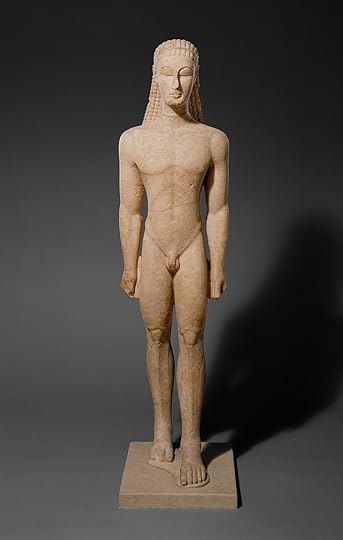
Elizabeth Inchbald published A Simple Story in 1791. For reference, Jane Austen was writing the first drafts of Sense and Sensibility, Pride and Prejudice, and Northanger Abbey in the mid to late 1790s, and her first published novel was Sense and Sensibility in 1811. There's a vast difference between the two authors in terms of characters, verisimilitude, pacing, dialogue, moral and ethical consequences. We might think of Inchbald's characters as the rigid, stiff Kouros statues of the Archaic period of Greece:
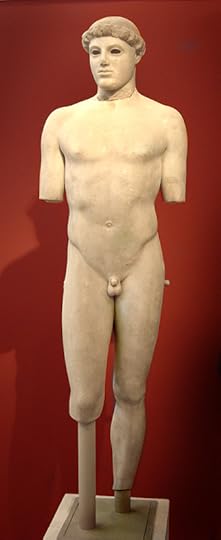
and Austen's as Kritios Boy -
the first statue known to use contrapposto, or standing with most of the weight on one foot, which realigns the body and shows an understanding of anatomy and muscles, and also imparts a psychological attitude to a pose.
Inchbald's story involves a girl, Miss Milner (she's never given a first name), whose father dies. She goes to live with her new guardian Dorriforth, a Catholic priest. Soon she has fallen in love with him. But she's also a flirt, and enjoys frivolous things. It takes a while, but eventually the two marry, after Dorriforth has inherited the title Lord Elmwood and been released from his vow of chastity.
Here's the poor pacing: we're shown nothing of their life together. Eighteen years pass within a couple pages, and the former Miss Milner, Lady Elmwood, is now on her deathbed. It turns out they had a daughter together, Matilda, but he had to go abroad for many years and she had an affair. He banished her and their daughter from the household. After she dies, he allows the daughter to move into one of his houses, but only on the condition that they have no contact.
Matilda accidentally meets her cousin Rushbrook, Lord Elmwood's nephew. Rushbrook was formerly banished from Dorriforth's home too; the priest hadn't approved of his sister's morals, and refused to have any contact with either of them until Miss Milner intervened and softened his hardened heart. So now Lord Elmwood loves Rushbrook as if Rushbrook were his son. But scorns the fruit of his own loins, Matilda.
Of course, Matilda and Rushbrook fall in love. But Matilda is abducted by a local rake/rapist and held hostage. Lord Elmwood has to decide if he will break his no-contact rule in order to rescue her.
Words learned:
gingle: "the gentle gingle of a tea-spoon" - obsolete, jingle. sopha: sofa. poniard: a small dagger.
I am honestly quiet suprised I really liked this novel!! At first I HATED IT-- couldn't get through it, was confused and it was hard for me to read but once I got adjusted to this language and got over the first few slow parts this book picked up and things got CRAZY and I ended up loving this book!!
I read this for my Romantic Novel class-- This is the last book I will read for this class as I already read Pride and Prejudice and won't re-read it for the semester. What great selection of books. I noticed some overlapping ideas or conversations I should say in this book and Austens although this book is written in the 18th century and Austen writes pride and prejudice in the 19th century the quote of marrying for love is so interesting.
Looking forward to finishing this novel next week in class!
I appreciate the deep analysis of the characters, the fact that they were coherent, well thought out, etc. This is definitely the strongest point of the novel.
However, the pleasure of listening was taken away from me by how long it was, which resulted from the excessive talk (analysis), often about the same thing.
Mr. Darcy tells Elizabeth Bennet at a pivotal moment, "You are too generous to trifle with me," and I can only admire his wisdom in choosing to love such a reasonable woman. Had he fallen for the dreadful Miss Milner of A SIMPLE STORY, Darcy might have ended with bashing his head repeatedly against the stones of Pemberley.
This book was recommended to me, and when I read the premise--that a young woman falls for her priest/guardian--I envisioned a late 18th-century THE THORN BIRDS. Not so at all. Rather, this is a story about a tiresome young woman, over-indulged and heedless, who trifles with everyone's feelings, including her beloved's. I abandoned ship at 51% because not only was Miss Milner driving me bananas, but just about everyone else in the book was too. Some examples, you ask?
1. Miss Milner, after getting her fella by 40%, decides that was too easy, and life would be more exciting if she tortured him a little to feel her power over him. Yuck.
2. Her guardian, who, along with Mr. Darcy could boast, "My good opinion, once lost, is lost forever" disdains his young nephew for no reason whatsoever except that the child is born of his sister's marriage, which he disapproved of. However, once Miss Milner decides to show favor to the child, her guardian also shows favor to him "whenever [he] wished to shew a kindness to Miss Milner, without directing it immediately to her." Ugh! Like poor kids used as pawns between divorcing parents.
And don't get me started on Mr. Sandford, the other priest, who doesn't behave like a priest any more than the love interest.
If you like 18th-century novels with lots of telling-not-showing and stupid characters, give this one a try.
Oh my gosh I LOVED THIS! ABSOLUTELY LOVED THIS! It didn't change my life, but this was SUCH an unexpected piece of work! The back does not even begin to tell you the full plot of this story, which is good because I ended up being pleasantly surprised! I expected the usual "she confesses her love, and then they marry" which either takes forever or happens quickly and then the rest of the book it just talks about how their marriage is doomed. BUT NO, this book had a great pace, and I dare say it was really sweet! Like the last part, I just loved that eeee! Don't want to give spoilers, but this was just such a great read!
This was such a surprise! It's well-written, engaging, and scandalous. I felt the characters were depicted quite realistically; their flaws were explored in detail, the changes of their dispositions over a lifetime made sense, and their interactions with each other were nuanced and intriguing. One character's persistent self-sabotage was hard to read, but realistic. Another character's implacability and resentment called to mind Mr Darcy, whose "good opinion, once lost, is lost forever" - yet this character trait was really taken to the extreme.
A few warnings: the entire story (in four volumes) takes place over many years, so don't expect a neat little happy ending in one volume to carry over to the next! I found the dramatic twists really threw me, especially as they were at times so sudden.
Also, this book express equally the flaws of men and women, yet at the end no badly-behaving man has excused himself, been punished, or even really changed - while the women are subjected to a moral about which one received the more "proper education" to guide their behaviour. (I can't take for granted the improvement in Mr Darcy's mind and character now that I've read this!)
I'm giving this novel four stars because it explores that unusual and electrifying topic: female desire and the will to power. The novel begins with Miss Milner (who dominates and powers the entire book despite being absent for the latter half of the novel) as a young coquette who falls in love with her guardian, Lord Dorriforth. "Miss Milner and Dorriforth are opposites in conflict, like Richardson's Lovelace and Clarissa with the sexual roles reversed. It is Miss Milner who, Lovelace-like, is attracted by the very quality which debars the fulfillment of desire, the beloved's purity...Miss Milner's wit, her sexuality, her will to dominate, threaten the masculine rule represented by her guardian." (taken from the excellent Introduction by Jane Spencer) Miss Milner's ending is strangely gratifying rather than upsetting: she owns it all.
I picked up A Simple Story having never previously encountered its author, Elizabeth Inchbald, and finished it wondering how she ever slipped from popular consciousness in the first place. Published in 1791, the novel is at once a moral drama, a romantic comedy of manners, and a surprisingly sharp social critique. Though often classified as a sentimental novel, it reads with a wit and tonal daring that feel unexpectedly modern—at moments recalling the romantic self-sabotage and clerical longing of Fleabag.
At its core, A Simple Story follows the fortunes of Miss Milner, a spirited and impulsive young woman placed under the guardianship of the Catholic priest Dorriforth. What begins as a light social comedy—complete with flirtation, jealousy, and drawing-room skirmishes—gradually deepens into something darker and more psychologically acute. The novel famously divides into two distinct halves: the first chronicling Miss Milner’s courtship and marriage, the second shifting focus to her daughter, Matilda, whose fate is shaped by the consequences of her mother’s earlier choices.
Miss Milner is one of the novel’s most arresting achievements. Far from a docile eighteenth-century heroine, she is wilful, passionate, and frequently reckless. Inchbald imbues her with charm and wit, but also with a self-destructive streak that feels remarkably contemporary. Her guardian, Dorriforth—later Lord Elmwood—embodies austerity and principle. As a Catholic priest bound by vows, his growing love for Miss Milner creates the novel’s central tension. The forbidden romance between a clergyman and a vibrant, emotionally candid woman is where comparisons to Fleabag become irresistible. Like the “hot priest” in that series (memorably portrayed by Phoebe Waller-Bridge’s co-star), Dorriforth is torn between spiritual obligation and human longing. Inchbald treats this conflict not as melodrama, but as a study in restraint and suppressed desire.
The early chapters have the air of pastoral comedy—not in the literal sense of shepherds and fields, but in their evocation of social play and romantic entanglement within a contained world. The middle class and minor aristocracy populate drawing rooms and country estates, engaging in gossip, mild scandal, and moral posturing. There is humor in the misadventures: Miss Milner’s flirtations are sometimes strategic, sometimes naïve, often ill-judged. Yet Inchbald steadily raises the stakes. The “simple story” of the title becomes layered with moral complexity, particularly as pride and miscommunication corrode the central relationship.
When Dorriforth unexpectedly inherits a title and wealth, becoming Lord Elmwood, the power dynamic shifts dramatically. His severity hardens; Miss Milner’s independence becomes more perilous. The second half of the novel—often startling to first-time readers—jumps forward in time. Miss Milner is largely absent, and her daughter Matilda must navigate her father’s forbidding household. Matilda is gentle, dutiful, and emotionally repressed where her mother was exuberant. Through this generational contrast, Inchbald explores themes of forgiveness, authority, and the long shadow of parental error. The tonal shift from romantic comedy to near-tragedy is bold, even jarring, but it reinforces the novel’s moral seriousness.
Inchbald’s prose is elegant yet accessible. She has a dramatist’s ear—unsurprising given that she was a successful playwright and actress before turning to fiction. Indeed, one fascinating biographical tidbit is that she began her career on the stage despite a pronounced speech impediment. Her determination to perform in a profession notoriously inhospitable to women speaks to the independence that animates her heroines. She later edited and critiqued plays, moving confidently within London’s theatrical circles. A Simple Story was her most successful novel, widely read in its day and admired for its emotional intensity.
Another intriguing aspect of the novel’s publication is its engagement with Catholicism at a time when anti-Catholic sentiment lingered in England. By making her romantic hero a Catholic priest, Inchbald ventured into politically and socially sensitive territory. Rather than caricature, she offers a nuanced portrayal of faith as both ethical anchor and emotional obstacle. This complexity likely contributed to the book’s enduring—if somewhat subterranean—reputation among scholars.
Reading A Simple Story today, I found particular pleasure in encountering an “obscure” female novelist whose work feels anything but minor. There is something deeply satisfying about seeing women writers of the eighteenth century reclaimed and re-explored, especially those who dared to depict female desire and moral fallibility with such frankness. Miss Milner is not punished merely for loving; she is rendered human in all her contradictions. Inchbald resists easy moralizing, instead presenting the messy interplay between passion and principle.
If the novel begins in the mode of a pastoral comedy about middle-class misadventures, it ends as a meditation on authority, repentance, and reconciliation. Its blend of wit, romantic tension, and psychological insight makes it feel strikingly modern. I came to A Simple Story unaware of its author; I left convinced that Elizabeth Inchbald deserves far more than a footnote in literary history.
The first half of this novel was fairly okay, and introduced some interesting ideas about power and gender roles within relationships, in the context of what constitutes a 'good' education. But the second half undergoes a massive leap in time and suffers as a result. The characters are even flatter than their first half counterparts. Moreover, the conflict in these books seemed to arise from actions that didn't make sense because they seemed to go against even the characters' own desires. It's main merit was being readable, but the story was melodramatic, had little impact, and the characters did not carry the novel as they needed to.
Elizabeth Inchbald was a late 18th-century actress and playwright who also wrote two books, of which this one is the better known; the other, Nature and Art, is hard to find nowadays, though you can read it at Project Gutenberg.
A Simple Story is a penetrating character study, of the passionate Miss Milner and her love for the stern Dorriforth, her guardian, who is also a Catholic priest. The plot becomes a little didactic, but Inchbald's gift for characterization is evident on every page: Miss Milner, Dorriforth, the loyal Miss Woodley, the volatile Sandford...all are memorable characters, subtly and sharply drawn through dialogue and actions.
Really wish Elizabeth Inchbald hadn’t felt pressure to write the second part of this book to make into more of a moral story. Enjoyed the first part immensely; she’s a writer whose use of language makes it so easy to picture a scene in the mind. Knowing about her background in theater and playwriting only made reading that much more fun. Second part isn’t bad on its own, but that it was written to seemingly punish (not that I think Inchbald *actually* wanted to) the first part’s complex female protagonist just soured me to the whole idea of it.
This was an effective and enjoyable novel. I preferred the last two volumes compared to the first two, but I think the structure and plot of this novel were my favourite parts, the dual timeline worked really well, and was used in a way that emphasised the differences between the various characters. Other than that, the characters felt flat, and the story wasn't my favourite. I'd recommend it if you're looking for 18th Century novels to read though.
3.5 stars. This novel is split into two parts: the first is the story of a mother, the second the story of her daughter. The novel started off rather delightfully, but after 100 pages or so I wearied of the no-plot-but-love-plot. The man/woman dynamic was interesting, if inherently--and purposefully--problematic. Some of the main themes I pick up on: what makes a good man, who decides who is a good woman, should love be tested, and what is the nature of forgiveness?